The Moment the Audit Stops Being Useful

An audit has a shelf life. Most practices don’t realize that until it’s already expired.
Here’s what actually happens: a clinic runs a check, gets a report full of gaps, and treats it like a deliverable. It isn’t. The diagnosis is the starting line – not the finish line. The moment a practice reads its findings and doesn’t immediately move into a structured decision process, that report starts going stale. Over 35 percent of adults are already searching digital platforms for chiropractic services before they ever pick up the phone(https://www.ncbi.nlm.nih.gov/pmc/articles/PMC6211221/). Every day a practice sits on a completed report is a day that demand is routing to whoever actually made a decision.
The audit doesn’t fail the practice. The absence of a next step does.
Why Most AI Visibility Reports Expire Without a Decision
AI visibility reports don’t expire because the data goes stale overnight. They expire because the competition doesn’t pause while a practice deliberates. Approximately 20 percent of U.S. adults are already using AI chatbots for everyday research factClaim_03. Those patients are asking questions right now. A competitor who moved from diagnosis to action last month is stacking entity trust signals. A clinic still reviewing a PDF is losing ground it will have to fight to recover.
But the expiration problem runs deeper than timing. Most AI visibility reports are built to document gaps – not to prescribe a sequence. They tell a practice what’s broken. They don’t tell it which gap to close first, what to commit to, or how to order the fix. So practices do what anyone does when handed incomplete instructions: they freeze. The report gets filed. The problem gets named. Nothing gets solved.
That’s the real failure. Not the audit. The missing decision framework waiting on the other side of it. If you’ve run a check and you’re sitting on findings with no clear path forward, what happens after your AI Authority Snapshot is exactly what the five-stage framework is built to answer.
The Gap Between Knowing and Acting
The gap between knowing and acting isn’t a motivation problem. It’s a structure problem. Practices that run an audit and stay invisible aren’t lazy. They’re stuck – too many gaps identified at once, no forced sequencing, no accountability for which move comes first.
The clinics that doubled new patient calls didn’t know more than their competitors. They moved faster through a locked sequence – Diagnosis Audit to Gap Prioritization to Infrastructure Commit – without stalling in the space between knowing and acting. The post-audit action plan that follows a diagnosis is where visibility either compounds or collapses. That’s the decision the framework forces – and the one most practices never make.
| Audit Outcome | What Clinics Typically Do | What the Framework Requires Instead |
|---|---|---|
| Gaps identified in AI visibility report | Review the findings, share with staff, schedule a follow-up conversation | Enter Gap Prioritization immediately – rank gaps by their impact on entity trust signals |
| Report reveals missing or broken schema markup | Note it as a future project, return to it when time allows | Treat it as a Stage 3 Infrastructure Commit blocker – schema is foundational, not optional |
| Audit shows weak or unverified entity signals | Assume the problem will resolve once more content is added | Commit to a structured authority infrastructure build before layering any Content Velocity |
| Competitive gap identified – a local competitor is being recommended by AI | Monitor the situation and reassess in a few months | Accelerate the decision timeline – every month of inaction compounds the competitor’s Authority Lock |
| Report delivered, practice feels overwhelmed by scope | Prioritize the easiest fixes and stop when momentum fades | Follow the locked five-stage sequence – Diagnosis Audit through Authority Lock – without skipping stages |
| Audit findings don’t include a clear action sequence | File the report and wait for the agency to recommend next steps | Demand a post-diagnostic decision framework – findings without sequencing are an expense, not a turning point |
Why Traditional SEO Fails the Post-Diagnostic Test
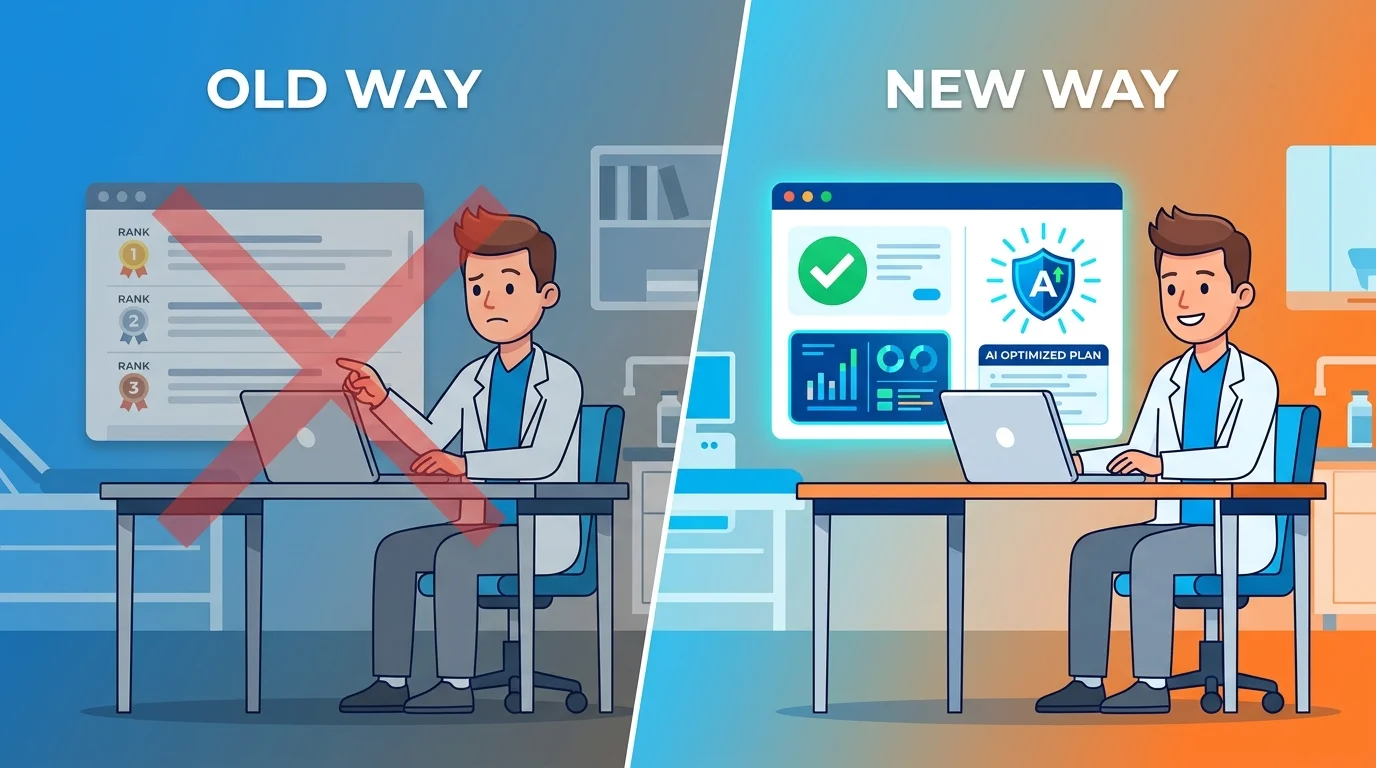
Traditional SEO was built for a world that no longer exists – and most practices are still paying for it.
Here’s the thing – when a chiropractor finishes an AI visibility audit and gets back a report full of entity trust gaps, schema failures, and missing structured signals, traditional SEO has no answer for any of it. Keyword density doesn’t build entity trust. Backlinks don’t tell ChatGPT who you are. An AEO content calendar doesn’t fix missing machine-readable markup. Traditional SEO was designed to move a page up a ranked list – and Gartner projects that list loses 25 percent of its query volume by 2026 as conversational AI agents replace it.
So a practice walks out of a Diagnosis Audit holding a list of AI visibility gaps – and traditional SEO hands it the same playbook it always hands everyone. More keywords. More links. More posts. None of that touches the problem the audit just named.
Optimizing for a List Nobody Is Reading Anymore
Gartner’s projection isn’t a distant warning – it’s already arriving. Traditional search results are a list. Conversational AI produces a verdict. A patient who asks ChatGPT "who’s the best chiropractor near me" doesn’t get ten blue links to evaluate. They get one name. Traditional SEO optimizes for the list. The five-stage framework optimizes for the verdict.
That’s not a gap in effort. That’s a structural mismatch. A practice can execute traditional SEO perfectly and still be completely invisible on every AI engine that matters. The optimization target is different. The trust signals are different. The infrastructure requirements are different.
Now, this matters specifically at the post-diagnostic moment. When a practice finishes a Diagnosis Audit and moves into Gap Prioritization, it’s looking at findings that traditional SEO doesn’t address – entity verification failures, schema gaps, citation velocity problems. Trying to fix AI invisibility with traditional SEO tactics is like diagnosing a structural problem and then repainting the walls. The Local AI Authority Engine exists precisely because the fix requires a different kind of authority infrastructure, not a louder version of what wasn’t working.
The Compliance Gap Traditional SEO Ignores
Here’s the part almost nobody in this industry is talking about: there’s a compliance dimension to this failure.
Healthcare providers are held to strict evidentiary standards – FTC guidelines require that any public claims about health outcomes be backed by competent, reliable scientific evidence. Traditional SEO content – built to rank, not to verify – routinely ignores this standard. It chases keyword volume with unsubstantiated outcome language. That’s not just a compliance risk. It’s a trust signal problem. AI engines evaluate the credibility of what they’re indexing. Unverified claims don’t build entity trust – they erode it. NIH research confirms that over 80 percent of clinical and professional service platforms show structural content issues and lack the machine-readable schema metadata that modern AI systems require to validate a practice’s authority. Traditional SEO built none of that. It was never designed to.
Who This Section Is Not For
Before going further – this section isn’t for everyone.
If you’re looking to layer a few AEO tweaks on top of your current traditional SEO strategy, this isn’t that. The five-stage process – Diagnosis Audit through Authority Lock – demands an infrastructure decision. Not a content calendar adjustment. Not a new agency add-on. Practices that want to keep their existing agency relationship and bolt on a "visibility layer" won’t get the outcome the framework produces.
And if you ran an audit, reviewed the findings, and you’re still weighing whether AI visibility is a real business problem – the framework isn’t for you yet. The seven-point post-audit action plan exists for practices that already know they need to act and want a structured way to assess whether their next move is the right one. But the decision to act has to come first. The framework rewards commitment. It doesn’t manufacture it.
| Metric | Traditional SEO Logic | AI Authority Reality |
|---|---|---|
| Optimization Target | Ranked position on a list of results | Named as the single trusted answer in a conversational AI verdict |
| Trust Signal Infrastructure | Keyword density, backlink volume, and page-level metadata | Entity verification, structured schema markup, and machine-readable authority signals |
| Post-Diagnostic Fit | No mapped response to entity trust gaps, citation failures, or schema deficiencies surfaced in a Diagnosis Audit | Gap Prioritization sequence directly addresses each finding with a committed infrastructure fix |
| Content Purpose | Keyword-targeted pages and AEO articles built to move up a ranked list | AI Authority articles built to compound entity trust and validate a practice’s authority to AI engines |
| Compliance Alignment | Content optimized for ranking volume – evidentiary standards for health claims frequently overlooked | Claims grounded in verifiable evidence, aligned with FTC standards and AI engine credibility requirements |
| Outcome When Executed Perfectly | Strong list visibility on a search format losing relevance to conversational AI | AI-readable infrastructure that positions a practice as the verified local authority across AI engines |
The 5-Stage Post-Diagnostic Decision Framework
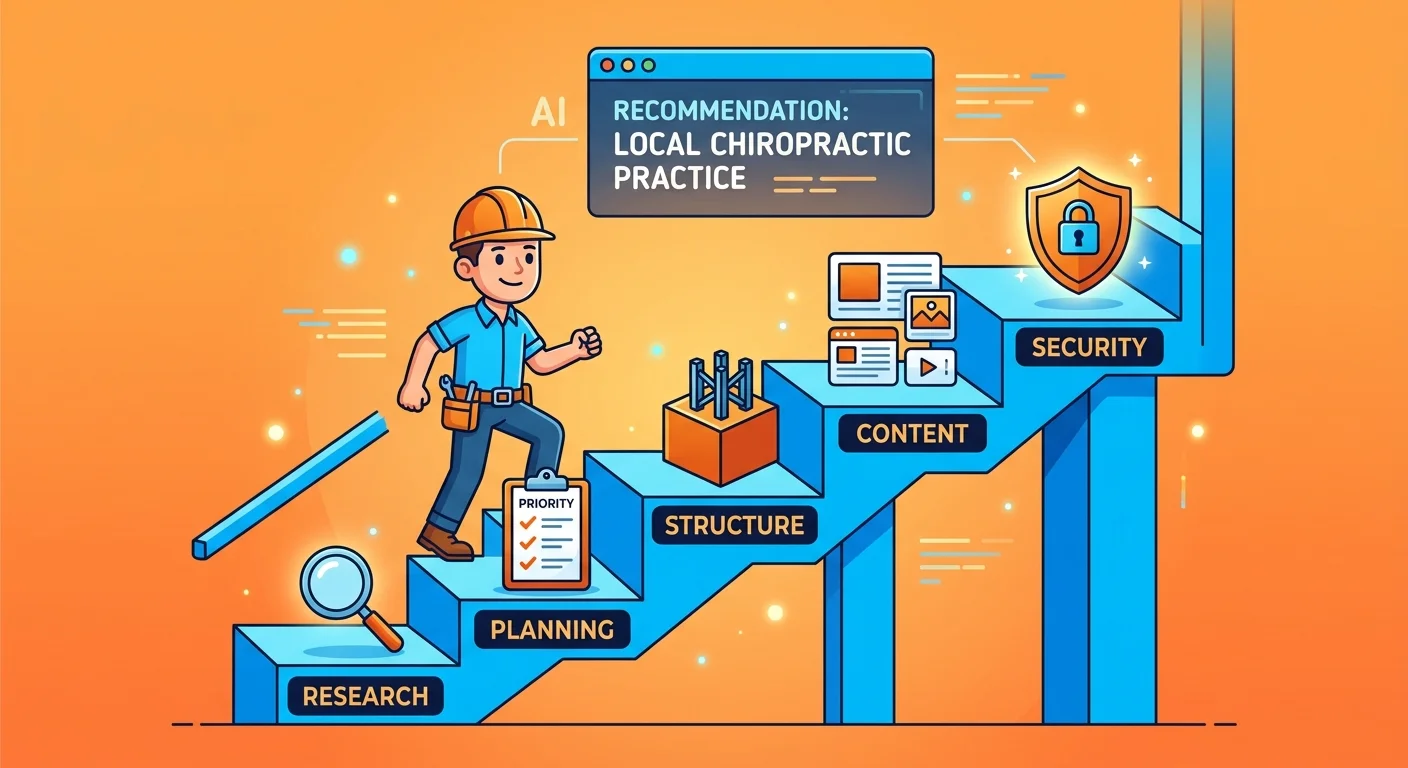
This isn’t theory. It’s a locked decision sequence – five stages that move a practice from raw audit findings to compounding AI recommendations.
Here’s the thing – the practices that stayed invisible after their audits weren’t missing information. They were missing a locked sequence. Structured decision frameworks cut the paralysis that follows any diagnostic. They force a practice to isolate the exact bottlenecks keeping it off the AI answer and move through them in order. That’s what this framework does.
Five stages. Each one builds on the last. None of them are optional.
Stage 1 – Diagnosis Audit: Reading the Findings Without Flinching
Stage 1 isn’t the check. It’s what happens in the 48 hours after the report lands. Most practices read their AI visibility findings and immediately start grabbing at the most alarming gap – charging at it before they understand the full picture. That’s the wrong move. The Diagnosis Audit stage is about reading everything before reacting to anything.
Here’s what the data says: over 80 percent of clinical and professional service platforms show structural content issues and lack machine-readable schema metadata. That means most practices won’t open their report and find one thing to fix. They’ll find a cluster. Entity verification failures. Schema gaps. Missing structured signals. Citation velocity at zero. Reading the findings without flinching means accepting the full scope – before you sequence a single fix.
So Stage 1’s output isn’t a prioritized action list. It’s an honest picture of where the practice stands against what AI engines actually require. That picture is the input for Stage 2.
Stage 2 – Gap Prioritization: Ranking What AI Actually Cares About
Not all gaps are equal. That’s exactly what most practices miss when they stall between diagnosis and action.
Gap Prioritization isn’t about fixing what’s easiest. It’s about sequencing what AI engines weight most heavily in their trust signals. Entity verification failures block everything downstream – a practice can’t build citation velocity on top of an entity AI doesn’t recognize. Schema gaps limit machine readability no matter how much content sits on top of them. The sequence matters more than the effort applied to any single item.
But here’s the failure point of most generic audit reports. They document gaps. They don’t sequence them. They hand a practice a list and walk away. Gap Prioritization is the structured decision layer that converts a list into a build sequence. Practices that follow a decision pathway consistently outperform the ones trying to fix everything at once.
Stage 3 – Infrastructure Commit: Building What AI Can Read
Stage 3 is the commitment stage. This is where the decision gets made – not just to address AI visibility as a concept, but to build the AI-readable infrastructure that makes entity trust possible. And it’s not a content calendar tweak. It’s an infrastructure decision. It has to be made before a single piece of content gets produced.
The Infrastructure Commit means standing up the machine-readable foundation – structured schema, entity verification signals, citation-ready architecture – before content velocity begins. Building AEO content on top of an unstructured foundation is the mistake that keeps practices invisible even when they’re producing volume. The proven case studies show the same pattern every time: the practices that compound are the ones that committed to the infrastructure first.
Stage 4 – Content Velocity: Feeding the Entity Trust Signal
Now the machine can read the practice. Stage 4 is about giving it something worth reading – consistently, at the velocity required to build entity trust over time.
Content Velocity isn’t blogging. It’s the sustained production of AI Authority articles that are semantically structured, factually verified, and anchored to the entity signals established in Stage 3. Each article adds a citation-ready data point to the practice’s authority profile. Each one deepens the semantic density AI engines use to validate subject matter credibility. The content doesn’t just answer questions – it reinforces the entity.
That’s the difference between AEO content execution and a standard content calendar. A content calendar optimizes for clicks. Content Velocity optimizes for the entity trust signal that determines whether AI names the practice – or doesn’t. The chiropractic decision framework that produced doubled call volume wasn’t built on more content. It was built on the right kind of content, at velocity, on top of a trusted entity foundation.
Stage 5 – Authority Lock: Compounding What AI Already Trusts
Authority Lock is where the framework pays off. And where the gap between the clinics that doubled calls and the ones still invisible stops closing.
The practices that stayed invisible after their audits didn’t fail because they lacked the right information. They failed because they never made the structured commitment that turns a diagnosis into a compounding asset. Authority Lock is the stage where consistent execution across all five stages crystallizes into a self-reinforcing authority signal. AI engines have enough entity data to recommend the practice confidently. Citation velocity is building. Every new AI Authority article deepens the signal that already exists. That’s not a monthly marketing expense. That’s an authority asset – and it compounds every month the practice keeps moving forward.
| Stage | Framework Label | Primary Action | AI Signal Built |
|---|---|---|---|
| 1 | Diagnosis Audit | Read the full AI visibility findings before reacting to any single gap – accept the complete scope of entity verification failures, schema gaps, and citation deficits | Establishes the honest baseline AI engines require before any trust signal can be built |
| 2 | Gap Prioritization | Sequence the identified gaps by downstream impact – entity verification failures first, schema gaps second, citation velocity gaps third – not by ease or cost | Removes the structural blockers that prevent AI engines from recognizing and categorizing the practice as a trusted entity |
| 3 | Infrastructure Commit | Stand up the machine-readable foundation – structured schema, entity verification signals, and citation-ready architecture – before any content production begins | Creates the AI-readable substrate that makes every downstream content asset indexable and attributable to a verified entity |
| 4 | Content Velocity | Produce AI Authority articles at sustained velocity – semantically structured, factually verified, and anchored to the entity signals built in Stage 3 | Deepens semantic density and adds citation-ready data points to the authority profile, reinforcing the entity signal with every published article |
| 5 | Authority Lock | Maintain consistent execution across all prior stages until AI engines have sufficient entity data to recommend the practice confidently and repeatedly | Crystallizes into a self-reinforcing authority asset that compounds month over month – converting a one-time infrastructure build into a permanent competitive position |
What the Framework Produces: Authority Signals AI Engines Trust
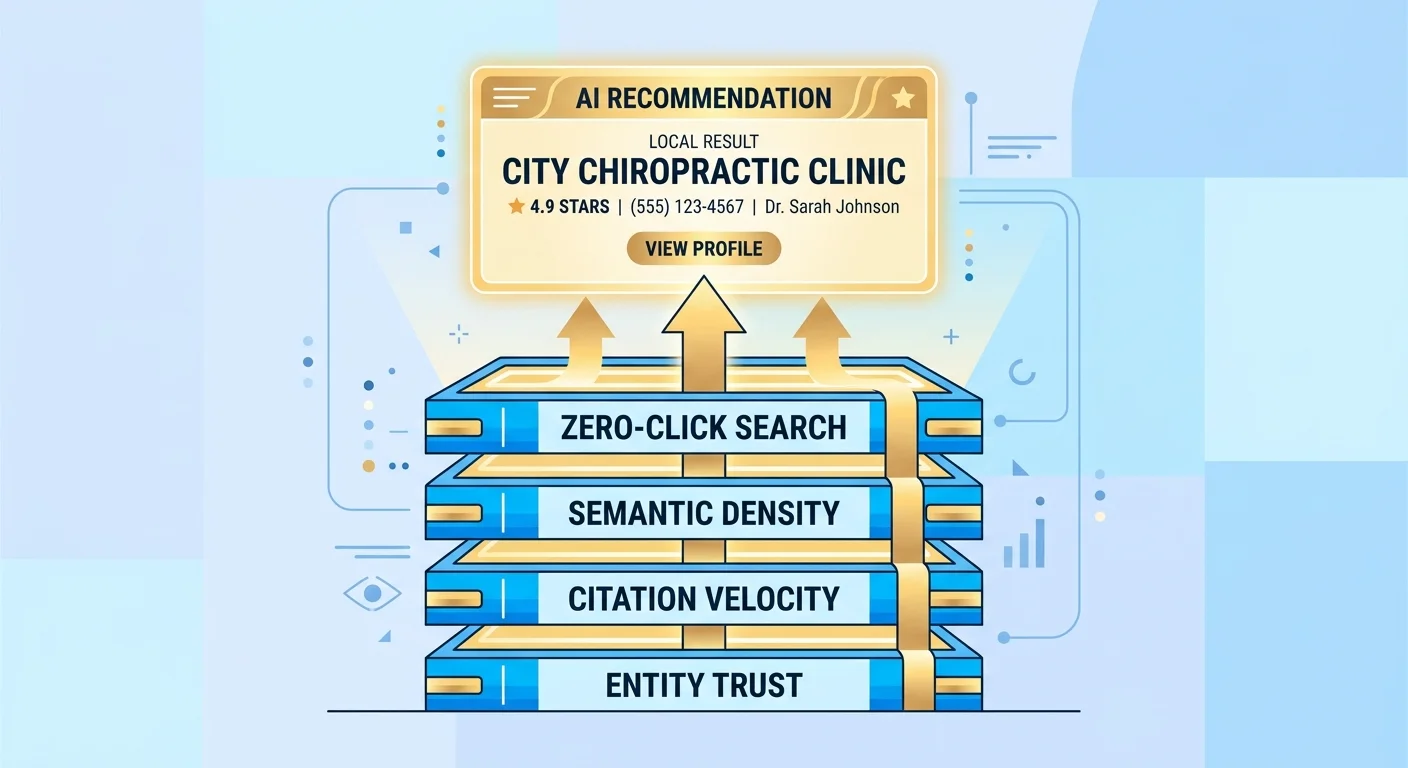
The five stages don’t just fix what’s broken. They build something that wasn’t there before. And what gets built is the exact infrastructure AI engines use to decide whose name gets said.
Gartner projects traditional search engine query volume will drop by 25 percent by 2026, driven by conversational AI agents replacing list-based results. That’s not a trend to monitor. That’s a deadline.
So the question isn’t whether AI recommendations matter. Every local practice already knows they do. The question is whether the practice has built the authority signals those engines are designed to evaluate. The framework produces exactly three: entity trust, citation velocity, and semantic density.
Entity Trust: The Signal That Gets You Named
Entity trust is the foundational output. It’s also the one that determines whether the other two signals register at all.
When someone asks ChatGPT who the best chiropractor in their market is, the engine isn’t scanning a keyword list. It’s asking itself: do I have enough verified, structured data about this entity to name it confidently? That means cross-referenced NAP signals, validated schema markup, and consistent entity data across the platforms AI engines treat as trusted validators. NIH research found that over 80 percent of clinical and professional service platforms show structural content issues – and lack the machine-readable schema required to pass that evaluation. Those practices don’t get named. Not because they’re bad at what they do. Because the engine can’t confirm who they are.
The Infrastructure Commit stage builds that entity trust layer from the ground up. That’s what makes every subsequent output – AEO content, citations, semantic signals – readable and attributable to a verified entity rather than floating unanchored. But here’s where it gets specific: where to invest first after a visibility check depends entirely on which signals are most degraded in your gap profile. The infrastructure decision isn’t identical for every practice. It’s sequenced from the audit findings.
Citation Velocity and Semantic Density in Practice
Citation velocity and semantic density are the compounding outputs. They’re what separates a practice that got recommended once from one that gets recommended every time.
Pew Research found that approximately 20 percent of U.S. adults now use AI chatbots for daily information and research. NIH data puts over 35 percent of adults researching alternative healthcare services like chiropractic care digitally before ever contacting a provider. That’s a large patient population actively asking AI engines for a name right now. Citation velocity determines whether those engines have enough accumulated authority data to surface a specific practice in response. Each AI Authority article produced in Stage 4 adds a citation-ready data point to the entity’s authority profile. Each one deepens the semantic density AI engines use to validate subject matter credibility. The proven case studies show the same pattern every time: velocity without a trusted entity foundation produces nothing. Velocity on top of a verified entity compounds.
Why the Framework Compounds and One-Time Builds Do Not
One-time builds don’t compound. That’s the hard fact most practices discover too late – after they’ve paid for the infrastructure build and watched the momentum quietly stop.
The framework isn’t a one-time build. It’s a decision sequence that, once executed in full, creates a self-reinforcing system. Authority Lock isn’t a finish line. It’s the stage where consistent execution makes the authority signal strong enough to sustain and deepen without starting over. Each new AI Authority article doesn’t just add content. It reinforces the entity signals already indexed, deepens the semantic density already established, and adds citation velocity to an authority profile that AI engines already trust. The signal compounds. That’s not a side effect – that’s the design.
That’s the difference between the clinics that doubled calls and the ones still invisible after their audits. It wasn’t better information. The chiropractic decision framework that produced those results didn’t give those practices new data. It gave them a locked decision sequence – and they followed it. Deliberately. In order. Committed at the infrastructure level. That’s what the framework forced. And that’s exactly what filing the audit report away never does.
| Authority Signal | What Builds It | What Decays It |
|---|---|---|
| Entity Trust | Verified schema markup, consistent NAP signals across trusted directories, cross-referenced entity data that AI engines can validate against multiple sources | Inconsistent business data across platforms, missing or broken schema, unverified citations that conflict with each other |
| Citation Velocity | Sustained production of AI Authority articles that are semantically structured, factually grounded, and anchored to an already-verified entity | Sporadic publishing, generic content with no entity anchoring, blog-style articles optimized for clicks rather than AI extraction |
| Semantic Density | Depth of topically relevant, structured content that confirms the practice’s subject matter authority across a defined area of expertise | Thin content spread across unrelated topics, duplicate or unfocused articles that dilute the entity’s topical signal |
| Recommendation Confidence | All three signals – entity trust, citation velocity, and semantic density – present simultaneously and mutually reinforcing | Any one signal missing or degraded; an engine that can’t verify the entity won’t name it regardless of content volume |
| Authority Compounding | Consistent execution across all five framework stages over time, with each new AI Authority article deepening signals that already exist | Treating the infrastructure build as a one-time project and stopping execution before the self-reinforcing loop is established |
Frequently Asked Questions
The framework clicks for most clinics. Then the questions start. Same ones, every time – right before they commit, or right before they don’t.
Here’s what those questions look like – answered straight.
How does a post-diagnostic decision framework actually drive chiropractic phone calls?
Most clinics that ran an audit got a report and stopped. The report named problems. Nobody built a pathway to resolve them in sequence. So nothing moved.
The framework fixes that gap – not by giving a practice more information, but by forcing a locked sequence of decisions. Gap Prioritization flows into Infrastructure Commit. Infrastructure Commit creates the machine-readable foundation. Content Velocity builds on top of that foundation, adding verified authority data to the entity profile month after month.
That’s the mechanism. AI engines accumulate enough verified entity data to name a practice confidently. The calls follow the trust. And the trust follows the commitment the framework forces – not the audit that preceded it.
Why do traditional chiropractic SEO strategies fail on modern conversational platforms?
Traditional chiropractic SEO was built for a ranked list. Keywords, backlinks, page-one placement – all of it designed for a search paradigm that’s actively contracting. Gartner projects traditional search engine query volume will drop by 25 percent by 2026, driven by conversational AI agents replacing those ranked lists entirely.
Conversational platforms don’t evaluate keyword density. They evaluate entity trust – structured schema, verified NAP signals, and semantic authority built through consistent AI Authority content execution. Traditional SEO produces none of those signals. It was never designed to.
So the failure isn’t a gap in effort. It’s a structural mismatch. Optimizing for a list when patients are asking AI engines for a single verdict is optimizing for the wrong game.
What is the difference between a visually appealing practice page and an AI-readable authority infrastructure?
A polished practice page is designed for humans to look at. An AI-readable authority infrastructure is built for machines to evaluate. Those are fundamentally different engineering problems.
A page that looks credible to a patient tells an AI engine almost nothing. Without structured schema markup, consistent entity signals, and machine-readable content architecture, the engine can’t confirm who the practice is, what it treats, or whether it’s trustworthy enough to name. Over 35 percent of adults research chiropractic and alternative healthcare services digitally before ever contacting a provider – and AI engines are increasingly the first stop in that research. A page AI can’t read doesn’t capture any of that demand.
The Infrastructure Commit stage rebuilds the foundation so it functions as a verified, machine-trusted entity. Not a brochure. Not a first impression. A signal.
How long does it typically take for a local clinic to see a doubling in call volume using AEO?
Here’s the honest answer: authority doesn’t run on a microwave schedule. Anyone promising a specific timeline is selling a guarantee the data doesn’t support.
What the framework guarantees is the sequence. Diagnosis Audit into Gap Prioritization into Infrastructure Commit into Content Velocity into Authority Lock – each stage builds on the last, and each month of consistent execution adds to the compounding authority signal. The practices that doubled calls didn’t hit a single inflection point. They accumulated enough verified entity data that AI engines became confident enough to name them consistently.
The timeline depends on what the Diagnosis Audit reveals. Practices with severely degraded entity signals take longer to stabilize than those starting from a partial foundation. What doesn’t vary is the direction. Consistent execution compounds. Stopping early surrenders whatever ground was gained.
Can a clinic achieve top-tier AI recommendations without building a full Local AI Authority Engine?
Depends entirely on what the Diagnosis Audit surfaces. Some clinics already have a partial foundation – schema partially in place, some entity signals live, content that’s close to AEO-ready. For those, Gap Prioritization can identify a targeted intervention that moves the needle without tearing everything down.
But some things aren’t negotiable. AI engines evaluate entity trust as a complete picture. Fix content velocity without fixing schema, and you plateau. Build authority content on top of an unverified entity, and you’re stacking on sand. The signals don’t work in isolation – they compound together or they stall together.
The Local AI Authority Engine is the full-stack version of the framework – built for clinics that want to close every gap, not just the loudest one. The Diagnosis Audit is what determines whether a targeted fix is enough or whether the full build is what the situation actually requires.
What happens to AI visibility if a clinic stops executing after the initial infrastructure build?
Authority decays. That’s not a warning – it’s how the system works. AI engines continuously re-evaluate entity trust based on current, consistent signals. A clinic that builds the infrastructure and stops executing has a strong foundation with nothing compounding on top of it.
Approximately 20 percent of U.S. adults now use AI chatbots for daily information and research – and that share is growing. The patient population asking AI engines for recommendations isn’t shrinking. But a clinic that stopped executing stops accumulating the citation velocity and semantic density that keep it competitive in those queries.
The practices that get recommended consistently aren’t the ones that built something once. They’re the ones that kept moving – adding AI Authority articles, reinforcing entity signals, deepening the semantic density already indexed. Stopping is a choice to let competitors who kept going take the ground you built. The proven case studies show the same pattern every time: the gap between visible and invisible clinics isn’t infrastructure. It’s ongoing execution.
The Verdict: Audits Don’t Double Calls – Decisions Do
Audits don’t double calls. Decisions do.
Every clinic that stayed invisible had the same information as the ones that compounded. The gap wasn’t knowledge. It was the commitment to act on it – in sequence, at the infrastructure level, without skipping stages.
That’s the only difference.
The five-stage framework – Diagnosis Audit, Gap Prioritization, Infrastructure Commit, Content Velocity, Authority Lock – isn’t a checklist. It’s a decision pathway.
The practices that doubled new patient calls didn’t run a better audit than their competitors. They used their findings to make a committed, structured decision and followed it all the way through. Every stage. In order. No shortcuts.
The ones still invisible? They ran the same audit. They just stopped there.
That’s what iTech Valet builds. Not a report. Not a ranking. A compounding authority asset – the kind that makes an AI engine confident enough to say your name when a patient asks who to trust.
The clinics getting recommended aren’t waiting to see how the search shift plays out. They already decided.
A diagnostic that reveals nothing is just a bill. The only question left is whether your practice makes a different choice – or whether your audit expires on a shelf.
Here’s what you actually need to know: where you stand right now. The AI Visibility Check shows you exactly what ChatGPT, Gemini, and Grok say when someone in your market asks who to trust. If the answer isn’t your name – you’ll know that in 15 minutes. And you’ll know what’s broken.