


How Do I Use AI Analytics to Grow My Chiropractic Practice in 2026?
 by Gerek Allen ~ Last Updated: January 29th, 2026 ~ 11 Min Read
by Gerek Allen
~ Last Updated: January 29th, 2026 ~
~ 11 Min Read ~
Short answer? AI analytics swaps out gut feelings for real data that actually tells you what's happening in your practice. No more checking your bank account at month's end and wondering where all the money went. You'll know exactly which patients are about to ghost you, which marketing's working, and where every dollar's going.
Here's the thing. Looking at spreadsheets once a month isn't cutting it anymore. That's the old way. Practices using AI-powered dashboards are catching at-risk patients before they cancel, stopping no-show revenue leaks with automated follow-ups, and making decisions that used to cost thousands in consulting fees.
But there's a bigger shift most docs aren't even aware of yet.
It's not just about tracking your internal numbers. It's about tracking how AI search engines see your practice. Nearly 60% of Google searches now end without anyone clicking anything. Patients are asking ChatGPT and Google's AI things like "Who's the best chiropractor near me for sciatica?" And the practices getting recommended? They're not always the ones with the best SEO. They're the ones AI trusts.
This guide covers everything: the KPIs that actually matter in 2026, tools that work for small practices, how to set up predictive modeling without a data science degree, and how to show up when AI assistants recommend local healthcare providers.
Let's get into it.
Understanding the AI Analytics Landscape for Chiropractors


The healthcare analytics game has changed. Like, really changed.
According to MGMA's 2025 Financials and Operations Report, practices that actually use their data consistently outperform everyone else. Top-performing medical groups review benchmarking data monthly. Not quarterly. Not "when I get around to it." Monthly.
But here's what makes 2026 different from every year before.
The Shift from Reactive to Predictive
Traditional practice reports tell you what already happened. Last month's revenue. Last quarter's patient counts.
It's like driving by only looking in the rearview mirror. Not exactly ideal.
Predictive patient modeling flips the script. These AI systems look at patterns in your historical data and forecast what's likely to happen next.
Here's the kicker. A 2025 study found that AI-driven scheduling and outreach systems reduced no-shows by 50.7%. That's not a small improvement. That's cutting your missed appointments in half.
By 2026, nearly 60% of hospitals have adopted at least one AI-assisted predictive tool, up from around 35% in 2022 according to healthcare analytics research. Small practices are catching on because the tools have gotten way more accessible.
Why Your EHR Reports Aren't Enough Anymore
Your EHR system probably has reporting features. You might even use them occasionally.
But there's a problem: EHR reports show you data. AI analytics tells you what to do about it.
The difference looks like this:
| "You had 12 no-shows last month" | "These 8 patients are at 73% risk of no-showing their next appointment. Here's an automated reminder sequence to intervene." |
| "Revenue was down 15%" | "Tuesday afternoon slots are consistently underbooked. Shifting your Google Ads to promote Tuesday availability would optimize your schedule." |
| "Patient retention is 65%" | "Patients who don't schedule their 4th visit within 10 days of their 3rd have an 80% dropout rate. Here are 23 patients who need a call today." |
See the difference? One tells you about problems. The other solves them.
The AEO Factor: Why AI Visibility Matters Now
Alright, quick reality check.
The way patients find healthcare providers is changing fast. According to BrightEdge research, AI-driven referral traffic grew by 620% year-over-year in Q3 2025. Zero-click searches—where users get their answer directly from AI without clicking any website—now account for nearly 60% of all queries.
What does this mean for you?
Your practice analytics need to track more than just internal numbers. You need to understand your Entity Authority—basically, how AI systems perceive your practice as a trustworthy source.
Think about it. When someone asks ChatGPT "Who's the best chiropractor in [your city] for neck pain?", do you show up?
If you're not being cited, you're invisible to a growing chunk of potential patients.
The KPIs Every Chiropractor Must Track in 2026

Not all metrics are created equal.
Some numbers look impressive on a dashboard but don't actually move the needle. Others are the hidden drivers of everything that matters.
Here's what you actually need to track.
Financial Metrics That Predict Growth
Patient Lifetime Value (LTV) is arguably the most important number in your entire practice. It's the average total revenue you'll generate from a patient over their entire relationship with you.
Calculating it isn't complicated. Take your average visit fee, multiply by your average visits per patient, factor in your average retention period. Done.
Industry estimates suggest chiropractic patient LTV typically ranges from $1,000 to $3,600 depending on your practice model and retention rates.
Why does this matter so much?
LTV tells you exactly how much you can afford to spend acquiring new patients.
If your average patient is worth $3,000 and you're spending $300 to acquire them, you've got room to scale hard. If your LTV is $500 and you're spending $400 to acquire, you're one bad month away from trouble.
Other financial metrics that matter:
- Cost Per Acquisition (CPA) - How much you spend on marketing divided by new patients acquired. Track this by channel to know what's actually working versus what's just burning cash.
- Revenue Per Visit - Total collections divided by total patient visits. Trending down? Might be a fee schedule problem. Might be an insurance mix problem.
Days in Accounts Receivable - MGMA benchmarks suggest keeping this under 30 days. AI systems can flag aging claims before they become write-offs.
Patient Retention Metrics
Here's a brutal truth: It costs 5-7x more to acquire a new patient than to keep an existing one.
Yet most practices obsess over new patient counts while ignoring retention. Kinda backwards, right?
Track these religiously:
- Patient Visit Average (PVA) - Total visits divided by new patients over the same period. According to Chiropractic Economics, the average PVA across practices is around 10-12 visits. If yours is way lower, patients are dropping off before completing care plans.
- Care Plan Completion Rate - What percentage of patients who start a care plan actually finish it? This is your money metric. Incomplete care plans mean incomplete revenue.
- No-Show Rate - Industry averages range from 15-30%. AI-powered reminder systems are crushing this. Some practices are hitting no-show rates as low as 5% with predictive interventions.
Reactivation Rate - Of patients who haven't visited in 90+ days, how many come back? AI can automate reactivation sequences triggered at exactly the right moment.
Operational Efficiency Metrics
Time is your most limited resource. These metrics reveal where you're leaking it.
- Average Wait Time - From check-in to table. Longer waits = lower satisfaction = higher dropout rates. Pretty straightforward.
- Documentation Time - How long you spend on notes per patient. AI scribe tools are cutting this by 40-60% for a lot of docs.
Schedule Utilization - What percentage of available appointment slots are actually filled? Anything under 85% means you're leaving money on the table.
The New Metric: AI Citation Frequency
This one's brand new. But it's increasingly critical.
AI Citation Frequency measures how often AI platforms recommend or mention your practice when users ask healthcare questions.
According to BrightEdge research, brands cited in AI responses earn 35% more organic clicks and 91% more paid clicks than those that aren't.
You can track this using specialized tools, or start manually by searching your own practice name and specialty in ChatGPT, Perplexity, and Google's AI Mode.
If you're not showing up, your competitors probably are.
NEED MORE CLIENTS?
Free conversion-focused analysis uncovers the 3 biggest problems killing your bookings — we'll walk you through your results personally
Setting Up Your AI Analytics Dashboard
Let's get practical.
You don't need to become a data scientist. You just need the right tools set up correctly.
Choosing the Right Platform for Your Practice Size
The best platform depends on your current setup and where you're headed.
If you're using ChiroTouch, you already have analytics built in. ChiroTouch's cloud platform offers real-time dashboards and end-of-day reports that track payments, charges, and appointments. The key is actually using them. Set up automated EOD reports to review daily, not monthly.
If you prefer Jane App, you get solid reporting and analytics for appointments, revenue, and patient trends. It's particularly strong for multi-location setups with practitioner-level reporting. The limitation? It won't satisfy practices looking for advanced predictive stuff.
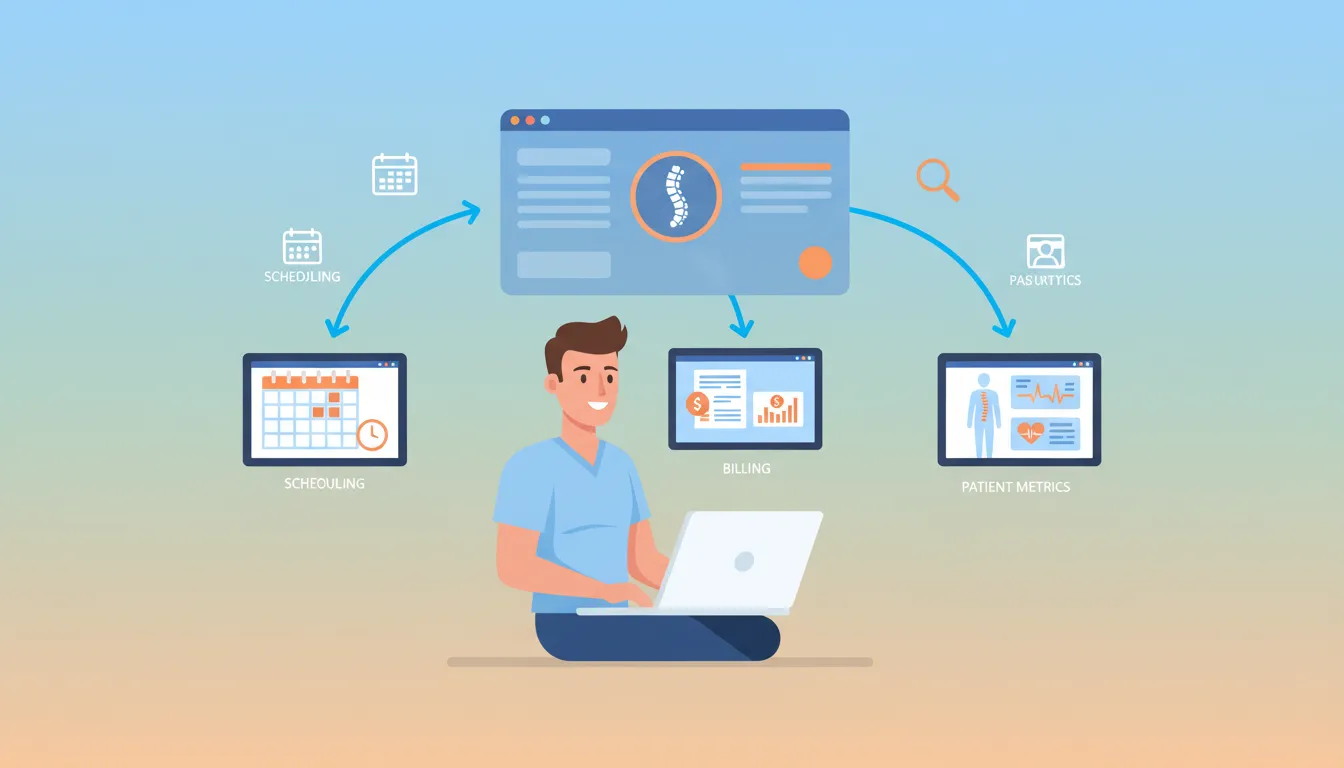
For dedicated AI analytics, platforms like BlueIQ aggregate data from QuickBooks, Facebook, Google Analytics, and your EHR into a single "Practice Health Score" dashboard. This is where you start seeing predictive capabilities.
Here's a quick comparison:
| ChiroTouch Cloud | Insurance-heavy practices | ~$159/month | Basic (real-time dashboards, EOD reports) |
| Jane App | Multi-location practices | $54-$399/month | Limited (standard reporting) |
| BlueIQ | Growth-focused practices | Contact for pricing | Advanced (aggregated dashboards, predictive insights) |
| Podium | Patient communication focus | Contact for pricing | Strong (AI employee for engagement, review management) |
Integrating Your Data Sources
Here's where most practices fail. They've got data in five different systems that don't talk to each other.
Your analytics platform needs to pull from:
- EHR/Practice Management System - Patient visits, treatments, diagnoses, billing
- Payment Processing - Actual collections, payment timing, outstanding balances
- Marketing Platforms - Google Ads spend, social media metrics, website traffic
- Communication Tools - Appointment reminders sent, confirmation rates, patient responses
- Review Platforms - Google reviews, Facebook ratings, sentiment trends
The magic happens when these connect.
Suddenly you can see that patients who book through online scheduling have a 23% higher completion rate than phone bookings. Or that patients who get text reminders have 40% fewer no-shows than email-only patients.
Most modern platforms offer integrations through APIs or direct connections. Podium, for example, integrates with over 200 tools across healthcare, automotive, and home services.
Configuring Alerts and Automation
A dashboard you have to check manually is a dashboard you'll stop checking. Guaranteed.
Set up automated alerts for:
- At-risk patients - Flag anyone who misses their scheduled visit pattern
- Revenue anomalies - Alert when daily collections drop below your baseline
- No-show spikes - Notify when no-show rate exceeds your threshold
- Review requests - Trigger review requests after positive visit completions
- Reactivation triggers - Automatically reach out when patients hit dormancy thresholds
The goal is proactive management. You should know about problems before they become crises.
Tracking chiro growth with dashboards means the data works for you. Not the other way around.
Predictive Patient Modeling: Your Secret Weapon
Now... this part matters.
This is where AI analytics goes from "nice to have" to "serious competitive advantage."
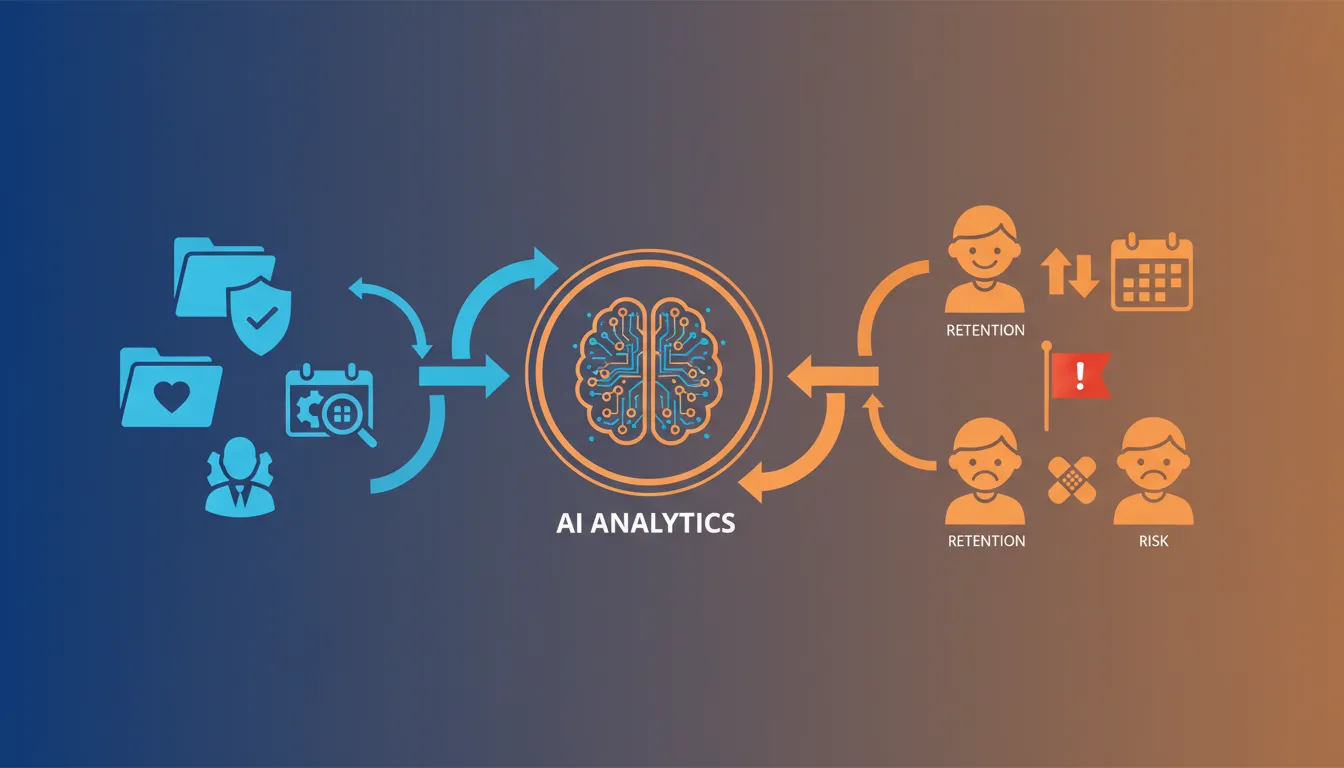
Predictive patient modeling uses machine learning to analyze patterns in your historical data and forecast future patient behavior. It's not guesswork. It's math.
How Predictive Analytics Actually Works
The system looks at hundreds of data points for each patient: visit frequency, payment history, appointment changes, communication patterns, time between visits, services received, demographic factors.
Then it compares these patterns to patients who dropped off in the past. The algorithm identifies which current patients share similar characteristics.
A 2025 study introduced a hybrid AI model specifically designed for no-show prediction that achieved 93.6% accuracy. That's dramatically better than any human gut feeling.
Here's what this looks like in practice:
- Monday morning, your system flags 8 patients with appointments this week who have a 70%+ probability of no-showing
- Automated text sequences go out immediately offering flexible rescheduling
- Your front desk gets a priority list for personal outreach
- By Friday, 6 of those 8 patients actually showed up instead of ghosting
That's not just reduced no-shows. That's recovered revenue you would've lost.
Identifying At-Risk Patients Before They Drop Off
No-shows are obvious. The harder problem is patients who are quietly disengaging.
They show up to appointments. They pay their bills. But something's off. Visit frequency is declining. They're pushing appointments further apart. They stopped referring friends.
AI systems catch these patterns humans miss.
Common at-risk indicators the algorithms identify:
- Appointment spacing increasing - Patient who came weekly is now coming every 3 weeks
- Engagement declining - Fewer opened emails, slower response to texts
- Payment behavior changing - Was always on time, now consistently late
- Visit duration decreasing - Less time spent in clinic per visit
- Questions decreasing - Less interactive during appointments
When the system flags these patients, you can intervene before they decide to leave. A simple "Hey, I noticed we haven't connected in a while. Everything okay?" call can save a $3,000 patient relationship.
Automation Triggers That Save Revenue
The real power comes from connecting predictions to automated actions.
Here's a framework that works:
| Low (20-40% risk) | Missing expected visit pattern | Friendly check-in text |
| Medium (40-60% risk) | Declining engagement + appointment gaps | Personal phone call task assigned |
| High (60-80% risk) | Multiple risk factors present | Doctor outreach + special offer |
| Critical (80%+ risk) | All indicators negative | VIP reactivation campaign |
This isn't cold automation. It's systematic care.
Patients feel remembered and valued. You save revenue that would've walked out the door.
The best chiropractic AI automation tools integrate these triggers directly into your workflow so nothing falls through the cracks.
Ready to See How We Fix Chiropractic Websites?
We've transformed 150+ service-based websites using our proven 4-step system. See exactly how we combine premium design with conversion science.
HIPAA Compliance: Protecting Patient Data with AI

Let's address the elephant in the room.
Every time you talk about AI and patient data, someone asks: "Is this even legal?"
The answer is yes. But with some critical conditions.
What Makes AI Analytics HIPAA Compliant
HIPAA requires specific protections for Protected Health Information (PHI). AI tools processing patient data must meet these standards:
- Data Encryption - All PHI must be encrypted both in transit and at rest using strong protocols (AES-256, TLS 1.2 or higher)
- Access Controls - Role-based permissions limiting who can see what data
- Audit Logs - Detailed tracking of every data access and modification
- Business Associate Agreement (BAA) - A legal contract where the vendor agrees to HIPAA requirements
Here's the critical point: Standard AI tools like basic ChatGPT are NOT HIPAA compliant.
According to the HIPAA Journal, OpenAI doesn't enter into Business Associate Agreements for standard ChatGPT. That means healthcare providers can't use it to process PHI. Period.
On January 6, 2025, the HHS Office for Civil Rights proposed the first major update to the HIPAA Security Rule in 20 years. This removes the distinction between required and addressable safeguards, making compliance requirements stricter across the board.
Choosing HIPAA-Compliant Analytics Platforms
Before adopting any AI analytics platform, verify these specific items:
- BAA availability - Ask directly: "Do you sign Business Associate Agreements?" If they hesitate or say no, walk away.
- Data residency - Where is your data stored? US-based servers with proper certifications?
- Encryption standards - Request documentation of their encryption protocols.
- Audit capabilities - Can you generate compliance reports showing data access?
Several platforms specifically designed for healthcare include:
- ChiroTouch - HIPAA compliant with cloud-based secure access
- Jane App - HIPAA, PIPEDA, and GDPR compliant
- Podium - Offers HIPAA compliance with BAA for healthcare practices
The 2025 HHS proposed regulations state that entities using AI tools must include those tools as part of their risk analysis and risk management compliance activities. This isn't optional anymore.
Data Privacy Best Practices
Beyond platform selection, implement these practices:
- De-identify when possible - If you're analyzing trends rather than individual patients, use anonymized data
- Minimum necessary standard - Only grant access to the minimum data required for each function
- Regular access reviews - Quarterly audits of who has access to what
- Staff training - Everyone touching patient data needs HIPAA training
- Vendor management - Conduct due diligence on every third-party tool
One common mistake? Using general AI chatbots for practice questions that might include patient details.
Even if you think you're being careful, it's super easy to accidentally share PHI. Use only designated, compliant tools for any analysis involving patient information.
Optimizing Your Practice for AI Search Visibility

Here's where things get interesting.
Traditional SEO optimizes for search engine rankings. Answer Engine Optimization (AEO) optimizes for AI citations.
When a potential patient asks ChatGPT or Google's AI assistant about chiropractors in your area, you want to be the practice that gets recommended. And guess what? This is now a measurable, trackable metric.
Understanding Entity Authority
AI systems determine which sources to trust and cite based on what's called Entity Authority. It's not just about keywords. It's about establishing your practice as a legitimate, authoritative source on specific topics.
According to BrightEdge research, AI Overview citations increasingly come from pages that also rank organically. The overlap grew from 32.3% to 54.5% in recent months.
So traditional SEO still matters. But it's not enough on its own.
Entity Authority gets built through:
- Consistent NAP data - Your Name, Address, Phone number must be identical across 100+ directories. AI uses citation consistency as a trust signal.
- Comprehensive content - Detailed pages covering specific conditions (sciatica, neck pain, sports injuries) that comprehensively answer every question
- Structured data - Schema markup that helps AI understand your content (MedicalBusiness, FAQ, LocalBusiness schemas)
Review volume and quality - AI systems factor in social proof when making recommendations
Tracking Your AI Visibility
How do you know if you're being cited?
Start manually. Search for queries your ideal patients would ask in:
- ChatGPT
- Google (look for AI Overviews at the top)
- Perplexity
- Claude
Try searches like:
- "Best chiropractor for back pain in [your city]"
- "Who should I see for sciatica treatment near [your area]"
- "Chiropractor recommendations [your city]"
Document whether you appear, and in what context.
For systematic tracking, BrightEdge AI Catalyst monitors brand presence across AI search engines. It tracks citations, sentiment, and provides actionable insights for improvement.
Key metrics to track:
- Citation frequency - How often you appear in AI responses
- Share of voice - Your visibility compared to competitors
- Sentiment - How AI describes your practice (positive, neutral, negative)
- Citation context - Are you recommended for the services you actually want to promote?
Building Content for AI Citation
AI systems prefer content structured in specific ways.
Implement these practices:
- Direct answers first - Start content with a clear, concise answer to the main question
- FAQ sections - Organized Q&A that AI can easily extract and cite
- Tables and structured data - Comparison tables, feature lists, step-by-step guides
- Authoritative external links - Citing reputable sources increases your content's perceived authority
- Schema markup - FAQPage, HowTo, MedicalBusiness schemas help AI understand your content
Chiropractic AI content automation can help you produce the volume of authoritative content needed to build entity authority.
The goal isn't gaming the system. It's genuinely becoming the most comprehensive, trustworthy source of chiropractic information in your market.
AI systems reward that authenticity.
Implementing AI Analytics: A Step-by-Step Framework
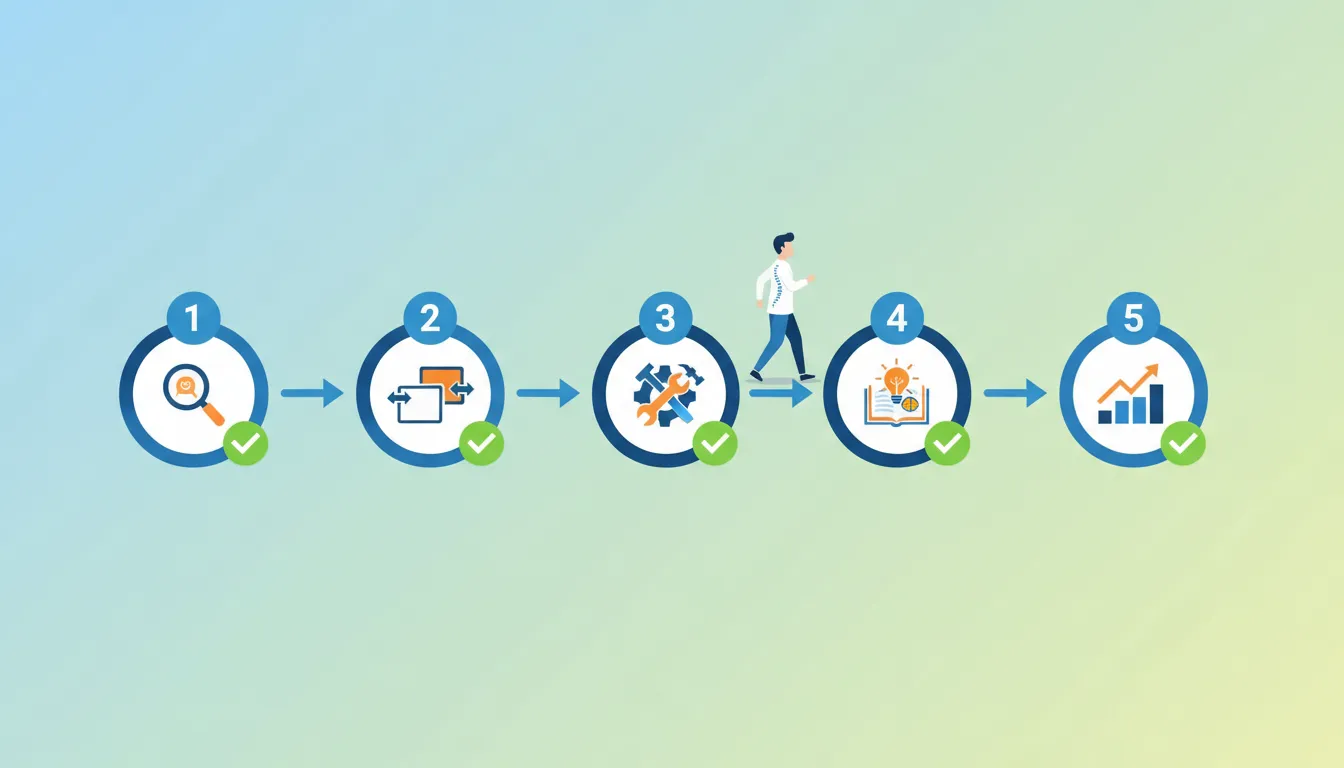
Let's turn all this into an actionable plan.
Here's exactly how to implement AI analytics in your practice, assuming you're starting from zero.
Week 1-2: Audit Your Current Data
Before adding new tools, understand what you already have.
Document every system that contains practice data:
- EHR/Practice Management
- Scheduling software
- Billing system
- Payment processor
- Email marketing platform
- Review management
- Website analytics
- Social media accounts
Identify your current metrics - What do you actually track today? Revenue? Patient counts? Anything more sophisticated?
Export historical data - Most systems let you export reports. Gather at least 12 months of: total revenue, new patients, total visits, no-show rates, collections.
Calculate your baseline LTV - Use this formula: (Average fee per visit × Average visits per patient × Average retention period). This number anchors everything that follows.
Week 3-4: Select and Configure Your Platform
Based on your audit, choose the analytics approach that fits:
If your EHR has built-in analytics (ChiroTouch, Jane App), start there. Most practices underutilize what they already have. Enable dashboards, set up automated reports, configure the KPIs we discussed.
If you need cross-platform visibility, add a dedicated analytics layer like BlueIQ that aggregates multiple data sources.
If patient communication is your weakness, consider Podium with its AI Employee features for review management and lead conversion.
Configuration priorities:
- Connect all data sources
- Set up daily automated reports
- Configure at-risk patient alerts
- Create your essential KPI dashboard
- Establish baseline benchmarks
Week 5-6: Train Your Team
Tools are useless if nobody uses them.
Front desk training:
- How to check the daily dashboard
- What the at-risk patient alerts mean
- Standard response protocols for flagged patients
- How to log communication for data tracking
Your own training:
- Weekly dashboard review process
- How to interpret trend data
- When to adjust based on metrics
- How to run specific reports
Create standard operating procedures for:
- Morning dashboard check routine
- At-risk patient intervention protocol
- End-of-day review process
- Weekly performance review meeting
Week 7+: Iterate and Optimize
Analytics isn't a one-time setup. It's an ongoing process.
Weekly: Review your KPI dashboard. Are metrics trending in the right direction?
Monthly: Deep dive into patient retention and acquisition costs. What's working? What's not?
Quarterly: Evaluate tool effectiveness. Are you getting ROI from your analytics investment? Should you add capabilities?
The practices that win with AI analytics treat it as a core business function. Not a side project.
Schedule protected time for data review just like you schedule patient appointments.
Tools and Platforms Comparison
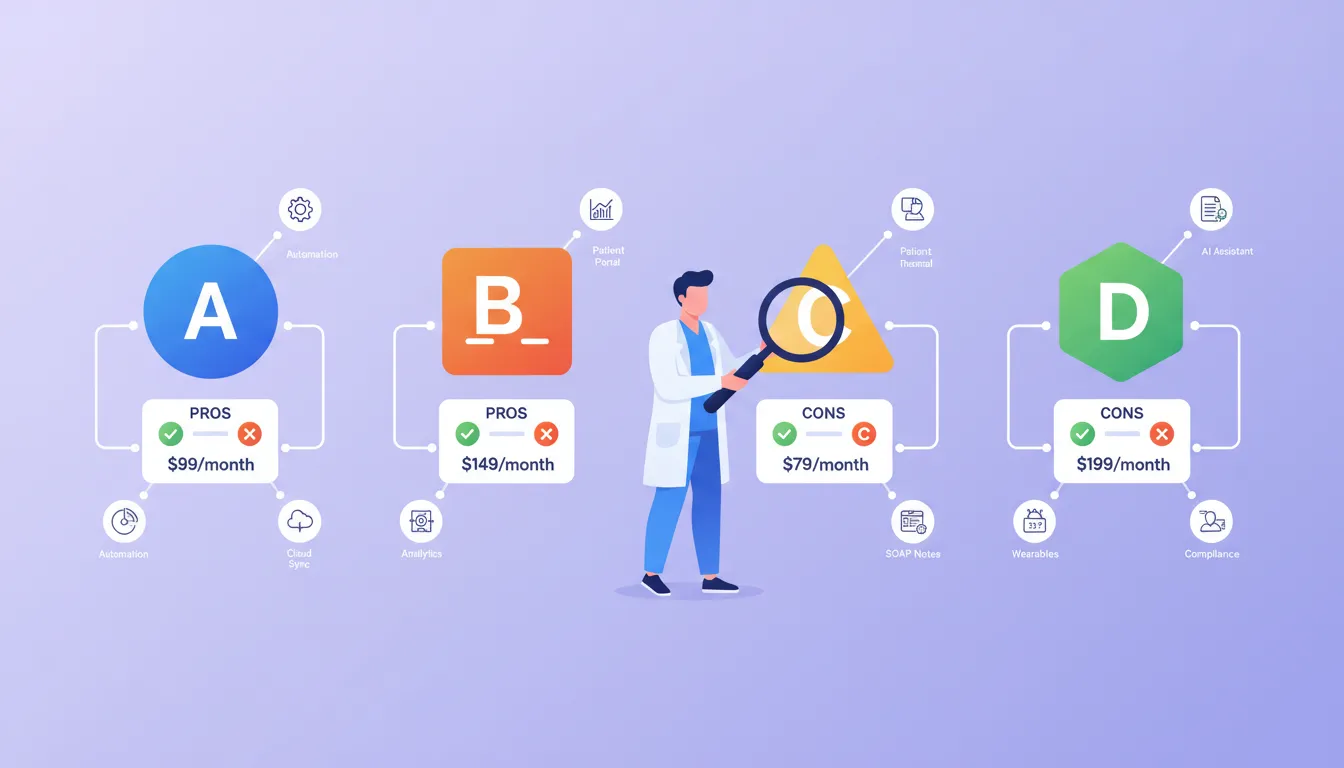
Let's break down the specific tools so you can make an informed decision.
EHR-Integrated Analytics Options
ChiroTouch Cloud Analytics
Best for: Insurance-heavy practices, those already using ChiroTouch
Key features:
- Real-time visual dashboards
- EOD summary reports (charges, payments, appointments)
- Transaction reporting by provider and location
- Integrated with patient engagement tools
- AI-powered SOAP notes generation
Limitations: Analytics are solid but not predictive. You get reporting, not forecasting.
Pricing: Starting around $159/month
Jane App Reporting
Best for: Multi-location practices, wellness-focused clinics
Key features:
- Appointment, revenue, and patient trend reports
- Multi-practitioner scheduling and reporting
- HIPAA, PIPEDA, GDPR compliant
- Clean, intuitive interface
Limitations: Reporting described as "somewhat basic" by users. Limited advanced analytics.
Pricing: $54-$399/month depending on plan and practitioner count
Dedicated AI Analytics Platforms
BlueIQ
Best for: Growth-focused practices wanting a "Practice Health Score"
Key features:
- Aggregates QuickBooks, Facebook, Google Analytics
- Lifetime patient value calculations
- Real-time alerts and smart insights
- Single dashboard view across tools
Limitations: Requires integration setup. May be overkill for small practices.
Pricing: Contact for custom quote
Patient Engagement with AI
Podium
Best for: Practices prioritizing patient communication and reviews
Key features:
- AI Employee responds to leads in under 1 minute
- Review management across 24+ platforms
- Text marketing and appointment reminders
- HIPAA compliant with BAA available
Reported results:
- 30% increase in sales
- 56% higher appointment show rates
- 80% more after-hours appointments
- 50% higher lead-to-sale conversion
Limitations: Pricing not transparent. AI features may require higher tiers.
Pricing: Contact sales for quote
Quick Comparison Table
| ChiroTouch | EHR + PM | Basic analytics, AI notes | Yes | Insurance practices |
| Jane App | PM + Booking | Standard reporting | Yes | Multi-location |
| BlueIQ | Analytics aggregation | Predictive insights | Verify | Data-driven growth |
| Podium | Communication | AI Employee, automation | Yes with BAA | Review/lead focus |
The right choice depends on your biggest pain point.
Struggling with documentation? ChiroTouch's AI features help there. Leads falling through cracks? Podium's AI Employee might be the answer. Need big-picture visibility? BlueIQ aggregates everything.
Most practices benefit from combining their existing EHR for clinical data + a patient communication platform for engagement + periodic review of AI visibility metrics.
Frequently Asked Questions
What are the most important KPIs for a chiropractor to track in 2026?
The most critical KPIs include Patient Lifetime Value (LTV), Cost Per Acquisition (CPA), patient visit average (PVA), no-show rate, care plan completion rate, and AI citation frequency for your online presence.
Track revenue per visit, days in accounts receivable, and patient retention rates to get a complete picture of practice health. MGMA benchmarks suggest keeping days in AR under 30 and regularly comparing your metrics against national peers.
The newer metric to add? AI citation frequency. As more patients use AI assistants for healthcare recommendations, tracking whether you're being mentioned becomes a leading indicator of future patient acquisition.
How much does AI analytics software for a small clinic cost?
AI analytics solutions range from $79 to $399+ per month depending on features and practice size.
ChiroTouch starts around $159/month with analytics included. Jane App ranges from $54-$399/month based on practitioner count and plan level. Dedicated analytics platforms like BlueIQ typically require custom quotes.
Many EHR systems now include basic analytics in their standard packages. The question is whether you need predictive capabilities that might require additional investment. For most solo practices, maximizing your existing EHR's analytics is the cost-effective starting point.
Can AI predict when a chiropractic patient is going to stop their care plan?
Yes. And remarkably accurately.
Predictive patient modeling uses historical data patterns to identify patients at high risk for dropping off care plans before it happens. Studies show AI-driven scheduling and outreach systems can reduce no-shows by up to 50.7%.
These systems analyze appointment history, payment patterns, engagement metrics, and behavioral signals to flag at-risk patients. A hybrid model tested in 2025 achieved 93.6% accuracy in no-show prediction.
The practical application? You get alerts about which patients need intervention, allowing proactive outreach before they ghost you.
Is AI-powered patient data tracking HIPAA compliant?
Depends entirely on the platform.
HIPAA-compliant AI tools must offer encryption, access controls, audit logs, and sign a Business Associate Agreement (BAA). Without a BAA, you can't legally use that tool for patient data.
Standard tools like basic ChatGPT are NOT HIPAA compliant. OpenAI doesn't offer BAAs for consumer ChatGPT. Healthcare-specific platforms like ChiroTouch, Jane App, and Podium do offer HIPAA compliance with proper BAAs.
Always ask specifically: "Do you sign Business Associate Agreements?" Verify their security documentation before implementing any AI tool that touches patient information.
How do I track my practice's citation frequency in AI search?
Start manually by searching relevant queries in ChatGPT, Google AI Overviews, and Perplexity. Document whether your practice appears and in what context.
For systematic tracking, tools like BrightEdge AI Catalyst monitor brand presence across AI search engines. They track citations, sentiment, and competitive positioning.
Key metrics to track: how often you appear in AI responses, your visibility compared to competitors (share of voice), the sentiment of how AI describes your practice, and which services you're being recommended for.
What is the difference between EHR reports and AI business intelligence?
EHR reports show you what happened historically through static data. You get numbers, charts, and summaries of past performance.
AI business intelligence predicts what will happen next and recommends actions. Instead of "you had 12 no-shows," you get "these 8 patients are at 73% risk of no-showing, here's the automated intervention."
Traditional EHR reports require manual analysis and interpretation. AI systems automatically identify trends, flag anomalies, and suggest optimizations based on pattern recognition.
One is reactive. The other is proactive.
How many new patients do I need to break even on an AI analytics stack?
With average patient lifetime values between $1,000-$3,600 and typical AI analytics costs of $150-$400 per month, you need roughly 1-2 additional new patients per month to cover the investment.
But honestly? That's the wrong way to think about it.
If the system helps you retain even one patient who would've dropped off, it pays for itself. If it prevents 5 no-shows per month at $100/visit, that's $500 in recovered revenue versus a $200 software cost.
The ROI usually comes from retention improvements, not just acquisition. Existing patients are worth more because you've already paid to acquire them.
Do I need a data analyst to run these tools in my practice?
Nope.
Modern AI analytics platforms are designed for practitioners without technical backgrounds. They feature visual dashboards, automated alerts, and plain-language insights.
Most systems require minimal setup and provide actionable recommendations without requiring you to interpret raw data or build custom reports. If you can read an email and respond to a text, you can use these tools.
The learning curve is typically a few hours for basic functionality and a few weeks to master advanced features. Vendors offer onboarding support and training resources.
Conclusion
The shift to AI analytics isn't coming. It's here.
Practices adopting these tools now are building competitive advantages that compound over time. They're retaining more patients, acquiring new ones more efficiently, and showing up when AI assistants recommend healthcare providers.
The good news? You don't need to transform overnight.
Start by maximizing the analytics your current EHR provides. Add predictive capabilities as you grow. Track your AI visibility as a leading indicator of future growth.
The practices that win in 2026 and beyond won't be the ones with the fanciest tools. They'll be the ones who actually use their data to make better decisions every single day.
Your competitors are figuring this out. The question is whether you'll lead or follow.
Look, I get it. You're already stretched thin running a practice. The idea of adding "AI analytics" to your plate probably sounds about as appealing as more insurance paperwork.
But here's what most chiropractors don't realize: your website and online presence are quietly costing you 15-20 qualified patient leads every single month. Not because your skills aren't good. Because your digital foundation isn't built to compete in 2026.
That's why we created our Free Website Conversion Analysis. It's not a sales pitch—it's a genuine walkthrough of the 3 biggest problems killing your bookings, delivered personally via Loom video within 24 hours.
We'll show you exactly:
- Why visitors leave without booking
- What's broken on mobile devices (where most searches happen)
- Missing trust signals costing you patients
- Where you rank vs. local competitors
- Simple fixes that drive more calls this month
You'll also get an instant case study while you wait, showing real examples of how other chiropractors fixed these exact problems.
Get your free analysis here — no credit card, no obligation, just actionable insights you can use whether you work with us or not.
Because every day your digital presence sits unoptimized is another day local patients are finding AI-recommended competitors instead of you.

Gerek Allen
Co-Owner iTech Valet
Entrepreneur, patriot, CrossFit junkie, IPA enthusiast, loves to travel to tropical destinations, and knows way too many movie quotes.


About iTech Valet
iTech Valet specializes in web design and content marketing for online entrepreneurs who want to share their expertise.
Services Include:
- Web Design
- Graphic Design
- Sales Copy
- Funnel Building
- Authority Sites
- Membership Sites
- Course Creation
- Email Systems
- Content Marketing
- Competitive Analysis
- Tech Integrations
- Strategic Planning
NEED MORE CLIENTS?
Free conversion-focused analysis uncovers the 3 biggest problems killing your bookings — we'll walk you through your results personally

621 Enterprises, Inc. | Copyright 2022 | All rights reserved