


What Are the Most Effective Lead Generation Strategies for Chiropractors?
 by Gerek Allen ~ Last Updated: December 1st, 2025 ~ 10 Min Read
by Gerek Allen
~ Last Updated: December 1st, 2025 ~
~ 10 Min Read ~
The most effective lead generation strategies combine local SEO optimization, strategic paid advertising (Google and Facebook), systematic content marketing, and automated referral programs working together.
Here's the reality: Most chiropractors waste 60-70% of their marketing budget on tactics that don't generate qualified leads. They're posting randomly on social media, running unfocused ads, or hoping their website magically attracts patients. Meanwhile, practices with systematic lead generation are booking 20-40 new patients monthly like clockwork.
The difference isn't budget—it's strategy. A $500/month focused campaign targeting the right channels with proper tracking outperforms a $3,000/month scattered approach every single time.
This guide breaks down the seven highest-ROI lead generation strategies for chiropractic practices in 2025: what works, what doesn't, realistic costs, expected timelines, and how to implement each systematically. We'll cover both immediate tactics (paid ads delivering leads within days) and long-term assets (SEO and content building sustainable patient flow over months).
If you're a new practice, start with paid ads for immediate leads while building organic presence. If you're established but plateaued, focus on conversion optimization and referral systematization. Either way, you'll have a complete lead generation roadmap by the end.
Understanding Lead Generation vs Patient Acquisition
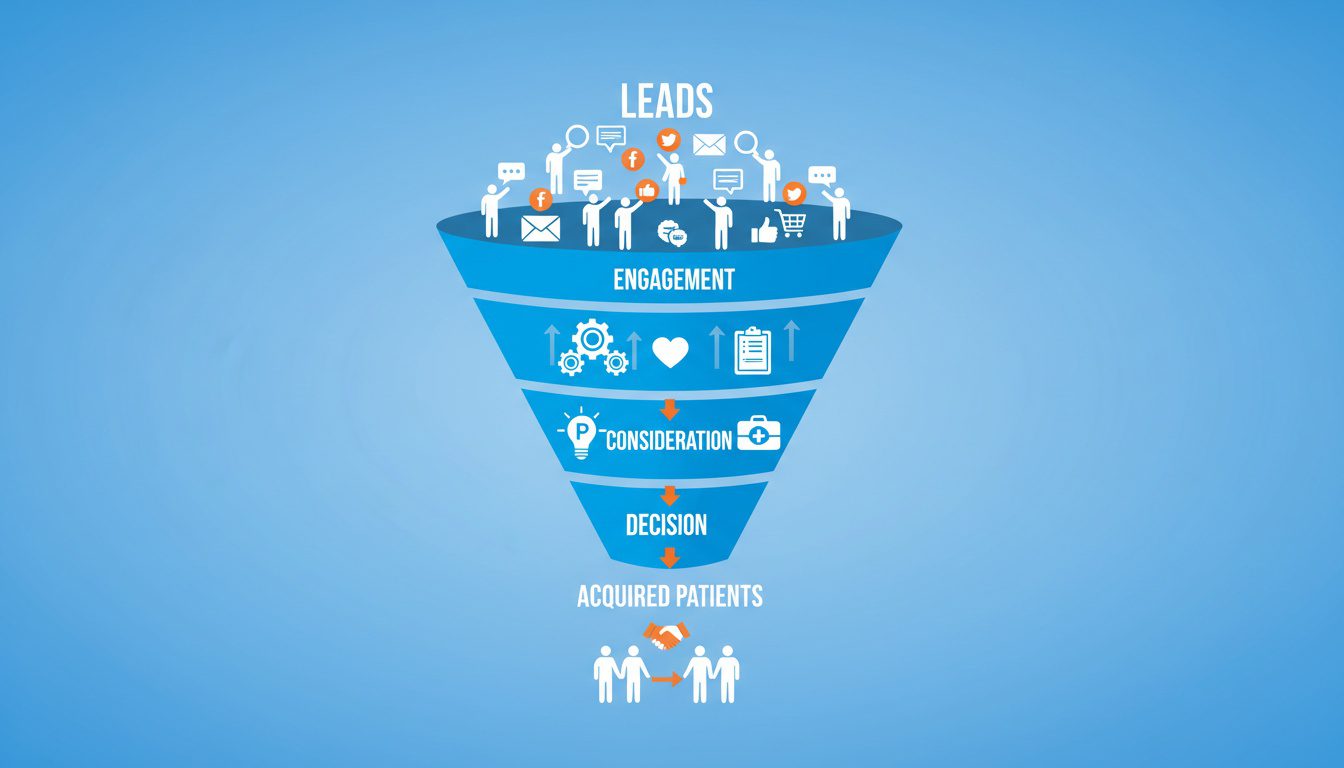
Most chiropractors confuse lead generation with patient acquisition—they're related but fundamentally different.
Lead generation is attracting potential patients and capturing their contact information. Someone sees your ad, visits your website, downloads your guide, or calls your office. They've raised their hand showing interest.
Patient acquisition is converting those leads into paying patients. They book an appointment, show up, receive treatment, and pay. This is where revenue happens.
You can generate 100 leads monthly and still struggle financially if your conversion rate is 5%. Or generate 30 high-quality leads converting at 40% and thrive. Quality matters more than quantity, but you need sufficient volume to hit patient targets.
The Lead Generation Funnel for Chiropractors
Every patient follows a predictable journey through your funnel:
Stage 1: Awareness (Problem Recognition)
- Patient realizes they have a problem (back pain, headaches, mobility issues)
- Starts searching online or asking friends for solutions
- Your marketing should intercept them at this exact moment
- Channels: Local SEO, paid search ads, social media content
Stage 2: Consideration (Researching Options)
- Patient compares chiropractors, reads reviews, checks websites
- Evaluating credibility, approach, convenience, cost
- Your marketing should demonstrate expertise and build trust
- Channels: Website content, video testimonials, educational resources, review management
Stage 3: Decision (Ready to Book)
- Patient decides to schedule an appointment
- Looking for easy booking process and clear next steps
- Your marketing should remove friction and provide clear path forward
- Channels: Online scheduling, special offers, strong CTAs, immediate response systems
Stage 4: Retention (Becoming Loyal Patient)
- Patient completes initial treatment and evaluates experience
- Deciding whether to continue care or refer others
- Your marketing should nurture relationship and encourage advocacy
- Channels: Email follow-up, patient education, referral requests, loyalty programs
Most practices focus all their energy on Stage 1 (getting attention) and ignore Stages 3-4 (conversion and retention). The result? Expensive leads that don't convert or don't stay long enough to be profitable.
Key Lead Generation Metrics to Track
You can't improve what you don't measure. Track these metrics monthly:
| Total Leads | Count all inquiries (calls, forms, messages) | 30-50 per month (solo practice) |
| Cost Per Lead | Marketing spend ÷ total leads | $40-80 (varies by market) |
| Lead-to-Appointment Rate | Appointments booked ÷ total leads | 40-60% |
| Appointment Show Rate | Patients who showed ÷ booked appointments | 75-85% |
| Cost Per Acquired Patient | Marketing spend ÷ new patients acquired | $80-150 |
Here's what matters most: Cost per acquired patient relative to lifetime value.
If your average patient is worth $2,500 over their lifetime and you're spending $100 to acquire them, you're winning. If they're worth $1,200 and you're spending $200, you're losing money on growth.
The practices that scale profitably know their numbers cold. They track which marketing channels produce the lowest cost per acquired patient and shift budget accordingly.
Why Traditional Marketing Fails for Chiropractors
Let's address why most chiropractic marketing doesn't generate leads:
Problem 1: No tracking or attribution - You don't know which marketing activities actually produce patients. You're flying blind, so you can't optimize or double down on what works.
Problem 2: Generic messaging - "Experience quality chiropractic care" doesn't speak to specific patient problems. Nobody wakes up thinking "I need quality chiropractic care." They think "my back is killing me and I need relief."
Problem 3: Abandoned leads - Someone fills out a form or calls when you're closed. Nobody follows up for 48 hours. That lead chose a competitor who responded in 10 minutes.
Problem 4: Inconsistent execution - You post on Facebook for two weeks, see no immediate results, quit. You try Google Ads for a month with poor targeting, decide "ads don't work," quit. Lead generation requires consistent execution over months.
Problem 5: No conversion optimization - Driving traffic to a website that doesn't convert is like inviting people to a store with locked doors. Your website conversion rate determines whether traffic becomes revenue.
Fix these foundational issues before spending more on lead generation. Otherwise you're pouring water into a leaky bucket.
Local SEO: The Foundation for Sustainable Leads

Local SEO is the highest-ROI long-term lead generation strategy for chiropractors—once you rank, you get consistent organic leads without ongoing ad spend.
The math is compelling: Ranking in the Google Map Pack for "chiropractor near me" and related searches can drive 50-150 qualified leads monthly at essentially zero ongoing cost. That's $2,000-$6,000 worth of paid advertising you're getting free.
But here's the catch: Local SEO takes 3-6 months to show meaningful results. You need to invest in the foundation while running shorter-term lead generation tactics to maintain patient flow.
Optimizing Your Google Business Profile
Your Google Business Profile is the single most important asset for local lead generation.
Priority actions that drive leads:
- Claim and verify your profile - If you haven't done this, you're invisible to 70% of local searchers. Takes 10 minutes plus 5-7 days for verification postcard.
- Complete every section 100% - Business name, address, phone, hours, services, service areas, attributes, photos, description. Google ranks complete profiles higher.
- Upload 5-10 high-quality photos - Interior, exterior, team, treatment rooms, before/after. Profiles with photos get 42% more direction requests according to Google research.
- Generate consistent reviews - Target 3-5 new reviews monthly minimum. Reviews are the #1 local ranking factor. Use systematic review generation strategies to maintain momentum.
- Post weekly Google Posts - Share updates, offers, tips. Google Posts increase engagement and signal active business. Takes 5 minutes weekly.
- Respond to all reviews within 24 hours - Shows engagement and improves conversion. Practices that respond see 15-20% higher booking rates from profile views.
- Add services with descriptions - List every service you offer (back pain relief, sports injuries, pregnancy care, etc.) with keyword-rich descriptions.
- Use relevant categories - Primary: Chiropractor. Secondary: Sports medicine clinic, pain management, wellness center (if applicable).
Most chiropractors set up their profile once and forget it. The practices dominating local search update it weekly and treat it like their most valuable marketing asset.
Ranking in the Google Map Pack
The Map Pack (those 3 businesses showing in maps at top of search results) captures 44% of all clicks for local searches, according to BrightLocal's research.
If you're not in the top 3, you're missing most of the organic lead generation opportunity.
Here's what determines Map Pack rankings:
- Proximity - How close you are to the searcher (you can't change this, focus on other factors)
- Relevance - How well your profile matches search intent (optimize categories, services, description)
- Prominence - How well-known and authoritative you are (reviews, links, citations)
Action steps to improve Map Pack ranking:
- Generate more reviews than competitors (volume + recency + star rating all matter)
- Build consistent NAP (Name, Address, Phone) across directories
- Earn links from local organizations (chamber of commerce, professional associations, local news)
- Create location-specific content on your website
- Ensure your website is mobile-friendly and fast-loading
- Maintain active Google Business Profile with regular posts
Expect 3-6 months of consistent optimization before seeing significant ranking improvements. Track your position weekly using tools like BrightLocal or Whitespark.
Website SEO for Chiropractic Lead Generation
Your website needs to rank for searches like "chiropractor [city]", "back pain relief [city]", and condition-specific terms your patients are searching.
On-page SEO essentials:
- Create dedicated service pages for each major condition (back pain, neck pain, sciatica, headaches, sports injuries)
- Optimize title tags and meta descriptions with location + condition keywords
- Include patient testimonials and case studies on service pages
- Add clear calls-to-action on every page (book appointment, call now, request consultation)
- Implement schema markup for local business, services, and reviews
- Ensure mobile-friendly design (60-70% of searches are mobile)
Content marketing for SEO:
- Publish educational blog posts targeting patient questions (2-4 articles monthly minimum)
- Answer common questions comprehensively (creates search visibility + builds trust)
- Use internal linking to connect related content and improve site structure
- Target both informational queries ("what causes lower back pain") and transactional queries ("chiropractor near me")
Technical SEO priorities:
- Site speed under 3 seconds (especially mobile) - Use Google PageSpeed Insights to test
- SSL certificate (HTTPS) - Required for trust and rankings
- Clean URL structure and logical site hierarchy
- XML sitemap submitted to Google Search Console
- Fix broken links and 404 errors
Local SEO for chiropractors deserves ongoing monthly attention. Allocate 5-10 hours monthly or hire an SEO specialist to handle optimization while you focus on patient care.

NEED MORE CLIENTS?
Free conversion-focused analysis uncovers the 3 biggest problems killing your bookings — we'll walk you through your results personally

Paid Advertising: Immediate Lead Generation
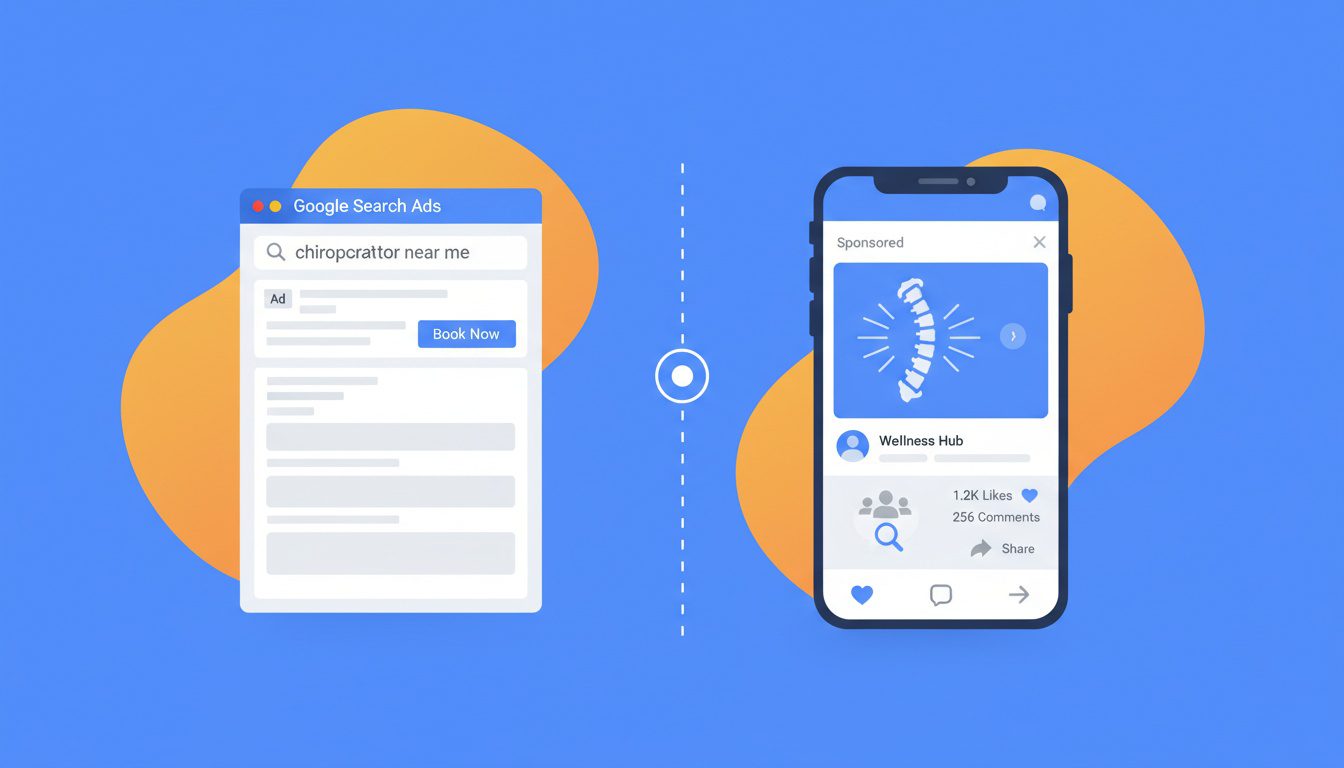
Paid advertising delivers leads faster than any other strategy—you can have qualified prospects calling within 24-48 hours of launch.
The downside? You're renting attention instead of building owned assets. Turn off the ads, leads stop immediately. This makes paid advertising perfect for new practices needing immediate patient flow or established practices wanting to scale faster than organic growth allows.
Smart practices use paid ads as the "now" strategy while building organic channels as the "later" strategy. Within 12-18 months, organic sources should supply 60-70% of new patients with paid ads filling gaps and enabling predictable growth.
Google Ads for Chiropractors
Google Ads captures people actively searching for a chiropractor right now—highest intent leads you can buy.
Someone searching "chiropractor near me" or "back pain relief [city]" is ready to book an appointment, not browsing casually. This is why Google Ads consistently delivers the best conversion rates among paid channels.
Campaign structure that works:
- Campaign 1: Branded searches - Your practice name and variations. Protect against competitors bidding on your brand. Low cost, high conversion.
- Campaign 2: Local service searches - "chiropractor near me", "chiropractor [city]", "[neighborhood] chiropractor". Highest volume, moderate competition.
- Campaign 3: Condition-specific searches - "back pain relief [city]", "sciatica treatment", "sports injury chiropractor". Lower volume, very targeted, high intent.
- Campaign 4: Competitor targeting - Bid on competitor names (carefully—some will bid on yours in retaliation). Moderate cost, decent conversion.
Budget and bidding strategy:
- Start with $30-50 daily budget ($900-1,500 monthly)
- Expect $3-8 per click in most markets
- Target $40-80 cost per lead (form fill or phone call)
- Use manual CPC bidding initially, switch to Target CPA once you have conversion data
Ad copy essentials:
- Include your city/neighborhood prominently
- Highlight unique selling proposition (same-day appointments, specific techniques, years experience)
- Show new patient special or value proposition clearly
- Use ad extensions (call, location, sitelink, callout)
- Create urgency where appropriate ("Book today")
Landing page requirements:
- Mobile-optimized (70% of clicks are mobile)
- Clear headline matching ad promise
- Online booking or prominent phone number above fold
- Social proof (reviews, testimonials, years in practice)
- Simple form (name, phone, email max—don't ask for medical history)
- Fast loading (under 2 seconds)
Most chiropractors make two critical mistakes with Google Ads: broad targeting that wastes budget, and weak landing pages that don't convert. Tight geographic targeting (3-5 mile radius for urban, 10-15 for rural) plus dedicated landing pages dramatically improve ROI.
For comprehensive setup guidance, check out our Google Ads guide for chiropractors.
Facebook and Instagram Ads
Facebook Ads capture people who aren't actively searching but match your ideal patient profile—different psychology, different approach.
Where Google Ads intercept existing demand, Facebook Ads create demand by reaching people before they realize they need help. This makes Facebook ideal for awareness-stage marketing and building your pipeline of future patients.
Campaign types that generate leads:
- Lead form ads - Native Facebook forms that capture contact info without leaving platform. Lower friction, higher volume, but sometimes lower quality leads.
- Landing page conversion ads - Drive traffic to your website with compelling offer. Higher intent leads who actively click through.
- Local awareness ads - Target people within specific radius of your practice. Great for grand openings or new patient specials.
- Retargeting ads - Show ads to people who visited your website but didn't book. Critical for conversion optimization.
Targeting strategy:
- Location: 5-10 mile radius of your practice (adjust based on urban/rural)
- Age: 30-65 (adjust based on your specialty—sports chiropractic skews younger)
- Interests: Fitness, wellness, natural health, yoga, running, specific health conditions
- Behaviors: Likely to move (new residents), new parents, recent life events
- Custom audiences: Upload patient list for lookalike targeting, retarget website visitors
Ad creative that works:
- Video testimonials from real patients (most effective)
- Before/after transformation stories (with permission)
- Educational content addressing common pain points
- Behind-the-scenes look at your practice and approach
- Special offers with clear deadline ("$49 new patient exam this week only")
Budget recommendations:
- Start with $20-40 daily ($600-1,200 monthly)
- Expect $1-3 per click (cheaper than Google)
- Target $30-60 cost per lead
- Split test multiple ad variations constantly
The big difference from Google Ads: Facebook leads require more nurturing. They're earlier in decision process. Expect 20-40% conversion rate vs 40-60% from Google Ads leads.
Use email and SMS follow-up sequences to nurture Facebook leads over 7-14 days. Those who book immediately are bonus, but most need multiple touchpoints before converting.
Other Paid Channels Worth Testing
Once Google and Facebook are profitable, experiment with these secondary channels:
- Yelp Ads ($300-500/month) - Display your profile above competitors in Yelp search results. Works well in markets where patients actively use Yelp.
- Local service ads (Google LSA) - Pay-per-lead model with guaranteed results. Currently limited markets for chiropractors but expanding.
- YouTube pre-roll ads - Target people watching health and wellness content. Excellent for building awareness and credibility.
- Nextdoor sponsored posts ($100-300/month) - Hyperlocal targeting for neighborhood penetration. Great for suburban practices.
Don't spread budget across 6 channels when starting. Master Google and Facebook first, then expand once those are producing predictable ROI.
Content Marketing for Long-Term Lead Generation

Content marketing is the most underutilized lead generation strategy among chiropractors—yet practices that nail it generate 40-60% of new patients from organic content.
Here's why it works: Every piece of content you create is a permanent asset that can attract leads for years. Unlike paid ads that stop working when you stop paying, a comprehensive blog post published today might generate 50-100 leads over the next 2-3 years.
The investment is front-loaded (time to create quality content), but the returns compound. Month 1-3 you might see 5-10 leads from content. Month 6-12 it grows to 20-30. Year 2-3 it becomes your primary lead source.
Building a Content Strategy That Generates Leads
Random content doesn't generate leads. Strategic content targeting specific patient searches does.
Start with keyword research to identify what your potential patients are actually searching for:
High-intent keywords to target:
- Condition + location searches ("back pain relief [city]", "sciatica treatment [city]")
- Treatment-specific searches ("chiropractic adjustment", "spinal decompression [city]")
- Comparison searches ("chiropractor vs physical therapy", "is chiropractic safe")
- Cost-related searches ("chiropractic cost", "does insurance cover chiropractic")
Educational keywords that build trust:
- "What causes [condition]"
- "How to relieve [pain type]"
- "When to see a chiropractor for [problem]"
- "Best exercises for [condition]"
Create comprehensive content (1,500-3,000 words) targeting each high-value keyword. Don't write 300-word blog posts that say nothing—write definitive guides that answer questions thoroughly.
Use tools like Answer The Public or Google's "People Also Ask" to find real questions patients are asking. Then answer them better than anyone else.
Content Formats That Drive Leads
Blog posts are your foundation, but diversifying formats amplifies reach:
- Long-form blog posts (1,500-3,000+ words) - Comprehensive guides targeting specific conditions or questions. Best for SEO and establishing expertise. Publish 2-4 monthly. Learn AI-powered blog creation to scale content production.
- Video content - Patient testimonials, technique explanations, exercise demonstrations. Embed videos in blog posts and share on YouTube for dual visibility. Videos build trust faster than text.
- Downloadable guides and checklists - Lead magnets that capture email addresses. Examples: "Desk Ergonomics Checklist", "Posture Assessment Guide", "10-Minute Daily Stretching Routine". Gate these behind simple forms.
- Case studies - Detailed patient success stories (with permission) showing transformation. Build credibility while demonstrating results potential patients want.
- FAQ pages - Compile common questions patients ask during consultations. Creates content targeting long-tail search queries while saving time answering repeatedly.
- Infographics - Visual explanations of complex topics (how spine works, posture problems, treatment process). Highly shareable on social media.
Implementation strategy:
- Core: 2-4 comprehensive blog posts monthly targeting patient searches
- Supporting: Weekly social posts sharing snippets and engaging community
- Lead magnets: Create 2-3 high-value downloadable resources
- Video: Record 1-2 videos monthly (testimonials or education)
- Repurpose: Turn each blog post into social content, email newsletter content, and video scripts
One comprehensive piece of content should generate 10-15 smaller pieces for multi-channel distribution.
Email Marketing for Lead Nurturing
Most chiropractic leads don't book immediately—email nurturing converts them over time.
Someone downloads your back pain guide or requests information isn't ready to book that second. They're researching, comparing options, or not quite ready to commit.
Email automation keeps you top-of-mind while providing value until they're ready:
New lead sequence (7-14 days):
- Day 0: Deliver promised resource immediately
- Day 2: Educational content related to their interest
- Day 4: Patient success story showing transformation
- Day 7: Overcome common objections or concerns
- Day 10: Special offer or booking incentive
- Day 14: Last-chance booking reminder
Newsletter strategy (ongoing):
- Send weekly or biweekly to entire email list
- Mix: 70% educational content, 20% practice updates, 10% promotional
- Include patient stories, health tips, new services, community involvement
- Always include clear booking CTA but don't make it salesy
Segmentation for relevance:
- Segment by interest (back pain, sports injuries, wellness care)
- Segment by engagement (opened last 5 emails vs dormant)
- Segment by stage (leads vs active patients vs former patients)
- Send targeted content matching their needs
Track open rates (target 20-30%), click rates (target 3-5%), and most importantly: booking conversions from email campaigns.
Measuring Content Marketing ROI
Content marketing ROI is harder to measure than paid ads but critical to track:
Metrics to monitor monthly:
- Organic traffic growth - Track visitors from organic search using Google Analytics
- Keyword rankings - Monitor position for target keywords (use tools like Ahrefs or SEMrush)
- Content-attributed leads - How many form fills came from blog posts or resource downloads
- Content-attributed patients - Track which patients discovered you through content
- Email list growth - New subscribers added monthly from content lead magnets
- Email conversion rate - Percentage of email list that books appointments quarterly
Calculate content ROI with this formula: (Revenue from content-attributed patients - Content creation costs) ÷ Content creation costs × 100
If you invested $2,000 in content creation over 6 months and generated 20 patients worth $50,000 lifetime value, your ROI is 2,400%. Even if only 5 of those 20 came purely from content, you're still at 1,150% ROI.
The challenge is attribution—patients rarely say "I read your blog post about sciatica" when booking. Use UTM tracking, ask at intake, and compare organic growth before/after content investment.
Referral Programs That Scale

Referral programs are the most cost-effective lead generation strategy—when someone refers a friend, that lead converts at 2-3x the rate of cold marketing leads.
According to Nielsen research on word-of-mouth, 92% of people trust recommendations from friends and family over all other forms of advertising. A referral comes pre-qualified and pre-sold on your practice.
Yet most chiropractors leave referrals to chance. "Please tell your friends" isn't a system—it's a hope.
Systematic referral generation requires three elements: making it easy, providing incentive, and automating the ask.
Creating a Systematic Referral Program
The best time to ask for referrals: immediately after a patient experiences a significant win.
They just got relief from chronic pain, hit a mobility milestone, or completed successful care plan. They're grateful, emotional, and motivated to help others. That's your moment.
In-office referral system:
- Train staff to ask after positive outcomes: "I'm so glad we could help you! Do you know anyone else dealing with [similar problem] who we could help?"
- Provide referral cards patients can hand to friends (include special offer for referred person)
- Display referral program benefits prominently at checkout
- Make it part of care completion process—not an afterthought
Automated referral requests:
- Email sequence triggered 30-60 days into successful treatment
- Include easy referral mechanism (forward email to friend, social sharing links, online referral form)
- Remind of benefits to both referrer and referred person
- Follow up with non-responders once 7-10 days later
Referral tracking system:
- Ask every new patient "How did you hear about us?" and record answer
- When they say referral, ask "Who can we thank for the referral?"
- Track referral volume by source patient in your practice management system
- Acknowledge and reward referrers promptly
Without tracking, you can't optimize or identify your best referral sources.
Referral Incentives That Work
The question every chiropractor asks: Should I offer incentives for referrals?
Short answer: Yes, when done correctly. Incentives increase referral volume by 30-50% compared to just asking.
Effective incentive structures:
- Discount on future service - $25-50 credit per successful referral. Applied to their next visit.
- Free service - Complimentary adjustment or wellness consultation after 3 referrals.
- Charitable donation - Donate $25 to local charity in patient's name per referral. Appeals to altruistic patients.
- Referrer and referred both benefit - "Give $50, Get $50" where both receive discount on service.
- Tiered rewards - Bronze (1-2 referrals), Silver (3-5 referrals), Gold (6+ referrals) with escalating benefits.
What doesn't work well:
- Cash payments (feels transactional, may violate regulations)
- Excessive incentives that attract wrong motivation
- Complicated reward structures patients don't understand
- Rewards that require 10+ referrals (too distant to motivate)
Keep it simple, valuable, and clearly communicated. Test different incentive levels to find sweet spot between cost and referral volume.
Building a VIP Referral Network
Your top 20% of patients generate 80% of referrals—systematically nurture these advocates.
Identify your most enthusiastic patients and create VIP status with special recognition:
VIP program benefits:
- Priority scheduling or extended appointment times
- Exclusive educational workshops or health talks
- First access to new services or techniques
- Recognition on "patient wall of fame" (with permission)
- Quarterly appreciation event (coffee and conversation)
- Higher referral rewards than standard program
How to identify VIP candidates:
- Patients who've referred 3+ people
- Long-term patients with excellent compliance
- Patients with strong community connections (business owners, coaches, teachers)
- Active on social media who engage with your content
- Patients in complementary professions (personal trainers, yoga instructors, massage therapists)
Invest disproportionate attention in your referral champions. A single well-connected patient who refers consistently is worth $10,000-$50,000 in lifetime referral value.
For detailed implementation steps, see our referral program setup guide.
Asking for Referrals Without Being Awkward
The key is making it about helping others, not helping yourself:
Script that works (for providers):
"[Patient name], I'm really happy with your progress over these past few weeks. You mentioned your husband has been dealing with similar back issues. I'd love to help him too if he's interested. What do you think—would it be valuable if he came in for a complimentary consultation?"
Why this works: You're offering help to someone in need, positioned through the lens of the patient's relationship. Not asking them to promote your business.
Script that works (for front desk):
"Before you go, I wanted to mention—we love helping people like you get relief from [condition]. If you know anyone struggling with similar issues, we'd be happy to offer them a complimentary consultation. We have referral cards here if you'd like to take a few."
Why this works: Casual, no pressure, provides easy mechanism (referral cards), positions as service to others.
Email script that works:
"Hi [Name], we're so glad we could help you with your [condition]! If you know anyone dealing with similar issues who could benefit from the care you've received, we'd love to help them too. Simply forward this email or share this link: [referral link]. We'll make sure they get the same great care you've experienced."
Why this works: Simple, one-click action, emphasizes the quality of care they received.
Never apologize for asking. If you genuinely helped someone, asking them to help others by referring is doing everyone a service.
Marketing Automation for Lead Management

The gap between lead generation and patient acquisition is lead management—automation bridges that gap.
You can generate 50 leads monthly and convert 10% because of poor follow-up, or generate 30 leads and convert 50% with systematic nurturing. The second scenario drives more revenue with less marketing spend.
Most chiropractic leads don't book immediately. They're researching, comparing options, or simply forgetting to follow through. Marketing automation ensures no lead falls through the cracks while saving hours of manual follow-up work.
Essential Automation Workflows
Build these automated sequences first—they deliver immediate ROI:
New lead nurture sequence:
- Trigger: Someone fills out contact form or downloads resource
- Immediate: Auto-response email with promised information
- 15 minutes: SMS text thanking them and offering to schedule call
- 4 hours: Follow-up email from doctor with video introduction
- Day 2: Educational email addressing their specific concern
- Day 5: Patient success story via email
- Day 7: Booking incentive and clear CTA
Appointment reminder sequence:
- Trigger: Appointment scheduled
- 72 hours before: Email confirmation with directions and what to bring
- 24 hours before: SMS reminder with reschedule link if needed
- 4 hours before: Final SMS reminder
No-show recovery sequence:
- Trigger: Patient misses appointment
- 1 hour after: SMS asking if everything okay, offering rescheduling
- Day 1: Email from provider expressing concern, easy reschedule link
- Day 3: Final outreach with special offer to come back
Abandoned booking sequence:
- Trigger: Someone started online booking but didn't complete
- 30 minutes: Email asking if they need help or have questions
- Day 1: SMS offering to schedule over phone if easier
- Day 3: Email with FAQ addressing common concerns
These sequences convert 15-25% of leads who would otherwise ghost you. Set them up once, they run forever.
Lead Response Time: The Critical Metric
Research shows 78% of customers buy from the company that responds first, according to InsideSales.com data.
Here's the brutal timeline:
- Respond within 5 minutes: 10x more likely to convert than waiting 30 minutes
- Respond within 1 hour: Still 7x better than waiting 24 hours
- Respond after 24 hours: Conversion rate drops to under 10%
Most chiropractic offices leave leads waiting hours or days because staff is busy with patients. That delay costs you 60-80% of your potential conversions.
Solutions:
- Implement live chat on website with instant response (use chatbots for after-hours)
- Enable SMS notifications when leads come in so staff responds immediately
- Hire virtual receptionist service for lead qualification and immediate response
- Use automated SMS/email immediate response while scheduling follow-up call
- Set up call routing to mobile phones when office phone rings
The goal isn't having deep conversation immediately—it's acknowledging receipt and setting expectations for next steps within 5-10 minutes.
Tools and Platforms for Automation
You don't need enterprise-level marketing automation. These tools work for small practices:
All-in-one practice management systems ($79-299/month):
- Jane App - Scheduling, billing, charting, automated reminders, two-way texting
- SimplePractice - Similar features, popular for smaller practices
- ChiroTouch - Chiropractic-specific with built-in marketing automation
Email automation ($20-100/month):
- Mailchimp - Easy to use, good for beginners, limited automation
- ConvertKit - More powerful automation, visual workflow builder
- ActiveCampaign - Sophisticated automation and CRM, steeper learning curve
SMS automation ($30-100/month):
- Podium - Reviews and messaging combined
- SimpleTexting - Affordable SMS campaigns
- EZ Texting - Two-way texting and automation
Lead capture and chat:
- Leadpages - Landing pages and pop-ups for lead capture
- Intercom - Live chat and chatbot automation
- Drift - Conversational marketing platform
Start simple. If your practice management software includes automation, use that first. Add dedicated tools as you scale and need more sophisticated features.
Measuring Automation ROI
Track these metrics to know if automation is working:
| Lead Response Time | 4-24 hours | Under 15 minutes | 90%+ faster |
| Lead-to-Appointment Rate | 20-30% | 40-60% | 2x conversion |
| Appointment No-Show Rate | 20-30% | 10-15% | 50% reduction |
| Follow-Up Touches Per Lead | 1-2 | 5-7 | 3-4x engagement |
Calculate time saved: If automation saves 10 hours weekly in follow-up work, that's $400-1,000 in freed capacity for revenue-generating activities.
The real ROI comes from converting leads you would have lost. If automation increases conversion by 15% on 40 monthly leads, that's 6 additional patients. At $2,500 lifetime value, automation just generated $15,000 in revenue monthly.
Frequently Asked Questions About Chiropractic Lead Generation
What's the fastest way to generate chiropractic leads?
Google Ads and Facebook Ads deliver leads within 24-48 hours of launch when targeting is correct. Start with $30-50 daily budget targeting "chiropractor near me" searches and local demographics matching your ideal patient. You'll see immediate traffic but need 2-3 weeks of optimization to dial in cost per lead.
Pair paid ads with strong landing pages featuring online booking to maximize conversion. This buys you time while organic strategies build momentum. The key is treating paid advertising as a sprint tactic while you build marathon systems like SEO and content marketing that generate sustainable leads long-term.
How much should I spend on lead generation monthly?
Allocate 7-10% of gross revenue for established practices, 12-15% for new practices building patient base. A practice generating $30,000 monthly should invest $2,100-$3,000 in lead generation across all channels. Split budget: 40% paid advertising, 30% content and SEO, 20% tools and automation, 10% testing new channels.
Track cost per lead by channel and shift budget toward what's working. Most profitable practices invest heavily in marketing during growth phases, then maintain steady spend once they hit capacity. Don't cut marketing when busy—that creates feast-or-famine cycles. Consistent investment drives consistent patient flow.
What's a good cost per lead for chiropractic practices?
Target $40-80 per qualified lead in most markets. Urban competitive markets may run $80-120. Rural or less competitive areas might achieve $25-50. What matters more than cost per lead is cost per acquired patient and lifetime value.
If your average patient is worth $2,500-4,000 lifetime value, spending $80 to acquire them is excellent ROI. Focus on lead quality over quantity—10 qualified leads converting at 30% beats 50 tire-kickers converting at 5%. Track both cost per lead AND conversion rate to understand true acquisition costs.
How long does it take to see results from lead generation efforts?
Paid advertising delivers leads within days, conversion optimization shows results in 2-4 weeks, local SEO takes 3-6 months, content marketing needs 4-8 months, and referral programs build momentum over 6-12 months.
Smart practices layer strategies—run paid ads for immediate leads while building organic systems for long-term sustainable growth. Month 1-3 focus on quick wins, months 4-6 see compounding effects, months 7-12 establish predictable patient flow. The practices that scale sustainably don't rely on single tactics—they build diversified lead generation engines.
Should I focus on one lead generation strategy or multiple?
Start with 2-3 complementary strategies, then expand. Begin with local SEO foundation plus one paid channel (Google or Facebook Ads) that delivers immediate results. Once those are profitable and systemized, add content marketing and referral programs.
Diversification protects against algorithm changes or platform issues. Practices relying solely on one channel face catastrophic risk if that channel changes. Aim for 3-4 reliable lead sources within 12 months. The most stable practices generate 40% from organic search, 30% from paid advertising, 20% from referrals, 10% from other sources.
What's the best lead magnet for chiropractors?
Educational guides addressing specific pain points convert best: posture assessment checklist, desk ergonomics guide, sports injury prevention, sciatica relief exercises. Pair with risk-free offers: new patient special, free consultation, complimentary screening.
Video content explaining your approach and philosophy builds trust faster than text. The best lead magnet solves an immediate problem while demonstrating your expertise. Test multiple offers—what works in one market may underperform in another. Track conversion rates and double down on winners.
How do I track which lead generation strategies are working?
Implement call tracking numbers for each marketing channel, use UTM parameters on all digital campaigns, ask every new patient how they found you, and track conversions in Google Analytics. Calculate cost per lead and cost per acquired patient by source monthly.
Use practice management software to monitor patient lifetime value by acquisition channel. Set up monthly reporting dashboards showing lead volume, conversion rates, and ROI by strategy. What gets measured gets improved. Without tracking, you're flying blind and wasting money on channels that don't produce patients.
Conclusion
Effective lead generation isn't about trying every tactic—it's about systematically implementing the strategies that match your practice stage and market.
New practices need immediate lead flow from paid advertising while building organic foundations. Established practices should shift toward sustainable organic channels that reduce acquisition costs over time. Either way, diversification across 3-4 channels protects against market changes while creating predictable patient flow.
Start with the fundamentals: optimize your Google Business Profile, launch one paid advertising channel, implement basic automation, and systematize referral requests. Perfect those basics before expanding to advanced content marketing and multi-channel campaigns.
Your lead generation system should run 80% on autopilot within 6-12 months, requiring only strategic oversight and optimization rather than constant manual effort. That's when your practice scales profitably.
Look, I get it—this is a lot to implement on top of actually running your practice and treating patients.
If you're thinking "this all makes sense, but I don't have time to do it right," you're not alone. Most successful chiropractors we work with felt the same way before they realized their website and online presence were quietly costing them 15-20 qualified patient leads every single month.
That's why we created our Free Website Conversion Analysis. It's not a sales pitch—it's a genuine walkthrough of the 3 biggest problems killing your bookings, delivered personally via Loom video within 24 hours.
We'll show you exactly:
- Why visitors leave without booking
- What's broken on mobile devices (where most searches happen)
- Missing trust signals costing you patients
- Where you rank vs. local competitors
- Simple fixes that drive more calls this month
You'll also get an instant case study while you wait, showing real examples of how other chiropractors fixed these exact problems.
Get your free analysis here — no credit card, no obligation, just actionable insights you can use whether you work with us or not.
Because every day your lead generation sits unoptimized is another day patients are choosing your competitors instead.

Gerek Allen
Co-Owner iTech Valet
Entrepreneur, patriot, CrossFit junkie, IPA enthusiast, loves to travel to tropical destinations, and knows way too many movie quotes.


About iTech Valet
iTech Valet specializes in web design and content marketing for online entrepreneurs who want to share their expertise.
Services Include:
- Web Design
- Graphic Design
- Sales Copy
- Funnel Building
- Authority Sites
- Membership Sites
- Course Creation
- Email Systems
- Content Marketing
- Competitive Analysis
- Tech Integrations
- Strategic Planning
NEED MORE CLIENTS?
Free conversion-focused analysis uncovers the 3 biggest problems killing your bookings — we'll walk you through your results personally

621 Enterprises, Inc. | Copyright 2022 | All rights reserved