


What's the Best Way to Manage Online Reviews for Chiropractors? (Tools + Process)
 by Gerek Allen ~ Last Updated: Dec 2, 2025 ~ 11 Min Read
by Gerek Allen
~ Last Updated: Dec 2, 2025 ~
~ 11 Min Read ~
The best way is simple: automated review software plus actually responding to every review you get.
Here's the short answer: Use platforms like Podium ($399/month), Birdeye ($299/month), or NiceJob ($75/month) to automatically text patients after appointments. Happy patients get directed to Google and Facebook. Unhappy patients get flagged for private follow-up before they torch your reputation publicly.
Most chiropractors screw this up by waiting for reviews to happen naturally or remembering to ask maybe 10% of the time. That's leaving serious money on the table.
According to RepuGen's 2024 patient survey data, 73% of patients consider online reviews when selecting a healthcare provider. And here's the kicker—77% use online reviews as their first step in finding a new doctor.
If you're not systematically collecting reviews, you're basically invisible to three-quarters of potential patients searching for a chiropractor right now.
Sound fair?
Why Review Management Actually Matters

Your online reputation isn't just some vanity metric to check when you're bored.
It's the difference between your phone ringing with new patient appointments or watching competitors steal patients who would've chosen you if they could've found you first. Most chiropractors don't realize how much money they're hemorrhaging until they fix the problem and watch new patient numbers double.
The Financial Impact Nobody Talks About
Let's talk real numbers because "online reviews are important" is generic advice that doesn't move the needle.
Research from BrightLocal's 2024 consumer survey shows 73% of patients won't even consider a practice rated below four stars. Not "prefer higher ratings"—won't consider you at all.
Here's what that means in actual dollars:
- One negative review sitting unanswered for six months - Can cost you roughly 86% of people who read it, translating to $30,000-50,000 annually in lost bookings for an average practice
- Practices with 4.5+ star ratings - Convert website visitors to appointments at 2-3 times the rate of practices with sparse or negative reviews
- Same traffic, double or triple the revenue - That's not a typo, it's math based on 200 monthly website visitors at $2,000 average patient lifetime value
If you're serious about attracting new chiropractic patients fast, review management isn't a nice-to-have anymore. It's table stakes.
How Reviews Actually Affect Your Google Rankings
Here's what most chiropractors miss about Google rankings, and it cost me clients for years before I figured this out.
Google doesn't just count your total reviews. They prioritize review velocity—how consistently you're collecting new feedback.
The practices showing up at the top typically share these characteristics:
- 100+ reviews total - Establishes credibility and trust with both Google and patients
- 4.5+ star average rating - Anything below 4.3 triggers red flags for potential patients
- 5-10 new reviews monthly - Signals active, thriving practice worth showing to searchers
- Local 3-pack placement - Can increase website traffic by 300-500% compared to organic results below the map
A practice with 150 dusty old reviews from 2019-2021 will rank lower than a practice with 80 reviews that's adding fresh ones every month.
If you want the detailed playbook on this specifically, check out our guide on optimizing your Google Business Profile.
Building Real Trust Through Social Proof
Patients don't just read reviews—they study them like they're researching a major purchase. Because they are.
Generic 5-star reviews don't move the needle. Detailed reviews mentioning specific treatments, staff names, and pain relief timelines create powerful social proof.
The most effective reviews answer these unspoken questions:
- Will this chiropractor actually listen to me?
- Can they help my specific problem?
- What will the experience actually be like?
- Are other people like me getting results here?
That's why collecting reviews isn't enough. You need a system that encourages patients to share specific details, not just tap five stars and disappear.
Understanding Review Management Software
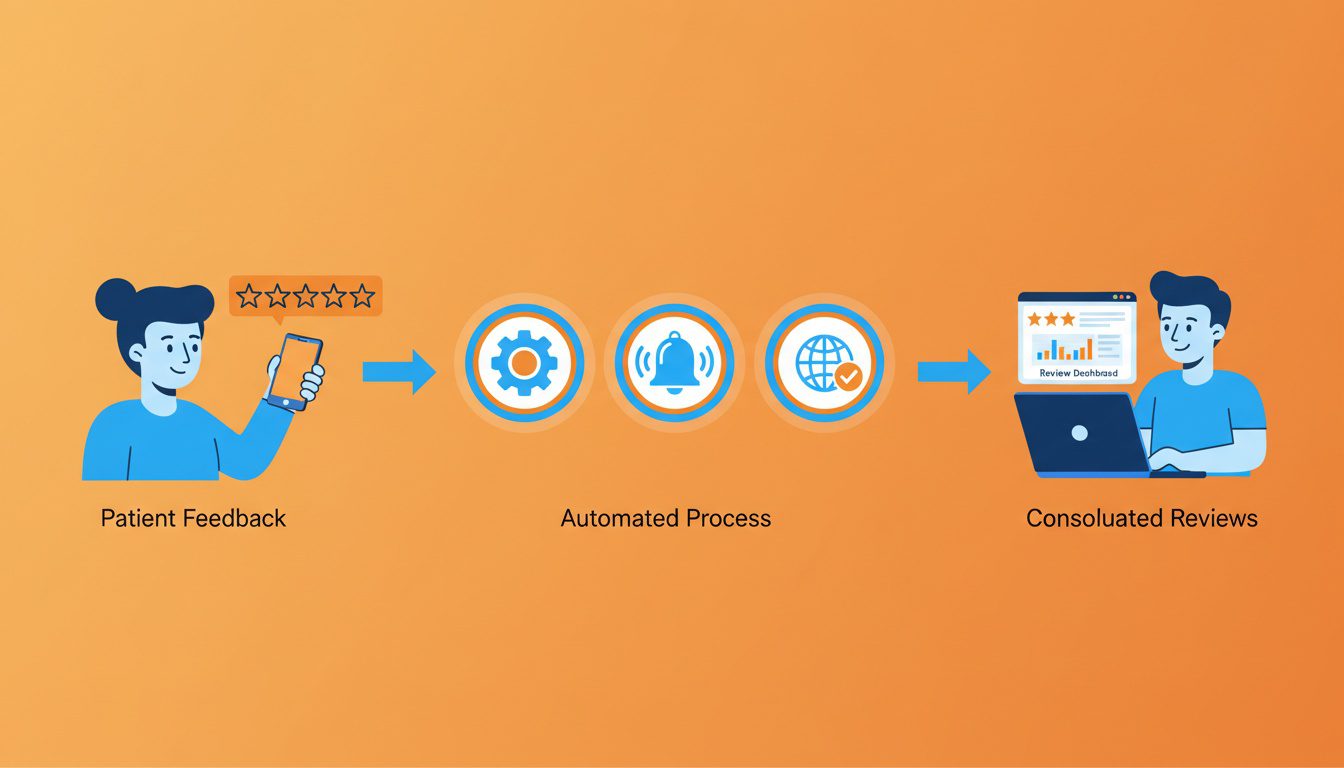
Review management software is the difference between manually begging patients for reviews every week and having a systematized approach that runs on autopilot.
These platforms do three things exceptionally well: automate review requests so you don't forget, centralize feedback from 50+ sites into one dashboard, and provide AI-powered response suggestions so you can reply in seconds. The best part? Most integrate directly with your existing practice management software.
Key Features That Actually Matter
Not all review management software is created equal, and a lot of platforms load up on features you'll never use just to justify higher pricing.
The platforms worth paying for include these core features:
- Automated review requests via text and email - System automatically sends personalized invitations within 24 hours of appointments, achieving 15-25% response rates compared to 2-5% for manual asking
- Multi-platform monitoring - Consolidates reviews from Google, Facebook, Yelp, Healthgrades into single dashboard so you never miss feedback
- Sentiment filtering - Directs happy patients (4-5 stars) to public review sites while capturing unhappy patients (1-3 stars) for private resolution
- Response templates and AI assistance - Pre-written responses you can customize in seconds, plus AI-generated replies that save time
- Analytics and reporting - Tracks review velocity, average ratings, response times, competitive benchmarks to measure ROI
- HIPAA-compliant communication - Ensures all automated messages meet healthcare privacy regulations
The platforms that excel at these features cost $100-400/month depending on practice size. Budget options exist around $75/month but typically sacrifice automation quality.
If you're looking to systemize more than just reviews, our chiropractic marketing automation guide covers how to automate your entire patient acquisition process.
How Automation Actually Works
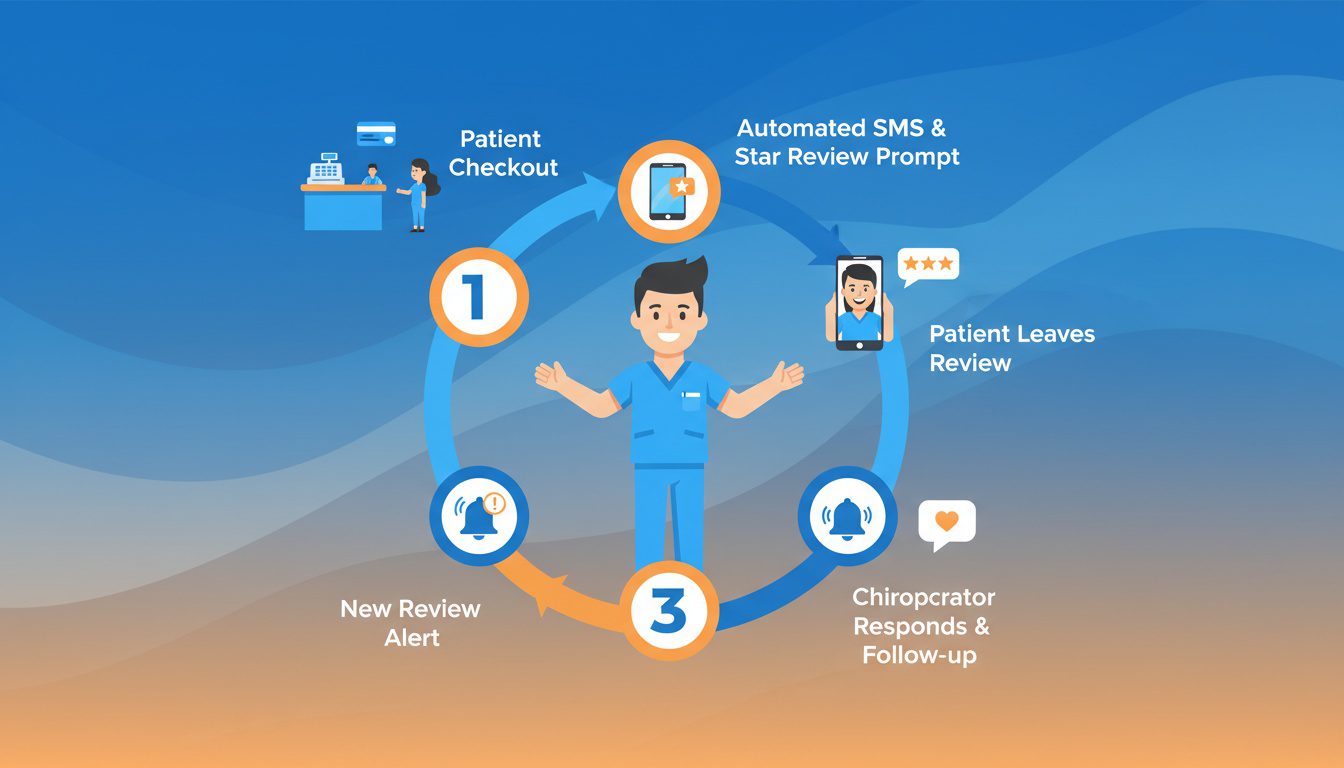
Here's the typical automated workflow that takes about 10 minutes to set up and then runs forever:
- Patient checks out - Your practice management system records the visit automatically
- 1-2 hours later - Review platform sends text message thanking them and asking for quick 1-5 star feedback
- If they rate 4-5 stars - System immediately sends second message with direct links to Google and Facebook
- If they rate 1-3 stars - System captures concerns privately and alerts you to follow up before they post publicly
The entire process happens without you lifting a finger. You simply log into your dashboard once daily to respond to new reviews and follow up with flagged patients.
Most practices see a 300-500% increase in review volume within the first 90 days of implementing automation. That's not magic—it's asking every single patient instead of remembering 10-20% of them.
Integration With Your Existing Systems
The real power comes from integration with tools you're already using.
If you're using ChiroTouch, Jane App, or similar practice management software, most review platforms can sync automatically:
- Patient contact information flows directly - No manual data entry or spreadsheet updates required
- Review requests trigger on appointment completion - Happens automatically based on checkout timestamps
- Visit history informs timing - System knows to wait until third or fourth visit for new patients
- No forgetting to send requests - Removes human error from the equation entirely
For practices without direct integrations, most platforms offer Zapier connections or manual CSV uploads. It's not quite as seamless but still beats tracking everything in spreadsheets.
The setup typically takes 30-60 minutes with support from the platform's onboarding team, and then it runs autonomously.

NEED MORE CLIENTS?
Free conversion-focused analysis uncovers the 3 biggest problems killing your bookings — we'll walk you through your results personally

Top Review Management Tools for Chiropractors

After testing dozens of platforms and consulting with hundreds of practices, these are the review management tools that consistently deliver results.
The right choice depends on your practice size, technical comfort level, and budget. Solo practitioners need different features than multi-location groups.
Best for Solo and Small Practices
For solo chiropractors and practices with 1-3 providers, these platforms offer the best balance:
- NiceJob ($75-174/month) - Budget-friendly option handling automated requests and basic monitoring. The "Grow" plan at $75/month works well for solo practitioners just starting. Interface is dead simple, which matters when you're already juggling everything.
- GatherUp ($99/month for one location) - Known for seamless automation and excellent customer support. Excels at SMS-based review requests, achieving 20-30% higher response rates than email-only systems. Best for practices wanting white-glove onboarding.
- Podium ($399/month minimum) - More expensive but includes webchat, text marketing, and payment collection beyond just reviews. Makes sense for practices doing $50k+/month revenue who can leverage additional features.
These platforms work well if you're seeing 50-150 patient visits per week and want to implement review management without overwhelming your staff.
Best for Multi-Location Practices
If you're operating multiple locations or managing 5+ providers, you need enterprise-level features:
- Birdeye ($299-399/month) - Comprehensive platform for multiple locations. Centralizes review management, social media monitoring, and appointment scheduling. Best for 3+ locations needing location-specific analytics and response workflows.
- RepuGen (custom pricing) - Healthcare-specific platform with advanced analytics, competitor benchmarking, and white-label options. Pricing starts around $300/month, scales with locations. Healthcare focus means better HIPAA compliance out of the box.
- ReviewTrackers (starts around $69/month) - Solid multi-location platform with sentiment analysis and competitive tracking. Pricing scales with locations, making it cost-effective for growing practices.
These platforms justify higher cost through time savings at scale. Managing responses for 5+ providers saves 10-15 hours weekly compared to manual management.
Best for Budget-Conscious Practices
Not ready to spend $100+/month? These options provide core functionality at lower price points:
- Shout About Us (estimated $50-100/month) - Cloud-based platform monitoring 75+ sites with response services. Entry-level plans work well for monitoring more than automation.
- Manual Google Forms + Zapier ($20/month for Zapier) - DIY approach using Google Form for feedback, Zapier to filter responses, manually send review requests to happy patients. Requires hands-on management but provides basic functionality.
The budget options work if you're generating fewer than 20 new patient visits weekly or bootstrapping during practice growth. Plan to upgrade once you're consistently seeing 40+ new patients monthly.
Here's how the main platforms compare:
| NiceJob | $75/month | Solo practices | Affordability + ease of use | Yes |
| GatherUp | $99/month | First-time users | Customer support | Yes |
| Podium | $399/month | High-revenue practices | All-in-one features | Yes |
| Birdeye | $299/month | Multi-location | Enterprise dashboards | Yes |
| RepuGen | Custom | Healthcare groups | Industry-specific tools | Yes |
Building Your Review Collection System
Software alone won't fix your review problem. Trust me—I've seen practices pay $400/month for platforms they never configured properly.
You need a complete system that combines automation with human touch points. The practices crushing it with reviews have built review collection into their patient experience as naturally as scheduling follow-ups.
Timing Your Review Requests
Strike while the iron is hot. The optimal window is within 24 hours of a positive appointment experience.
Wait longer than 48 hours and response rates drop by 60-70%. Here's why timing matters:
- 2-4 hours after checkout - Patient's home or back at work, positive experience remains top of mind
- Same-day for first visits - Never do this, they haven't experienced enough to provide meaningful feedback
- Third or fourth visit minimum - Wait until they've built rapport and achieved measurable progress
- Within 24-hour window - Patients 3-4 times more likely to leave reviews versus waiting a week
The patients most likely to leave detailed, helpful reviews are the ones who've seen real results over multiple visits. Those are worth 10x more than generic "nice place" reviews from first-timers.
Crafting Effective Review Request Messages
Your review request message makes or breaks response rates, and most chiropractors completely blow this.
Generic "please leave us a review" messages get ignored. Personal, specific requests that acknowledge individual experience generate 3-4 times more responses.
Effective messages follow this structure:
- Personal greeting with patient's name - "Hi Sarah" not "Dear Patient"
- Specific reference to recent visit or condition - "Thanks for coming in yesterday for your lower back treatment"
- Clear explanation why feedback matters - "It helps other people dealing with similar pain find our practice"
- Direct link to review platform - Takes them straight to review form, not Google search
- Optional time estimate - "Takes less than a minute"
Here's an example: "Hi Sarah, thanks for coming in yesterday for your lower back treatment. Your progress over the past three weeks has been amazing to watch. Would you mind sharing your experience on Google? It helps other people dealing with similar pain find our practice. [Direct link] Takes less than a minute. - Dr. Smith"
Compare that to: "Please leave us a review! [Link]"
The personalized version gets 400-500% higher response rates because it feels human, not automated. Most modern platforms let you insert patient name, condition type, and provider name dynamically.
If you're working on your overall chiropractic marketing plan, review collection should be one of your core pillars.
Implementing Sentiment Filtering
This is the secret weapon most chiropractors don't know exists: sentiment filtering prevents negative reviews from ever going public.
Here's how it works:
- Initial feedback request - Every patient rates experience 1-5 stars privately first
- 4-5 star ratings - System immediately sends links to Google, Facebook, other public sites with message encouraging public sharing
- 1-3 star ratings - System captures concerns privately, alerts you to follow up within 24 hours before they post publicly
- Private resolution - Gives you chance to fix issues before they damage public reputation
Most platforms call this "review gating." While Google technically discourages it, the practice remains standard across healthcare. The key is genuinely following up with unhappy patients—don't just suppress negative feedback without taking action.
Practices using sentiment filtering see 85-90% of public reviews at 4-5 stars while simultaneously improving patient retention by addressing concerns early.
Making It Stupid Easy for Patients
Friction kills review collection. Every extra click cuts your response rate by 20-30%.
The review process should be stupidly simple:
- Click link in text message - Opens directly to review page, not Google search
- Already logged in if possible - Direct review URLs bypass login requirements
- One click to select stars - Mobile-optimized interface that works on any device
- Type feedback, submit - Done in 60 seconds total
- No confusing instructions - Patient shouldn't need to figure anything out
For in-office review collection, QR codes work incredibly well. Create a sign at checkout: "Love your experience? Scan here to share it!"
Patients standing at checkout have nothing else to do for 30-60 seconds anyway. Some practices see 10-15% scan and review on the spot, which is pure bonus on top of automated follow-up.
Managing and Responding to Reviews

Collecting reviews is only half the battle, and honestly it's the easier half.
How you respond to feedback determines whether your online reputation becomes an asset or liability. Most chiropractors either ignore reviews completely or respond sporadically. Both approaches cost you patients and rankings.
Responding to Positive Reviews
Even 5-star reviews deserve responses, and this is where most practices drop the ball.
According to BrightLocal research, 88% of consumers are more likely to use a business that responds to all its reviews. That includes the good ones.
Keep positive responses short, personalized, and authentic:
- Thank patient by name - "Thanks for the kind words, Sarah" not "Thank you for your review"
- Mention something specific - Reference exact detail they shared in their review
- Invite continued care - "We're here whenever you need us"
- Keep it under 50 words - Don't write novels, patients won't read them
Here's what works: "Thanks for the kind words, Sarah! So glad we could help with your lower back pain. We're here whenever you need us. - Dr. Smith"
Avoid copy-paste responses that sound robotic. Google and patients both notice when every response is identical. Most platforms provide AI assistance that personalizes based on review content.
Response time matters. Reply within 24-48 hours. Newer responses appear higher in search results and signal you're actively monitoring feedback.
Handling Negative Reviews Without Losing Your Mind
Negative reviews trigger panic, but they're actually opportunities to demonstrate professionalism.
First rule: never respond when emotional. Take 2-4 hours to cool down. I've seen careers damaged by chiropractors who responded angry at 11 PM.
Second rule: always respond publicly first, then follow up privately. Your public response isn't for the unhappy patient—it's for the hundreds of potential patients reading how you handle criticism.
The proven framework:
- Thank them for feedback - Even if you disagree, thank them for taking time
- Apologize for their experience - "I apologize that your experience didn't meet our standards"
- Acknowledge specific concern - Reference what they mentioned without revealing HIPAA details
- Offer private discussion - "I'd like to understand what happened and find a resolution"
- Provide direct contact - "Please call our office at [phone] and ask for me personally"
Here's what it looks like: "Thank you for sharing your feedback, Sarah. I apologize that your experience didn't meet our standards. I'd like to discuss this further to understand what happened. Please call our office at [phone] and ask for me directly. - Dr. Smith"
Notice what's NOT there: excuses, arguments, blame shifting, or defensive explanations.
If you're working on your overall online presence, check out our guide on chiropractic reputation management for the complete playbook.
HIPAA Compliance in Review Responses
This is where chiropractors get into serious trouble: revealing protected health information in public responses.
Never acknowledge someone's specific condition, treatment plan, or confirm they were a patient unless they explicitly mentioned it first.
Safe language:
- "Thank you for your feedback"
- "I apologize for your experience"
- "I'd like to discuss this further"
- "Please contact our office directly"
Unsafe language:
- "I'm sorry your back pain treatment didn't progress as quickly as we hoped"
- "We tried multiple adjustment techniques with you"
- Anything referencing specific dates, conditions, or treatment details
The risk isn't just ethics—HIPAA violations carry fines of $100-50,000 per incident. One careless response could cost more than years of review software.
Setting Up Response Workflows
Responding shouldn't require monitoring ten different platforms daily. Centralize everything through your review software.
Here's what actually works:
- Configure immediate notifications - New reviews generate email or text alerts within minutes
- Create response templates - Positive reviews, negative about wait times, negative about billing, negative about outcomes
- Assign clear responsibility - Each doctor handles their reviews OR one staff member handles all OR hybrid approach
- Block 10-15 minutes daily - Morning with coffee or end of day, check dashboard and respond
- Track response time metrics - Aim for 100% response rate within 24-48 hours
Consistency matters more than perfection. Responding to 100% of reviews within 48 hours beats perfect responses to 60% of reviews.
Tracking Performance That Actually Matters
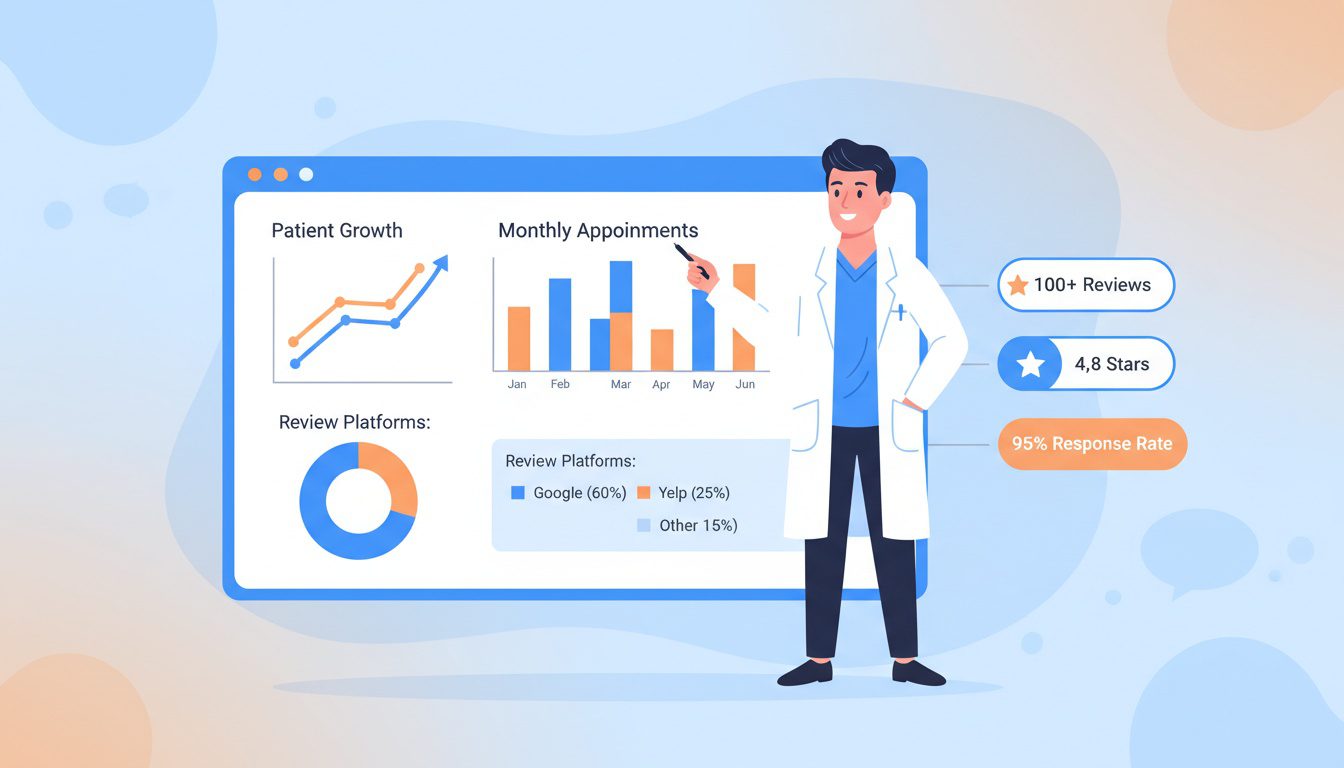
Numbers don't lie, and vague feelings about your reputation won't pay the bills.
Tracking review metrics reveals exactly what's working and where you're leaving money on the table. Most chiropractors check their Google rating occasionally and call it good. That's like checking your bank account once per quarter and hoping everything's fine.
Key Metrics That Predict Business Outcomes
Focus on these five metrics that actually move the needle:
- Review velocity (new reviews per month) - Target 5-10+ for solo practices, 15-25+ for multi-provider. Declining velocity signals system breakdowns or patient satisfaction issues.
- Average rating across platforms - Maintain 4.5+ stars on Google, 4.7+ on Facebook. Anything below 4.3 requires immediate attention and systematic improvement.
- Response rate (percentage you respond to) - Aim for 100% on Google and Facebook, 80%+ on secondary platforms. Lower rates signal you're missing feedback damaging reputation.
- Negative review percentage - Healthy practices see 5-10% negative reviews (1-3 stars). Spikes above 15% indicate systemic problems requiring operational fixes.
- Conversion rate from review sites - Track clicks from Google Business Profile to website (typical 15-25%) then website to booked appointments (typical 3-8%).
Most platforms provide these metrics in dashboard reports. Export data monthly to track trends and correlate review performance with new patient bookings.
If you're serious about tracking the full patient journey, our guide on chiropractic marketing analytics covers connecting reviews to actual revenue.
Competitive Benchmarking
Your competition is every practice ranking higher than you in local search results.
Identify your top 5-10 competitors based on Google Maps rankings. Track monthly:
- Review count - How many total reviews do they have?
- Average rating - What's their star rating across platforms?
- Review velocity - How many new reviews are they collecting monthly?
- Response rate - Are they responding to reviews consistently?
This competitive intelligence reveals market positioning. If competitors average 150 reviews and you have 45, you're invisible to patients comparison shopping.
Some platforms include competitive tracking automatically. If yours doesn't, manually check competitor profiles monthly. Takes 10 minutes, provides invaluable strategic direction.
Here's what platform distribution typically looks like:
| Google Business Profile | 80%+ check here first | Critical | 50-100 reviews |
| ~45% check here | High | 25-50 reviews | |
| Healthgrades | Healthcare-specific | Medium | 15-25 reviews |
| Yelp | ~30% check here | Medium | 10-20 reviews |
| Vitals | Healthcare-specific | Low | Monitor only |
Identifying Improvement Opportunities
Review content contains goldmines of actionable feedback most practices ignore.
Read every review—not just skim them. Look for patterns:
- Three patients mention long wait times - That's a scheduling problem, not bad luck
- Multiple reviews complain about billing confusion - That's a front desk training issue
- Patients consistently praise specific staff member - Make them your review request champion
- People rave about explanation style - Highlight this differentiator in marketing
Create a quarterly review audit categorizing feedback themes:
- Wait times
- Staff interactions
- Treatment results
- Billing/admin
- Facility cleanliness
- Other
Quantify how many reviews mention each category positively versus negatively. This data drives operational improvements that increase patient satisfaction, which drives more positive reviews, which drives more bookings.
ROI Calculation
Review management costs money—software fees, staff time, potentially outsourced responses. You need to know if it pays off.
Calculate ROI using this formula:
- Track new patient bookings - How many cite online reviews as discovery source?
- Multiply by lifetime value - Average $1,500-2,500 for most practices
- Subtract monthly costs - Software plus staff time at opportunity cost
- Compare before and after - What changed since implementing your system?
Most practices see 15-25% of new patients mention finding them through positive reviews. If you're booking 20 new patients monthly and five found you through reviews, that's $7,500-12,500 in monthly revenue attributed to review management.
If your software costs $200/month and you spend 5 hours monthly on responses at $75/hour opportunity cost, total investment is $575/month. At conservative $7,500 revenue estimate, that's a 1,200% ROI.
The practices seeing highest ROI share these characteristics: consistent review collection (10+ monthly), fast response times (within 24 hours), active resolution of negative feedback, and integration with existing patient communication.
Common Mistakes That Kill Review Collection
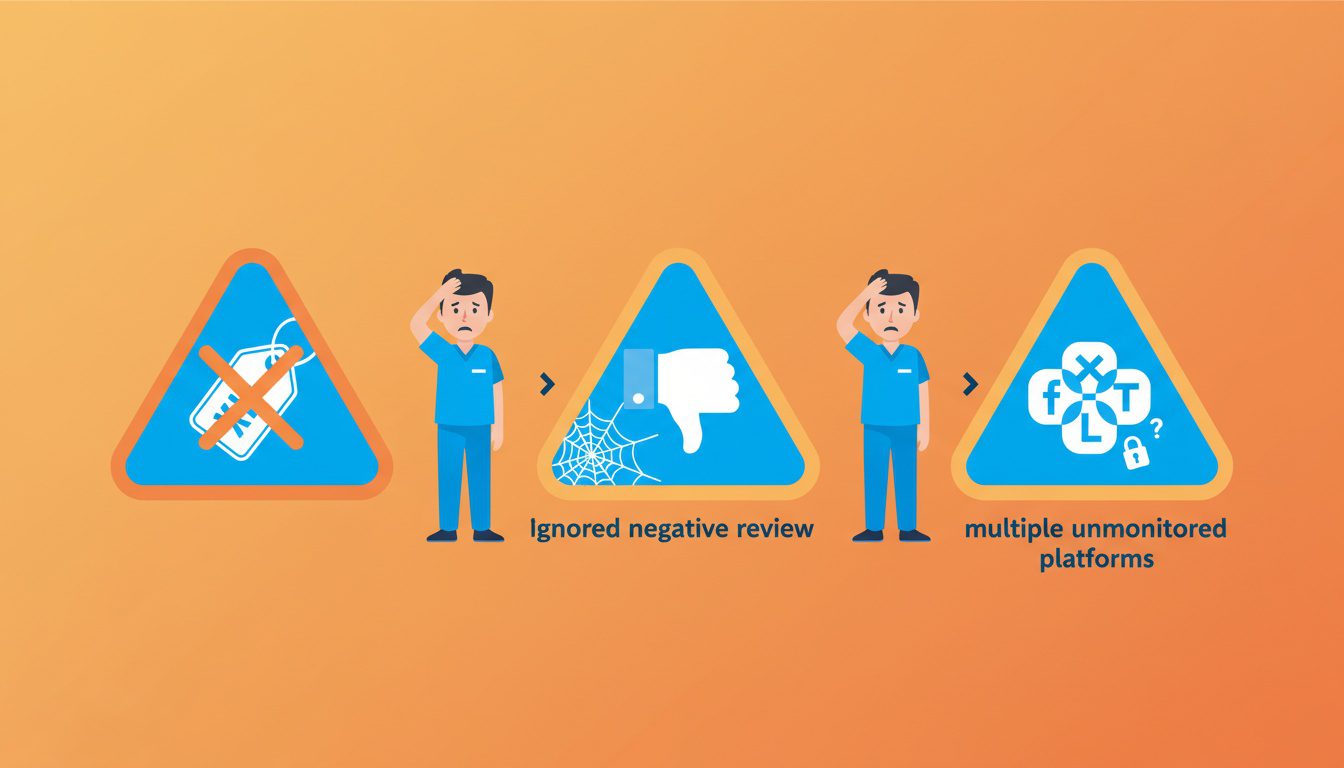
Even practices with good intentions sabotage their review management through preventable mistakes.
I've seen chiropractors lose Google Business Profiles, get sued by patients, and watch ratings tank—all from errors taking five seconds to avoid. Let's make sure you don't make these same costly mistakes.
Offering Incentives for Reviews
Stop right there. Don't offer gift cards, discounts, or contest entries in exchange for reviews.
It violates Google's policies and can get your entire review history wiped. Here's what happens:
- Google identifies the pattern - Their algorithms detect incentivized review language and timing
- All reviews get removed - Not just incentivized ones, sometimes your entire history
- Profile gets suspended - You lose visibility for weeks or months during review process
- Reviews look fake anyway - Patients can tell when feedback feels purchased versus earned
I've seen it happen, and it's devastating. Instead, focus on:
- Delivering exceptional experiences worth reviewing naturally
- Making review process frictionless through automation
- Implementing consistent asking without offering compensation
What you CAN do: Thank patients who leave reviews after they've posted, feature positive reviews on your website, acknowledge reviewers during next appointment. These show appreciation without creating quid pro quo violations.
Ignoring Negative Reviews
Negative reviews don't disappear when you ignore them. They compound like interest on credit card debt.
An unanswered negative review tells future patients three things:
- You don't care about patient concerns
- You're not monitoring your online presence
- You might not take accountability for problems
Every negative review you ignore costs 5-10 potential patients who read it and choose competitors instead. Over a year, one unaddressed negative review can cost $15,000-25,000 in lost revenue.
The fix takes two minutes: respond professionally to every negative review within 24-48 hours following the framework we covered. Even if you can't resolve the issue, showing you tried matters enormously.
Some chiropractors worry responding amplifies negative reviews. The opposite is true—88% of consumers are more likely to use a business that responds to all reviews, including negative ones.
Neglecting Secondary Review Platforms
Google dominates, but patients check multiple sites when researching healthcare providers.
According to research, 40% of consumers consult reviews on multiple platforms before deciding. If your Google reviews are stellar but your Yelp profile has three unanswered 1-star reviews from 2019, patients notice the inconsistency.
Monitor at minimum these platforms monthly:
- Google Business Profile - Check daily, critical for local search
- Facebook - Check 2-3 times weekly, second-most important
- Yelp - Check weekly, controversial but patients still use it
- Healthgrades - Check monthly, healthcare-specific credibility
If your practice is listed on additional sites like Vitals or RateMDs, check quarterly. Your review software should aggregate all platforms into one dashboard, making monitoring effortless.
Fake Reviews and Review Manipulation
Never, ever post fake reviews or ask friends/family to write reviews pretending to be patients.
Not only is it unethical, it's also illegal in many jurisdictions and violates platform terms of service. Here's the risk:
- Sophisticated detection algorithms - Platforms analyze account behavior, IP addresses, patterns, content
- Lose all reviews - Not just fake ones, your entire review history
- Business profile suspended - Potential permanent ban from the platform
- Legal consequences - Some states prosecute fake review schemes
Competitors sometimes post fake negative reviews hoping to damage your practice. If you suspect a review is fake because the person was never a patient, flag it for platform review.
But be careful—only flag reviews that are genuinely fraudulent, not just negative feedback you disagree with. Most platforms won't remove negative reviews simply because you dispute the facts.
Frequently Asked Questions About Chiropractic Review Management
How much does review management software cost for chiropractors?
Review management software typically costs $75-400 per month depending on features and practice size.
Solo practitioners can start with tools like NiceJob at $75/month, while multi-location practices might need platforms like Birdeye starting at $299/month. Most platforms offer 14-day free trials to test functionality before committing.
Factor in additional costs:
- Onboarding (usually free with most platforms)
- Staff time to learn system (2-4 hours initially)
- Ongoing management (10-15 minutes daily)
The ROI typically justifies investment within the first month. If software helps you collect 10 additional positive reviews that influence 2-3 new patient bookings, you've already covered the monthly fee through increased revenue.
What's the fastest way to get more patient reviews?
Automated review request systems are the fastest way to consistently collect patient reviews.
These platforms send text or email requests within 24 hours of each appointment, directing satisfied patients to review sites like Google and Facebook. Practices using automated systems typically see 300-500% more reviews within 3-6 months compared to manual asking.
Key factors driving success:
- Timing requests within 24 hours of visits
- Using text messages over email (20-30% higher response rates)
- Implementing sentiment filtering to direct happy patients to public platforms
- Maintaining consistency by automatically requesting from every patient
If you're starting from zero reviews, prioritize Google Business Profile exclusively for the first month. Once you reach 20-30 Google reviews, expand to Facebook and other platforms.
Our guide on getting more chiropractic patient reviews has the complete step-by-step process.
How should chiropractors respond to negative reviews?
Respond to negative reviews within 24-48 hours with a professional, empathetic tone.
The proven framework:
- Thank patient for feedback
- Apologize for their experience
- Offer to discuss privately via phone or email
- Never argue publicly
- Never share protected health information
- Always maintain HIPAA compliance
A proven template: "Thank you for sharing your feedback, Sarah. I apologize that your experience didn't meet our standards. I'd like to discuss this further to understand what happened. Please call our office at [phone] and ask for me directly. - Dr. Smith"
Follow up privately after posting your public response. Even if you can't make the patient happy, documenting your good-faith efforts protects your practice if disputes escalate.
Which review platforms matter most for chiropractors? [H3]
Google Business Profile is the most important platform, with over 80% of patients checking Google reviews as their first step.
Facebook is second at approximately 45%, followed by Yelp and healthcare-specific sites like Healthgrades and Vitals. Focus your review collection efforts on Google and Facebook for maximum impact on local search visibility.
These two platforms drive majority of patient acquisition and rank highest in search results. Once you maintain 50+ reviews on Google and 25+ on Facebook, expand to Yelp and Healthgrades.
Don't spread efforts thin trying to build presence on ten platforms simultaneously—concentrate on the big two first.
How many reviews does a chiropractic practice need?
Most patients won't consider practices with fewer than 50 reviews total.
According to research, 28% of consumers won't even consider using a business with under 50 reviews. Aim for 100+ reviews across all platforms to appear credible and established.
However, review velocity matters more than total count:
- Consistent 5-10 new reviews monthly - Signals active, thriving practice
- Practice with 80 reviews + 10 in past month - Looks more attractive than 200 reviews with none in six months
- Recency signals relevance - Google and patients both value fresh feedback
Set progressive goals: reach 25 reviews in first three months, 50 reviews by month six, 100+ within first year of systematic collection.
Can chiropractors offer incentives for reviews?
No, offering gifts, discounts, or payments in exchange for reviews violates Google's policies and appears inauthentic to patients.
Incentivized reviews can result in having your entire review history removed by Google, destroying years of reputation building overnight. I've seen it happen multiple times.
Instead, focus on:
- Delivering exceptional care worth reviewing naturally
- Making review process simple through automated requests
- Providing direct links to review platforms
What you CAN do: thank patients who leave reviews after they've posted, feature positive reviews on your website, acknowledge reviewers during next appointment. These show appreciation without creating quid pro quo violations.
What's the best time to ask patients for reviews?
The optimal time is within 24 hours of a successful appointment while the positive experience is fresh.
Research shows patients who receive requests within this window are 3-4 times more likely to leave reviews than those asked a week later. Automated systems can send requests immediately after checkout via text or email.
Best practices:
- Configure software to deliver requests 2-4 hours post-appointment
- Gives patients time to leave office and settle into their day
- Positive experience remains top of mind
- Avoid late night (after 8 PM) or early morning (before 8 AM) requests
Avoid asking first-time patients for reviews—they haven't experienced enough appointments to provide meaningful feedback. Wait until their third or fourth visit when they've achieved measurable progress and built rapport with your practice.
Putting It All Together
Managing online reviews isn't a one-time project you check off and forget about.
It's an ongoing system that compounds over time. The practices dominating local search results didn't get there by implementing a review strategy for three months and stopping.
They built review collection into their patient experience permanently.
Here's the thing...
Your review management system should become as automatic as scheduling follow-ups or processing insurance claims. When it's integrated into daily operations rather than treated as an extra marketing task, it runs sustainably long-term.
Start with the basics:
- Choose your review management software
- Set up automated requests
- Configure notifications
- Commit to responding to every review within 48 hours
These fundamentals will generate 80% of your results. You can optimize from there as you learn what works for your specific practice.
The practices seeing the best results share one characteristic: they view review management as patient relationship management, not just online reputation maintenance. When you approach reviews as an opportunity to strengthen connections with patients rather than a chore to check off, authenticity comes through and patients respond.
Look, I get it—managing reviews feels like one more thing on your already overwhelming plate.
If you're thinking "this all makes sense, but I don't have time to implement and monitor a review system on top of everything else," you're not alone. Most successful chiropractors we work with felt the same way before they realized their online reputation was quietly costing them 15-20 qualified patient leads every single month.
That's why we created our Free Website Conversion Analysis. It's not a sales pitch—it's a genuine walkthrough of the 3 biggest problems killing your bookings, delivered personally via Loom video within 24 hours.
We'll show you exactly:
- Why visitors leave without booking
- What's broken on mobile devices (where most searches happen)
- Missing trust signals costing you patients
- Where you rank vs. local competitors
- Simple fixes that drive more calls this month
You'll also get an instant case study while you wait, showing real examples of how other chiropractors fixed these exact problems.
Get your free analysis here — no credit card, no obligation, just actionable insights you can use whether you work with us or not.
Because every day your review management system sits on your "someday" list is another day patients are choosing your competitors instead.

Gerek Allen
Co-Owner iTech Valet
Entrepreneur, patriot, CrossFit junkie, IPA enthusiast, loves to travel to tropical destinations, and knows way too many movie quotes.


About iTech Valet
iTech Valet specializes in web design and content marketing for online entrepreneurs who want to share their expertise.
Services Include:
- Web Design
- Graphic Design
- Sales Copy
- Funnel Building
- Authority Sites
- Membership Sites
- Course Creation
- Email Systems
- Content Marketing
- Competitive Analysis
- Tech Integrations
- Strategic Planning
NEED MORE CLIENTS?
Free conversion-focused analysis uncovers the 3 biggest problems killing your bookings — we'll walk you through your results personally

621 Enterprises, Inc. | Copyright 2022 | All rights reserved