Why Marketing Spikes Fail in the AI Authority Economy
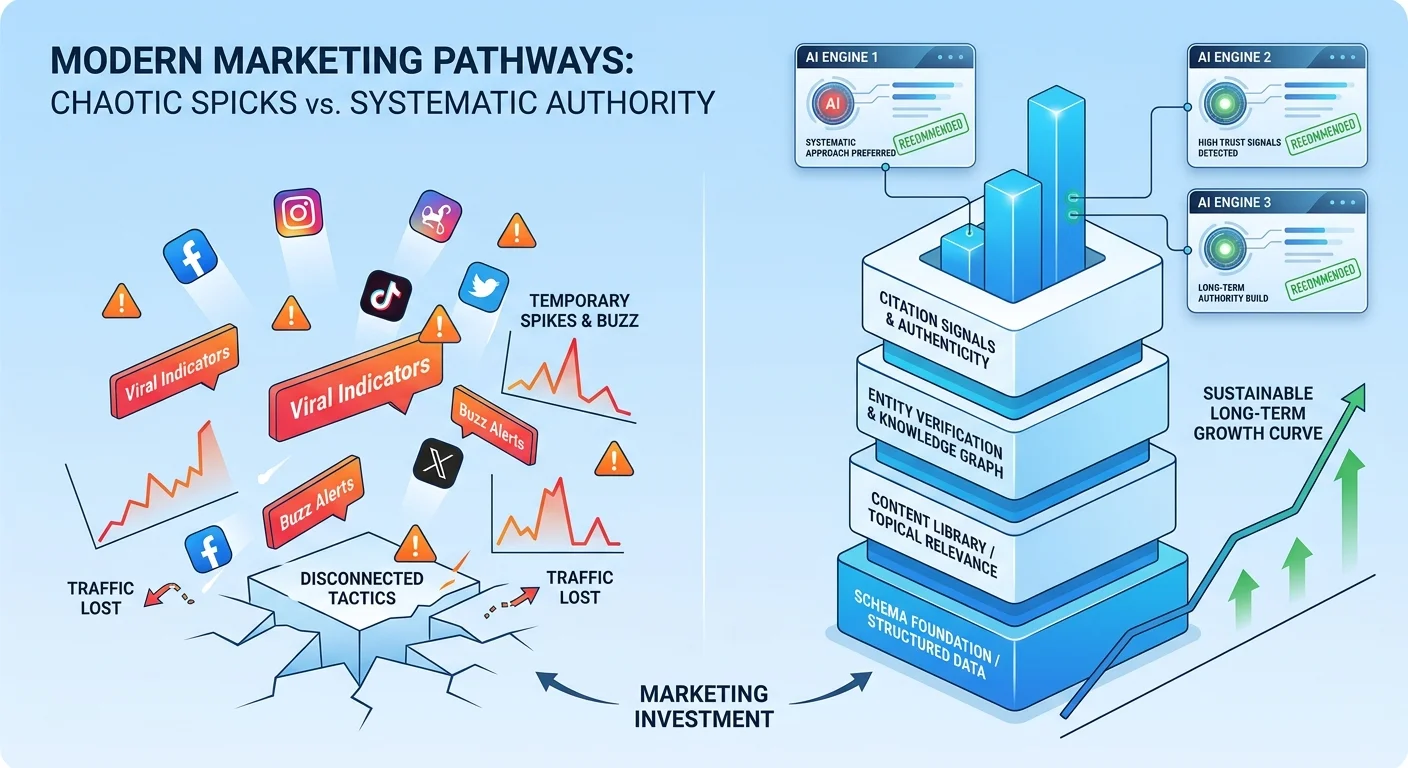
The marketing industry trained you to chase loud.
Viral moments. PR wins. Paid campaigns that flood your phone for three weeks and then go quiet.
The playbook was always the same: make noise, grab attention fast, convert while the window’s open, and repeat next month.
That worked when humans filtered everything.
When patients found you through Google results they clicked through. When Facebook ads drove traffic you could retarget. When word-of-mouth was the trust mechanism.
It doesn’t work now.
AI Engines Don’t Measure Popularity – They Measure Trust
Here’s what changed.
AI answer engines don’t care if your video went viral last Tuesday. They’re not tracking impressions. They’re not measuring social engagement or counting shares.
They’re measuring entity trust.
And entity trust is built on structural signals – not emotional ones.
It’s machine-readable proof that your business is real, consistent, credible, and deep.
Real means verified across multiple authoritative platforms. Consistent means publishing regularly with information AI can fact-check. Credible means backed by citations, credentials, and third-party validation. Deep means demonstrating actual expertise through comprehensive, well-structured content.
A spike is loud. But it’s thin.
Your viral post might hit 10,000 views. But if your website is structurally invisible to AI, your entity profile is incomplete, and your content library is basically empty – AI sees a temporary noise event attached to a structurally weak business.
The spike fades.
The structural weakness stays.
And the next time someone asks AI who to trust in your market – you’re not even part of the conversation.
The Hidden Cost of Spike-Chasing
Nobody tells you this part.
Marketing spikes aren’t just expensive in dollars. They’re expensive in opportunity cost.
Every dollar you spend chasing a viral moment is a dollar not invested in the authority infrastructure AI actually trusts. Every month you run paid campaigns that disappear the second you stop paying is a month your competitor spent building content depth that compounds.
The gap widens while you’re not looking.
You’re spending $3,000 a month on Facebook ads that generate clicks but zero structural trust. The practice down the street is spending that same budget building an entity profile, publishing AEO content, and stacking the exact signals AI uses to determine who gets recommended.
Research from Deloitte Insights confirms what you’d expect: brands with a long-term, purpose-driven approach build deeper customer trust and loyalty.
The same dynamic applies to AI trust.
Consistency beats intensity. Every single time.
Why “One Big Win” Doesn’t Build Durable Authority
A big PR hit feels like real progress.
A feature in the local magazine. A viral TikTok. A speaking engagement that gets shared on LinkedIn.
And for a moment, it is progress. Traffic spikes. The phone rings. Bookings come in.
Then it stops.
Because that visibility wasn’t built on structural trust. It was built on attention. And attention is temporary.
AI doesn’t trust temporary.
Academic research in the Journal of Business Research confirms that trust is built through consistent, reliable interactions over time – not single events.
A one-time magazine feature doesn’t tell AI you’re credible. It tells AI that someone wrote about you once.
Without the underlying entity infrastructure to validate that mention – the signal decays.
The article gets indexed. The mention gets logged. But without ongoing content execution, entity verification, and schema reinforcement – AI doesn’t compound that signal into trust. It files it away as a historical event.
And when someone asks AI who to trust today – your big PR win from six months ago doesn’t register.
| Marketing Approach | Visibility Duration | Entity Trust Impact | AI Recommendation Likelihood |
|---|---|---|---|
| Viral Social Post | 48-72 hours of attention spike | Zero structural signals – AI cannot verify or cite | None – AI does not index fleeting social content as authority |
| One-Time PR Hit | News cycle attention (days to weeks) | Temporary brand mention without verifiable entity depth | Low – single citation without supporting infrastructure |
| Paid Ad Campaign | Active only while budget is live | Zero – ads build awareness, not machine-readable trust | None – AI does not treat paid placements as authority signals |
| Authority System | Compounds indefinitely | Layered entity signals strengthen with each execution cycle | High and increasing – AI trusts consistent, verifiable patterns |
How Authority Actually Compounds
Authority isn’t built in a single transaction.
It’s built through systematic accumulation of trust signals that reinforce each other over time.
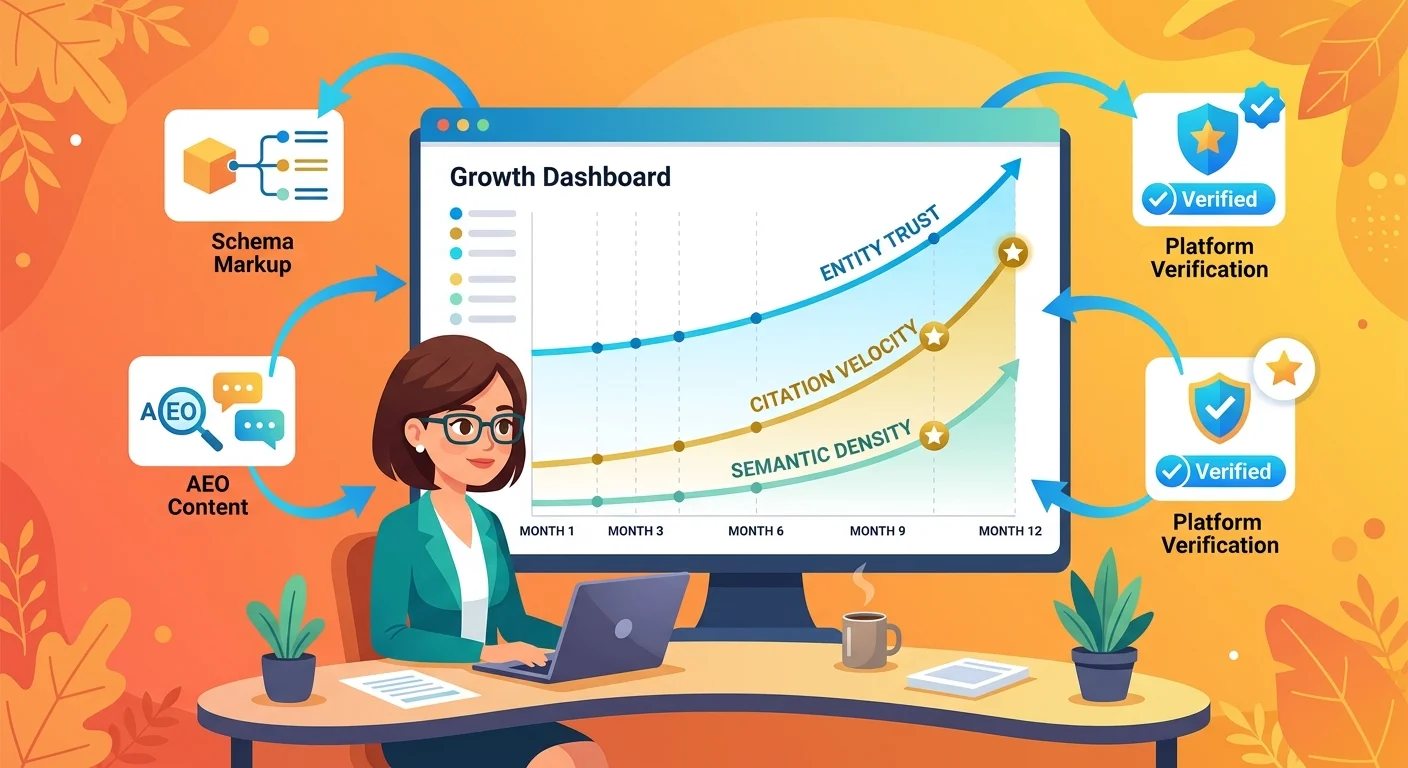
Think of it like compound interest. The first deposit into a savings account doesn’t look impressive. The second deposit looks the same. But by year three – the growth curve starts to bend upward. By year five, the compounding effect becomes undeniable.
Authority works exactly the same way.
The Compounding Mechanism: How AI Builds Trust Over Time
When AI evaluates your business, it’s not looking at a single data point.
It’s analyzing the pattern of signals across your entire digital presence.
Here’s what compounds:
Content depth – every AEO article you publish adds to the body of expertise AI can cite. Entity verification – every platform where your business name, address, and credentials match reinforces your legitimacy. Citation velocity – the rate at which authoritative sources reference your content or business. Semantic density – the consistency and comprehensiveness of topic coverage in your field. Recency signals – how frequently you update, publish, and maintain your authority infrastructure.
Each of these signals is weak in isolation.
But when they’re deployed systematically – month after month – AI starts to recognize a pattern.
This business shows up consistently. Their information is verifiable. Their expertise is deep. Their content is current.
That’s when the compounding kicks in.
The 12th article you publish doesn’t just add one more data point. It reinforces the 11 articles before it. It deepens the semantic network. It validates the expertise you’ve been demonstrating for months.
AI doesn’t reward isolated brilliance.
It rewards sustained, verifiable competence.
The Flywheel Effect: Authority Builds Momentum
HubSpot’s flywheel model demonstrates how momentum builds over time through systematic, compounding effort – contrasting sharply with the “leaky funnel” of traditional marketing spikes.
In the flywheel framework, every input feeds the next cycle.
Customer trust leads to referrals. Referrals lead to more content opportunities. More content leads to deeper AI trust. Deeper AI trust leads to more recommendations.
The wheel spins faster the longer it runs.
Authority compounding works the same way.
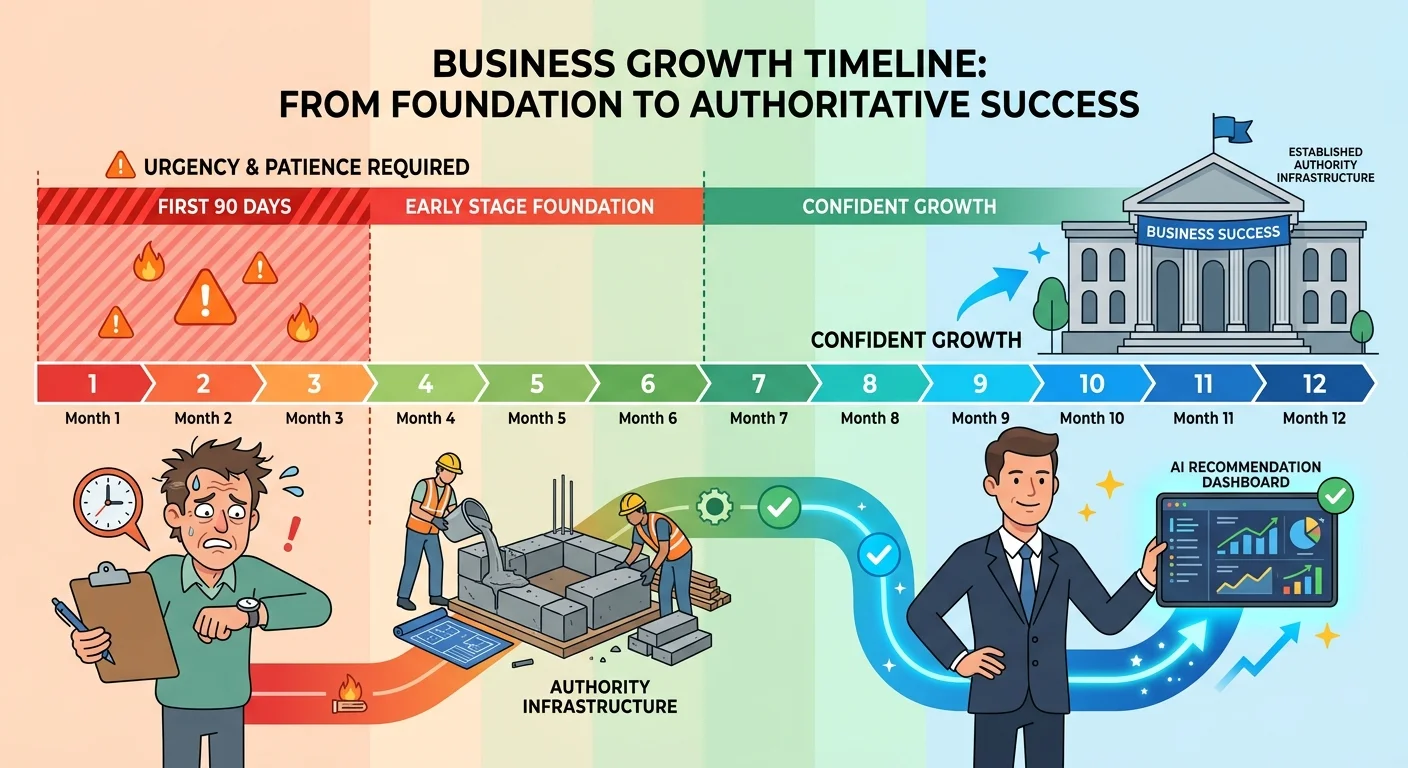
Month 1-3: Foundation build – schema, entity verification, site architecture. Month 4-6: Content execution begins – AEO articles publish, citations start accumulating. Month 7-9: Semantic density deepens – topic clusters connect, AI begins recognizing expertise patterns. Month 10-12: Momentum accelerates – citation velocity increases, AI trust compounds, recommendations surface.
The first three months look like progress on paper but feel slow in practice.
The middle three months start showing measurable entity trust improvements.
The final six months – that’s when the compounding becomes undeniable.
But only if you keep the wheel spinning.
Stop publishing content? The wheel slows. Let your schema decay? The wheel drags. Chase a marketing spike and abandon the system? The wheel stops – and you start over from zero.
Why Consistent Execution Beats Occasional Excellence
You don’t need to publish the perfect article.
You need to publish consistently verifiable content that reinforces the expertise AI already associates with your entity.
HubSpot’s 2024 State of Content Marketing report confirms that consistent content creation remains one of the most effective long-term marketing strategies – not because it generates viral moments, but because it compounds trust.
AI doesn’t care if one article is brilliant and the rest are mediocre.
It cares that every article meets a baseline standard of accuracy, depth, and entity alignment.
The practice that publishes 12 solid AEO articles per year will always outrank the practice that publishes one “perfect” article and then goes silent for 11 months.
Because authority isn’t about peaks.
It’s about the baseline.
| Timeline | Authority Activity | AI Trust Signals | Visible Outcome |
|---|---|---|---|
| Month 1-3 | Infrastructure rebuild – schema implementation, entity verification, foundational content | Entity recognition established, semantic density begins building | AI starts recognizing the business as a legitimate entity in the market |
| Month 4-6 | Consistent AEO content execution (12 articles/month), internal linking maturation | Citation velocity increases, topical authority signals strengthen | AI begins including the business in broader answer sets – not yet the top recommendation |
| Month 7-9 | Authority depth compounds – content library reaches critical mass, entity trust deepens | Semantic connections between entity and topic become undeniable | AI starts citing the business as a trusted source in specific query contexts |
| Month 10-12 | Full authority infrastructure mature – compounding accelerates | Entity trust signals reach threshold where AI defaults to this business over competitors | AI recommends the business as the primary answer in its market – the compounding effect becomes self-evident |
The System vs. Spike Framework: Redefining Marketing Investment
Here’s the shift that changes everything.
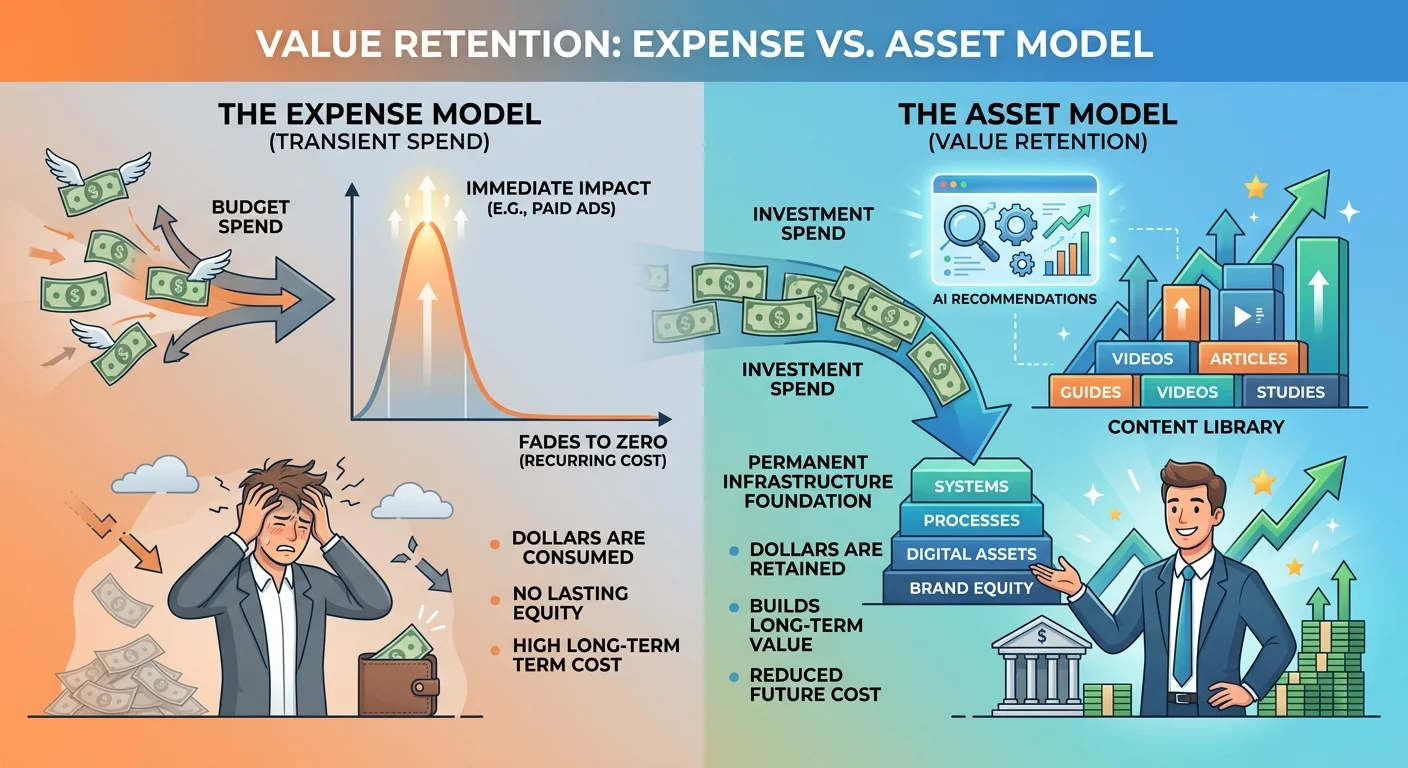
Stop thinking of marketing as an expense line and start thinking of it as asset allocation.
A spike is an expense. You pay for it. You get temporary visibility. It disappears. Next month, you pay again.
A system is an investment in an asset. You build infrastructure. You execute content. The asset compounds. Next month, it’s worth more than it was before.
This isn’t a metaphor.
This is how AI actually evaluates your business.
Spikes Are Expenses – Systems Are Assets
Let’s break this down financially.
A $3,000/month Facebook ad budget generates clicks. Maybe bookings. But the moment you stop paying – the visibility stops. Every dollar spent is consumed. There’s no residual value.
That’s an expense.
A $15,000 AI Authority Engine build + $1,200/month AEO content execution generates entity trust. Schema architecture. Citation velocity. Content depth.
And every month of execution adds to the asset.
Stop executing after 12 months? The infrastructure is still there. The content library is still there. The entity trust you’ve built doesn’t vanish.
The asset retains value.
That’s the difference between renting visibility and owning authority.
AI Is an Unemotional Asset Manager
AI doesn’t care about your brand story.
It doesn’t care if you’re a nice person or if your practice has great energy.
AI is a machine evaluating asset quality.
When someone asks ChatGPT or Gemini who to trust, the engine is essentially asking: “Which business in this market has the strongest authority portfolio?”
It’s not looking for the loudest voice.
It’s looking for the most structurally sound investment.
Your authority infrastructure is your balance sheet. Your content execution is your recurring contribution. Your entity trust is your net worth.
AI recommends the business with the highest net worth in the category.
And just like financial portfolios – the businesses that compound early and compound consistently will always outperform the ones chasing high-risk, high-reward bets.
The Real ROI of an Authority System
The industry trained you to measure ROI in 90-day windows.
Clicks per dollar. Conversions per campaign. Immediate results.
That framework doesn’t apply here.
The ROI of an authority system is measured over years – not quarters.
Because the goal isn’t a temporary spike in bookings. The goal is to become the undeniable answer AI recommends in your market – and to hold that position for the next decade.
That ROI looks like this:
Year 1: Foundation built, entity trust established, AI begins citing your content. Year 2: Semantic density deepens, citation velocity accelerates, recommendations surface consistently. Year 3: Competitors are playing catch-up while you’re compounding on an 18-month head start. Year 5: Your authority infrastructure is so deep that new competitors can’t close the gap without years of execution.
That’s not a 90-day ROI.
That’s a legacy asset.
Case Studies show exactly what this looks like in practice – practices that started building early and now own the AI answer in their markets.
| Marketing Type | Upfront Cost | Residual Value | AI Trust Impact | Durability |
|---|---|---|---|---|
| Monthly Retainer (Tactics) | $500-$2,000/month ongoing | Disappears when payments stop – no asset created | Minimal – optimizes for algorithm that AI is replacing | Zero – results vanish immediately upon cancellation |
| One-Time PR Push | $5,000-$15,000 event cost | Temporary attention with no structural foundation | Temporary spike without supporting entity signals | Days to weeks – forgotten once news cycle moves on |
| Viral Campaign Attempt | $3,000-$10,000 creative production | Lottery ticket – 99% chance of zero return | None – AI does not index social virality as authority | Non-existent – fleeting attention with no compounding mechanism |
| Authority System | $15,000 infrastructure + $1,200/month execution | Permanent asset – infrastructure and content compound indefinitely | Deep and increasing – every month strengthens entity trust | Permanent – infrastructure remains, content library grows, authority signals compound even after active execution pauses |
This Is Not for the 90-Day Miracle Seeker
Let’s pause here.
If you’re reading this article hoping to find a shortcut – a way to build authority in 60 days and flood your schedule by Q2 – this isn’t your strategy.
Authority compounding is a long-term asset play.
It’s for the practice owner who understands that the businesses dominating AI recommendations two years from now are the ones building the infrastructure today.
If that timeline doesn’t fit your decision framework – no judgment.
But you need to know what you’re walking into.
The Microwave Timeline Problem
The marketing industry conditioned businesses to expect fast results.
Run an ad campaign, see bookings within a week. Post on social media, watch engagement spike overnight.
That feedback loop trained a generation of business owners to think in 30-day windows.
And when they invest $15,000 in an authority system and don’t see a flood of patients by month two – they panic. They assume it’s not working. They bail.
Here’s the truth: authority doesn’t run on a microwave schedule.
The first three months of execution are foundational. You’re building the infrastructure AI needs to even recognize you exist. Schema goes live. Entity profiles get verified. Content execution begins.
AI sees it.
But AI doesn’t trust it yet.
Because trust requires time + consistency + depth.
Months 4-6 are when the signals start reinforcing each other. Citations begin accumulating. Semantic density deepens. AI starts associating your entity with expertise in your field.
But you still won’t see a flood of bookings.
Months 7-12 are when the compounding becomes measurable. Citation velocity accelerates. AI recommendations surface more frequently. The infrastructure you built six months ago is now generating results you didn’t have to pay for this month.
That’s the curve.
And if you’re not willing to ride it out – you’ll quit right before it bends upward.
Why Impatience Kills Authority
The practices that fail at authority building don’t fail because the system doesn’t work.
They fail because they stop executing before the compounding kicks in.
They build the foundation. They publish six months of content. They see modest improvements. And then they decide it’s “not working fast enough” and shift to a cheaper, faster alternative.
And the moment they stop – the compounding stops.
All that infrastructure? Still there. But without ongoing content execution, it decays. Citations stop accumulating. Semantic density stalls. AI moves on to the competitor who kept publishing.
Authority doesn’t forgive abandonment.
This is why the 90-Day Miracle Seeker is an anti-persona. Not because they’re bad people. But because their timeline expectations are fundamentally incompatible with how authority actually builds.
If you need patients next month – run ads. Hire a lead generation firm. Pay for temporary visibility.
But if you want to own the answer AI gives when someone in your market asks who to trust – you need to think in years, not quarters.
What an Authority System Actually Looks Like
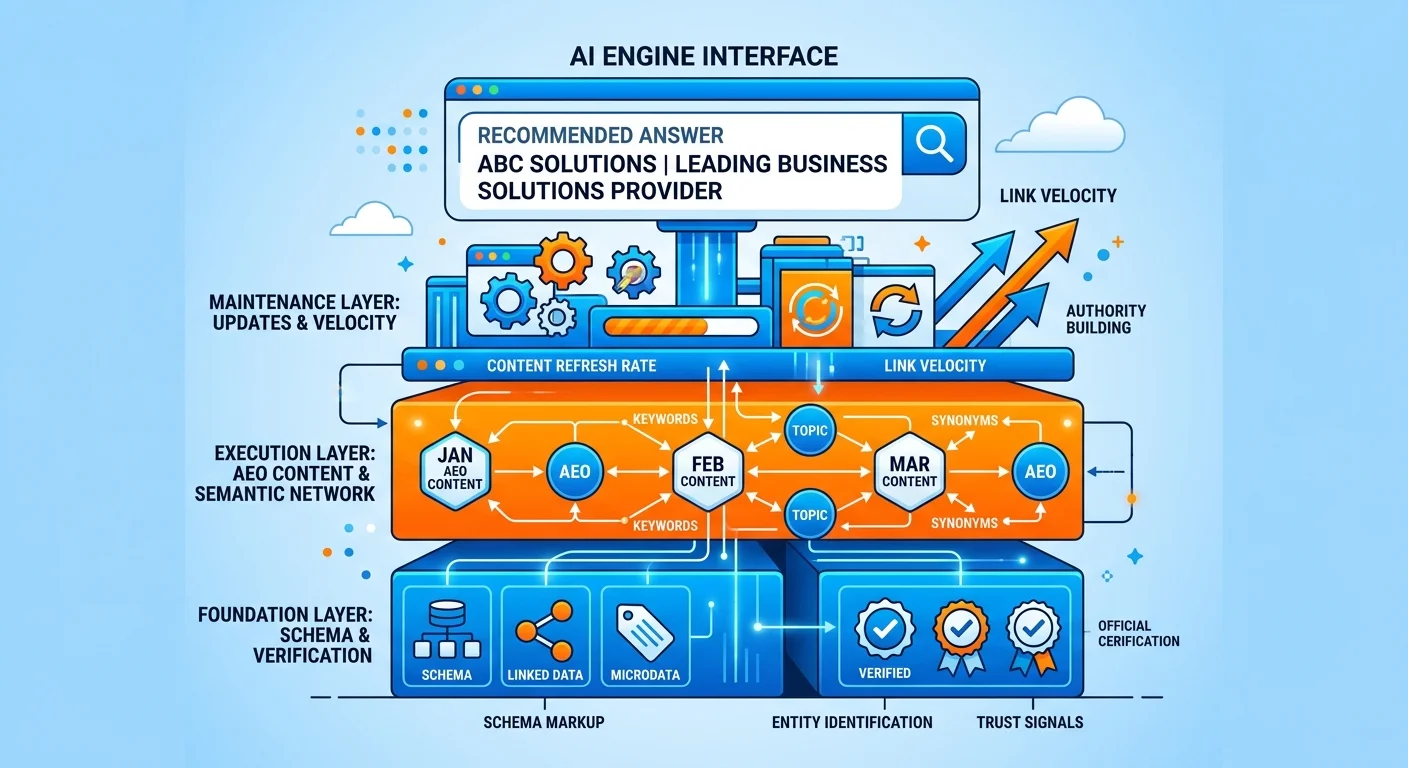
So what does a real authority system involve?
Not in theory. In practice.
Here’s the structure.
Foundation: The Infrastructure Layer
Before you publish a single piece of content, the machine-readable foundation has to be in place.
That means schema markup deployed across every critical page – telling AI exactly what your business is, what you do, and where you operate. Entity verification across authoritative platforms – Google Business Profile, healthcare directories, professional listings – all with consistent NAP data. Site architecture optimized for AI readability – clean URL structure, logical hierarchy, internal linking that guides AI through your expertise.
Without this foundation, content execution is building on sand.
AI can’t trust content if it can’t verify the entity publishing it.
This is the difference between a $500/month SEO retainer and a $15,000 AI Authority Engine. The retainer optimizes for an algorithm that’s being replaced. The Authority Engine builds the infrastructure AI actually uses.
Execution: The Monthly Content Layer
Once the foundation is live, the compounding begins.
That means publishing AEO content every month – not blog posts, not SEO articles, but content specifically engineered to answer the questions AI pulls into recommendations.
The standard execution model: 12 AEO articles per year (one per month) for local practices. 30+ articles per year for national brands. Every article sourced, verified, and optimized for entity trust. Every article reinforcing the semantic network AI uses to determine expertise.
This isn’t “content marketing” in the commodity sense.
This is authority proof execution.
Each article adds to the portfolio. Each article deepens the entity trust. Each article compounds the signals AI uses to decide who gets recommended.
And unlike a paid ad campaign that disappears the moment you stop paying – these articles are permanent assets. They sit in your content library. They get cited by AI. They reinforce your authority six months, 12 months, 24 months after they’re published.
That’s compounding.
Maintenance: The Ongoing Verification Layer
Here’s where most practices fail: they think authority is a one-time build.
It’s not.
Authority decays without ongoing execution. Citations go stale. Competitors publish more content. AI’s trust signals shift.
The practices that maintain their authority position do three things consistently: update existing content to keep recency signals fresh, verify entity data across all platforms to prevent citation drift, and publish new content to sustain citation velocity and semantic depth.
As outlined in our Maintenance Protocol, authority isn’t a project you complete.
It’s an asset you maintain.
Stop maintaining it? The asset depreciates.
And the competitor who kept executing takes the spot you abandoned.
FAQ: Authority Compounding vs. Marketing Spikes
How long does it take for authority compounding to show results?
While foundational signals can strengthen in 3-4 months, true authority compounding is a long-term asset. The goal is not a 90-day spike but to build an undeniable presence that AI trusts more and more each month.
Most practices see measurable entity trust improvements by month 6. AI recommendations start surfacing more consistently by month 9-12.
But the real compounding – the point where your authority is so deep that competitors can’t close the gap – that takes 18-24 months of consistent execution.
If that timeline doesn’t align with your expectations, this strategy isn’t your fit.
Can’t a big PR hit or viral video build authority quickly?
A viral event can generate a temporary spike in attention, but it doesn’t build the underlying structural trust AI needs. AI looks for sustained signals, not a single loud noise.
A viral video might get 100,000 views.
But if your entity profile is incomplete, your schema is broken, and your content library is shallow – AI sees a popularity event, not an authority signal.
The views fade. The structural weakness remains.
And the next time someone asks AI who to trust – you’re still not the answer.
What’s the difference between an authority “system” and a regular “content plan”?
A content plan is just a schedule for publishing articles. An authority system integrates content with technical infrastructure, schema, and entity-building to ensure AI can read, understand, and trust the information.
Most marketing agencies sell content plans. They’ll publish blog posts on a schedule.
But without the schema architecture, entity verification, and semantic alignment – those articles are invisible to AI.
An authority system is content plus infrastructure. The content compounds because the foundation is built to support it.
A content plan without infrastructure is like investing in a business with no accounting system. You’re spending money, but you can’t track the asset.
Is this just another name for SEO?
No. Traditional SEO chases rankings on a list. Authority compounding focuses on building the underlying entity trust that makes you the single, recommended answer within AI – a fundamentally different outcome.
SEO optimizes for Google’s old algorithm. You target a keyword, build backlinks, hope to rank on page one.
Answer Engine Optimization is fundamentally different.
With AI Recommendations, that game is over. AI doesn’t rank you on a list. It either names you as the answer or it doesn’t.
Authority compounding builds the signals AI uses to make that determination.
It’s not about ranking higher. It’s about being the only name AI says.
What are the first steps to building an authority system?
The first step is a diagnostic to see what AI currently says about your business. This reveals the foundational gaps in your authority infrastructure that need to be fixed before any content can compound effectively.
Most practices assume their website is fine. Their Google profile is set up. They’ve got reviews. They’re “doing SEO.”
Then they run the diagnostic and discover AI doesn’t know they exist.
Schema is missing. Entity data is inconsistent. Content depth is nonexistent. And AI has no structural reason to trust them.
That diagnostic – the AI Visibility Check – shows you exactly where you stand. No guessing. No assumptions. Just data.
If the results don’t make the problem self-evident, walk away. But if they do – you’ll know exactly what needs to happen next.
Can I build this system myself, or do I need an agency?
You can absolutely build pieces of it yourself.
Schema markup can be added manually. Content can be written in-house. Entity profiles can be claimed and verified.
But here’s the reality: most practice owners don’t have the time, technical knowledge, or strategic clarity to execute this at the level AI requires.
Look, the docs who win at this do one of two things.
They either try to build a whole new department inside their practice – which is expensive and a massive headache. Or they partner with someone who just gets it done for them. No learning curve. No new payroll. Just results.
The second option is what the AI Authority Engine delivers. You don’t manage it. You don’t learn schema syntax. You don’t write the content.
The infrastructure gets built. The content gets executed. The asset compounds.
How it happens is our problem. That the steak gets on the plate is the only thing that matters.
What happens if I stop executing after 12 months?
The infrastructure remains. The content library remains. The entity trust you’ve built doesn’t vanish overnight.
But authority decays without ongoing execution.
Citations go stale. Competitors keep publishing. AI’s assessment of who’s the current authority in your market shifts.
You won’t lose everything. But you’ll stop compounding.
And in a market where your competitors are still executing – stopping means falling behind.
The practices that dominate long-term don’t build authority once and walk away. They treat it like the asset it is – and they maintain it.
How do I know this is actually working if I can’t track “rankings”?
You track entity trust signals instead of keyword rankings.
That means monitoring citation velocity – how often authoritative sources reference your content. Semantic density – how comprehensively you cover topics in your field. Entity verification – how consistently your business data appears across platforms. AI recommendation frequency – how often your name appears in AI-generated answers.
These aren’t vanity metrics.
They’re the structural signals AI uses to determine authority.
And unlike keyword rankings – which fluctuate daily based on algorithm changes – entity trust compounds predictably over time when execution is consistent.
The Authority Investment Thesis
Here’s the bottom line.
You’re making a choice right now – whether you realize it or not.
You can keep chasing spikes. Viral posts. PR wins. Paid campaigns that generate temporary visibility and disappear the moment you stop paying.
Or you can build an asset.
An asset that compounds. An asset that makes you the answer AI recommends. An asset that your competitors can’t replicate without years of execution.
The practices that will dominate AI recommendations five years from now aren’t the ones with the biggest marketing budgets.
They’re the ones that started building today – and kept executing month after month while everyone else chased the next shiny tactic.
This isn’t a 90-day play. It’s not a quick win.
It’s a legacy asset.
And if that’s the game you’re playing – you already know what to do next.
Want to know if AI is recommending your practice – or your competitor’s?
Run the AI Visibility Check. It takes 15 minutes and shows you exactly what ChatGPT, Gemini, and Grok say when someone asks who to trust in your market.
No fluff. No assumptions. Just data.
If the results don’t make the problem self-evident – walk away. But if they do, you’ll know exactly where your authority stands and what it takes to close the gap.