The Fundamental Difference: Lists vs. Verdicts
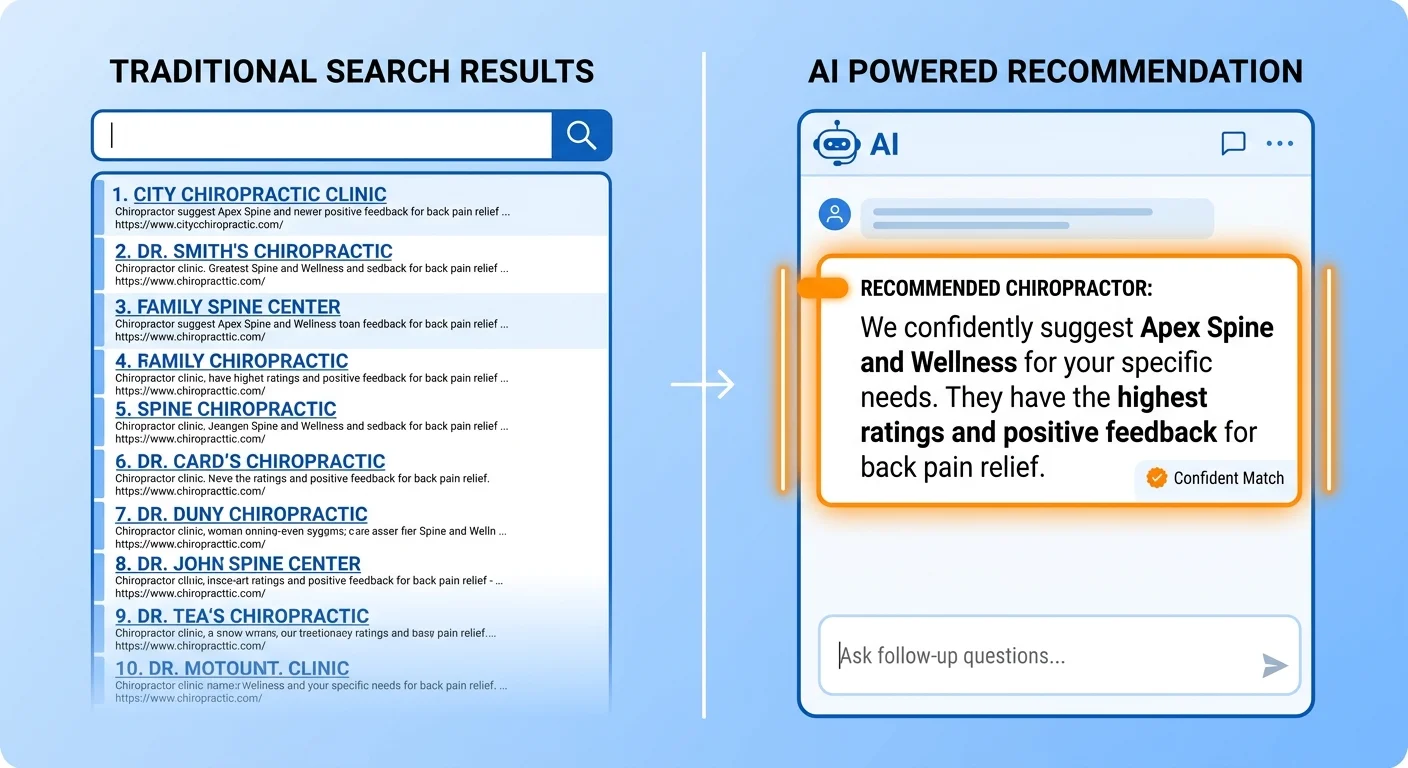
SEO gets you on a list. AEO gets you named as the answer.
Those aren’t the same thing – and treating them like they are is why most practices are invisible right now.
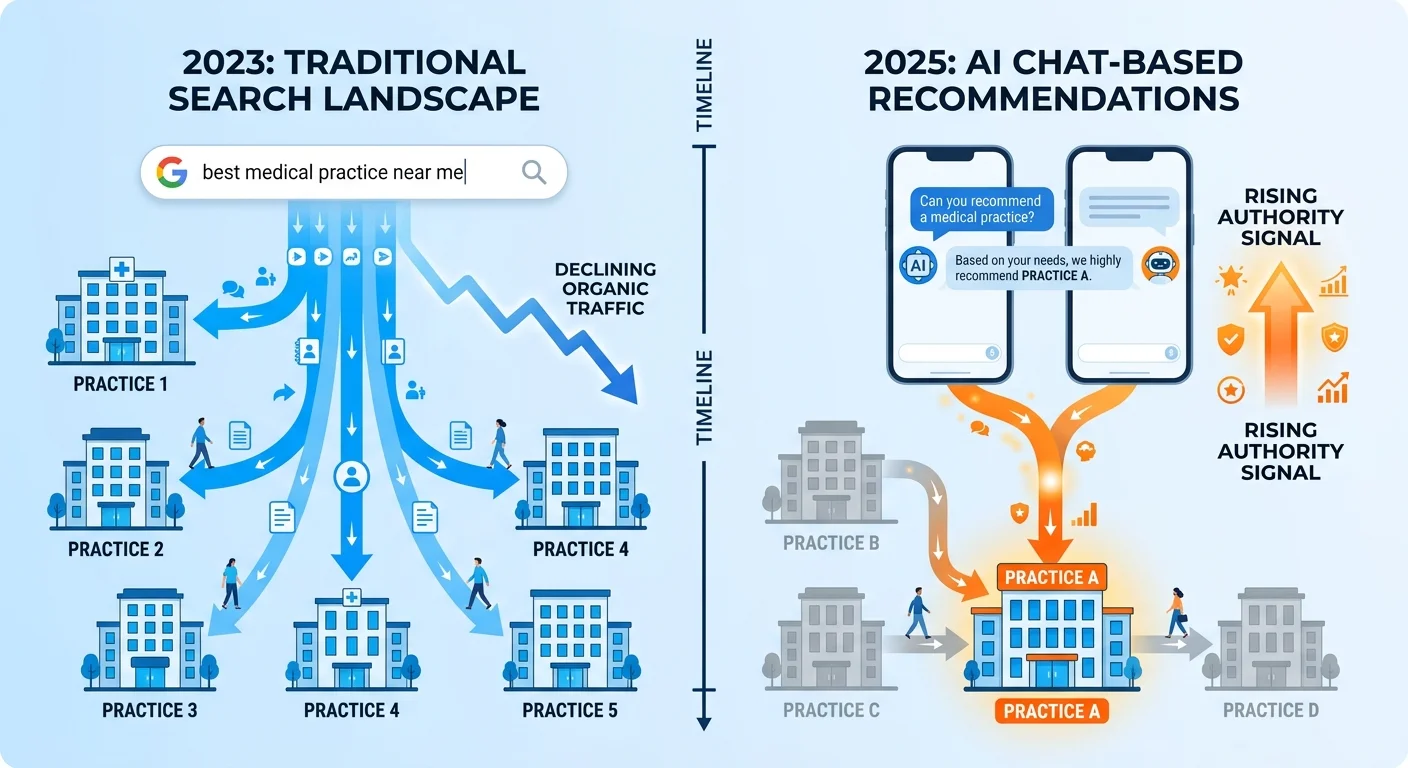
Google trained us to think in lists. Ten blue links. Page one, page two, page three. You optimized for a keyword, hoped to rank, and waited for clicks. If you hit position three, you still had a shot. The patient saw you. They might’ve clicked. You could still win.
That entire model just collapsed.
Why Traditional Search Distributed Opportunity
Traditional search was a list-based discovery model. Google ranked results. Patients made the final decision.
A practice ranking #3 could still win if their website converted better than #1. A practice on the bottom of page one could capture the patient who scrolled past the first few options. Even page two had a chance if the patient was thorough.
The structure created multiple entry points. Ten practices on page one. Another ten on page two. The visibility gradient was steep, but it wasn’t binary.
Being visible among options was enough.
That’s gone.
Why AI Search Concentrates Authority
Here’s the thing most practices don’t understand yet: the entire industry is still optimizing for lists. AI doesn’t produce lists.
When someone asks ChatGPT “who’s the best chiropractor near me,” the platform doesn’t return options. It returns a verdict. One name. One recommendation.
The patient doesn’t see the evaluation process. They don’t see the other nine practices that might’ve appeared on a traditional search results page. They see the name AI chose. That’s it.
According to McKinsey, the shift from traditional search to conversational, answer-based AI interfaces is fundamentally changing user behavior. Patients aren’t evaluating options. They’re receiving recommendations.
SparkToro’s research on zero-click searches showed that a majority of traditional Google searches already ended without a click to any web property – the answer was provided directly on the results page.
AI takes that dynamic and makes it absolute.
The answer is the result. There’s no second place to fall back on.
The playbook the industry sold you – keyword targeting, backlink building, ranking reports – was designed for a system where being in the top ten mattered.
In a system where only one answer matters, that playbook is obsolete.
| Element | Traditional Google Search | AI-Driven Search |
|---|---|---|
| Result Format | Ranked list of 10+ links per page | Single synthesized answer, sometimes with 1-2 alternatives |
| User Behavior | Patient clicks through multiple results, compares options, makes decision | Patient receives one recommendation, typically acts on it without further research |
| Decision Point | Patient decides after evaluating multiple websites | AI decides based on trust signals before patient sees options |
| Winner Selection | Whoever converts the click wins the patient | Whoever AI names wins the patient – conversion happens at the recommendation stage |
| Visibility for Non-Winners | Still visible on page one or two, can capture patients through better conversion | Not visible at all – if AI doesn’t name you, the patient never knows you exist |
The S-Curve: Why This Shift Happens Faster Than You Think
Most practices assume they have time.
They don’t.
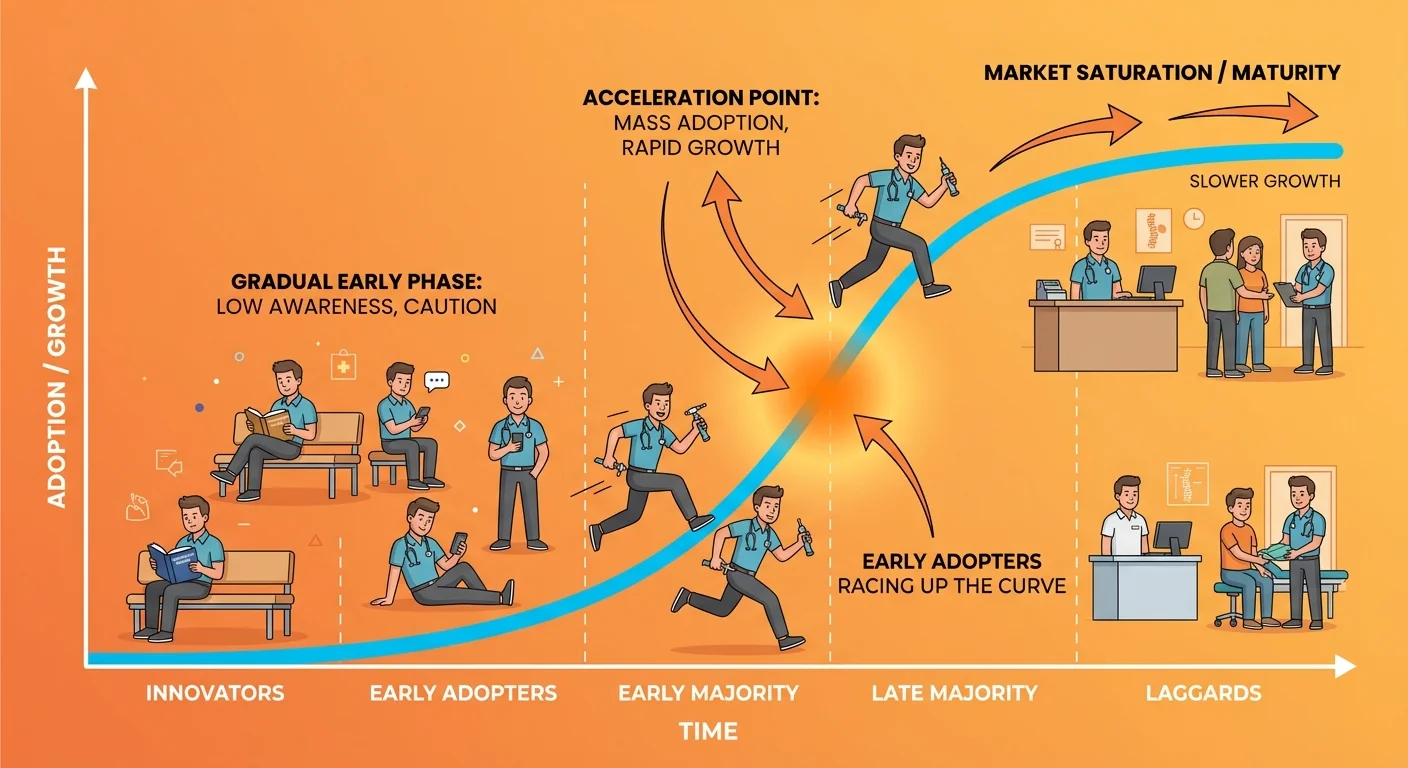
Technology adoption doesn’t happen linearly. It follows an S-curve. Early phases feel slow. A few early adopters experiment. Most of the market ignores it.
Then adoption hits a tipping point and accelerates exponentially.
The National Bureau of Economic Research documented this pattern in their study of disruptive technology diffusion. The companies that moved early didn’t just gain a head start – they locked in structural advantages that late movers could never replicate.
AI search is in the early acceleration phase right now. Voice assistants are embedding conversational search into every device. Google’s integrating AI overviews into traditional search results. Perplexity and ChatGPT are becoming default research tools for millions of users.
The practices that dismiss this as “too early” are the same practices that’ll panic in twelve months when new patient volume starts declining and they can’t figure out why.
The Tipping Point: When Delay Becomes Fatal
The inflection point is the moment when more patients discover chiropractors through AI than through traditional search.
Once that happens, the game’s over for practices that waited.
Authority compounds. The practice AI recommends this month builds citation velocity – more patient reviews, more directory mentions, more semantic content depth. Next month, they’re harder to displace.
By month six, the gap is wide enough that catching up requires building stronger trust signals than a competitor who’s been executing consistently for half a year.
You can’t buy that back with ad spend. You can’t shortcut it with a website redesign. Authority is an output of sustained execution, and the longer you wait, the steeper the climb becomes.
The practices that moved early didn’t need to be perfect. They just needed to be first on Google’s successor platform.
Why Your Current Marketing Creates False Security
The entire agency infrastructure is built on managing ad spend and broad SEO. If they admitted traffic volume doesn’t matter anymore, they’d have nothing left to sell. So they keep selling it.
That’s the friction point most practices don’t see.
Your Google Analytics dashboard shows session counts trending up. Your agency sends monthly reports highlighting impressions, clicks, keyword rankings. Everything looks fine.
But none of that data addresses the question that actually matters: Is AI recommending your practice when patients ask who to trust?
Traffic is a lagging indicator of an old system. It measures success within a model where being visible among options was enough. In a zero-sum model where only one answer matters, traffic becomes a vanity metric.
BrightEdge’s 2024 SEO statistics confirm that traditional organic search still drives significant traffic – but the format and influence of that traffic are being fundamentally challenged by generative AI integrations.
The volume might look stable today. It won’t look stable when 40% of your patient base shifts to AI-first discovery and your practice isn’t the name those engines say.
The agencies optimizing for yesterday’s metrics aren’t lying to you. They’re just measuring the wrong thing. And by the time the traffic reports start declining, the authority slot in your market will already be filled by whoever built AI trust signals while you were watching impression counts.
What AI Evaluates When It Names a Winner
AI doesn’t read your website the way a human does.
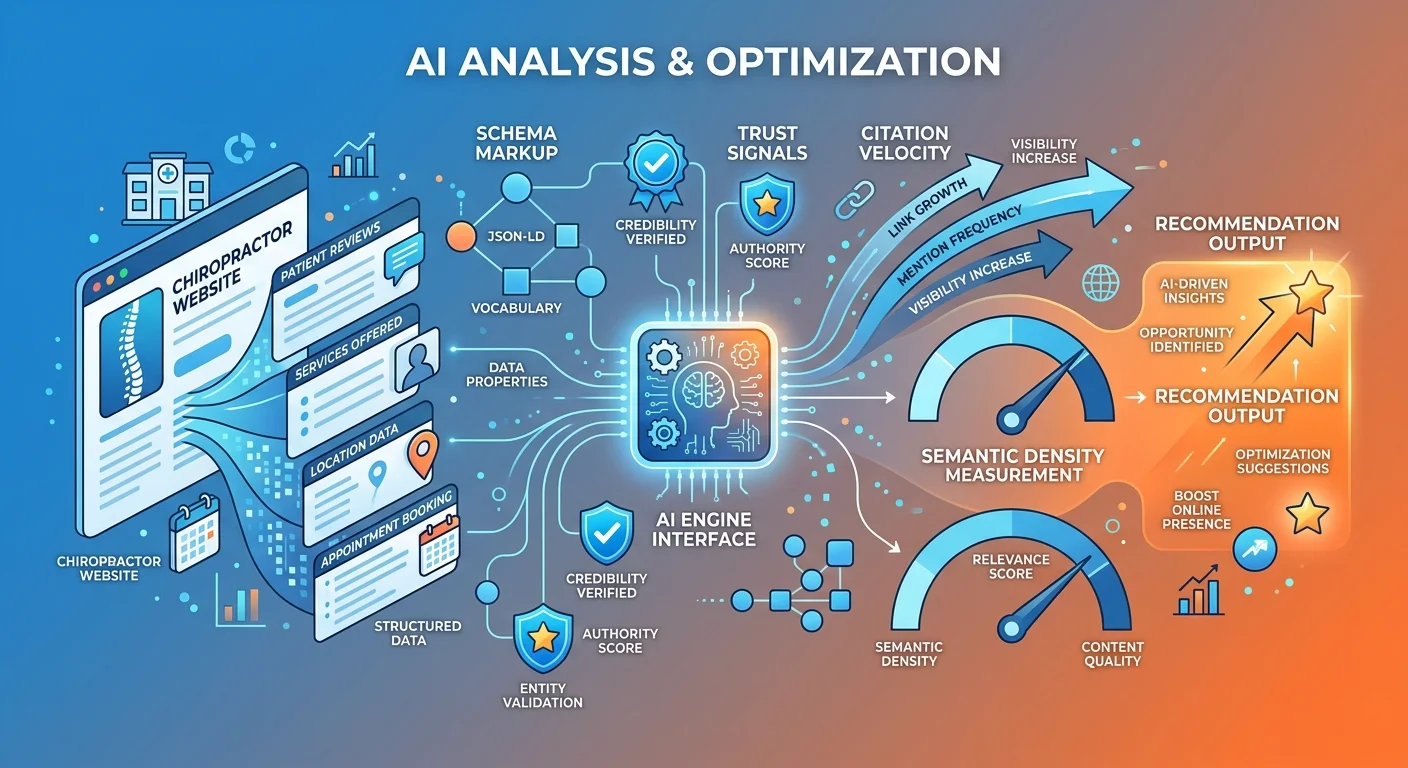
It’s not looking at your homepage copy, your patient testimonials, or your staff photos. It’s evaluating structured signals that indicate whether you’re a credible, trustworthy entity in your market.
These signals are machine-readable. They exist as metadata, schema markup, citation patterns, and semantic relationships.
If your infrastructure isn’t readable to AI, you’re invisible – no matter how compelling your website looks to a human.
The three primary signals AI uses to determine authority are entity trust, semantic density, and citation velocity. These aren’t ranking factors in the SEO sense. They’re validation mechanisms.
They determine whether AI considers you a candidate for recommendation at all.
Entity Trust: The Foundation AI Requires
Entity trust is machine-readable proof that you are who you claim to be.
It’s built from structured data – schema markup that declares your business type, location, services, and credentials. Consistent NAP (name, address, phone) data across directories. Verified business entities in knowledge graphs. Clear semantic relationships between your practice name and the conditions you treat.
If AI can’t confirm your identity as a legitimate, authoritative entity, it can’t recommend you.
It doesn’t matter how many years you’ve been in practice or how many patients you’ve treated. Without structured entity validation, you’re not in the conversation.
This is why template websites fail at AI visibility. They’re designed for human eyes, not machine parsing. The schema’s incomplete. The entity signals are weak. The NAP data’s inconsistent across directories because nobody audited it when the site launched.
AI reads those gaps as red flags. Not low authority. Uncertain identity.
And uncertain identities don’t get named.
Semantic Density: Proof You Treat What You Claim
Semantic density is the depth of topical coverage AI can verify.
A homepage that says “We treat back pain” is a claim. A library of condition-specific content – structured articles on lumbar disc herniation, sciatica management, posture correction protocols, spinal decompression – is proof.
AI measures semantic density by evaluating how thoroughly your content covers the topics you claim expertise in. It’s not about keyword frequency. It’s about topical relationships, entity co-occurrence, and structured data that ties your content to recognized medical terminology.
This is where most practices fail. They’ve got a services page listing everything they do. They’ve got a blog with generic wellness tips.
But they don’t have the semantic infrastructure that proves domain expertise in the conditions patients are asking AI about.
The practice AI recommends has that infrastructure. They published 50+ condition-specific articles. They structured the content with schema. They built semantic relationships between their entity and the problems they solve.
AI doesn’t have to guess whether they’re qualified – it can verify it.
Citation Velocity: How AI Measures Momentum
Citation velocity is how frequently your entity appears in trusted contexts.
This is not backlinks. Citations are structured mentions of your practice in authoritative platforms – healthcare directories like Healthgrades, Zocdoc, and WebMD. Local business directories with verified NAP data. News mentions. Industry publications.
AI tracks citation patterns to measure whether your authority is growing, stable, or declining. A practice with increasing citation velocity signals active presence and expanding trust. A practice with flat or declining citation velocity signals stagnation.
The compounding effect matters here. The practice that built citation velocity six months ago has a momentum advantage over a competitor starting from zero today.
Each new citation reinforces the existing pattern, making the authority signal stronger every month.
| Signal Type | What It Measures | Why It Matters |
|---|---|---|
| Entity Trust | Machine-readable proof of identity through schema markup, consistent NAP data, and verified business entities | AI can’t recommend what it can’t confirm. Without entity validation, you’re not a candidate. |
| Semantic Density | Depth of topical coverage and structured content proving expertise in claimed conditions | Claims aren’t proof. AI evaluates whether your content library validates your stated expertise. |
| Citation Velocity | Frequency and recency of authoritative mentions across directories, news, and healthcare platforms | Authority’s not static. AI measures whether your presence is growing or stagnating. |
| Schema Completeness | Structured data that declares your business type, services, location, credentials, and topical focus | Schema is the language AI reads. Incomplete schema means incomplete entity understanding. |
| NAP Consistency | Alignment of your name, address, and phone number across all directories and platforms | Inconsistent NAP signals uncertain identity. AI prioritizes entities with verified, consistent data. |
Why Being Second Place Means Being Invisible

In traditional search, second place still captured clicks.
The practice ranking #2 on Google might’ve lost some traffic to the #1 result, but they were still visible. Patients still saw their name. They could still win the patient if their website converted better.
In AI search, second place doesn’t exist.
When ChatGPT names one chiropractor, the patient doesn’t see the runner-up. They don’t see the practice that almost got recommended. They see the winner, and they book with the winner.
The nine other practices that might’ve appeared on a traditional search results page aren’t on page two. They’re not in the conversation at all.
This is the zero-sum framing. AI gives one answer. If you’re not the answer, you don’t exist.
That dynamic makes displacing the incumbent exponentially harder than climbing a ranked list ever was.
The Compounding Gap: Why Waiting Costs More Every Month
Authority doesn’t reset every month.
The practice AI recommends in January builds momentum. They get patient reviews. They publish more content. They earn more citations. By February, their trust signals are stronger than they were in January.
The practice that waited and watched doesn’t just have to match the incumbent’s current authority. They have to exceed the incumbent’s compounding authority after months of sustained execution.
That’s the gap most practices don’t see until it’s too late.
Every month you delay is a month your competitor gains. Not linearly. Compounding.
Their citation velocity accelerates. Their semantic density deepens. Their entity trust solidifies. And every incremental gain makes displacing them harder.
The first-mover advantage in a zero-sum game isn’t just about being early. It’s about locking in structural compounding that late movers can never replicate at the same pace.
What Happens When Your Competitor Moves First
This isn’t for the practice that needs a contractual guarantee before they act.
Becoming the AI-recommended authority isn’t a line item you can purchase. It’s not a service package with a fixed timeline and guaranteed outcome. It’s the result of building real trust signals that AI engines recognize as credible.
If you need a guarantee before you move, you’ll wait until the authority position’s already filled. And once it’s filled, displacing the incumbent requires out-executing them on every trust signal for months – maybe longer.
Here’s what that looks like in practice.
Your competitor starts building AI authority in January. They publish condition-specific content with structured schema. They audit and correct NAP inconsistencies across directories. They build citation velocity through verified listings on Healthgrades, Zocdoc, and local platforms.
You keep optimizing for Google rankings. Your traffic reports look fine. Your ad spend’s converting. Everything seems stable.
Six months later, patients start asking AI who to trust. AI names your competitor. Not because they’re better clinicians. Because they built the infrastructure AI requires to validate authority.
You never see those patients. They don’t click through to your website from a search results page because there is no search results page. They book with the practice AI recommended and move on.
Your Google Analytics still shows traffic. But new patient volume starts declining. Slowly at first. Then faster.
And you don’t understand why – because the discovery channel shifted to a platform where you’re invisible.
By the time you realize what happened, your competitor has twelve months of compounding authority. Their citation velocity’s entrenched. Their semantic density’s deep. Their entity trust is validated across every major platform.
You can still displace them. But it’s gonna take longer, cost more, and require sustained execution while they continue building.
The gap doesn’t close because you start. It closes when you out-execute them long enough to surpass their accumulated trust signals.
That’s the cost of waiting. Not a missed opportunity. A structural disadvantage that compounds every month you delay.
The difference between AEO and traditional SEO is that SEO let you catch up by outranking a competitor. AEO requires you to out-trust them.
And trust takes time to build.
| Timeline | Practice A (Building AI Authority) | Practice B (Optimizing for Traditional SEO) |
|---|---|---|
| Month 1 | Publishes 12 AEO articles, completes schema audit, begins NAP correction across 50+ directories | Continues traditional SEO execution – keyword targeting, backlink building, blog content |
| Month 3 | 36 AEO articles live, citation velocity building, AI engines begin referencing practice in local searches | Traffic reports stable, rankings improving for target keywords, no change in AI visibility |
| Month 6 | 72 AEO articles published, entity trust validated across major directories, AI recommends practice in 60% of local queries tested | Traffic still strong, but new patient volume begins declining as discovery shifts to AI – Practice B doesn’t notice yet |
| Month 12 | 144 AEO articles, semantic density deep across all treated conditions, AI authority locked in – displacement now requires 6-9 months of sustained execution by a competitor | New patient volume down 30% year-over-year, Practice B realizes AI’s the problem, begins building authority 12 months behind Practice A’s compounding momentum |
The “But Google Still Works” Objection
Yes. Google still sends traffic. For now.
But traffic volume isn’t the metric that matters anymore. Consensus trust from AI engines matters more than click volume in a zero-click future.
Here’s what most practices miss: patients aren’t abandoning Google. They’re using Google differently. The search bar’s becoming a conversational interface. Google’s integrating AI overviews directly into search results. The user experience is shifting from “here are ten links” to “here’s the answer.”
The traffic you’re measuring today is coming from a discovery model that’s being replaced in real time.
Optimizing for yesterday’s platform while tomorrow’s platform makes the actual referral decision isn’t a strategy. It’s a delayed failure.
Andreessen Horowitz explains that generative AI acts as a “synthesizer,” collapsing the discovery process from a list of links into a single, trusted narrative recommendation.
Patients aren’t clicking through multiple results anymore. They’re accepting the answer AI provides and moving to action.
When that answer isn’t your practice, you’re not losing to better marketing. You’re losing to a platform shift you didn’t see coming.
Why Traffic Reports Are the Wrong Metric
Session counts measure success within a system where being visible among options was enough.
But visibility among options is gone. The new system measures whether AI considers you credible enough to name as the singular answer.
A practice can have strong traditional SEO performance – ranking on page one for competitive keywords, driving consistent organic traffic, converting clicks into patients – and have zero AI authority.
When the patient base shifts to AI-first discovery, that traffic advantage evaporates. Not gradually. All at once.
Because the discovery mechanism changed, and the infrastructure that produced traditional search traffic was never designed to build AI trust signals.
Traffic reports don’t show you that gap. They can’t. They measure engagement within the old model. They don’t measure whether your entity’s validated, whether your semantic density’s deep enough, or whether AI engines trust you enough to recommend you.
The practices relying on traffic as their primary performance indicator are measuring the wrong thing. And by the time the traffic starts declining, the competitive gap’ll be too wide to close quickly.
The Real Question: Where Are Your Future Patients Looking?
Current patients found you through traditional search. That’s fine. That system still works – for now.
Future patients are adopting AI tools embedded in their devices, browsers, and voice assistants. They’re not making a conscious choice to switch platforms. The platforms they already use are integrating AI as the default discovery mechanism.
Siri. Google Assistant. Alexa. ChatGPT integrated into search bars. Grok as the default research tool.
These aren’t niche technologies. They’re becoming the standard interface for how people ask questions and receive answers.
The question isn’t whether Google still works today. The question is whether you’ll be the name AI says tomorrow.
And if you’re waiting for traditional traffic to decline before you act, you’re waiting until the moment when building authority becomes exponentially harder – because someone else already has it.
What Most Practices Get Wrong About Timing
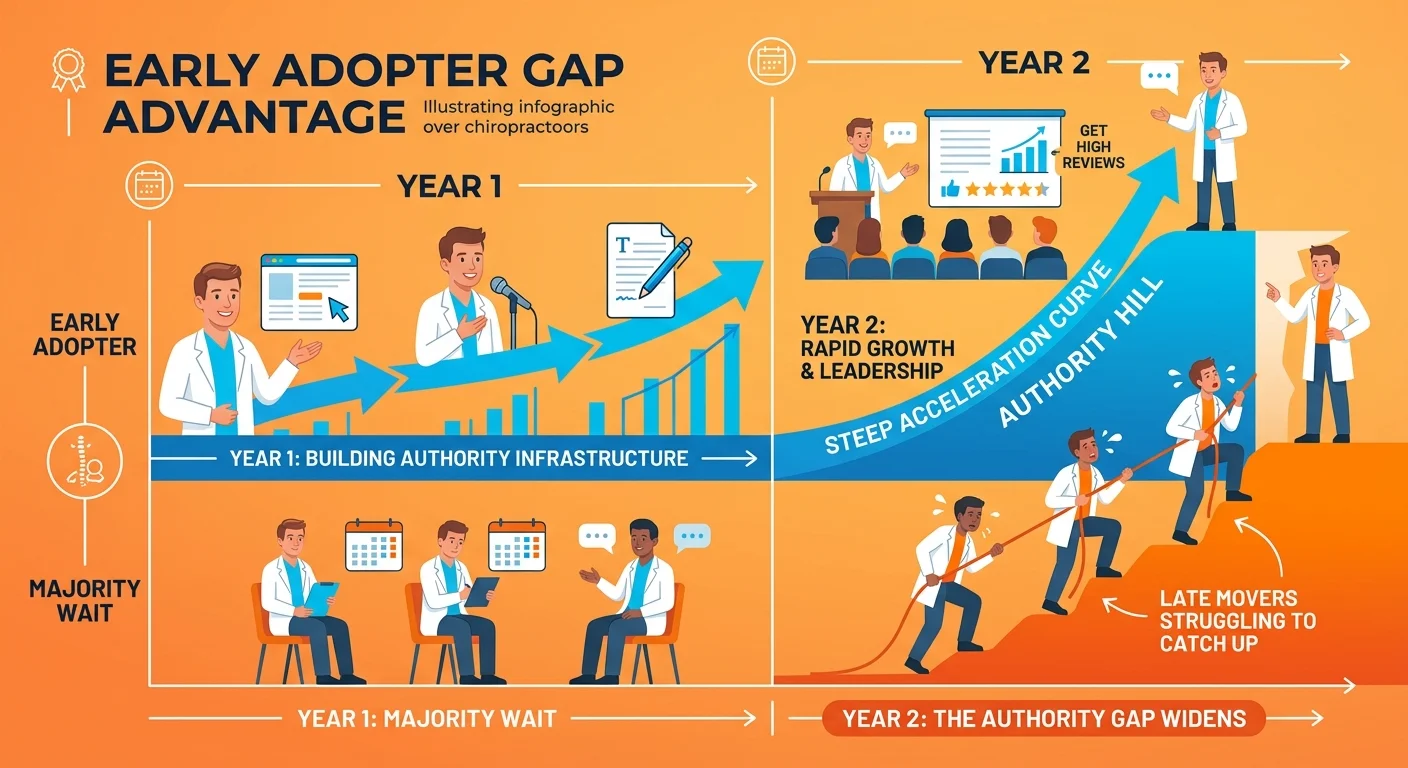
Most practices think they have time.
AI’s interesting. Worth watching. Maybe worth exploring next year when the market proves it’s real.
That assumption – “I’ll move when it’s obvious” – is the most expensive mistake a practice can make.
Authority doesn’t build overnight. The infrastructure that convinces AI to recommend you – entity validation, semantic density, citation velocity – takes months of sustained execution to establish.
You don’t flip a switch and become the authority. You build it, layer by layer, month by month.
The practices that wait for proof are waiting until the moment when acting becomes exponentially harder. Because by the time the shift’s obvious to everyone, the early movers have already locked in six to twelve months of compounding authority that late entrants can’t replicate.
Why “Wait and See” Is Not Neutral
Choosing not to build AI authority feels like a safe, neutral position.
It’s not.
Every month you wait is a month someone else is building. Their citation velocity’s accelerating. Their semantic content’s deepening. Their entity trust is solidifying. And every month of compounding makes displacing them harder.
“Wait and see” isn’t inaction. It’s actively ceding the recommendation slot to whoever moves first.
The illusion is that you’re preserving optionality. The reality is that you’re losing ground while telling yourself you’re being strategic.
Authority’s a zero-sum game. Only one practice gets recommended. If you’re not building, you’re not staying neutral – you’re losing.
The First-Mover Advantage in a Zero-Sum Game
In traditional SEO, being first mattered, but it wasn’t permanent. You could displace a competitor by outranking them. Build better content, earn stronger backlinks, optimize conversion rates. The playing field reset with every algorithm update.
In AI search, first-mover advantage is structural.
The practice AI recommends first builds momentum. They earn patient reviews. They generate more citations. They publish more semantic content. Every interaction reinforces their authority position.
Displacing them doesn’t mean matching their current signals. It means building stronger signals than they have after months of compounding.
And they’re not standing still while you catch up. They’re continuing to execute, widening the gap every month.
The longer they hold the recommendation slot, the steeper the climb becomes for anyone trying to take it from them.
That’s why timing matters more in this model than it did in traditional SEO. The first practice to build AI authority in a market doesn’t just get a head start. They lock in a compounding advantage that becomes exponentially harder to overcome the longer it persists.
If you’re not building now, you’re not “waiting for the right time.” You’re giving away months of compounding authority to whoever understood this first.
The AI Authority Engine doesn’t promise overnight results. It builds the infrastructure that compounds. The timeline’s not the constraint. The constraint is whether you start now or wait while a competitor builds six months of compounding advantage.
Frequently Asked Questions
Is traditional SEO dead because of AI?
Traditional SEO isn’t dead, but its purpose has changed.
It now functions as a support layer for building authority signals that AI can evaluate, rather than the primary mechanism for ranking on a list users may never see.
The infrastructure that made SEO work – structured data, entity consistency, topical depth – still matters. But the outcome it produces is different. Instead of ranking among ten options, you’re building the trust signals that determine whether AI names you as the singular answer.
The practices that treat SEO as a way to rank on Google are optimizing for a system being replaced. The practices that treat SEO as a foundation for entity validation and semantic authority are positioning themselves for the platform that’s taking over.
How is being the “one answer” different from being #1 on Google?
Being #1 on Google places you at the top of a list the patient still has to evaluate.
Being the AI’s “one answer” means you’re the singular recommendation presented with the platform’s implicit endorsement.
The patient doesn’t compare you to nine other options. They see your name as the trusted solution. That’s not a ranking advantage. That’s a structural monopoly on discovery in that moment.
In traditional search, the patient made the decision. They evaluated options, compared websites, and chose who to trust. In AI search, the platform makes the decision for them. AI evaluates the trust signals and outputs a name. The patient’s decision is whether to act on the recommendation – not whether to trust it.
That’s the fundamental difference. You’re not competing for attention. You’re competing for the platform’s endorsement.
Can’t I just run ads to get recommended by AI?
No.
AI recommendations aren’t purchased. They’re earned through structured trust signals.
Ads buy attention in a paid placement model. You bid on keywords, display impressions, and pay per click. The visibility’s temporary – it lasts as long as the ad budget lasts.
AEO builds authority that AI engines recognize as credible. The infrastructure that determines whether AI names you – entity trust, semantic density, citation velocity – can’t be accelerated with ad spend.
Authority compounds over time through consistent execution, not budget allocation. You don’t buy your way to being the answer. You build it.
How long does it take to become the AI-recommended authority?
Authority doesn’t build on a fixed timeline. It compounds.
The starting point matters – current entity trust, existing content depth, citation patterns already established. A practice with zero AI-readable infrastructure’ll take longer than one with partial signals already in place.
Consistent AEO execution builds momentum every month. The timeline’s not the constraint. The constraint is whether you start now or wait while a competitor builds six months of compounding advantage.
I’ve seen practices start showing up in AI recommendations within three months. I’ve seen others take nine months to displace an entrenched incumbent. The variable isn’t the methodology. It’s the competitive context and how aggressively the practice executes.
What I will say: every month of execution builds on the last. The practices that stick with it compound. The ones that quit give that ground to whoever kept going.
What happens if I ignore AI and just focus on my current marketing?
Ignoring AI means seeding the most valuable patient discovery channel to whoever moves first.
Current marketing may continue producing results in the near term, but patient behavior’s shifting. As more users adopt AI-integrated search tools, the volume of traditional search traffic declines.
The practice that built AI authority early captures the patients migrating to conversational discovery. The practice that optimized for yesterday’s platform watches new patient volume erode without understanding why.
This isn’t speculation. The data already shows it. Zero-click searches are the majority of queries. Conversational AI tools are becoming the default interface. The shift’s happening.
The only variable is how long it takes your market to reach the tipping point where traditional search traffic’s no longer the primary discovery mechanism.
And when that happens, the practice that moved early wins. The practice that waited loses. Not because they did bad marketing. Because they optimized for the wrong platform.
Can I displace a competitor who already has AI authority?
Yes, but it requires building stronger trust signals than they currently have.
Displacing an incumbent’s harder than being first. The competitor who already holds the AI recommendation slot has months of compounding citation velocity, content depth, and entity validation.
You can’t outspend them with ads. You have to out-execute them on authority infrastructure.
That means deeper semantic content. More consistent citations. Stronger schema architecture. Sustained AEO execution until your trust signals surpass theirs.
It’s not impossible. It’s just slower than moving before they did.
I tell practices this all the time: if your competitor’s been building AI authority for six months, you’re not competing against their current position. You’re competing against their current position plus six more months of compounding while you catch up.
That doesn’t mean don’t act. It means act now, and commit to executing longer and harder than they are. Because the gap only closes when you out-execute them consistently enough to surpass their accumulated advantage.
The Only Logical Next Step
AI gives one answer. If you’re not the answer, you don’t exist.
This isn’t a metaphor. It’s how the technology works.
The patients asking who to trust aren’t receiving a list to evaluate. They’re receiving a name. If it’s not yours, you’re not in the conversation.
Every month that passes without building AI authority is a month your competitor compounds theirs. The gap widens. The displacement cost increases. Waiting for proof that the shift’s real means waiting until the position’s already filled.
You don’t need more evidence. You need to know where you stand right now.
Are you the name AI says when patients ask who to trust? Or is your competitor?
That’s the only question that matters. And the only way to answer it is to run the check.
Want to know if AI’s naming your practice – or your competitor’s – when patients ask who to trust? The AI Visibility Check from iTech Valet takes 15 minutes and shows you exactly what ChatGPT, Gemini, and Grok say about your market. No guesswork. No assumptions. Just the actual answer AI gives right now.