
When rater8 looked at AI adoption by age, people aged 45 to 60 came first at 64%, followed by ages 30 to 44 at 52%. The 18-to-29 group is very aware of AI (67%), but only 28% have actually used it to research a provider. AARP Research found that generative AI use among adults 50 and older grew from 9% in 2023 to 18% in 2024 and 30% in 2025. In the National Poll on Healthy Aging, 55% of adults 50 and older said they had ever used AI that one speaks or types to, and 14% used AI for health information.
Patients 45 to 60 Lead AI Use for Provider Research
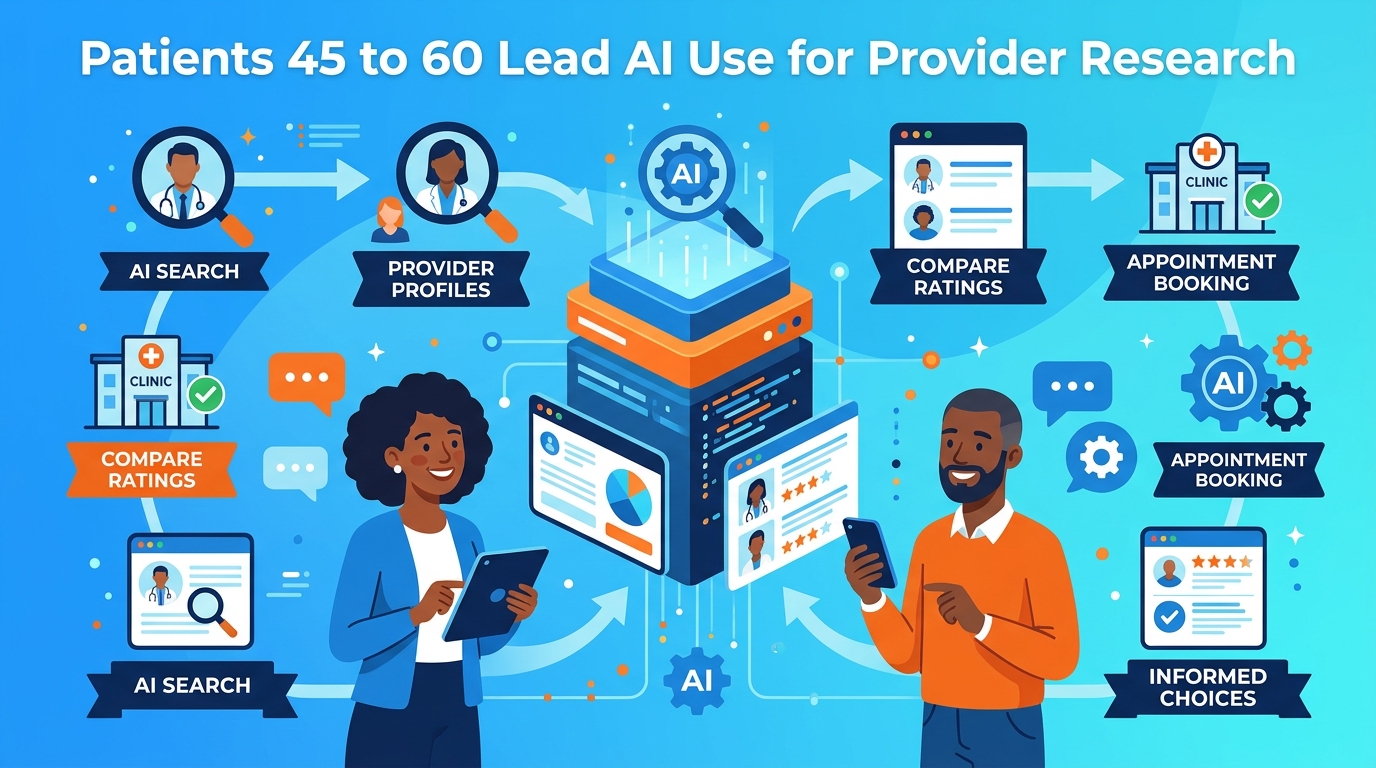
Here’s what most people miss. The middle-aged bracket came first, not the young one.
When rater8 looked at AI adoption by age, people aged 45 to 60 topped the list at nearly two-thirds (64%). Ages 30 to 44 followed at just over half (52%).
The youngest adults look different. In the 18-to-29 group, 67% are highly aware of AI. But only 28% have actually used it to research a provider.
Want to know what AI engines say about your practice? The AI Visibility Check looks at exactly that.
How Fast AI Use Is Growing Among Adults 50 and Older
It’s growing fast.
Generative AI use among adults 50 and older went from about 1 in 10 (9%) in 2023 to about 1 in 5 (18%) in 2024. In 2025 it hit about 3 in 10 (30%). That’s the AARP Research finding in Older Adults are Navigating AI.
Age still matters inside that group. Nearly half (47%) of people in their 50s know about and use AI and AI-driven chatbots. Just 1 in 4 (25%) of those over 70 do.
Here’s how AARP says older adults use AI technology:
- Almost half (48%) use predictive text and auto-correction.
- About 4 in 10 (38%) use AI to answer questions.
- A little over 1 in 3 (36%) use virtual assistants.
- About 1 in 3 (32%) use voice-to-text technology.
The National Poll on Healthy Aging adds two numbers.
A little over half (55%) of adults 50 and older have ever used AI that they speak or type to. About 1 in 7 (14%) used AI for health information.
The table below lines up these numbers for adults 50 and older.
| Measure | Group | Figure |
|---|---|---|
| Generative AI use | Adults 50+ | 9% (2023), 18% (2024), 30% (2025) |
| Know about and use AI and AI-driven chatbots | In their 50s vs over 70 | 47% vs 25% |
| Ever used AI that one speaks or types to; used AI for health information | Adults 50+ | 55%; 14% |
Older Adults Now Carry the Phones to Do It
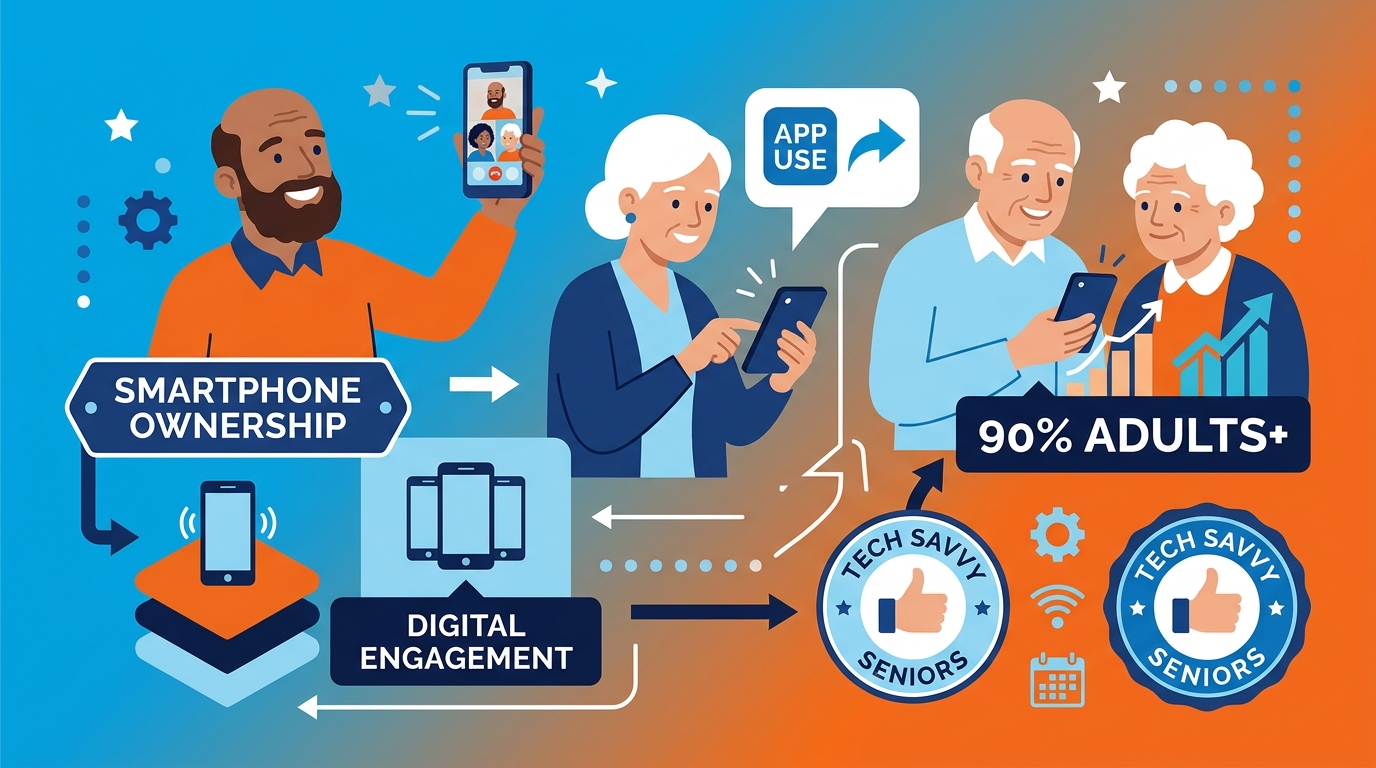
Nine in ten adults 50 and older now own a smartphone.
Look at AARP’s survey, Tech Use and Adoption Growing Among Adults Age 50-Plus. Ownership among adults 50 and older climbed from a little over half (55%) in 2016 to nine in ten (90%) in 2025.
Pew Research Center breaks ownership out by age. In Internet use, smartphone ownership, digital divides in the US, 97% of adults under 50 and 90% of those 50 to 64 have a smartphone. Adults 65 and older are the least likely to own one, but 78% of them still do.
Time online still differs by age. About 1 in 7 adults 65 and older (14%) say they’re online almost constantly. For adults 18 to 29, it’s a majority, about 6 in 10 (63%).
The table below shows phone ownership and time online by age.
| Measure | Group | Figure |
|---|---|---|
| Smartphone ownership | Adults 50+ | 90% in 2025, up from 55% in 2016 |
| Smartphone ownership | Under 50 / 50-64 / 65+ | 97% / 90% / 78% |
| Online almost constantly | 18-29 vs 65+ | 63% vs 14% |
Which AI Formats Older Adults Use
Here’s where the numbers come from. AARP Research reports on each format in AARP Research Insights on Technology.
Platforms such as ChatGPT or Copilot. Among adults 50 and older, about 1 in 5 (19%) use them. About 1 in 5 (21%) are interested. About 6 in 10 (59%) say they have no interest.
Among those using AI, a little under 6 in 10 (58%) have used a specific branded platform or app, such as ChatGPT or Microsoft Copilot.
Voice assistants. About 3 in 10 (31%) use AI as a voice personal assistant. About 1 in 5 (20%) are interested. And about 1 in 3 older adults (35%) now owns a home assistant.
Health monitoring. About 1 in 8 (13%) use AI for health monitoring. About 1 in 3 (32%) are interested.
Routes in. Among adults 50 and older who have used AI, most got there through an AI platform or app (58%). Next comes a voice personal assistant, at nearly half (49%). Then a chatbot, at about 4 in 10 (39%).
When someone asks ChatGPT, Copilot or a voice assistant who to see, I build for your practice to be the source the assistant names and draws on. Not one more line in a directory list.
What Pushes Older Adults Toward or Away From Health Tech
Where interest lies
- Older adults are especially interested in AI health monitoring devices. They also want AI tools that answer health questions or give nutritional guidance.
- About 4 in 10 older adults (37%) expect AI to be useful in health care. About 1 in 3 (33%) say it’ll help them manage their home.
The employment gap
- Work changes the odds. Employed adults 50 and older are twice as likely to have used generative AI. About 4 in 10 (42%) of them have. For those not employed, it’s about 1 in 5 (21%).
Where use and views are rising
- Use of medical digital services, such as health records or pharmacy apps, saw a significant increase, from about 1 in 3 (35%) in 2024 to almost half (46%) in 2025.
- Among adults 80 and older, the share who agree that technology enables a healthy life rose from 39% in 2024 to 46% in 2025.
Barriers
Here’s what holds them back. The top barriers to using technology to better their health:
- A preference to focus on non-tech solutions (35%).
- Not knowing what tech options exist (29%).
Why Older Adults Still Hesitate to Trust AI Health Answers
Here’s where the hesitation comes from.
About half of older adults who hesitate to adopt new technology, especially AI tools, say the same thing. Their top concerns are trust, privacy and data security.
- Most older adults (68%), about 7 in 10, worry AI may reduce human interaction.
- Nearly half (46%) of adults 50 and older had very little or no trust in AI-generated health information. That’s from Artificial Intelligence Use and Views: Key Findings From the National Poll on Healthy Aging.
- Most older respondents rate their AI skill as beginner (42%) or intermediate (28%). Just 7% call themselves advanced.
For an audience this cautious, I put your effort and money into clear, credible information your practice owns. It keeps paying off. It grows.
Ads and paid placements don’t. They stop the moment the spending stops.
Age Brackets vs. Generations: Reading the Numbers Right
Here’s what looks like a conflict.
A low Boomer number can look like it clashes with rater8’s result for ages 45 to 60. The two sources just sort people differently. SOCi sorts by generation. rater8 sorts by age bracket.
By generation, SOCi found Millennials are the heaviest users of AI tools at 63%. They’re ahead of Gen Z (49%) and Gen X (48%). Baby Boomers? Far behind at 11%.
Gallup shows another split.
Among people who recently used AI for health, about 7 in 10 (69%) of those aged 18 to 29 use AI to research on their own before seeing a doctor. For those 65 and older, it’s fewer than half (43%).
Want to know how assistant answers affect bookings? Read How Assistant Answers Impact Bookings: A Complete Guide.
Frequently Asked Questions
Do adults over 50 think AI’s benefits outweigh its risks?
Just over half do. AARP Research found that 51% of older American adults say the benefits of AI are greater than the possible risks. Don’t assume older adults are against it.
Do older adults feel technology is designed for them?
No. Most don’t. Three in 5 adults 50 and older say technology isn’t designed with their age in mind. Keep that in mind with everything you put in front of them.
How many older adults feel they lack the digital skills to get the most out of being online?
About 3 in 10 (30%). AARP Research found that these older adults do not believe they have the necessary digital skills to take full advantage of being online.
How interested are adults 50+ in using AI day to day?
About 1 in 3 (35%). In the National Poll on Healthy Aging, 35% of adults 50 and older reported interest in using AI in their day-to-day lives.
Do older adults want to know whether information came from a person or from AI?
Yes. Nine in 10 (92%) adults 50 and older agreed they want to know if the information they get is from a person or from AI. That’s from the National Poll on Healthy Aging. About 8 in 10 (81%) wanted to learn more about the risks of AI. So tell them which is which.
Older Patients Do Research Care With AI, So Don’t Write Them Off
Here’s what most people miss.
Older patients do research care through AI. And the 45-to-60 bracket leads. rater8 found people aged 45 to 60 came first at 64%. Ages 30 to 44 followed at 52%.
The 18-to-29 group is very aware of AI (67%). But only 28% have used it to research a provider.
You can’t write this audience off.
Want to know how the work gets done? The iTech Valet Service Plans & Pricing page explains it. Want to see what AI says about your practice today? Run My AI Visibility Check.