
Entity Clarity: Why AI Needs to See Your Practice Before It Can Trust You
AI engines like ChatGPT, Gemini, and Perplexity don't "find" your practice the way Google does — they verify it. Entity Clarity is the technical state where an AI engine can unmistakably confirm your practice name, credentials, location, and area of expertise across the entire web, not just your website.
Without that confirmation, it doesn't matter how great your site looks or how many five-star reviews you've collected. If AI can't verify who you are, it won't recommend you. And in many cases, it will fill that gap with fabricated data — wrong services, wrong location, wrong founder.
Entity Clarity is built on three core infrastructure signals: deep schema markup that makes your data machine-readable, consistent NAP (Name, Address, Phone) information across directories and platforms, and verified third-party endorsements that tell AI your entity is stable and credible. When these signals are coherent and consistent, AI sees a clear, trustworthy identity. When they're absent, conflicting, or thin, AI either skips you entirely or invents a version of your practice that doesn't exist.
This shift from traditional SEO to Answer Engine Optimization (AEO) is not a trend. It's a structural response to how patient discovery now works. AI doesn't produce a list of results for patients to scroll. It produces a verdict. Either that verdict includes your practice — or it doesn't. There is no partial credit for being close, and no amount of keyword optimization bridges that gap.
This article breaks down exactly what Entity Clarity means, why it matters more than any ranking you've ever chased, and what the infrastructure looks like when it's built correctly.
Last Updated: April 10, 2026
The Practice Nobody Can Find
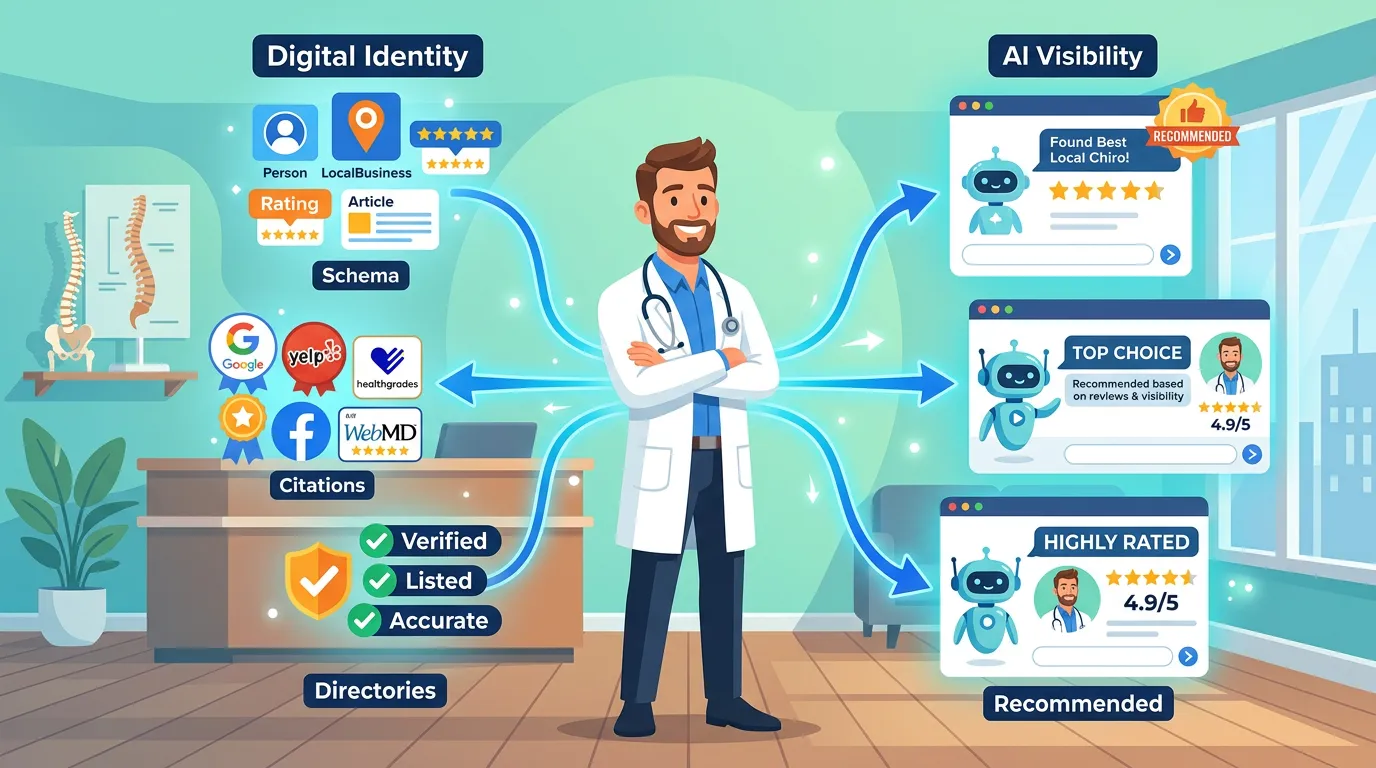
Good practices go invisible every day.
That's not dramatic. I've talked to docs with strong reputations, solid reviews, and modern websites who had zero AI presence. When we checked, ChatGPT either had no idea they existed — or had assembled the wrong story about them entirely.
None of that showed up on the monthly marketing report.
What "Being Online" Actually Means to AI
Google reads your website. AI verifies your existence.
Not the same operation.
When a patient searches "best chiropractor for sciatica near me" on Google, the algorithm scans for relevance signals and ranks a list. When that same patient asks ChatGPT or Gemini the exact same question, the AI goes looking for consensus — a coherent identity it can confirm across multiple independent sources simultaneously.
Here's what that looks like in practice. Fifteen-year practice, same location the whole time. Excellent reputation. Modern website. But the practice name is formatted differently across three directories, the address notation varies between listings, and the schema was auto-generated by a template platform — technically present, completely shallow. To a human scanning the web, that practice looks established. To an AI cross-referencing entity signals, it looks uncertain. Uncertain doesn't get recommended.
That's the gap. Not aesthetics. The machine-readable signals underneath everything.
Here's what AI is actually checking:
- Practice name consistency — Exact match across every citation and directory, no abbreviations or alternate formats that introduce doubt
- NAP coherence — Name, Address, Phone in identical format everywhere, down to suite number notation
- Schema depth — Machine-readable code that encodes your specialties, credentials, and services directly instead of making AI infer them from homepage copy
- Third-party verification — Credible, independent platforms confirming your identity and expertise, not just your own website claiming it
- Topical authority signals — Content that encodes specific expertise in specific conditions, not generic wellness copy that could belong to any practice on the web
Miss any of these consistently, and AI either skips you or invents the parts it can't confirm.
You're Not Missing Google — You're Missing the Trust Layer
Here's what most agencies aren't going to tell you.
Google ranking and AI trust are built on completely different infrastructure. You can dominate page one and still be a ghost to ChatGPT. We see this split constantly as an AI authority agency — practices with strong rankings and zero AI presence. Sometimes the reverse: older site, simpler design, clean entity signals, and AI treats that practice as a verified authority.
Your patients are already moving to a different channel. Traditional search volume is projected to drop 25% by 2026 as patients shift to AI for direct provider recommendations. Your agency's green arrows? Pointed up on a graph that's becoming irrelevant.
The practices winning AI recommendations aren't the ones with the most optimized websites. They're the ones with the clearest entity signals. That's the trust layer. Most practices don't have it — and most agencies don't know how to build it.
How AI Actually Decides Who to Trust
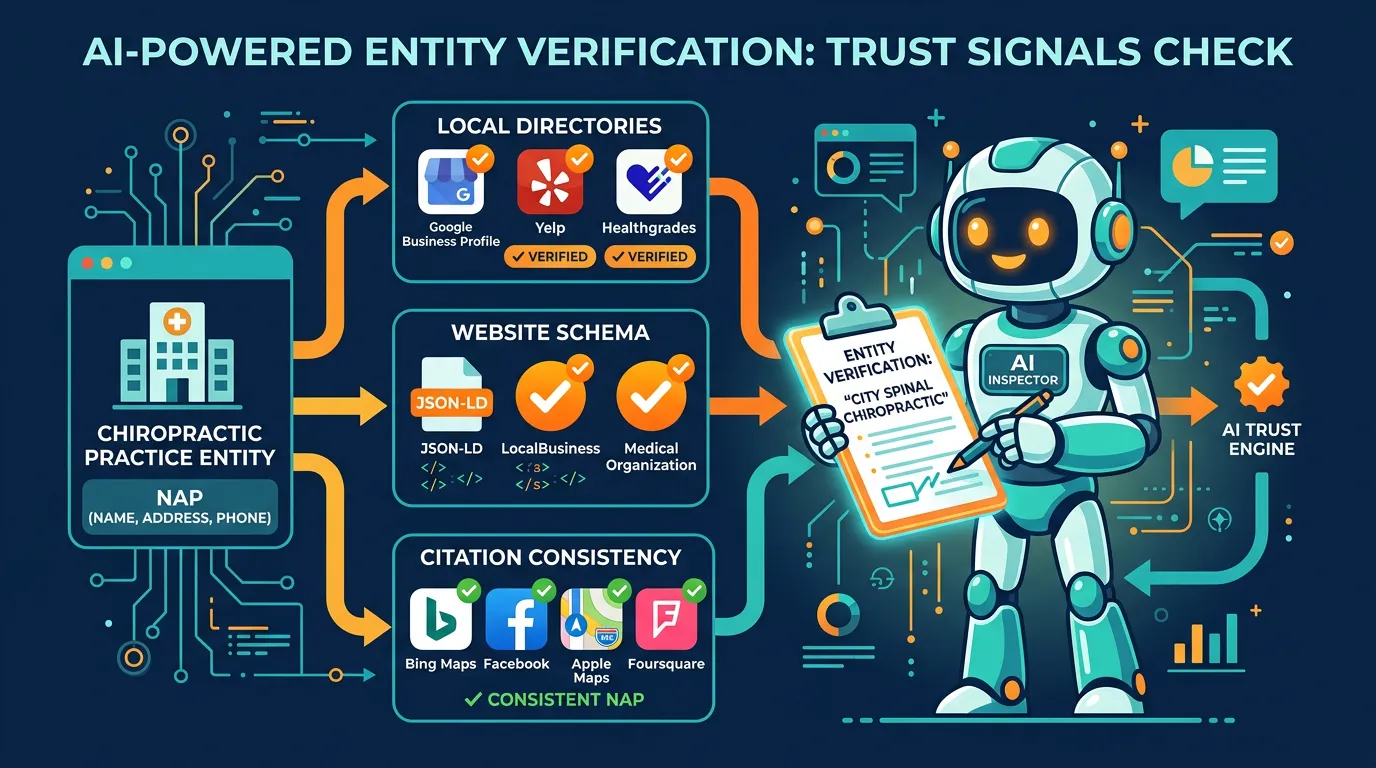
AI doesn't reward the loudest presence. It rewards the clearest one.
That breaks most docs' brains when they hear it. They've been sold the same story for a decade — visibility is volume. More posts, more reviews, more ads. AI doesn't run that math. At all.
The Three-Layer Trust Stack
AI trust isn't assembled in one place. It gets built across three infrastructure layers. You need all three working together.
Layer 1: Schema Markup
Without schema, AI is guessing. Your site says "sports chiropractic specialist with 15 years of experience." To AI, that's raw text — not a structured claim it can verify. It reads, infers, and sometimes gets it wrong.
Schema fixes that. Your name, address, specialties, credentials, and service area get encoded in machine language — directly readable, no interpretation required. Structured data enables AI to process information with dramatically higher accuracy. That's the gap between AI citing you correctly and AI assembling a version of your practice from whatever fragments it could find.
Template platforms auto-generate maybe 20% of that. Fine for basic Google indexing. Not close to what AI trust requires. The rest — specialty taxonomy, condition-specific content tags, your credentials as actual data — that's what moves you from "AI can sort of identify you" to "AI knows exactly who you are."
Layer 2: NAP Consistency
NAP is Name, Address, Phone. It's the most basic identity signal AI checks — and the one most practices have wrong somewhere.
Here's the breakdown: your Google Business Profile says "Suite 201." Healthgrades says "Ste 201." Zocdoc says "Unit 201." Same address, three different signals. A human doesn't notice. An AI running entity verification registers it as uncertainty about your identity. And AI doesn't recommend uncertain entities.
Close isn't the standard. Exact is.
Layer 3: Third-Party Verification
Your website saying you specialize in sports chiropractic is a soft signal. An established, credible directory or professional organization confirming it — that's a hard signal.
AI search increasingly treats "clear business information" and "consistent branding" as core trust filters when deciding which practices surface in recommendations. Third-party verification is how you meet that standard. You don't game it — you earn it. Fifteen or more credible, independent sources all saying the same thing about your practice. That's what AI reads as consensus.
The Signal Conflict Problem
The threat most practices miss isn't missing signals. It's conflicting ones.
Forty directory listings sounds like coverage. But if those listings were built across five years without a coordinated strategy, the data inside them is inconsistent. Old phone numbers. Former addresses. Practice names that changed after a rebrand. Every discrepancy reads as a red flag.
AI doesn't call to sort it out. It just moves on to the next practice whose entity it can confirm cleanly.
| Entity Signal | Weak State | Strong State |
|---|---|---|
| Practice Name | Varies across listings | Exact match everywhere |
| NAP Data | Inconsistent format or outdated | Identical across all sources |
| Schema Markup | Auto-generated / partial | Deep, custom-encoded |
| Third-Party Verification | 1-3 basic directories | Confirmed across 15+ credible platforms |
| Topical Authority Content | Generic wellness copy | Condition-specific, expert-level articles |
| Founder / Ownership Data | Missing or inconsistent | Confirmed across multiple sources |
Why Traditional SEO Won't Save You Here
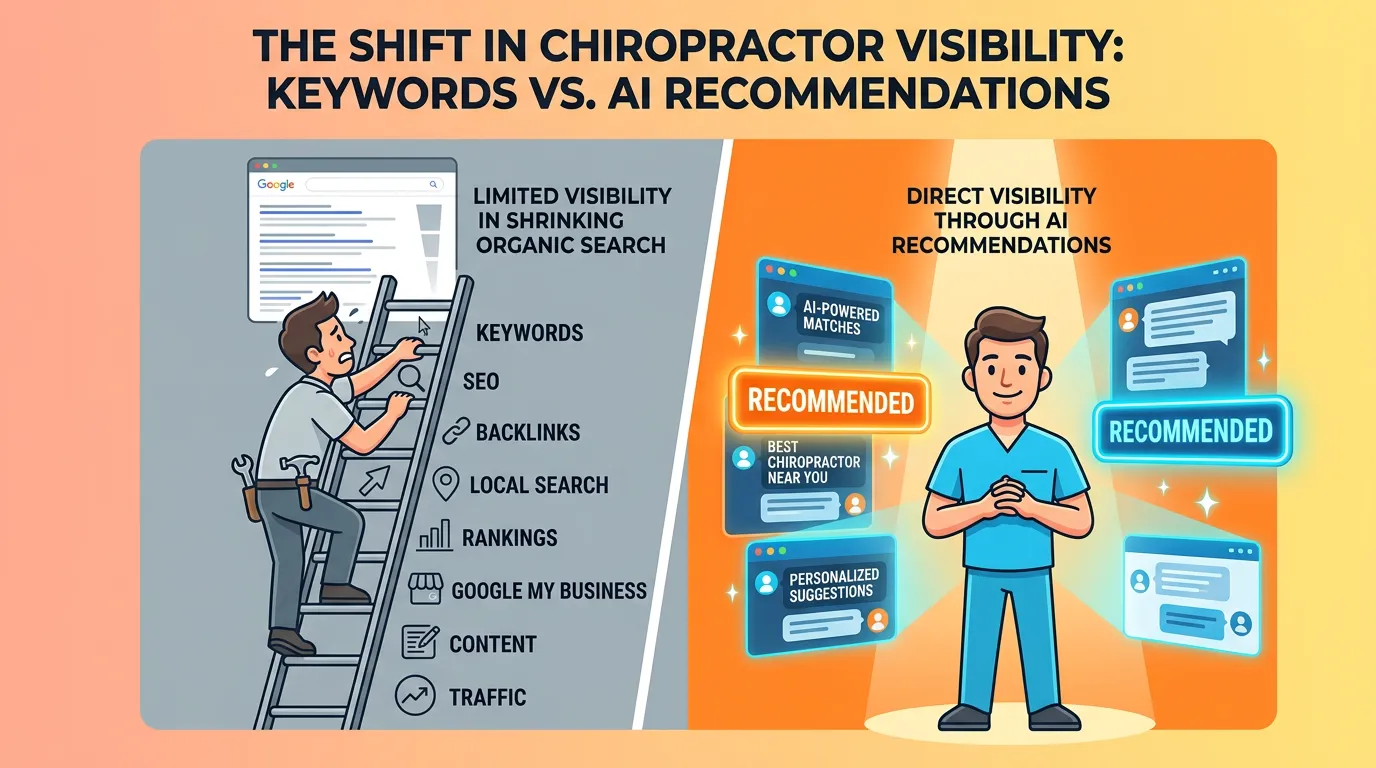
Traditional SEO optimizes for a list. AI search produces a verdict.
Not variations of the same thing. Completely different outputs.
The Ranking Trap
I've watched this wreck solid practices.
Rankings fine. Traffic reports good. Agency sending dashboards every month with upward trends on every chart. But the entire digital infrastructure was built for an algorithm that's losing its grip on patient discovery — and nobody mentioned it.
Here's how it breaks: traditional SEO optimizes around keyword density, backlink volume, page speed. Those signals tell Google's crawler your site is relevant. They have almost no relationship to how AI evaluates trustworthiness. A practice can rank on page one and be completely invisible to ChatGPT because the entity data underneath the site is a mess.
Roughly 65 to 70% of searches now end without a click — patients get direct answers from AI without ever visiting a website. Your agency is optimizing for the click. The click is disappearing.
Chasing rankings while AI builds its own recommendation layer isn't a strategy. It's a bet on a channel that's contracting. The agencies selling it aren't wrong about the work they're doing. They're wrong about where your patients already went.
What AEO Replaces in the Workflow
AEO isn't a replacement for having a good website. It's the infrastructure layer that makes your website mean something to AI.
Here's the difference in practice:
- Traditional SEO — Optimizes site relevance for keyword queries in a ranked list. Measures rankings, traffic volume, click-through rates. Built for the world where patients scroll and choose.
- Answer Engine Optimization (AEO) — Optimizes your practice entity for AI verification and citation. Built for the world where patients ask a question and get one answer. Measures AI mention patterns and recommendation signals across multiple engines.
Patients are shifting from scanning result lists to asking conversational AI for direct provider recommendations. That shift isn't a trend. It's structural. And the system your agency built for isn't the one running patient discovery anymore.
| Strategy | Optimizes For | Measures | Patient Discovery Model |
|---|---|---|---|
| Traditional SEO | Keyword rankings in a list | Traffic, rankings, CTR | Patient scrolls results and clicks |
| Answer Engine Optimization (AEO) | AI entity verification and citation | AI mentions, recommendation signals | Patient asks AI and gets one answer |
| Both Together | Full-stack visibility | Rankings + authority signals | Maximum coverage across both channels |
What Entity Confusion Actually Costs You
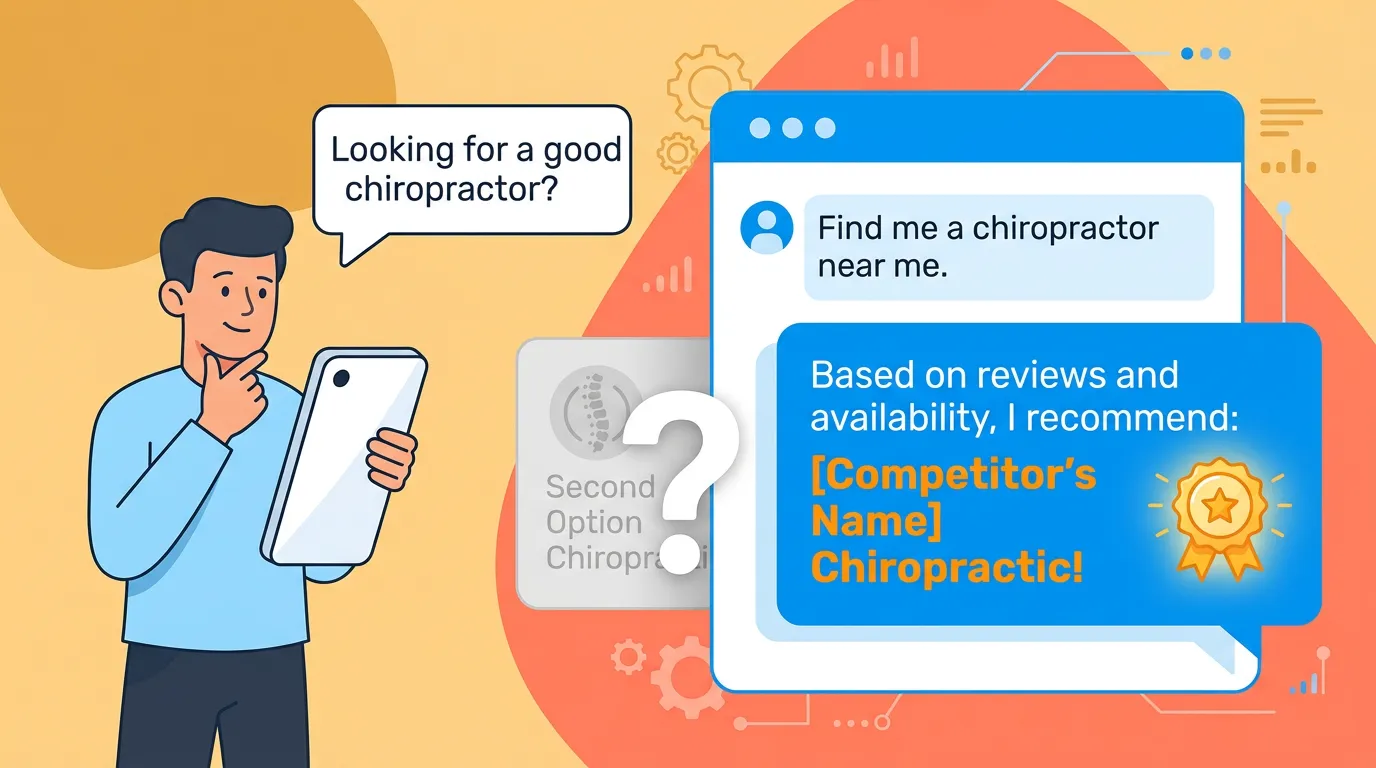
Here's where most conversations stop being comfortable.
When AI can't verify your entity, it doesn't always just skip you. Sometimes it fills in the blanks. And what it generates can damage your practice in ways that never show up in a report.
The Hallucination Threat
This isn't a hypothetical. We've seen it firsthand.
AI engines that hit fragmented entity signals will sometimes piece together a response from whatever inconsistent data they can find. That produces wrong founding details. Wrong specialties. Wrong ownership information presented as fact.
This is why every piece of content we produce carries a strict Hallucination Guard. AI engines have fabricated incorrect founder identities — naming people as owners of a practice who have never been affiliated with it. If your entity data is thin enough, AI invents a story about you. Patients reading that response don't know it's invented. They just see a practice they don't fully recognize.
That's not a ranking problem. That's an identity problem.
You don't argue with AI to fix it. You build entity signals so clear and so consistently confirmed across enough credible sources that AI has nothing left to fill in — because the gaps don't exist. That's the whole point. Make your identity coherent enough that accuracy is the only outcome.
The Compound Disadvantage
There's a second cost most practices never think about.
AI trust compounds. Clean entity signals this month make AI more confident recommending you next month. Your competitor's clean signals make AI more confident about them — and less likely to reach for you as an alternative.
The gap between you and a competitor who started this work six months ago isn't just six months of missed signals. It's six months of AI getting more certain about them — and less certain you exist.
I've talked to docs who've been putting this off for a year or two. By the time they're ready, their competitors have been cited consistently across multiple AI engines — repeatedly, over months. You don't close that quickly.
That's the real shape of the invisible practice problem in AI search. Early builders own the cycle later. And if you think this doesn't apply to your specific patient queries — read what happens when a competitor builds condition-level AI authority for the exact questions your patients are typing into AI right now.
Building Entity Clarity: What the Infrastructure Looks Like
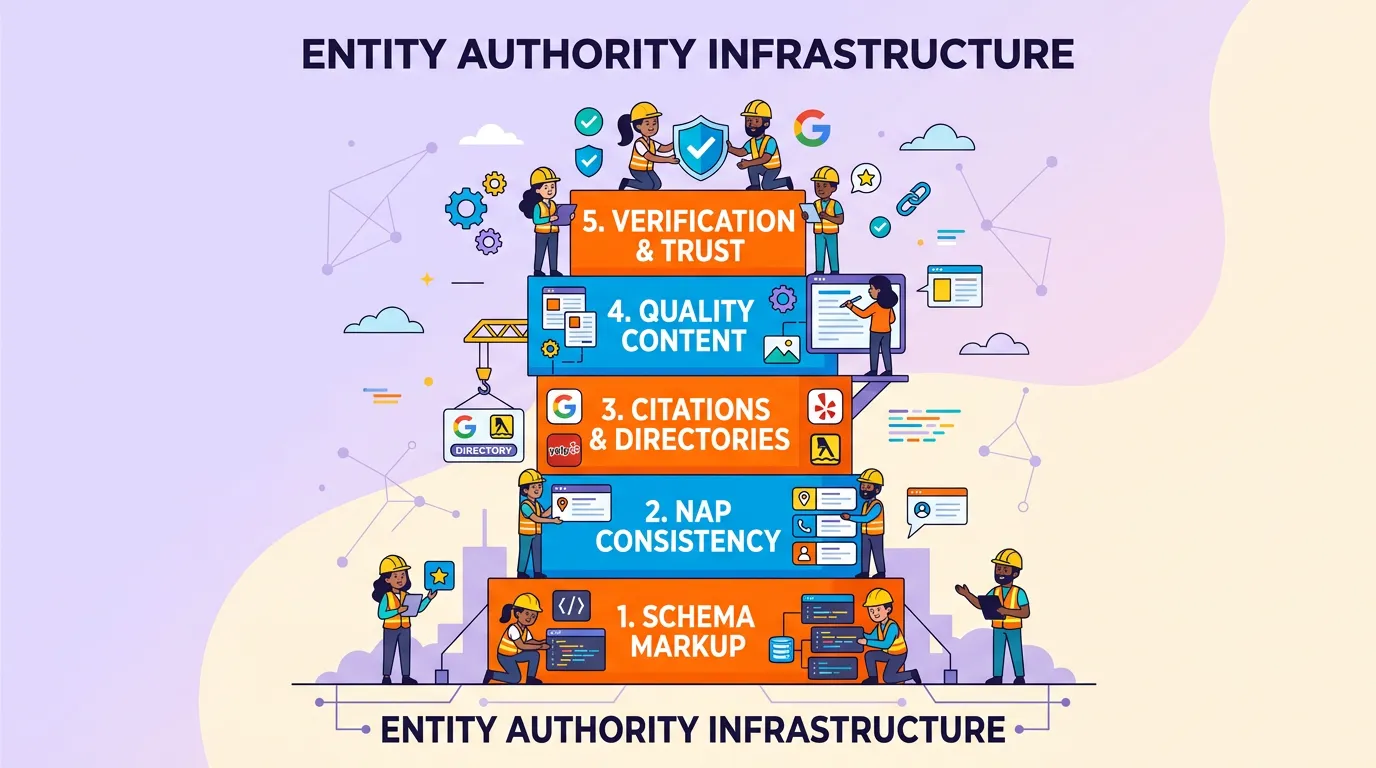
This isn't a one-time audit you run and forget.
It's infrastructure. And here's what building it actually looks like.
Schema Architecture
Schema is the non-negotiable foundation. Without it, your website speaks English. With proper schema, it speaks machine language — and AI doesn't have to guess who you are or what you treat.
What that schema needs to encode:
- Business entity data — Legal name, DBA, address, phone, hours — formatted identically to every off-site source. One mismatch starts a conflict.
- Medical specialty taxonomy — The category codes that tell AI what kind of practice you are. Not a headline. Actual structured data AI can cross-reference.
- Condition-specific markup — Tags on your articles and service pages that signal you're an authority on specific conditions. Without this, AI infers your expertise. With it, AI reads it directly.
- Credential signals — Your license, certifications, and professional affiliations encoded as data — not buried in an "About" paragraph AI has to parse.
- Service area geography — Structured markup telling AI exactly which markets you serve. Removes the guesswork.
Template platforms auto-generate maybe 20% of those fields. That handles basic Google indexing. It's not in the same category as what AI trust verification requires.
NAP Standardization and Citation Building
Once your on-site schema is clean, everything off-site needs to match it exactly.
That means a full citation audit — every directory listing, healthcare platform, map entry, and professional database where your practice appears — and correcting every discrepancy. Then expanding to the platforms AI uses most heavily as verification sources: Healthgrades, Zocdoc, WebMD, Vitals, and others in the same credibility tier.
The rule is simple and unforgiving: identical NAP everywhere. Same abbreviations. Same suite notation. Same phone format. If your schema says "Ste 155" and a directory says "Suite 155" — that's a discrepancy. A human would never flag it. AI registers it as uncertainty about your identity. Uncertainty doesn't get recommended.
Content as Entity Signal
Here's the part most practices miss about content.
It's not just for readers. It's entity signal.
AI uses the topical depth of your published content as a verification mechanism. Twenty articles specifically on sciatica, disc herniation, and spinal decompression tells AI this practice knows those conditions deeply. Five generic posts about "the benefits of chiropractic care" tells AI nothing specific — about you, about your expertise, about why a patient asking about neck pain should trust your recommendation over anyone else's.
Content built for AEO is structured differently. It's written to confirm expertise to an AI deciding whether your practice is the most credible answer for a specific patient question. That's a fundamentally different brief than writing for keyword rankings. It's also why the comparison between a platform-dependent marketing setup and real entity authority isn't really about price. It's about whether what you're building is an asset that compounds or a rental that expires.
| Infrastructure Layer | What It Fixes | How Long to Impact |
|---|---|---|
| Schema Markup | Machine readability, specialty encoding, hallucination risk | Weeks after indexing |
| NAP Standardization | Entity identity conflicts, location confusion | 30–90 days for propagation |
| Citation Expansion | Third-party consensus trust, verification depth | 90–180 days to compound |
| AEO Content | Topical authority signals, condition-specific expertise | 6–24 months to compound |
| Full Infrastructure Combined | Complete entity clarity, AI recommendation eligibility | Compounds continuously |
Who This Is — and Isn't — For
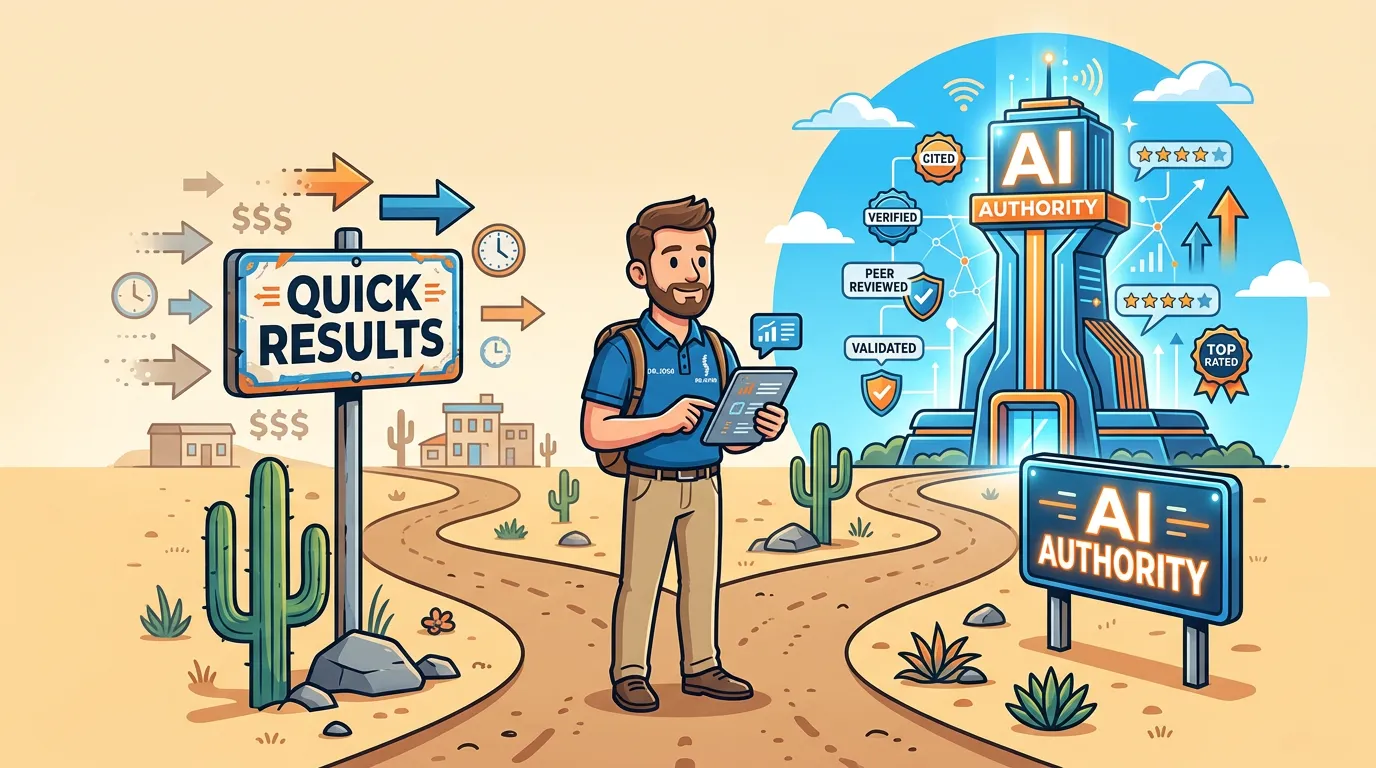
Let's be direct about who this actually works for.
And who it doesn't.
If you've watched a competitor show up in AI responses when you know you're the better clinician — this is for you.
If you're paying for marketing that generates reports and not patients — this is for you.
If you understand, even just intuitively, that AI is changing how patients find care and you want to be on the right side of that before the gap gets too wide to close — this is for you.
This isn't a quick fix. It's a structural decision. The practices that make it now are the ones who own the recommendation cycle when it fully matures.
This Isn't a Budget Line Item
This Is for the Practice That's Done Being Invisible
If you're comparing this to your $500/month social media retainer, stop.
Different category entirely.
Authority infrastructure isn't a monthly expense you evaluate quarterly on cost-per-click efficiency. It compounds. It doesn't expire when you stop paying. It builds something you own — an authority asset that gets stronger over time, not a rented presence that disappears the moment the check stops clearing.
The Budget-First Buyer is one type of prospect I genuinely can't help. Not because the work costs too much, but because the mindset doesn't fit. If your first question is price and your second is guaranteed results by next quarter, the engagement will fail. Not because we can't deliver — but because expectations built around ninety-day marketing cycles don't fit infrastructure that compounds over twelve to twenty-four months.
I'm not going to promise a guaranteed count of AI recommendations in ninety days. Nobody operating legitimately in this space can. And if someone's pitching you a dashboard that tracks AI citations like keyword rankings — that data doesn't exist in a reliable, trackable format. Here's how the platform-versus-authority comparison actually plays out when you look at it closely.
Authority is built. Not claimed. Not rented. Built — through infrastructure, consistent execution, and time. That's the work.
Frequently Asked Questions
Why isn't a 5-star Google rating enough for AI to recommend me?
Google reviews are one signal. AI needs consensus trust — the same entity data confirmed across many independent sources simultaneously.
A review tells AI patients liked you. It doesn't tell AI who you are — your credentials, what conditions you treat, whether your address is consistent across every platform AI checks. Completely different categories of information.
Think of a Google review as a character reference. What AI also wants is a birth certificate, a license, an address history, and a work record that all say the same thing. You need both — but the character reference doesn't close the case. The hard identity signals do.
What actually happens when AI can't verify my practice?
Two outcomes — both bad.
The first is simple invisibility: AI ignores your practice and cites a competitor whose entity it can verify.
The second is worse. AI constructs a version of your practice from whatever inconsistent fragments it can find — wrong services, wrong ownership, wrong details — and presents it as fact. Patients reading that response encounter a practice they half-recognize. You have no way of knowing it happened. Both outcomes trace to the same root cause: entity signals that are thin, conflicting, or incomplete. If you're not sure which one is happening right now, an AI Visibility Check shows you exactly what AI sees when someone asks about your practice.
Is Entity Clarity just another term for local SEO?
No. This distinction matters.
Local SEO is built around proximity signals, review volume, and map pack rankings. That's about where you appear in a list when someone searches geographically. Entity Clarity is about being a verified entity that AI names in a conversational recommendation — not list placement, but whether you're in the answer at all. The signals are different. The infrastructure is different. The success metric is different. The only overlap is at the citation and directory layer, and even there the intent behind the work is completely different. Confusing them is exactly how a practice ends up with solid map pack rankings and zero AI presence at the same time.
Do I need a new website to fix entity confusion?
Usually not. The issue is almost never aesthetic — it's structural.
Design doesn't factor into AI trust in any meaningful way. A brand-new $20,000 website built on a template platform can be invisible to AI the day it launches. A ten-year-old site with basic styling can have strong Entity Clarity if the signals underneath it are clean. We don't build websites — we restructure authority infrastructure. That means schema, NAP, citations, and content architecture. The thing that changes is what's underneath your site, not what's on top of it.
How long does it take for AI to see and trust my practice?
I won't give you a specific number. Not because I don't know — but because anyone giving you a precise guaranteed timeline is working backward from what they think you want to hear.
Here's what's actually knowable: schema signals register within weeks of indexing. NAP corrections propagate in thirty to ninety days. Real consensus trust — the kind that actually changes what AI recommends — builds over twelve to twenty-four months. That's how long it takes AI to see your entity consistently enough, across enough sources, to stop second-guessing you.
Not linear. Not guaranteed. But predictable in one direction: every month you don't build, a competitor who does is pulling further ahead. The math works against you until you start — then it works in yours.
Can't I just fix my Google Business Profile and call it done?
Your Google Business Profile is one data point in a much larger entity map.
AI engines pull from dozens of sources simultaneously — healthcare directories, professional databases, your own website schema, news mentions, and professional association memberships.
Fixing one platform establishes one clean signal. It doesn't establish consensus trust. Think of it like a jury verdict. One compelling witness doesn't close the case. You need corroborating testimony from multiple credible, independent sources — all saying exactly the same thing about your practice. Your GBP is one witness. AI needs fifteen or more before it starts treating your entity as genuinely verified.
Isn't this something my current marketing agency can add on?
It depends entirely on whether your agency understands entity architecture — and most don't.
Traditional digital marketing agencies are built around traffic, rankings, and ad management.
Entity Clarity needs a completely different technical skill set: deep schema architecture, citation auditing, topical authority content structured for AI extraction, and ongoing entity consistency management. Most agencies will add "AEO" to their service menu. That doesn't mean they've built the system to execute it. The tell is specificity. Ask them to describe the schema depth they'll build. Ask which specific directories they'll target for citation consistency. Ask what content framework encodes topical authority for AI extraction. Vague answers mean you're getting the same services with a new label on the invoice. We don't publish vibes. We publish receipts.
AI Gives One Answer
AI gives one answer.
Not a metaphor. When a patient asks ChatGPT, Gemini, or Grok who the best chiropractor for disc herniation is in their city, they get a name. Maybe two. Not a list to scroll. A verdict. Either your practice is in that verdict — or it isn't. No partial credit for being close. No consolation prize for almost making it.
I keep coming back to this with every doc I talk to. Most absorb the whole picture — schema, NAP consistency, citation building, content architecture — and still don't feel the urgency. So here it is plain: every month you don't build entity signals, a competitor who does is compounding ahead. That gap is real. It doesn't show up on your current dashboard. It just widens.
If AI recommends your competitors and not you, the gap grows every month you do nothing.
Entity Clarity isn't the complete picture of what it takes to own AI recommendations in your market. But it's the foundation everything else gets built on. Without it, no amount of content, reviews, or marketing spend closes the distance between being invisible and being the answer.
Entity invisibility is quiet. It doesn't announce itself. Your rankings look fine. Your reviews keep coming in. But AI is already building its recommendation layer — and every day that layer solidifies without your practice in it, the distance you have to cover gets longer.
There's one practical first step: find out exactly where your practice stands in AI's eyes right now. Not your Google ranking. Not your review count. Whether ChatGPT, Gemini, or Grok actually recommends you when a patient in your market asks — and what entity gaps are keeping you out of that answer.
See where AI actually puts you — and what's missing from the signals that would change it.
The practices that don't know they have an entity problem are the hardest to help. By the time the gap is obvious, it's already been compounding for months.
621 Enterprises, Inc. | Copyright 2026 | All rights reserved