What Changes When an Account Moves From a Founder's Desk to a Junior Handler's Queue

Here's the thing: the handoff itself is dead simple. A founder sells the engagement, then somebody else does the work.
And that swap changes who owns the strategic calls on the account. Who picks up the phone is the least of it.
The Handoff Mechanism, Defined
The classic agency bait and switch is a familiar story. You're sold by the experienced founder but your account is managed by a junior employee.
So the junior inherits a strategy they never built. They're working from the notes, not from the thinking that produced them.
What Was True About This in the Old Search Model
Let's keep it real: in old-school search work, this handoff was clunky but rarely fatal. Most of the job was a repeatable checklist.
A checklist survives a handoff reasonably well, because the steps don't depend on who runs them. That same tolerance doesn't hold once the comparison shifts to boutique firm versus large agency for clinic authority, where strategic judgment, not task completion, decides whether an entity's file stays coherent.
Why the Checklist Model of Account Management Fails Generative Search
Here's the problem with the checklist model: it treats account management like a stack of repeatable chores. Add the structured data, update the profiles, publish the articles on schedule. And it assumes whoever runs those steps never needs to know why they were picked in the first place.
Why Rankings as a Metric Break Down as an Operating Model
A results-page position number only told you where a business sat in a list somebody could scroll right past. It never told you whether an engine would name that business inside a generated answer.
Now… that gap hits hardest on enterprise-scale entity data, the messy kind generative systems may parse to decide what a business is and does. Bodensohn et al. (DFKI, TU Darmstadt and SAP, 2025), testing LLMs on enterprise database tables, found LLMs may perform well on public benchmarks but can perform poorly in real-world enterprise settings. And a business entity is no tidy benchmark, because it's live, inconsistent, and passed between people who each read the file a little differently (which is exactly where that gap shows up).
How a Checklist Handles Repetition but Not an Entity
A checklist survives repetition because the task stays the same regardless of who runs it. An entity doesn't survive the same way, because every handler leaves a trace in how the business is described. However, in the new era of generative AI answers, the person managing an account isn't just executing a checklist; they are defining that business's entire digital entity. Spotting that shift early starts with knowing what spotting a silent handoff from founder to staff actually looks like from the outside.
What the Data Actually Shows About Entity Consistency and AI Overviews
That case file analogy holds up once you look at the data. Every sloppy note makes the next diagnosis worse, and generative engines may read a business record the exact same way.
The Share of Queries Where AI Overviews Now Lead
Here's the kicker: the share of queries where this matters isn't a fringe slice anymore. Grossman et al. (NJIT), in a 2026 benchmark of 11,500 queries, found AI Overviews appeared above organic results for about half (51.5%).
How Strategic Drift Degrades an Entity's Knowledge Graph Over Time

Strategic drift occurs when the day-to-day execution of a campaign loses touch with the high-level business objectives it was designed to achieve. In an entity file, that drift shows up as small contradictions that compound rather than correct themselves.
The Mechanism by Which Drift Accumulates
A handler who didn't write the original strategy inherits terminology choices without inheriting the reasoning behind them. Each small substitution, a renamed service, a dropped phrase, a reworded description, may read to a generative system as a new fact rather than a continuation of an old one. Publishing more of that inconsistent material doesn't resolve the contradiction; it multiplies the places where it appears.
What More Content Does Not Fix
Volume may never have been the variable generative systems were weighing. More pages may not repair a file an engine already finds inconsistent. That is the problem our done-for-you AEO services are built to solve, by keeping the strategy behind the content from resetting mid-engagement.
The Architecture of a Founder-Consistent Entity Signal
Strategic consistency isn't a soft virtue here. It's an architecture.
The entity case file only strengthens when the same hand keeps writing it, checking new entries against what's already on record before adding another.
| Structural Element | Founder-Consistent Pattern | Junior-Handoff Pattern |
|---|---|---|
| Terminology & Naming | Service names, positioning language, and descriptive phrasing stay fixed across every published surface, because one strategic voice decides the wording and never reinterprets it. | Terminology shifts each time a new handler inherits the account, since each person rewrites descriptions in their own words without reference to the original reasoning. |
| Structured Data Decisions | Organization structured data choices are set once against a clear strategic rationale and extended consistently as new content is added. | Structured data choices get revisited piecemeal by whoever currently holds the account, introducing small contradictions the original strategy never intended. |
| Strategic Objective Alignment | Day-to-day execution stays tied to the high-level objectives the engagement was built around, because the person executing is the person who set those objectives. | Execution drifts away from the original objectives over time, since the handler carrying out the work wasn't present when those objectives were defined. |
| Entity Record Continuity | Every new piece of published content checks against what's already on record, so the entity file reads as one continuous account. | Every handoff introduces a handler who hasn't read the full prior record, so new content risks contradicting what's already published. |
What Stays Fixed When One Strategic Voice Owns the Account
One strategic voice keeps terminology locked across every surface a generative system reads. Service names, positioning language, and structured data choices stop drifting, because nobody's reinterpreting them mid-engagement. That fixed vocabulary lets an entity file read as one continuous record instead of a pile of handoffs stitched together after the fact. That takes continued founder involvement throughout the engagement.
Where Structured Data and Account Continuity Intersect
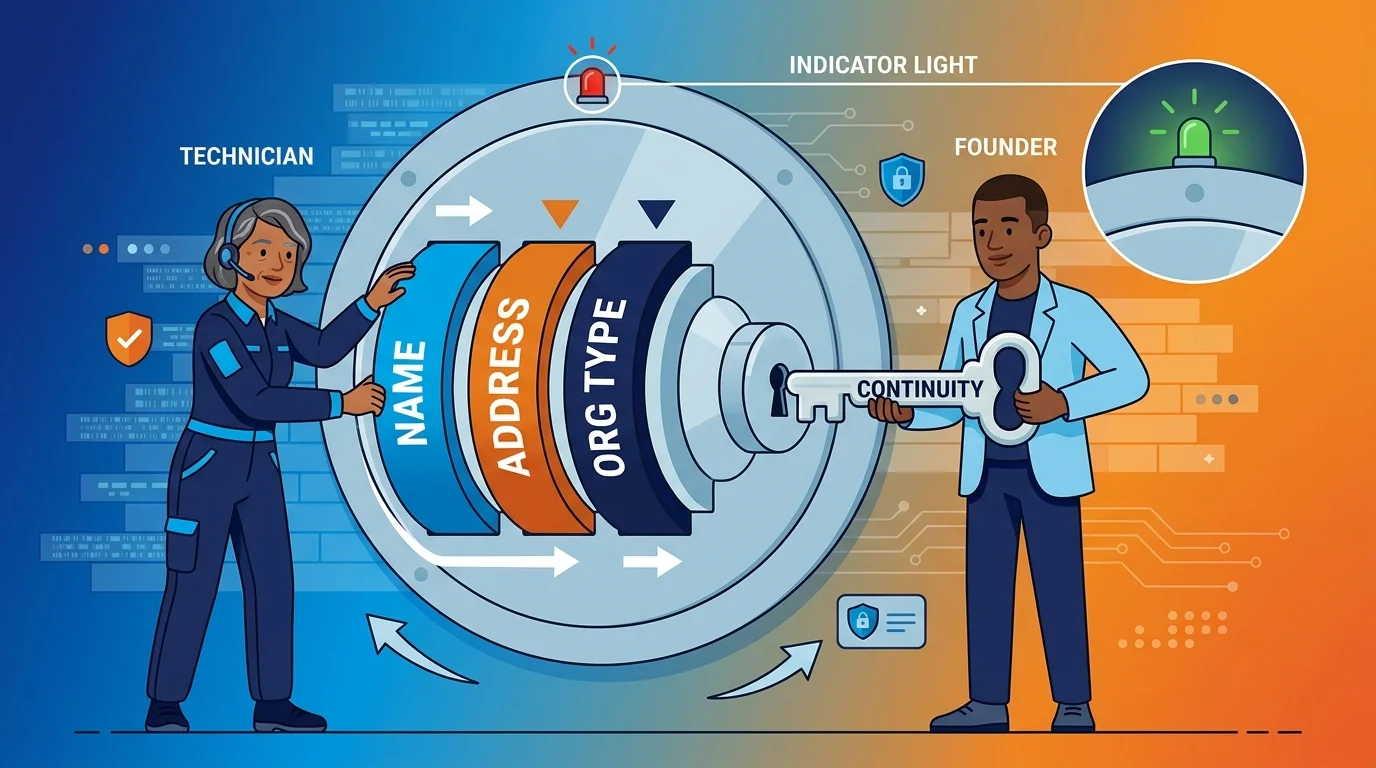
Here's where it gets granular: structured data is the most technical layer where continuity either holds or breaks. One half is a markup choice, and the other half is a judgment call about who keeps that markup honest over time.
| Structured Data Field | Why It Matters to Disambiguation |
|---|---|
| Organization Name and Legal Name | A generative system needs a stable label to match a business against every other mention of it. A handler who renames or reorders the entity's name mid-engagement breaks that match. |
| Address and Service Area Fields | These fields anchor a business to a physical or service footprint an engine can disambiguate against competitors. Outdated fields left unchecked after a handoff tell an engine something that is no longer true. |
| sameAs Profile Links | This field ties the entity to its presence across other verified surfaces, reinforcing that every mention points back to one record. A handler unfamiliar with which profiles were already declared can leave the set incomplete or contradictory. |
| Service or Specialty Descriptions | The wording here is what an engine reads to understand what the business actually does. A new handler reinterpreting that wording without the original reasoning introduces a description that reads as a different entity. |
| Administrative Contact Details | These details give an engine a verifiable point of record behind the entity. Continuity here depends on someone recognizing when a detail changes and updating it deliberately, not by accident. |
What Organization Structured Data Actually Tells an Engine
Organization structured data on a home page is a straight-up declaration of administrative fact. Adding organization structured data to a home page can help Google better understand an organization's administrative details and disambiguate it in search results.
Why Disambiguation Depends on Who Maintains the Markup
Now… disambiguation only holds if the markup stays accurate as the business changes, and a handler without the original context can leave stale fields sitting there without ever spotting the drift. Google's documentation says adding organization structured data to a home page can help Google better understand an organization's administrative details and disambiguate it in search results (this covers Google Search). That's where continuity can fail first, because markup errors may stay invisible until an engine misreads the entity behind them.
Frequently Asked Questions
These questions come up every time this handoff pattern gets named out loud. Here's what's worth knowing before the next account review.
What changes operationally when an account manager is swapped without notice?
The person who made the terminology and positioning calls stops enforcing them. Then structured data fields, service descriptions, and published pages start drifting. Nobody decided to change any of it, it just slid.
How does entity consistency specifically affect inclusion in AI Overviews?
Generative engines may pull from entity records that read as coherent, not just current. A business that describes itself differently across its own pages has a problem. An engine gets less reason to treat it as a confirmed, citable source.
What is strategic drift and how is it measured in an account?
Strategic drift is the gap between an account's original objectives and what its day-to-day execution actually produces. It shows up as small contradictions in terminology, structured data, and published content that accumulate rather than resolve.
Why did checklist-based account management work under the old search model?
Checklist-based management worked because ranked-link visibility rewarded task completion over judgment. A junior handler could follow steps correctly without understanding the reasoning behind them, and the results still held.
What does organization structured data actually change for a business entity?
Organization markup on a home page declares administrative facts engines may use to disambiguate a business. Skip maintenance through a handoff, and that markup goes stale. It still looks technically present the whole time.
The Bottom Line
In our view, founder-led consistency compounds entity authority over time, and a junior staff handoff risks resetting it back to square one.
Your practice's entity case file only gets stronger when the same hand keeps writing it. Break the continuity, and the file breaks right along with it. That's the real choice hiding under every structured data decision, every reworded service description, and every handoff you never saw happen.
Founder-led consistency is, in our view, the operating condition generative engines reward, and loyalty has nothing to do with it. So if you want to know where your own entity file stands right now, get a straight answer through an AI Visibility Check.