The 100-Website Realization
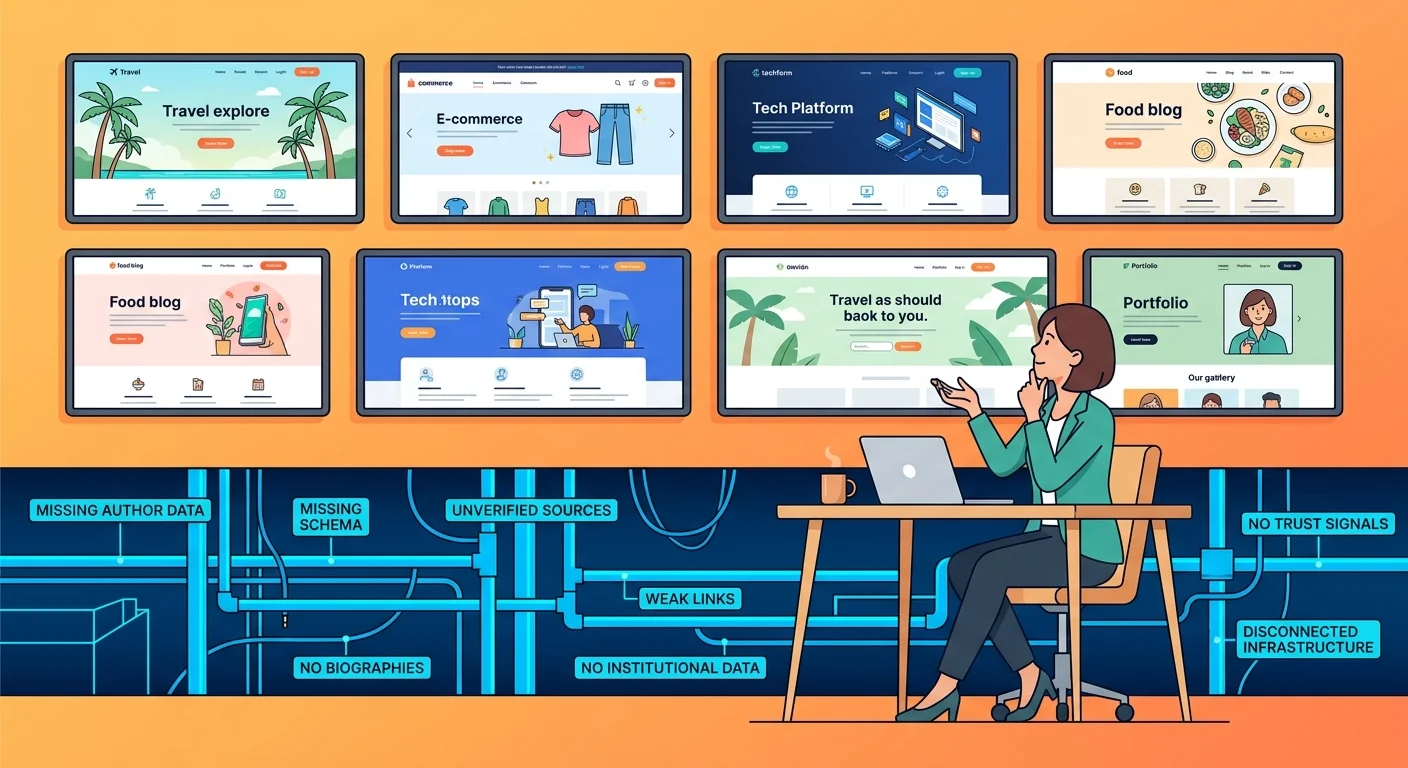
Pretty doesn’t matter if the machine can’t read it.
I learned that after building 100+ websites. Every single one started the same way. Client wanted modern design. Clean branding. Professional photography. We delivered. The site looked incredible. Launch day felt like a win.
Three months later? Same conversation. “Traffic’s up, but the phone isn’t ringing.”
Six months? “We’re ranking for our keywords, but competitors are getting the bookings.”
The Pattern I Kept Seeing
Beautiful homepage. Strong branding. Custom photography. Mobile responsive. Fast load times. All the boxes checked.
Zero machine-readable infrastructure.
No schema markup telling AI what the business actually does. NAP data inconsistent across directories. Content structured for humans to skim, not for AI to parse and validate. Internal linking that looked good visually but established no topical hierarchy.
These sites were digital brochures. They worked great if someone already knew the business name and typed it directly into Google. They failed completely at the one job that actually mattered-being discoverable and trustworthy to the mechanisms patients use to make decisions.
- Beautiful design – Awards won, client satisfaction high, conversion rate stayed flat
- Mobile responsive – Perfect on every device, zero impact on AI visibility
- Fast load times – Technical scores maxed out, AI couldn’t validate the entity
- Professional copy – Read great to human eyes, so generic AI couldn’t determine specialization
Clients loved the design. Agencies collected monthly retainers. Revenue stayed flat.
That gap-between client satisfaction with aesthetics and the complete absence of results-that’s the friction I couldn’t ignore anymore.
When “Award-Winning” Means Nothing
I’ve seen sites win design awards that AI couldn’t read at all.
The disconnect is structural. Human eyes see beautiful layouts, compelling copy, professional imagery. AI sees missing entity signals, unverified claims, and a beautiful website that AI cannot read.
When ChatGPT tries to recommend a chiropractor and your site has no schema markup, no consistent directory presence, and content so generic it could describe any practice in any city-you’re not in the conversation. You’re not even on the list. You’re invisible.
The irony? Some of the ugliest sites I’ve seen-outdated designs, clunky navigation, amateur photography-rank higher in AI recommendations because they accidentally got the infrastructure right. Consistent citations. Structured data. Content that demonstrates specific expertise instead of vague “we care about you” platitudes.
Aesthetics became a red herring. A distraction from the actual mechanism that determines whether a business gets recommended or forgotten.
The Revenue Plateau No One Could Explain
Traffic targets hit. Keyword rankings achieved. Bounce rate optimized. Time on site up. Every metric trending green on the monthly report.
Bookings? Flat.
Agencies pointed to “industry changes.” “Increased competition.” “Market saturation.” Always external factors. Never the possibility that the methodology itself was the problem.
I watched businesses spend $50,000 on a website redesign and see zero revenue impact. I watched practices double their monthly ad spend and get the same number of calls. The math stopped working, and no one in the industry wanted to admit why.
The mechanism had changed. Patients stopped clicking through lists of search results to compare options. They started asking AI for a single trusted recommendation and booking with whoever got named.
If your business wasn’t that name, all the traffic in the world didn’t matter.
The Hopium Cycle
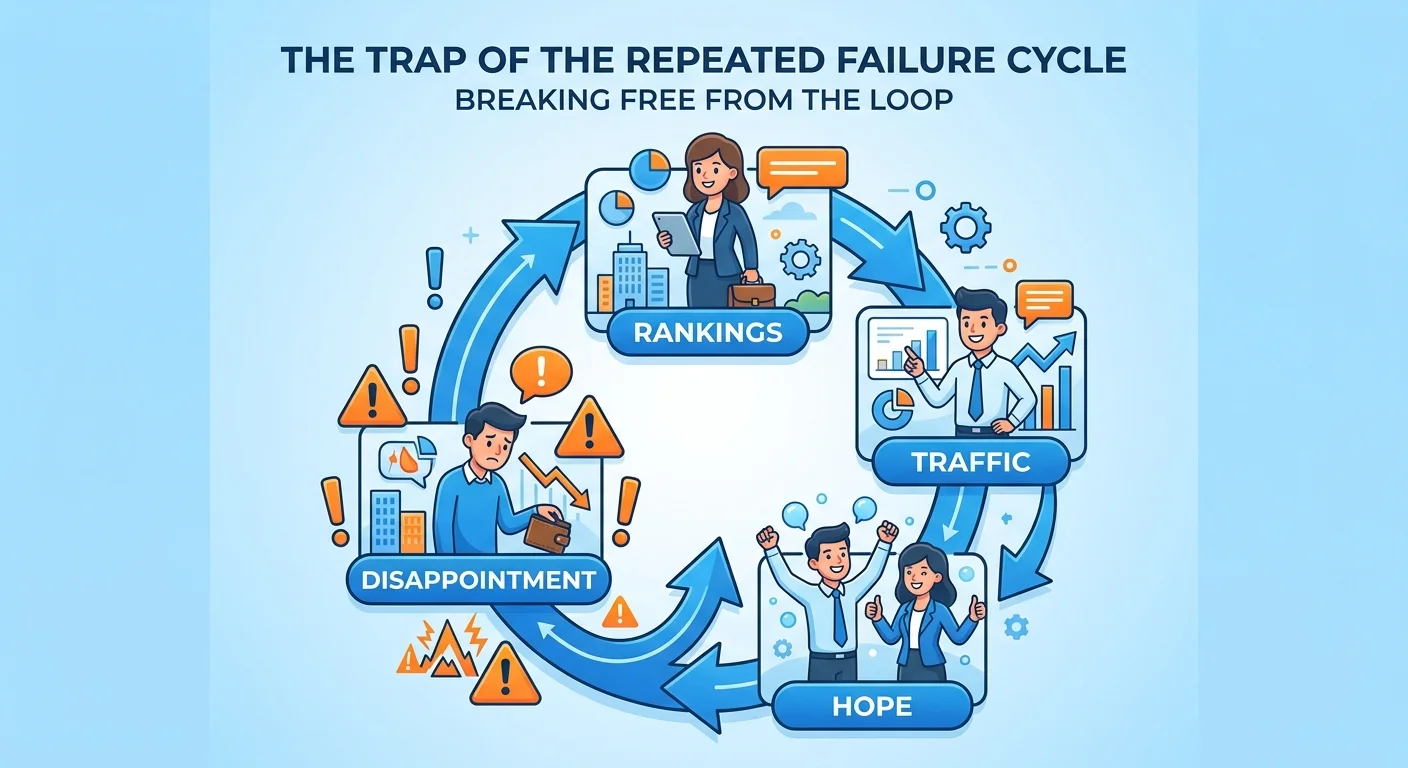
The industry runs on a cycle. Promise results. Deliver metrics. Blame external factors when revenue doesn’t move. Upsell a new service. Repeat.
I watched it for two decades. Different agencies. Different tactics. Same outcome.
Why Marketing Agencies Sell What’s Hot
The business model is simple. Sell recurring services. Lock clients into 12-month contracts. Report on metrics that look impressive but don’t correlate to bookings.
When SEO was the hot thing, agencies sold SEO packages. Rankings became the goal. Get to page one, and patients will flood in. Except they didn’t. So agencies added “conversion optimization” as an upsell.
When social media exploded, the same agencies rebranded as social media experts. Now it was about engagement, followers, impressions. Revenue still flat. So they added “content marketing” as the next layer.
Now AI’s the buzzword. Same agencies slap “AI-powered SEO” on their service menu and charge more for the exact same broken tactics they’ve been running for years.
According to McKinsey & Company, generative AI is creating a “new battle for search.” Agencies are framing that as an opportunity to upsell more services. Not as a fundamental rethinking of the entire methodology.
It’s hopium. Sold in 12-month contracts with impressive-sounding deliverables that don’t move the number that matters.
The Metrics That Don’t Correlate to Revenue
Impressions. Clicks. Bounce rate. Time on site. Pages per session. Keyword rankings.
These are lagging indicators of visibility in a system patients no longer use to make decisions.
I’ve seen practices with 10,000 monthly website visitors get 12 phone calls. I’ve seen e-commerce brands rank #1 for their primary keyword and lose market share to a competitor that didn’t even show up on page one.
The cognitive dissonance was brutal. Agencies celebrated “wins” in the metrics. Clients nodded along because the charts looked good. Revenue didn’t move.
Nobody wanted to say it out loud: the metrics we were measuring had stopped predicting outcomes.
- Impressions – How many people saw your listing in search results. Doesn’t matter if they’re not clicking.
- Clicks – How many people visited your site. Doesn’t matter if they leave without booking.
- Bounce Rate – Percentage of visitors who left without interacting. Optimizing this doesn’t create demand.
- Time on Site – How long visitors stayed. Great if they’re reading. Useless if they’re confused and trying to figure out what you actually do.
- Keyword Rankings – Where you show up in a list. Completely irrelevant if patients aren’t looking at lists anymore.
All of these metrics were accurate. All of them were being gamed. None of them connected to the real question: “Did the phone ring?”
I Watched This for Two Decades
E-commerce brands spending $10,000/month on Google Ads with a 0.8% conversion rate. Agencies called that “industry standard.” It wasn’t an industry standard. It was a broken funnel no one wanted to fix because monthly retainers were easier to sell than structural rebuilds.
Service businesses with 15,000 monthly visitors converting at 0.5%. Twelve phone calls. Agencies blamed “low intent traffic” and recommended more content marketing. The real problem? The content had no semantic density. AI couldn’t validate the claims. The site wasn’t building entity trust-it was adding noise.
I saw this pattern across industries. SaaS companies. Local service providers. Healthcare practices. Different markets, same cycle.
Promise rankings. Deliver traffic. Revenue stays flat. Upsell another layer. Blame the algorithm when it doesn’t work.
The honest answer nobody wanted to hear: the entire premise was wrong. SEO was built for a world where patients compared options from a list. That world doesn’t exist anymore.
Why Traffic Became a Vanity Metric
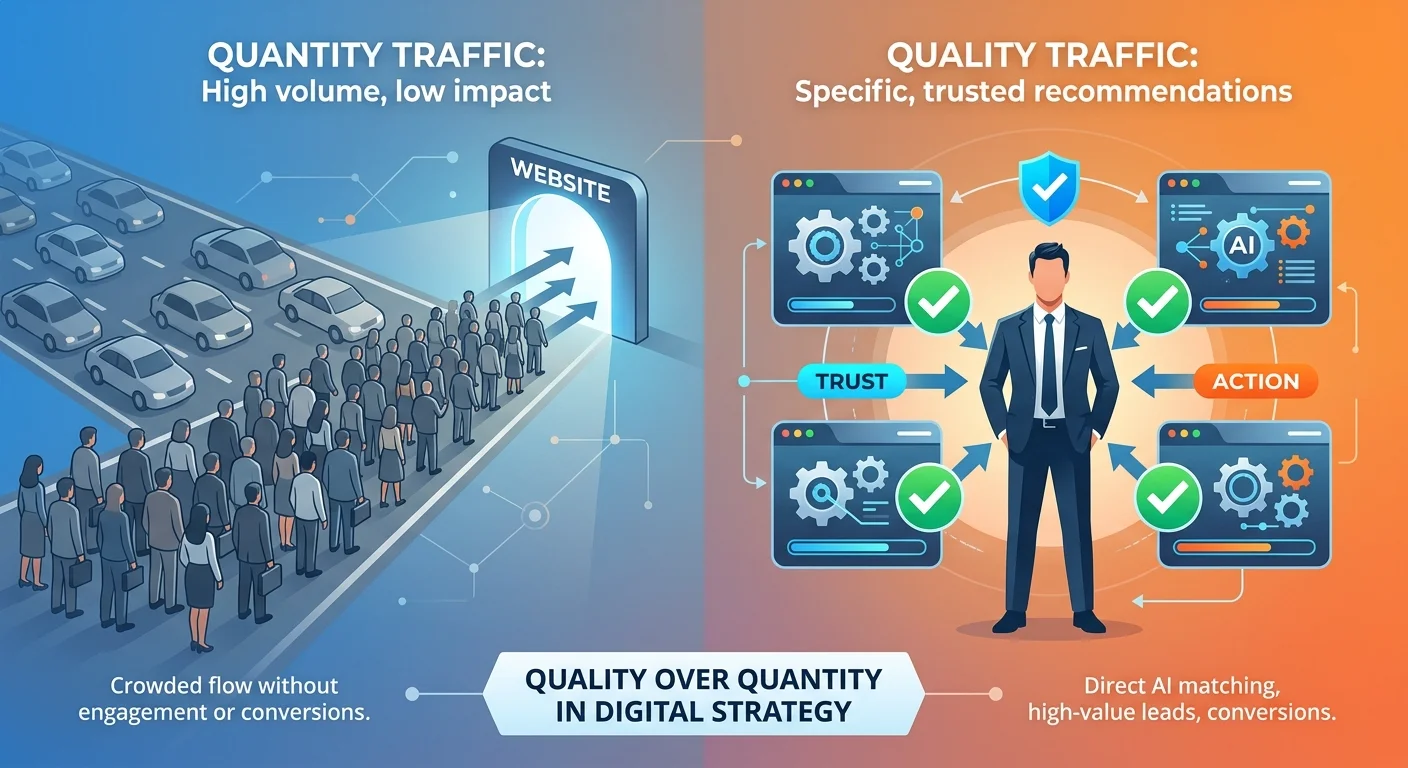
High traffic. Low conversions. That was the pattern that broke the industry.
It wasn’t laziness. It wasn’t bad execution. It was a structural shift in how patients make decisions.
The Zero-Click Search Problem
Patients used to Google a question, see ten blue links, click through three or four sites, compare options, then decide.
Now? They ask ChatGPT. Get a single answer. Book with that practice. Never visit a website.
According to SparkToro (Similarweb data), zero-click searches are exactly what they sound like-the user gets their answer directly on the results page and never clicks through to a website.
That changes everything.
If the patient never visits your site, all the traffic metrics you’ve been optimizing for are irrelevant. Doesn’t matter how beautiful your homepage is. Doesn’t matter how fast it loads. Doesn’t matter how well your conversion funnel is optimized.
If AI doesn’t name you as the answer, you’re not in the decision at all.
- Old Model – Patient searches “best chiropractor near me.” Google shows ten options. Patient clicks three sites, reads reviews, compares pricing, books.
- New Model – Patient asks Gemini “who’s the best chiropractor near me?” Gemini names one practice. Patient books. Game over.
The traffic you were counting on never happens. The funnel you optimized doesn’t get entered. The conversion rate you spent six months improving is measuring a visitor pool that no longer exists.
When High Volume Stops Mattering
Stanford research shows that search behavior has fundamentally changed. Patients aren’t typing simple keywords anymore. They’re asking full conversational questions. Complex, multi-layered queries.
“Should I see a chiropractor or a physical therapist for lower back pain after a car accident?”
That’s not a keyword. It’s a diagnostic question. And the answer isn’t a ranked list-it’s a reasoned recommendation from an AI engine that evaluated entity trust, content authority, and citation consistency across the entire web.
If your website is optimized for “chiropractor near me,” you’re not even in the conversation.
The shift isn’t gradual. It’s binary. Either AI trusts your entity enough to recommend you, or it doesn’t. High traffic volume from old-style keyword searches won’t save you if the patient never sees that traffic because they got their answer from Gemini without visiting a website.
| Behavior Type | Traditional Search (2015) | AI-Driven Search (2025) |
|---|---|---|
| Query Format | Short keywords (“chiropractor near me”) | Full conversational questions (“Should I see a chiropractor for sciatica or wait?”) |
| Results Displayed | Ranked list of 10+ options | Single recommended answer |
| User Action | Clicks through 3-5 sites to compare | Accepts AI’s recommendation and books |
| Traffic Impact | High traffic volume, moderate conversion | Zero traffic, high conversion for the named practice |
| Optimization Focus | Keyword density, backlinks, page speed | Entity trust, semantic density, citation velocity |
High volume stopped being the game. Consensus trust became the only metric that mattered.
The Realization That Broke Me
I watched a chiropractic practice dominate every traditional SEO metric. #1 rankings for their primary keywords. 8,000 monthly visitors. Strong backlink profile. Perfect technical SEO score.
They averaged 18 phone calls a month.
Their competitor-worse rankings, 1,200 monthly visitors, older website-averaged 47 calls.
The difference? The competitor was being directly recommended by Google Assistant, Siri, and Alexa. Voice search named them. AI cited them. Patients never saw the search results page.
The high-traffic practice was winning a game that didn’t matter anymore. The low-traffic competitor owned the mechanism that did.
That was the moment I stopped believing in traditional SEO. Not because it was executed poorly. Because it was optimized for the wrong outcome.
The Shift from Lists to Verdicts
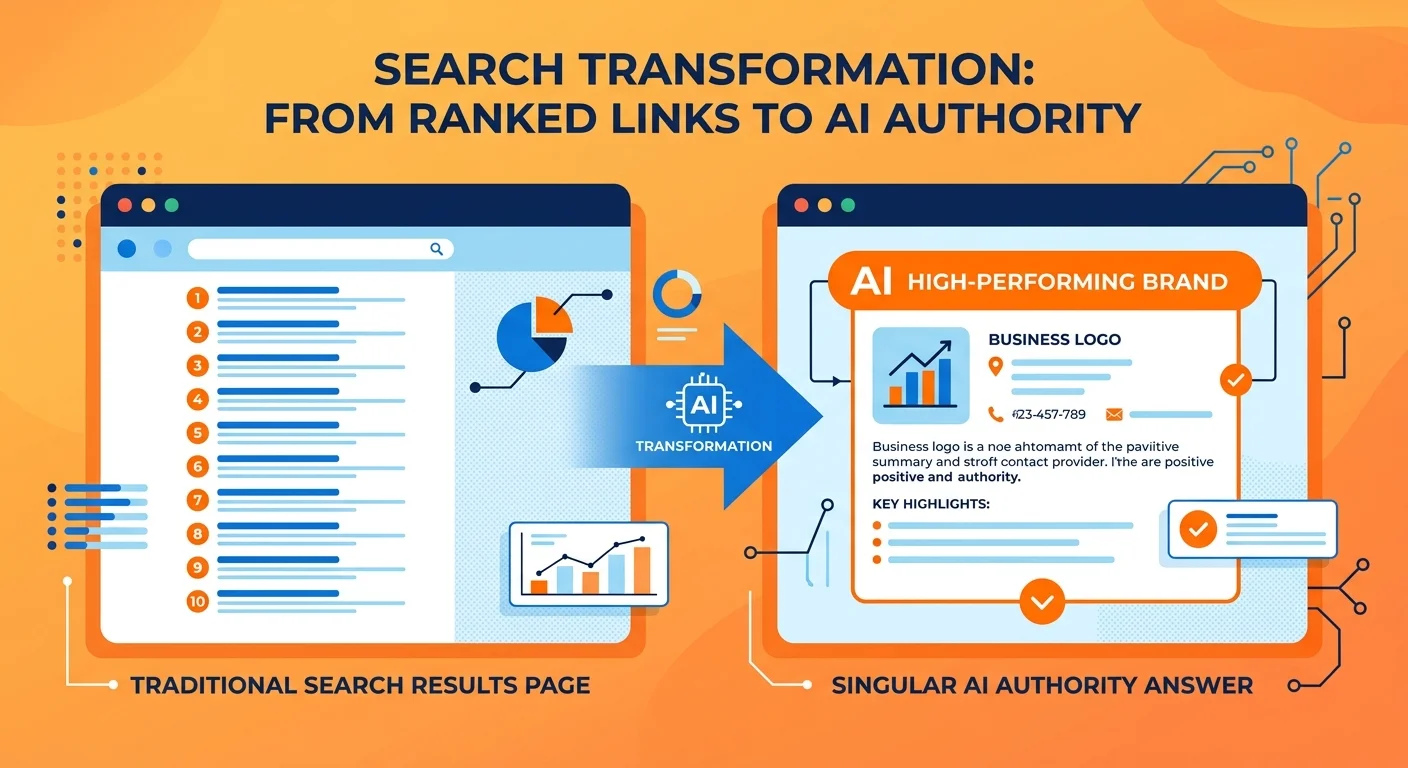
SEO optimizes for a list. AEO engineers for being the verdict.
Those aren’t variations of the same thing.
SEO Was Built for a Different Mechanism
Google’s PageRank algorithm worked on a premise: users would click through multiple results to evaluate options.
The goal was to get on page one. Ideally in the top three spots. Because users rarely went to page two.
That user behavior is gone.
Patients don’t browse anymore. They ask a question and accept the first answer. If that answer comes from ChatGPT or Gemini and names a specific practice, the patient books with that practice. They don’t verify. They don’t comparison shop. They trust the AI’s judgment.
Traditional SEO optimized for placement in a ranked list. It assumed the patient would see the list, evaluate the options, and click through.
That assumption no longer holds.
AI Engines Don’t Rank-They Recommend
According to Forbes, the “10 blue links” model of search is being replaced. AI engines don’t show a list. They produce a verdict.
When a patient asks ChatGPT “who’s the best chiropractor near me?”, ChatGPT doesn’t return ten options. It names one. Maybe two. The patient books with the first name or asks a clarifying question.
There’s no page two. There’s no comparison shopping. There’s no traffic to your website unless you’re the name AI said.
This isn’t a UX tweak. It’s a fundamental replacement of the decision-making mechanism.
- Old model – Google ranks 10 sites. User clicks through 3-5. Decides based on website content, reviews, pricing.
- New model – AI names 1 practice. User books. Game over.
If you’re not that one name, you’re invisible. Doesn’t matter if you’re #2 on a list the patient never sees.
This Is Not a Trend-It’s a Replacement
BrightEdge data shows the rise of generative AI in search results is accelerating. This isn’t a beta feature Google’s testing. It’s the new default.
Zero-click searches are now the majority of searches. Patients get their answer on the results page-or from an AI assistant-and never visit a website.
The old system isn’t being improved. It’s being replaced.
Businesses optimizing for keyword rankings are refining their strategy for a mechanism that’s becoming obsolete. It’s like mastering Yellow Pages ads in 2010. Technically correct execution of a dead model.
If You’re Waiting for This to Blow Over
Quick pause.
If you’re reading this and thinking “AI search is just a fad” or “real patients will always use Google the old way”-this methodology isn’t for you. No hard feelings.
But if you’re tired of watching competitors get named while you stay invisible, keep reading.
AI is brutally selective. It doesn’t hedge. It doesn’t say “here are five good options.” It names one answer. The practices that own those recommendations six months from now are building the authority signals today.
Waiting isn’t a neutral position. It’s a decision to let competitors lock in the trust signals AI uses to determine who gets recommended.
The gap compounds. Every month you’re invisible, they’re building citation velocity, entity consistency, and semantic authority that makes them exponentially harder to displace.
What AI Engines Actually Validate
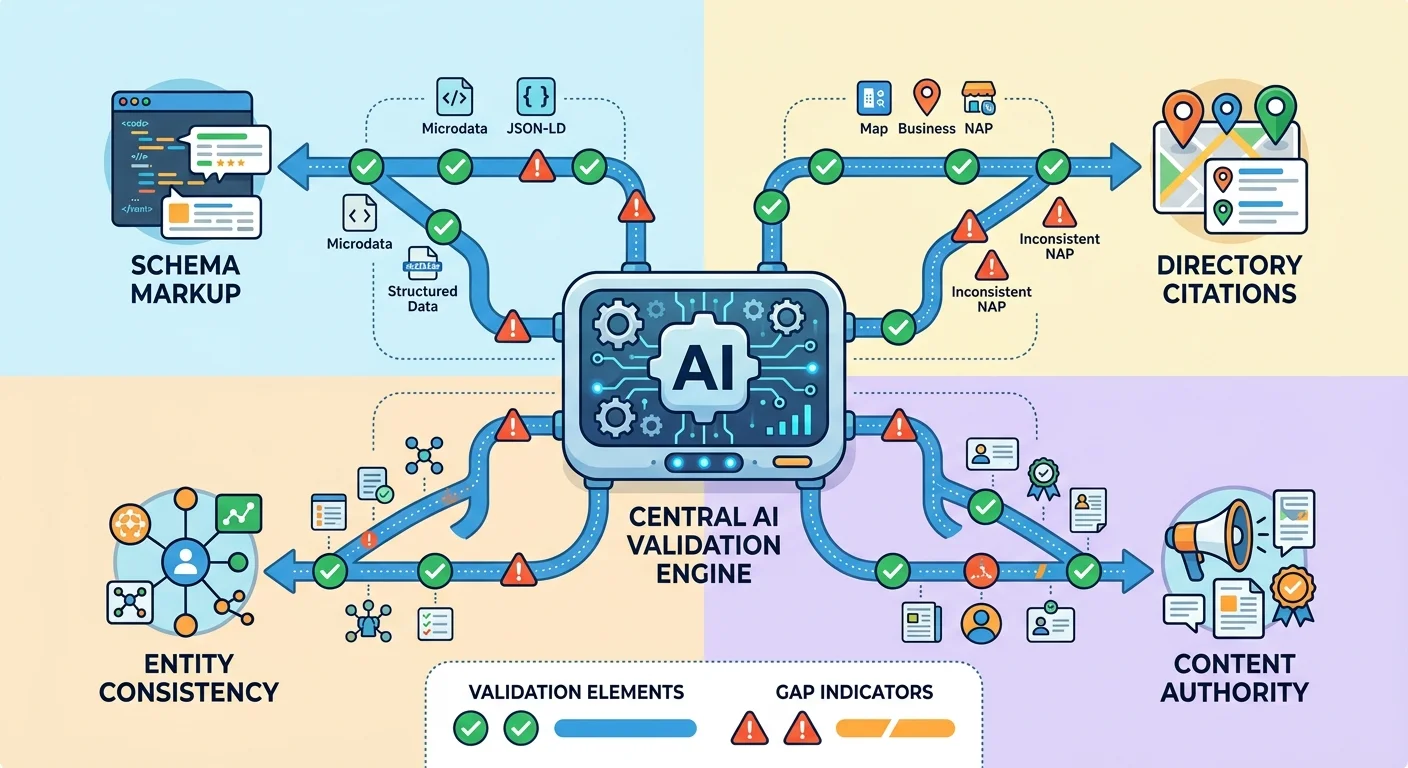
AI engines don’t count backlinks. They validate entities.
That’s the fundamental shift most businesses don’t understand yet.
Entity Trust Is Not Link Building
Google’s old PageRank algorithm counted backlinks as votes. More links = more authority. That’s why link building became an industry.
AI engines don’t work that way.
They validate your entity across the web. Is your business name consistent in every directory? Does your schema markup match your Google Business Profile data? Can AI cross-reference your expertise claims with institutional sources?
If the answers are no, if you are not the answer, you do not exist.
- Entity Validation – AI checks your business identity across multiple platforms (Google, Yelp, Healthgrades, WebMD, your website) to confirm the data matches. Name, address, phone, services offered, hours, credentials-all must be consistent.
- Content Authority – AI evaluates whether your content demonstrates specific, verifiable expertise. Generic “we care about our patients” copy doesn’t pass. Detailed explanations of treatment protocols, cited research, case study depth-those do.
- Citation Consistency – AI looks for your business being mentioned or recommended across authoritative third-party sources. If you’re only cited on your own website and nowhere else, trust score drops.
- Schema Markup – Structured data that tells AI exactly what your business does, who you serve, what conditions you treat. Without it, AI can’t parse your expertise.
Building entity trust isn’t about accumulating backlinks. It’s about creating a web-wide trail of consistent, verifiable proof that your business is what it claims to be.
The Infrastructure Most Websites Are Missing
Most websites were built for human eyes. Not machine validation.
Here’s what AI engines need to validate an entity-and what most sites are missing:
- Schema.org Markup – Structured data in JSON-LD format that defines your business type, services, location, hours, credentials. Without it, AI guesses. And when AI guesses, you lose.
- Consistent NAP Data – Name, Address, Phone must match exactly across every directory, citation, and platform. Inconsistencies signal low trust.
- Proper Heading Hierarchy – H1, H2, H3 structure that organizes content topically. AI uses this to understand what you’re an expert in. A page with five H1 tags and no hierarchy is unreadable.
- Semantic Density – Content that demonstrates depth of knowledge on a specific topic. AI evaluates vocabulary range, concept relationships, and whether claims are supported or asserted.
- Internal Linking Hierarchy – Links that establish topical relationships between pages. Not decorative “related posts” widgets. Structural links that tell AI “this page is the authority on this subtopic.”
These aren’t optional. They’re the baseline for being considered.
| Validation Signal | What AI Checks | Impact if Missing | Where It’s Built |
|---|---|---|---|
| Schema Markup | Business type, services, location, hours | AI can’t categorize you-treats you as generic | Website rebuild, CMS integration |
| NAP Consistency | Exact match across all directories | Trust score drops-AI sees conflicting data | Directory audit, citation cleanup |
| Content Authority | Depth, specificity, citations | Generic content = no expertise signal | AEO articles, service page rewrites |
| Internal Linking | Topical hierarchy, authority flow | No clear expertise focus-AI can’t determine specialization | Site architecture, content clusters |
If these signals are absent, you’re not in the validation conversation. You’re a guess. And AI doesn’t recommend guesses.
Why Template Sites Fail This Test
Template websites are built for speed and aesthetics. Not machine readability.
Stock “About Us” copy. Generic service descriptions. Placeholder schema. Internal links that go nowhere meaningful. AI interprets lack of multimodal proof as a trust gap.
A beautiful homepage with professional photos and clean branding gives AI nothing to validate. It looks great to human eyes. To an AI engine trying to determine if you’re trustworthy enough to recommend, it’s invisible.
The technical execution is fine. The premise is wrong.
Template sites are built on the assumption that patients will visit the website, see the design, read the content, and decide to book. That was the old model.
The new model: AI validates your entity before the patient ever sees your website. If the validation fails, the patient never visits. Your conversion-optimized funnel doesn’t get entered.
Entity trust is the gate. Template sites don’t pass it.
Why I Built the AI Authority Engine
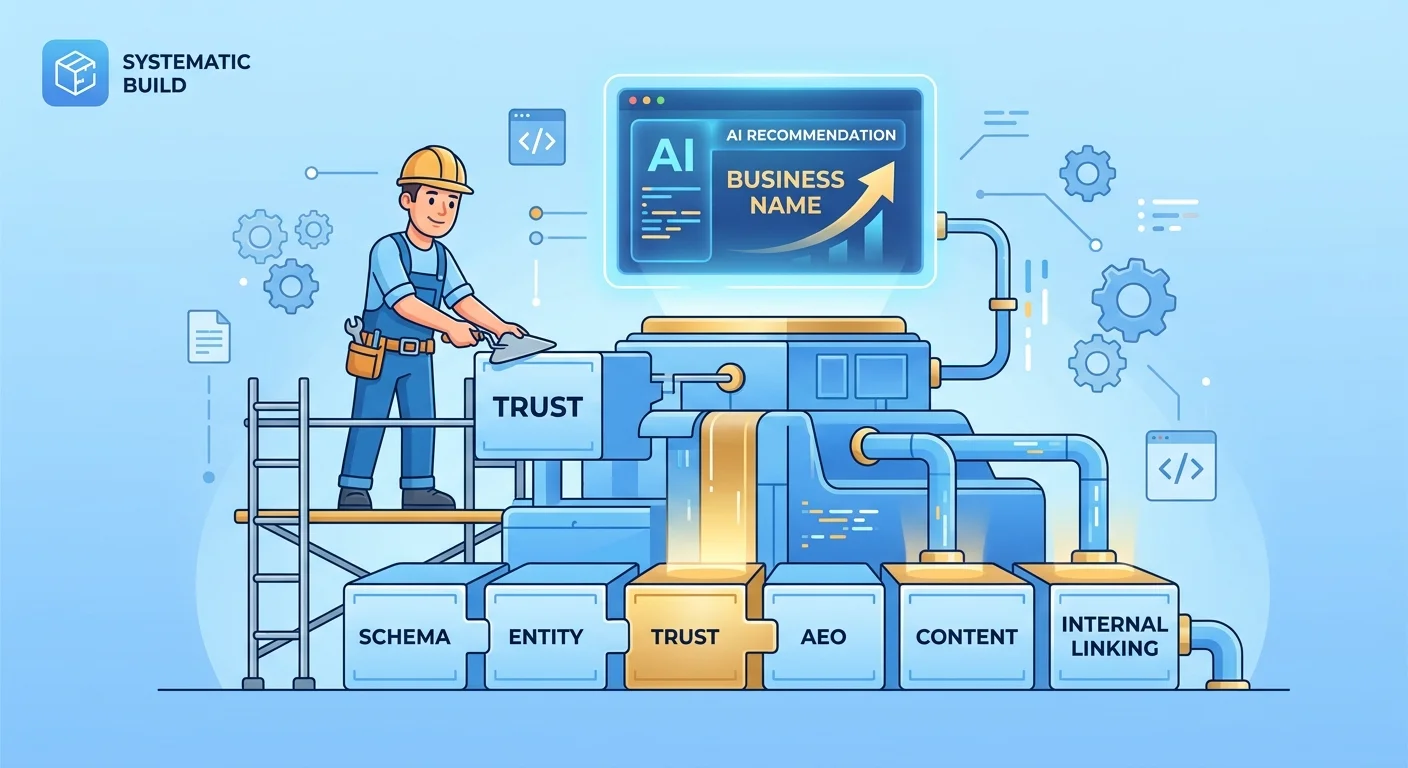
After 20 years of watching the old model fail, the solution became obvious.
Stop optimizing for rankings. Engineer the digital infrastructure and content execution that AI engines use to determine trust.
The System That Resulted from the Diagnosis
The problem was structural. Websites built for human consumption. Content optimized for keyword density. Marketing strategies built around traffic volume.
None of that builds entity trust.
The AI Authority Engine is the full-stack methodology that rebuilds a business’s digital foundation from scratch. Not a template. Not a bolt-on. A complete infrastructure overhaul designed to pass AI validation at every layer.
- Infrastructure Rebuild – Schema markup, NAP consistency, site architecture, internal linking hierarchy. Every technical element required for AI to validate your entity.
- AEO Content Execution – 12 AI Authority articles per month. Not blog posts. Strategic content engineered to build semantic density, establish topical authority, and generate citation velocity.
- Entity Trust Buildout – Directory optimization, citation cleanup, third-party validation. Creating the web-wide trail of proof that AI uses to confirm your expertise.
- White-Glove Execution – The client does nothing. No learning curve. No platform management. No content creation. The steak gets on the plate.
This isn’t an SEO package with “AI features” tacked on. It’s a replacement methodology built for a different decision-making mechanism.
Why This Can’t Be Bolted Onto Existing SEO
I’ve had clients ask: “Can you just add AEO to our current SEO strategy?”
No.
Traditional SEO services are built on the wrong premise. You can’t take a website optimized for Google’s 2015 algorithm and “add AEO” to it.
The foundation is wrong.
Schema is missing or incomplete. Content lacks semantic density. Internal linking is decorative, not hierarchical. Directory citations are inconsistent. The site architecture doesn’t establish entity boundaries.
You can’t fix that with surface-level tweaks. The entire structure has to be rebuilt.
It’s like trying to convert a paper map into GPS. The underlying data model is incompatible. You need to start from scratch.
White-Glove Execution, Not a Toolkit
This is not a course. Not a consultation. Not a “we’ll teach you how to do it yourself” model.
The client does nothing.
We rebuild the infrastructure. We write the content. We handle the directory cleanup. We manage the technical execution. We deploy the schema. We build the internal linking. We monitor AI visibility across ChatGPT, Gemini, and Grok.
The business owner shows up to patient appointments. That’s it.
No learning curve. No platform logins. No content calendars to manage. The steak gets on the plate. How it got there is our problem.
| Component | AI Authority Engine | Traditional SEO Package |
|---|---|---|
| Website Infrastructure | Full rebuild-schema, architecture, entity markup | Template site with basic on-page optimization |
| Content Execution | 12 AEO articles/month, semantic density focus | 4 blog posts/month, keyword-focused |
| Internal Linking | Hierarchical authority flow, topical clusters | Decorative “related posts” widgets |
| Directory Management | Full NAP audit, citation cleanup, consistency enforcement | Basic GMB setup, no ongoing maintenance |
| Client Involvement | Zero-white-glove execution | Heavy-client writes content, manages platforms |
| Goal | Be the answer AI recommends | Rank on page one of Google |
One of those goals still matters. The other is optimizing for a mechanism patients no longer use.
FAQ
What is the biggest flaw in traditional SEO for local businesses today?
The biggest flaw is that traditional SEO is built to get you on a list of 10 blue links. But patients aren’t looking at lists anymore. They’re asking AI for a single, trusted recommendation.
When a patient asks ChatGPT “who’s the best chiropractor near me?”, traditional SEO metrics don’t matter. Keyword rankings don’t matter. Backlink count doesn’t matter.
What matters: does AI trust your entity enough to say your name?
If the answer is no, you’re invisible. Doesn’t matter if you’re #2 on a list the patient never sees.
SEO optimizes for placement in a ranked list. AEO engineers the outcome of being named as the answer. Those aren’t the same thing.
How is Answer Engine Optimization (AEO) different from SEO?
SEO optimizes for an algorithm to get ranked on a list. AEO engineers the underlying digital infrastructure to build verifiable trust so that AI engines name you as the answer.
The difference is structural, not semantic.
SEO focuses on keywords, backlinks, and technical site speed. The goal is to rank high enough that patients click through from search results.
AEO focuses on entity validation, semantic density, and citation consistency. The goal is to build enough trust that AI recommends you without the patient ever seeing a search results page.
One optimizes for visibility in a list-based system. The other engineers trust in a verdict-based system.
Did Gerek Allen always work in AI-focused marketing?
No. Gerek Allen’s background includes over 20 years of hands-on experience in e-commerce, web design, brand building, and operational leadership.
He’s built 100+ websites across his career. Managed multi-channel marketing campaigns. Ran e-commerce brands. Scaled service businesses.
It was that deep, frustrating experience with traditional marketing models that revealed the limitations. The wasted spend. The vanity metrics. The hopium cycle.
AEO wasn’t invented in a vacuum. It’s the system that resulted from watching the old model fail for two decades.
Why is “building entity trust” more important than “link building” now?
AI engines don’t count links the way Google’s old PageRank algorithm did. They validate entities.
Link building was based on the idea that more backlinks = more authority. It worked when Google used link count as a primary ranking signal.
AI engines don’t use that signal anymore.
They cross-reference your business across the entire web. Is your name consistent in every directory? Does your schema markup match your NAP data? Can AI verify your expertise claims with institutional sources?
Building entity trust is about creating consistent, verifiable proof of your expertise across every platform where your business exists.
A backlink is one data point. Entity trust is a web-wide validation layer. One is a vote. The other is a verified identity.
Does iTech Valet still offer any traditional SEO services?
No. We don’t offer traditional SEO packages. The methodology has been replaced entirely by AEO.
Why? Because chasing rankings in an obsolete system doesn’t build long-term authority.
Traditional SEO is optimized for a world where patients click through ranked lists to compare options. That world is disappearing. Fast.
If a business wants keyword rankings and backlink reports, there are hundreds of agencies that will sell that. We’re not one of them.
We build authority infrastructure. We engineer entity trust. We make businesses the answer AI recommends.
That’s not a variation of SEO. It’s a replacement.
Doesn’t Google still send most of the traffic?
Yep. For now. Here’s what “for now” means: by the time everyone else sees it, the practices that moved early own the authority AI uses to decide who to recommend. Waiting isn’t neutral. It’s handing someone else your spot.
The brands that own AI recommendations six months from now are building that authority today.
Authority is cumulative. Citation velocity compounds. Entity trust deepens over time. The gap between visible and invisible isn’t linear-it’s exponential.
Waiting isn’t a neutral position. It’s a decision to let someone else take the spot.
Can’t I just optimize my existing site for AI instead of rebuilding?
If your site was built as a template, it’s missing the structural foundation AI engines require. Schema is incomplete or absent. Content lacks semantic density. Internal linking doesn’t establish topical hierarchy. NAP data is inconsistent across directories.
You can’t bolt AEO onto a broken foundation.
I’ve tried. Clients have asked. “Can’t you just add schema to our existing site and write some AI-optimized content?”
Technically, yes. But it won’t pass validation.
AI engines don’t just check for the presence of schema. They validate that the schema matches the content, which matches the directory data, which matches the third-party citations. If any layer is inconsistent, trust score drops.
Template sites are built for speed and aesthetics. Not machine readability. The infrastructure has to be rebuilt.
The Authority Gap Is Widening
Every month a business spends invisible to AI, their competitors compound authority.
This isn’t a problem that stabilizes. It accelerates.
The practices AI recommends today will be exponentially harder to displace six months from now. Why? Citation velocity and entity consistency are cumulative signals.
Authority builds on authority. The more AI recommends a practice, the more third-party sources cite that practice, the stronger the entity trust signal becomes. It’s a compounding loop.
The gap between visible and invisible isn’t linear. It’s exponential.
There’s no version of this where doing nothing is a safe play.
AI is already making recommendations in your market. Either your name is in the answer or a competitor’s is. That gap widens every month it goes unaddressed.
The AI Visibility Check takes 15 minutes. It’ll show you exactly where you stand-what ChatGPT, Gemini, and Grok say when someone asks who to trust in your market.
If the results don’t make the problem self-evident-walk away. No pressure.
But if they do? You’ll know exactly what to do next.
Run your AI Visibility Check now and see what ChatGPT, Gemini, and Grok say when someone asks who the best chiropractor in your area is. If it’s not your name, that’s the gap we close.