
AI assistants such as ChatGPT, Gemini, AI Mode and Perplexity read your Google Business Profile, Practo, JustDial, your website and any other page that names you. Then they repeat the facts that show up most consistently. On Schema.org, four types have a medicalSpecialty, and so does every type that descends from them. Google tells businesses to choose a specific category from its list for their Business Profile. Its own example is picking Nail salon instead of Salon. AI grounds brand answers overwhelmingly in third-party sources: about 6 out of 7 citations (85.7%) point to sites the brand does not own.
What Assistants Read When They Size Up a Clinic
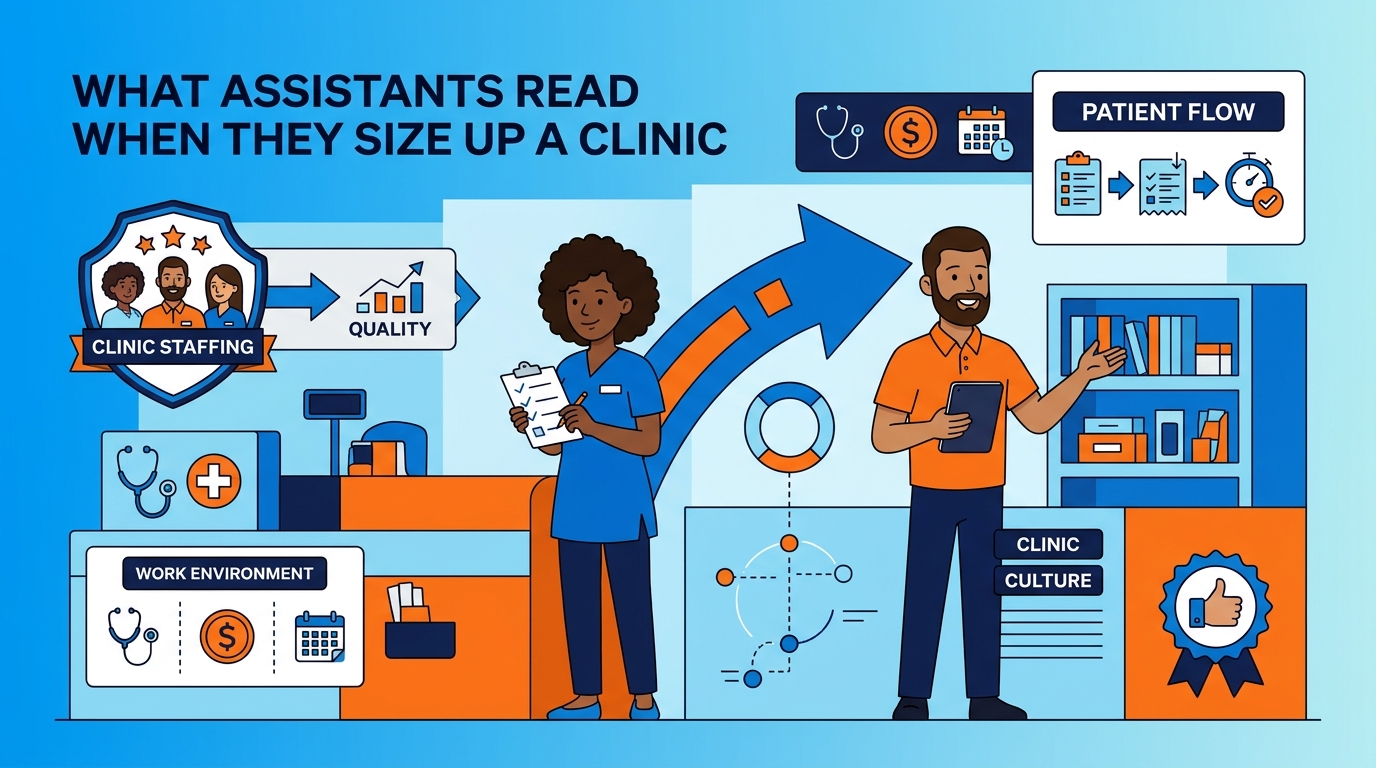
Here’s how it works. MedSlots notes that artificial intelligence (AI) assistants such as ChatGPT, Gemini, AI Mode and Perplexity read your Google Business Profile, Practo, JustDial and your website. They read any other page that names you too. Then they repeat whichever facts show up most consistently.
Google Search Central says that, where appropriate, generative AI responses can include product listings, product information, and information about local businesses. Local businesses are on that list.
There’s also a matching step. Shubham Chatterjee, of Missouri University of Science and Technology, writes that entity-oriented retrieval is built on one idea. Entity-oriented retrieval just means finding documents through the people, places and things they mention. The idea is that documents that fit a search should show people, places or things that fit what the searcher needs to know. His paper is Entities as Retrieval Signals: A Systematic Study of Coverage, Supervision, and Evaluation in Entity-Oriented Ranking.
I treat getting picked by AI answer tools as its own discipline, not old search work with a new name. I don’t chase keywords, inbound links or ranking position. I build for the question these systems are asking: who is your practice, and is it credible? My job is to make that question easy for them to answer.
Why Other Sites’ Descriptions of the Clinic Weigh More Than Its Own
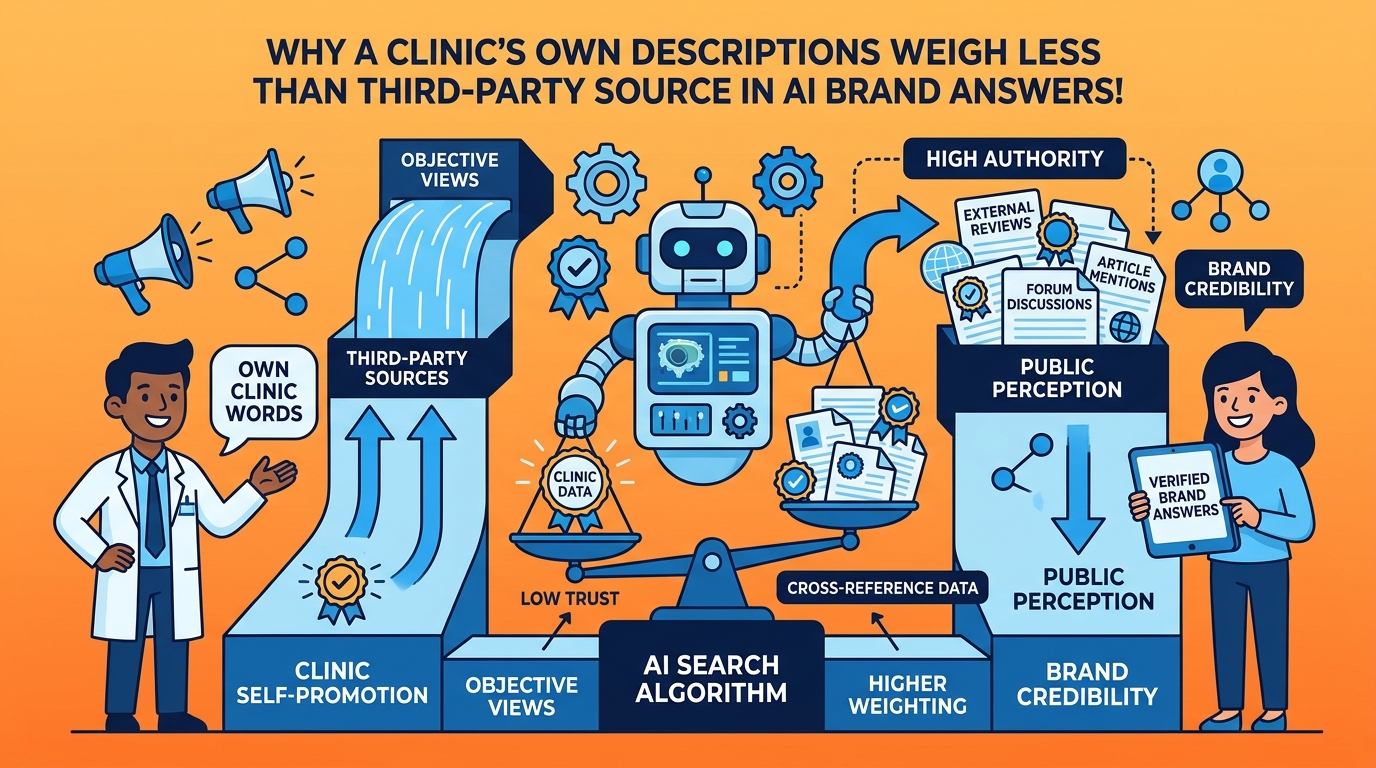
AI grounds its brand answers overwhelmingly in third-party sources. One arXiv study found that about 6 out of 7 citations (85.7%) point to sites the brand does not own, against about 1 out of 7 (14.3%) that point to sites it owns.
Researchers writing on arXiv report that AI Search has a systematic and overwhelming bias toward earned media over brand-owned and social content. Earned media means third-party, authoritative sources. They call this a stark contrast to Google’s more balanced mix.
An arXiv paper also found a three-tier ladder of brand stature on the very first visibility runs. On their first tracking run, global household names such as Stripe and Nike showed up in about 3 out of 4 (73%) of the relevant AI answers. Established mid-market and regional brands such as Olipop and Klaviyo showed up in a bit over 4 out of 10 (44%). Niche and small brands showed up in just about 1 out of 10 (11%). Each tier sat about 30 percentage points (30 out of 100) below the one before it.
| Brand tier | Share of relevant AI answers |
|---|---|
| Global household names (such as Stripe and Nike) | 73% |
| Established mid-market and regional brands (such as Olipop and Klaviyo) | 44% |
| Niche and small brands | 11% |
An arXiv paper also gives practitioners guidance. It stresses the critical need to:
- Build content so machines can scan it easily and can justify using it.
- Dominate earned media to build authority as AI sees it.
- Use engine-specific and language-aware strategies.
- Overcome the built-in “big brand bias” for niche players.
I’d rather your practice be the source an assistant names and draws on than one more line in a list of businesses. I aim for being relied on, not just being listed.
Declaring a Specialty in Schema
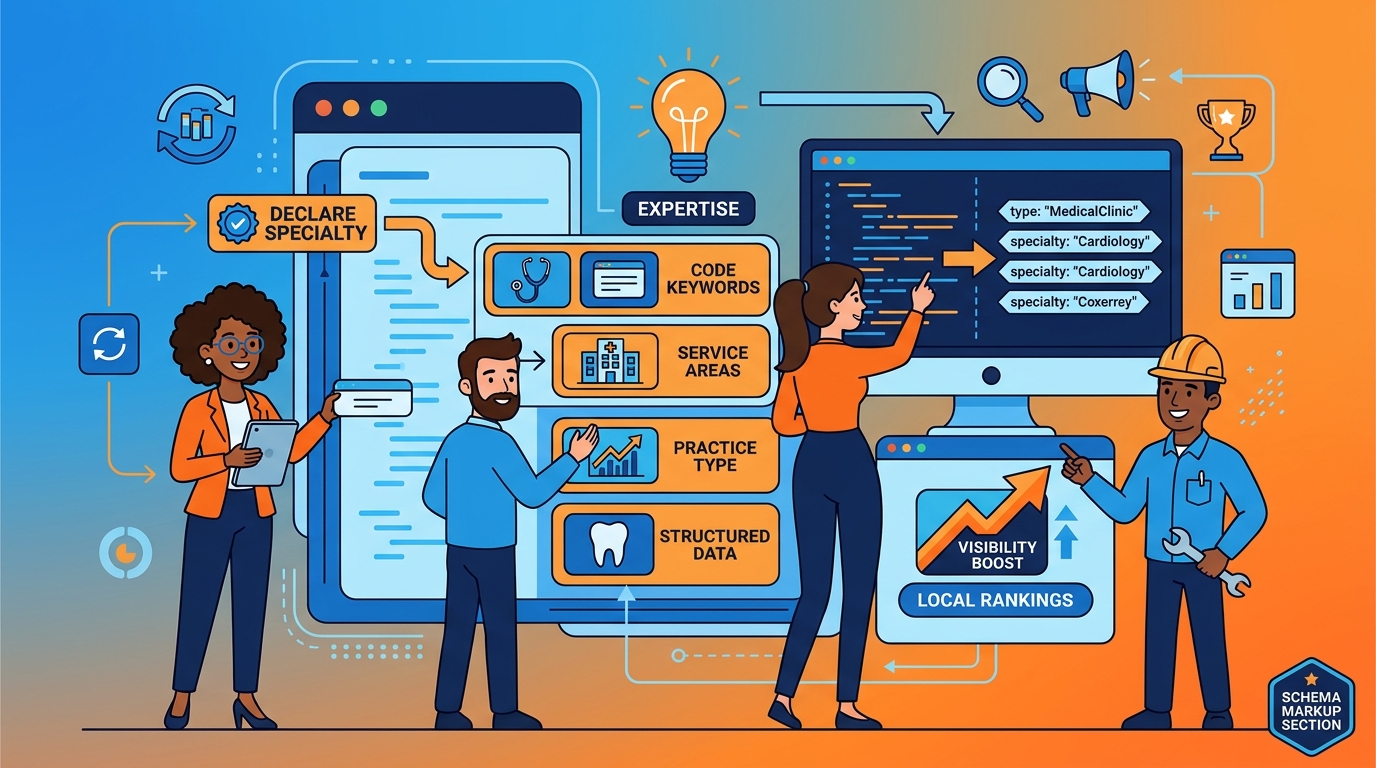
Schema is where your practice states in code what it does. It has limits. MedSlots notes that Google has no separate rich result (a special search display) for MedicalClinic, Physician or Dentist markup. Only two types, LocalBusiness and Organization, are tied by Google to any visible feature. And even those come with no guarantee.
One rule holds for all of it. Everything in the markup has to match what a visitor can actually read on the page. Google’s own guidance is that structured data must reflect the visible page and must not add facts that are not there. MedSlots covers this in Which schema markup should a clinic website actually use?
For what goes on a spinal hub page, I wrote What Belongs in a Spinal Condition Hub, and What Does Not. For how the pages are built, I wrote Building Machine Readable Condition Hubs: A Complete Guide.
Picking the Most Specific Clinic Type
MedSlots advises using the most specific type that matches your practice: MedicalClinic for a practice with more than one doctor, and Physician or Dentist for a single practitioner’s own page.
Schema.org.ai, quoting Schema.org, defines a MedicalClinic as a facility, often associated with a hospital or medical school, that is devoted to the specific diagnosis and/or healthcare.
On Schema.org, LocalBusiness is a type of structured data label for a particular physical business or a branch of an organization.
Google Search Central says that adding organization structured data (labeling code) to your home page can help Google better understand your organization’s administrative details. It can also help Google tell your organization apart from others in search results.
Declaring Specialty and Services
Schema.org.ai, quoting Schema.org, defines a Medical Specialty as any specific branch of medical science or practice. It also notes that four types have a medicalSpecialty – Schema.org.ai: Hospital, MedicalClinic, MedicalOrganization and Physician. So does every type that descends from them.
Services have their own property. On Schema.org, availableService – Schema.org Property names a medical service that a provider offers. Its value is expected to be a MedicalProcedure, a MedicalTest or a MedicalTherapy. It’s used on these types: Hospital, MedicalClinic and Physician.
The Business Profile Category as the Lead Specialty Signal
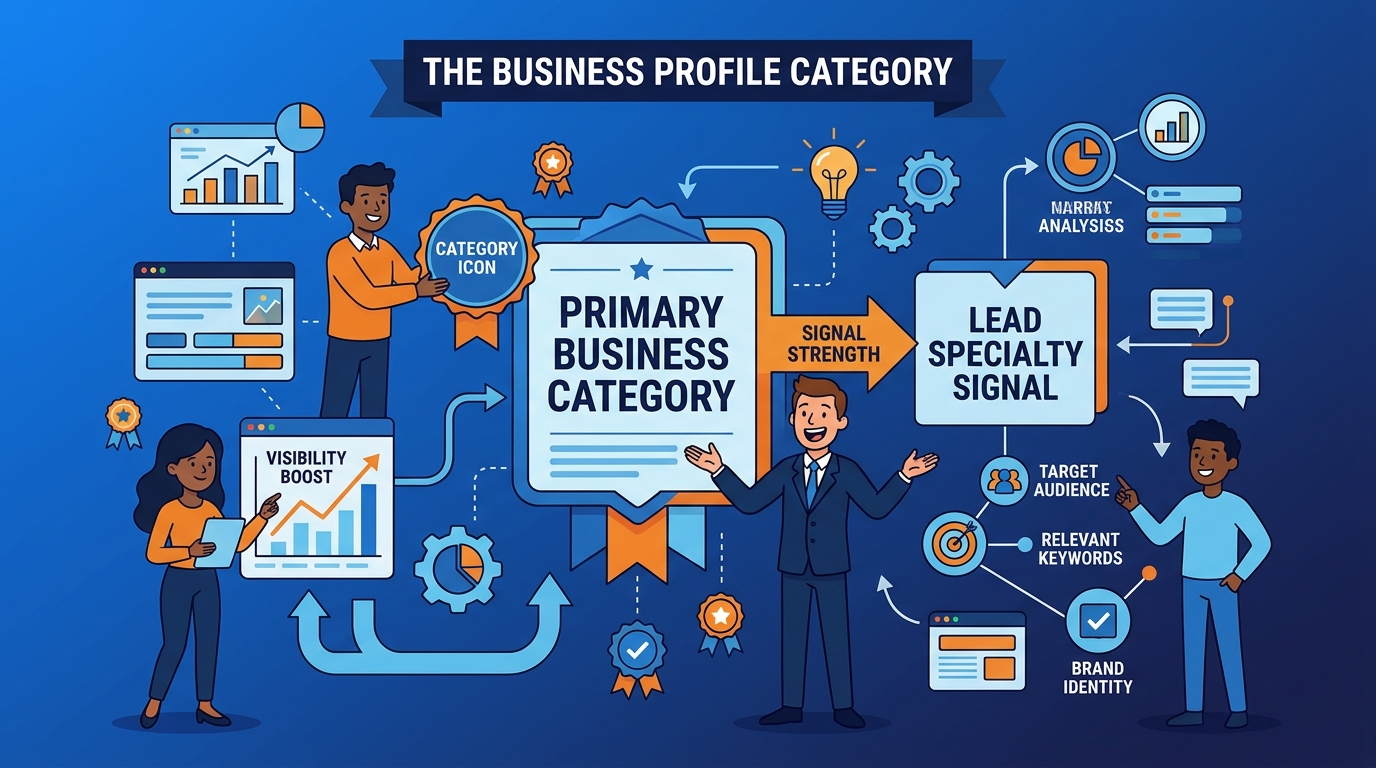
Start with the primary category.
Innovative Group reports in Google Business Profile Categories: Pick the Primary that in Whitespark’s 2026 Local Search Ranking Factors study, 47 local search experts scored 187 factors. The primary Google Business Profile category came out on top of the individual local pack factors, with a score of 227. The local pack is the group of local results shown with a map.
Innovative Group calls Google’s instruction direct: choose a specific category from the list. Google’s own example is picking Nail salon instead of Salon.
You can’t create your own category. Google says so plainly.
If the exact description of your business isn’t on the list, pick the closest option. Then let your services, description and website carry the detail.
Additional categories exist to describe special departments or services. Google explicitly warns against picking a category for every product or service you offer. So don’t.
Edits can bring a check. If you add or edit an existing category, Google notes you might be asked to verify your business again.
MedSlots adds one more point. Schema markup does not replace a complete Google Business Profile. Your profile, not the structured data code on your website, is what drives most local search and Maps results.
Here’s how I think about it. I put your practice’s effort and money into assets you control, such as clear and credible facts about yourself, because I count on those to keep paying off and to grow over time. I don’t build on ads or paid placement, since that visibility stops when the spending stops.
Your profile is an asset you control. So I start there. Our approach to this writing is laid out on AEO Content Writing, and iTech Valet Service Plans & Pricing explains how the work is done.
Keeping the Clinic’s Facts Consistent Across Directories and Registries
Provider records break in ordinary ways.
A review published by the National Library of Medicine described what went wrong, rather than counting it. Matching provider directories was hard for providers who changed their names, moved, or listed different addresses in each database. It was also hard when names were misspelled in either record. And it was hard when the federal database had the wrong taxonomy (category label) for the provider.
Public registry data stays public. The Centers for Medicare & Medicaid Services says there is no way to “opt out” or “suppress” the record data in the federal provider database for health care providers with active provider numbers.
Names can collide too. One arXiv paper notes that the same name can be associated with two different Wikidata items. With Wikidata, that confusion can be resolved by looking at the information linked to each item.
Google says the information in knowledge panels comes from its Knowledge Graph, which is like a giant virtual encyclopedia of facts. It also says that, to keep your Business Profile accurate, it gathers information from different sources, like user reports and licensed content.
Wikipedia’s page on Local search engine optimisation lists the main things that affect a local business’s chance of showing up in local search. They are the right categories in business directories, your business’s name, address and phone number (NAP) being readable by search crawlers on your website, and citations, which are mentions of your business elsewhere online.
I don’t publish more to get your practice recommended. I’d take one plain, consistent set of facts over a pile of extra mentions.
I build for what an assistant can grasp easily. Clear, factual content in a sensible order. Not volume.
How Much Patients Now Lean on AI to Choose a Provider
Here’s where patients are now.
In rater8’s 2026 Patient Choice Report, 36 percent (36%) of U.S. patients who actively searched for a doctor in the past year cited AI tools like ChatGPT and Claude as an influence. That edged out Google search at 34 percent and doctor recommendations at 32 percent. Last year, the comparable “conversational AI assistants” response came to only 17 percent (17%).
Among patients who actually switched providers, AI’s influence was even higher. About 4 in 10 (39%).
rater8 also found that about 2 in 3 U.S. patients (66%) ran into wrong provider information from an AI tool. Even so, most (60%) still said they trusted the AI summary without checking it further.
I no longer use position tracking to measure success. AI tools now give direct answers instead of lists of links, so I don’t read your spot in a results list as a sign that your practice gets found. I treat rank-tracking reports as numbers that look good but don’t drive outcomes.
What I check is whether the AI answer a patient reads names your practice.
Frequently Asked Questions
Is FAQ markup still worth adding for Google Search?
Not for the FAQ display. MedSlots reports that Google stopped showing the FAQ rich result, the special question-and-answer display, in Search from 7 May 2026.
Can a clinic mark up its own reviews to get stars in search?
No. Google’s rule makes a business ineligible for the review result if it reviews itself. That includes reviews shown through an embedded widget.
What decides which clinics show in Google’s local results?
Google’s own local ranking guidance says local results are based mainly on relevance, distance and prominence. Relevance is how well a business matches the search, and prominence is how well known it is.
Google says prominence is also based on information like how many websites link to your business and how many reviews you have.
What can LocalBusiness markup tell Google?
Google Search Central says that with Local Business structured data you can tell Google about your business hours, the different departments within your business, reviews (if your site captures reviews about other businesses), and more.
What happens if a page’s structured data breaks Google’s rules?
According to Google Search Central, a structured data manual action means the page loses its eligibility to appear as a rich result (an enhanced search listing). It doesn’t change how the page ranks in Google web search.
See Whether an Assistant Recognizes Your Practice
An assistant recognizes a spine specialist when the category, the markup, the third-party mentions and the registry records all say the same thing. iTech Valet does Answer Engine Optimization work for practices, and its Local AI Authority Engine is built for practices that own one market. The AI Visibility Check is free and diagnostic, and it does not sell. Want to see where your practice stands with AI assistants today? Run My AI Visibility Check.