The Search Shift AI Changed Everything About How Patients Find You
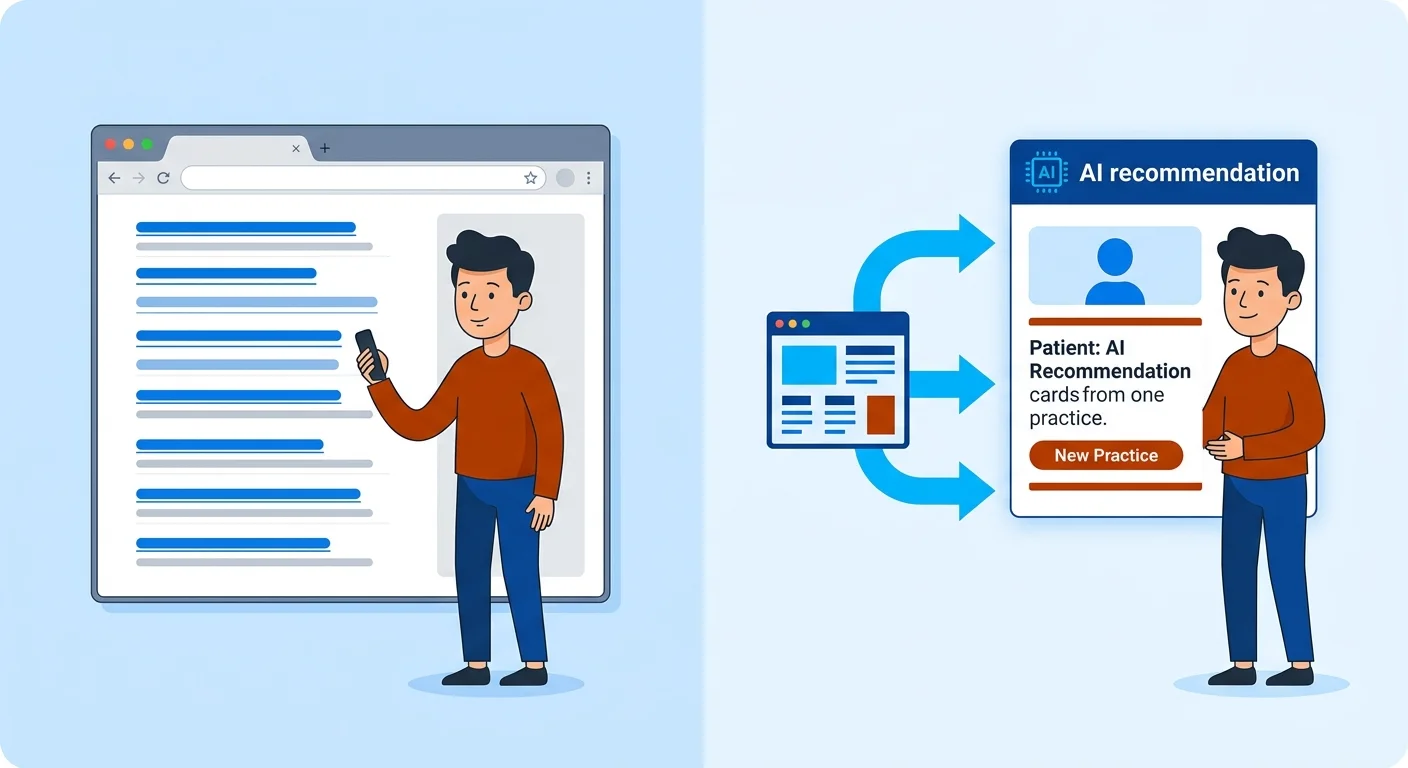
The way patients find a chiropractor just changed.
Not gradually. All at once. And most practices are still operating like it didn’t.
For decades, the model was simple. Rank on Google. Get clicked. Get booked.
Patients scrolled a list, compared options, made a call. That chain only needed your website to be visible – not trusted. So the entire marketing industry optimized for clicks and called it a strategy.
Nobody questioned the chain. It was working.
But the chain is broken.
Patients aren’t navigating lists anymore. They’re asking a question and receiving a single, synthesized answer. One name. One recommendation. The list is gone – and so is the click-through model that sustained it.
If your digital presence was built for that old world, it was built for a world that no longer exists.
From Link Lists to Direct Answers: What Actually Changed
Here’s what actually changed: the interface.
Google gave you ten blue links and let the patient decide. ChatGPT, Gemini, and Grok give you one answer and end the conversation.
That’s not a variation of the same thing. That’s a fundamentally different outcome.
When a patient asks an AI engine who the best chiropractor near them is, the engine doesn’t return a ranked list. It returns a verdict.
It names one practice. It moves on. There is no second place. There is no ‘also consider.’
There is the answer – and there is everyone who didn’t make it.
That shift has mass behind it. Traditional search engine volume is projected to drop by 25% by 2026 as consumers move to conversational AI for research, decisions, and recommendations, according to Gartner. Approximately 58% of U.S. adults are already aware of ChatGPT, per Pew Research.
This isn’t a trend on the horizon. It’s already deciding whose door your next patient walks through.
And AI engines require structured, verifiable signals before they’ll name any practice as the answer. No signals – no recommendation.
Why Your Brochure Website Was Built for a World That No Longer Exists
Your brochure website was designed for a patient who was already looking for you.
It was built to confirm a decision – not earn one. The patient found you through a search result, landed on your homepage, and needed something to read while they made up their mind.
That patient no longer exists in the same way. And that assumption just became a liability.
AI engines don’t browse your homepage. They don’t read your About page.
They scan structured data, evaluate entity signals, and cross-reference your presence against trusted registries to decide whether you’re worth recommending at all. A brochure has no schema. A brochure has no entity signals.
A brochure is invisible to the logic AI uses to decide whose name to say. the full investment model
The Local AI Authority Engine exists specifically to close that gap – replacing the static brochure with a structured, machine-readable authority system that feeds AI engines exactly what they need to trust your practice and say your name.
Because a brochure gets handed out and forgotten.
Authority infrastructure compounds.
| Search Behavior | Traditional Search Engine | AI Answer Engine |
|---|---|---|
| What the patient does | Types a query and scans a ranked list of results | Asks a question and receives one synthesized answer |
| What the interface returns | Ten or more clickable links to compare | A single named recommendation – no list, no alternatives |
| How a practice gets found | By appearing in ranked results and earning the click | By being identified as the trusted answer before the patient ever clicks |
| What drives visibility | Keyword density, backlinks, and page authority signals | Entity trust signals, structured data, and citation velocity across authoritative sources |
| Role of the website | A destination the patient navigates to after finding you | A machine-readable signal layer the AI engine evaluates before recommending you |
| Competitive dynamic | Multiple practices visible simultaneously – patient chooses | One practice named as the answer – all others are absent from the conversation |
| What happens if you do nothing | Ranking slips gradually as competitors outbuild you | You are invisible by default – AI names whoever built authority first |
| Asset value over time | Visibility tied to ongoing spend – stops when payments stop | Authority compounds with every month of execution – builds on itself indefinitely |
Why Traditional SEO Fails the AI Recommendation Test
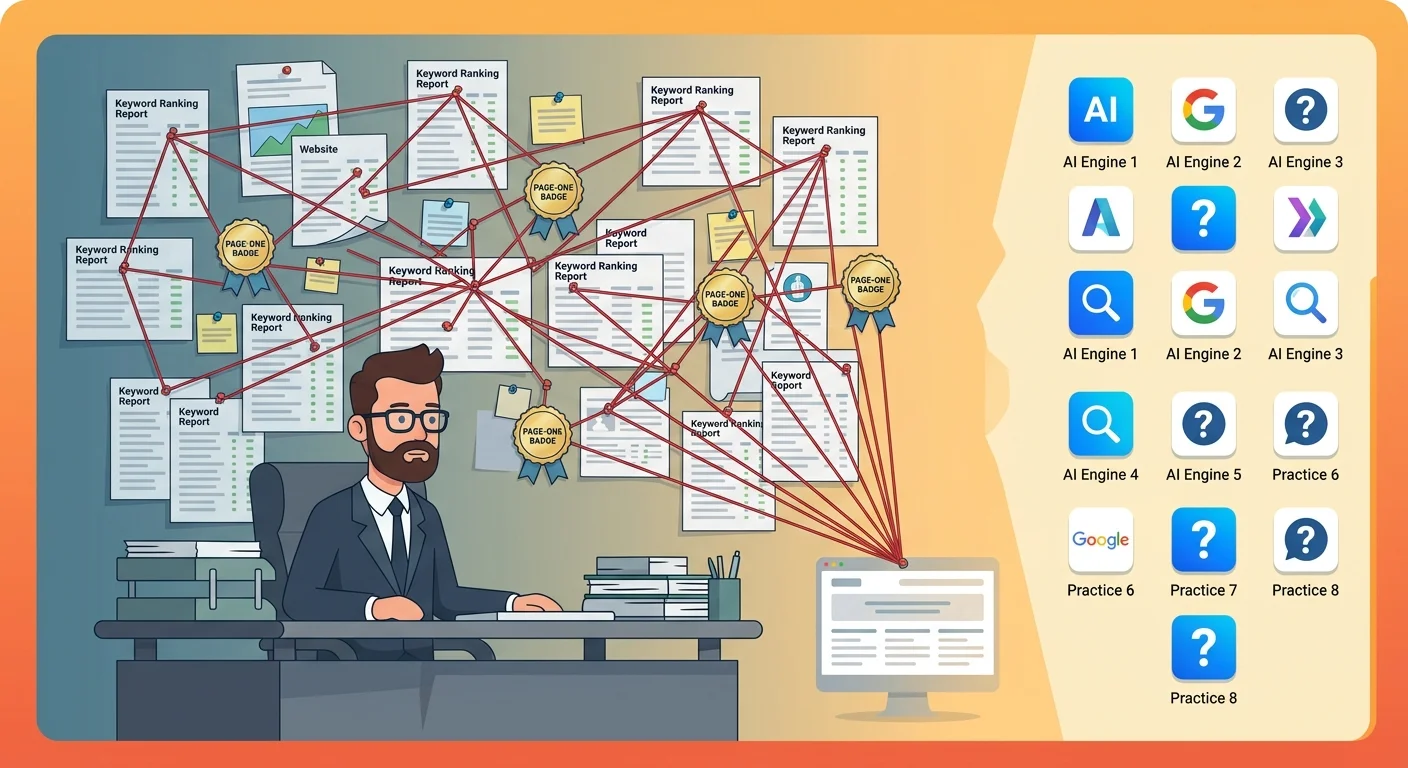
Traditional SEO was built for clicks. Rank on page one, get seen, get booked. That was the whole model.
It worked – inside an interface that no longer controls the conversation.
Here’s the thing: traditional SEO assumes a patient is picking from a list. They see ten results, compare, click, decide.
AI engines don’t present a list. They return a verdict. And no traditional SEO keyword retainer was ever built to earn a verdict – only a click.
That’s the gap most practices don’t catch until the schedule starts thinning.
The method that owned local provider discovery for two decades is now optimizing for an interface that 22% of global professionals have already replaced with conversational AI tools. The retainer keeps running. The patients keep migrating.
And the practice keeps getting better at ranking on a list nobody’s opening.
Why Keyword Retainers Are the New Brochure
A traditional SEO keyword retainer works exactly like a brochure.
You pay to produce it. It circulates for a while. Stop paying – it stops working. No residual value. No compounding return. No memory.
But the cost isn’t even the real problem. The architecture is.
Keyword retainers optimize content for search engine crawlers reading text on a page. AI recommendation engines don’t work that way. They’re evaluating entity signals, cross-referencing structured data, validating your practice’s identity against trusted registries before they’ll say your name.
To an AI engine, a keyword-optimized page is still a brochure. It looks fine on the surface. It communicates nothing useful to the logic underneath.
So the retainer produces content that ranks. And ranking still feels like winning.
Until you look at the numbers: 79% of global respondents now report exposure to generative AI – and they’re asking those tools for recommendations instead of scrolling ranked lists.
The click the retainer was built to earn never happened. The patient never opened a search results page.
That’s the real cost of renting instead of building.
A keyword retainer buys visibility inside an algorithm. It doesn’t build anything you own. When search engine volume drops – and Gartner projects a 25% decline by 2026 – that visibility disappears with the algorithm. Years of monthly payments. Nothing compounding. Nothing left.
That’s why authority built on rented land is the single most expensive mistake a practice can make right now.
What AI Engines Actually Look For (And Why Rankings Don’t Tell Them)
AI engines don’t read rankings. They don’t check domain authority scores. They don’t care how many keywords you’ve optimized or whether your meta description is airtight.
None of that speaks their language.
What AI engines actually evaluate is verifiable entity data.
Consistent, structured signals that confirm who you are, where you are, what you do – and whether trusted sources across the web back that identity up. Schema markup. NAP consistency. Structured content that maps to real-world entities. Citation patterns across authoritative sources.
Those are the signals that determine whose name gets said. And none of them have anything to do with where you rank on a results page.
Practices investing in keyword retainers are getting sharper at winning a game AI recommendation engines aren’t playing.
They’re printing more sophisticated brochures. The conversation has moved somewhere their brochure was never designed to reach.
| Metric | Traditional SEO Retainer | AI Authority Infrastructure |
|---|---|---|
| Optimization Target | Search engine crawlers reading keyword density and link authority | AI recommendation engines reading structured entity signals and trusted registries |
| What Gets Built | Ranked positions inside an algorithm you don’t own | Authority infrastructure that compounds with every month of execution |
| Asset Durability | Disappears when payments stop – no residual value, no memory | Continues to compound after build – entity signals persist and deepen over time |
| Patient Discovery Model | Patient navigates a list of results and chooses | AI engine returns a single verdict – one name, no list, no comparison |
| Schema and Entity Signals | Not required – crawler reads visible page text | Required – AI engines validate structured data before recommending any practice |
| Content Function | Keyword-optimized text designed to rank on a results page | AEO content that feeds citation velocity and builds topical authority AI can verify |
| Competitive Outcome | Visibility among a set of ranked options the patient still has to evaluate | Named as the single trusted answer – competitors are not presented alongside you |
| Long-Term Value | Monthly expense that produces no owned asset when discontinued | Compounding authority asset – each layer reinforces the next and deepens AI trust |
The Four Layers of a Compounding Authority Asset
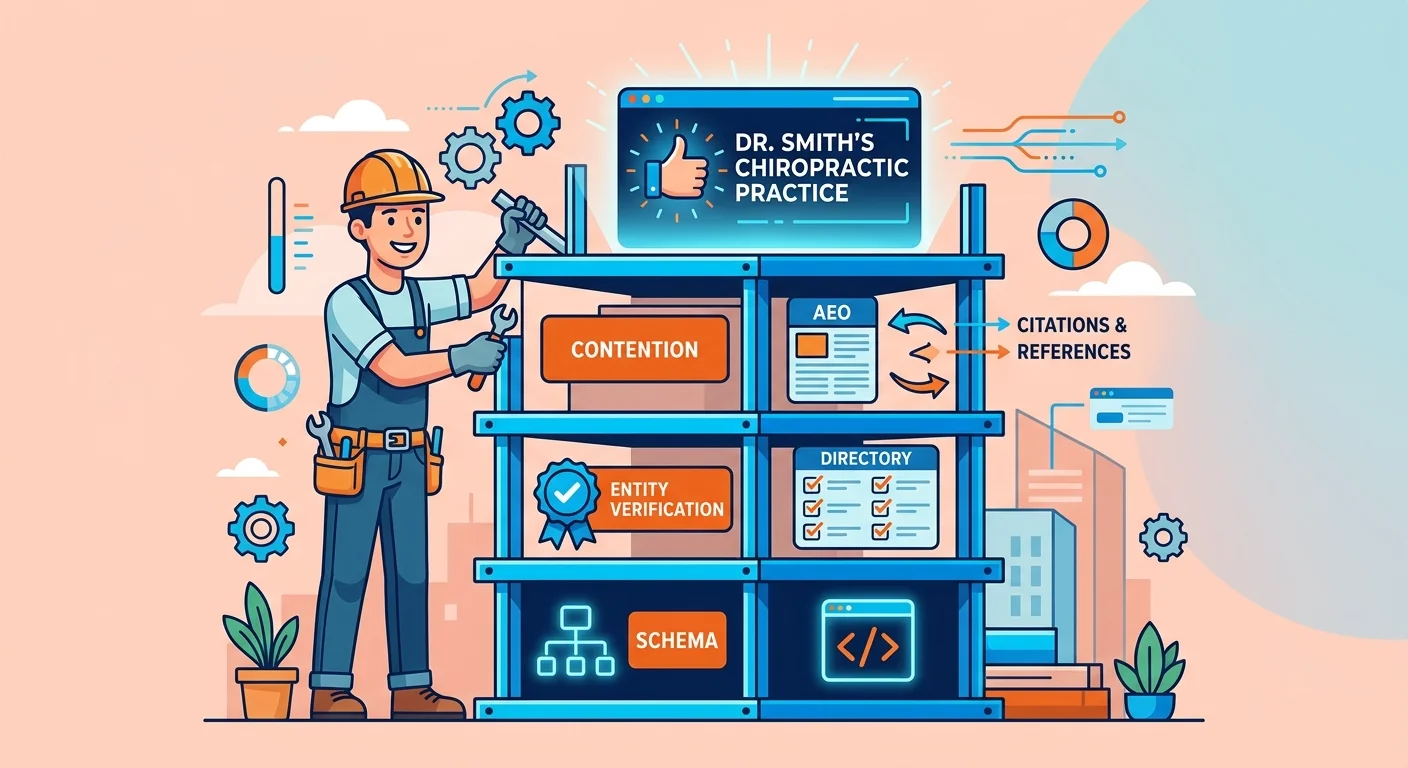
So what does it look like instead?
Not a better brochure. Not a smarter keyword retainer. A fundamentally different kind of asset – one that grows, compounds, and earns more trust with every month of execution.
Here’s the thing: AI engines don’t evaluate your website the way a patient does. They evaluate it the way a fact-checker does.
Four questions. Simultaneously. Can I read your structure? Do I trust your identity? Do authoritative sources back your claims? Do you go deep enough on this topic to be worth recommending?
Every layer of a compounding authority asset answers one of those questions.
Four layers. Each one feeding the next. Each one building on what came before.
If you want to see how every dimension stacks up – infrastructure, compounding value, asset ownership – the side-by-side authority asset comparison maps it out exactly.
Layer 1: AI-Readable Infrastructure
AI-Readable Infrastructure is the foundation. Nothing else works without it.
Schema markup. Consistent NAP data. Machine-readable signals that tell AI engines who you are, where you operate, and what you do. All of that gets evaluated before a single piece of your content is ever considered.
A brochure has none of this. A homepage with readable text and a phone number buried in the footer isn’t a signal – it’s noise.
AI engines require explicit semantic structures to reduce context processing errors and avoid recommending entities they can’t verify. If your infrastructure doesn’t speak that language, you don’t exist in the evaluation. Full stop.
And here’s what a keyword retainer can’t say: this layer doesn’t decay.
Build it right once and it keeps working. It doesn’t need rebuilding every month. It doesn’t vanish when you stop paying. It’s the permanent foundation everything else compounds on top of.
Layer 2: Entity Trust Signals
Layer 2 is Entity Trust Signals – and this is where most practices have the biggest gap they don’t know about.
Entity trust is the web of corroborating signals that confirm your practice is real, consistent, and authoritative. Structured directory listings. Consistent business data across platforms. Authoritative citations pointing back to a single verified entity: you.
AI engines cross-reference your practice against trusted registries before they’ll say your name. That’s not a preference – that’s how recommendation logic works.
Factual registries and validated data are how AI systems separate trustworthy entities from unverified noise. A brochure can’t pass that test. It was never designed to.
And here’s what makes this layer compound: every new signal strengthens all the existing ones.
Not additive – multiplicative. Each corroborating data point makes the entity picture more complete. A more complete picture means AI engines have more confidence recommending you over a practice with thinner signals.
Layer 3: AEO Content and Citation Velocity
Layer 3 is AEO Content and Citation Velocity – the active engine of the compounding asset.
But not content the way a keyword retainer produces it. AEO content is engineered to answer the specific questions AI engines receive from patients – structured so the engine can extract, validate, and cite the answer directly.
Search isn’t a list anymore. It’s a verdict. AI engines shifted user behavior from navigating links to receiving direct, synthesized responses – and that changes the entire content equation.
The content AI recommends isn’t the content that ranked highest. It’s the content that answered most precisely and was backed by verifiable entity signals. AEO content is built for that evaluation. A traditional keyword-optimized piece is not.
Citation velocity is the compounding mechanism.
Every piece of AEO content that earns a citation increases the probability the next one will too. AI engines learn which entities produce accurate, structured answers – and they reward consistency. That’s how one month of execution becomes a six-month advantage over a practice that waited.
Layer 4: Semantic Density and Topical Authority
Layer 4 is Semantic Density and Topical Authority. This is where depth separates a compounding asset from a pile of disconnected articles.
AI engines don’t just evaluate individual pieces of content. They evaluate whether a practice speaks with enough consistency, depth, and structural coherence across an entire topic domain to be trusted as the authority on it.
22% of global professionals are already using generative AI regularly in their daily workflows. That number is accelerating.
Those users are asking increasingly specific questions. The practices with the deepest, most semantically coherent content libraries are the ones getting named as the answer. Topical authority isn’t built in a day. It’s built article by article, month by month, layer by layer.
That’s the payoff.
A brochure gets handed out and forgotten. It contributes nothing going forward. Semantic Density and Topical Authority does the opposite – it deepens with every month of execution, compounds with every article added to the library, and gets harder to displace the longer you stay consistent.
This is what a compounding authority asset feels like from the inside.
| Layer | Component | What It Signals to AI | Brochure Site Equivalent |
|---|---|---|---|
| Layer 1 – AI-Readable Infrastructure | Schema markup, NAP consistency, machine-readable site structure | I can parse and verify this entity’s identity, location, and service area | A homepage with readable text and a phone number buried in the footer |
| Layer 2 – Entity Trust Signals | Structured directory listings, consistent business data, authoritative cross-web citations | Multiple trusted sources corroborate this entity – it is real, verified, and authoritative | A standalone website with no corroborating signals outside its own domain |
| Layer 3 – AEO Content and Citation Velocity | Structured answers to patient questions, engineered for AI extraction and citation | This entity produces precise, verifiable answers that I can cite with confidence | Keyword-optimized blog posts designed for ranked list placement, not direct answer extraction |
| Layer 4 – Semantic Density and Topical Authority | Deep, coherent content library covering a topic domain with consistency and structural logic | This entity speaks with enough depth and consistency to be trusted as the authority on this subject | A handful of disconnected service pages with thin, generic copy that covers nothing in depth |
This Is Not for Everyone: Who Should Stop Reading Now

Here’s the thing: the four-layer system above works. But it only works for a specific kind of buyer.
79% of global respondents report exposure to generative AI. The practices that own the next three years aren’t the ones experimenting – they’re the ones treating authority infrastructure as an asset.
Building a real asset requires a specific kind of commitment. Not every practice owner has it. That’s fine.
So here’s the filter.
If any of the following sounds like you – this system will frustrate you. Better to find out now than six months in.
The Short-Term Retainer Seeker
If you need measurable ROI in 90 days or less – this isn’t your answer.
According to this source, A compounding authority asset doesn’t run on a microwave schedule. AI-Readable Infrastructure gets built first. Entity Trust Signals deepen second. AEO Content and Citation Velocity accelerate third. Each layer feeds the next – that’s the compounding mechanism.
The layers are sequential by design. You can’t skip to month six. If that structure doesn’t fit your decision framework, no hard feelings – but it’s worth understanding what authority metrics actually predict growth before you walk away.
This is infrastructure. Not a shortcut.
Built correctly, it doesn’t need to be rebuilt. But it does need to be built. If that’s not the conversation you’re ready to have, there are faster products out there.
The Guarantee Demander and the DIY Underestimator
If you need a contractual guarantee of rankings, leads, or bookings – we’re not your fit.
The FTC has explicitly targeted groundless or exaggerated AI capability claims as a federal enforcement concern. So we don’t promise outcomes we can’t control.
What we do guarantee is the process – verified, structured, built to the exact standards AI engines use to evaluate credibility. Authority is what a sound process produces when it’s executed consistently. It’s a result, not a line item on a contract.
And if you’re thinking this is a checklist someone could handle in-house after a quick explanation – that belief is the system’s biggest enemy.
Semantic Density and Topical Authority isn’t a template. It’s a methodology built on two-AI validation, structured entity mapping, and ongoing execution that compounds month over month. 22% of global professionals are already using generative AI regularly in their daily workflows. The practices getting recommended aren’t the ones that figured it out on a weekend.
This is a done-for-you system, by design. If you want to own the execution yourself, you want a different product.
What Compounding Actually Looks Like Over 12 Months
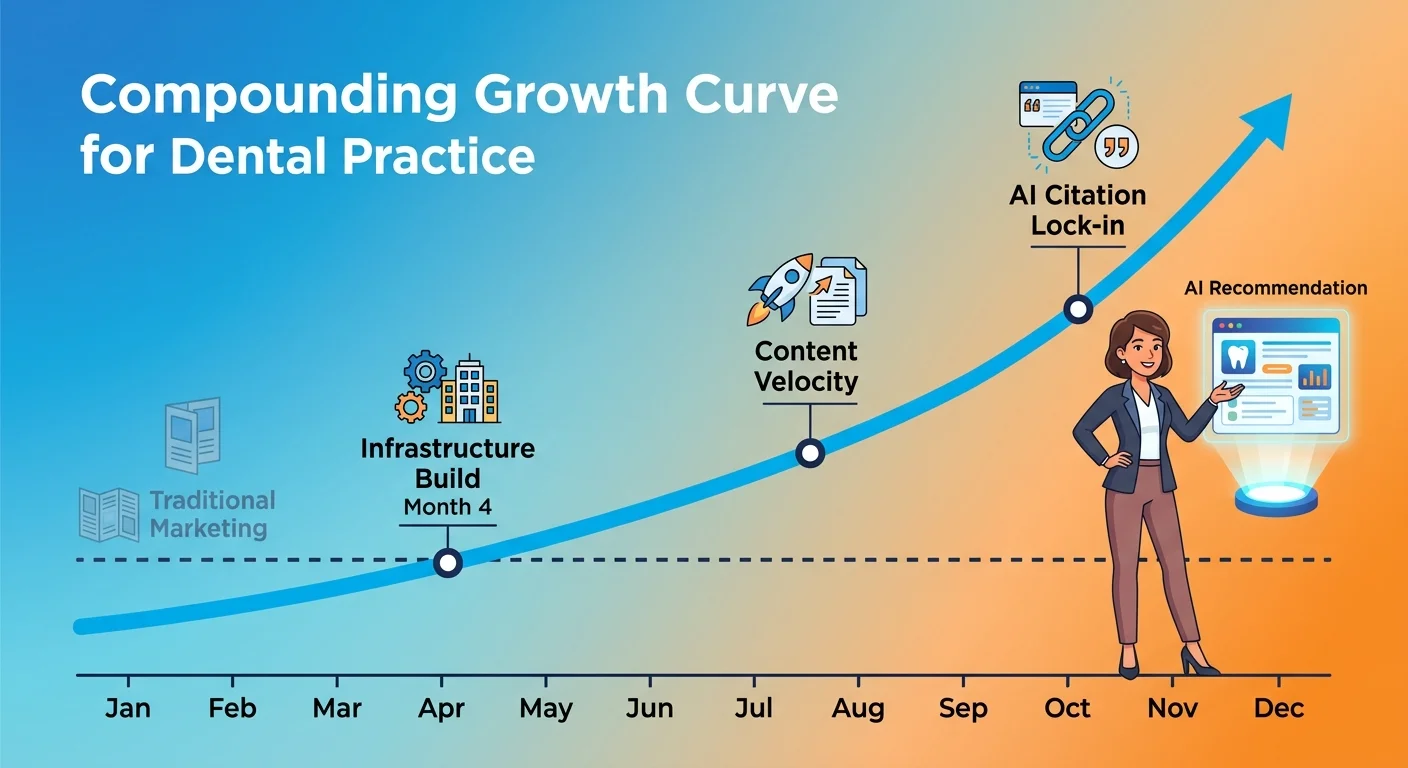
Here’s what this actually looks like.
Not in a pitch deck. Not in theory. Month by month, in real terms.
Traditional search engine volume is projected to drop 25% by 2026. That’s not a gradual fade – it’s a migration. Patients are already asking AI engines for a name, not clicking through a list of ten.
The practices that own those answers aren’t waiting for the shift to become obvious. They started building before the curve bent.
So here’s what the build actually looks like.
Month 1 Through 3: Foundation Is Not Invisible – It Is Loading
Months one through three feel quiet. They’re not.
The most important work in the system is running – it just hasn’t surfaced yet.
This is when the foundation gets laid. Schema deployed. NAP data audited and aligned across every platform AI engines actually consult. Entity Trust Signals cross-referenced against the trusted registries that determine whether a practice is even in the evaluation pool.
Explicit semantic structures reduce context processing errors and hallucinations – and that work has to come first. AEO content and Citation Velocity can’t compound on top of nothing.
A brochure skips this entirely. That’s why a brochure never compounds.
Think of it as the foundation of a building.
Nobody stands at the construction site and calls it impressive. But pull that foundation and every floor above it collapses. This phase works exactly the same way – it’s loading. It just doesn’t announce itself.
Practices that skip it because it doesn’t feel like progress are the ones that never compound. The ones that trusted the process are the ones AI is recommending by month ten.
Month 4 Through 12: The Curve Starts to Bend
Month four is where the curve starts to move.
AEO content and Citation Velocity comes online – structured answers to the exact questions AI engines are fielding from patients, engineered to be extracted, cited, and trusted. Each article deepens the entity picture. Each citation reinforces what was built in the first three months.
And the system starts doing something a brochure never could. It accumulates. See the side-by-side authority asset comparison to understand exactly how each dimension stacks up.
By months seven through nine, Semantic Density and Topical Authority is compounding in a way that’s genuinely hard to displace.
79% of global respondents now report exposure to generative AI. The engines those users are consulting are actively evaluating which practices own a topic domain – and which ones have a scattered pile of disconnected pages. Depth wins. Consistency wins.
The practices executing since month one are the ones AI names by month ten.
That’s the payoff the brochure never delivers.
A brochure gets handed out and forgotten. An authority asset built across four structured layers deepens every single month. The longer you stay consistent, the harder it becomes for anyone else to take your spot.
The gap between the practice AI names and the practice AI ignores is built one month at a time. It’s also closed one month at a time – but only if you start.
| Phase | Months | Primary Activity | Authority Signal Being Built | Brochure Site in Same Period |
|---|---|---|---|---|
| Foundation Build | Months 1-3 | AI-Readable Infrastructure deployed – schema, NAP alignment, entity registry cross-referencing | AI-Readable Infrastructure + Entity Trust Signals established | Brochure site unchanged – no new signals, no new trust, no compounding begins |
| Content Activation | Months 4-6 | AEO Content and Citation Velocity comes online – structured answers engineered for AI extraction and citation | Entity picture deepens with every article; citation pattern begins to form | Brochure site still static – no content structure AI engines can extract or cite |
| Compounding Begins | Months 7-9 | Semantic Density and Topical Authority builds across the content library; AI engines evaluate topic ownership | Practice recognized as a consistent, trustworthy source across a full topic domain | Brochure site accumulates no authority signals – competitor gap widens every month |
| Authority Lock-In | Months 10-12 | All four layers operating together – infrastructure, entity signals, citation velocity, and topical depth reinforcing each other | AI engines consistently name the practice as the trusted answer in its market | Brochure site remains a static, ignored page – invisible to AI recommendation logic entirely |
Frequently Asked Questions
Good questions survive a real system. The practitioners asking them – especially the ones who’ve been burned by agencies selling dashboards instead of results – deserve straight answers.
Here are the five that come up most. No hedging.
How does AI search change the way patients find local chiropractors?
It changed completely. Traditional search handed patients a list of ten options and let them decide. AI search hands them a verdict – one name, a synthesized reason to trust it, and nothing else.
Approximately 58% of U.S. adults are already aware of ChatGPT. Traditional search engine volume is projected to drop 25% by 2026 as that awareness converts into daily habit.
The patient who used to scroll your Google Business Profile is now asking Gemini or ChatGPT who the best chiropractor near them is. Those engines don’t browse. They evaluate entity trust, citation velocity, and structured content depth.
The practice with the strongest authority infrastructure gets named. Everyone else doesn’t exist in that answer.
What is the difference between a traditional digital brochure website and AI-readable authority infrastructure?
A brochure communicates. AI-readable infrastructure qualifies. That’s the whole difference – and it’s not subtle.
A traditional website was built for humans to read and evaluate. Pages, images, text, a contact form. Fine for a person. Noise to an AI engine.
AI engines don’t browse. They process structured signals – schema markup, entity consistency, semantic relationships between content, verified data registries. A flat, unstructured site doesn’t just fail to impress them. It produces interference they have to filter out before they can evaluate anything.
Explicit semantic structures and factual registries reduce context processing errors and hallucinations. That’s not a preference – that’s the architecture AI recommendation logic is built on.
AI-readable infrastructure translates your practice’s real-world authority into a format AI engines can read, evaluate, and trust. A brochure skips that translation entirely. And a brochure gets handed out and forgotten.
Why are traditional SEO keyword retainers failing in the age of conversational AI answers?
Because they were built for a model that’s being replaced.
The logic behind a traditional SEO keyword retainer is simple: optimize pages for specific phrases, build links, climb a ranked list. That model assumes patients are navigating results and choosing. AI search doesn’t produce a list – it produces a recommendation.
And AI engines don’t weight keyword density or backlink counts the way traditional algorithms did. They evaluate entity trust, topical depth, and citation consistency. A keyword retainer produces none of those signals.
It optimizes for a game that’s winding down. Being named as the trusted answer requires an entirely different infrastructure – one a keyword retainer was never designed to build.
79% of global respondents now report exposure to generative AI. The audience has already moved. The retainer model just hasn’t caught up.
How do schema markup and entity trust signals turn content into a compounding asset?
They do something a standalone piece of content never can – they give AI engines a verifiable, machine-readable reason to trust the source before they cite it.
Schema tells AI engines what your content is about and who it comes from, in a structured language they can process without interpretation. Entity trust signals confirm the entity behind that content is real, consistent, and credible. Consistent NAP data. Verified directory listings. Structured citations across trusted registries.
Explicit semantic structures reduce context processing errors and hallucinations. That’s exactly why AI engines depend on this infrastructure before recommending anyone.
Here’s what makes it compound: every piece of AEO content you add on top of a verified entity foundation earns trust faster than the last one. The schema and entity layer converts content from a flat asset into a signal that accumulates.
That’s the difference between publishing and building.
What is the risk of leaving my practice’s AI visibility unmanaged?
Compounding invisibility. That’s the risk – and it accelerates.
Every month you leave AI visibility unmanaged, a competitor who is building authority infrastructure adds another month to their advantage. AI engines reward consistency and depth. The practices that started earlier aren’t just ahead. They’re pulling further ahead with every article published and every entity signal reinforced.
22% of professionals are already using generative AI regularly in their daily workflows. The patients among them are asking AI engines for recommendations right now. If your name isn’t in those answers, someone else’s is.
And the longer that gap exists, the more established the competitor’s authority becomes in the engine’s evaluation model.
Unmanaged AI visibility isn’t a neutral position. It’s a decision to let someone else own the answer while you wait.
The Brochure Had Its Day. This Is What Replaces It.
A brochure gets handed out and forgotten.
It looked good. It said the right things. For a long time, that was enough.
It’s not enough anymore.
AI engines don’t browse brochures. They evaluate entities. A flat, static website with no schema, no entity signals, no citation velocity, and no topical depth doesn’t register in that evaluation at all – invisible to the exact engines your next patient is already using to find someone just like you.
So here’s what replaces it.
Four structured layers – AI-Readable Infrastructure, Entity Trust Signals, AEO Content and Citation Velocity, and Semantic Density and Topical Authority – each one compounding on the last. Each one building something a brochure never could: an asset that grows with every month of consistent execution.
That’s not a marketing expense. That’s infrastructure. And unlike a brochure, it doesn’t stop working when you stop handing it out.
iTech Valet was built to engineer exactly this outcome – to take a practice’s digital footprint from a passive, forgotten brochure to the name AI actually says out loud.
Every competitor who waits on this build hands the practices that started earlier one more month of compounding advantage. That gap doesn’t close on its own. It widens.
The only question left is whether AI says your name – or your competitor’s.
A brochure gets handed out and forgotten. Your competitor’s authority infrastructure does not.
The AI Visibility Check takes fifteen minutes. It shows you exactly what AI engines say about your practice right now – and what it would take to make sure they say your name.