
What Conflicting Clinic Data Actually Looks Like
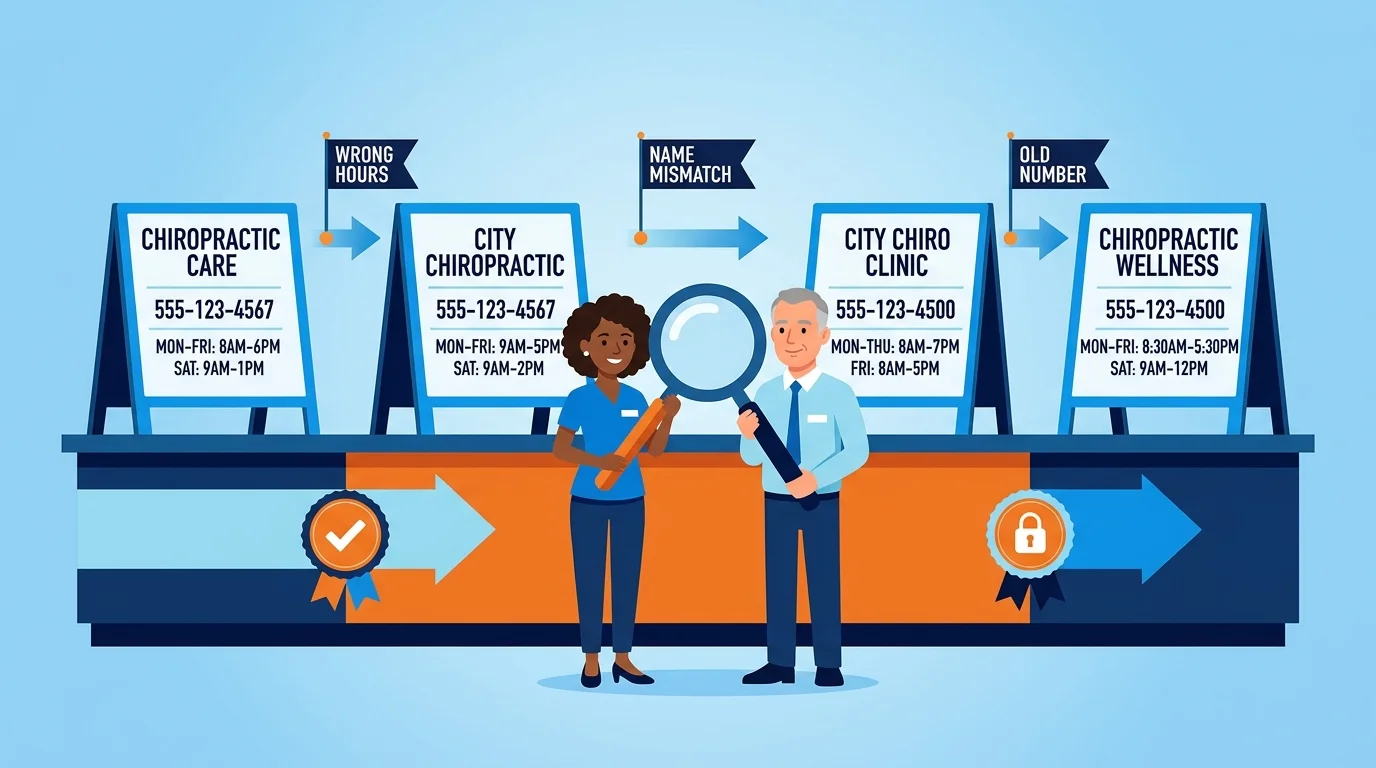
Here's the thing: conflicting clinic data almost never looks like a crisis. It looks like the practice's phone number sitting correctly on its own site, then showing up one digit off on some directory nobody's touched in years.
Now multiply that one slip across dozens of platforms, and the practice doesn't have one identity online anymore. It has a fragmented file on itself, scattered across directories, each holding a slightly different version of the truth. And not one page anywhere says which version is right.
Why Manual Listing Cleanup Breaks Down at Scale
The common fix is manual cleanup: a staff member logging into each directory and editing fields one at a time. That approach treats the problem as a listings issue, something to tidy up for human searchers scrolling through map results.
But AI visibility is not old-school search work wearing a new name tag, because machines read every scattered, conflicting record and still have to pick one to trust. That's why patching the big directories rarely ends the conflict. a complete guide to clinic listing repair shows how the mismatches buried in smaller listings keep feeding aggregators long after the obvious ones get fixed.
How Bad Data Actually Spreads Through the Local Ecosystem
A single bad listing rarely stays contained. Directories and map services pull from each other constantly, trading records back and forth in an automated handoff that nobody at the practice ever sees.
That handoff is the same web of directories, aggregators, and search engines mentioned earlier, except now it is working against the practice instead of for it. One outdated address doesn't just sit on one obscure site. It gets picked up, resyndicated, and treated as fresh data somewhere else entirely.
| Layer | Who Holds the Data | What It Feeds |
|---|---|---|
| Primary Directories | Major map services and the practice's own listed profiles | First point of contact for patients and the initial source most aggregators pull from |
| Data Aggregators | Background syndication networks that connect directories to one another | Bulk records that get redistributed to smaller directories without manual review |
| Niche and Local Directories | Smaller regional or industry specific listing sites | Secondary copies of a practice's details that rarely get checked but still feed back into aggregators |
| Search and AI Engines | Systems that compile signals from every layer above into a single answer | A composite record used to answer patient queries or satisfy an AI citation |
The Aggregator Handoff Chain
Now… this part matters. The aggregators underneath many directories may not check whether a record is accurate, only whether it matches the last version they pulled, so an old address can outlive the lease on the old building by years.
That's the mechanism behind listings that seem to fix themselves and then quietly revert. A practice corrects one directory, and an aggregator further down the chain can overwrite it on the next sync. For a realistic view of how long that correction actually needs to hold before it sticks, see realistic time needed to fix directory inconsistencies.
What the Research Says About Listing Accuracy
So is scattered directory data just a hunch? Nope. Researchers who lined up two commercial business databases covering St. Louis found out exactly how far apart those records can drift.
A 2010 study by Hoehner and Schootman (Washington University School of Medicine) found two commercial business databases agreed on only about a third of St. Louis businesses (about a quarter for health-care services).
Where Entity Confusion Costs the Most
Entity confusion is not an abstract data problem. For a chiropractic practice, conflicting information like wrong hours or a disconnected phone number can directly lead to lost patient appointments.
A shiny directory position means squat if the record behind it is wrong. If you want to know what a real fix looks like (beyond watching one listing flip), here's how to confirm directory corrections took effect.
How Entity Recognition Actually Works
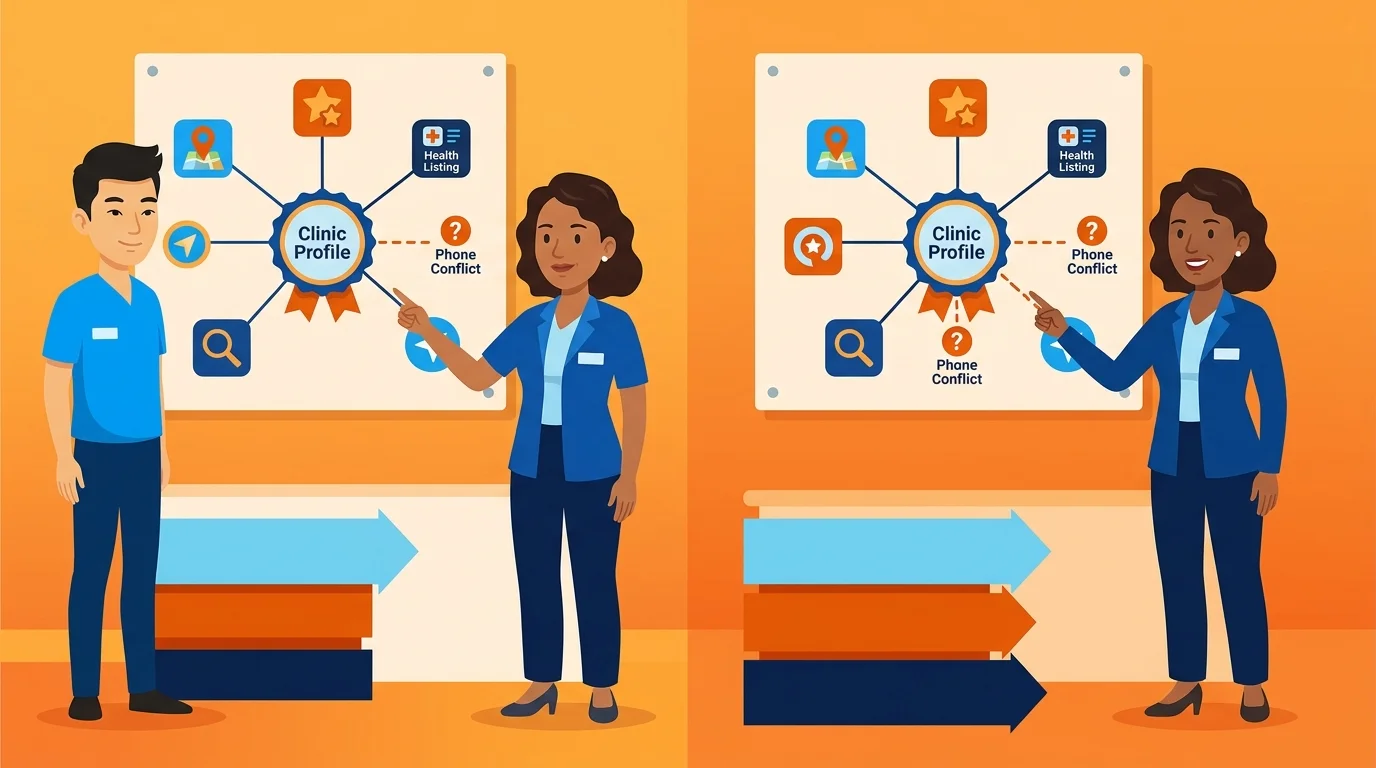
So how does a machine decide whether ten scattered listings are one chiropractic practice or ten different businesses? That's entity recognition, and it works by hunting for matching signals across every source, not by finding one directory that happens to be right.
Why Multiple Phone Numbers Break Trust Signals
A phone number can be one of the stronger matching signals a system checks. Give it three different numbers floating around the directories, and it may not be able to tell which one belongs to the real practice. So it may treat all three as weaker evidence (kinda like a witness who keeps changing the story).
That uncertainty is the same mechanism behind the fragmented file problem described earlier, applied to a single field. Resolving it on the clinic's own site matters more than chasing every directory, which is the kind of correction our done-for-you AEO services are built to handle.
Building the Single Source of Truth
So what actually ends the conflict? A record the practice's own site controls directly, the version the others should be copying, instead of one more directory to babysit.
Schema as the Override Layer
Enter structured data markup, the override layer. It spells out the practice's name, address, phone number, and hours in a format machines can read directly, so they may not have to guess from directories that can't agree.
The Reconciliation Sequence and What Comes After
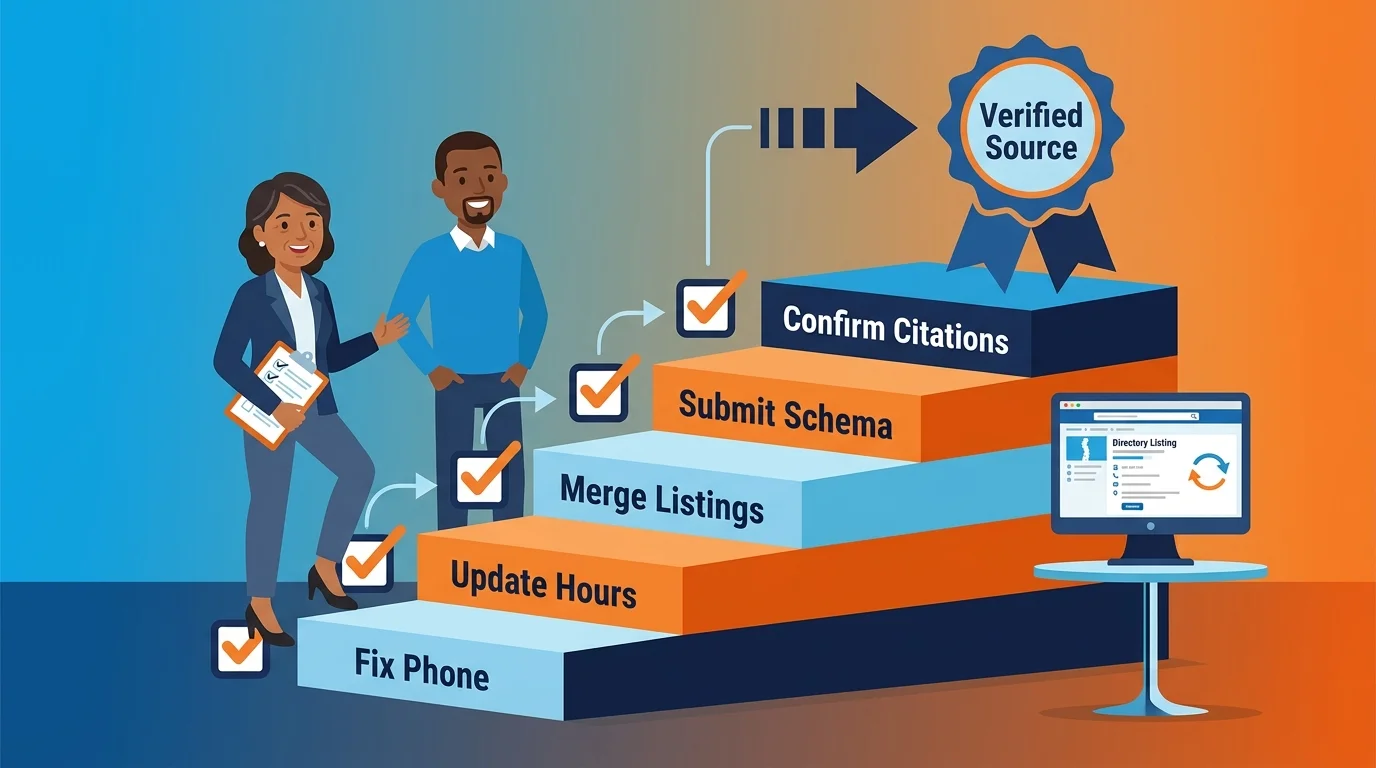
Here's what I tell docs: reconciliation is a sequence, not one quick edit. It starts with the audit, moves through correction, then lands on the practice's own site: keeping the site's markup accurate and matching the visible page is good practice, and it's the part the practice controls.
| Step | Action | What to Confirm |
|---|---|---|
| Audit | Locate every existing listing for the practice, from major platforms down to niche local directories. | Every version of the name, address, phone number, and hours currently published, not just the prominent ones. |
| Correct | Fix discrepancies directly on each platform, or push a single corrected record through a data aggregator. | That the correction matches the single verified source of truth, not just a cleaner-looking listing. |
| Override | Publish structured data markup on the practice's own site stating the authoritative version of its identity. | That the markup is accurate and matches the visible page, the part the practice controls. |
| Verify | Recheck corrected listings after aggregator sync cycles have had time to run. | Whether the fix held, or whether an outdated record resynced and quietly overwrote it. |
Verifying the Fix Actually Held
Alright, quick reality check: a correction that looks finished on screen isn't the same as one that held. Aggregators resync on their own schedule. So a fixed listing can quietly flip back weeks later, and nobody at the front desk ever notices.
Frequently Asked Questions
These questions come up every single time this topic does. Here are the straight, mechanical answers.
What are the most common causes of conflicting clinic data online?
Three usual suspects. Automated data aggregation, old listings from a past address, and plain human error. Each one spins out a slightly different version of the same record.
Can I just fix my Google Business Profile and ignore other directories?
No. A corrected Google Business Profile is one accurate record among dozens of scattered ones, and aggregators keep pulling from the others regardless.
How long does it typically take for corrected data to appear across all major directories?
No promises here, because propagation follows aggregator sync schedules, not a calendar. A listing can look fixed today. Then an aggregator resyncs from an older source, and it quietly flips back.
What is the difference between manual citation cleanup and using a data aggregator service?
Manual cleanup means editing each directory by hand, one field at a time, on every platform separately. A data aggregator service instead pushes one corrected record outward to its network, correcting many downstream listings from a single source.
If I move my clinic, what is the first step to updating my information everywhere?
Lock down the single verified record on the practice's own site first. Every directory fix after that gets checked against it, not the other way around.
How does having multiple phone numbers listed online affect my practice?
Multiple phone numbers can weaken entity recognition because the system may not be able to confirm which number actually belongs to the practice. That uncertainty gets treated as unresolved conflict, not extra information.
The Bottom Line
So here's where this lands. One clean directory never fixes a fragmented file on your practice. It gets fixed when every scattered version of the truth answers to one single record.
That record lives on your own site, backed by structured data, instead of scattered across platforms and waiting on an aggregator to sync it right. Being the cited source beats being a listed address. When every other source disagrees, the practice that controls its own record is the one AI systems can more easily trust.
And building that one trusted file is ongoing work (sorry, there's no one-and-done cleanup here). If you want help turning your scattered listings into the record AI engines actually cite, see how iTech Valet approaches AI visibility.