Why Traditional SEO Metrics No Longer Work
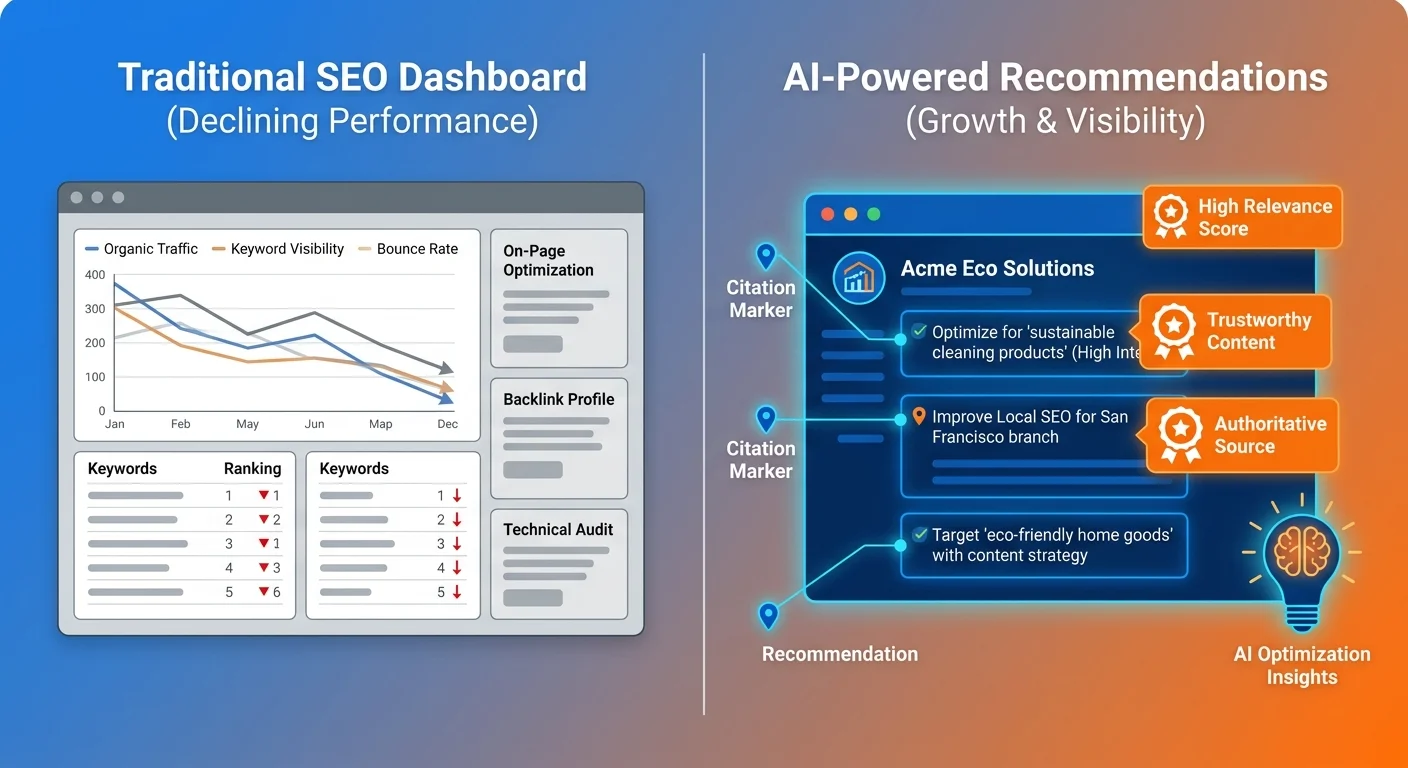
SEO agencies sold you a scoreboard. Keyword rankings. Page one positions. Traffic graphs that climbed up and to the right. Every month you’d get a report showing your climb from position 7 to position 4 for ‘best chiropractor near me.’
It felt concrete. It felt measurable.
It was also a lagging indicator of a game that’s already over.
That scoreboard is breaking. Gartner predicts search engine volume will drop 25% by 2026 because users aren’t typing queries into Google and scrolling through ten blue links anymore.
They’re asking ChatGPT. They’re trusting Perplexity’s citations. They’re reading AI Overviews and never clicking through.
The behavior shifted. The scoreboard didn’t.
When roughly two-thirds of Google searches end without a click, ranking on page one stops mattering.
If the user never leaves the search results page – if AI delivers the answer directly and names your competitor instead of you – your position 4 ranking is worth exactly nothing.
The Shift from Rankings to Citations
The game changed. Traditional SEO optimized for a ranked list of results that users would evaluate and click through.
AI search produces a verdict.
ChatGPT doesn’t show you ten options and let the user decide. It names one answer. Gemini doesn’t rank you. It cites you or it doesn’t.
That’s not a variation of the same problem. That’s a different problem entirely.
Ranking is a competition for position. Citation is a test of entity trust. You can’t optimize for citation using the same tactics that got you to page one in 2019 – because the concept of zero-click searches means AI engines are answering the question without ever sending traffic to your site.
So agencies pivoted. Now they’re selling ‘AI citation tracking’ as if it’s the new keyword ranking report.
Same hopium. Same vanity metric. Same fundamental misunderstanding of what the scoreboard measures.
The scoreboard isn’t the game. Counting citations doesn’t build authority. It’s just a prettier way to avoid doing the actual work.
| Metric Type | What It Measures | Why It’s Outdated |
|---|---|---|
| Keyword Rankings | Your position in a list of ten blue links for a specific search query | Users don’t scroll through ranked results anymore – AI delivers one answer directly, and rankings become irrelevant when zero-click searches dominate |
| Page One Traffic | How many visitors clicked through from Google’s first page of results to your website | Traffic stops mattering when AI engines answer the question without sending users to any website – being page one doesn’t help if no one clicks |
| Domain Authority (DA) | A third-party score estimating your site’s likelihood to rank based on backlink profiles | DA was built to predict Google rankings – AI engines don’t use backlink-based authority scores, they use entity trust signals and structured data |
| Bounce Rate / Time on Site | How long visitors stayed on your page and whether they navigated to other pages | Engagement metrics assume users visit your site – when AI answers questions directly, those metrics measure nothing because the user never arrives |
| Monthly Search Volume | How many people searched for a specific keyword each month in traditional search engines | Search volume is collapsing as users shift to conversational AI – measuring demand for a query that’s migrating to ChatGPT tells you nothing about AI visibility |
What AI Engines Actually Track
So what’s AI actually tracking when it decides who to name?
Not your domain authority. Not your backlink profile. Not how many blog posts you cranked out last quarter.
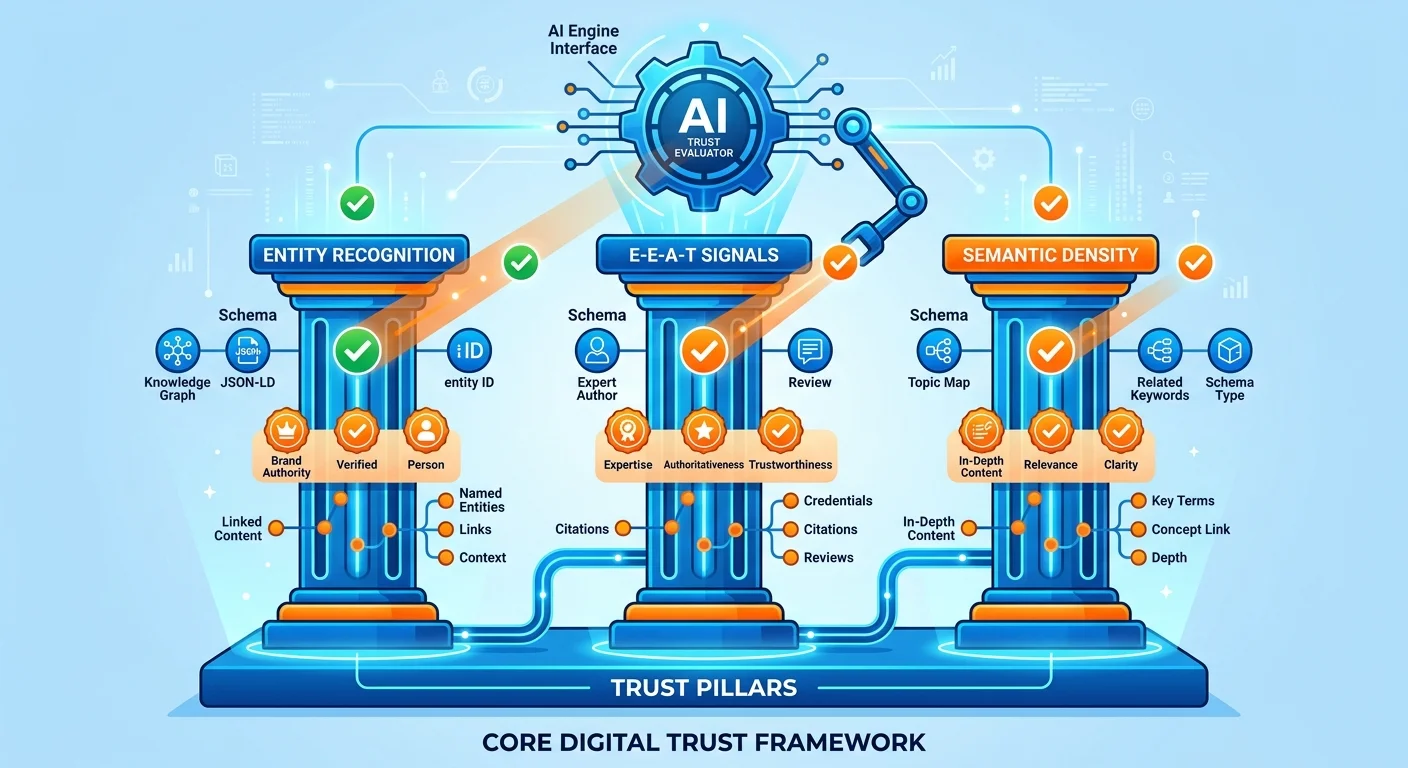
AI engines track three signals: whether you exist as a recognized entity with structured data, whether your content demonstrates experience and trustworthiness, and whether that content is semantically dense enough for machines to parse.
Those aren’t marketing terms. They’re the difference between being visible to AI and being invisible.
Entity Recognition
Entity recognition is the first gate.
AI engines don’t cite websites. They cite entities – businesses, practitioners, organizations that exist as structured, machine-readable records in their knowledge graphs. If your business isn’t registered as an entity with verified schema markup, consistent NAP data, and clear attribution across directories, AI doesn’t know you exist.
Traditional SEO treated your website as a collection of pages. AI treats your business as a single entity with attributes. Name. Location. Services. Credentials. Relationships to other entities.
The more complete and consistent that entity record is across the web, the more confident AI engines are in citing you.
That’s why building Entity Trust is the foundation of every Authority Engine we build.
Without entity recognition, you’re not in the game.
E-E-A-T Signals
The second signal is E-E-A-T: experience, expertise, authoritativeness, and trustworthiness.
Google’s AI Overviews rely on these signals to determine which sources are reliable enough to cite. This isn’t new – but it’s enforced differently. Traditional search could rank a mediocre page if it had enough backlinks. AI engines won’t cite a source they don’t trust.
E-E-A-T is demonstrated through practitioner credentials, institutional affiliations, published authority content, and citation velocity from other trusted sources. It’s not a checkbox. It’s a compounding signal that builds over time.
AI engines don’t trust you because you said you’re an expert. They trust you because other verified entities cite you as one.
The foundational principles of E-E-A-T were written for traditional search, but they’re more critical now.
AI engines need proof. Credentials that can be verified. Content that demonstrates depth. Attribution that shows other authorities recognize your expertise. Without those signals, you don’t get cited.
Content Semantic Density
The third signal is semantic density.
AI engines don’t scrape your homepage and guess what you do. They parse structured, topic-specific content that clearly defines relationships between concepts, services, and entities. If your content is vague, generic, or written for keyword stuffing instead of conceptual clarity, AI can’t extract citable answers from it.
Semantic density means your content explicitly names the entities, processes, and relationships AI needs to build context. Schema markup tells machines what each page represents. Internal linking maps your site’s topical authority. FAQ sections answer the exact questions users ask – in the exact language AI engines use to evaluate relevance.
It’s not about keyword stuffing. It’s about conceptual clarity machines can parse.
Low-density content – the kind most agencies produce – reads fine to humans. But machines can’t parse it.
No clear answer to extract. No entity to attribute. No semantic structure to trust. AI engines skip over it and cite the competitor who built their content for machine readability, not just human skimmability.
| AI Signal | What AI Checks For | Infrastructure Required |
|---|---|---|
| Entity Recognition | Does your business exist as a structured, machine-readable entity with verified schema markup, consistent NAP data, and clear attribution across directories and knowledge graphs | Complete schema implementation, verified business profiles across major directories, consistent entity attributes, practitioner credential markup, organizational affiliations |
| E-E-A-T Signals | Can AI verify your experience, expertise, authoritativeness, and trustworthiness through practitioner credentials, institutional affiliations, and citations from other trusted entities | Verified practitioner credentials in schema, published authority content, institutional affiliations, inbound citations from trusted sources, author attribution on all content |
| Semantic Density | Can machines parse clear, structured answers from your content that explicitly name entities, processes, and relationships AI needs to build context | Topic-specific content with explicit entity relationships, comprehensive schema markup on every page, internal linking that maps topical authority, FAQ sections answering exact user questions |
| Citation Velocity | How frequently are other trusted sources citing your business as an authority in your domain over time | Ongoing content execution that compounds authority, consistent publishing cadence, external citations from institutional and peer sources, growing backlink profile from trusted entities |
| Content Extractability | Can AI engines extract complete, citable answers from your pages without ambiguity or guesswork | Direct Answer sections at the top of every article, clear heading hierarchy, structured data for every content type, no vague or keyword-stuffed copy |
How We Measure Authority Infrastructure
Here’s how we measure whether your infrastructure is built to be seen.
We don’t hand you a dashboard counting how many times ChatGPT mentioned your name last month.
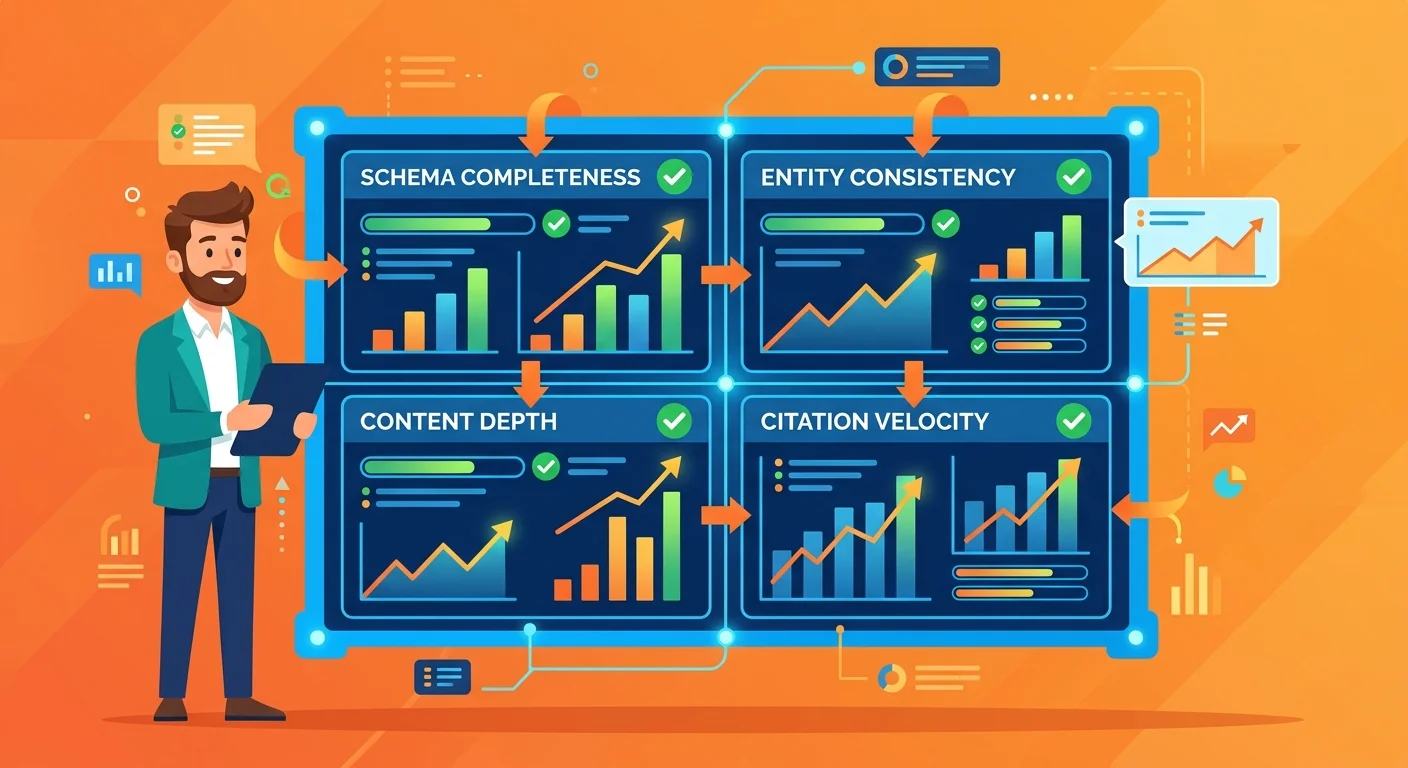
We audit the four foundational pillars that determine whether AI engines can recognize you as a citable entity in the first place.
Schema completeness. Entity consistency. Content authority depth. Citation velocity.
These aren’t vanity metrics. They’re the structural signals that make citation possible.
Each pillar has a measurable baseline and a target state. We assess where you are when we start. We identify the gaps blocking AI visibility. We build the infrastructure to close them.
The goal isn’t a graph that trends upward every month.
The goal is reaching the threshold where AI engines see you as the only logical answer – and then maintaining that position while competitors scramble to catch up.
This is how iTech Valet measures success. Not by chasing citations. By building the Authority Infrastructure that makes citations inevitable.
Schema Completeness Audit
Schema markup is the language machines use to understand what your business is, what you do, and who you serve.
Without it, AI engines can’t parse your site. They see unstructured text. No entity. No attributes. No confidence to cite you.
Schema completeness measures how much of your business identity is machine-readable – and how consistently it’s implemented across every page.
We audit Organization schema, LocalBusiness schema, Service schema, and Person schema for every practitioner on your site. We verify that your credentials, affiliations, and service offerings are structured as entities with relationships AI can map. We check FAQPage schema, HowTo schema, and BreadcrumbList schema so your content is semantically tagged for extraction.
Incomplete schema is the most common reason AI engines ignore a business that should be cited.
The baseline is binary. Either your schema is complete enough for AI engines to trust it, or it isn’t.
Partial schema is worse than no schema – because it signals to machines that your data is inconsistent or unreliable.
We measure completeness as a percentage of required schema types implemented correctly across your site. Target is 100%. Anything less leaves you invisible.
Entity Consistency Score
Entity consistency measures how uniformly your business name, address, phone number, and service descriptions appear across every platform AI engines use to verify identity.
Google Business Profile. Yelp. Healthgrades. Your website. Your schema markup. Your directory listings.
If those don’t match exactly, AI engines can’t confirm you’re the same entity – so they won’t cite you.
We audit every public-facing mention of your business across directories, citation sources, and knowledge graph inputs. We check for NAP inconsistencies, duplicate listings, incomplete profiles, and missing attribution.
We score entity consistency on a 100-point scale based on how many verified platforms carry accurate, complete, and matching data.
A score below 80 means AI engines are seeing conflicting signals about who you are.
Traditional SEO ignored this. It didn’t matter if your Yelp listing said ‘Main St’ and your website said ‘Main Street’ – because Google’s algorithm ranked you anyway.
AI engines can’t. They need exact matches.
Entity consistency isn’t a nice-to-have. It’s the foundation of recognition.
Content Authority Depth
Content authority depth measures whether your site contains enough semantically dense, topic-specific content for AI engines to cite.
A homepage and a services page aren’t enough. AI engines cite sources that demonstrate depth – content that answers questions, defines concepts, and establishes relationships between entities.
That’s why our AEO Content Writing Services focus on building authority libraries, not blog posts.
We measure content depth by counting how many core topics your site covers, how many questions each topic answers, and how much semantic structure each article provides. We audit FAQ density, internal linking patterns, and schema tagging across your content library.
The baseline is how many citable answers your site contains right now.
The target is full coverage of every question a prospect asks before choosing a provider – with every answer structured for machine extraction.
Low-depth sites get skipped. AI engines don’t cite a business that only has surface-level content. They cite the business that has the most complete, most structured, most authoritative answer.
Content depth is how you become that business.
Citation Velocity Tracking
Citation velocity tracks how often your business is mentioned, linked, or cited by other verified entities over time. It’s the compounding signal that separates new entrants from established authorities.
AI engines don’t just check whether you exist as an entity. They check whether other trusted sources recognize you as one.
The more citations you accumulate from authoritative platforms, directories, and content sources, the more confident AI engines are in naming you.
We measure velocity by tracking how many new citations your business earns per month from Tier 1 and Tier 2 sources. New directory listings. Guest mentions. Press coverage. Industry association profiles.
Every verified external mention strengthens your entity graph.
The baseline is how many citations you have when we start. The target is sustained monthly growth that compounds your authority faster than competitors can match.
Traditional SEO measured backlinks. AI citation velocity measures entity mentions – and it’s harder to fake.
You can’t buy your way onto the graph. You earn it by building the core AI Authority Engine that makes your business the logical answer in the first place.
| Infrastructure Component | Measurement Method | Pass/Fail Threshold |
|---|---|---|
| Schema Completeness | Percentage of required schema types (Organization, LocalBusiness, Service, Person, FAQPage, HowTo, BreadcrumbList) implemented correctly across all site pages | 100% – partial schema signals inconsistency and blocks AI trust |
| Entity Consistency | 100-point scale audit of NAP accuracy and completeness across all directories, citation sources, and knowledge graph inputs | 80+ – scores below 80 indicate conflicting entity signals that prevent citation |
| Content Authority Depth | Count of core topics covered, questions answered per topic, FAQ density, and semantic structure across content library | Full coverage of every prospect question with machine-extractable answers in every article |
| Citation Velocity | Monthly count of new entity mentions from Tier 1 and Tier 2 verified sources (directories, press, industry associations) | Sustained monthly growth that compounds authority faster than competitors |
Why Citation Count Is the Wrong Goal
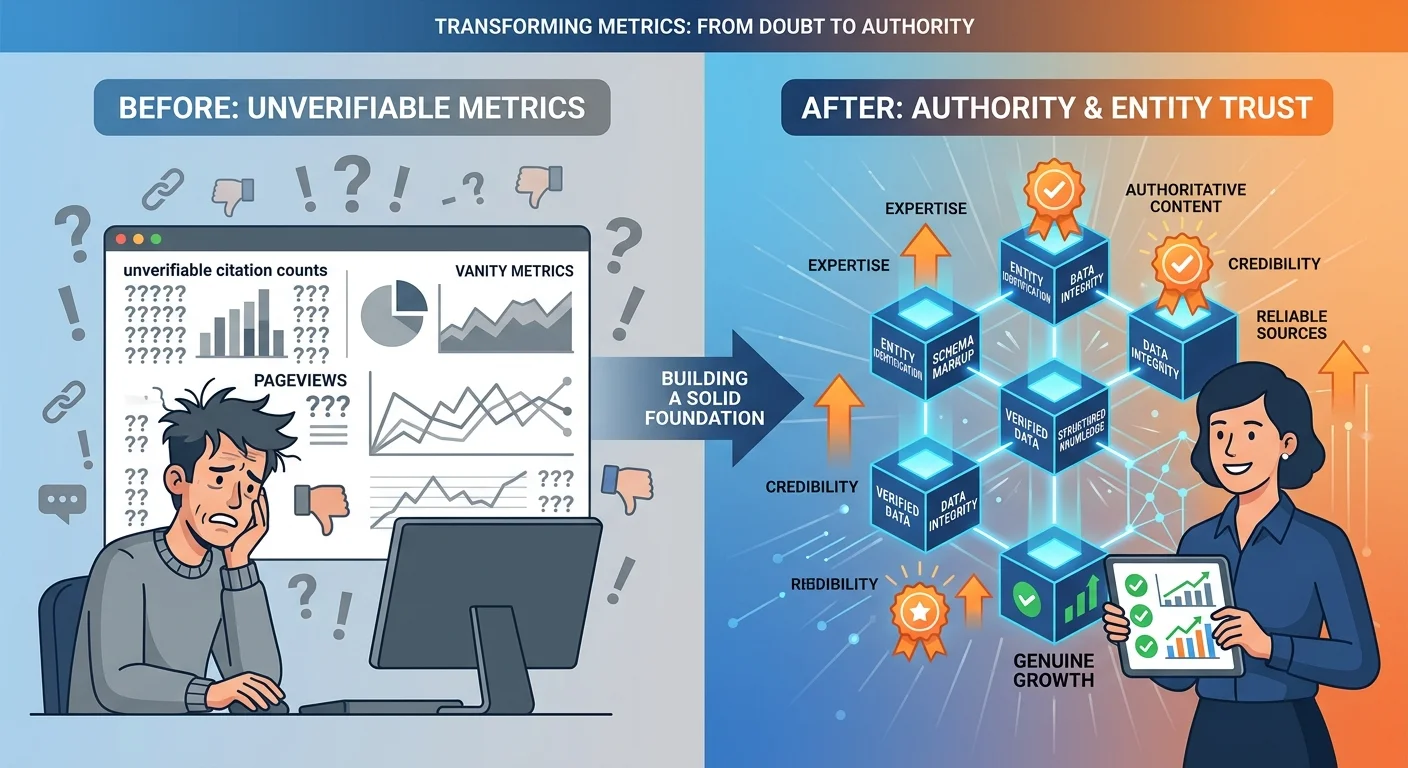
Here’s the part most agencies get backwards.
They’re measuring the outcome instead of the system that produces it.
They’ll pitch you on ‘AI citation tracking’ as if it’s the next frontier of SEO. They’ll show you dashboards that claim to count how many times ChatGPT or Gemini mentioned your business this month. They’ll frame it as a concrete metric – something you can check daily, like keyword rankings.
And they’re wrong.
Citation count isn’t the goal. It’s the symptom.
The real measure? Whether your business is built to be cited in the first place. Whether AI engines recognize you as an entity. Whether they trust your authority. Whether they can extract structured answers from your content.
Chasing citations without building that foundation is how generative AI is changing search – and most businesses aren’t ready.
The Unverifiable Citation Problem
No AI engine publishes a real-time citation log.
ChatGPT doesn’t tell you how many times it named your business this week. Gemini doesn’t send monthly reports. Perplexity doesn’t offer a dashboard.
The citation-tracking tools agencies sell? They’re reverse-engineering outputs they can’t verify – scraping answers, guessing attribution, presenting estimates as facts.
You can’t optimize what you can’t measure. And you can’t measure something that isn’t logged.
Citation count is unverifiable because the engines don’t surface it. What they do surface – the answers they generate – shifts based on context, user history, phrasing.
The same question asked twice can produce different answers with different sources.
Traditional SEO rankings were at least deterministic. You could check your position on page one. You could track changes daily.
AI citations don’t work that way. They’re probabilistic. They shift. They depend on signals you can’t directly observe.
Agencies selling citation counts are repackaging the same hopium they sold with keyword rankings – a scoreboard that distracts you from the fact that the game changed.
The Vanity Metric Trap
Even if you could track citations accurately, the number itself is meaningless.
Getting mentioned five times this month doesn’t tell you whether those mentions were positive, authoritative, or contextually relevant. It doesn’t tell you whether AI engines trust you enough to cite you for high-stakes questions.
It doesn’t tell you whether your infrastructure is strong enough to keep that visibility.
Vanity metrics feel good. They trend upward. They look impressive in quarterly reports.
But they don’t answer the only question that matters – are you the answer when someone asks AI for the best provider in your market?
Because if you’re not, the citation count is irrelevant. You’re one of five options AI considers. Not the answer it recommends.
This is why we don’t measure success by chasing citations. We measure it by building the Authority Infrastructure that makes you the only logical choice.
Schema completeness. Entity consistency. Content authority depth. Citation velocity from verified sources.
Those are the signals AI engines use to decide who gets cited. That’s what determines whether an Authority Engine is a better investment than a website that wasn’t built for machine trust.
Frequently Asked Questions
Here are the questions practices ask when they realize their current agency is selling repackaged SEO hopium.
These are the questions that separate businesses chasing dashboards from businesses building infrastructure.
How is measuring AI citations different from tracking SEO keyword rankings?
SEO keyword rankings measure your position in a list of search results. AI citations measure whether you’re recognized as an entity that AI engines trust enough to name directly in an answer.
Rankings are deterministic. You can check your position daily. Citations are probabilistic. They shift based on context, user history, and phrasing.
SEO optimized for a ranked list that users evaluated. AEO optimizes for being the single recommended answer inside a conversational response. Those aren’t variations of the same thing.
What are the most important signals for improving my authority visibility for AI?
Is it possible to guarantee that AI engines like ChatGPT or Gemini will cite my business?
No.
Anyone who guarantees AI citations is lying to you. AI engines are probabilistic. They don’t publish citation logs. They don’t guarantee visibility.
What you can guarantee is that your infrastructure meets the requirements AI engines use to decide who gets cited. Schema completeness. Entity consistency. Content depth. Authority signals from verified sources.
We don’t guarantee rankings. We don’t guarantee citations. We guarantee our processes are verified by the AI engines themselves.
What tools can I use to see if AI is recommending my competitors over me?
Query the AI engines directly.
Ask ChatGPT who the best provider in your market is. Ask Gemini. Ask Perplexity. Document the answers. See who gets named.
There’s no dashboard that tracks this. No third-party tool has access to real-time citation data. The engines themselves don’t publish it. The only way to know what AI says is to ask it.
That’s what the AI Visibility Check does. We query the engines manually. We document the responses. We show you exactly what AI says when someone asks for the best provider in your market.
How long does it take to build enough authority to get cited by AI engines?
There’s no microwave schedule.
Authority compounds. Schema implementation is immediate. Entity consistency fixes take weeks to propagate across platforms. Content authority depth builds over months of sustained execution. Citation velocity accelerates as more verified sources recognize you.
We won’t promise results in a specific timeframe. Not because this doesn’t work. Because authority doesn’t run on a timeline you can game. What we will say is this: every month of execution builds on the last. The practices that stick with it compound. The ones that quit give that ground to whoever kept going.
The Bottom Line
Traditional SEO sold you page one rankings. Now agencies are selling AI citations. Same game, different scoreboard.
But the scoreboard isn’t the game.
You can’t chase a metric you can’t verify. You can’t optimize for an outcome AI engines don’t publish. What you can do is build the foundation that makes citing you the obvious choice.
Schema that machines trust. Entity signals that verify your identity. Content that answers every question AI engines extract. Authority that compounds with every verified mention.
That’s the infrastructure. That’s the work.
We measure success by whether your business is structurally ready to be the answer.
Schema completeness tells us if AI can read you. Entity consistency tells us if AI can recognize you. Content authority depth tells us if AI can cite you. Citation velocity tells us if other trusted sources already do.
Those signals don’t fluctuate with algorithm updates. They don’t change based on who’s asking the question.
They’re durable. They compound. They separate businesses that exist in AI’s knowledge graph from businesses that don’t.
This isn’t about tracking how many times ChatGPT mentioned you last week.
It’s about building the Authority Infrastructure that makes you the only logical answer when someone asks.
That’s what we build. That’s how we measure success.
The citations follow.
Want to see what AI actually says about your business right now? The AI Visibility Check takes fifteen minutes. We query ChatGPT, Gemini, and Perplexity directly and show you who gets named when someone asks for the best provider in your market. If it’s your competitor and not you, the gap is self-evident. The scoreboard isn’t the game – but it’ll show you whether you’re even on it.