
Why Your Agency Still Sells You Indexing
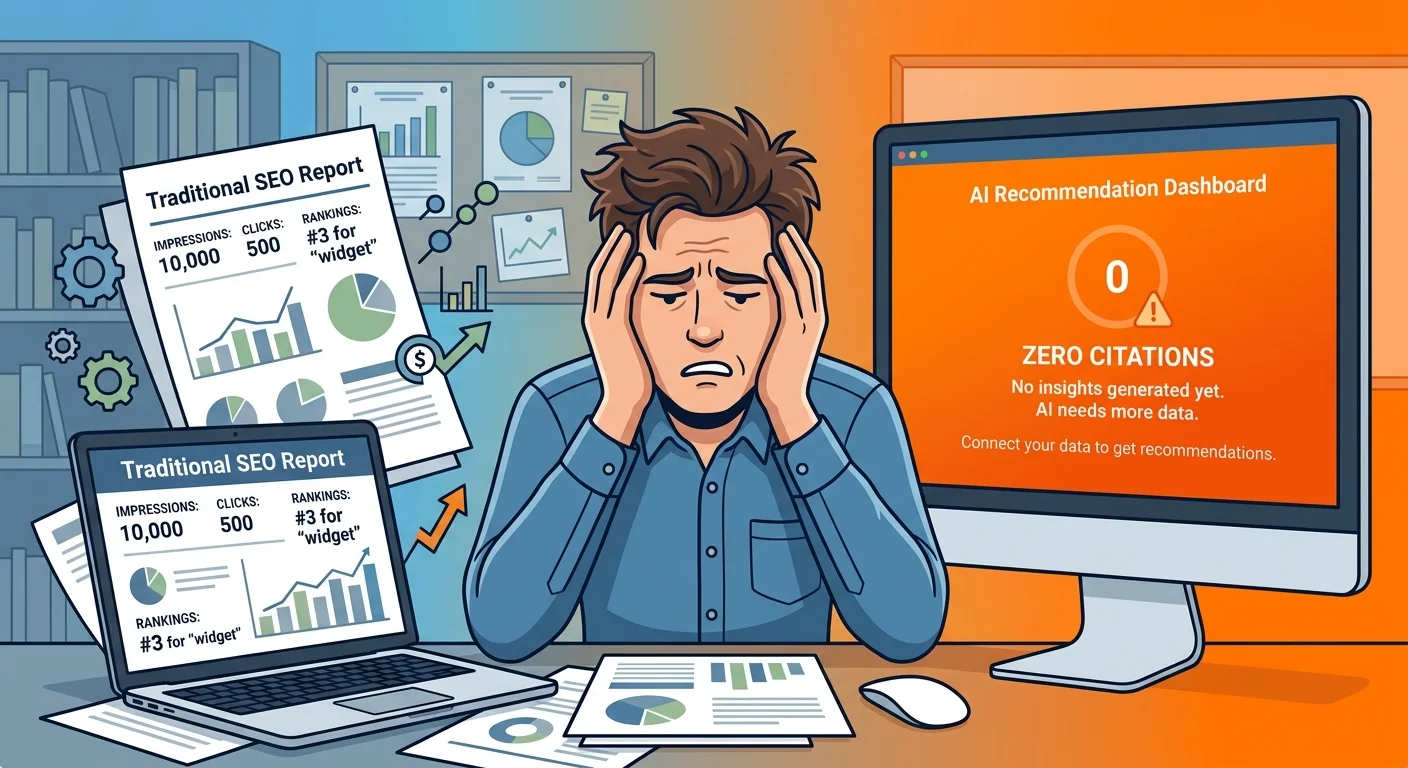
Most chiropractors don’t realize their agency celebrates page one rankings because that’s all they know how to deliver.
You get monthly reports. Impressions climbing. Clicks increasing. Keyword positions improving. None of it means AI trusts you enough to say your name when someone asks.
The industry optimizes for indexing because it’s easy to measure. Easy to package in a dashboard. Simple to explain on a client call. “We got you on page one for three more keywords this month” sounds like progress.
It’s not progress. It’s a vanity metric from a search model that’s being replaced while they’re still charging you to game it.
The Digital Brochure Problem
Here’s what happened. Your agency built you a website. Pretty hero image. Services listed. “Book Now” button that nobody uses.
The site gets indexed because it exists and Google’s crawlers found it. That’s where the value stops.
AI can’t read it.
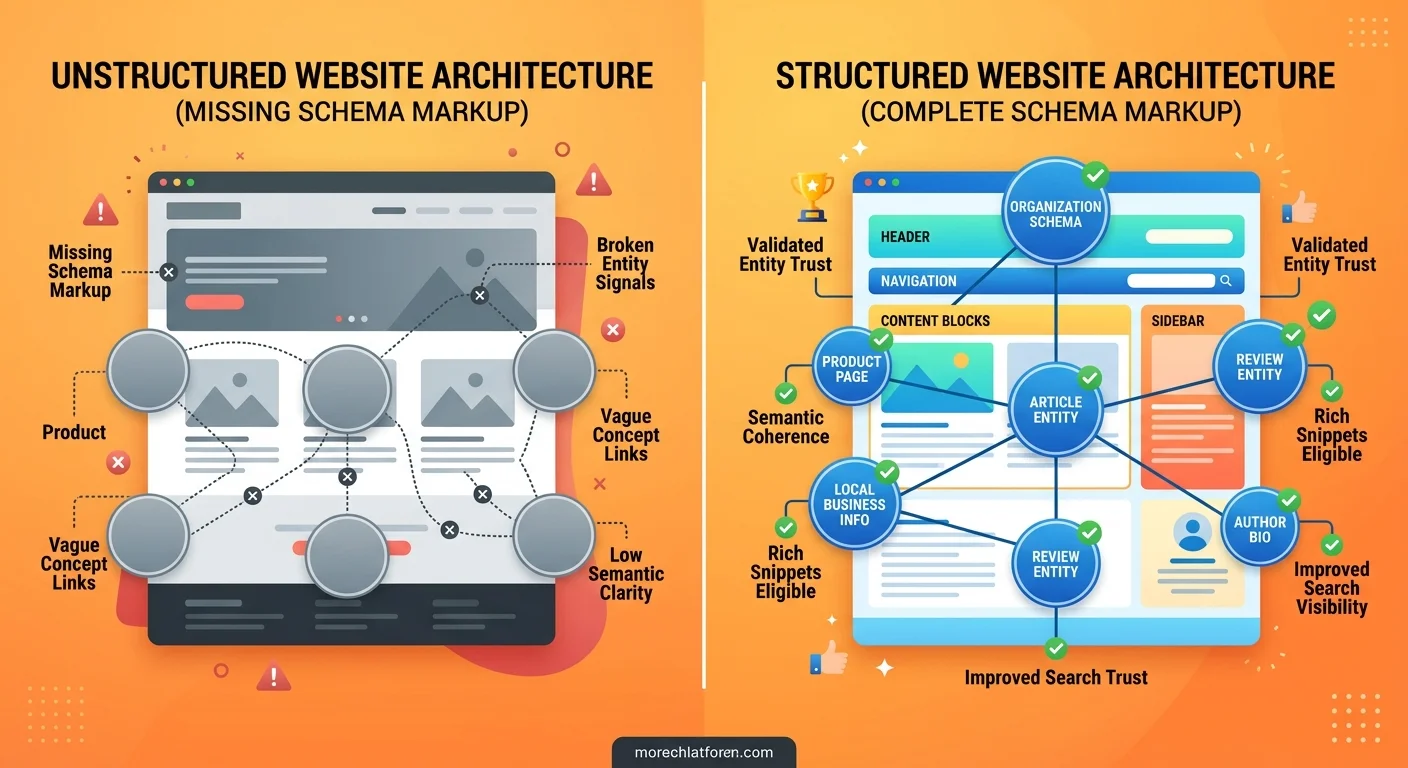
No schema markup telling engines what the business actually is. No entity signals confirming you’re a verified, trusted authority. No structured data architecture that machines can validate.
The website is a billboard on a highway AI never drives down.
It exists in Google’s index the way every business card ever printed exists in a landfill somewhere – technically present, functionally irrelevant.
Template websites get built. Get indexed. Generate zero patient calls from AI search.
The agency that sold it doesn’t know why. They weren’t trained to build for machine trust. They were trained to make things look professional in a browser.
That skill set worked in 2015. It’s obsolete now.
What Traditional SEO Reports Actually Measure
Impressions measure how many times your listing appeared in search results.
Not how many people clicked. Not how many booked appointments. Just how many times Google showed your name in a list users scrolled past.
Clicks measure how many people visited your site after seeing it in search results. Sounds valuable until you realize AI recommendations bypass search results entirely.
These metrics lie to you. Your agency celebrates numbers that don’t matter. Zero-click queries never generate a click. The patient gets the answer, calls your practice, and your analytics stay flat because the interaction never touched your website.
Rankings measure where you appear in a list of ten blue links.
ChatGPT doesn’t produce ten blue links. It names one answer.
If you’re number two on Google’s results page, you’re still invisible to the patient who asked AI for a recommendation.
These metrics worked when search meant scrolling through options. They’re worthless now that search means trusting a single answer.
| Metric | What It Measures | Why Agencies Report It | What It Doesn’t Tell You |
|---|---|---|---|
| Impressions | How many times your listing appeared in search results | Easy to show growth month-over-month in dashboards | Whether AI engines trust you enough to recommend you |
| Click-Through Rate | Percentage of users who clicked your listing after seeing it | Industry benchmark makes it easy to contextualize performance | Zero-click AI queries never generate clicks regardless of your authority |
| Keyword Rankings | What position your page holds for specific search terms | Clients understand rankings and agencies know how to move them | AI doesn’t rank – it recommends one answer or none |
| Page Views | How many times users loaded pages on your site | Volume sounds impressive and justifies retainer fees | Whether those visitors came from AI recommendations or bounced traffic |
Every one of these metrics can improve while you stay completely invisible to the only search behavior that matters – patients asking AI who to trust.
I’ve watched practices celebrate their best SEO month ever while their phone stayed silent. The vanity metrics looked great. AI wasn’t saying their name.
The Technical Difference Between Indexed and Recommended
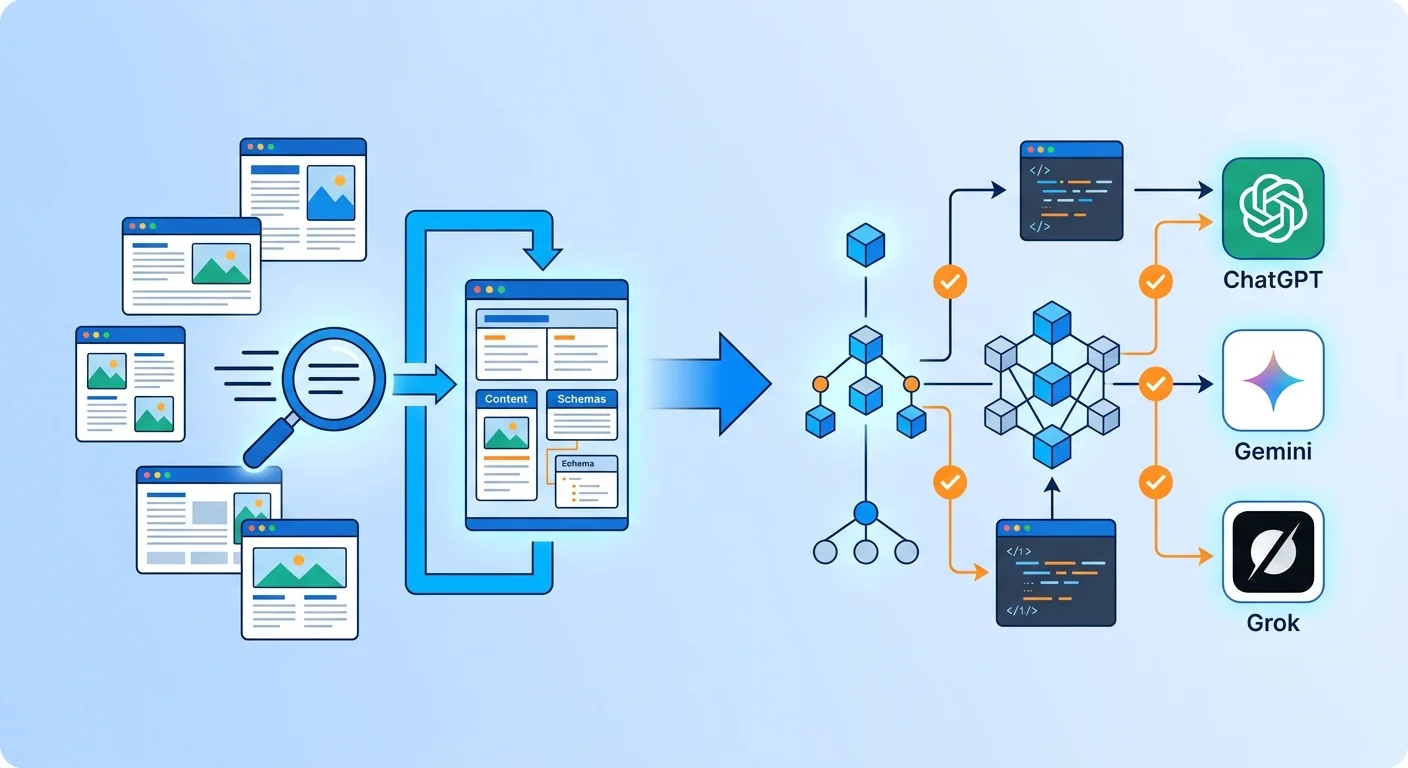
Indexing is passive discovery.
A search engine’s crawler visits your site. Reads the text. Notes the internal links. Catalogs the pages into a database. It’s mechanical.
If the page loads and contains words, it gets indexed. Quality doesn’t matter at this stage. Trust doesn’t matter. Authority doesn’t enter the equation.
The page exists. The crawler found it. Indexing complete.
Recommendation is active evaluation.
AI doesn’t just catalog your content – it validates it. Schema markup confirms what the page claims to be about. Entity signals verify who you are as a business. Semantic density proves you understand the topic deeply enough to be trusted. Citation velocity shows other authoritative sources reference your work.
Only after passing every validation layer does your practice become a candidate for recommendation.
The gap between these two processes is where most chiropractic practices disappear.
What Happens During Indexing
Google’s crawler hits your site. Processes the HTML. Extracts the text. Identifies the structure. Stores all of it.
According to Google’s documentation on how search works, crawling and indexing are the foundation of search visibility. Their automated systems discover pages by following links, reading sitemaps, exploring the web systematically.
This process evaluates nothing about trust.
A spam site and a legitimate chiropractic practice both get indexed the same way. The crawler doesn’t differentiate between authoritative content and keyword-stuffed garbage at this stage.
It just catalogs what it finds.
If your page loads and isn’t blocked by robots.txt, it gets indexed. That’s the bar. Existence.
What Happens During AI Recommendation
AI engines don’t recommend pages based on whether they exist. They recommend based on whether they can validate the page as trustworthy.
That validation happens through machine-readable infrastructure – schema markup, entity signals, structured data, semantic coherence.
Schema tells AI what the page is about in a language machines understand. Without it, AI has to guess. It won’t.
Entity signals confirm who owns the content and whether that entity is verified across the web. Without entity trust, AI can’t confirm you’re a real business worth recommending.
Semantic density proves the content demonstrates actual expertise rather than surface-level keyword stuffing.
Citation velocity shows whether other authoritative sources reference your work.
Google itself has described how its systems now prioritize experience, expertise, authoritativeness, and trustworthiness (E-E-A-T) when ranking content in AI-powered search results.
These aren’t subjective judgments. They’re machine-readable validation points extracted from structured data and entity signals.
Research into semantic networks shows how search engines use structured data to understand relationships between entities and concepts. This is the foundation of how AI determines authority and decides what to recommend.
If your site lacks this infrastructure, AI cannot evaluate you.
You’re indexed. You’re not a candidate for recommendation.
| Factor | Role in Indexing | Role in Recommendation |
|---|---|---|
| Page Text | Extracted and cataloged for keyword relevance | Analyzed for semantic depth and factual accuracy |
| Internal Links | Used to discover additional pages on the site | Evaluated for logical content hierarchy and authority flow |
| Schema Markup | Ignored or minimally processed for rich snippets | Critical for entity validation and machine-readable trust signals |
| Entity Signals | Not evaluated – indexing doesn’t verify identity | Required for AI to confirm business legitimacy and authority |
| Citation Velocity | Not measured during indexing | Tracked to determine whether other authoritative sources validate claims |
| Structured Data | Cataloged but not validated for trust | Verified for completeness, accuracy, and semantic coherence |
Indexing asks: “Does this page exist?”
Recommendation asks: “Can I stake my reputation on telling a user to trust this?”
Why Indexed Content Fails to Get Recommended
Most chiropractic websites are indexed. Very few are recommended.
The failure happens at the validation layer.
AI queries the site for entity data and finds nothing. It looks for schema markup and finds placeholder code the web designer never finished. It evaluates semantic depth and finds three-hundred-word blog posts that barely scratch the surface of the topic.
The site exists in Google’s index. AI can’t trust it.
That’s the gap.
Missing Schema Markup
Schema is the language AI uses to validate what a page claims to be about.
It’s structured data that tells machines: “This page is written by Dr. Smith, who owns Smith Chiropractic, located at this address, specializing in these conditions, verified by these external sources.”
Without schema, AI reads your page the way you’d read a document in a language you don’t speak.
Words exist. Structure is unclear. Claims can’t be verified.
The page gets indexed because it has text. It never gets recommended because AI cannot confirm what it’s looking at.
Template websites ship with minimal or broken schema. The agency that built it didn’t know how to implement LocalBusiness markup. They didn’t connect the practice to verified external entities. They didn’t structure the content in a way machines can parse.
The site looks fine in a browser. It’s invisible to AI during the recommendation evaluation.
Weak Entity Signals
AI needs to know who you are as a verifiable entity before it can recommend you.
Entity signals include structured data on your site, third-party directory citations, and semantic consistency across your entire digital footprint.
When AI queries multiple sources and they all confirm the same entity data – same name, same address, same phone number, same services – trust compounds.
Template websites exist in isolation.
No schema linking the site to Google Business Profile. No structured citations on healthcare directories. No entity verification connecting the practice to authoritative external sources.
AI sees the site and cannot confirm it represents a real, verified business.
The practice is indexed. The entity is invisible.
Building Entity Trust requires deliberate infrastructure. It doesn’t happen accidentally. It doesn’t come bundled with a $3,000 template website.
The practices AI recommends built that infrastructure intentionally.
Generic Content That Dilutes Authority
Here’s what happens when a chiropractor tries to be everything to everyone.
The website covers sports injuries, prenatal care, auto accidents, wellness consultations, pediatric adjustments, geriatric care, nutritional counseling, and fifteen other service categories.
Every page is three hundred words. None of it goes deep. All of it is indexed.
AI evaluates this and sees a generalist. No demonstrated expertise in any single area. No semantic density proving the practice understands one topic deeply enough to be trusted above all competitors.
The site gets indexed for twenty different conditions. It gets recommended for none of them.
Specialization builds trust. AI rewards practices that demonstrate depth in a defined area.
A chiropractor with twenty articles on sciatica treatment – each one covering mechanisms, protocols, patient outcomes, clinical reasoning – becomes the authority AI names when someone asks about sciatica.
The generalist with one shallow page on sciatica and nineteen other random topics gets passed over.
If you refuse to specialize because you want to attract every possible patient type, you’ve guaranteed AI will never recommend you for anything specific.
Authority is built through depth, not breadth.
| Structural Failure | How It Appears to AI | Result |
|---|---|---|
| No schema markup | Page claims to be a chiropractic practice but provides no machine-readable validation | AI cannot confirm entity identity – recommendation impossible |
| Broken entity signals | Practice name, address, and phone number inconsistent across web properties | AI sees conflicting data and defaults to more verified competitors |
| Shallow content | Three hundred word blog posts covering surface-level information | AI evaluates semantic density as insufficient – content lacks authority depth |
| Generalist positioning | Website covers twenty service categories with minimal depth in each | AI cannot determine what the practice is actually an authority in – specialization unclear |
| Missing external citations | No references to authoritative medical sources or peer-reviewed research | AI has no third-party validation to confirm claims are accurate |
Every one of these failures is fixable.
None of them get fixed by traditional SEO agencies because they don’t understand the validation layer exists.
The Zero-Click Search Reality
Search behavior fundamentally changed.
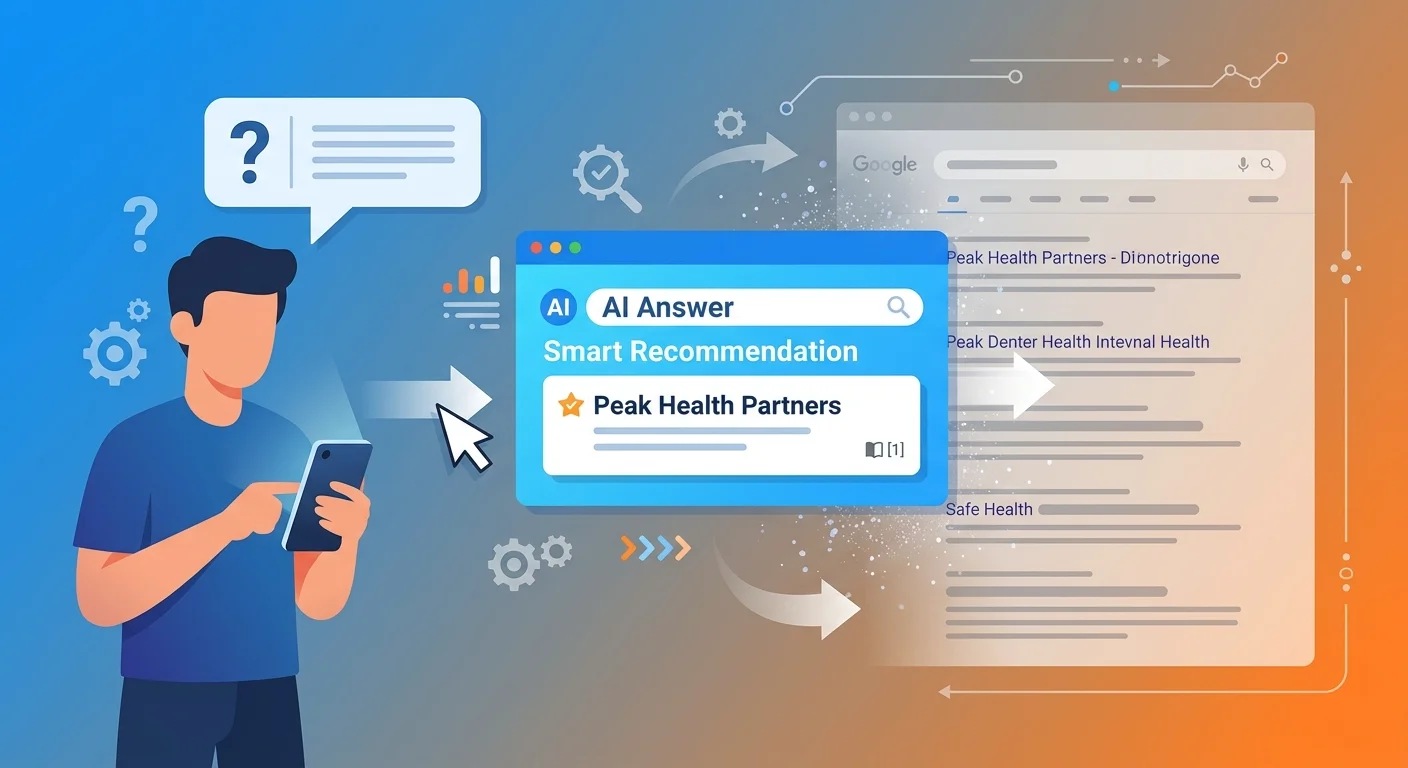
Users don’t scroll through ten results anymore. They ask AI a question and trust the single answer provided.
If you’re not that answer, the patient never sees your name.
Your ranking doesn’t matter. Your indexed pages don’t matter. The conversation happened without you.
Most searches don’t click through anymore. SparkToro confirmed it: zero-click queries are the majority now (Similarweb data). That’s not a trend – it’s the baseline. Users get the information they need directly from the search interface – featured snippets, knowledge panels, AI-generated answers – and never click through to a website.
The practices optimizing for traditional click-through traffic are chasing a shrinking pool.
What Zero-Click Means for Chiropractic Practices
A potential patient opens ChatGPT. Asks: “Who’s the best chiropractor for sciatica near me?”
AI evaluates every indexed chiropractic practice in the area. Checks entity trust. Validates schema markup. Measures semantic depth. Confirms external citations.
One practice passes all validation layers.
AI names that practice.
The patient calls. Books an appointment. Never visits a website. Never sees a Google search results page. Never compares options.
The decision was made the moment AI delivered the recommendation.
Every other practice in that market – indexed, ranked, paying for SEO – was invisible during the interaction that mattered.
That’s the new baseline. Answer Engine Optimization is the only strategy that puts you in that conversation.
Why Traditional Rankings Don’t Matter Anymore
“But my practice shows up on page one for several keywords. Doesn’t that mean I’m visible?”
Not to AI.
Page one rankings measure where you appear in a list of links. AI doesn’t present lists. It presents verdicts.
When a patient asks AI who to trust, they’re not evaluating ten options. They’re accepting one answer.
If you’re number two in traditional search rankings, you’re still invisible to the patient who never saw the list.
Google’s documentation on ranking in generative AI search makes it clear: the systems evaluating content for AI-powered results prioritize experience, expertise, authoritativeness, and trustworthiness.
These are machine-readable validation points – not keyword density or backlink counts.
Traditional SEO optimized for a world where users compared options. That world is gone.
Users trust AI to make the comparison for them. The only ranking that matters is whether AI ranked you first.
Everything else is invisible.
How to Know if You’re Indexed or Recommended
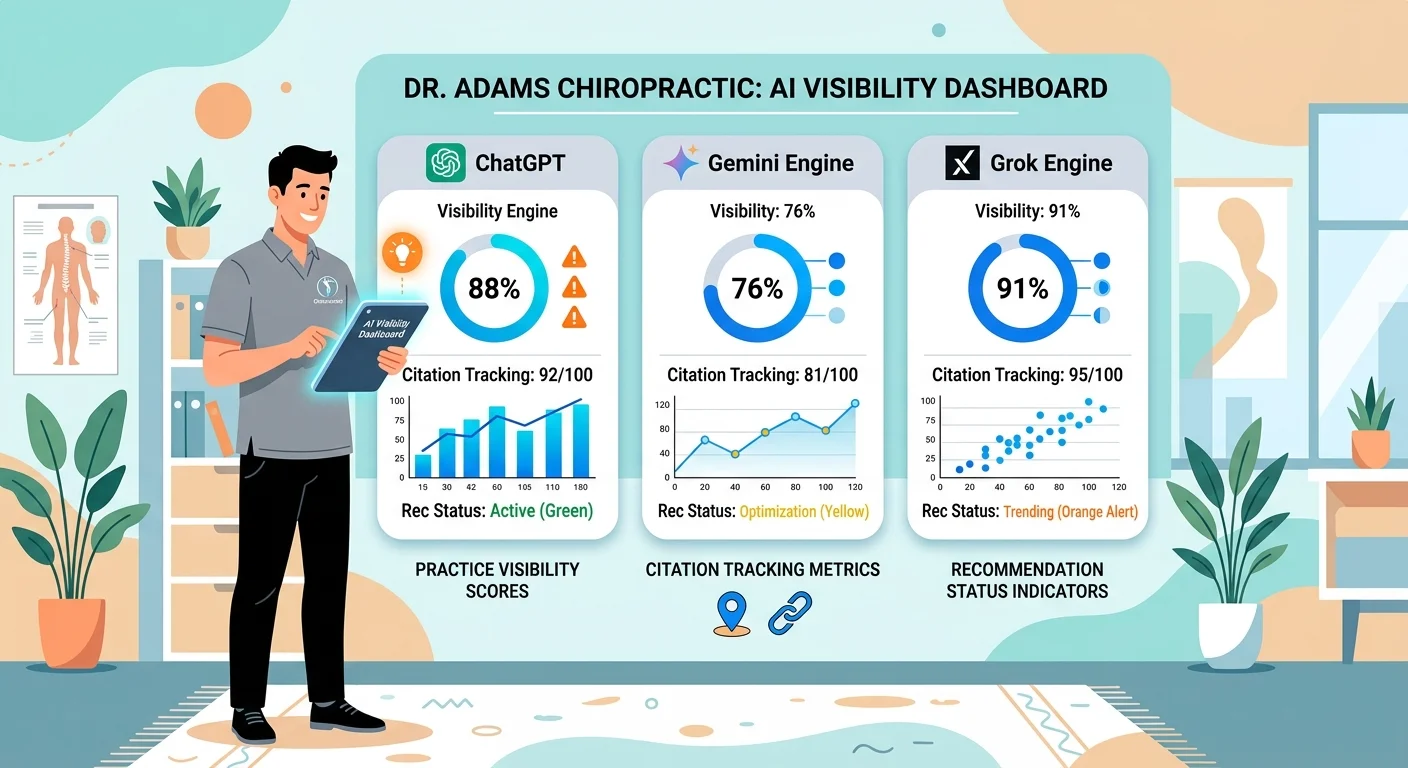
You can’t guess. You can’t assume.
The only way to know if AI engines are recommending your practice is through systematic discovery using multiple AI platforms.
Run an AI Visibility Check and you’ll see exactly what ChatGPT, Gemini, and Grok say when someone asks who to trust in your market.
What an AI Visibility Check Measures
The check queries each AI engine with real patient questions.
“Who’s the best chiropractor for lower back pain in [your city]?”
“What chiropractic practice specializes in sports injuries near me?”
“Where should I go for sciatica treatment in [your area]?”
Each engine evaluates every indexed practice in your market. One gets named. You see whether that’s you or a competitor.
If AI recommends your practice, you know your authority infrastructure is working. Entity signals validated. Schema markup recognized. Semantic depth confirmed.
The recommendation proves the validation layer passed.
If AI names a competitor instead, you know the gap exists.
Your site might be indexed. AI doesn’t trust it enough to say your name.
That’s the diagnostic clarity most chiropractors never get until they see it in real time.
Why Traditional SEO Audits Miss This
Standard SEO audits measure keyword rankings, backlink counts, page speed, mobile responsiveness.
None of these metrics tell you whether AI trusts your entity enough to recommend you.
They measure indexing performance. They ignore the recommendation validation layer entirely.
Traditional SEO audits will tell you that your site loads fast and ranks for twelve keywords.
They won’t tell you that AI can’t read your schema, your entity signals are broken, and your content lacks the semantic depth required for recommendation.
That evaluation requires a completely different diagnostic framework – one built around machine trust, not human-readable metrics.
Understanding semantic search is critical here. AI doesn’t just match keywords. It evaluates context, intent, relationships between concepts, and whether the content demonstrates actual expertise.
Traditional audits don’t measure any of this because traditional SEO wasn’t built for it.
FAQ
Isn’t getting indexed on Google the most important thing for my practice?
It used to be the goal. Now it’s just the prerequisite.
Being indexed makes you eligible to be found in traditional search. Being recommended by AI makes you the answer patients receive in zero-click queries.
Only recommendation drives patient acquisition in the current landscape.
Indexing without recommendation is like being listed in the phone book when everyone stopped using phone books. Technically present. Functionally irrelevant.
How can I see if my practice is being recommended by AI?
The only way is through systematic discovery using multiple AI engines like ChatGPT, Gemini, and Grok.
An AI Visibility Check queries these platforms with real patient questions in your market and reveals whether your practice is named as the recommendation or ignored entirely.
You can’t run this yourself by asking AI once or twice. The check requires structured queries across multiple engines, comparing your visibility to competitors, tracking citation patterns.
It’s diagnostic infrastructure, not a casual conversation.
Can you be recommended by an AI without being indexed first?
No. Indexing is the non-negotiable prerequisite. AI can’t recommend a page it doesn’t know exists.
However, being indexed doesn’t guarantee recommendation.
Most indexed pages fail the validation layer because they lack the machine-readable trust signals AI requires. Schema missing. Entity signals weak. Semantic depth insufficient.
The page exists in the index. AI can’t confirm it’s trustworthy enough to recommend.
Why would an AI recommend my competitor if my website has better content?
Because AI doesn’t evaluate “better” the way humans do.
AI recommends based on machine-readable trust signals – schema markup, entity validation, structured data, citation velocity.
Your competitor’s site is structured in a way AI can parse and validate. Yours isn’t.
The prose quality might be higher on your site. The infrastructure is stronger on theirs.
Infrastructure wins.
Content quality matters. But only after the validation layer passes. If AI can’t read your site’s entity data, the quality of your blog posts is irrelevant.
Does having more indexed pages help me get recommended?
Not necessarily. Authority depth is more important than content volume.
AI is more likely to recommend a practice with twenty in-depth articles on sciatica than one with two hundred generic blog posts covering every condition superficially.
Specialization builds trust. Generalization dilutes it.
If you’re indexed for a hundred different keywords but demonstrate no deep expertise in any single area, AI sees a generalist.
Generalists don’t get recommended for specific conditions. Specialists do.
What if my practice shows up on page one for my main keywords?
Page one rankings measure where you appear in a list of traditional search results. AI doesn’t present lists. It presents single answers.
If you’re ranked number one for “chiropractor near me” in traditional search and AI names a competitor when asked the same question, your ranking is meaningless to the patient who never saw the list.
Zero-click queries bypass search results entirely. The interaction happens inside the AI interface.
Your traditional ranking never enters the conversation.
Conclusion
AI gives one answer. If you’re not the answer, you don’t exist.
Being indexed means you’re in the phone book. Being recommended means you’re the one name patients hear when they ask AI who to trust.
Traditional agencies still sell indexing metrics because they’re easy to report. Impressions climbing. Keywords ranking. Traffic growing.
None of it matters if AI doesn’t say your name.
Indexing is a vanity metric. Recommendation is the only visibility that drives patient acquisition in the zero-click search landscape.
The practices building AI-readable authority infrastructure now are locking in competitive advantage that compounds every month.
The ones waiting for this shift to become obvious will spend the next three years competing for the scraps left behind by practices that moved early.
You’re either the answer or you’re invisible. There’s no middle ground.
The gap between indexed and recommended is the gap between a phone that rings and a phone that doesn’t. Most chiropractors don’t know which side of that gap they’re on until they see it in real time.
Your practice might be indexed. But is it recommended?
Most chiropractors assume being “on Google” means patients can find them. That assumption costs them every patient who asks AI for a recommendation and hears a competitor’s name instead.
The AI Visibility Check takes fifteen minutes. It queries ChatGPT, Gemini, and Grok with real patient questions in your market. You see exactly what AI says.
If your practice is named as the recommendation, you know your authority infrastructure is working. If a competitor is named instead, you know the gap exists.
The practices that wait for AI invisibility to become a consensus problem will be competing for leftover market share. The ones diagnosing the gap now are building the authority that compounds.