What a Traditional Website Actually Does
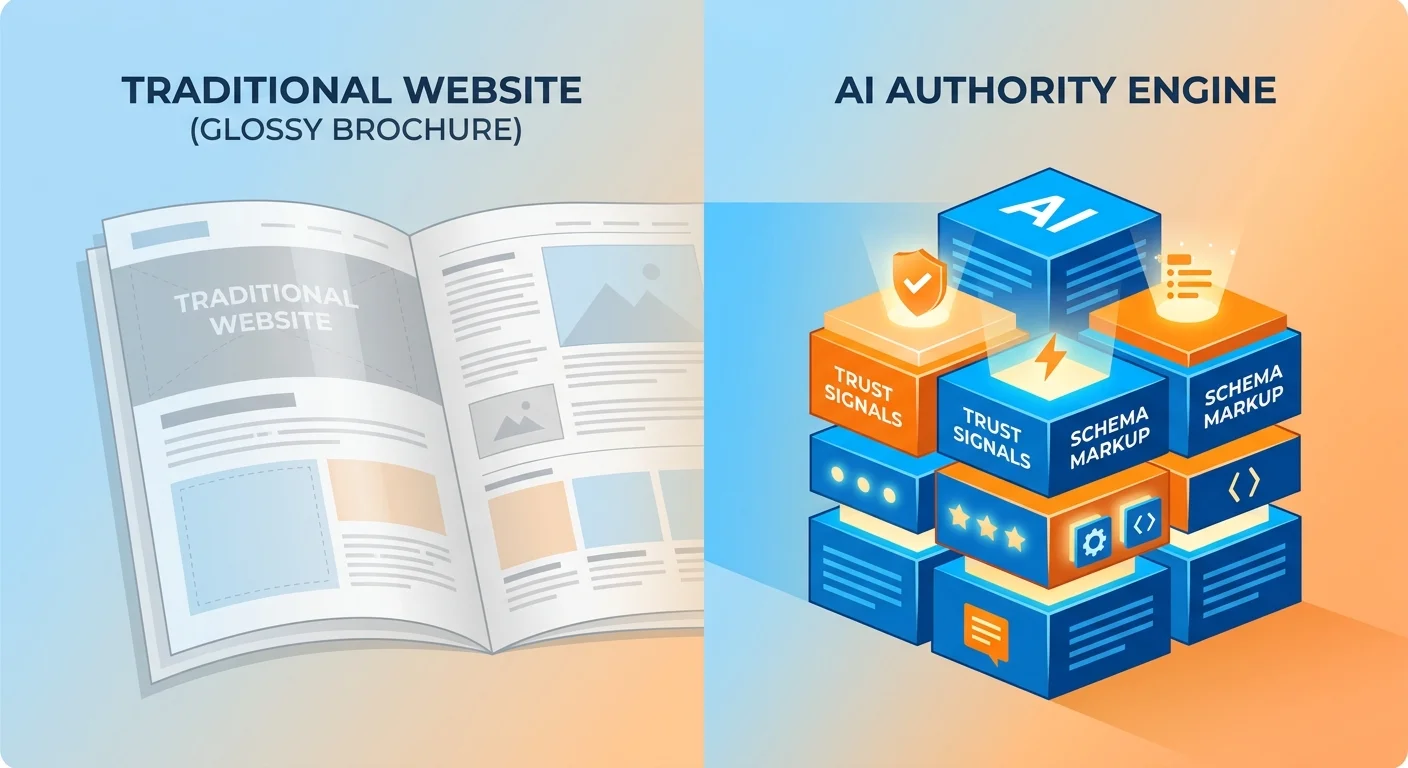
A traditional website is a digital brochure. It’s a container for information humans read when they’re already looking for you. Your hours. Your address. Your services. Maybe some testimonials. It’s formatted to look good on a screen.
That’s the entire job description.
It’s optimized for conversion – not discovery. The assumption is that someone found you somewhere else, clicked through, and now they’re deciding whether to call. The website is the closer. Not the finder.
That worked when Google sent traffic to a list of ten blue links and humans picked their favorite.
It doesn’t work when AI is the one making the recommendation.
What Makes It a Brochure
Most websites get built around aesthetics and user experience. Clean design. Fast load times. Mobile responsiveness. A hero section with a stock photo and a tagline. Three service boxes with icons. A contact form at the bottom.
It’s packaging.
The content exists to fill space between the design elements. That’s why it’s a brochure – the structure is the product, not the authority.
Google’s Helpful Content System is a sitewide signal. If your site is filled with thin, templated content built to look good rather than answer questions, the entire domain gets deprioritized.
AI engines apply the same filter. A brochure doesn’t teach. It advertises.
Advertising isn’t authority.
Why AI Can’t Read It
AI engines don’t process websites the way humans do. They don’t see your layout. They don’t care about your branding.
They parse structured data – schema markup, canonical URLs, entity references, semantic density. If those signals aren’t present, the content is invisible.
The page loads perfectly in a browser. To an AI engine it’s just unstructured text with no verifiable context.
That’s the gap. A traditional website is built for human eyes. An AI engine needs machine-readable infrastructure.
Google’s E-E-A-T guidelines emphasize that Trust is the most critical aspect of authority. But Trust isn’t conveyed through design. It’s conveyed through verifiable entity signals that tell AI who you are, what you’re qualified to do, and why you’re the answer.
Your website doesn’t have those signals. It wasn’t built to.
| Feature | Traditional Website | Authority Engine |
|---|---|---|
| Primary Purpose | Convert visitors who already found you | Make you the answer AI engines recommend |
| Content Structure | Templated pages designed for human readability | Structured, schema-rich content optimized for machine parsing |
| Authority Signals | Testimonials, case studies, branding elements | Verified Entity Trust, canonical references, E-E-A-T architecture |
| Discovery Model | Assumes traffic arrives from external sources | Built to be the source AI cites when users ask |
| Maintenance Impact | Decays without updates; aesthetic refresh every few years | Compounds over time; each content layer strengthens authority |
| AI Readability | Minimal to none – unstructured text with no entity context | Full machine-readable infrastructure with canonical entity signals |
| Investment Type | One-time expense with recurring hosting costs | Compounding asset that builds equity with each execution cycle |
What an Authority Engine Actually Is

An Authority Engine isn’t a website with better SEO. It’s a different category of asset.
It’s infrastructure built to make your business the singular answer AI engines cite when someone asks a question in your domain. Not one option in a list.
The answer.
The difference is architectural. A website is designed for human consumption. It’s read, navigated, and judged by people. An Authority Engine is designed for machine trust. It’s parsed, validated, and cited by AI.
The content isn’t decoration. It’s the structural foundation that tells AI why you’re the authority.
That’s the flip from digital brochure to compounding asset.
The Three Core Layers
An Authority Engine is built on three locked layers. Each layer compounds the one below it. Miss one and the entire structure weakens.
These aren’t features. They’re the foundation.
The three layers are AI-Readable Infrastructure, Verified Entity Trust, and Citation Velocity. Every layer serves a specific function in the chain from invisibility to authority.
They don’t work in isolation. They stack.
AI-Readable Infrastructure
This is the base layer. It’s the technical architecture that allows AI engines to parse your content as structured, verifiable data instead of unstructured text.
Schema markup tells AI what type of entity you are – a local business, a service provider, a professional practice. Canonical URLs eliminate duplication. Semantic density reinforces topic authority.
Most websites don’t have this. They’re built in page builders with minimal schema and zero entity reinforcement. AI can’t extract clean data from them.
It’s like handing someone a printed book and asking them to update a database. The content might be accurate, but it isn’t machine-readable.
That’s the invisibility gap.
AI-Readable Infrastructure is what allows an AI engine to understand who you are at the entity level. Without it, your content is just words on a page. With it, you’re a verifiable business with context, credentials, and relationships.
That’s the difference between being mentioned and being cited.
Verified Entity Trust
Trust is the most critical aspect of E-E-A-T. It’s the foundation of authority. AI engines don’t trust content because it’s well-written or because it ranks on Google. They trust entities – businesses, practitioners, organizations – that can be verified through structured signals.
Building Entity Trust means integrating practitioner credentials, professional affiliations, and canonical references into your infrastructure so AI can validate your authority independently.
A traditional website can’t do this. It doesn’t carry the entity-level signals AI engines use to verify trust. It’s just a collection of pages with content.
An Authority Engine anchors every piece of content back to a verified entity. That’s what makes it citeable.
Citation Velocity
Citation Velocity is the rate at which your business gets named as the answer. It’s not traffic. It’s not impressions.
It’s how frequently AI engines reference your entity when responding to queries in your domain. The faster your Citation Velocity, the stronger your authority signal becomes.
This layer compounds. Every month of execution – new content, entity reinforcement, schema updates – increases the frequency with which AI engines cite you.
Nearly one-third of organizations are already using Generative AI’s breakout year as a turning point in at least one business function. The businesses accelerating their Citation Velocity now are the ones AI will default to six months from today.
A website doesn’t compound. You launch it, it looks good for a while, then it decays.
An Authority Engine accelerates. The gap between you and your competitors widens every month because Citation Velocity is cumulative.
That’s the asset.
The Investment Model: Expense vs Asset
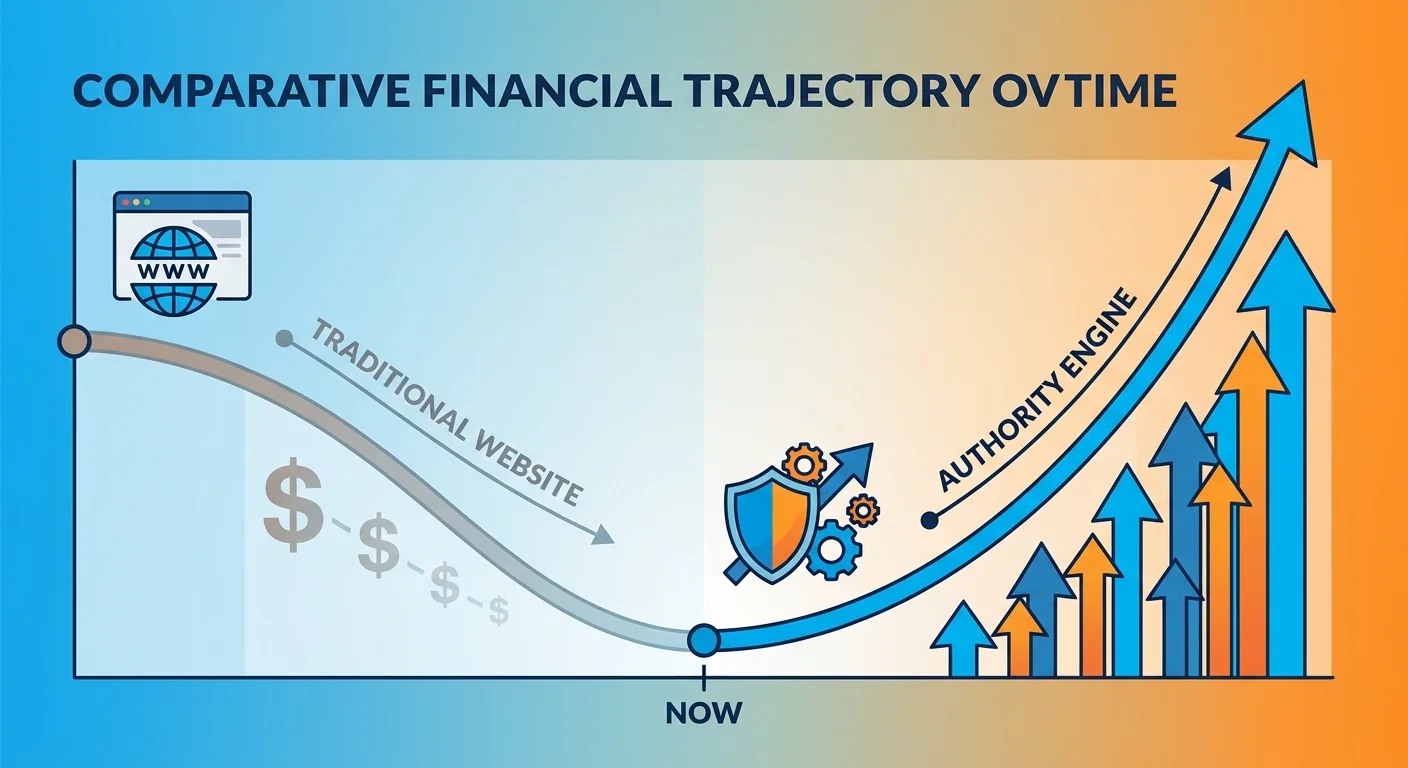
The architectural difference creates a financial difference. A website is an expense. An Authority Engine is an asset.
That’s not semantic wordplay. It’s accounting.
A website costs money to build. Money to maintain. Money to update. The value peaks at launch and decays from there.
An Authority Engine costs money to build and execute, but the value compounds. Every month of execution increases the asset’s worth because Citation Velocity is cumulative.
One depreciates. The other appreciates.
Companies dedicate a significant share of total revenue to their marketing technology budget. That shift signals something clear – businesses are treating infrastructure as investment, not decoration.
Authority isn’t a line item. It’s a strategic allocation.
Websites Depreciate
A traditional website starts losing value the day it goes live. The design that looks modern today? Dated in eighteen months. The content that felt sharp when you wrote it? Stale by next quarter.
Competitors launch newer sites. Yours stops being fresh.
The decay isn’t just cosmetic. It’s structural.
Over a quarter of all Google searches are now zero-click searches – the user gets the answer directly from the results page. No click. No visit. No traffic.
Your site might load perfectly. But if AI never cites it, it’s not generating business.
That’s depreciation. You paid for something that loses value every month unless you keep dumping money into it.
Maintenance doesn’t compound. It just delays the inevitable.
Authority Engines Compound
An Authority Engine works the opposite direction.
Every month of execution – structured content, entity reinforcement, schema updates – strengthens the signals AI uses to validate trust. Citation Velocity increases. The gap between you and competitors widens.
Month one you publish content that reinforces AI-Readable Infrastructure. Month two that content gets indexed and starts generating citations. Month three new content builds on the authority signals from the first two months.
By month six you’re not starting over. You’re accelerating.
That’s compounding.
The investment doesn’t vanish when you stop paying for ads or when design trends shift. It’s baked into the infrastructure. The entity trust you built doesn’t decay.
It’s verifiable.
That’s the difference between spending money on marketing and investing in authority. One expires. The other appreciates.
| Investment Type | Value Over Time | When You Stop Paying |
|---|---|---|
| Traditional Website | Peaks at launch, decays continuously | Asset becomes obsolete; value approaches zero |
| Authority Engine | Compounds monthly as Citation Velocity accelerates | Entity Trust remains verifiable; infrastructure retains value |
| Paid Ads | No residual value; exposure ends immediately | Lead flow stops the moment budget is cut |
| Traditional SEO | Temporary ranking boost; vulnerable to algorithm shifts | Rankings decay without ongoing link building and content refresh |
| Social Media Marketing | Audience rented from platform; reach controlled externally | Access to audience disappears; no owned asset remains |
How ROI Is Measured Differently
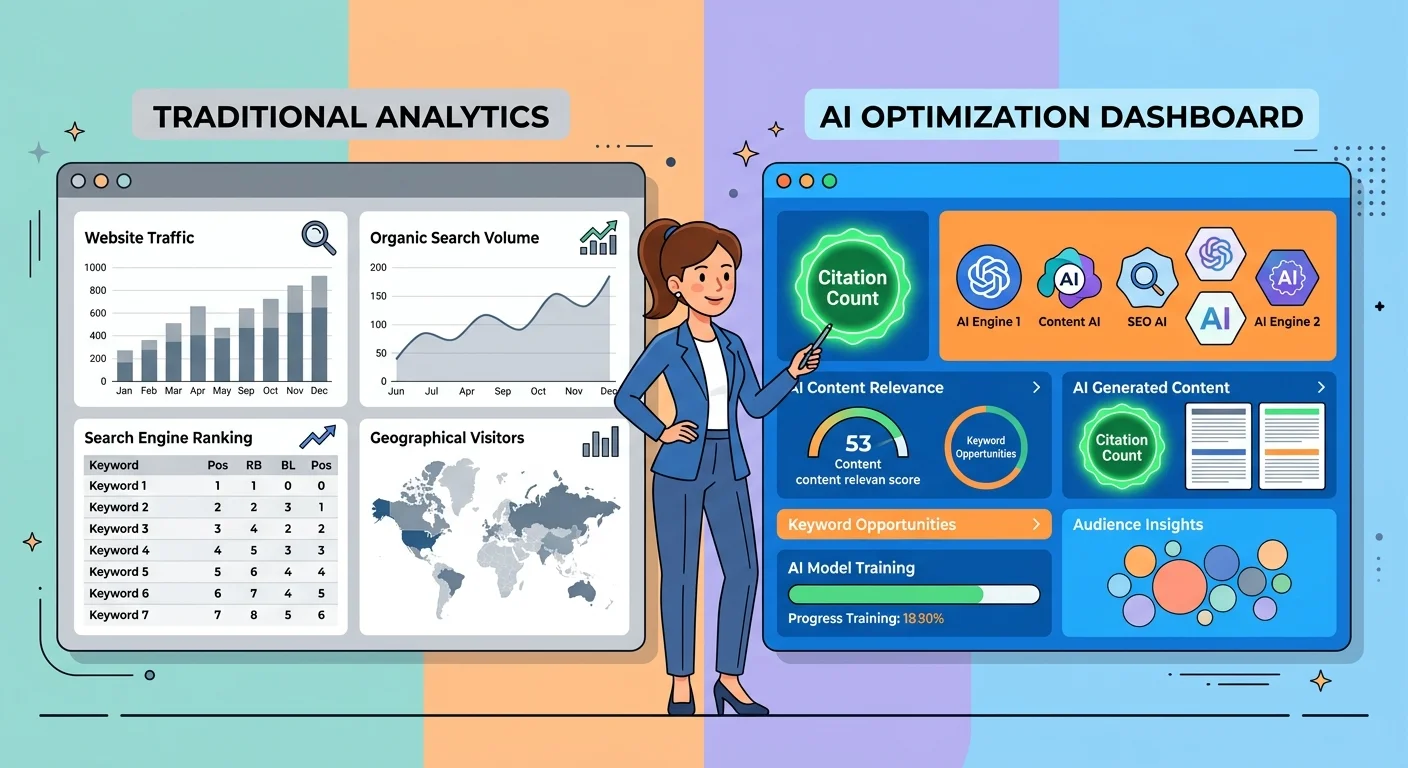
The asset class changed. So the measurement framework has to change too. A website gets measured by traffic, time on page, bounce rate – metrics tracking human behavior. An Authority Engine gets measured by citations, entity mentions, and recommendation frequency – metrics tracking machine trust.
You can’t use website KPIs to evaluate an Authority Engine.
They’re solving different problems.
The biggest challenge isn’t generating traffic. It’s generating leads. According to the latest State of Marketing report, lead generation is the top obstacle for 23% of marketers. That gap widens when AI engines become the primary source of recommendations. Traffic doesn’t convert if AI never sends the searcher to your site in the first place.
That’s the shift.
ROI isn’t about clicks anymore. It’s about being the answer.
Website ROI: Vanity Metrics
Traditional website ROI gets measured in impressions, clicks, and conversions. An agency tells you your site got more visitors this month. Your bounce rate improved. Your ranking moved up for a keyword.
These are vanity metrics.
They measure activity, not authority.
Traffic doesn’t mean trust. Clicks don’t mean citations. A spike in visitors tells you people saw your site. It doesn’t tell you whether AI engines consider you the definitive answer in your domain.
That’s the gap.
You can have high traffic and zero authority. One measures human behavior. The other measures machine trust.
The problem gets worse when AI search becomes the default. If ChatGPT recommends your competitor and you’re measuring success by traffic, you won’t see the shift until it’s too late. You’ll keep optimizing for a metric that no longer drives business.
Vanity metrics are lagging indicators in a world where AI engines make the recommendation before the searcher ever visits a website.
You’re measuring the wrong thing.
Authority Engine ROI: AI Citation Tracking
An Authority Engine gets measured differently. Tracking AI citations and authority visibility means auditing recommendation frequency – how often your entity gets named when someone asks an AI engine a question in your domain. Not traffic.
Did ChatGPT name you? Did Gemini cite your business? Did Perplexity list you as the verified answer?
That’s the ROI.
This metric compounds. Month one you get cited in a narrow set of queries. Month three you’re being named for adjacent topics. Month six your Citation Velocity is accelerating because every piece of content you published reinforced Verified Entity Trust and AI-Readable Infrastructure.
That’s measurable. Not a guess.
It’s verifiable data showing whether AI engines consider you the authority or just one option on a list.
The ROI isn’t a one-time boost. It’s cumulative. Every month of execution increases the frequency with which AI engines default to your business. That’s an appreciating asset.
A website’s traffic can spike and then drop.
An Authority Engine’s Citation Velocity accelerates because the infrastructure you built doesn’t decay. It compounds. That’s the financial difference.
| Metric | What It Measures | What It Tells You |
|---|---|---|
| Traffic | Number of visitors to your website | Human activity – tells you people saw your site, not whether AI trusts your entity |
| Bounce Rate | Percentage of visitors who leave without interacting | Human behavior – tells you whether visitors engaged with your site, not whether AI cites you |
| Keyword Rankings | Position on Google’s search results page for specific terms | List placement – tells you where you appear, not whether AI engines name you as the answer |
| Citation Frequency | How often AI engines name your business when answering queries | Machine trust – tells you whether AI considers you the definitive authority in your domain |
| Entity Mentions | Number of times AI engines reference your verified entity | Authority signal – tells you whether your entity is recognized and trusted by AI engines |
| Recommendation Velocity | Rate at which AI engines cite you as the primary answer over time | Compounding authority – tells you whether your asset is appreciating or stagnating |
Why You Can’t Just Upgrade Your Current Website
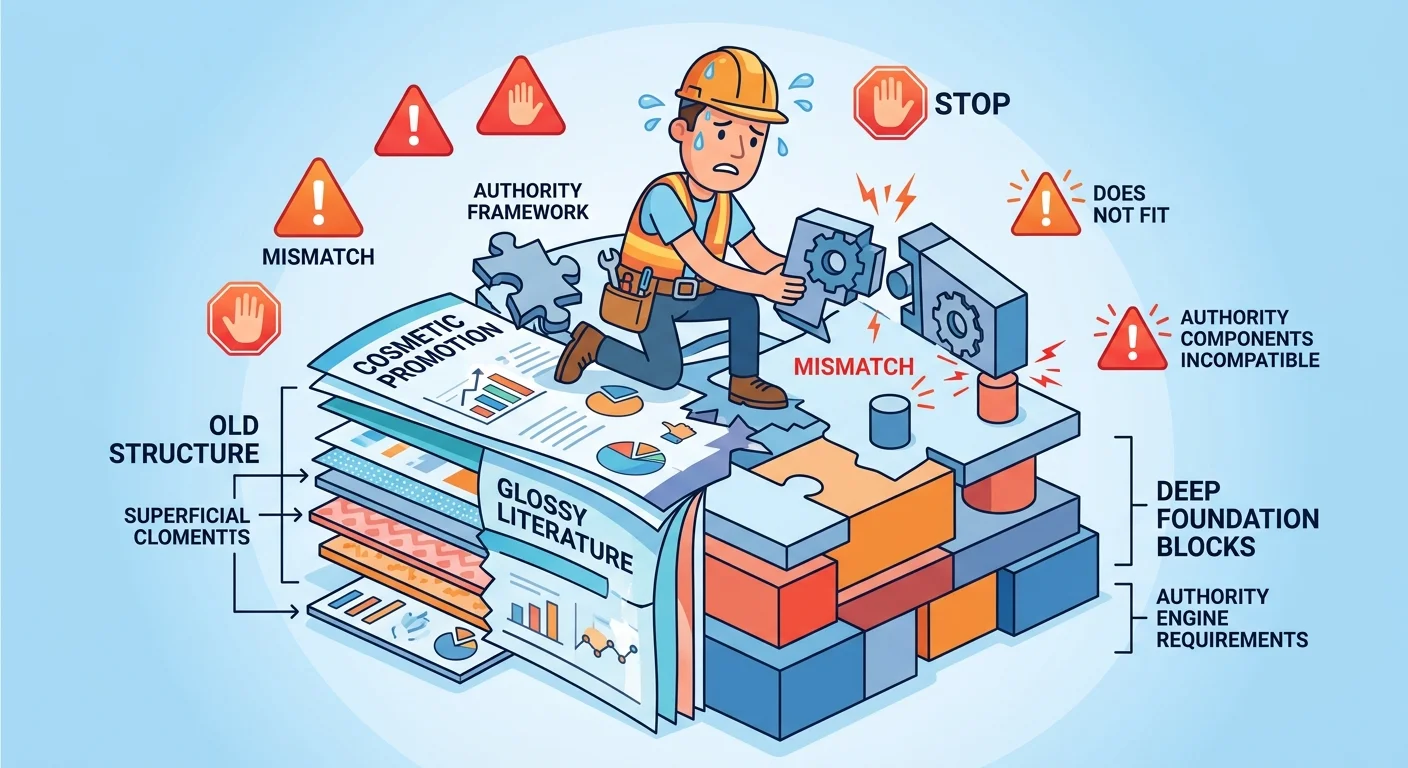
Most practices think they can bolt authority onto their existing site. Add some schema. Publish a few articles. Tweak the homepage copy.
That’ll fix it.
It won’t.
The problem isn’t surface-level. It’s architectural. A traditional website wasn’t built to be an Authority Engine. You can’t upgrade your way out of a structural mismatch.
The foundation is wrong.
The Structural Problem
Your current website was built for humans. Clean layout. Pretty images. Conversion-optimized CTAs. That’s the brief every web designer gets.
Make it look good so visitors trust it enough to book a call.
AI doesn’t care what your site looks like. It can’t see the hero image. It doesn’t evaluate your color palette or your font choices.
It reads structured data. Schema markup. Entity signals. Internal linking architecture that reinforces topical authority.
Your site doesn’t have those layers. It wasn’t designed for machine trust. It was designed for aesthetic credibility.
The gap isn’t cosmetic. It’s foundational.
AI-Readable Infrastructure requires a different skeleton. You can’t retrofit trust signals onto a digital brochure. It’s like trying to turn a house into a skyscraper by repainting the walls.
The structure wasn’t built to carry that load.
The Content Problem
Fix the structure and the content problem still remains.
The helpful content system operates as a sitewide signal. If a significant amount of your content is thin, outdated, or promotional, it drags down the authority of everything else on your domain.
You can’t just add good content on top of bad infrastructure and expect AI engines to ignore the rest.
Most existing sites are loaded with legacy pages that don’t serve authority. Service descriptions written like brochures. Blog posts optimized for keywords instead of answers. Testimonial pages with no entity reinforcement.
That content doesn’t disappear when you add new articles. It’s still there. It’s still sending signals.
And those signals tell AI engines your site isn’t a trusted source. It’s a marketing funnel.
The Execution Problem
The final problem is execution.
Building an Authority Engine isn’t a one-time project. It’s an ongoing system. Every month requires structured content execution that reinforces Verified Entity Trust and accelerates Citation Velocity.
That’s not something you bolt onto an existing workflow.
iTech Valet’s proprietary Two-AI Validation System verifies every article before it goes live. Gemini researches. Claude writes. Gemini validates.
That’s the standard.
Most agencies publish content written by one AI tool with zero verification. The result is hallucinated data, weak entity signals, and content that AI engines can’t trust. You can’t upgrade your way into that level of rigor.
It requires a different system.
AEO Content Writing Services exist because content execution is the compounding layer. You can build the infrastructure. But if the monthly content isn’t reinforcing entity trust and Citation Velocity, the asset doesn’t appreciate.
It stalls.
Upgrading your existing site doesn’t solve that problem. You’re still executing on the wrong foundation.
Frequently Asked Questions
Here’s what comes up when business owners compare the two.
These aren’t abstract questions. They’re the exact friction points that decide whether you build an asset or keep renting visibility.
The answers aren’t what most agencies want you to hear.
What’s the core difference between a traditional website and an Authority Engine?
A traditional website is aesthetic packaging. It’s a digital brochure designed for human eyes. AI engines don’t see the hero image. They don’t care about your color palette.
An Authority Engine is infrastructure built for machine trust.
It speaks the language AI uses to verify credibility – AI-Readable Infrastructure, Verified Entity Trust, Citation Velocity. Your website wasn’t designed to do that. It was designed to look good.
Those aren’t the same thing.
Can’t I just optimize my current website for AI search instead of getting a whole new system?
No. The problem isn’t surface-level. It’s architectural.
Your current site was built for humans. You can’t bolt AI-Readable Infrastructure onto a digital brochure any more than you can turn a house into a skyscraper by repainting the walls. The foundation is wrong.
The content problem makes it worse.
Google’s the helpful content system operates as a sitewide signal. If you’ve got legacy pages – thin service descriptions, keyword-stuffed blog posts, promotional fluff – that content drags down everything else. You can’t upgrade your way out of that.
The structure wasn’t built to carry authority.
How is the ROI of an Authority Engine measured differently than a website’s traffic?
Website ROI is measured in traffic, clicks, and bounce rates. Vanity metrics. They measure human behavior.
An Authority Engine is measured by recommendation frequency.
Did ChatGPT name you? Did Gemini cite your business? Did Perplexity list you as the verified answer? That’s the ROI. It’s verifiable data that shows whether AI engines consider you the authority or just one option on a list.
The biggest challenge for marketers isn’t traffic. It’s generating leads.
According to the latest State of Marketing report, lead generation is the top obstacle for 23% of marketers. That gap widens when AI becomes the primary recommendation engine. Over a quarter of all Google searches are zero-click searches – users get their answer without visiting a website.
Traffic doesn’t convert if AI never sends the searcher to your site.
If my website already ranks well on Google, why would I need an Authority Engine?
Google rankings measure how well you played yesterday’s game. AI recommendations are today’s game.
You can rank #1 for a keyword and still be invisible to ChatGPT.
Google’s algorithm evaluates pages. AI engines evaluate entities. They’re not the same assessment.
Rankings measure position in a list. Authority measures whether AI considers you the singular answer. If you’re ranking well but AI engines don’t cite you, you’re optimized for a distribution channel that’s losing market share.
That’s not a win. It’s a lag indicator.
Is an Authority Engine a one-time build or an ongoing process?
Both. The infrastructure is built once. The content execution is ongoing.
You build the foundation – schema, entity signals, internal linking architecture. That’s the one-time investment. Then you execute monthly content that accelerates Citation Velocity and reinforces Verified Entity Trust.
That’s the compounding layer.
A website is a one-time build that decays. An Authority Engine is a one-time build with ongoing execution that appreciates.
It compounds.
What happens to my old website if I invest in an Authority Engine?
It gets replaced. Not renovated. Replaced.
You can’t retrofit AI-Readable Infrastructure onto a digital brochure. The foundation is wrong. The content signals are wrong. The entity architecture is wrong.
You’re not upgrading a house. You’re building a different structure.
Your old website was built for human eyes. An Authority Engine is built for machine trust. Those require different skeletons. One doesn’t evolve into the other.
You choose which investment you’re making.
The Bottom Line
A website is a digital brochure. An Authority Engine is a business asset.
One depreciates the moment you launch it. The other compounds every month you execute on it.
That’s not a subtle difference. It’s a different category of investment.
The digital brochure was built for human eyes. Aesthetic packaging designed to look credible enough that a visitor might book a call. AI engines don’t see the hero image. They don’t care about your color palette or your conversion-optimized layout. They read AI-Readable Infrastructure. They verify Verified Entity Trust. They track Citation Velocity. Your website wasn’t built to speak that language. It was built to look good.
Those aren’t the same thing.
The question isn’t whether an AI Authority Engine is a better investment than a website. It’s whether you’re willing to invest in an asset that appreciates or keep spending on one that decays.
One model optimizes for aesthetics and clicks – a game AI engines don’t play anymore. The other builds the infrastructure AI uses to decide who to trust.
You can’t retrofit trust onto a brochure. You build it from the ground up.
That’s the difference between a website and an AI Authority Engine.
The practices that own AI recommendations six months from now are building that authority today. The ones that wait are handing the spot to someone else.
You can’t see what AI says about your business until you ask.
That’s what the check does. It takes 15 minutes. It shows you exactly where you stand right now – whether AI engines consider you the authority or whether they’re naming a competitor instead. Whether you’re a compounding asset or still a digital brochure.
If the results don’t make the problem self-evident, walk away. But if they do, you’ll know exactly what to do next.