
What Your Agency Is Actually Doing to Your Patient Data
Here’s the thing – your agency isn’t trying to expose you. They just don’t see your practice as different from any other client.
Same pixel. Same scripts. Same setup they rolled out last week for a gym, a restaurant, and a law firm.
None of that was built for HIPAA.
Think of a plumber who leaves a gas line open and walks out.
No alarm fires. Nothing looks wrong. The house smells fine – until it doesn’t.
That’s exactly how this exposure works. The liability builds in silence.
So this isn’t about finding a bad agency. It’s about a model that was never built for the compliance reality healthcare practices operate in.
The default tools do exactly what they were designed to do. They just weren’t designed for you.
And that gap – between what a standard agency deploys and what a HIPAA-covered entity actually needs – is exactly why most agencies fail healthcare practices on this exact issue. why most agencies fail healthcare practices on this exact issue
The Pixel Fires Every Time a Patient Visits Your Site
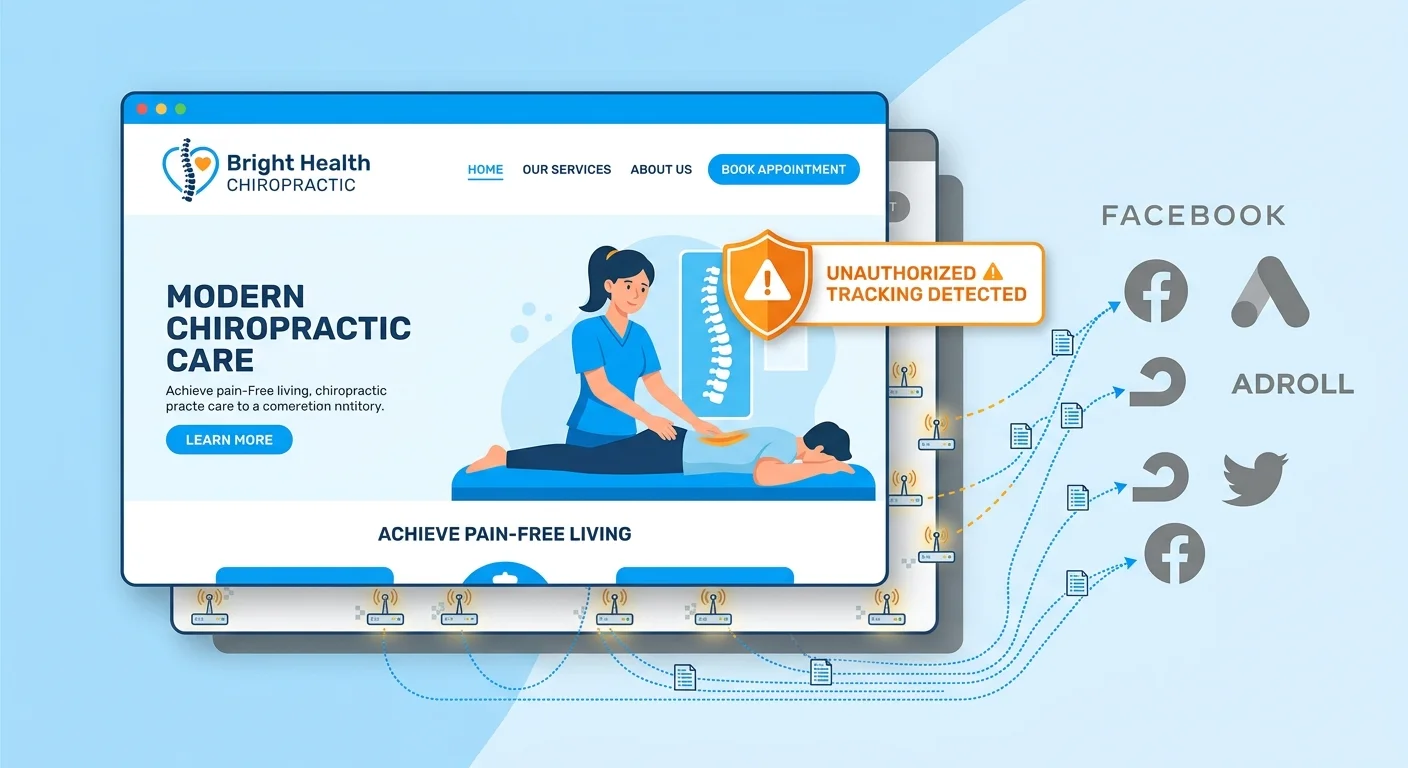
Every time a patient lands on your site – checks appointment availability, reads about a condition, clicks toward a contact form – the pixels fire.
Silently. Automatically. Without anyone pressing a button.
Those pixels collect and transmit IP addresses, geographic location, device IDs, and appointment data – straight to third-party platforms.
According to HHS guidance on online tracking technologies, that information constitutes Protected Health Information under HIPAA – even when it looks anonymized on the surface.
The HHS OCR didn’t leave room for interpretation on this one.
The classification doesn’t require a name attached to the data. A device ID tied to a healthcare visit is enough.
The pixel fires. The data moves.
The legal exposure attaches to your practice – not theirs.
Why Most Practices Have No Idea This Is Happening
Most practice owners never see a flag. Never get an alert. The agency dashboard shows clicks and conversions – and nothing in that interface signals a problem.
But the data is still moving. One major hospital system had private health data from over 1 million patients transmitted to tech companies via tracking pixels – before a single enforcement action was ever filed.
The dashboard looked clean the whole time.
The Local AI Authority Engine is built to eliminate this at the infrastructure level.
No tracking pixels. No surveillance-style conversion loops. No patient data touched – period.
Cookieless, AI-readable infrastructure. Authority signals go straight to the engines that matter.
| Data Type Collected by Pixel | HIPAA Classification | Who Receives It | Practice Owner Awareness |
|---|---|---|---|
| IP Address | PHI – links a device to a healthcare visit | Ad platforms, data brokers, third-party analytics | Almost never |
| Geographic Location | PHI – reveals where a patient sought care | Ad networks, retargeting platforms | Almost never |
| Device ID | PHI – persistently ties a device to medical activity | Social media platforms, tracking networks | Almost never |
| Appointment Data | PHI – discloses condition, provider type, or care intent | Marketing platforms with no BAA in place | Almost never |
| Page Visit Patterns | PHI – condition pages and service pages reveal health context | Analytics platforms, ad retargeting engines | Almost never |
| Form Interaction Data | PHI – contact and intake forms capture care-seeking intent | CRM tools, email platforms, pixel networks | Almost never |
Why Standard Agencies Cannot Solve This
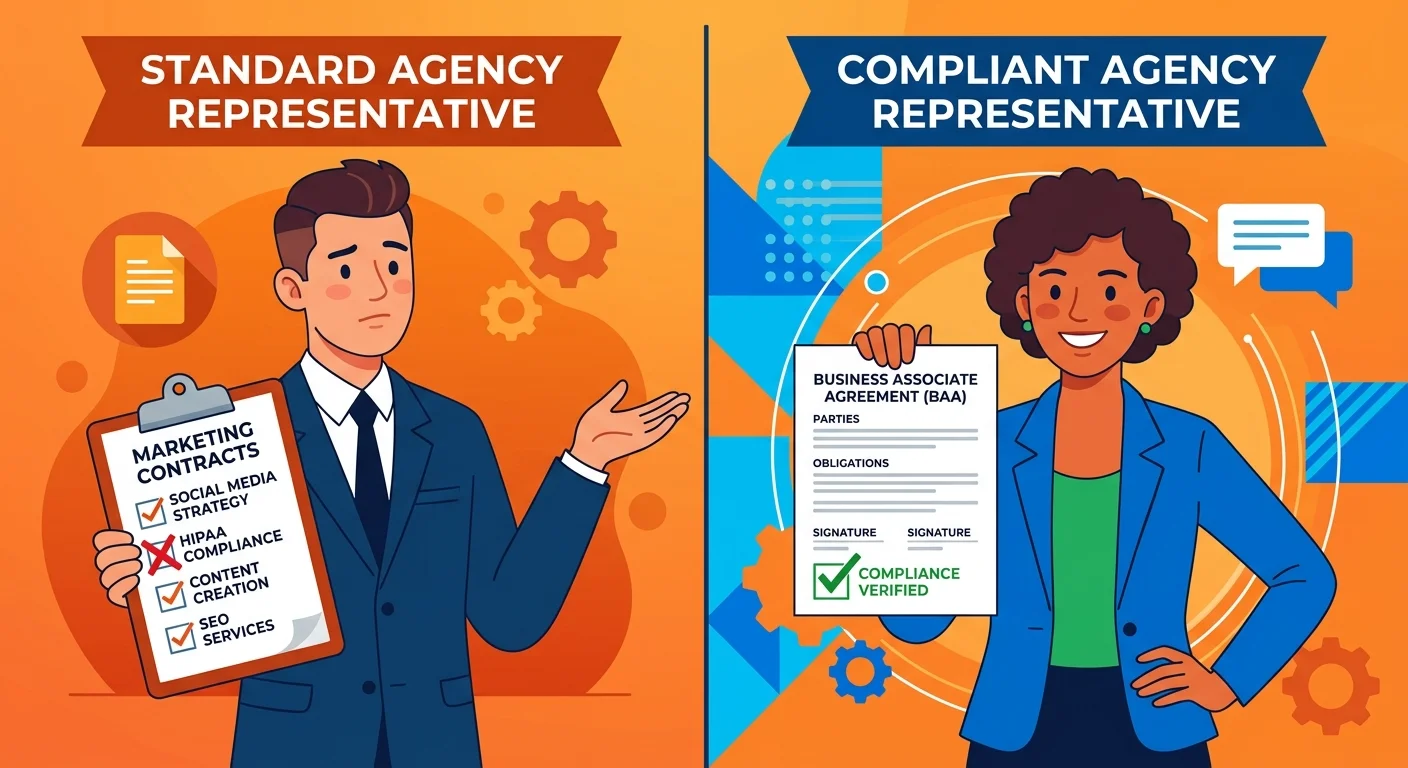
Standard agencies aren’t built for healthcare. They’re built for volume.
Spin up campaigns. Install the tracking stack. Optimize for conversions. That workflow runs clean for a gym or a restaurant.
It doesn’t run legal for a practice that handles Protected Health Information.
The tools haven’t changed. The client list has.
That gap – between what the agency knows how to do and what your compliance reality requires – is where the exposure lives. And it’s yours to carry, not theirs.
This isn’t fixable by asking your agency to be more careful.
It’s a structural problem. The model they operate on is fundamentally incompatible with HIPAA.
Good intentions don’t change that.
The Business Associate Agreement Most Agencies Have Never Signed
Before any third party can legally create, receive, maintain, or transmit Protected Health Information, a Business Associate Agreement must be signed.
That’s federal law. Not a best practice. Not a suggestion.
Most standard marketing agencies have never signed one.
Many don’t know they need to. And the ones that do know often push back – because signing a BAA means accepting legal accountability for how patient data is handled.
Their standard toolkit wasn’t designed for that accountability. So they avoid it.
So the agency runs your campaigns without a BAA. The pixels fire. PHI moves to third-party servers.
Every day that continues, the liability accumulates on your side of the table – not theirs. The Texas Attorney General’s pixel-tracking enforcement action against a major hospital system makes that consequence real: one lawsuit, and one agency still collecting retainer checks.
They walk away clean. You don’t.
Why This Agency Model Is Built for Non-Healthcare Clients
Standard agency workflows are engineered for one thing: capture as much behavioral data as possible and use it to retarget.
Every click. Every page visit. Every form interaction – logged and fed back into the ad platform.
That’s the model. It works in almost every industry. Healthcare is the exception.
In healthcare, that model is a legal liability. The HIPAA Business Associate Agreements framework exists because third-party data handling in this space requires a documented legal structure – one that most general-purpose agencies have never built.
The FTC has already put over 100 health-tech and hospital companies on notice for exactly this kind of unlawful data sharing. OCR settlements tied to active tracking software have exceeded $1.5 million in penalties.
Gerek Allen has seen this pattern repeatedly: the agency had no idea their standard toolkit was creating the exposure. That’s not a defense. That’s the problem.
The Wrong Buyer for This Article
This article isn’t for every practice owner.
If you want a cheaper agency that promises fast results and skips the hard compliance questions – stop here. There’s no version of that approach that ends well in a healthcare context.
We’re not going to soften that.
But if you’ve already noticed the referral pipeline isn’t what it used to be – you’re the right reader.
This isn’t only a compliance problem. The old model of buying visibility through surveillance-style tracking is being replaced by something AI engines actually trust: structured, cookieless authority signals.
That shift is already underway. You can see exactly where the old model breaks when you look honestly at When Referrals Dry Up.
What follows is for practice owners who are done holding a loaded gun they can’t see.
The ones who want to build something that compounds – without the liability sitting underneath it.
| Agency Type | BAA Required? | Pixel Tracking Used? | PHI Exposure Risk | Recommended for Healthcare Practices? |
|---|---|---|---|---|
| General Digital Marketing Agency | No – rarely signs one; often unaware it’s required | Yes – standard install on all client sites | High – PHI transmits to third-party ad platforms on every patient visit | No |
| SEO/Content Agency (non-healthcare) | No – not part of their standard service agreement | Yes – conversion tracking and retargeting pixels are default | High – no compliance framework; patient behavior data captured and exported | No |
| Healthcare-Specialized Marketing Agency | Sometimes – depends on the individual agency and contract | Varies – some have removed pixels; many still rely on them | Moderate to High – depends entirely on their specific toolkit and BAA status | Only with verified BAA and documented pixel-free infrastructure |
| In-House Marketing Staff (no compliance training) | No – internal staff are not third-party Business Associates under HIPAA | Often Yes – installs tracking codes without understanding PHI implications | Moderate – exposure accumulates if tracking scripts are live on patient-facing pages | Not without dedicated HIPAA compliance oversight |
| iTech Valet – AI Authority Engine | N/A – no PHI is created, received, maintained, or transmitted | No – cookieless infrastructure by design; zero tracking pixels deployed | None – authority infrastructure is built entirely outside the patient data environment | Yes – built specifically for healthcare compliance and AI visibility |
What a Compliant Marketing Infrastructure Actually Looks Like
Compliant infrastructure isn’t a cleaned-up version of what your agency is already running.
It’s a different model. Built differently. Designed for a compliance reality that standard agencies don’t operate in.
No PHI touched. No surveillance scripts. No liability baked in by default.
Here’s the thing – AI engines don’t need your patients’ behavioral data to recommend your practice.
They need structured, entity-level signals they can read, trust, and cite.
That’s a cookieless problem. It has a cookieless solution.
Traditional lead-gen tracking isn’t just risky – it’s architecturally wrong for this problem.
The practices that figure this out early don’t just cut compliance exposure. They build authority that compounds, without the liability sitting underneath it.
Two outcomes. One choice.
Cookieless Authority Building vs. Pixel-Dependent Lead Generation
Here’s the structural difference.
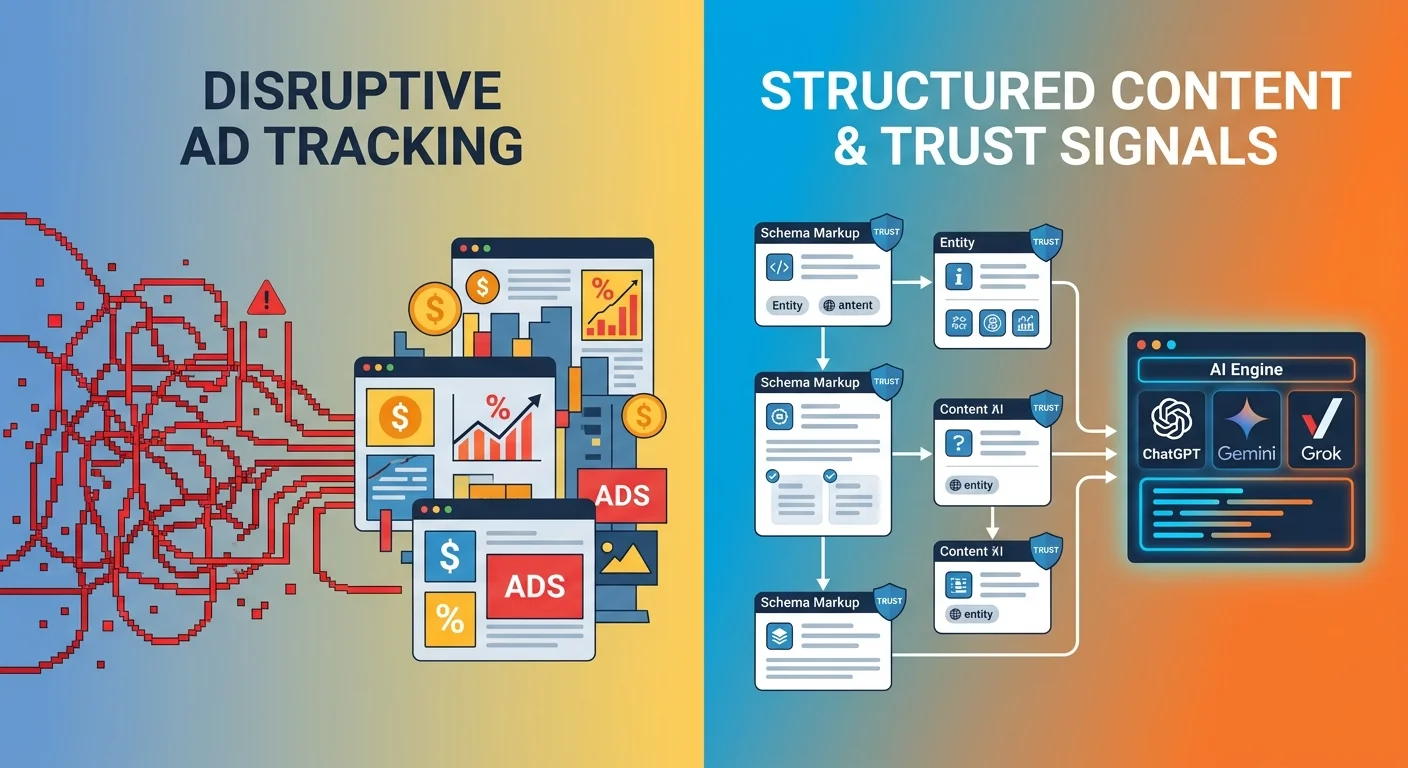
Pixel-dependent lead generation captures behavioral data from patients and feeds it to ad platforms. Cookieless authority building feeds structured semantic data directly to AI engines.
One creates compliance exposure. The other creates AI recommendations.
The FTC has already issued warnings to over 100 health-tech and hospital companies for unlawful sharing of consumer health data via tracking pixels.
That enforcement posture isn’t softening. It’s expanding.
Every month a practice runs pixel-dependent campaigns, it’s accumulating exposure in a regulatory environment that’s actively looking for exactly this pattern. The clock doesn’t pause because the agency dashboard looks clean.
Cookieless authority infrastructure sidesteps the problem entirely. Not by being more careful with the same tools – by never touching patient data in the first place.
No pixels fire. No behavioral data moves to third-party servers. The authority signals – schema markup, structured content, entity trust – go directly to AI engines through the content itself.
The FTC health privacy guidelines aren’t a concern when patient data was never in the loop to begin with. That’s not a loophole. That’s the design.
How AI Engines Replace the Need for Surveillance-Style Tracking
AI engines don’t recommend businesses because of retargeting data. Full stop.
They recommend businesses because the structured signals on a site – schema, entity reinforcement, semantic density, authoritative content – tell them the practice is real, credible, and worth citing.
Pixel tracking was never built to produce that. It was built to follow people around the internet. Those are not the same job.
If you’ve already read about When Referrals Dry Up, this is the other side of that story.
The practices replacing surveillance-style tracking with AI-readable infrastructure aren’t just reducing risk. They’re building the exact kind of authority that gets named when a patient asks an AI engine who to trust.
That’s not a side benefit. That’s the point. And it’s available right now – without a single tracking pixel.
| Infrastructure Component | Traditional Agency Approach | Compliant AI-Authority Approach | HIPAA Risk Level |
|---|---|---|---|
| Website Tracking & Analytics | Third-party pixel scripts (Meta Pixel, Google Analytics) installed on all pages – including patient portals and booking forms | Cookieless schema markup and structured entity signals – no behavioral tracking, no third-party data transmission | Critical – pixels on patient-facing pages constitute PHI transmission under HHS OCR guidance |
| Lead Generation Method | Retargeting loops that capture visit behavior, condition searches, and appointment intent – fed back into ad platforms | AI Authority content that attracts patients by being the trusted answer AI engines cite – no surveillance required | High – behavioral health data captured by retargeting constitutes PHI regardless of anonymization claims |
| Third-Party Data Agreements | No BAA in place – agency operates standard vendor contracts not designed for healthcare compliance | BAA executed before any patient-adjacent work begins – legal accountability documented and enforced | Critical – operating without a BAA while transmitting PHI is a direct HIPAA violation |
| Content Infrastructure | Generic blog content optimized for keyword rankings – no structured schema, no entity reinforcement | AI Authority articles built with semantic density, schema markup, and entity trust signals AI engines can read and cite | Low direct risk – but zero authority value means the practice remains invisible to AI recommendations |
| Authority Signal Mechanism | Ad spend and retargeting data used as the primary visibility driver – authority disappears when budget stops | Compounding entity trust signals embedded in site architecture and content – authority builds with every published article | Low – cookieless infrastructure removes the PHI transmission vector entirely |
| Regulatory Exposure Profile | Continuous OCR, FTC, and state AG exposure – standard toolkit creates ongoing liability with every campaign | Designed from the ground up to operate outside the surveillance-tracking model – no exposure surface to enforce against | None – the compliance risk is structural, not behavioral; removing the architecture removes the liability |
How to Audit Your Current Agency Before OCR Does It for You
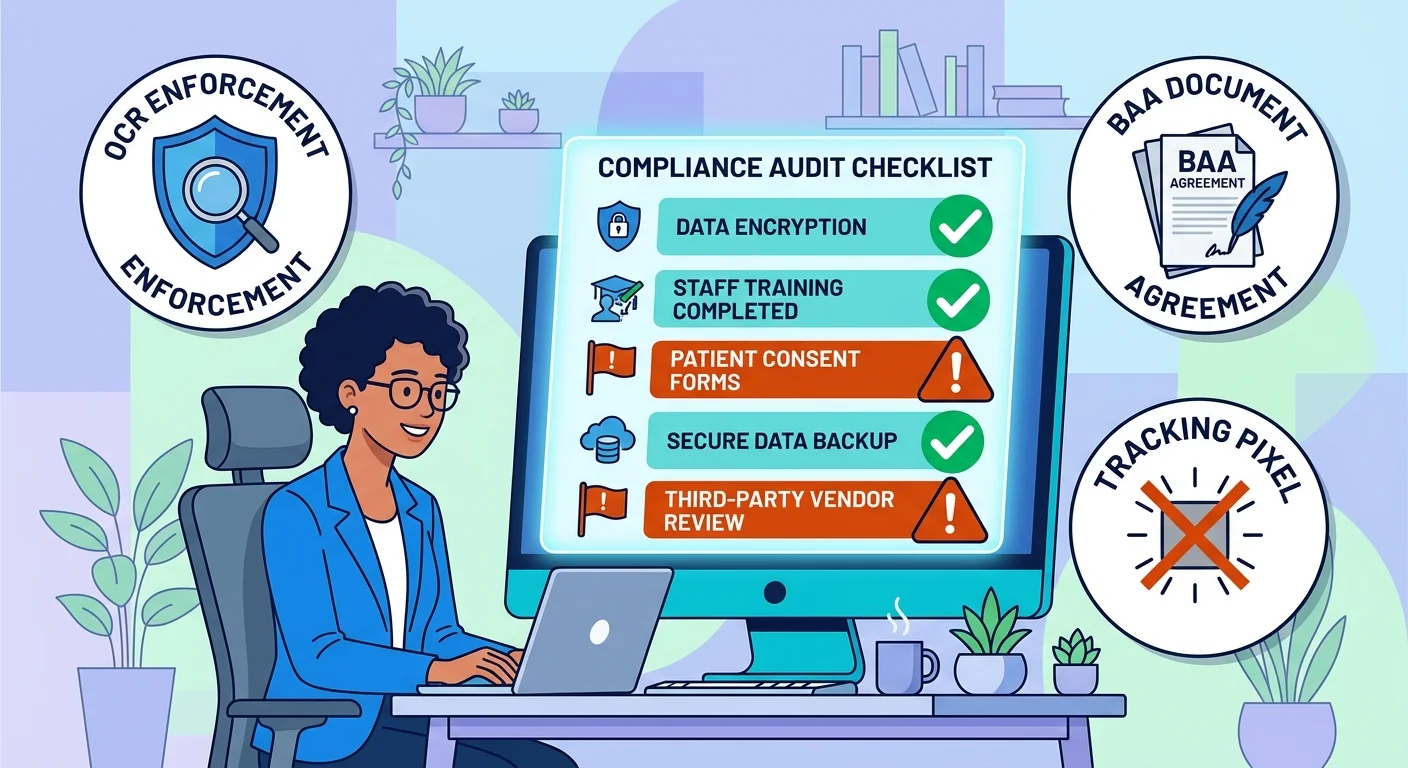
Here’s the thing: you don’t have to wait for an OCR investigation to find out you have a problem.
The questions take ten minutes. The answers are immediate. And what they reveal will tell you more than any agency dashboard ever will.
Here’s the assumption that gets practices in trouble: compliance is the agency’s responsibility.
It isn’t. When OCR files an enforcement action, it’s addressed to the covered entity. That’s you – not them.
The AI Visibility Check is one place to start understanding where your digital footprint actually stands. But the real audit starts with a direct conversation with your current vendor, asking for documents they should already have on file.
Five Questions to Ask Your Agency Today
First: has your agency signed a Business Associate Agreement with your practice?
A BAA must be executed before any third party can legally create, receive, maintain, or transmit Protected Health Information. That’s federal law – not a best practice.
If they haven’t signed one – or if they look at you blankly when you ask – stop the conversation there. You already have your answer.
contractual accountability gap
These aren’t trick questions. A compliant agency answers all five in under ten minutes – with documentation.
An agency that isn’t built for healthcare will stall, redirect, or reassure you without showing a single piece of paper. Both responses tell you exactly what you need to know.
Red Flags That Signal Immediate Exposure
The loaded gun doesn’t announce itself.
The pixel fires on every page visit, every form submission, every appointment inquiry – while the agency dashboard shows nothing but clicks and conversions. The red flags are structural. They show up before any enforcement action is filed. You just have to know what you’re looking at.
No signed BAA is the clearest signal.
Without one, the agency is operating outside the legal structure required to handle PHI. OCR settlements tied to that gap have exceeded $1.5 million in penalties. That isn’t a hypothetical outcome. It’s a documented one.
The FTC has already issued warnings to over 100 health-tech and hospital companies for exactly this kind of unlawful data sharing. The enforcement posture isn’t softening – it’s expanding.
Other red flags: retargeting campaigns built on patient site behavior. No healthcare-specific data handling addendum in the service contract. An agency that responds to compliance questions with marketing language instead of legal documentation.
Gerek Allen has seen this pattern across practice after practice. The agency didn’t hide the risk.
They just never looked for it. And neither did the practice – until OCR did it for them.
| Audit Question | What a Safe Answer Looks Like | Red Flag Answer | Immediate Action Required |
|---|---|---|---|
| Has your agency signed a Business Associate Agreement (BAA) with your practice? | A fully executed BAA is on file, reviewed by legal counsel, and covers all services the agency provides to your practice. | The agency says they don’t need one, doesn’t know what it is, or promises to ‘look into it.’ | Stop the engagement immediately. No BAA means no legal authority to touch any system that transmits patient information. |
| Which tracking technologies are installed on your patient-facing web pages? | The agency provides a specific, written inventory of every script on your site and confirms none are deployed on patient-facing pages without a compliant data-handling structure. | The agency mentions Meta Pixel, Google Analytics, or ad retargeting scripts on appointment pages, contact forms, or patient portals – without a compliant data handling structure in place. | Request immediate removal of all non-compliant tracking scripts from patient-facing pages and document the request in writing. |
| Does your service contract include healthcare-specific data handling provisions? | The contract includes an explicit healthcare data addendum or data processing agreement that addresses PHI, breach notification obligations, and liability allocation. | The standard agency contract contains no healthcare-specific language – only generic data and privacy boilerplate written for e-commerce or retail clients. | Do not sign a renewal. Engage legal counsel to assess current contract exposure before any further campaign activity. |
| How does the agency generate leads for your practice? | Lead generation is based on content authority, AI-readable infrastructure, and organic entity signals – no retargeting audiences built from patient site behavior. | Lead generation relies on retargeting pixels that build audiences from site visitor behavior, appointment page visits, or form interactions. | Audit which audiences are currently active in ad platforms. Suspend any campaigns built on behavioral data sourced from patient-facing pages. |
| Who carries the liability if a data breach occurs through the agency’s tools? | The agency’s contract clearly allocates liability for breaches caused by their tools, and they carry cyber liability insurance that covers healthcare clients. | The agency deflects, redirects to their general terms of service, or assures you verbally without producing documentation. | Treat this as confirmation that liability defaults to you as the covered entity. Begin documenting all current vendor data relationships for your compliance file. |
| Can the agency demonstrate how their work complies with OCR guidance on online tracking technologies? | The agency references specific regulatory guidance, explains their data handling architecture in concrete terms, and provides written confirmation of compliance posture. | The agency responds with marketing language, vague reassurances, or pivots the conversation to results metrics instead of answering the compliance question directly. | A compliant agency answers this in writing, with specifics, in under 24 hours. Anything else is your answer. |
Frequently Asked Questions
Here’s what happens next.
You bring this up with your agency. They push back. This section answers every version of that pushback – and explains why none of it moves the liability off your desk.
Five questions. Straight answers. HIPAA compliance rules don’t leave room for softening – so neither does this.
Does my marketing agency need to sign a Business Associate Agreement (BAA)?
Yes. No gray area.
A Business Associate Agreement must be executed before any third party can legally create, receive, maintain, or transmit Protected Health Information. That’s a federal requirement – not a best practice. Not optional.
If your agency manages your website, runs analytics, or places tracking scripts on patient-facing pages, they’re touching systems that transmit PHI. Without a signed BAA, the entire arrangement is operating outside the legal structure.
An agency that says they don’t need one is either uninformed about healthcare compliance – or banking on the fact that you won’t push back. Either answer tells you the same thing.
How do Meta Pixels and Google Analytics violate HIPAA on a healthcare website?
The violation isn’t about intent. It’s about what the technology actually does.
HHS OCR clarified in its HHS guidance on online tracking technologies that tracking scripts collect and transmit IP addresses, geographic location, device IDs, and appointment data – all of which constitute PHI under HIPAA rules. That happens even when the identifiers look anonymized on the surface.
A patient who visits your scheduling page or clicks toward booking is generating data these scripts capture and send to third-party ad platforms. The script doesn’t distinguish between a shoe shopper and someone booking a chiropractic intake.
The compliance rules do. That’s the problem.
Can a healthcare practice use standard digital marketing without risking OCR penalties?
Not with the standard toolkit.
The FTC health privacy guidelines resulted in warnings to over 100 health-tech and hospital companies for unlawful sharing of consumer health data via tracking pixels. Federal and state enforcement isn’t softening – it’s expanding.
Standard digital marketing infrastructure – retargeting pixels, behavioral audience building, conversion tracking through ad platforms – was designed for e-commerce. PHI rules weren’t part of that design.
A healthcare practice can run compliant digital marketing. But it requires a completely different model than what a standard agency deploys by default. Asking the same agency to be more careful with the same tools doesn’t close that gap. It just adds the appearance of effort.
What happens if my agency refuses to sign a BAA or claims they don’t need one?
That refusal tells you exactly what you need to know.
An agency that claims they don’t need a BAA either doesn’t understand HIPAA’s Business Associate rules – or isn’t willing to accept the legal accountability that comes with signing one. Their standard toolkit wasn’t built for that accountability. So they avoid it.
But the liability doesn’t transfer to them when they walk. It stays with you. As the covered entity, you own the compliance obligation regardless of which vendor created the exposure.
The agency that installed the script doesn’t appear in the OCR resolution agreement. You do.
If an agency won’t sign a BAA, there’s one compliant path forward: move your patient-facing infrastructure away from their tools entirely.
How does iTech Valet build AI visibility without using tracking cookies or risking compliance?
By building authority at the entity level – not the behavioral level.
Traditional lead-gen tracking captures patient behavior and feeds it to ad platforms. iTech Valet’s approach bypasses that architecture entirely. No pixels fire. No behavioral data moves to third-party servers. No PHI is touched – at all.
Authority signals – schema markup, structured content, semantic density, entity trust reinforcement – go directly to AI engines through the content itself.
AI engines don’t recommend practices because of retargeting data. They recommend practices because the structured signals on a site tell them the practice is real, credible, and worth citing.
That’s a completely different trust mechanism. And it doesn’t require patient data to work – which means there’s nothing to expose, nothing to audit, and no liability sitting underneath it.
Stop Letting Your Agency Be Your Biggest Compliance Risk
The pixel fires silently. The fine arrives loudly.
And the agency that installed the script? They’re not named in the OCR resolution agreement.
You are. Every time. Because that’s how the liability structure works – and it works the same way regardless of whether your agency meant harm, knew the rules, or had the best dashboard in the business.
The practices that stop running this risk don’t just reduce their exposure. They swap the entire model out.
Cookieless, AI-readable authority infrastructure doesn’t trade one vulnerability for another. It removes the surveillance layer completely. What replaces it is something AI engines actually trust: structured entity signals that build over time, with no PHI anywhere in the loop.
No enforcement posture to outrun. No pixels firing on patient visits. Just authority that compounds, month after month, with nothing underneath it that can blow up.
Doing nothing is not a neutral position. Every month the standard tracking stack runs, the exposure accumulates – quietly, invisibly, exactly the way this has played out in OCR resolution agreements across the country.
That’s the loaded gun. And now you know it’s loaded.
What iTech Valet builds is the alternative: structured, cookieless authority infrastructure that gets your practice named by AI engines – without touching a single patient record. The AI Visibility Check takes fifteen minutes. It shows you exactly what AI engines say when someone asks who to trust in your market. If the results don’t make the problem obvious – walk away. But if they do, you’ll know exactly what to do next.
You’ve seen how the exposure happens. You’ve seen what the alternative looks like. The only question left: what is AI saying about your practice right now? Run the check and find out.