
How Agency Burnout Becomes Learned Helplessness
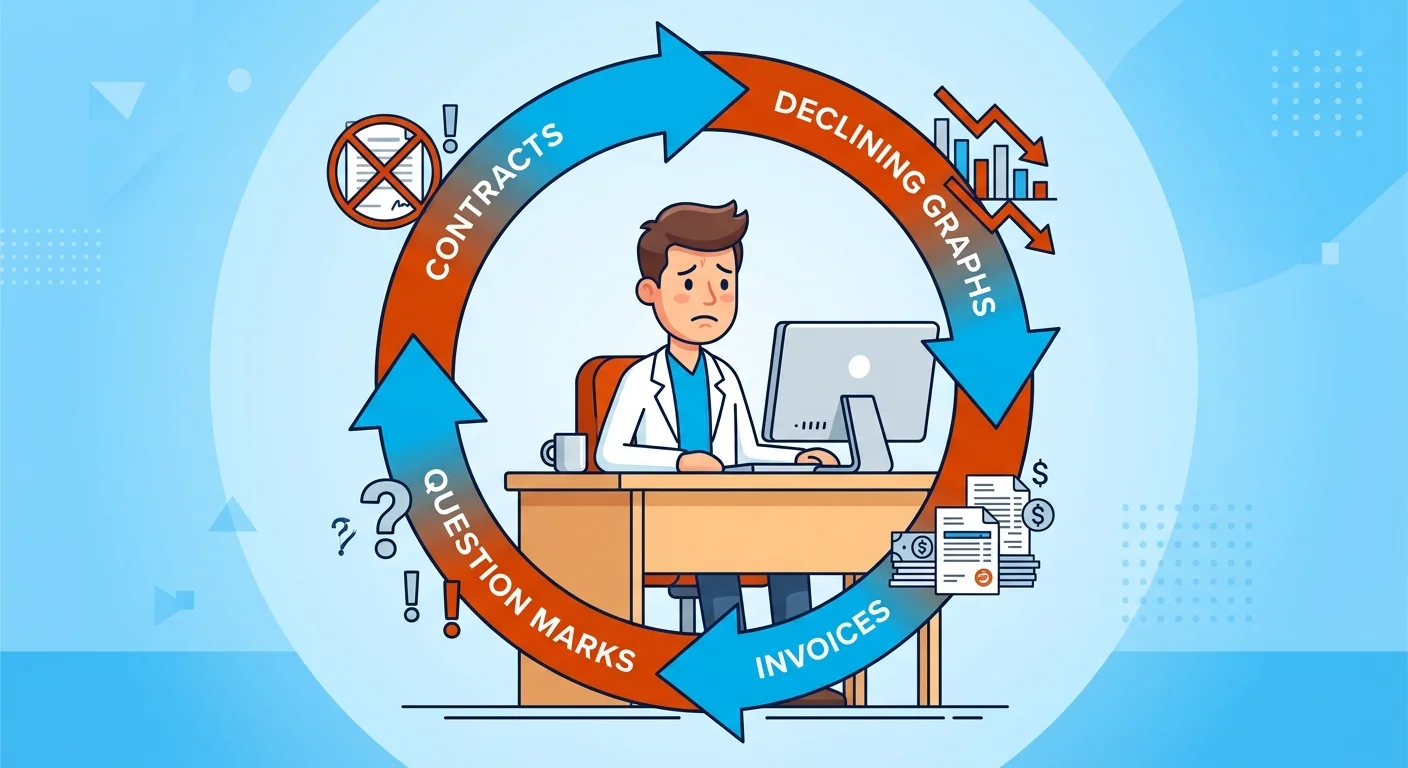
A failed agency relationship doesn’t just drain the budget.
It rewires the owner.
The research on stress and burnout among chiropractors doesn’t leave room for debate. Managing a problematic external marketing relationship alongside high-volume patient care correlates with a 40% increase in baseline stress scores.
That’s not minor friction. That’s a clinical-level burden stacking on top of an already brutal clinical role.
Stack that across two or three failed contracts and the clinical implications of learned helplessness start showing up in the body. Elevated cortisol. Degraded executive function. A nervous system trained – by repeated, uncontrollable failure – to stop registering solutions as real.
This isn’t a practice owner who quit. It’s a practice owner whose brain stopped believing the game could change.
The Four-Stage Cycle That Traps Practice Owners
The cycle has four locked stages: Conditioning, Paralysis, Surrender, and Recovery.
Most practice owners are stuck somewhere in the first three – and don’t know it.
Conditioning starts with the first agency disappointment. The reports looked good. Rankings moved. The phone didn’t.
The owner asked questions. The agency had answers. And the owner accepted them – because what do you do when you’re seeing patients from 8 to 6 and can’t blow up the arrangement mid-campaign?
So the pattern sets. Performance theater gets accepted as performance. The bar drops.
Paralysis hits after the second or third cycle. The owner has data now – data that says agencies don’t deliver. So they freeze. They stay too long, bounce to someone new with no real conviction, or stop investing in AI visibility altogether.
Surrender is when that freeze becomes a belief system: this is just how it works, there’s nothing better out there.
That’s the chiropractor’s hopium cycle at its most damaging – not the bad agency, but the conclusion that all agencies are the same. The first break in that pattern starts with what separates failing models from legitimate ones
Why This Pattern Is Not a Personality Flaw
Repeated exposure to uncontrollable negative outcomes blocks professionals from acting – even when a real solution is sitting right in front of them.
That’s not weakness. That’s documented behavioral psychology.
The chronic learned helplessness patterns documented by the APA aren’t a character defect. They’re a predictable response to a model that was never designed to deliver ownership.
A chiropractor who rents their treatment room pays every month and owns nothing. The agency retainer works exactly the same way.
The problem was never the practice owner’s resolve. The problem was the model.
| Stage | Label | Behavioral Signal | What It Costs the Practice |
|---|---|---|---|
| Stage 1 | Conditioning | Owner accepts performance reports that show activity but produce no new patient bookings; raises concerns, receives plausible explanations, and pays another month | Tolerance for performance theater becomes the baseline; the owner’s standard for what ‘working’ means is lowered permanently |
| Stage 2 | Paralysis | Owner has accumulated enough failed cycles to distrust all solutions; stays with a failing agency past reason, bounces to a replacement without conviction, or stops investing in visibility altogether | Momentum stalls; competitors continue compounding their authority signals while the practice stands still |
| Stage 3 | Surrender | Owner internalizes the belief that no better model exists; visibility becomes something that happens to competitors, not something the practice can control or own | Decision-making authority over the practice’s future is ceded entirely; the owner stops evaluating new solutions even when presented directly |
| Stage 4 | Recovery | Owner recognizes the model was broken – not their resolve; shifts from renting campaign results to building permanent, machine-readable AI Authority Infrastructure that compounds over time | Visibility becomes an owned asset rather than a monthly rental; the practice re-enters the AI recommendation conversation with compounding structural advantage |
Why Traditional SEO Agencies Make It Worse
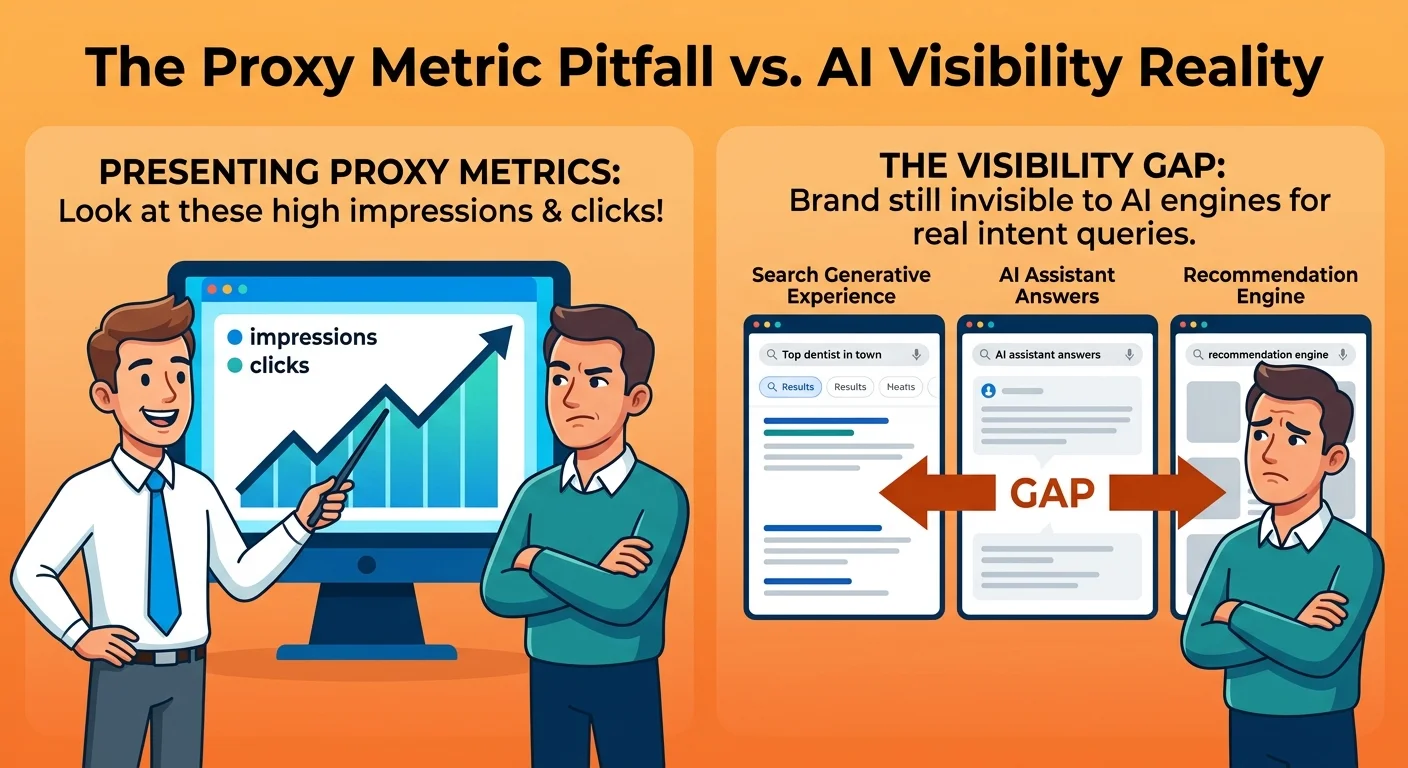
Traditional SEO agencies don’t just fail to deliver. They actively deepen the damage.
The model is engineered to manufacture the appearance of progress. Nothing compounds. Nothing is owned. Nothing survives the moment you stop paying.
That’s not cynicism. That’s the business model.
Rankings decay instantly when monthly subscription budgets stop. Every dollar spent rents a position that evaporates. After enough cycles of paying for something that disappears, a practice owner stops believing permanent AI visibility is even possible.
And that belief – right there – is the agency’s best retention tool.
Here’s the thing: the agency doesn’t need to deliver results. It only needs to deliver enough plausible activity to justify next month’s invoice.
That’s the whole game. Once a practice owner stops believing permanent authority is achievable, they stop demanding it. They settle. They renew.
Understanding vanity metrics vs. patient acquisition is the first step in seeing how the model was never designed to create ownership – and was always designed to rent it back to you, month after month.
The Vanity Metric Playbook: How Agencies Stay Paid While You Stay Invisible
Here’s the actual playbook.
The agency runs a campaign. Drops a report in your inbox. Fills it with impressions, click-through rates, ranking positions, and domain authority scores.
Not one of those numbers connects to a new patient sitting in your treatment room. But they’re real numbers – and real numbers are hard to argue with when you’re seeing patients from 8 to 6 and have zero time to interrogate a dashboard.
So the invoice gets paid. Again.
The chronic learned helplessness patterns the APA documents aren’t an accident here. Repeated exposure to uncontrollable negative outcomes trains professionals to stop acting – even when a fix is sitting right in front of them.
Vanity metrics are the delivery mechanism. They keep the real outcome invisible just long enough to reset the billing cycle before you can connect the dots.
That’s why Stage 1 Conditioning sticks.
The agency never has to lie outright. It just has to keep the scoreboard full of numbers that look like forward motion.
By the time you hit Stage 2 Paralysis, you’ve been trained to expect exactly this: constant activity, zero ownership.
Why Keyword Rankings Cannot Build AI Authority
Keyword rankings can’t build AI authority. Full stop.
The entire premise – optimize a phrase, climb a list, capture a click – assumes a search behavior that AI answer engines have already replaced. When someone asks ChatGPT who the best chiropractor in their area is, there’s no list.
There’s one answer.
What determines that answer isn’t keyword density. It’s entity trust – the depth and consistency of structured signals that tell AI engines your practice is real, credible, and worth recommending.
Traditional SEO retainers don’t build entity trust. They build rankings that evaporate the moment payments stop.
And a practice owner who’s already watched rankings disappear twice? They’re in no shape to trust a third agency. That’s not stubbornness. That’s Stage 3 Surrender – and it’s a completely rational response to a model that was never going to deliver anything permanent.
| Agency Metric Reported | What It Actually Measures | What AI Engines Actually Need | The Visibility Gap Created |
|---|---|---|---|
| Keyword ranking position | Where a webpage appears in a traditional search results list | Entity trust signals – structured proof that the practice is real, authoritative, and locally relevant | A high-ranking page is invisible to AI answer engines that never consult the ranked list |
| Impressions and click-through rate | How often an ad or listing was displayed and how often users clicked | Semantic density – consistent, structured content that confirms the practice’s expertise across multiple topics | Volume of exposure has no relationship to AI citation; a practice seen by thousands can still be unnamed by ChatGPT |
| Domain authority score | A proprietary third-party estimate of a site’s general link popularity | Citation velocity – the rate at which authoritative, structured references to the practice accumulate across trusted sources | A strong domain authority score does not signal trustworthiness to AI engines using their own knowledge graph logic |
| Monthly content volume (pages published) | How many new pages or posts were created during the billing period | AI-readable infrastructure – schema-structured, entity-anchored content that AI engines can parse and extract | Content quantity without machine-readable structure is invisible to AI; publishing more of the wrong format compounds the gap |
| Backlink count | The number of external pages linking to the practice’s website | Structured entity reinforcement – consistent NAP data, authoritative directory presence, and verified organizational signals | Link counts from low-relevance sources provide no entity verification and do not influence AI recommendation logic |
Why Most Chiropractors Stay Stuck After Firing the Agency
Firing the agency feels like escaping the trap.
It isn’t. Not yet.
Most practice owners who cut a failing retainer don’t break the cycle. They pause it.
Here’s what the data says: over 50% of independent healthcare practice owners report moderate-to-severe burnout symptoms tied directly to non-clinical, administrative burdens.
Firing the agency removes one line item from that burden. It doesn’t remove the wiring.
The Stage 3 Surrender belief – nothing is actually going to work – doesn’t leave with the contract. It stays. And it quietly governs every decision that comes next.
That’s not a character flaw. That’s chronic learned helplessness patterns in action – repeated exposure to uncontrollable bad outcomes rewires professionals to stop trying, even when a real fix is sitting right in front of them.
So the practice owner who just cut the agency doesn’t spring into action. They stall. They research indefinitely. They wait for certainty that never comes.
And every month they wait, a competitor who kept building pulls further ahead.
Who This Section Is Not For
Stop here for a second.
What follows isn’t for everyone.
If you’re still convinced the right agency is out there and you just haven’t found the right price point yet – this isn’t for you.
If you want someone to guarantee a specific number of new patients in 90 days, we’re not your fit. That’s the same hopium in a different bottle. Chasing it puts you right back at Stage 1 Conditioning, ready to run the cycle again from the top.
We don’t do guarantees. We do infrastructure that compounds. Those aren’t the same thing.
This is for the owner who has stopped believing the retainer model works.
Not frustrated with it. Done with it.
And now trying to figure out what comes next without walking straight into another version of the same trap.
The DIY Trap and the Wait-and-See Trap
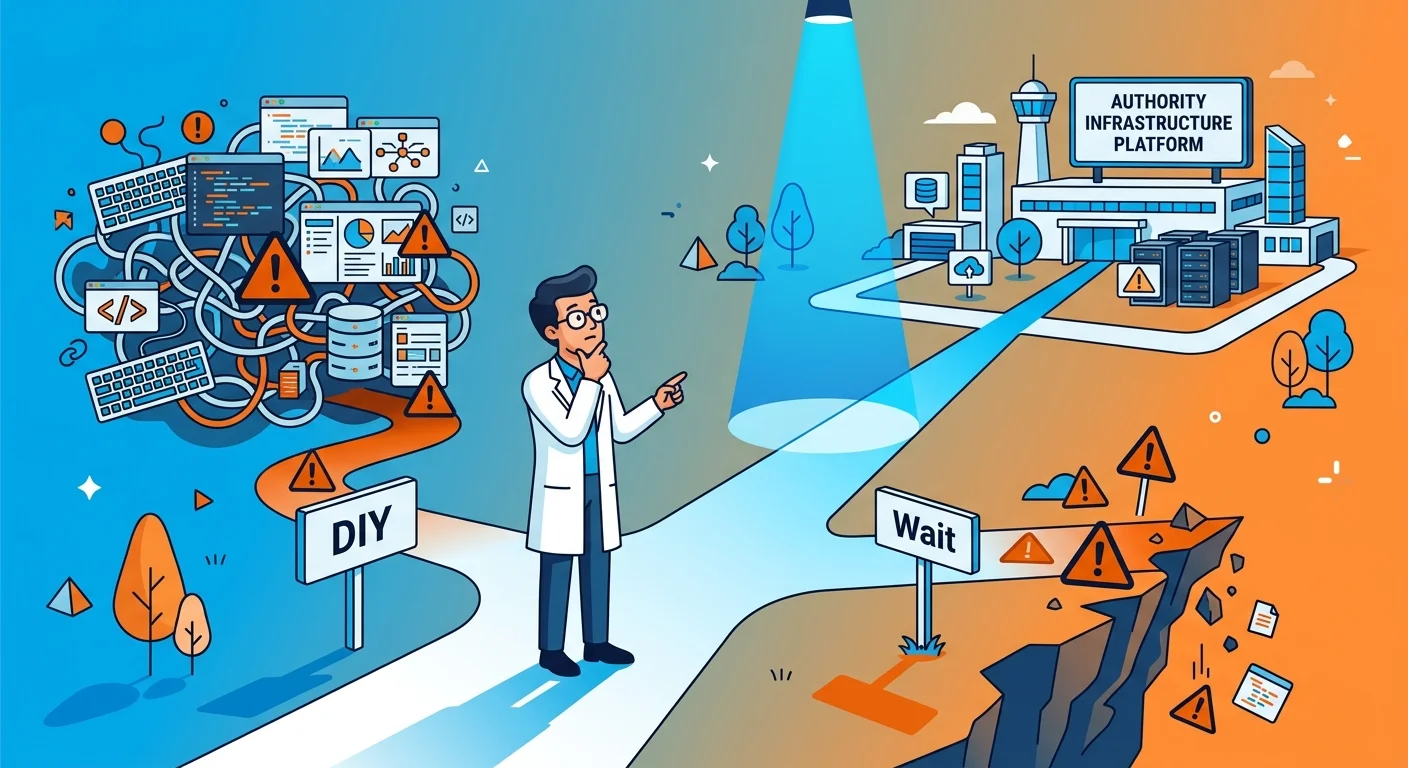
After a practice owner fires the agency, two responses dominate. Both make things worse.
The first is DIY. The owner decides to handle AI visibility in-house, learns just enough about content and keywords to stay busy, and watches months go by without a structural result. Busy isn’t the same as building.
The second is wait-and-see. The owner stops investing entirely, tells themselves they’ll revisit it when the timing is better, and lets the gap between their practice and a competitor’s authority compound – quietly, month by month.
Neither builds anything. That’s the part that gets missed.
DIY replicates the surface activity of the old agency – without the depth. It creates motion that looks like progress. It doesn’t construct the machine-readable AI Authority Infrastructure that determines whose name gets cited when a patient asks an AI engine who to trust.
Wait-and-see is just Stage 3 Surrender with better vocabulary.
Here’s the rented chair metaphor again. A chiropractor who takes over cleaning and managing a rented treatment room hasn’t changed the ownership equation. They’re just doing more work in a space that still isn’t theirs.
Stage 4 Recovery doesn’t start with finding a better agency. It starts with the vanity metrics vs. patient acquisition distinction – the moment a practice owner stops chasing metrics that look like progress and starts building infrastructure that actually compounds.
That’s the first cognitive break. And it only happens when you own something.
| Post-Agency Response | Why It Feels Rational | Why It Deepens Helplessness | The Structural Problem It Ignores |
|---|---|---|---|
| DIY Visibility Management | The owner already knows the practice – who better to tell its story? Taking control feels like reclaiming agency after years of being managed poorly. | Surface activity replaces strategic infrastructure. The owner stays busy enough to feel productive while the foundational machine-readable signals AI engines actually use remain unbuilt. | AI authority isn’t produced by content volume or keyword effort. It’s produced by entity trust signals – structured, consistent, and compounding. DIY replicates the motion of the old retainer without the architecture that makes any of it stick. |
| Wait-and-See Pause | After absorbing financial and emotional losses, stopping all spending looks like fiscal discipline. Doing nothing costs nothing – at least in the short term. | Every month of inaction is a month a competitor’s authority compounds unopposed. The gap isn’t static – it widens. Waiting isn’t neutral; it’s a decision to fall further behind. | AI visibility isn’t maintained passively. The entity trust signals that determine whose name gets cited decay without consistent reinforcement. Pausing execution doesn’t preserve a position – it erodes one. |
| Bargain-Hunting for a Cheaper Retainer | If the expensive agency didn’t deliver, maybe a lower-cost provider with fewer overhead costs will produce a leaner, more honest result for less monthly spend. | Price compression doesn’t change the structural model. A cheaper retainer still rents temporary positioning – it just rents less of it. The Stage 1 Conditioning cycle restarts at a lower price point with the same architectural outcome: nothing owned. | The problem was never the retainer’s cost. It was the retainer’s design. A model built to generate monthly activity metrics – not compounding AI authority infrastructure – produces the same result regardless of what it charges. |
| Platform-Chasing (Social, Ads, Directories) | If the agency’s approach failed, the channel must be wrong. Shifting spend to social media, paid ads, or directory listings feels like diversifying away from a bad bet. | Channel-switching relocates the same rented-visibility problem to a new platform. Paid placements stop producing the moment the budget does. Directory listings without structured entity reinforcement don’t build AI authority – they add noise. | AI engines don’t cite the most active brand. They cite the most trusted entity. Trust is built through structured, machine-readable infrastructure – not through platform presence or ad spend. Switching channels postpones the real structural decision. |
The Structural Shift: From Rented Campaigns to Owned Authority
Here’s the move that ends it.
Not a better agency. Not a different retainer. A structural shift.
Every stage of this loop – Conditioning, Paralysis, Surrender, Recovery – traces back to one structural flaw.
The practice owner never owned anything.
Rankings decay the moment the retainer stops. That’s not a vendor problem. That’s a model problem. And the only exit from a broken model is to stop renting and start building.
The rented chair metaphor closes here.
A chiropractor who buys the building doesn’t just stop paying rent – they stop being vulnerable to whoever holds the lease.
AI Authority Infrastructure is the building. It’s owned. It compounds. It doesn’t evaporate the moment an invoice stops.
What AI Authority Infrastructure Actually Means
AI Authority Infrastructure isn’t a content strategy. It’s not an AEO package with a new logo slapped on it.
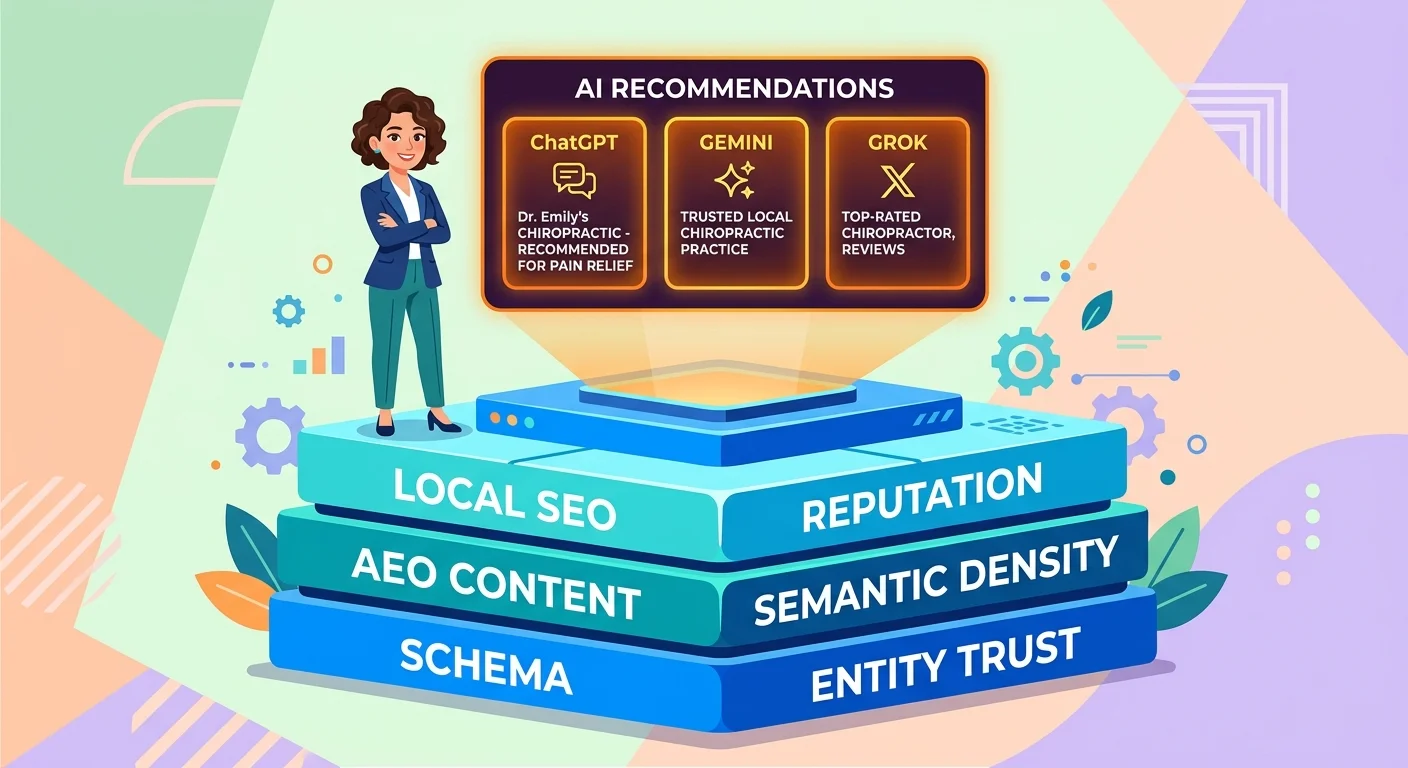
It’s the machine-readable foundation that tells AI engines – ChatGPT, Gemini, Grok – that your practice is a real, trustworthy, citable entity.
Most practice owners have never been offered the real thing. They’ve been sold the rental dressed up as ownership.
That foundation has specific components: structured schema markup, entity signals distributed across authoritative platforms, semantic content that answers real patient questions with depth and consistency, and internal architecture that reinforces who you are and what you treat.
None of that is built for an algorithm. It’s built for the AI systems that have already replaced the algorithm.
And unlike keyword rankings – it doesn’t disappear the moment you stop paying.
Here’s a question most practice owners never think to ask their agency: who’s accountable for how your digital systems interact with HIPAA obligations?
Retainer-based agencies have zero skin in that game. They build what gets approved, bill what gets paid, and disappear when the contract ends. The liability stays with you.
Owned infrastructure means you control what gets built – and what risk gets introduced. That’s not a minor footnote. compliance risks in your practice
How Delegation Breaks the Helplessness Loop
Delegation is what makes Stage 4 Recovery something that actually happens – not something you intend to get to.
Not delegation in the vague, hand-wave sense. Structured, done-for-you execution that removes the non-clinical burden entirely. Mitigating burnout through systematized delegation is what shortens the recovery period.
That gap – between intending to recover and actually recovering – lives in the execution model.
That’s the model Gerek Allen built iTech Valet around: white-glove execution where the practice owner does nothing but show up and treat patients.
No learning curve. No content calendar. No monthly calls where you’re expected to have opinions about keyword clusters.
The infrastructure gets built. The authority compounds. And the practice finally owns something that can’t be taken away when the contract ends.
| Capability | Rented SEO Campaign | Owned AI Authority Infrastructure |
|---|---|---|
| Ownership | Agency retains all assets – rankings, content, and access disappear when the contract ends | Practice owner holds the infrastructure permanently – entity signals, schema, and authority content are fully owned |
| Compounding Effect | Visibility resets to zero the moment monthly payments stop – no cumulative build | Authority signals layer and compound over time – each month of execution strengthens the foundation already in place |
| AI Engine Readiness | Keyword optimization targets search algorithms that AI answer engines have already replaced | Structured schema, entity signals, and semantic content are built specifically for how AI engines evaluate and cite sources |
| Practice Owner Burden | Ongoing involvement required – reviewing reports, interpreting metrics, approving campaigns | White-glove execution removes all non-clinical marketing burden – the practice owner shows up and treats patients |
| Resilience to Vendor Change | Losing the agency means losing everything built under the retainer | Infrastructure lives on the practice’s own digital real estate – no vendor holds the keys |
| Visibility Mechanism | Rankings and clicks driven by keyword density in a list-based search format | Entity trust signals that tell AI engines the practice is real, authoritative, and worth recommending by name |
Frequently Asked Questions
You’ve seen the full loop – Conditioning, Paralysis, Surrender, Recovery. Now come the real questions. The ones a burned practice owner asks when they’re staring at something different and trying to figure out if this time is actually different.
These aren’t hypotheticals. The learned helplessness wiring doesn’t just switch off. Get these answers wrong and you’re back at Stage 1 before the year is out.
How does agency burnout directly impact a healthcare practice owner’s clinical decision-making?
Harder than most will admit. Elevated cortisol levels and prolonged executive function fatigue are consistently documented in professionals exhibiting learned helplessness behaviors. That’s not a wellness footnote – that’s a clinical performance problem. The mental bandwidth that should go toward patients gets consumed by a marketing relationship that isn’t working. Nobody puts that cost on the invoice. But it’s there. Every single session.
Why do traditional SEO metrics keep chiropractors trapped in the hopium cycle?
Because the metrics feel real. Rankings go up. A report lands in your inbox. The numbers look good. Then the payment stops – and so does everything else. Rankings decay instantly when monthly subscription budgets are stopped. That’s the trap. The dashboard gives you the sensation of progress without the structure of ownership. It’s designed to require renewal. And every renewal keeps you inside Stage 1 – mistaking rented visibility for a built asset.
What are the financial risks of letting marketing-induced learned helplessness go unaddressed?
It compounds in two directions at once. First, the internal cost: over 50% of independent healthcare practice owners report moderate-to-severe burnout symptoms tied to non-clinical, administrative burdens. That burnout reduces patient throughput and degrades clinical judgment – neither of which shows up on a marketing report. Second, the structural cost: every month of AI invisibility is a month a competitor’s authority compounds and yours doesn’t. There’s no neutral position here. The gap widens whether you’re watching or not.
How does building an AI-readable authority infrastructure disrupt past experiences with marketing failures?
It breaks the pattern because it changes what you own. Every prior failure ran the same model – you rented vanity metrics vs. patient acquisition and watched it evaporate when the payments stopped. AI Authority Infrastructure breaks that at the structural level. It’s not a content campaign. It’s machine-readable entity signals, schema markup, and semantic depth that tell AI engines your practice is real and worth citing. It doesn’t disappear when an invoice goes unpaid. Owning something that compounds is a fundamentally different experience than renting something that decays – and that difference gets felt before it gets measured.
What is the average timeline for recovering practice visibility after terminating a legacy agency contract?
There’s no honest fixed number – and anyone offering one is selling the same hopium in different packaging. What the research does confirm: structured delegation to standardized, done-for-you systems reduces operational recovery periods by up to 60%. The faster the non-clinical burden lifts, the faster the cognitive recovery follows. Practically, the recovery clock starts when you stop renting and start building. Firing the agency stops the bleeding. Building the infrastructure is what closes the wound.
Stop Renting. Start Owning.
Here’s where it ends.
Not with a better agency. Not with a cheaper retainer. Not with a 90-day trial of the same broken model wearing a different name.
The rented chair metaphor closes right here. A chiropractor who finally buys the building doesn’t just stop paying rent – they stop being vulnerable to whoever holds the lease.
Every stage of the loop – Conditioning, Paralysis, Surrender – ran on the same broken assumption: that rented visibility was close enough to owned authority.
It wasn’t. Rankings decayed the moment the invoice stopped. The retainer reset every month. The scoreboard filled with numbers that looked like progress and built nothing you could keep.
AI Authority Infrastructure breaks that pattern permanently. It compounds every month you hold it. It doesn’t evaporate when the contract ends. And it answers the question that actually matters right now – not "where do I rank on a list?" but "does ChatGPT say my name? Does Gemini? Does Grok?"
Stage 4 Recovery isn’t a mindset shift. It’s a structural decision.
Stop renting their visibility. Start building infrastructure that compounds – infrastructure that tells ChatGPT, Gemini, and Grok your practice is real, trustworthy, and worth recommending.
The practices that own their authority don’t worry about what happens when the next agency invoice doesn’t get paid. They already own the building.
The bleeding doesn’t stop while you’re still paying for hopium. AI engines are naming someone in your market right now – and if you don’t know whether it’s you, that’s the answer. Find out where your practice stands in 15 minutes.