
The Visual Design Trap: Why “Pretty” Doesn’t Mean “Readable”
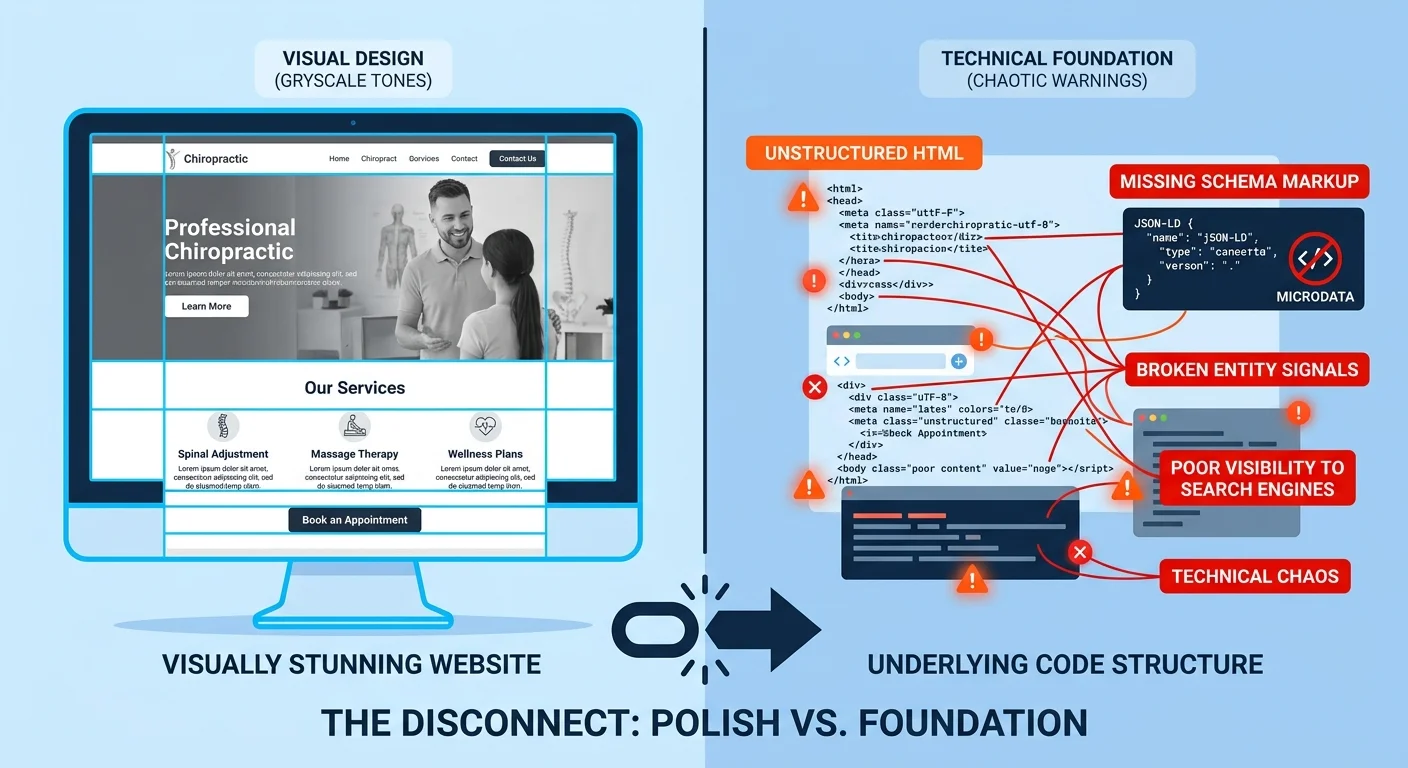
You paid five grand for a website that looks incredible.
Clean layout. Professional photos. Smooth navigation. Testimonials displayed beautifully. Everything your web designer promised.
And when a patient asks ChatGPT who the best chiropractor near them is?
Your competitor’s name. Never yours. That’s what happened. Here’s why: your designer optimized for human eyes. AI engines don’t have eyes.
What Humans See vs. What Machines Read
When you open a website, your brain processes visual hierarchy instantly. You see headings, images, buttons. You understand context from layout and color.
AI crawlers see none of that.
They parse HTML tags. They read Schema markup. They trace entity relationships through structured data.
If your site doesn’t explicitly tell the machine what each element means, the machine guesses. And when machines guess, they default to “untrustworthy” and move on.
Think of it like a book with no table of contents. No chapter headings. No page numbers. The text exists – a human could eventually figure it out. But nobody’s got time for that. And neither does an AI engine processing millions of pages per second.
According to Google’s structured data documentation, explicit markup is how you communicate meaning to software. Without it, you’re asking AI to infer your expertise from vibes.
The Digital Brochure Fallacy
Most chiropractic marketing agencies treat a website as a static placeholder.
A digital business card.
They optimize for “pretty” – because that’s what gets approval in the sales meeting.
What they don’t tell you: a beautiful website that AI doesn’t recognize is functionally invisible.
I’ve watched agencies mask this failure for years. They report on clicks and impressions. They celebrate “page one rankings” for keywords nobody searches. They avoid the one metric that actually matters: how many patients booked because AI recommended you.
The reason they avoid that metric? They can’t deliver it.
Because delivering it requires technical depth most agencies don’t have.
They build brochures. iTech Valet builds authority infrastructure.
Here’s the kicker: the brochure costs just as much. You paid for it. You just didn’t get machine readability in the deal.
The Three Pillars of Machine Readability
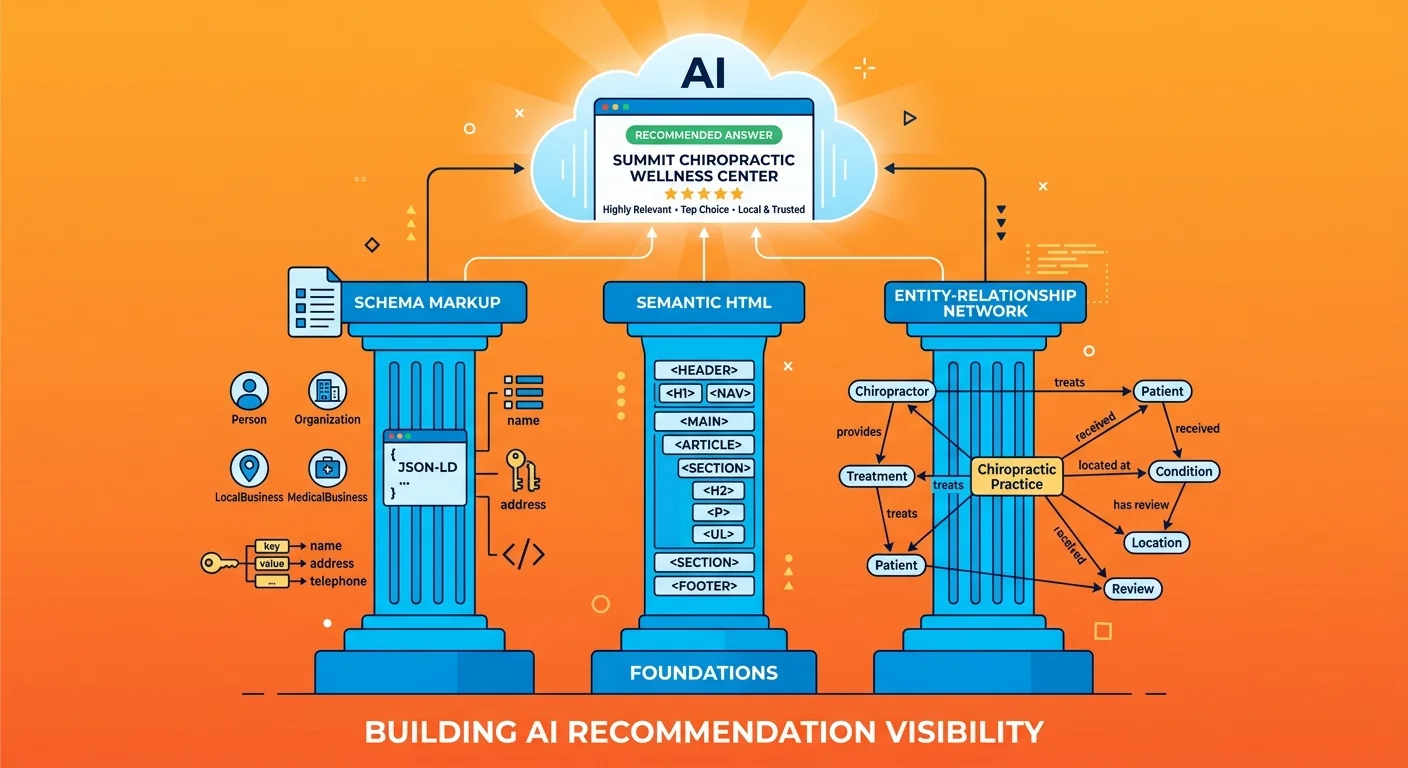
Machine readability isn’t one thing. It’s three technical foundations working together.
Miss any one of them and the whole structure collapses.
Structured Data: Teaching Machines Your Business Language
Structured data is how you tell AI engines what your content is – not what it says, but what it means.
Schema.org is the vocabulary. It’s a standardized dictionary that lets you label every piece of your site with machine-readable tags.
- LocalBusiness schema – Tells AI this is a physical business with an address and operating hours. Not a vague “serving the area” claim.
- MedicalBusiness schema – Identifies you as a healthcare provider. Not a retail shop. Not a law firm. A medical practice.
- Service schema – Labels each treatment you offer with explicit semantic meaning. “Sciatica treatment” becomes a defined entity, not just words on a page.
- Review schema – Wraps patient testimonials in markup that AI recognizes as social proof. Not screenshots. Not generic quotes. Structured, verifiable reviews.
- Person schema – Defines you (the practitioner) as a unique entity with credentials and relationships to the business entity. This is how AI confirms you’re real.
Without these labels, AI engines see unstructured text. They can’t confirm you’re a chiropractor. They can’t verify your location. They can’t determine whether your reviews are real or fabricated.
Structured data removes ambiguity.
It’s the difference between “someone talking about back pain” and “Dr. Smith, a licensed chiropractor at Smith Chiropractic in Austin, Texas, specializing in sciatica treatment.”
One is vague. The other is citeable.
| Schema Type | What It Labels | Why AI Needs It |
|---|---|---|
| LocalBusiness | Physical location, hours, contact info | Confirms you exist in a verifiable geographic location |
| MedicalBusiness | Healthcare classification, services offered | Distinguishes you from non-medical businesses in the same area |
| Person | Practitioner identity, credentials, relationship to business | Establishes individual authority and trustworthiness |
| Service | Specific treatments, conditions addressed | Allows AI to match patient queries to your expertise |
| Review | Patient testimonials, ratings, dates | Provides social proof AI can verify and cite |
This is what Answer Engine Optimization is built on.
Not guessing. Not hoping. Explicit machine-readable signals that AI engines trust enough to recommend.
Semantic HTML: Building a Clear Hierarchy
Semantic HTML is the structure that tells machines how your content is organized.
Heading tags (<h1>, <h2>, <h3>) aren’t styling tools. They’re hierarchy markers. They tell AI which sections are primary topics, which are subtopics, and how everything connects.
- Proper heading structure – Your H1 is the page topic. H2s are major sections. H3s are subsections. AI reads this like an outline. Not like a random pile of text.
- ARIA labels – Accessibility markup that also helps machines understand interactive elements and navigation structure. This isn’t just for screen readers – it’s for AI crawlers.
- Semantic tags –
<article>,<section>,<nav>,<aside>explicitly label content types instead of generic<div>containers. AI sees structure. Not soup.
When your site uses semantic HTML correctly, AI engines can build a mental model of your content. They understand that “Sciatica Treatment” is a service, “Patient Testimonials” is social proof, and “About Dr. Smith” is entity validation.
When your site uses <div> tags for everything and styles headings with CSS instead of proper H-tags?
AI sees a blob. No hierarchy. No structure. No reason to trust anything.
Entity Definitions: Establishing Your Digital Identity
An entity, in AI terms, is a uniquely identifiable thing with attributes and relationships.
You’re an entity. Your practice is an entity. Your location is an entity. Your services are entities.
AI engines build knowledge graphs that map how all these entities connect.
When a patient asks, “Who’s the best chiropractor for sciatica near me?” – AI doesn’t search for keywords.
It searches its knowledge graph for entities that match:
- Location entity → Near the patient’s current coordinates
- Service entity → Sciatica treatment expertise
- Trust entity → High Entity Trust signals from verified sources
If your website doesn’t define these entities clearly – if your location data conflicts across platforms, if your services are vaguely worded, if your credentials aren’t structured – AI engines can’t map you.
You’re not in the knowledge graph.
You’re not an option.
Entity definitions are how AI confirms you’re real, you’re qualified, and you’re located where you claim to be. Without them, you don’t exist in the machine’s model of the world.
Why Template Websites Fail the Machine Readability Test
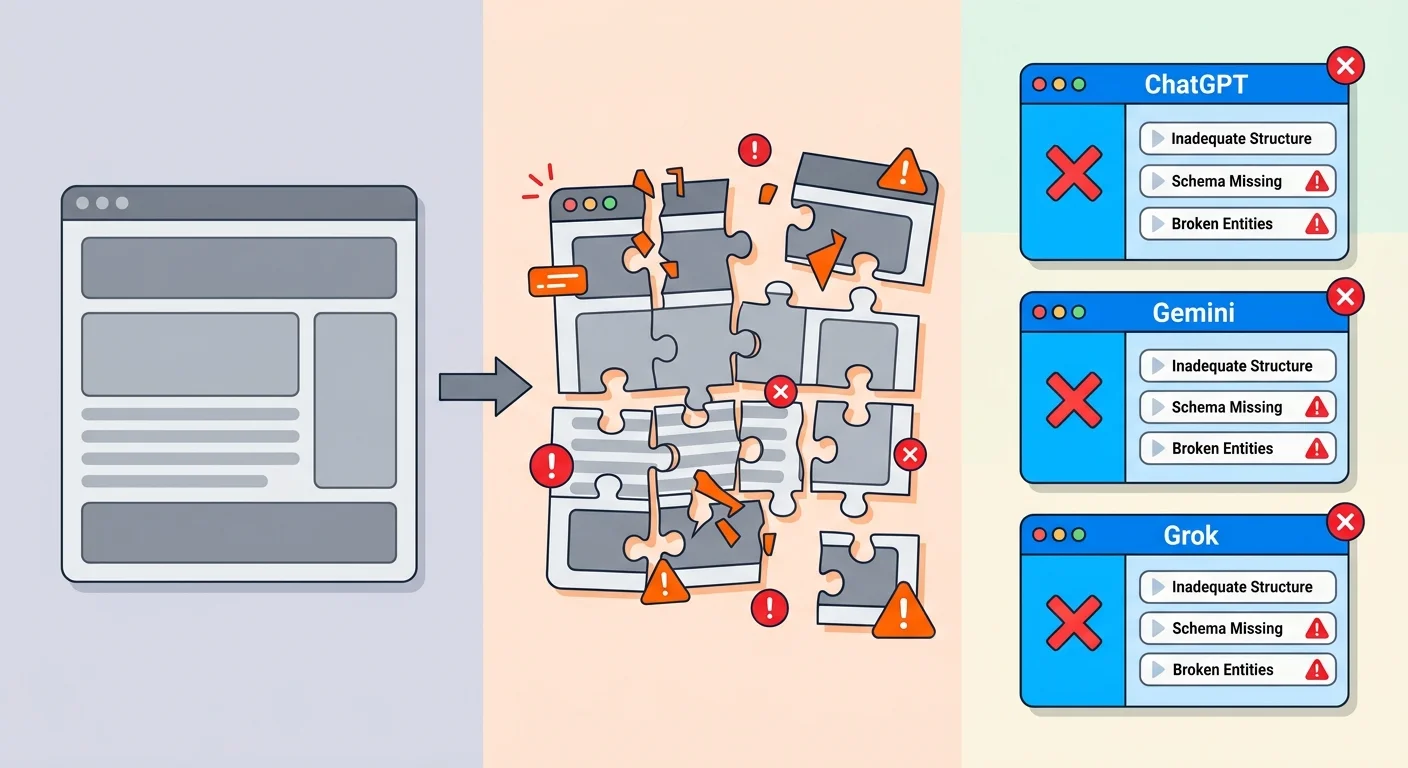
The One-Size-Fits-All Structure Problem
Template agencies – Squarespace, Wix, generic WordPress themes – produce websites that are structurally invisible to AI.
Not because templates can’t technically support Schema markup. They can.
But because their one-size-fits-all approach prevents the creation of a unique, authoritative entity graph.
Here’s the thing about templates: they’re built for visual flexibility. You can swap colors, fonts, images. What you can’t do is rebuild the underlying entity architecture without breaking the template’s core structure.
The Schema that ships with most templates is generic. It labels you as “a business” and stops there.
No specialization. No service-level markup. No entity relationships that distinguish your practice from the 47 other chiropractic sites built on the same template.
The code exists. The hierarchy is poorly organized. The entity signals are so weak that AI engines ignore them entirely.
According to Search Engine Journal’s guide to structured data, comprehensive markup requires custom implementation tailored to your specific business model.
Templates don’t allow that depth.
I’ve seen practices spend $3,000 on a template website and then wonder why they’re invisible. The problem isn’t the design. It’s that the template was never built to communicate authority to a machine.
Why Your “SEO-Friendly” Theme Isn’t Enough
Your web designer told you the theme was “SEO-friendly.”
What they meant: it loads fast, has clean URLs, and doesn’t break on mobile.
What they didn’t mean: it’s built for AI recommendation.
Old-school SEO optimized for Google’s algorithm. You picked keywords. You built backlinks. You got on page one for “chiropractor near me.”
That game is over.
AI engines don’t rank pages in a list. They cite entities in a single answer. The technical requirements are completely different.
- Old SEO → Keyword density, meta descriptions, H1 tags that match search queries
- AEO → Entity definitions, Schema markup, knowledge graph integration
Your “SEO-friendly” theme supports the first list. It has zero infrastructure for the second.
This isn’t a criticism of your designer. Most of them learned SEO in 2015. The landscape changed in 2023.
They haven’t caught up yet.
Machine Readability vs. Traditional SEO: The Critical Difference
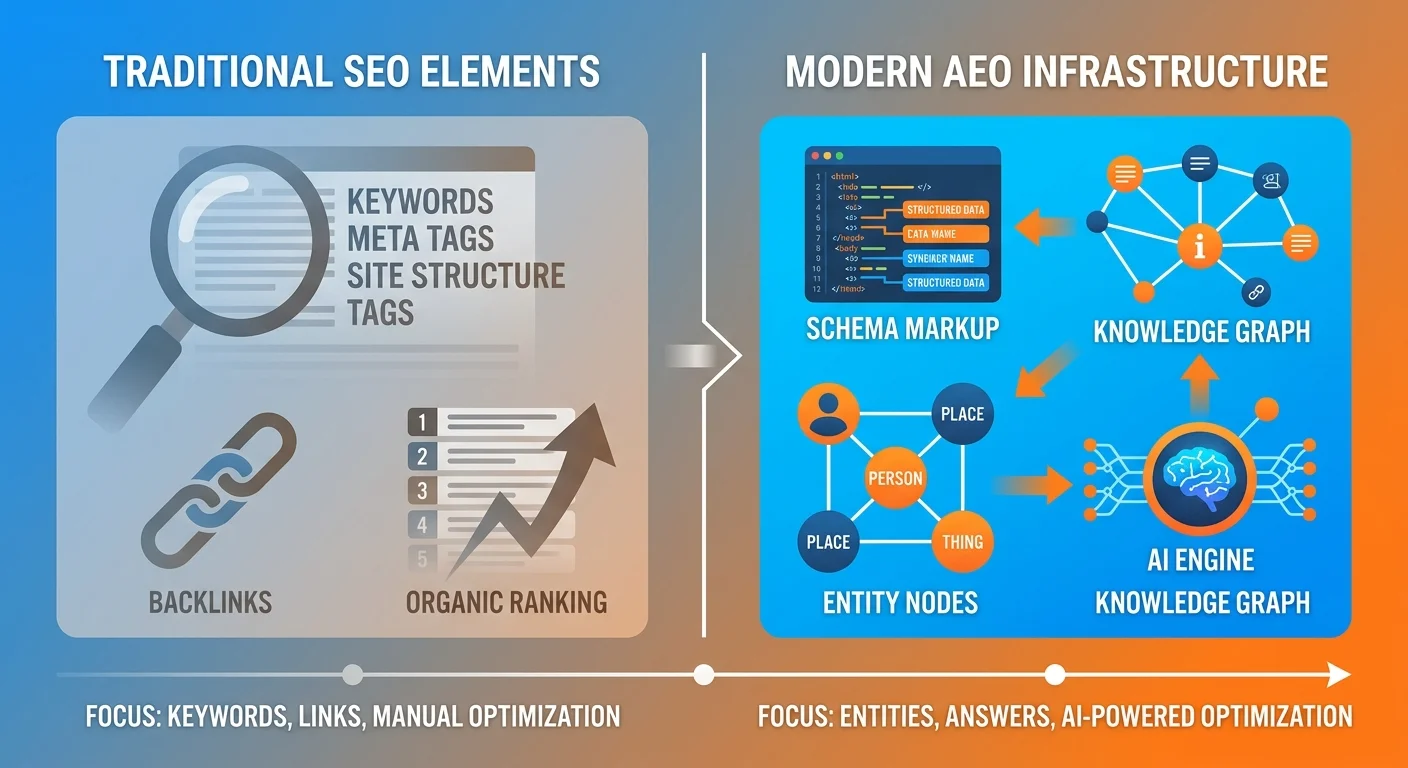
Traditional SEO was built for a world where patients clicked through a list of ten options.
AI search produces a verdict. One answer. One recommendation.
Those aren’t variations of the same thing.
| Factor | Traditional SEO Approach | Machine Readability Approach | Why It Matters |
|---|---|---|---|
| Goal | Rank on page one of search results | Be the single recommended answer | Patients trust AI recommendations more than ranked lists |
| Primary Signal | Keyword optimization and backlinks | Entity trust and structured data | AI engines evaluate relationships, not keyword frequency |
| Content Focus | Blog posts targeting search queries | Authority content that builds semantic density | AEO requires depth and interconnected entity signals |
| Technical Foundation | Meta tags, sitemaps, mobile-friendly design | Schema markup, knowledge graph integration | Machines can’t infer authority-markup must be explicit |
| Success Metric | Page views and click-through rate | AI citation and recommendation frequency | Traffic doesn’t matter if AI never names you |
Ranking in a List vs. Being the Recommended Answer
When someone Googled “chiropractor near me” in 2019, they got a map pack and ten blue links.
They evaluated options. They clicked through. They compared.
When someone asks ChatGPT the same question today, they get one name. Maybe two.
No list. No comparison. Just a recommendation.
Being “Indexed” and “Recommended” are not the same thing.
Your site can be indexed by Google – fully crawled, every page cataloged – and still never get recommended by AI.
Because indexing confirms you exist. Recommendation requires trust.
AI engines don’t promote pages. They cite entities.
If your entity isn’t defined, structured, and validated across multiple authoritative sources, you’re not in the conversation.
Why Keyword Density Doesn’t Matter to AI
Traditional SEO counted how many times you used a keyword on a page.
AI engines don’t care.
They evaluate:
- Entity relationships – How your practice connects to verified directories, professional associations, and authoritative sources
- Citation velocity – How frequently trusted platforms reference your entity
- Semantic density – How comprehensively your content covers a topic, measured by entity connections and structured data depth
According to Moz’s research on entity-based SEO, search engines shifted from “strings” (keywords) to “things” (entities) years ago.
AI answer engines took that shift to its logical conclusion.
A page stuffed with “sciatica treatment” 47 times but lacking Schema markup? Invisible.
A page with proper entity definitions, service-level markup, and knowledge graph integration? Citeable.
Why Generalist Practices Are Machine-Unreadable
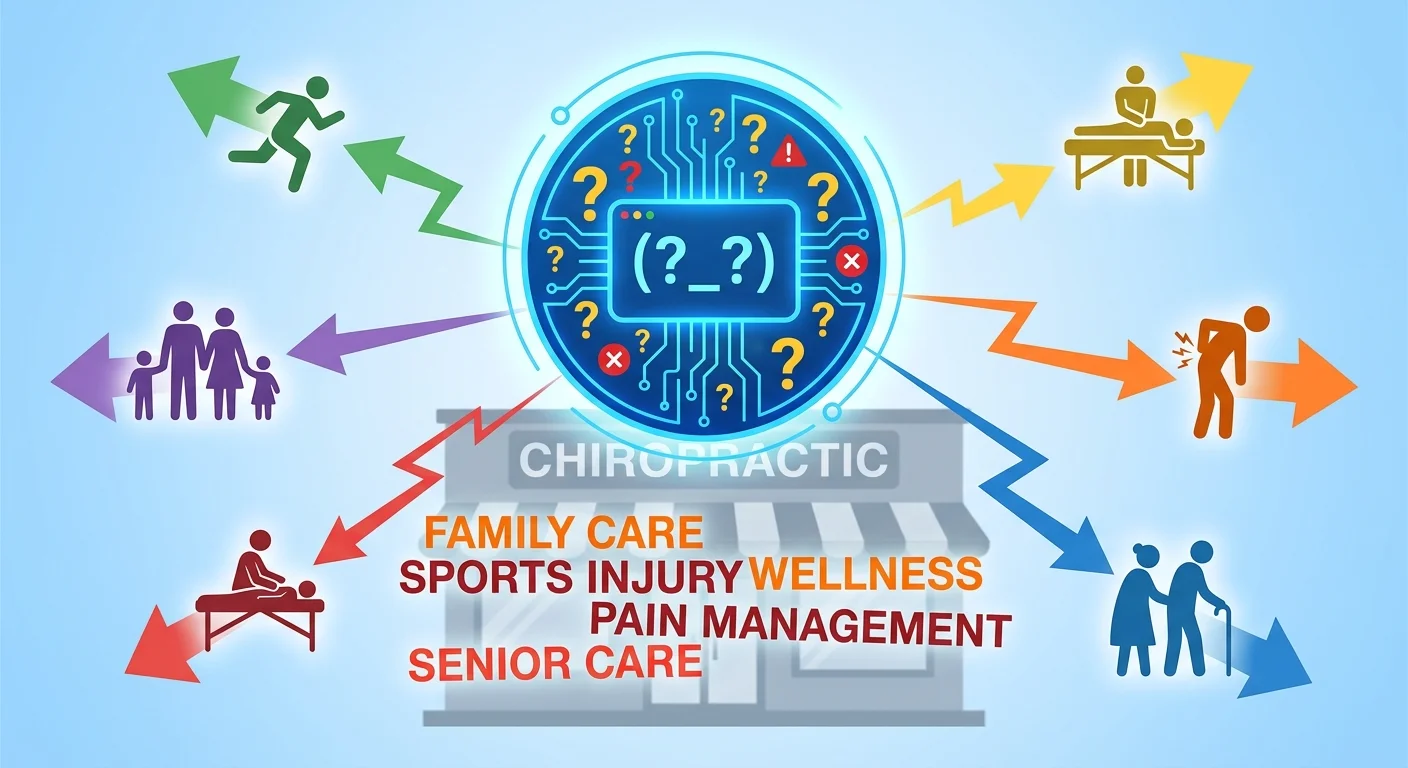
The “Everything to Everyone” Problem
You treat everyone.
Families. Athletes. Seniors. Pregnant patients. Auto accident injuries. Workplace ergonomics. Wellness care.
From a human perspective, that’s versatility.
From a machine perspective, that’s noise.
AI engines assign authority based on semantic clustering. When a patient asks for the best chiropractor for sciatica, AI scans its knowledge graph for entities with strong sciatica-related signals.
If your entity is labeled “family chiropractic care” and “sports injury treatment” and “prenatal wellness” and “geriatric mobility” and “workplace ergonomics” – AI can’t determine what you’re actually authoritative in.
You’re not the answer for sciatica. You’re not the answer for sports injuries. You’re not the answer for anything specific.
You’re a generalist. And generalists don’t get cited.
This isn’t about turning away patients. It’s about how machines categorize expertise.
A practice that refuses to define a clear specialty registers as weak authority across all topics.
If you’re not willing to specialize for AI visibility, you’re choosing invisibility. Period.
How Machines Categorize Authority
AI engines don’t evaluate authority the way humans do.
They don’t read your “About” page and get impressed by your 20 years of experience.
They measure:
- Topical clustering – How tightly your content, services, and citations group around a specific semantic category
- Entity signal consistency – Whether your service definitions, directory listings, and structured data all agree on what you do
- Citation patterns – Which authoritative sources reference your entity in relation to specific conditions or treatments
A practice that claims expertise in 15 unrelated areas dilutes its signal across all of them.
AI sees weak authority everywhere instead of strong authority somewhere.
You don’t need to treat fewer patients. You need to structure your entity around one primary specialty.
Everything else is secondary.
How AI Engines Build Knowledge Graphs
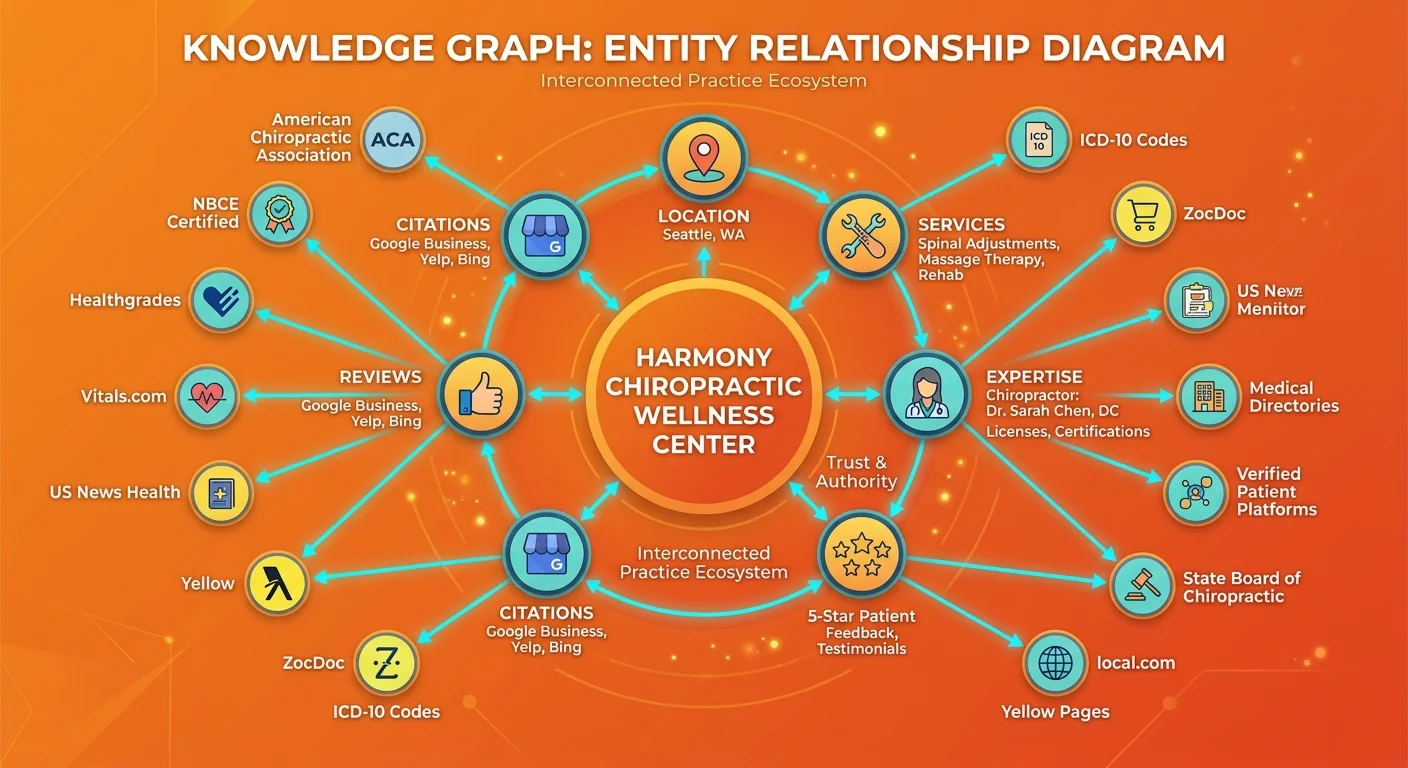
AI engines don’t store websites. They store knowledge graphs – massive networks of entities and the relationships between them.
When you ask ChatGPT who the best chiropractor for sciatica is, it queries its internal knowledge graph.
It looks for entities with strong relationships to:
- The condition → Sciatica treatment entity
- The location → Your city or region entity
- Trust signals → Citations from verified directories, professional associations, patient reviews
If your practice entity isn’t in the graph – or if the relationships are weak, conflicting, or undefined – you don’t get recommended.
According to Stanford’s research on knowledge graphs, these structures are how machines represent real-world entities and their connections.
They’re not optional infrastructure. They’re the foundation of AI reasoning.
Entity Relationships: The Map AI Uses to Verify You
Your practice entity connects to other entities through structured data and external citations.
- Your address – Links to Google Maps entity, city entity, state entity
- Your staff – Links to Person entities with credentials and professional affiliations
- Your services – Links to condition entities, treatment entities, medical classification entities
- Your directory profiles – Links to Healthgrades entity, Zocdoc entity, professional association entities
Each connection strengthens your entity. Each missing or conflicting connection weakens it.
AI engines cross-reference these relationships to verify claims.
If your website says you’re in Austin but your Google Business Profile lists Dallas, AI flags the conflict and downgrades your trust score.
If your Schema markup says you treat sciatica but none of your directory profiles mention it, AI assumes the claim is unverified.
Entity relationships are how machines confirm you’re real, qualified, and trustworthy. Without them, you’re just unverifiable text on a page.
Citation Velocity: Why Authority Compounds Over Time
Citation velocity is the rate at which authoritative sources reference your entity over time.
The more AI engines see your practice cited across trusted platforms – medical directories, professional associations, local news, patient reviews – the stronger your entity becomes in their knowledge graph.
This compounds monthly.
- Month 1 – Basic entity defined with Schema markup and directory listings
- Month 3 – Authority content published, internal entity relationships strengthened
- Month 6 – External citations increase, AI engines begin referencing your entity in answers
- Month 12 – Citation velocity accelerates, you become the default answer for your specialty in your market
Machine readability enables this compounding.
Without it, you’re not generating citations. You’re generating invisible content that AI engines ignore.
| Entity Signal Type | Machine-Readable Example | Machine-Unreadable Example | Impact on AI Trust |
|---|---|---|---|
| Location | Schema markup with coordinates + verified GMB profile + consistent NAP across directories | Generic “serving the greater metro area” text with no structured data | AI can’t confirm physical location, excludes from local recommendations |
| Service | Service schema explicitly labeling “Sciatica Treatment” with ICD codes and condition descriptions | Vague “back pain relief” mentioned in paragraph text | AI can’t match query to service, cites competitor with explicit markup |
| Credentials | Person schema with license numbers, graduation dates, board certifications | “Experienced doctor” claim with no structured validation | AI treats as unverified marketing claim, downgrades trust score |
| Reviews | Review schema with star ratings, dates, reviewer names, embedded in structured format | Screenshot images of Google reviews pasted into page | AI can’t parse or verify, ignores social proof entirely |
| Authority Content | AEO articles with entity markup, internal linking, external citations | Blog posts with no Schema, no entity definitions, weak semantic clustering | AI sees content as noise, doesn’t connect to entity graph |
The Real Cost of an Unreadable Website
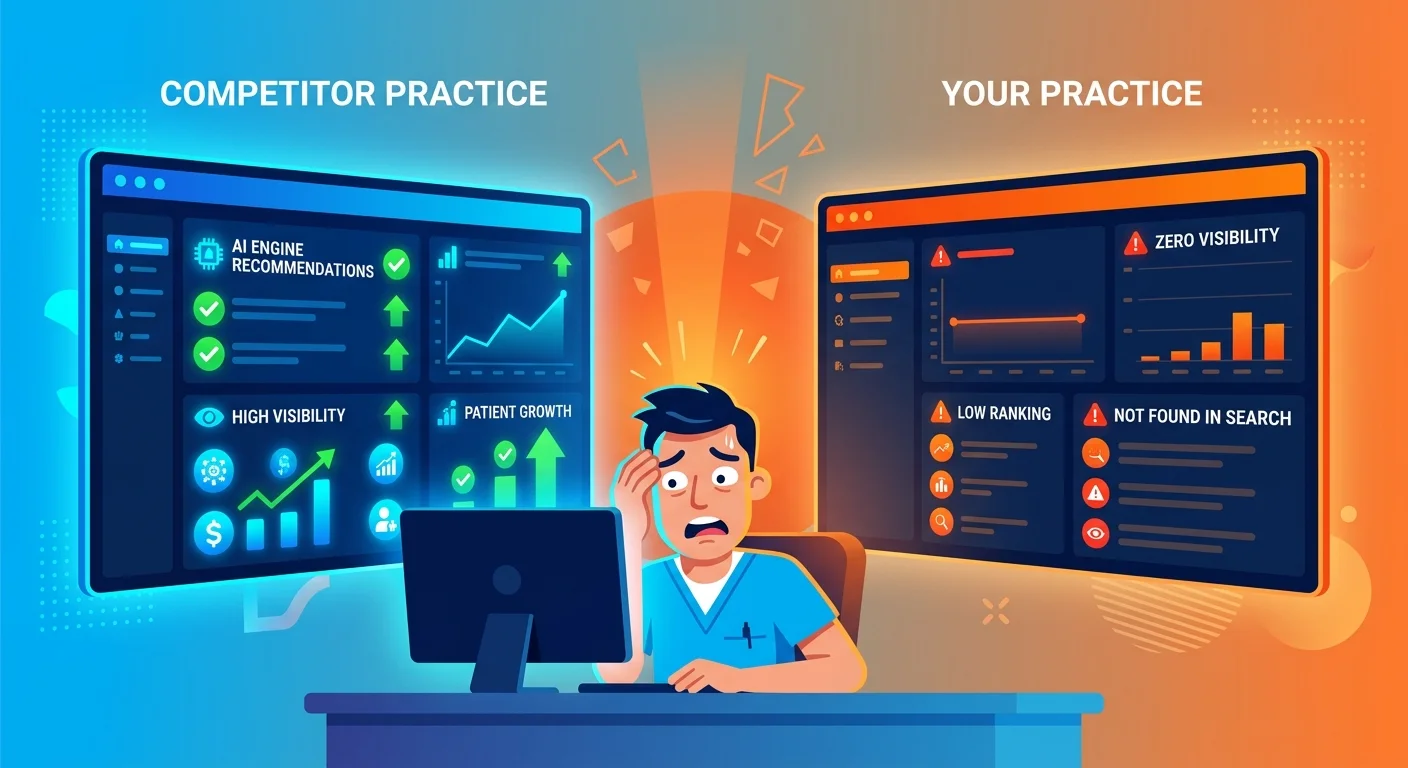
You’re not just invisible.
You’re falling behind while someone else compounds ahead.
Every Month Invisible Is a Compounding Loss
Your competitor fixed their machine readability six months ago.
They’ve been building citation velocity, entity trust, and semantic density ever since.
Every month they publish authority content. Every month their entity gets stronger in AI knowledge graphs. Every month more patients ask AI for a chiropractor and get their name as the answer.
You? You’re still waiting to see if this AI thing is real.
It’s real. And the gap between you and the practices that moved early is widening exponentially.
Authority doesn’t reset monthly. It compounds.
The practices building it today will own AI recommendations in their markets for years.
Waiting isn’t a neutral position. It’s a choice to let someone else take the spot.
Why Patients Trust AI Recommendations More Than Ads
Patients don’t perceive AI recommendations as marketing.
They perceive them as unbiased, evidence-based answers.
When Google shows a paid ad at the top of search results, patients know it’s a paid ad. When ChatGPT recommends a chiropractor by name, patients trust it like they’d trust a referral from a doctor.
Being invisible to AI means being excluded from the highest-trust discovery channel in history.
You can run Facebook ads. You can buy Google Ads. You can send mailers.
None of that changes the fact that when a patient asks AI who to trust, your competitor’s name appears.
Not yours.
Frequently Asked Questions
Is machine readability the same thing as traditional SEO?
No.
Traditional SEO was built for Google’s algorithm in 2015. You optimized keywords, built backlinks, and got on page one of a ranked list.
Machine readability is built for AI answer engines. You structure data so machines understand your entity, trust your authority, and recommend you as the direct answer.
One optimizes for a list. The other optimizes for being the answer.
They’re not variations of the same thing. They’re different paradigms.
What is the difference between a machine-readable website and a mobile-friendly one?
Mobile-friendliness is about visual display. Does your site look good on a phone? Do buttons work? Does text resize?
Machine readability is about structural understanding. Can AI engines parse your entity definitions? Do they trust your Schema markup? Can they map your relationships in their knowledge graph?
A site can be mobile-friendly and completely unreadable to AI. Most are.
Your web designer optimized for humans. AI engines don’t care how your site looks. They care whether the code tells them what your business is.
How does Schema.org help with machine readability?
Schema.org is a standardized vocabulary that machines use to understand content.
Without it, AI reads your “About” page and sees unstructured text. It can’t confirm what you do, where you’re located, or why you’re qualified.
With Schema markup, you explicitly label each element:
LocalBusinessschema → “This is a physical business at this address”MedicalBusinessschema → “This business provides healthcare services”Serviceschema → “This page describes sciatica treatment”Reviewschema → “This is a verified patient testimonial”
Schema removes ambiguity.
It’s the difference between “someone talking about back pain” and “Dr. Smith, a licensed chiropractor in Austin, specializing in sciatica treatment.”
One is vague. The other is citeable.
Can I just add a schema plugin to my WordPress site to fix this?
Plugins can add basic Schema markup. But they can’t create the deep, interconnected entity trust AI engines require for recommendations.
Most Schema plugins generate generic LocalBusiness markup and stop. They don’t build service-level Schema. They don’t connect your entity to external authoritative sources. They don’t structure your content for knowledge graph integration.
True machine readability requires comprehensive authority infrastructure. Not a plugin you install in five minutes.
If a $50 plugin could solve this, every practice would already be visible to AI.
They’re not.
What’s the first step to find out if my practice’s website is machine-readable?
Run a diagnostic.
The AI Visibility Check analyzes what AI engines currently understand – or don’t understand – about your practice.
It shows you:
- Whether your entity is defined in AI knowledge graphs
- Which structured data elements are missing or broken
- How your authority infrastructure compares to competitors in your market
It takes 15 minutes. The results make the problem self-evident.
But doesn’t Google still send most of the traffic?
Yep. For now.
Here’s what “for now” means: by the time the shift is obvious to everyone, the practices that moved early will have already locked in the authority signals AI uses to determine trust.
The brands that own AI recommendations six months from now are building that authority today.
Google traffic isn’t disappearing overnight. But patients are increasingly asking AI directly instead of clicking through search results.
And every month that trend accelerates.
Waiting for the shift to become undeniable isn’t a strategy. It’s a decision to give your competitors a 12-month head start.
Conclusion
Machine readability is the foundation. Nothing else works without it.
You can write the best authority content in your market. You can publish daily. You can get featured in every directory.
If the technical foundation isn’t machine-readable, none of it matters.
Authority content sits on top of infrastructure. Entity trust requires structured data. Citation velocity depends on knowledge graph integration.
Without machine readability, you’re building a mansion on sand.
This isn’t optional. This isn’t “nice to have.” This is the price of admission to AI-driven patient discovery.
Every practice that gets recommended by AI has one thing in common: their technical foundation tells machines who they are, what they do, and why they’re trustworthy.
The AI Visibility Check shows exactly what AI engines see when they scan your practice.
No guesswork. No assumptions. Just a clear diagnostic of whether your infrastructure is built for authority or invisibility.
If the results show you’re invisible, the Post-Check Roadmap walks you through exactly what it takes to close the gap.
If you’re already visible? You’ll know that too. And you can stop worrying about whether your competitors are passing you.
Curious where you stand right now? The AI Visibility Check takes 15 minutes and shows you exactly what ChatGPT, Gemini, and Grok see when they scan your practice. No sales pitch. No pressure. Just a diagnostic that makes the gap – or the opportunity – self-evident. Either your infrastructure tells AI you’re trustworthy, or a competitor’s does. That gap compounds monthly. The check shows you which side you’re on – and what happens if you stay there.