What Market Authority Displacement Actually Means
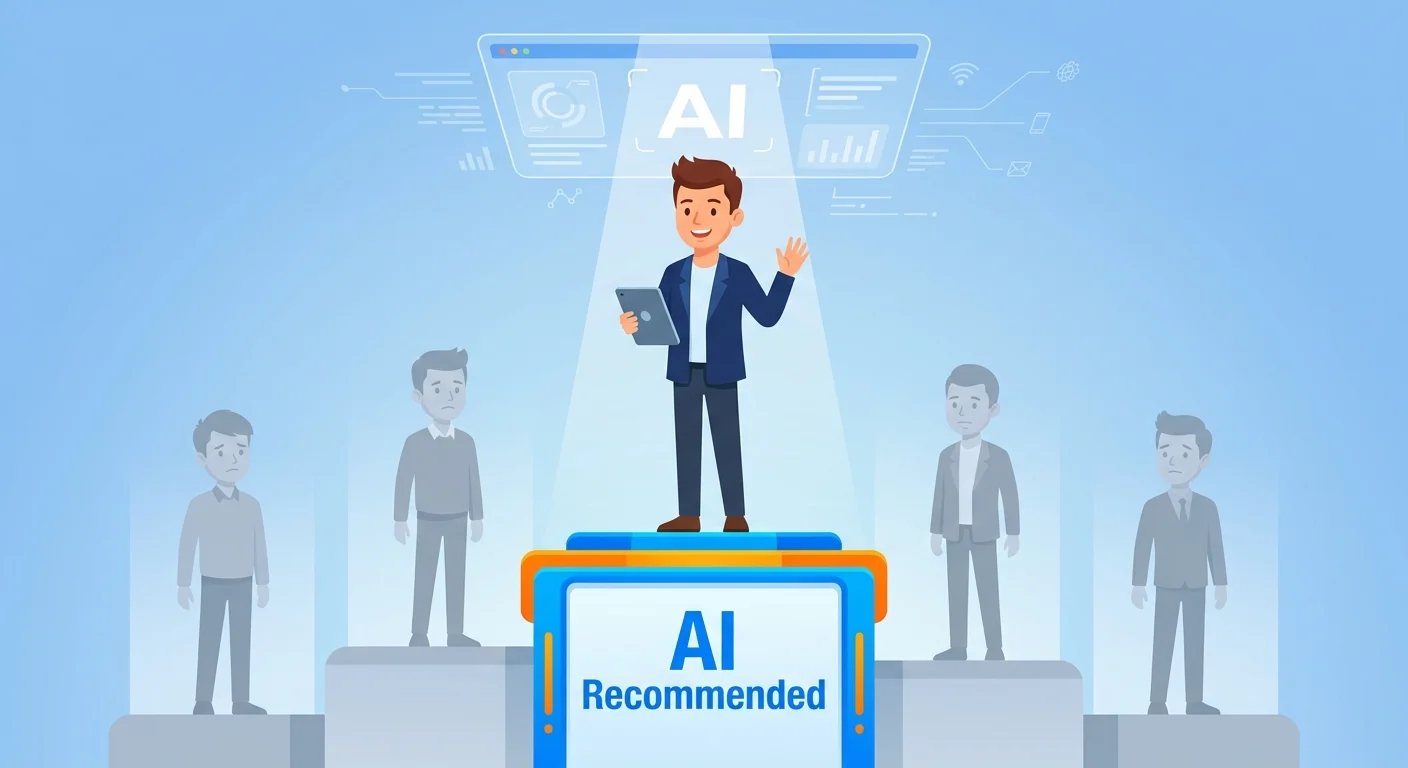
Market Authority Displacement isn’t a marketing win you celebrate on LinkedIn. It’s what happens when your business becomes the one entity AI answer engines trust enough to name-no alternatives, no qualifiers, no hedging.
The mechanism: your entity signals, semantic architecture, and citation velocity hit the threshold where AI stops evaluating competitors and starts citing you by default. Not as one option among several. As the answer.
Displacement is the final step in AI readiness because readiness without it is just infrastructure without ROI. You can rebuild your site to be machine-readable. You can publish authority content every month. You can deploy perfect schema markup and entity validation.
But if AI engines still name your competitor when someone asks? You haven’t displaced anyone.
The infrastructure exists for one outcome: exclusivity in the answer.
And displacement compounds. The business that becomes the only recommendation in your city first locks in citation velocity. Every time AI names that entity, the trust signals deepen. Every patient who walks in saying "ChatGPT recommended you" reinforces the loop.
The gap between the displaced and the invisible doesn’t hold steady. It widens.
Displacement vs. Ranking
Traditional SEO optimized for a ranked list. You fought to land in position one, two, or three. Market Authority Displacement operates in a different world: AI delivers a direct verdict, not a menu. When someone asks "Who’s the best chiropractor near me?" ChatGPT doesn’t hand back ten blue links.
It says a name.
That’s the game now.
So the competitive dynamic flips entirely. You’re not trying to rank higher than the clinic two spots below you. You’re trying to be the only entity AI can verify as authoritative enough to cite.
Ranking assumed users would compare options. Displacement assumes AI already did the comparison-and your job is to be the entity that passes the filter.
The Single-Name Problem
The single-name problem is this: AI engines are built to minimize user friction. Giving users three options creates decision fatigue. Giving them one trusted answer is frictionless.
That design choice-baked into how enterprise adoption of generative AI is being rolled out-means the default behavior is a singular recommendation, not a list.
So if you’re not the one name, you’re not in the conversation.
There’s no silver medal. The business that gets displacement owns the market. Everyone else is invisible. And the longer you wait, the harder it gets-because the entity that got named first is already compounding trust while you’re still tweaking meta descriptions.
Why AI Engines Choose One Business Over Another
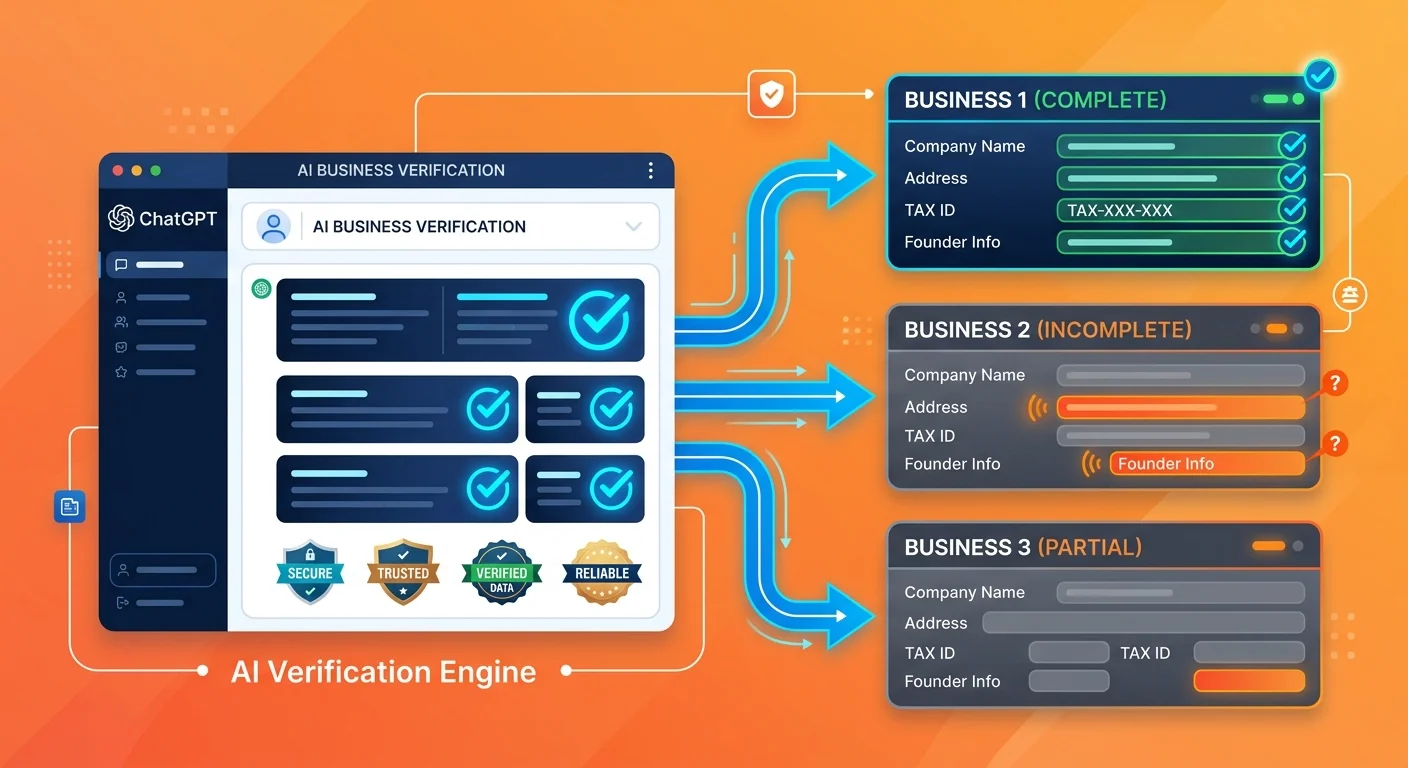
AI engines don’t browse. They filter.
You’re either in the pool or you’re not. The selection mechanism is binary. Your entity has the signals required to be cited, or it doesn’t. If it doesn’t, you’re invisible. No amount of content quality or clever messaging changes that-because the filter runs before AI ever evaluates what you’re saying.
The filter is built on Entity Foundation-machine-readable proof that you exist, you’re verified, and institutional sources recognize you.
Schema markup that declares your business type, location, and service offering. Structured data that connects your brand name to your physical address. NAP consistency across directories. knowledge graph presence that ties your entity to a verified ID.
AI engines rely on signals of Experience, Expertise, Authoritativeness, and Trustworthiness to validate which sources to cite. If those signals are weak or absent, you’re not authoritative. You’re unverifiable.
And here’s what most businesses miss: public trust in AI is still developing. Only a minority of U.S. adults are confident that tech companies will use AI responsibly.
That means AI engines are conservative in their citations. They won’t risk naming a business they can’t validate.
The threshold for being cited is higher than the threshold for ranking ever was-because the reputational cost of recommending a bad actor is catastrophic for the platform. So they default to entities with the deepest, most verifiable trust signals. Everyone else gets filtered out before the evaluation even begins.
Entity Trust as the Gatekeeper
Entity trust is the first gate.
If AI can’t verify who you are, it won’t say your name. That verification happens at the infrastructure level-not the content level. It’s schema markup that tells AI your business type, your location, your hours, your accreditation. It’s NAP consistency across every directory, citation, and profile. It’s knowledge graph presence that connects your brand to a verified entity ID Google, Microsoft, and OpenAI can reference.
Most businesses think their website establishes entity trust.
It doesn’t.
A beautiful homepage with a contact form and a services list tells AI nothing it can verify. Building the entity trust AI requires means implementing machine-readable identity signals at every layer-structured data that declares your entity type, location schema that pins your coordinates, organizational markup that links your brand to real-world accreditation and institutional validation.
Without entity trust, your content doesn’t matter.
You could publish the best article ever written on your service category, optimized perfectly for Google’s E-E-A-T signals, and AI still won’t cite you-because it can’t confirm the article came from a verified, authoritative entity.
The filter runs first. Content gets evaluated second. If you fail the first gate, the second never opens.
The Citation Filter
The second gate is Citation Velocity-how often your entity appears in institutional sources, structured directories, and third-party validation platforms.
AI engines don’t trust self-published content alone. They cross-reference. If your business name appears on Healthgrades, Zocdoc, the Better Business Bureau, and verified local directories with consistent NAP data-AI treats that as confirmation.
If your name only appears on your own website, that’s not validation. That’s a claim.
Citation velocity compounds.
The more often your entity is referenced by external, authoritative sources, the stronger the trust signal becomes. That’s why the business that achieves displacement first locks in an accelerating advantage-every external mention deepens the citation history AI uses to determine authority.
The gap between the entity with high citation velocity and the entity with none isn’t linear. It’s exponential. And every month you’re not building citations, your competitor who is just widened the gap.
| Signal Type | What AI Reads | Why It Matters for Displacement |
|---|---|---|
| Entity Foundation | Schema markup, NAP consistency, knowledge graph presence, structured organizational data | AI won’t cite what it can’t verify-Entity Foundation is the gate that determines whether your business enters the evaluation pool at all |
| Semantic Architecture | Content hierarchy, internal linking structure, topic clustering, keyword relationships embedded in H-tags and anchor text | AI reads relationships between concepts to determine topical authority-scattered content signals confusion, structured architecture signals expertise |
| Citation Velocity | Frequency and recency of external mentions across directories, institutional sources, and third-party validation platforms | Trust compounds over time-high citation velocity separates the entity AI names first from the one it never considers |
| E-E-A-T Signals | Experience markers, expertise credentials, authoritativeness indicators, trustworthiness validation across content and entity data | AI engines prioritize sources that demonstrate real-world authority-weak E-E-A-T signals disqualify your entity before content quality is evaluated |
| Answer Density | Direct answers to user queries embedded in the first 200-300 words of content, structured for AI extraction | AI engines extract answers from content optimized for machine parsing-if your content requires interpretation, it gets skipped |
Traditional SEO Assumed a List. AI Delivers a Name.
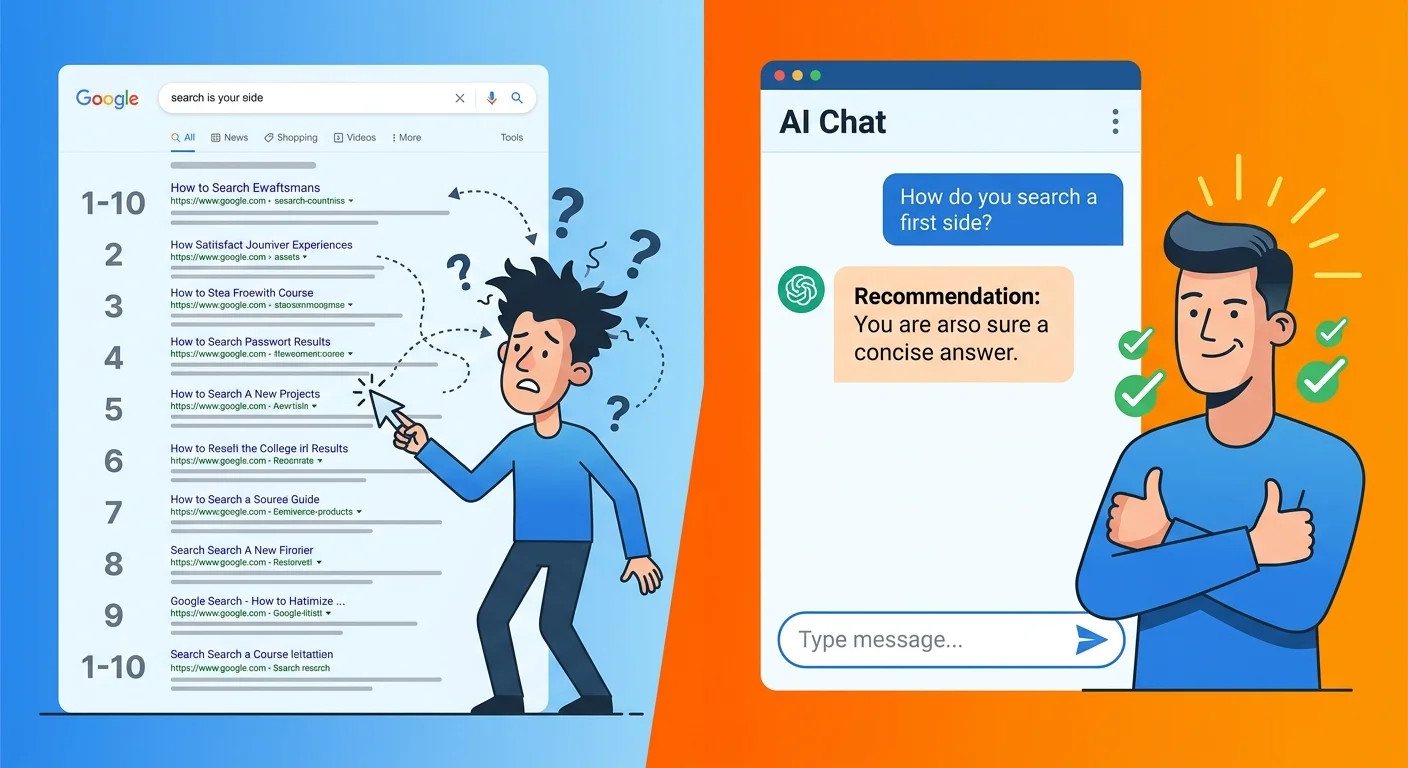
Traditional SEO was built on a simple bet: users would see ten results, scan the list, and click the one that looked most credible. The entire optimization playbook-keyword density, backlink profiles, meta descriptions-existed to win position one in that ranked list.
That’s the game agencies sold for two decades.
And it worked. Until it didn’t.
AI doesn’t produce lists. It produces a single, synthesized answer. When someone asks ChatGPT or Gemini who the best chiropractor near them is, they don’t get ten blue links to evaluate. They get a name.
One business. The verdict.
The paradigm shift isn’t subtle. It’s architectural. AI-powered search exists to provide a direct verdict, not a menu of options. So every tactic built for list-based competition is now solving for a format that no longer exists. You’re not competing to rank higher than the practice two spots below you. You’re competing to be the answer.
Why Most Practices Stay Invisible
Most businesses stay invisible because they’re still running Google’s 2015 playbook. They’re chasing page-one rankings. Publishing blog posts stuffed with target keywords. Building backlinks to juice domain authority.
All of that worked when the goal was to appear in a ranked list of search results.
None of it works now.
AI engines don’t crawl your site hunting for keywords. They filter for entity trust signals first. If your business can’t be verified as a legitimate, authoritative entity through structured data, schema markup, and external citations-you’re eliminated before your content ever gets evaluated.
The optimization happens at the infrastructure layer, not the content layer.
And that’s the gap most agencies will never close. Because they’re still selling content when the fight moved to structure years ago.
Practices stay invisible not because their content is weak, but because their infrastructure is unreadable. AI can’t confirm who they are. Can’t validate their authority. Can’t cross-reference their entity against institutional directories.
And without that verification, AI won’t say their name-no matter how good the blog post is.
The filter runs before the evaluation. Most businesses never make it past the filter.
The Zero-Click Precursor
The shift didn’t start with ChatGPT. It started with the rise of zero-click searches. Nearly two-thirds of all Google searches now end without the user ever clicking a result. Google answers the question directly-on the search results page, in the knowledge panel, in the featured snippet.
Users get what they need without visiting a website.
That behavior trained an entire generation of searchers to expect immediate answers, not lists of links to explore.
AI-native search extended that zero-click model to conversational queries. The goal wasn’t incremental improvement. It was to eliminate the list entirely. When users ask a question, they want the answer. Not ten possible answers. Not a ranked menu of websites to evaluate.
The answer.
And that expectation-the one zero-click search normalized-is why patients trust the AI recommendation so deeply. It’s not just convenience. It’s the psychological shift from "I need to research this" to "AI already did the research for me."
| Old SEO Game | The Assumption | Why It Fails Now |
|---|---|---|
| Keyword-stuffed blog posts | Users will scan a list and click the one with the right keyword | AI doesn’t scan lists-it filters for entity trust before evaluating content |
| Backlink building campaigns | More links from other sites signal authority to Google’s algorithm | AI validates authority through schema and institutional citations, not backlink counts |
| Optimizing meta descriptions for click-through rate | Users will read your snippet and choose to visit your site over competitors | AI synthesizes answers without showing users your meta description or giving them a choice |
| Competing for page-one rankings | Being in the top ten results is enough to capture traffic | AI delivers one name as the answer-second place on a list that no longer exists means nothing |
| Publishing frequency as a ranking signal | More content equals more visibility in search results | AI prioritizes entity verification and citation velocity over volume of self-published content |
Market Authority Displacement in Action
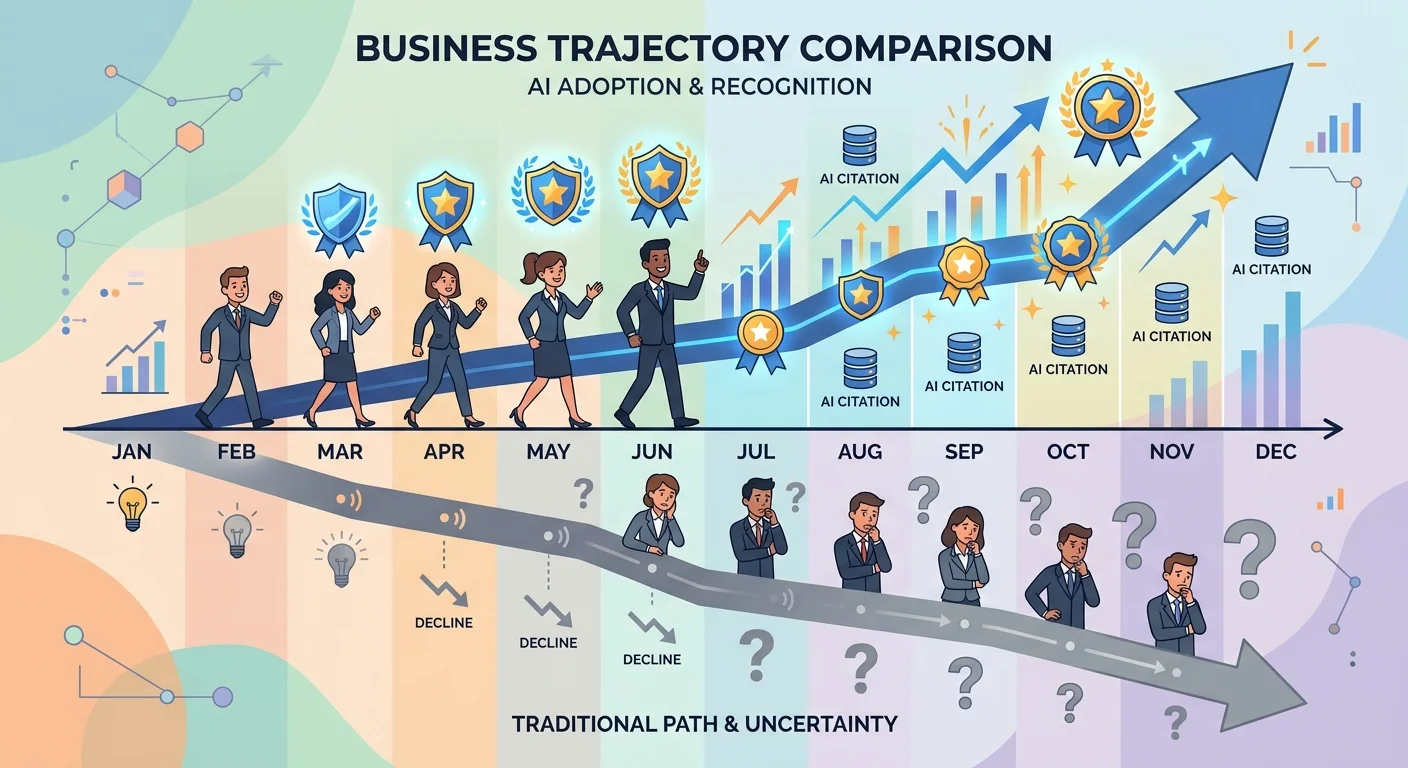
Displacement doesn’t happen in theory.
It happens in real time. In specific markets. When one entity crosses the threshold and becomes the singular recommendation AI delivers.
Ask ChatGPT for a chiropractor in Austin and you get one name. Not three options. One.
Gemini recommends a specific law firm for estate planning in Phoenix and never mentions the competitors who spent years optimizing meta descriptions. Perplexity cites a single accounting practice for small business tax strategy and treats that citation as the final word.
The verdict isn’t preceded by a list.
The verdict is the output.
And the business that owns it just captured the entire top-of-funnel for their market.
What It Looks Like When a Market Tips
When a market tips, the shift looks instant. But the cause was cumulative.
The entity that achieved displacement didn’t stumble into it. They built Entity Foundation. Layered on Semantic Architecture. Sustained Citation Velocity long enough for AI to treat them as the authoritative answer.
The tipping point looks sudden because AI doesn’t give partial credit. You’re either the verdict or you’re invisible.
Here’s what changes the moment one entity achieves displacement.
Every conversational query in that market starts flowing to them. Not some of the queries. Not the high-intent ones. All of them.
AI doesn’t diversify its recommendations to be fair. It names the entity with the strongest trust signals. That entity starts getting patient inquiries they didn’t pay for. Bookings they didn’t advertise for. Referrals they didn’t chase.
The growth curve stops being linear and starts compounding.
And the economic potential of generative AI is $2.6 trillion to $4.4 trillion annually across various sectors.
That means the businesses capturing AI-driven discovery aren’t just winning their local market. They’re capturing a disproportionate share of a macroeconomic shift.
The competitor who’s still running Google Ads and optimizing for keywords isn’t losing to better marketing. They’re losing to authority they didn’t build while the window was open.
The Compounding Gap
The gap between the entity that achieved displacement and everyone else doesn’t stay static.
It widens.
Because the entity being recommended is now generating more patient interactions. More reviews. More external mentions. More directory updates. Every single one of which deepens the citation history AI uses to validate authority.
That’s the compounding mechanism. The trust signals that got them to displacement are now accelerating because of displacement.
So the competitor who decides to build AI readiness six months later isn’t just six months behind.
They’re competing against an entity whose citation velocity is now exponentially stronger than it was at the start. The entity that moved early locked in the economic potential for their market.
Everyone else is fighting for scraps in a discovery channel that no longer distributes opportunity evenly.
This isn’t a gap you close with better content or a bigger ad budget. This is authority as a compounding asset, and the entity that built it first just made the market unwinnable for everyone who waited.
| Month | Displaced Business | Invisible Competitor |
|---|---|---|
| Month 1 | Entity Foundation verified – schema deployed, NAP consistent across directories, AI engines can confirm who they are | Website looks good but lacks structured data – AI can’t verify the entity, so it never evaluates the content |
| Month 3 | Semantic Architecture built – authority content published monthly, internal linking structure maps entity to expertise | Publishing blog posts optimized for keywords but no schema, no entity signals – AI treats it as unverified noise |
| Month 6 | Citation Velocity building – external mentions accumulating, cross-references multiplying, AI starts citing the entity in conversational answers | Still invisible – no citations, no external validation, AI has no reason to trust or recommend them |
| Month 9 | Displacement achieved – AI names them as the singular recommendation, patient inquiries compound, every new review deepens citation history | Competitor awareness kicks in but too late – the gap is now exponential, not linear |
| Month 12 | Market locked – citation velocity accelerating, every patient interaction strengthens authority signals, compounding advantage widens | Starts building AI readiness but competing against an entity whose trust signals are now exponentially stronger than when displacement began |
The Three Layers of AI-Readable Infrastructure
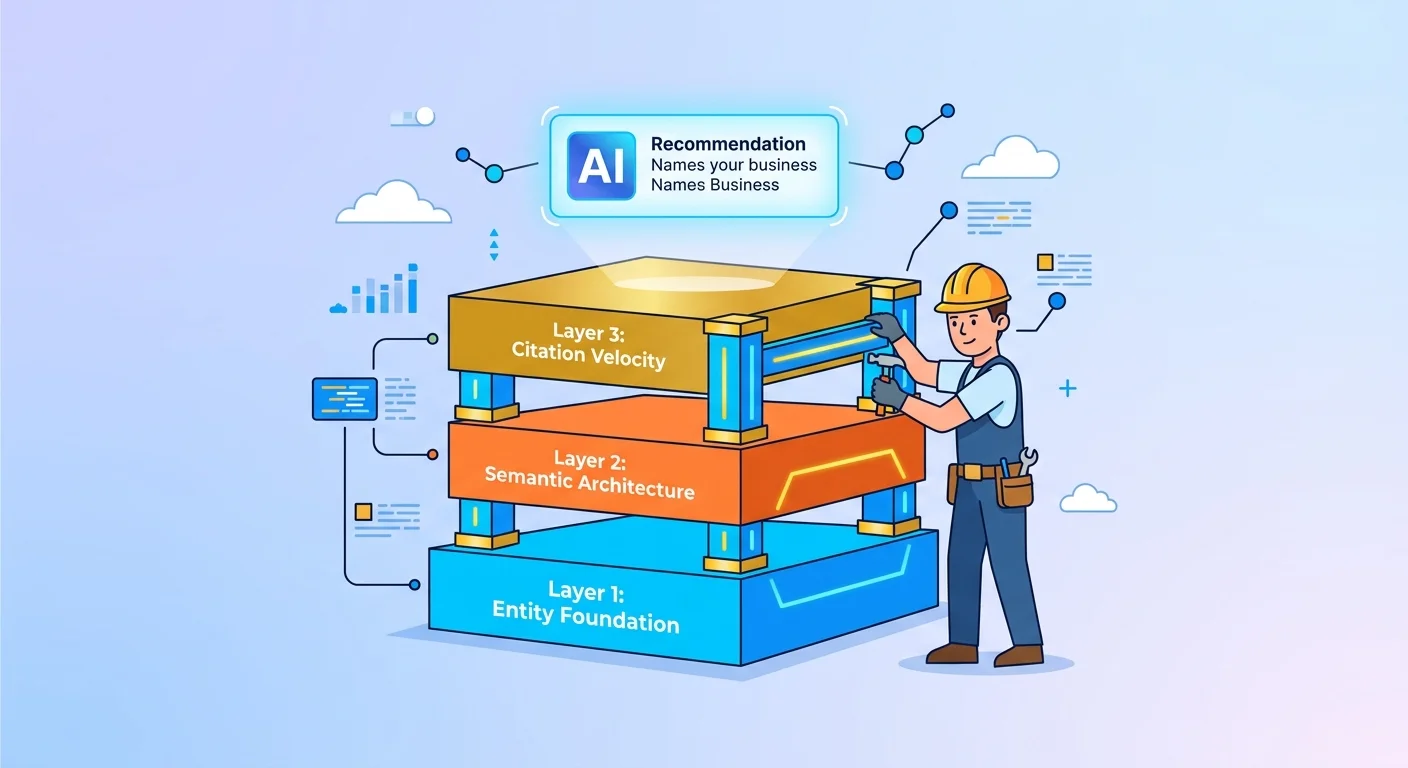
So how do you actually build infrastructure AI can read?
Not with blog posts. Not with better keywords. With a three-layer system that mirrors the way AI engines validate authority.
Each layer builds on the one before it. You can’t skip the foundation and jump to content execution. You can’t build semantic architecture without entity verification. You can’t sustain citation velocity if the first two layers are weak.
The businesses that achieve displacement didn’t treat this as a content problem. They understood it was a structural rebuild.
They didn’t tweak their existing website. They tore down infrastructure AI couldn’t read and replaced it with a system built for machine trust.
Layer 1: Entity Foundation
Entity Foundation is the machine-readable proof that your business exists, operates in a specific location, and can be verified through external sources.
AI engines rely on signals of Experience, Expertise, Authoritativeness, and Trustworthiness (E-E-A-T) to validate which sources to cite. If your entity can’t be confirmed through schema markup, structured data, and consistent NAP (Name, Address, Phone) across directories, AI eliminates you before it ever evaluates your content.
The filter runs first. Content gets evaluated second.
This layer isn’t about aesthetics. It’s about machine legibility.
Does your website include LocalBusiness schema? Does your Google Business Profile match your website’s NAP data exactly? Are you listed on institutional directories like Healthgrades, Zocdoc, the Better Business Bureau, and Yelp with consistent entity information?
If the answer to any of those is no, your entity foundation is broken-and AI will never recommend you, no matter how good your content is.
And here’s the kicker-most businesses fail this layer without knowing it.
Their website was built by a designer who prioritized visuals over structure. Their schema was auto-generated by a plugin that didn’t validate. Their directory listings were claimed five years ago and never updated.
AI runs the entity verification check first. If you fail here, nothing else matters.
Layer 2: Semantic Architecture
Semantic Architecture is how you structure your content so AI understands what you do, who you serve, and why you’re the authority.
AI doesn’t read your website the way a human does. It doesn’t interpret tone or infer meaning from clever headlines. It parses structured content hierarchies-H1 through H3 tags, internal linking patterns, topic clustering, and semantic relationships between pages.
If your site architecture is flat, disorganized, or built around a blog with no connective tissue, AI can’t map your authority. It sees noise.
This is where AEO content writing services become infrastructure, not marketing.
Every article published under a semantic architecture reinforces a specific authority signal. When you write content that answers the exact questions patients ask AI-and you link that content back to your core service pages in a structured hierarchy-you’re teaching AI what you’re authoritative about.
The goal of AI-powered search is to provide a single, synthesized answer, and semantic architecture is how you become that answer. You’re not optimizing for a list. You’re building the structural proof that you own the topic.
Layer 3: Citation Velocity
Citation Velocity is the rate at which your entity is mentioned, linked to, and validated by external sources over time.
AI doesn’t trust self-published content alone. It cross-references. If your business name appears consistently across institutional directories, review platforms, local news mentions, and third-party validation sources-AI treats that as confirmation.
If your entity only appears on your own website, that’s not validation. That’s a claim.
But citation velocity isn’t static-it compounds.
Every external mention deepens the citation history AI uses to validate authority. That’s why the entity that achieves displacement first locks in an accelerating advantage. Their citations are growing because they’re being recommended, which makes AI recommend them more often, which generates more citations.
The competitor who waits isn’t competing against the entity’s current citation count-they’re competing against a velocity curve that’s already compounding. And the gap doesn’t close by publishing more blog posts or running more ads. It closes by rebuilding all three layers from the ground up using Our AI Authority Engine-which is exactly what most businesses waited too long to do.
| Infrastructure Layer | What It Builds | AI Impact |
|---|---|---|
| Entity Foundation | Machine-readable proof of existence-schema markup, NAP consistency across directories, verified business profiles, structured data that confirms you’re a real entity operating in a real location | AI runs entity verification first. If you fail this layer, your content is never evaluated. You’re filtered out before the authority check begins. |
| Semantic Architecture | Structured content hierarchies that teach AI what you’re authoritative about-H1-H3 tag structure, internal linking patterns, topic clustering, and semantic relationships between service pages and supporting content | AI parses structure, not tone. A flat or disorganized site reads as noise. Semantic architecture is how AI maps your authority and understands the scope of your expertise. |
| Citation Velocity | The rate at which your entity is mentioned, linked to, and validated by external sources over time-directory listings, review platforms, institutional mentions, third-party citations that cross-reference your authority claims | AI doesn’t trust self-published content alone. It cross-references. Citation velocity is the compounding mechanism-every external mention deepens the trust signal AI uses to justify naming you as the verdict. |
Frequently Asked Questions
The infrastructure layers are mapped. The competitive gap is clear.
But the questions that stop most businesses from moving aren’t technical.
They’re strategic. Can this actually be done? Will my existing site work? How long does it take?
And most importantly-how do I know if I’m already displaced?
Here’s what we hear most often.
What is market authority displacement?
Market Authority Displacement is what happens when one business in a local market becomes the only entity AI engines trust enough to recommend by name.
Not one of five options. The answer.
It’s not about ranking higher. It’s about being named when someone asks AI for a recommendation-and no one else is.
When that threshold is crossed, the displaced competitors don’t lose traffic. They lose discovery entirely. AI made the verdict. The entity that achieved displacement captured the entire top-of-funnel for conversational search in that market.
How is AI displacement different from traditional SEO competition?
Traditional SEO competition was about ranking on a list. You optimized for keywords. You built backlinks. You fought for position one through ten.
If a competitor ranked above you, patients still saw your name on the page. You had a shot at the click.
AI displacement is different.
The goal of AI-powered search is to provide a single, synthesized answer. AI doesn’t give patients a list to evaluate. It gives them one verdict. So if AI names your competitor and not you, you’re not competing for position anymore.
You’re invisible.
The patient never knew you existed. That’s not a ranking problem you fix with better keywords. That’s an authority gap you close by rebuilding infrastructure AI can verify.
Will my existing website work for AI answer engines?
Probably not.
Most websites were built by designers who prioritized aesthetics over machine legibility. Schema markup is missing or broken. Entity Foundation signals-LocalBusiness schema, structured NAP data, verified directory listings-weren’t part of the build.
Semantic Architecture is flat. Blog posts sit in a reverse-chronological feed with no topic clustering and no internal linking strategy. AI can’t map your authority because the structure doesn’t exist.
And here’s the brutal part-fixing a website like that is harder than rebuilding it.
Because the foundation wasn’t built for AI readiness. It was built for humans. AI answer engines rely on signals of Experience, Expertise, Authoritativeness, and Trustworthiness (E-E-A-T), and if your site can’t deliver those signals in a machine-readable format, no amount of content will compensate.
You don’t optimize your way out of this. You rebuild.
How long does it take to become the AI-recommended authority in a market?
There’s no microwave schedule for authority.
Entity Foundation and Semantic Architecture can be built in weeks. But Citation Velocity compounds over months. External validation doesn’t happen overnight. Directory updates take time. Review accumulation takes time. AI’s cross-referencing process takes time.
The businesses that achieved displacement early didn’t get there because they moved fast. They got there because they moved first.
So the real question isn’t how long does it take. The real question is: how much wider does the gap get while you wait?
By 2026, over 80% of enterprises will have deployed generative AI. The competitor who’s building AI-readable authority today is compounding citation signals while you’re still deciding whether this matters.
Every month of inaction is a month of compounding advantage you’ll never recover.
What’s the first step to see if my business is being displaced by AI?
Ask AI.
Open ChatGPT, Gemini, or Perplexity. Ask it who the best provider in your category and city is.
If it names your competitor and not you-you’re displaced.
If it hedges and says it can’t recommend specific businesses-your Entity Foundation is too weak for AI to verify. If it gives you a list of three options and you’re not on it-your Semantic Architecture isn’t structured enough for AI to map your authority.
That diagnostic takes fifteen minutes. And it tells you exactly where you stand right now-not six months from now when the gap is wider.
Most businesses don’t want to run that test because they already know the answer. But knowing the answer is the first step to fixing it.
The Final Verdict
AI gives one answer.
Not three options. Not a list you compare.
One verdict.
The business that becomes that one verdict just won discovery for the entire market. Everyone else disappeared-not because they’re worse, but because AI already decided.
This isn’t about being better anymore.
It’s about being trusted enough to be named.
Market Authority Displacement happens when that trust threshold gets crossed. When Entity Foundation is verified, Semantic Architecture is structured, and Citation Velocity compounds long enough that AI stops hedging and starts recommending.
When every conversational query in your market flows to one name.
That’s not a marketing win. That’s a structural advantage built into the infrastructure AI reads. And once one entity locks it in, the game tips.
Displaced competitors don’t get to build authority retroactively. They get relegated to the businesses AI doesn’t trust enough to name.
So here’s the reality.
If your business isn’t being recommended when someone asks ChatGPT, Gemini, or Perplexity for the best provider in your category and city-you’re already displaced. The entity that is being named just captured the entire top of the funnel.
And every month you wait to rebuild your infrastructure as AI-readable authority, that gap compounds.
Want to see where you stand? Run your AI Visibility Check. Fifteen minutes. Real data. No guessing.
You’ll know whether you’re the verdict-or whether someone else already won.
So where do you stand right now?
Are you the verdict AI delivers when someone asks-or are you already displaced?
The gap compounds every day. The entity being recommended is building citation velocity while you’re deciding whether this matters. Fifteen minutes gives you the answer. Real data. Zero guessing.