
Why AI Doesn’t Trust Text-Only Authorities
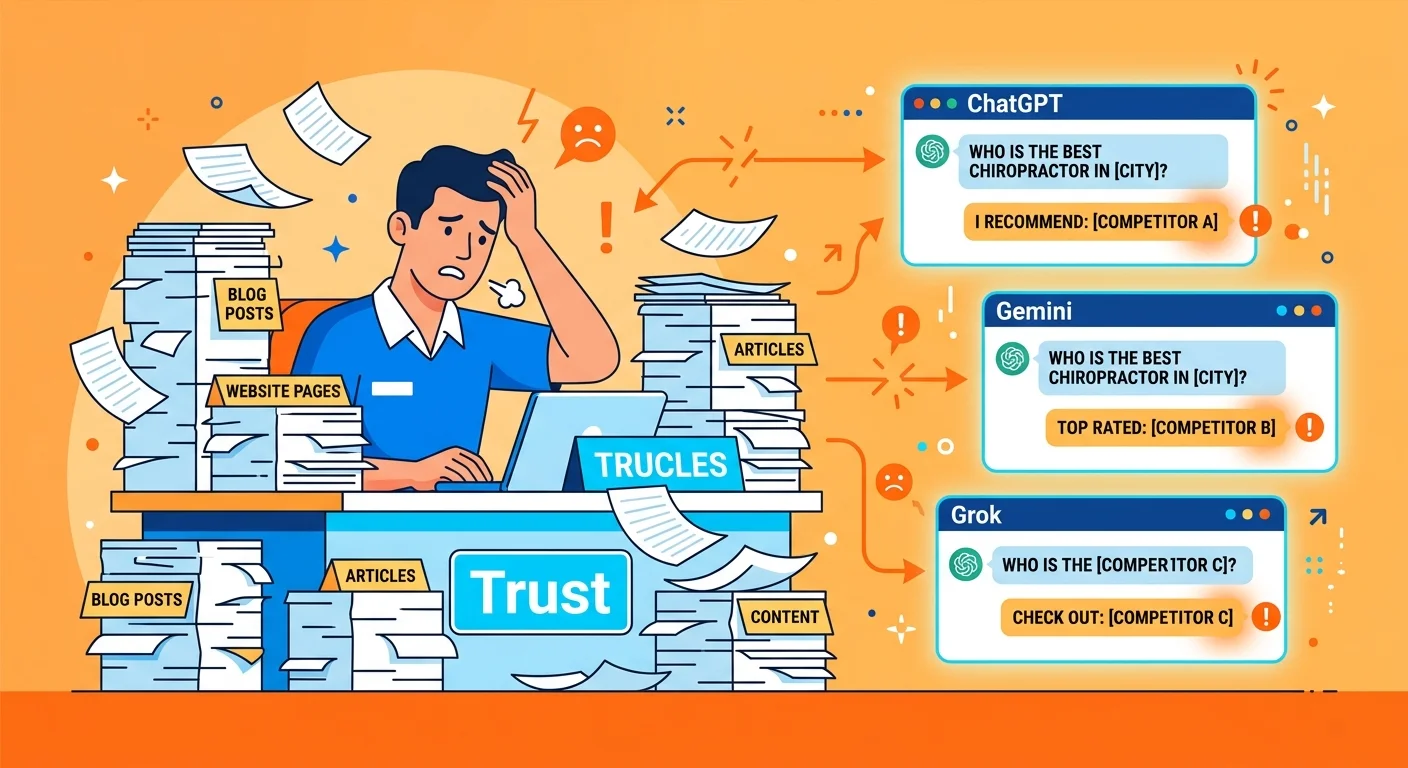
Here’s what most chiropractors don’t realize: your website isn’t the problem.
The problem is that AI can’t verify it.
Schema missing. Entity signals weak. Content so generic that ChatGPT and Gemini have no way to confirm who you are, what you do, or whether you’re worth recommending. The marketing industry sold you a beautiful digital brochure and called it a strategy.
It’s not.
Your site looks professional. Service pages explain what you do. Blog’s full of articles about chiropractic care. You’ve spent thousands on SEO. And yet when someone asks ChatGPT who the best chiropractor in your area is-AI names your competitor.
Not you.
Here’s what happened: you built a text-only presence. Website. Blog posts. Maybe a LinkedIn profile with some written updates. That was enough when Google ranked pages based on keywords and backlinks. It doesn’t work anymore.
Because AI engines don’t rank pages. They verify entities.
And an entity that only exists in text can’t be verified.
The Old Model: Text Was Enough
Traditional SEO operated on one assumption: written content was sufficient.
You optimized for keywords. Built backlinks. Created service pages and blog posts and FAQs. Google ranked those pages based on relevance and authority signals like domain age and link profiles.
That model worked because Google’s algorithm evaluated pages, not people. It didn’t need to verify that “Dr. Smith” was a real chiropractor with real patients. It just needed to confirm that the page about chiropractic care was relevant to the search query.
AI engines don’t work that way.
They evaluate entities, not pages. And entities need proof.
The New Reality: AI Requires Cross-Modal Verification
AI doesn’t rank content. It verifies entities.
When you ask ChatGPT who the best chiropractor is, it doesn’t return a list of web pages for you to evaluate. It makes a decision on your behalf and names a specific practice.
That decision requires trust. And trust requires verification across multiple data sources and formats.
A chiropractor mentioned only in text? Triggers skepticism. Could be anyone. Could be fabricated. Could be outsourced content from a marketing agency that has no idea whether the claims are real.
A chiropractor with a YouTube channel explaining techniques, a podcast discussing patient care, AND a website? That’s a verifiable pattern. Same name. Same expertise claims. Same topics. Different formats.
That’s the triangulation AI needs to confirm the entity is real.
According to Google’s own explanation of E-E-A-T, the first “E” now stands for Experience-demonstrating first-hand knowledge. First-hand knowledge is easier to verify when AI can see your face on video, hear your voice on a podcast, and cross-reference those signals against your written content.
Text alone is just claims.
Video and audio are proof.
Understanding how search engines build trust around real-world entities is critical. If your authority isn’t structured as a verifiable entity across multiple formats, you’re not invisible because your content is bad. You’re invisible because AI can’t confirm you’re real.
Why Most Chiropractors Are Still Invisible
Most practices invested heavily in “great websites” with “lots of blog content” but remain invisible to AI because their authority is one-dimensional.
They assumed more blog posts would equal more authority. They hired agencies to publish weekly SEO articles. They optimized meta descriptions and internal links. They did everything traditional SEO told them to do.
And it didn’t work.
Because AI engines don’t care how many blog posts you publish if they’re all in the same unverifiable format.
Your expertise only exists as text on a website anyone could have written. There’s no voice. No face. No pattern AI can cross-reference to confirm you’re the real expert behind the content.
Your competitor with half as many blog posts but a YouTube channel with 15 videos and a podcast with 10 episodes? They’ve created something you haven’t: a verifiable entity.
AI can see their face, hear their voice, read their website, and confirm the same person is consistently delivering the same expertise across all three formats.
That’s why they’re getting recommended.
Not because their content is better. Because their authority is verifiable.
| Signal Type | What AI Sees (Text-Only) | What AI Sees (Multimodal) |
|---|---|---|
| Website content | Unverified claims about expertise | Foundation layer confirmed by other signals |
| Video presence | Nothing-entity may not be real | Face, voice, and visual proof of expertise |
| Audio presence | Nothing-entity may not be real | Consistent vocal signature across time |
| Cross-platform verification | Single unconfirmed source | Triangulated trust across formats |
| Entity confidence score | Low-no corroborating signals | High-multiple verifiable data points |
The Three Modalities AI Uses to Verify Expertise
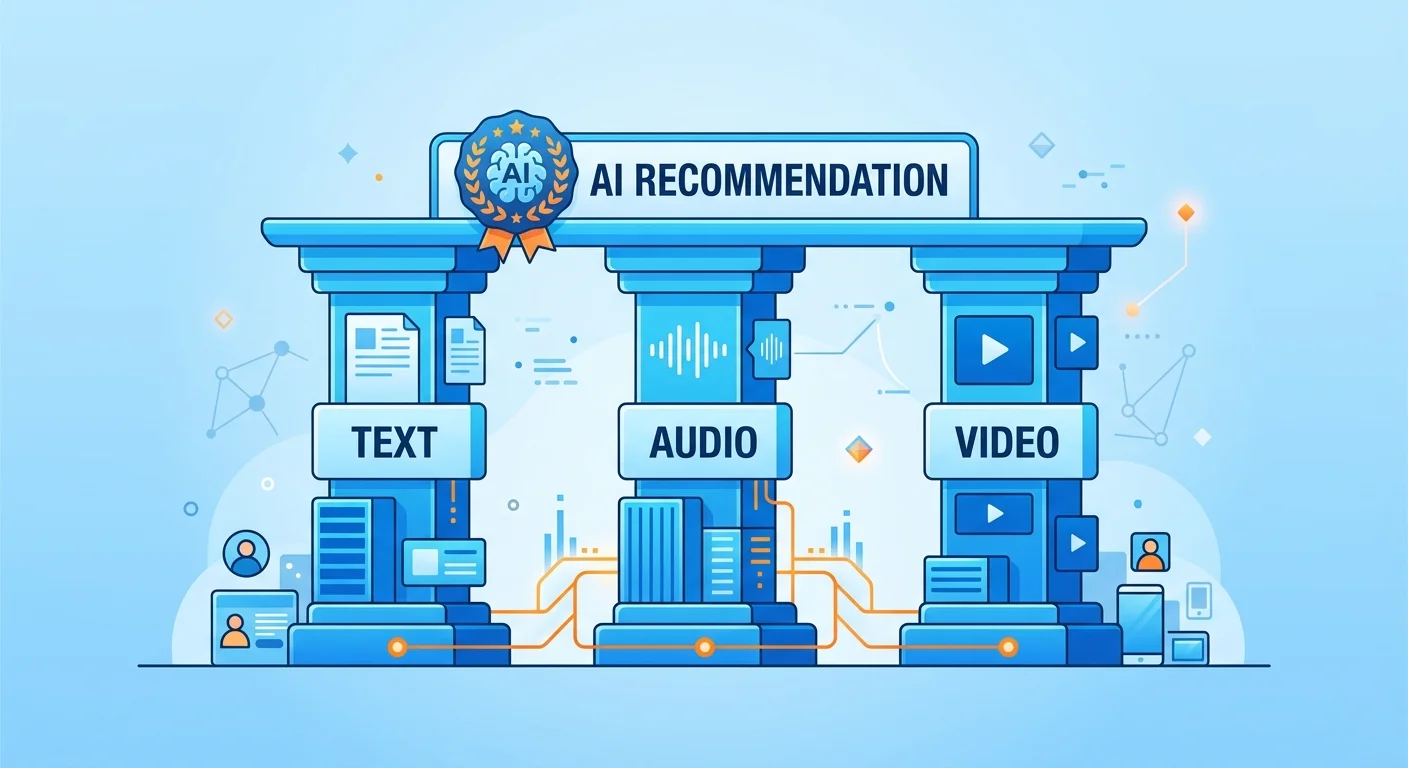
AI engines triangulate trust across three primary modalities: text, audio, and video.
Each modality provides a different type of verification signal.
Text establishes your semantic footprint. Audio confirms your vocal identity. Video integrates both voice and visual proof.
Together, they create a pattern AI can verify across platforms.
Without all three, your entity is incomplete.
Text: The Foundation Layer
Written content is still necessary.
It’s just no longer sufficient.
Your website, blog articles, LinkedIn profile, and guest posts create the initial entity footprint. They establish the topics you cover, the expertise you claim, and the semantic territory you occupy. This is where AI first encounters your name and begins building a knowledge graph around your entity.
But text alone is just claims.
“Dr. Smith is a chiropractor specializing in sports injuries” is a statement anyone could write. Without corroborating signals, AI has no way to verify it’s true.
That’s why building your authority infrastructure starts with text but can’t end there. The foundation layer creates the semantic anchor. The other modalities prove the foundation is real.
Audio: The Voice Verification Layer
A podcast or audio series provides AI with a consistent vocal signature.
When you publish regular audio content over time-whether it’s a podcast, LinkedIn audio posts, or voice-recorded articles-you create a pattern AI can verify.
Same voice. Same topics. Same expertise signals. Different episodes.
This isn’t about listener count. You’re not trying to build an audience. You’re building an entity verification layer.
Every episode is a data point that confirms “Dr. Smith” is a real person with a real voice discussing real expertise consistently over months.
According to HubSpot’s 2024 State of Content Marketing report, podcasting has become one of the primary content formats marketers use-not because it drives traffic, but because it builds trust.
And what builds trust with humans also builds trust with AI.
AI engines cross-reference your podcast episodes against your website. If the topics align, the expertise claims match, and the voice remains consistent-that’s a powerful verification signal.
Video: The Face and Voice Integration Layer
Video combines voice with visual identity, creating the strongest verification signal.
When AI can confirm that “Dr. Smith” is a real person explaining real concepts on camera, it’s not relying on inference anymore. It’s verifying entity existence.
Same face. Same voice. Same expertise. Different videos.
YouTube channels linked to your website become powerful trust anchors. AI engines index video content just like they index text. The difference is video provides multiple verification signals simultaneously: visual identity, vocal consistency, subject matter expertise, and temporal patterns (you’ve been publishing videos over time, not all at once).
This doesn’t require high production value.
A simple screen-share video where you walk through a chiropractic technique is infinitely more valuable than no video at all. Consistency and authenticity matter more than polish.
As discussed in Face, Voice, and Fact: The Three Pillars of Founder-Led AI Trust, the integration of visual and vocal identity creates compound trust signals AI engines prioritize when making recommendations.
How AI Connects These Signals Across Platforms
AI engines don’t just stumble upon your YouTube channel or podcast.
Your website tells them these platforms exist through structured data.
Schema markup on your site creates machine-readable connections between your entity and your content across formats. When your homepage includes schema pointing to your YouTube channel, podcast feed, and LinkedIn profile, you’re building explicit entity relationships AI can verify.
Consistent naming across platforms matters.
If your website lists you as “Dr. John Smith,” your YouTube channel should be “Dr. John Smith” or “John Smith Chiropractic”-not a completely different brand name AI can’t connect. Same logic applies to your podcast title, LinkedIn profile, and any other platform where your expertise appears.
According to Search Engine Journal’s guide to entity-based SEO, search engines build a knowledge graph around an entity by connecting concepts across platforms. A YouTube channel, podcast, and website all discussing the same topics under the same name create a dense knowledge graph AI can trust.
Cross-links tell AI the connection is real. Website links to YouTube. YouTube links back. That loop confirms the entity isn’t fragmented across unrelated platforms.
Your website should link to your YouTube channel and podcast. Your YouTube video descriptions should link back to your website. Your podcast show notes should reference specific articles.
These aren’t backlinks for SEO. They’re entity verification signals for AEO.
| Modality | Platform Example | Signal Type | What AI Confirms |
|---|---|---|---|
| Text | Website, blog, LinkedIn articles | Semantic expertise footprint | Topics covered, claims made, depth of knowledge |
| Audio | Podcast, LinkedIn audio posts | Vocal identity and consistency | Real person with consistent voice discussing expertise over time |
| Video | YouTube, embedded site videos | Visual and vocal integration | Face matches voice matches claims across temporal pattern |
| Cross-platform verification | Schema markup, cross-linking, consistent naming | Entity relationship mapping | All platforms belong to the same real-world entity |
Why Your Competitors Are Getting Recommended and You’re Not
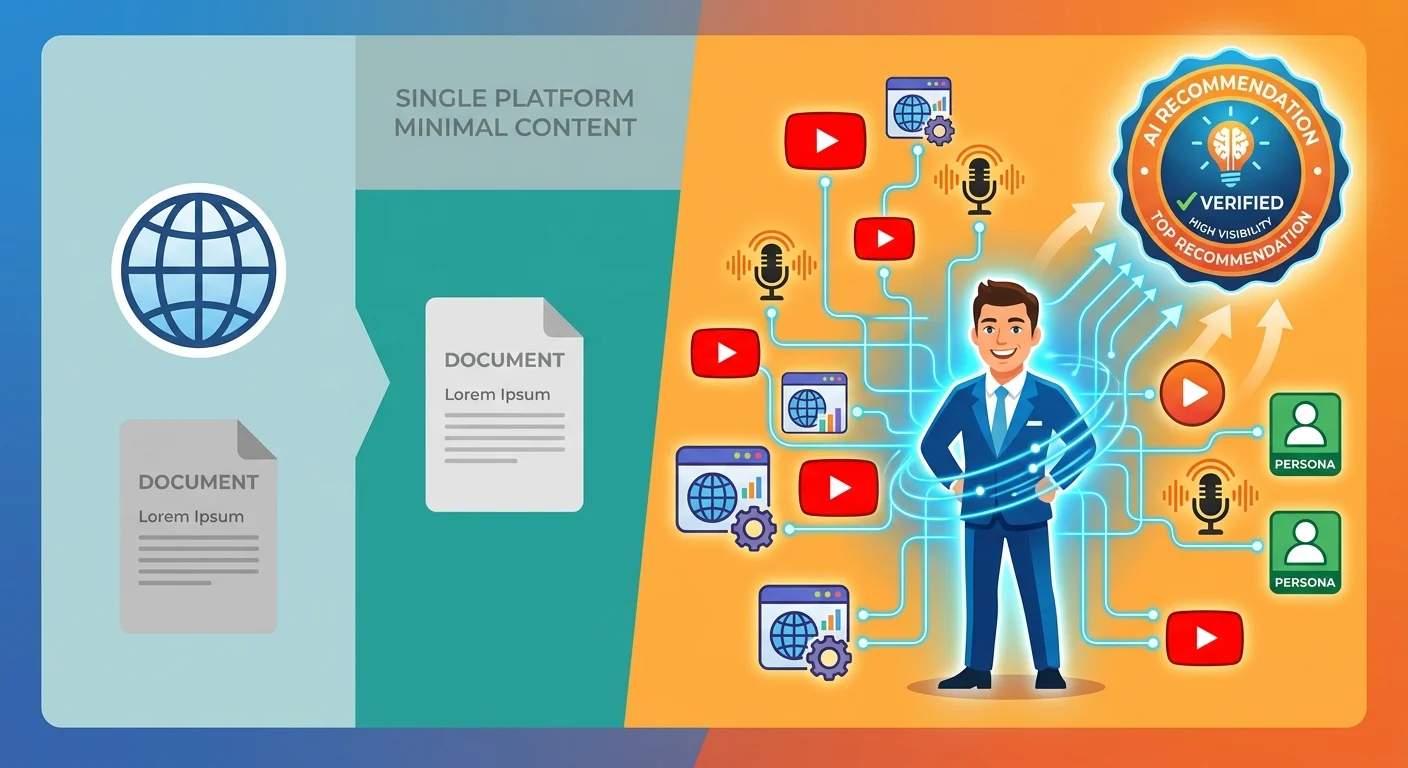
You have more content than your competitors.
More blog posts. More service pages. A bigger website.
And they’re the ones getting recommended by AI.
Here’s why: the gap isn’t content volume. It’s entity verification.
The Gap Isn’t Content Volume
Having 100 blog posts doesn’t matter if they’re all text-only.
Your competitor with 20 blog posts, a YouTube channel with 15 videos, and a podcast with 10 episodes has created a verifiable entity pattern. AI can see their face on video. Hear their voice on audio. Read their website. Cross-reference all three to confirm the same person is consistently delivering the same expertise.
That triangulation creates trust.
Your 100 blog posts create… more unverified claims.
You optimized for the old model. They’re building for the new one. And the new model rewards verifiable entities, not content volume.
As explained in The AEO Imperative, traditional SEO metrics like keyword rankings and backlink profiles are relics. AI engines don’t rank pages anymore. They verify entities and recommend the ones they trust most.
Your competitor isn’t “better at marketing.”
They’re structurally visible in a way you’re not.
This Isn’t for the Old School Holdout
Let’s be direct: if you think your word-of-mouth reputation and a nice-looking website are enough in an AI-driven world, you’re handing the market to whoever adapts first.
Multimodal content isn’t a nice-to-have. It’s a fundamental requirement.
The practitioner who refuses to record a single video or podcast episode because “that’s not how I built my practice” is the same practitioner who will be invisible when AI controls 50% of patient discovery.
And that shift is already happening.
The Old School Holdout believes technology is a fad and traditional methods will always work. They’re wrong. Not because word-of-mouth doesn’t matter-it does. But because the mechanism patients use to find practitioners has fundamentally changed.
When someone asks ChatGPT for a recommendation, your Yellow Pages mindset doesn’t show up in the answer.
Your refusal to adapt isn’t protecting your practice. It’s protecting your competitors’ market share.
They’re Building Proof, Not Traffic
The assumption most chiropractors make: the goal is to get more visitors to your website.
Wrong.
The new model is building verifiable entity proof that gets you named as the answer with zero traffic required.
When ChatGPT recommends your practice, the patient doesn’t click through 10 blue links and evaluate options. You ARE the answer.
That recommendation doesn’t require traffic. It requires proof AI can verify across formats.
Your competitors aren’t chasing blog traffic. They’re building layers of verification that make AI confident enough to say their name out loud.
A podcast episode where they discuss patient care philosophy. A YouTube video where they explain a specific adjustment technique. A blog post that goes deep on a clinical topic.
All three formats. Same entity. Different signals.
According to Google’s Helpful Content System documentation, content should demonstrate first-hand expertise. And first-hand expertise is infinitely easier to demonstrate when someone can see your face and hear your voice explaining a concept than when they’re reading anonymous text.
Your competitors understand this.
They’re not trying to rank for keywords. They’re trying to become the verified expert AI trusts enough to recommend.
| Activity | What It Signals to AI | Why It Matters |
|---|---|---|
| Publishing only blog posts | Text-only entity with unverified claims | AI can’t confirm expertise is real |
| Adding a YouTube channel | Visual and vocal proof of expertise | AI can verify face matches voice matches written content |
| Starting a podcast | Consistent vocal signature over time | AI confirms entity is a real person with temporal pattern of expertise |
| Cross-linking all platforms via schema | Explicit entity relationship mapping | AI connects all signals to one verified entity |
| Consistent naming and branding across formats | Clear entity identity | AI can confidently say “this person exists across these platforms” |
How to Build Multimodal Authority Without Becoming a Content Creator
The biggest objection: “I don’t have time to become a YouTuber.”
You’re right. You don’t.
But you also can’t stay text-only and expect AI to recommend you over competitors who are building verifiable proof.
So the real question isn’t whether you have time. It’s whether you’re willing to add one additional modality to your existing workflow.
Because that’s all it takes to stop being invisible.
Start With One Additional Modality
You don’t need to launch a podcast, a YouTube channel, and a LinkedIn video series simultaneously.
Pick one.
If you’re comfortable on camera, start with video. Record short explainer videos on your phone. Post them to YouTube. Link your channel from your website. Done.
If you’d rather not show your face, start a podcast. Record audio versions of your blog posts. Publish them as podcast episodes. Add your podcast feed to your website schema. Done.
Adding one other format-either audio or video-is infinitely better than staying text-only.
You don’t need to do both immediately. You just need to stop being a one-dimensional entity.
AI doesn’t compare your podcast to Joe Rogan. It compares your verified entity to your competitor’s unverified one. One modality beyond text is enough to shift that equation.
Repurpose Existing Content
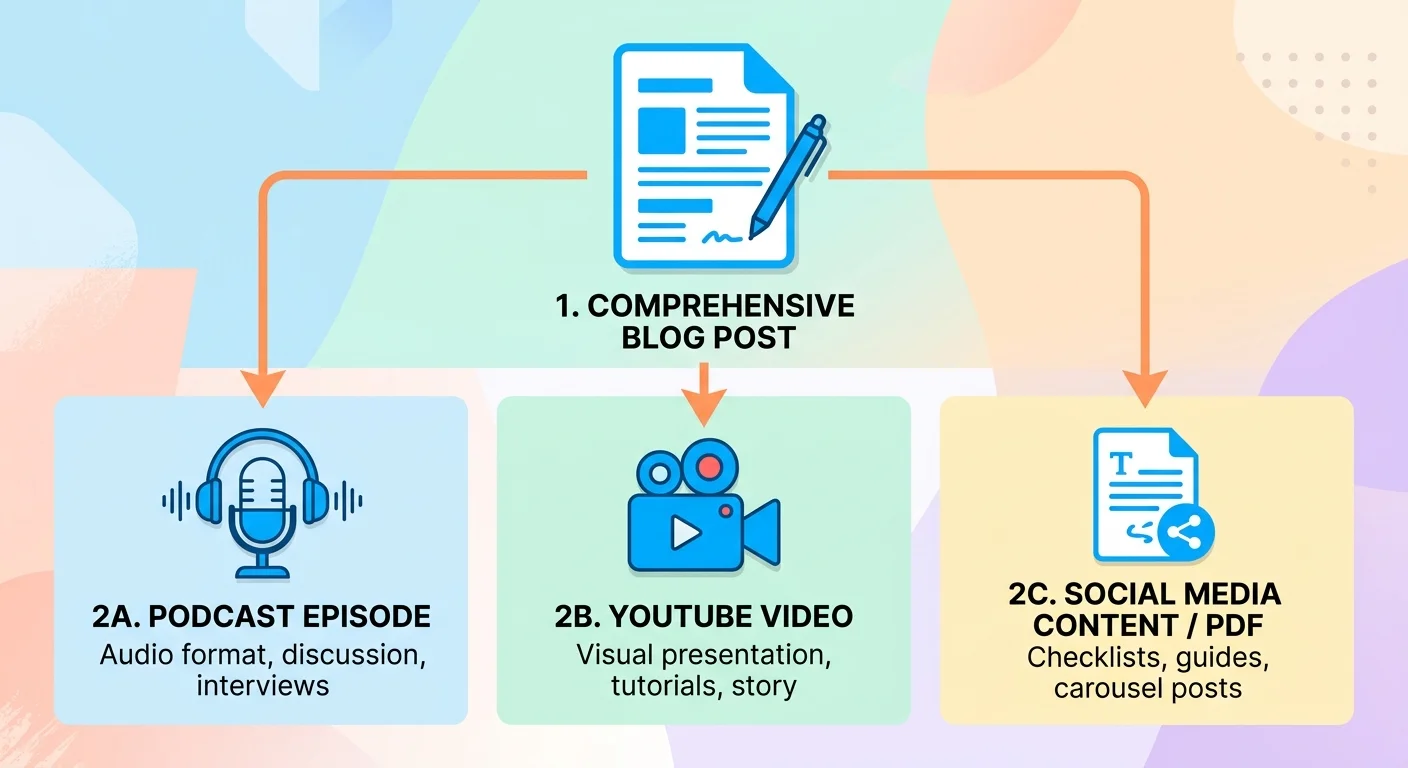
The fastest way to start: turn existing blog posts into video scripts or podcast episodes.
You’ve already done the research. You’ve already written the content. You’ve already structured the argument.
Reformatting that into another modality doesn’t require starting from scratch.
Take a comprehensive blog post on “How to Choose a Chiropractor.” Record yourself reading it aloud with minor adjustments for conversational flow. Publish it as a podcast episode.
Same content. Different format. New verification signal.
Or turn that blog post into a 5-minute video. You on camera, explaining the same concepts in a more casual tone. Upload it to YouTube. Link it from the original blog post.
AI now has text, voice, and video all covering the same topic under your name.
This isn’t additional work. It’s reformatting work you’ve already completed into the formats AI needs to verify your entity.
Batch Production Reduces Time Commitment
You don’t need to record content every week.
Block off half a day. Record 5 podcast episodes or 3 videos in one session. Schedule them for release over the next two months.
You’ve created consistent output without requiring weekly time investment.
AI doesn’t care that you recorded everything on the same day. It cares that episodes are published consistently over time, which creates a temporal pattern it can verify.
Same entity. Same voice. Different dates.
Batch production is the most efficient way to build multimodal authority without it becoming a second job.
Consistency Matters More Than Production Quality
AI doesn’t rank your video editing skills.
It verifies that “Dr. Smith” consistently discusses chiropractic care with a real voice and a real face over time.
A simple screen-share video where you walk through a treatment approach is sufficient. A podcast recorded on your phone with no editing is sufficient.
What’s not sufficient: perfect production that happens once and then never again.
Consistency beats polish. Always.
If you’re waiting until you can afford professional equipment, a studio setup, and a video editor before you start-you’re never going to start.
And every month you wait is a month your competitors are compounding their verified authority while you remain invisible.
Learn more about how we approach this at iTech Valet.
White-Glove Execution Removes the Burden
If creating multimodal content feels like a second job, you’re not the right fit for DIY.
Some practitioners have the time, inclination, and systems to manage their own content creation. Most don’t.
And that’s fine-as long as you’re not trying to do it alone.
The AI Authority Engine handles the infrastructure, the content execution, and the cross-platform verification so you don’t have to learn, manage, or execute anything.
You show up for a recorded conversation once a month. We turn that into podcast episodes, video clips, and written content. We publish it across platforms. We build the schema connections. We verify the entity relationships.
You don’t need to become a content creator.
You need to become a verifiable entity.
Those aren’t the same thing.
FAQ
Does having a YouTube channel really help AI recommend my practice?
Yes.
A YouTube channel linked to your primary entity-your website-provides AI with a powerful signal of real-world expertise. It confirms you’re a real person with a face and a voice, not just a text-based entity someone could have fabricated.
When AI cross-references your name and sees the same expertise claims on your website and in your YouTube videos, that triangulation builds trust. The channel doesn’t need thousands of subscribers. It needs to exist, be linked from your site via schema, and contain consistent content over time.
Is a podcast better than a video series for building AI trust?
Neither is inherently better.
Both provide a crucial non-text signal AI uses to verify your entity. The best choice depends on your comfort level and your ability to be consistent.
If you’re comfortable on camera, video provides the strongest verification signal because it integrates visual and vocal identity. If you’d rather not show your face, a podcast still gives AI your vocal signature and creates a temporal pattern it can verify.
What matters most: pick one and stick with it. AI values a consistently updated signal more than the specific format.
How does AI connect my podcast or YouTube channel back to my website?
Through structured data, consistent naming, and cross-linking.
Your website should include schema markup that explicitly points to your YouTube channel and podcast feed. When AI crawls your site, it reads that schema and understands “this YouTube channel belongs to this entity.”
Consistent naming reinforces that connection. If your website lists you as “Dr. John Smith” and your YouTube channel is “John Smith Chiropractic,” AI can connect them. If your YouTube channel is “Wellness Guru 2024” with no mention of your name, AI can’t.
Cross-linking matters too. Your YouTube video descriptions should link back to your website. Your podcast show notes should reference specific articles. These create bidirectional verification signals AI uses to confirm all platforms belong to the same entity.
Can I build multimodal authority without showing my face on camera?
Yes.
A podcast is an excellent way to build authority using only your voice. You can also create screen-share videos where you walk through concepts on a whiteboard or slides without ever appearing on camera.
Animated explainers, interview-style content where you’re the host, and audio-only content all work. The key is creating a consistent vocal or visual signature AI can verify over time.
You don’t need to be comfortable on camera to build multimodal authority. You just need to exist in more than one format.
What’s the fastest way to get started with multimodal content?
Repurpose existing content.
Pick your most comprehensive blog post. Record yourself reading it aloud with minor adjustments for conversational flow. Publish it as a podcast episode. Or turn it into a simple screen-share video.
Same content. Different format. New verification signal.
This leverages work you’ve already done to create a new authority layer without starting from scratch. You can have your first podcast episode or video published in less than an hour.
How long does it take before AI starts recognizing my multimodal presence?
Authority compounds. It doesn’t appear overnight.
AI needs to see a pattern before it trusts your entity. One video or one podcast episode isn’t enough. But three months of consistent weekly episodes? That’s a pattern. Six months? That’s a verifiable track record.
I won’t promise you a timeline. Not because this doesn’t work-because authority doesn’t run on a microwave schedule. What I will say: every month of execution compounds. The practices that stick with it compound. The ones that quit hand that ground to whoever kept going.
Do I need professional equipment to create video or podcast content?
No.
Your phone is sufficient. A basic USB microphone is better than your phone’s built-in mic for audio, but it’s not required to start.
AI doesn’t evaluate production quality. It evaluates entity consistency. A podcast recorded on your phone with background noise is infinitely more valuable than no podcast at all because waiting for “perfect” equipment means you never start.
Start with what you have. Upgrade later if consistency proves you’ll actually use it.
What if my competitors already have established YouTube channels or podcasts?
A late start isn’t disqualifying.
Your competitor’s head start matters less than you think. AI doesn’t reward “first mover” status. It rewards verified entities with consistent, high-quality signals.
If your competitor has 50 videos but they’re all low-effort, poorly structured content, and you publish 10 well-researched, clearly explained videos over three months, AI may trust your entity more because your signal quality is higher.
Systematic execution over time still builds verifiable authority, even if you’re starting after your competitors. The question is whether you’re willing to start now or wait another six months while they compound their advantage further.
Conclusion
The gap between invisible and recommended isn’t content volume.
It’s entity verification.
You can publish 100 blog posts, optimize every meta description, and build backlinks until you’re exhausted. None of it matters if your authority only exists in text. AI can’t verify what it can’t cross-reference.
And an entity that can’t be verified doesn’t get recommended.
Your competitors aren’t “better at marketing.” They’re structurally visible in a way you’re not. They have a face AI can see, a voice AI can hear, and written content AI can read.
All three formats. Same name. Same expertise. Different signals.
That’s the triangulation that builds trust.
Text alone is just claims. Video and audio are proof. And in a world where AI makes the recommendation instead of presenting a list of options, proof is the only thing that matters.
Every month you delay building that second or third modality is a month your competitors compound their advantage. The practitioner who starts a podcast this month and publishes consistently for six months will be verifiable by AI. The one who waits for “perfect” conditions will still be invisible.
This isn’t optional anymore.
The mechanism patients use to find practitioners has already changed. AI is making recommendations right now. Either your name is in the answer or a competitor’s is.
Authority is built through verifiable proof. Not claimed through text alone.
Want to know if AI can verify your expertise-or if you’re still a text-only entity it can’t trust? The AI Visibility Check takes 15 minutes and shows you exactly what ChatGPT, Gemini, and Grok see when they evaluate your authority across formats. If the results don’t make the problem self-evident, walk away. No pressure. But if they do? You’ll know exactly what needs to change.