The Search Shift Is Already Happening – And Paid Ads Were Built for a Different Era
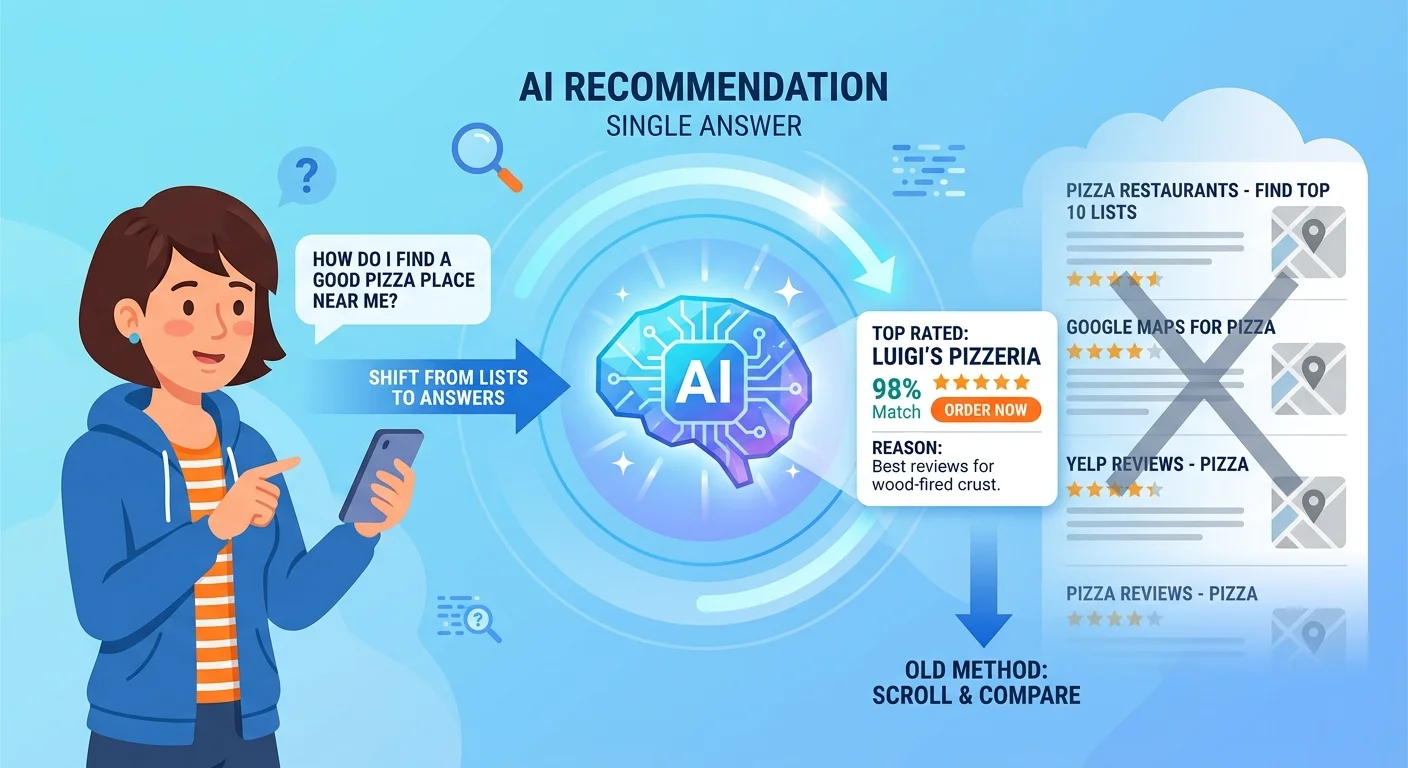
The world paid ads were built for is gone.
Not fading. Not shifting. Gone. They were engineered for one chain reaction: someone types a query, scans ten blue links, clicks the paid placement at the top. That chain doesn’t run the way it used to.
Gartner projects traditional search engine volume will drop 25 percent by 2026 as conversational AI agents replace list-based discovery.
That’s not a trend line. That’s a demolition notice for the channel paid ads depend on.
And it’s not coming. It’s here. Roughly 23 percent of Americans are already using ChatGPT to get answers – not to browse a list, not to evaluate options. They ask. They get a name. They act.
The businesses responding to this aren’t buying more ad inventory. They’re building machine-readable authority.
How AI Engines Replaced the Click-Through Model
Generative AI engines don’t rank. They rule.
One answer. One name. One recommendation – delivered with the confidence of a trusted advisor, not a search algorithm sorting ten options.
The click-through model assumed the user wanted to evaluate options. Generative AI assumes the opposite.
When someone asks ChatGPT or Gemini which chiropractor to trust, they’re not expecting a shortlist. They’re expecting the answer. AI systems synthesize – pulling from structured entity data, semantic content, and verified signals to surface one recommendation.
A pay-per-click bid doesn’t register in that process. Not even a little.
So before you renew another campaign optimized for a delivery mechanism AI is quietly replacing – it’s worth understanding what it actually takes to get named in the new one.
The Local AI Authority Engine was built for exactly this transition. Not to chase the shrinking channel. To own the one replacing it. how this model works
Why the Rental Model Breaks When the Landlord Changes
Here’s the problem with renting attention: the landlord can change the terms whenever they want.
Ad platforms adjust algorithms. They raise floor prices. They restrict categories. They get bypassed entirely by a new interface. Every one of those moves resets your visibility to zero – because you don’t own what you built. You were a tenant the whole time.
Entity trust doesn’t work that way.
When AI systems recognize a business as a verified, citable authority, that recognition compounds with every additional signal – every structured content piece, every schema layer, every semantic cluster built on top of the last one.
It’s not a lease that expires. It’s a deed. And in a world where generative AI is becoming the primary arbiter of who gets recommended, the practices that own their entity trust don’t just survive the shift – they become the address AI sends everyone to.
| Discovery Channel | How It Worked (Pre-AI) | How It Works Now (AI Era) | Impact on Paid Ads |
|---|---|---|---|
| Organic Search (SEO) | Users typed queries, scanned ranked lists of ten blue links, and clicked through to whoever ranked highest | AI engines synthesize a single answer from structured entity data – no list, no scrolling, no click-through evaluation | Ad placements and top-of-page bids become irrelevant when there is no list to appear on |
| Paid Search (PPC) | Businesses bid on keywords to buy placement above organic results and capture intent-driven clicks | Generative AI bypasses the search results page entirely, delivering a direct recommendation without displaying ads | Budget spend produces zero visibility inside AI-generated answers regardless of bid amount |
| Directory Listings | Patients browsed category-based directories, comparing multiple providers before choosing one | AI engines pull from verified entity signals and structured data to name one trusted provider as the answer | Directory prominence doesn’t translate to AI citations without machine-readable entity infrastructure |
| Conversational AI (ChatGPT, Gemini, Grok) | Did not exist as a consumer discovery channel | Users ask a direct question and receive a single recommended entity – the AI acts as a trusted advisor, not a search engine | Creates a new channel where only verified, citable entities get named – paid ads have no entry point |
| Word of Mouth / Referrals | Operated independently of digital channels; driven by personal relationships and patient networks | AI amplifies entity trust signals at scale – a well-structured authority profile reaches far beyond a personal referral network | Paid ads cannot replicate or accelerate the trust signals AI uses to validate referral-worthy entities |
Why Traditional SEO and Paid Ad Agencies Get This Wrong
Most agencies didn’t miss the AI shift by accident.
They missed it because their business model depends on you never asking the right question.
The right question isn’t "how do I get more clicks this month?" It’s "which investment builds something AI will trust and cite six months from now?"
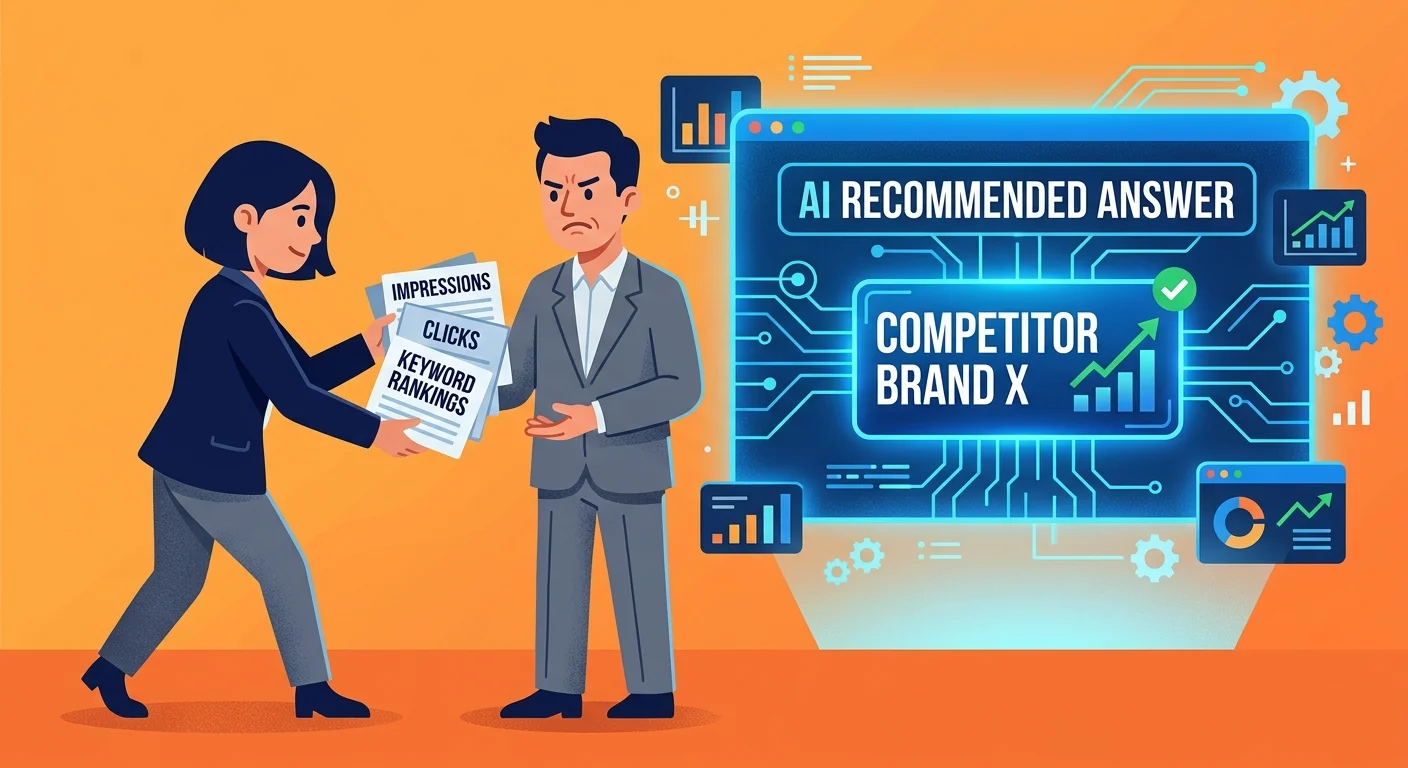
Traditional SEO and paid ad agencies aren’t built to answer that. Their retainer model rewards activity – reports, rankings, impressions – not the machine-readable entity trust that determines who generative AI recommends.
And as search engine volume drops 25 percent by 2026, optimizing for that shrinking channel isn’t a strategy. It’s a slow retreat.
The problem isn’t bad tactics. It’s the wrong architecture entirely.
Keyword-density optimization and paid retainer churn were built to game a ranked list. Generative AI doesn’t produce a ranked list – it synthesizes structured entity data into a single verdict.
The agencies selling the old model aren’t just behind. They’re actively building infrastructure that AI ignores.
The Hopium Business Model: Selling Clicks in a Zero-Click World
Here’s the business model in plain terms: agencies sell you the hope of visibility.
Not the asset. The hope.
You pay the monthly retainer. They run the ads or push the keyword reports. The clicks come in – or they don’t – and the invoice arrives either way.
When you stop paying, the clicks stop. No residual. No compounding. No authority left behind.
You rented attention for another month and handed back the keys.
This is what Gerek Allen calls the hopium model: selling activity metrics to clients who want patient bookings, in a channel that’s structurally contracting.
AI adoption has scaled to roughly 50 percent globally across tracked business categories. The businesses winning right now aren’t buying more ad inventory – they’re building machine-readable infrastructure.
The agencies still running the old playbook aren’t offering a strategy. They’re selling a lease on someone else’s platform in a neighborhood that’s being demolished.
Zero-click search makes it worse. When AI produces a single answer, a pay-per-click bid doesn’t register in the process at all.
A practice can have outstanding outcomes, a perfect five-star record, and a fully optimized ad account – and still be completely invisible to the AI engine recommending someone else.
Quality doesn’t get you cited. Structured, verifiable entity trust does. That’s the clinical results gap.
What Agencies Optimize For vs. What AI Engines Actually Read
Ask any traditional SEO agency what they optimize for and you’ll get the same list: keyword rankings, domain authority, backlink profiles, page speed.
Real metrics. Wrong question.
AI engines don’t crawl a site hunting for keyword density. They synthesize structured relational data – schema markup, entity signals, semantic content clusters – to determine which businesses are verifiable, trustworthy, and citable.
A perfectly keyword-optimized page with no structured schema is invisible to that process. An ad campaign driving traffic to a site with weak entity signals produces clicks that never convert into AI citations.
The optimization targets are completely misaligned.
That misalignment is the real cost.
Every month spent optimizing for ranked lists is a month not spent building the entity infrastructure generative AI reads. The gap compounds. Practices that started building machine-readable authority earlier don’t just have a head start – they’ve accumulated the kind of structured trust signals that AI systems treat as validation.
Catching up gets harder every quarter the old model runs unchallenged.
| What Traditional Agencies Optimize For | What AI Engines Actually Evaluate | The Gap This Creates |
|---|---|---|
| Keyword rankings and page-one placement | Structured entity signals – schema markup, verified business data, and semantic content clusters | A perfectly ranked page with no structured schema is invisible to the AI recommendation process |
| Backlink profiles and domain authority scores | Citation velocity – how consistently and credibly a business entity is referenced across trusted sources | Backlinks move rankings on a list; they don’t build the machine-readable trust AI uses to produce a single named recommendation |
| Click-through rate and ad impression volume | Entity verifiability – whether AI can confirm who you are, what you do, and why you’re trustworthy | Ad spend drives traffic to a site; it produces zero entity trust signals that generative AI can read or cite |
| Monthly activity reports – rankings moved, impressions delivered, clicks generated | Compounding authority infrastructure – structured content architecture that deepens AI recognition over time | Activity metrics reset to zero the moment the retainer stops; authority infrastructure compounds whether or not you’re actively spending |
| Broad audience targeting and demographic reach | Semantic density – a tightly structured content cluster that signals deep subject-matter authority to AI engines | Broad targeting optimizes for human eyeballs scanning a list; AI engines don’t scan lists – they synthesize structured data into a verdict |
What Paid Ads Actually Buy You (And What They Don’t)
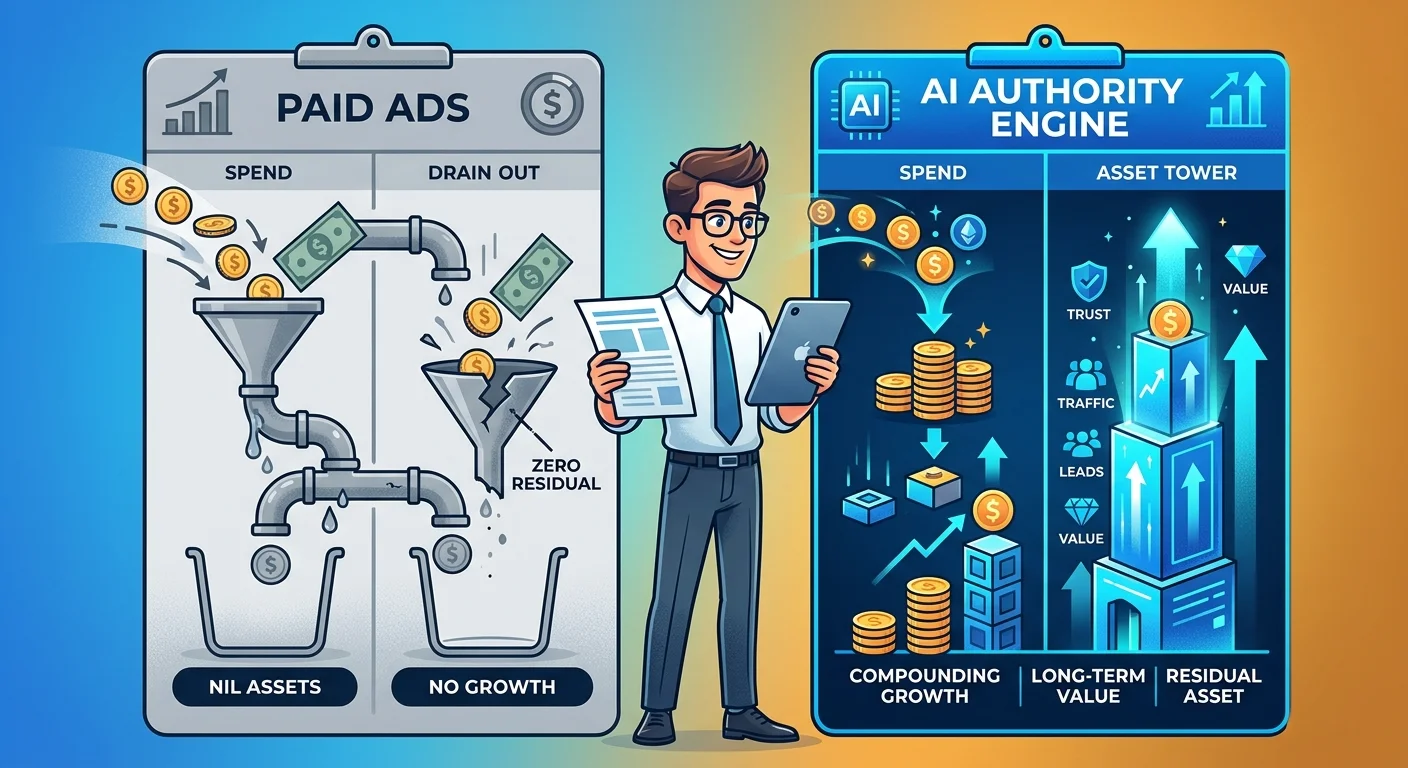
Here’s what paid ads buy you: attention. Rented. Conditional. Metered by the click, owned by the platform, and gone the second the budget stops.
That’s not an attack on paid ads. It’s just how the math works. You pay a platform to put your name in front of someone already searching. They click – or they don’t – and the invoice comes either way. The moment you stop funding the placement, you disappear. No residual. No compounding. Nothing left behind.
What paid ads can’t buy is entity trust. They don’t signal to AI engines that your practice is verifiable, structured, or citable. They don’t build schema layers, semantic clusters, or the relational data signals generative AI reads when it decides who to recommend. You’re renting a storefront on a street that AI’s GPS doesn’t have on any map.
The Real Ledger: What You Get for Every Dollar of Ad Spend
Pull the ledger on a typical paid ad campaign and the line items look legitimate: impressions, clicks, cost-per-click, conversion rate. These are real numbers. The problem isn’t that they’re fake – it’s that none of them carry over. Every metric on that report resets to zero when the campaign ends.
And there’s a column most agencies never show you. The Federal Trade Commission explicitly warns that marketing claims about AI capabilities must be backed by scientific, verifiable evidence. That means the platforms selling you AI-optimized ad targeting are legally required to prove what that optimization delivers. What it delivers is placement. Not trust. Not citations. Nothing permanent.
Every dollar of ad spend buys one unit of conditional visibility with a hard expiration date. When you stop paying, it expires. There’s no depreciation schedule – because there’s nothing left to depreciate. You weren’t holding a deed. You were holding a lease. And the lease is up.
The Zero-Asset Problem: Why Ad Spend Doesn’t Build Entity Trust
According to this source, stanford’s 2024 AI Index Report makes the structural reality hard to ignore: AI models have hit or exceeded human performance across key benchmarks, and internet architecture is shifting toward massive, centralized large language model systems. These systems don’t read ad bids. They synthesize structured entity data – and they reward the businesses that built it.
According to this source, that’s the zero-asset problem in plain terms. A practice can run paid ads for years, rack up thousands of clicks, and walk away with nothing an AI engine can read or trust. No schema. No verified entity signals. No semantic content architecture. The money was spent – and it left no infrastructure behind. The first real move a practice can make is how to build AI authority without selling – and building it in a way that actually compounds.
Generative AI doesn’t care how much you’ve spent on visibility. It cares whether you’re verifiable. Those aren’t the same standard – and confusing them is exactly why practices with massive ad histories are still invisible when someone asks ChatGPT or Gemini who to trust. Ad spend builds a platform relationship. Entity trust builds an AI relationship. Only one of those relationships produces a recommendation when the budget isn’t in the room.
| Investment Type | What It Builds | What Happens When You Stop Paying | AI Visibility Impact |
|---|---|---|---|
| Paid Advertising (PPC / Display) | Platform relationship, conditional placement, click volume | Visibility drops to zero immediately – no residual, no carryover, no compounding | No impact – ad bids are invisible to AI recommendation engines; entity trust is not built |
| Traditional SEO Retainer | Keyword rankings, backlink profiles, domain authority scores | Rankings degrade over time without ongoing maintenance; no permanent infrastructure remains | Minimal – keyword density and backlink signals are not the structured relational data AI engines synthesize |
| AI Authority Content (AEO Articles) | Semantic content clusters, structured entity signals, citation-ready authority | Content and entity signals persist and continue compounding; nothing resets to zero | Direct – structured, schema-backed content is exactly what generative AI reads when deciding who to recommend |
| Schema & Entity Infrastructure | Machine-readable identity layer: verified business data, structured markup, relational signals | Infrastructure remains fully intact – it is not rented or platform-dependent | High – schema and entity verification are primary inputs AI engines use to assess trustworthiness and citability |
| Paid Social / Boosted Content | Audience reach on a third-party platform, brand impressions, engagement metrics | Reach collapses the moment budget stops; no structured data or authority carries forward | None – social engagement metrics carry no weight in AI recommendation logic; entity trust requires structured, verifiable signals off-platform |
The Compounding Math: How the AI Authority Engine Builds Over Time
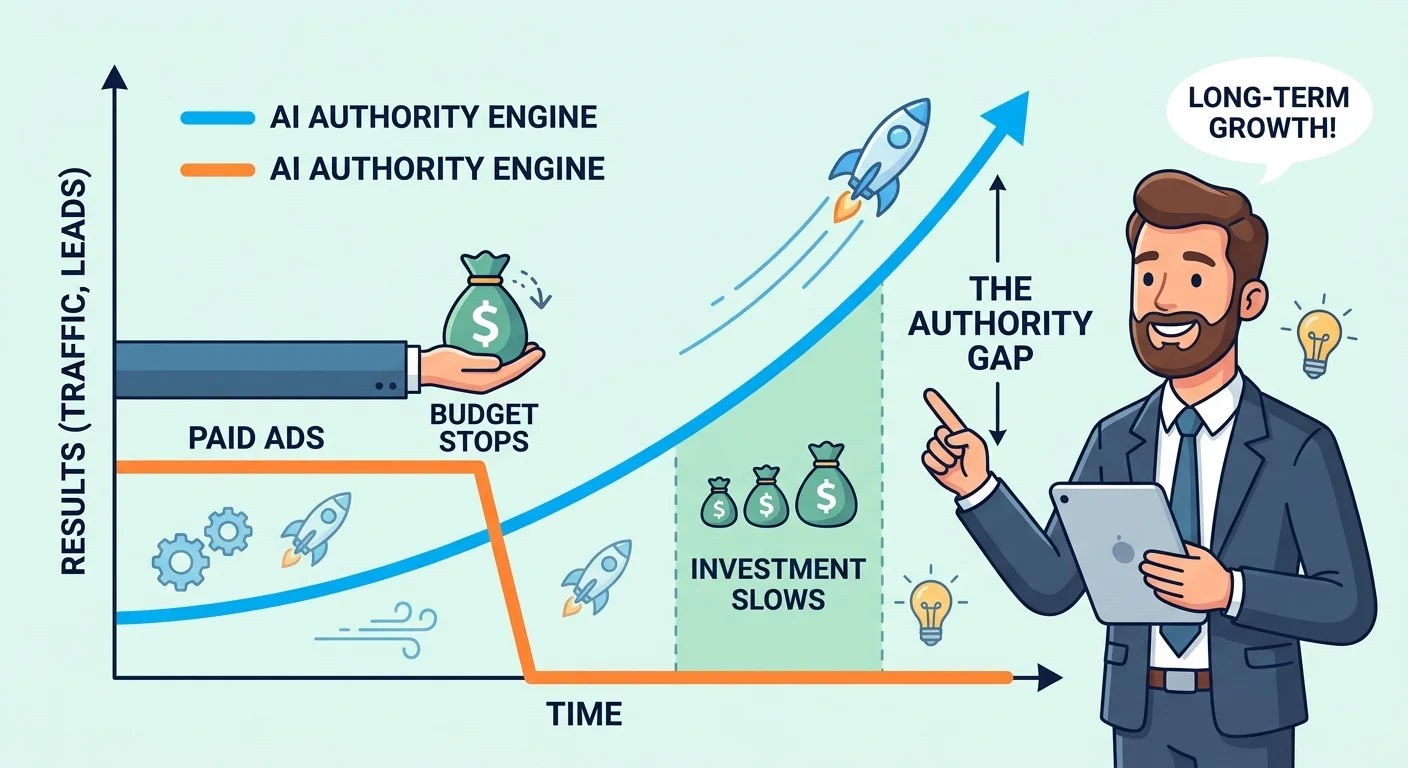
Here’s what the ownership model does that the rental model structurally cannot: it stacks.
Every schema layer you add builds on the one before it. Every piece of structured content deepens the topical signal. Every semantic cluster connects back to a verified entity – yours. AI engines read those signals cumulatively, and the more of them you hold, the more trustworthy your entity becomes.
That’s not a metaphor. That’s the architecture.
Paid ads reset to zero. Entity trust doesn’t.
Each month of execution builds on the last – stacking Citation Velocity, deepening Semantic Density, reinforcing the entity signals generative AI reads when it decides who to recommend. The practices that started building this infrastructure earlier don’t just have a head start.
They’ve made the gap structurally harder to close.
Ad spend produces sunk costs. Every dollar expires when the campaign does. Nothing carries over. Nothing appreciates.
The AI Authority Engine runs on opposite math – it builds infrastructure that AI systems can read, trust, and cite indefinitely. That’s the difference between a recurring expense and an asset. authority stack as a balance sheet asset
Entity Trust, Citation Velocity, and Semantic Density: The Three Compounding Levers
Three mechanics drive compounding authority. None of them have an equivalent inside a paid ad account.
The first is Entity Trust – the degree to which AI systems can verify that a business is real, structured, and citable. The second is Citation Velocity – the rate at which AI engines encounter and reinforce a business’s entity signals across indexed content. The third is Semantic Density – the depth of topical coverage that signals genuine expertise rather than keyword repetition.
Three levers. One compounding system.
Each lever reinforces the others. Higher Entity Trust increases the likelihood of citations. More citations build Citation Velocity. Deeper Semantic Density expands the range of queries an entity can be trusted to answer.
AI engines don’t evaluate these signals independently. They synthesize them – producing a unified read on how reliable, verifiable, and citable a business actually is.
A pay-per-click bid never touches that process.
Generative AI adoption has scaled to approximately 50 percent globally across tracked business categories. The systems driving that – centralized large language models that have hit or exceeded human performance on standard benchmarks – are built to reward structured, verifiable entity data.
Businesses that have invested in all three compounding levers don’t just show up in AI responses. They become the default answer.
Stanford’s AI Index Report documents that model capabilities are accelerating. So is the gap between businesses with structured entity infrastructure and those without it. Every month the old model runs unchallenged, that gap gets wider.
Month-by-Month: What the Authority Stack Looks Like at 3, 6, and 12 Months
At three months, the foundation is in the ground.
Schema is installed. Entity signals are structured and indexed. The first wave of AI Authority content is live – each piece a semantic node that builds topical coverage and starts registering with generative AI systems as verifiable output.
Nothing dramatic yet. But the clock is running.
At six months, the stack starts pulling its own weight.
Citation Velocity builds as more structured content accumulates. Semantic Density deepens as topical clusters connect and overlap. AI engines encounter the entity repeatedly across indexed sources – and that repetition inside a credible, structured framework is exactly how modern AI systems decide who to trust.
A practice that started in month one now holds six months of compounding signals no competitor can buy retroactively. That’s not a head start. That’s a structural lead.
At twelve months, the gap is structural.
Entity Trust is established. Citation Velocity is sustained. Semantic Density covers the full range of queries a patient or referral source is likely to ask.
And here’s what the rental model can never replicate: every month of execution between month one and month twelve is still working. It didn’t expire. It didn’t reset.
The practices that own their entity trust at twelve months don’t just survive the AI shift – they become the address AI sends everyone to.
| Time Horizon | Paid Ads Position | AI Authority Engine Position | Compounding Advantage |
|---|---|---|---|
| Month 1-3 | Ads running, clicks accumulating, zero residual infrastructure being built – every dollar is a rental payment with an expiration date | Schema installed, entity signals structured and indexed, first AI Authority content live – the deed is being written | AI Authority Engine is building a permanent foundation; paid ads are building nothing that carries forward |
| Month 4-6 | Visibility is entirely conditional on continued spend – pause the campaign and the practice disappears from results immediately | Citation Velocity increasing as structured content accumulates; Semantic Density deepening as topical clusters begin to connect and reinforce each other | AI Authority Engine compounds on what was built in months 1-3; paid ads have no equivalent of this effect – there is nothing to compound |
| Month 7-12 | Ad account holds a ledger of sunk spend; Entity Trust is zero; AI engines have no structured signals to read or cite | Entity Trust established, Citation Velocity sustained, Semantic Density covers the full query range – AI engines encounter the entity repeatedly across indexed sources | The gap becomes structural – a competitor cannot retroactively purchase the compounding signals built over the preceding months |
| When budget stops | Visibility resets to zero – no residual traffic, no authority signals, no AI citations; the lease expired and the practice is out on the street | Entity Trust, Citation Velocity, and Semantic Density remain active – the infrastructure doesn’t expire when a billing cycle ends | The ownership model’s defining advantage: the asset keeps working whether or not anyone is actively paying for new execution |
| Long-term position | Practice holds no AI-readable infrastructure after years of spend – the AI shift renders the entire investment strategically irrelevant | Practice has become a structured, verifiable, citable entity that generative AI systems can read and recommend by default | The practices that own their entity trust don’t just survive the AI shift – they become the address AI sends everyone to |
Who This Is For – And Who Should Keep Running Ads

Not every practice belongs here. That’s not a hedge. It’s a filter – and running it upfront saves everyone time.
Roughly 23 percent of Americans are already using ChatGPT to find information. Gartner projects traditional search volume drops 25 percent by 2026 as conversational AI takes over discovery. That shift doesn’t land evenly. It hits hardest the businesses built entirely on borrowed visibility – paid placements, rented audiences, keyword rankings that belong to someone else’s algorithm. If that describes your current setup, the math is going to get worse before it gets better.
So here’s the cut. Who this is actually built for – and who should keep running ads.
The Practice Ready to Own Its Authority
You’re ready for the Authority Engine if you’ve already done the math on paid ads and didn’t like the answer. You’ve watched budget cycle in, paused the campaign, and heard the phone go quiet. That’s not a targeting problem. That’s the rental model working exactly as designed – and you finally recognized it for what it is.
You’re the right fit if you want visibility that doesn’t reset. Authority an AI engine can read, verify, and cite – not because you’re paying this month, but because the infrastructure exists. You’re not buying impressions. You’re writing a deed. That’s a different asset class than anything a paid ad campaign produces.
And you’re the right fit if you can operate on a longer horizon. Authority doesn’t run on a microwave schedule. The practices that own their entity trust at twelve months are the ones who committed at month one – not because results are slow, but because compounding requires time to stack. If that timeline doesn’t fit your decision framework, no hard feelings. But if you’re tired of short-term tactics that vanish the moment you stop paying – you’re in the right place.
Who the AI Authority Engine Is Not Built For
But let’s be direct about who this isn’t for. If you need measurable ROI in 90 days or you’re walking, this isn’t your fit. The Authority Engine builds infrastructure – and infrastructure isn’t a sprint channel. There’s no 90-day guarantee here. Anyone offering one is selling the exact hopium this article has been arguing against. That’s not a dig. It’s just the truth about how authority actually compounds.
If you’re comparing this to a $500-a-month retainer and shopping on price – keep running ads. That’s not a criticism. It’s a genuine redirect. The rental model exists, it functions, and for someone whose ceiling is a low monthly outlay, it’s the right tool for the job. What it won’t do is build anything an AI engine can cite, trust, or recommend when the budget isn’t in the room.
And if you believe you can replicate this after a brief explanation – absorb the schema architecture, the semantic content execution, the entity signal strategy, and run it yourself – you’re describing a different kind of buyer than the one this is built for. The value here is in the execution, not the explanation. The steak gets on the plate. How it got there is iTech Valet’s concern.
| Profile | Primary Motivation | Right Tool | Why |
|---|---|---|---|
| The Done-With-Ads Practitioner | Wants visibility that doesn’t reset when the budget pauses | AI Authority Engine | Has already run the paid ad experiment and watched the phone go quiet the moment spend stopped – ready to own the asset instead of renting the placement |
| The Long-Horizon Builder | Wants infrastructure that compounds month over month | AI Authority Engine | Understands that authority deepens over time and is willing to commit at month one knowing the full stack pays off at month twelve and beyond |
| The AI-Era Thinker | Wants to be the answer AI recommends – not one of several options | AI Authority Engine | Recognizes that generative AI produces a verdict, not a list, and wants the entity trust infrastructure that earns that recommendation by default |
| The 90-Day ROI Seeker | Needs measurable return within a short fixed window | Paid Ads | The rental model is built for speed, not compounding – if a hard short-term deadline is the decision filter, paid placements are the correct tool for that timeline |
| The Budget-First Buyer | Shopping on monthly outlay and comparing options by price | Paid Ads | Low-commitment retainers exist and function for their purpose – but they build no machine-readable entity signals and produce nothing an AI engine can cite, trust, or recommend |
| The DIY Operator | Believes the system can be replicated internally after a brief explanation | Neither – until that assumption is tested | The value is in the execution, not the explanation – the schema architecture, semantic content strategy, and entity signal layering require dedicated ongoing execution, not a one-time briefing |
Frequently Asked Questions
The paid ads vs. entity trust comparison raises real questions. Here are straight answers.
No hedging. No ‘it depends.’ Same conviction the rest of this article has been building toward.
Why are paid ads becoming less effective in the era of generative AI search?
The audience moved. Roughly 23 percent of Americans are already using ChatGPT for information gathering – and that number keeps climbing. Gartner projects traditional search engine volume will drop 25 percent by 2026 as conversational AI takes over discovery.
Paid ads were engineered for list-based search. When someone stops Googling and starts asking an AI engine who to trust, a pay-per-click bid has no mechanism to influence the answer.
The channel isn’t broken. It’s aimed at an audience that’s increasingly not there.
What is the difference between search engine optimization and building entity trust?
SEO gets you on a list. Entity trust gets you named as the answer inside a conversational AI response. Those aren’t variations of the same thing – they’re structurally different games.
SEO operates on keyword signals that belong to a search engine’s indexing algorithm. Entity trust operates on structured, verifiable data that AI engines synthesize into a single reliability signal. You can rank on page one of Google and still be completely invisible to ChatGPT.
That’s not a bug. That’s what happens when two systems use fundamentally different criteria to decide who they surface.
How do AI engines like ChatGPT and Gemini decide which businesses to recommend?
They don’t scroll a list. They synthesize.
AI engines read structured entity data – schema markup, semantic content, citation patterns – and decide whether a business is real, verifiable, and authoritative enough to name. ChatGPT and Gemini aren’t ranking based on popularity. Their trust criteria are rigorous and consistent.
A practice with a polished website and zero structured entity signals isn’t invisible by accident. It’s invisible because there’s nothing machine-readable to anchor a recommendation to.
Can a practice rely on traditional web design to establish AI visibility?
No. A traditional website – even a well-designed one – is a visual asset built for human visitors. AI engines don’t experience visual design. They read structured data: schema markup, semantic content architecture, entity signals that confirm a business is real and citable.
A website without that infrastructure is a beautiful brochure an AI engine can’t parse. It won’t be recommended because there’s nothing machine-readable inside it to recommend.
Design and AI visibility are two completely separate problems. Solving one doesn’t touch the other.
How long does it take to build a compounding authority asset compared to launching an ad campaign?
An ad campaign can launch in days. That’s the rental model’s one real advantage – fast access to borrowed visibility that stops the moment the budget does.
The AI Authority Engine builds infrastructure. Schema, entity signals, and structured content start registering with generative AI systems from the first wave of execution. But Citation Velocity increases and Semantic Density deepens across months – not days.
Here’s the reframe: practices asking ‘how fast can I see results’ are still thinking in ad-campaign terms. The right question is ‘how fast can I own something that doesn’t expire?’ The answer: you start on day one.
Does running paid ads hurt a practice’s chances of being recommended by AI engines?
Running paid ads doesn’t directly hurt AI visibility. The two channels don’t interfere at a technical level.
What hurts AI visibility is neglecting the infrastructure AI engines actually use to evaluate trust: structured entity data, semantic content, schema markup. The risk isn’t that ads damage your authority signals. It’s that budget and attention locked into ad retainers crowd out the investment in entity trust – and every month that gap goes unaddressed, the AI shift widens it.
Ads and authority aren’t mutually exclusive. But treating ads as a substitute for authority infrastructure is exactly the rental trap. And that trap has no exit until you build something the AI can actually read.
The Verdict: Own the Answer or Keep Paying to Rent It
According to this source, here’s the verdict: paid ads are a lease.
Stop paying and you’re out. No residual visibility. No compounding signals. Nothing an AI engine can read or trust. You don’t own the audience – you’re renting it by the month.
Entity trust is a deed. Every schema layer, every semantic node, every structured content piece is yours. It doesn’t expire on a billing cycle. It doesn’t reset when the budget pauses. It sits in your digital foundation and keeps working long after the invoice does.
The practices that own their entity trust don’t just survive the AI shift – they become the address AI sends everyone to.
That’s not marketing language. That’s architecture. Generative AI synthesizes Entity Trust, Citation Velocity, and Semantic Density into a single reliability signal. And once that signal is built, no competitor can buy it retroactively. They can only start building their own – from zero, behind you.
Every month you hold the asset, the gap widens.
So the decision is plain: keep renting, or start owning.
Keep paying for placements that vanish the moment the invoice is late – or build the infrastructure AI engines read, trust, and cite by default. iTech Valet builds that infrastructure.
Right now, somewhere in your market, someone is asking ChatGPT who to trust. Either your name is the answer – or you’re funding a competitor’s visibility while you wait to decide.
That gap between renting attention and owning authority? It’s measurable. Run the AI Visibility Check and see exactly where you stand – in fifteen minutes.