
The Displacement Mechanism: How Trust Transfers From Human to Algorithm
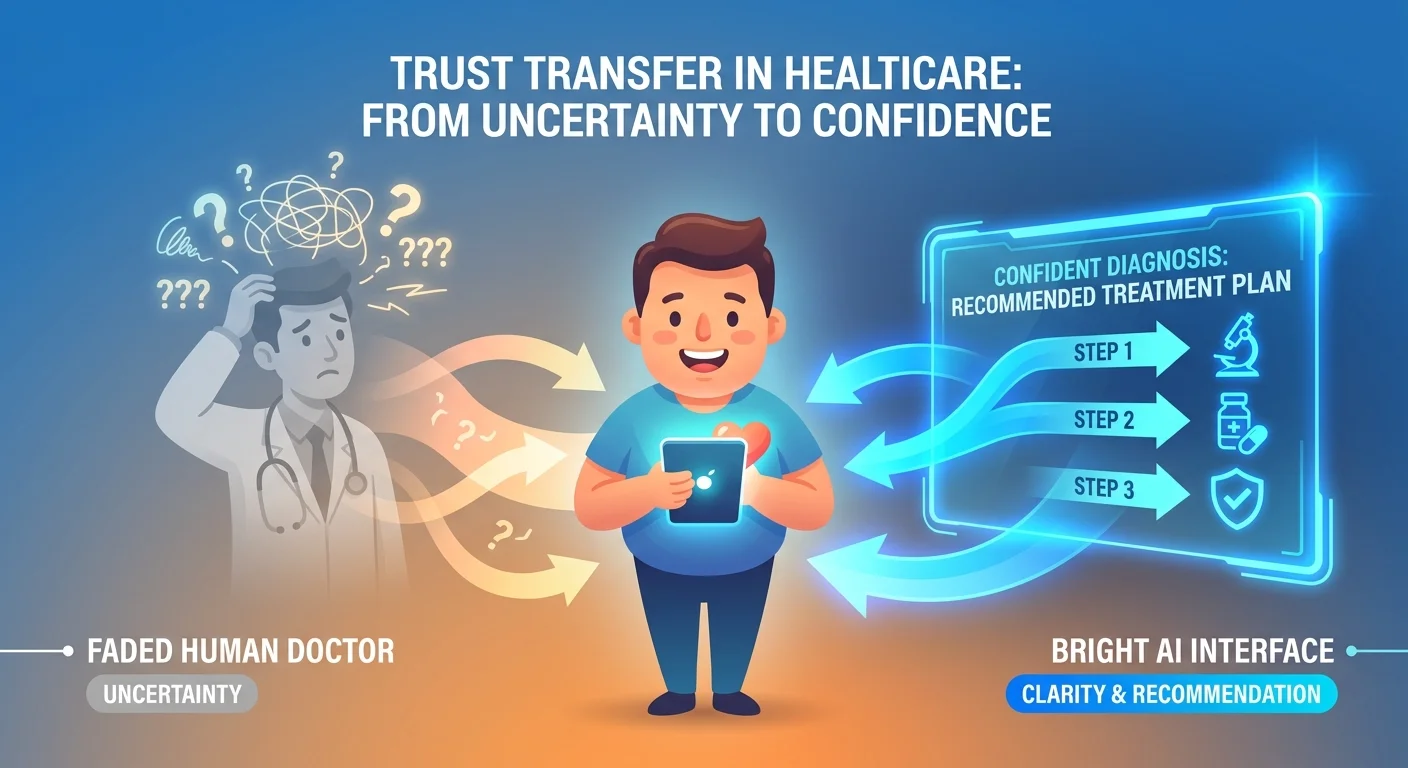
Displacement isn’t a metaphor.
It’s a clinical term borrowed from psychology. It describes how emotional energy, trust, or dependence originally directed at one target gets redirected onto another. In the context of AI, it’s the process by which patients who once looked to their doctor, a specialist referral, or their own research now look to the AI’s single, definitive answer.
The original trust relationship doesn’t evolve. It gets replaced.
The patient doesn’t consult the AI and the doctor. They ask the AI, get the answer, and the conversation ends there.
This isn’t happening because AI is more accurate-though in some domains, it is.
It’s happening because AI delivers certainty without the friction patients have learned to expect from human systems. No wait times. No insurance navigation. No second-guessing whether the recommendation is influenced by referral relationships or outdated training.
The AI answers immediately, confidently, and with the illusion of impartiality.
And that illusion is enough to trigger displacement.
Here’s what makes this dangerous for providers who aren’t named in that answer: displacement is psychologically final.
Once trust transfers, it doesn’t just diminish the original source. It erases it.
If the AI says Dr. Smith is the answer, the patient doesn’t wonder who else is good. They book Dr. Smith. If your name isn’t in the verdict, you’re not competing for second place.
You don’t exist in the decision at all.
What Displacement Looks Like
Displacement looks like this: A 40-year-old with chronic lower back pain opens ChatGPT and asks, "Who’s the best chiropractor near me?"
The AI names a provider. The patient doesn’t Google five options, read reviews, or ask friends. They book.
That’s the entire journey.
The trust they used to place in word-of-mouth referrals or a Google search has been displaced onto the AI’s singular recommendation. The decision tree collapsed into a single node.
It also looks like this: A dermatology practice spends years building a reputation through patient care, community involvement, and local SEO. Then a competitor engineers their digital infrastructure to become the answer AI engines cite.
Within months, new patient calls shift.
Not because the competitor is better clinically-but because they’re the name the AI says. The original practice isn’t losing market share gradually. They’re losing the entire conversation.
That’s displacement at scale.
Why It Works on Humans
Displacement works because of three psychological drivers that converge in AI recommendations.
The first is Perceived Objectivity-patients believe the AI isn’t biased by financial incentives, ego, or outdated protocols. In a JAMA Internal Medicine study, licensed healthcare professionals preferred chatbot responses to physician answers in 78.6% of evaluations, rating them higher in both quality and empathy. That preference isn’t about clinical accuracy. It’s about the feeling of neutrality.
The second driver is Cognitive Offloading-making a decision is exhausting, and patients are desperate to offload that burden onto something that feels authoritative.
The third is Authority Vacancy-trust in traditional healthcare institutions has eroded, and AI fills the vacuum not by earning trust, but by inheriting it from the institutions that failed.
And here’s the kicker: most Americans have already encountered AI doing tasks usually done by humans.
The psychological groundwork is already laid. Patients aren’t resisting this shift-they’re welcoming it.
The displacement mechanism isn’t theoretical. It’s operational.
And the providers who aren’t building the authority infrastructure to become that singular answer are watching their patient pipeline evaporate in real time.
The Three Psychological Drivers Behind AI Trust
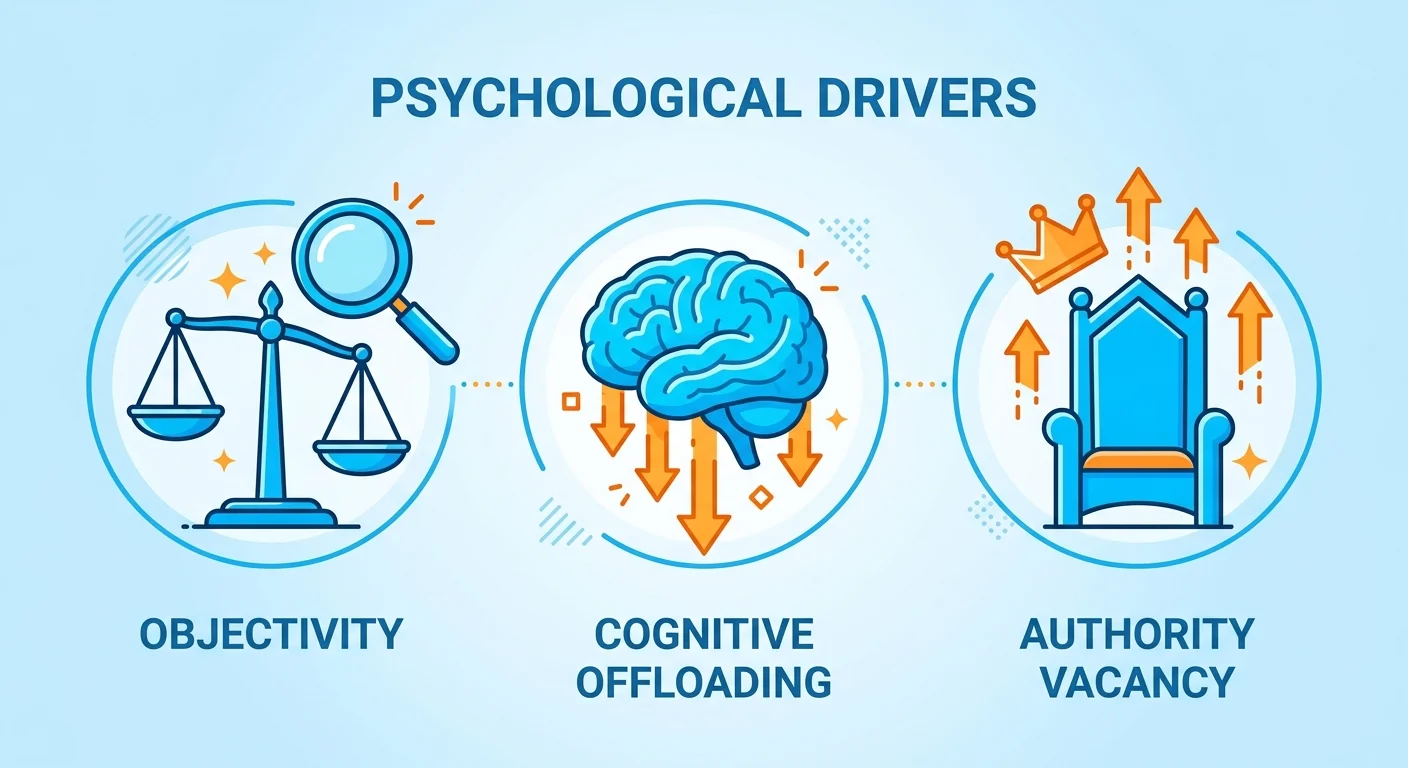
Displacement doesn’t happen by accident. Three psychological forces drive it.
Perceived Objectivity makes patients believe the AI has no agenda. Cognitive Offloading lets them escape the exhaustion of deciding. Authority Vacancy means the AI fills a seat no one else occupies anymore.
These aren’t theories. They’re the mechanism.
And they don’t operate separately. They lock together.
That’s why a patient who trusted their PCP for years will ask ChatGPT for a specialist recommendation-and never mention it to the PCP again. The AI didn’t just answer the question. It replaced the entire authority chain the patient used to rely on.
Perceived Objectivity
Patients believe AI recommendations are objective because they assume the algorithm has no agenda.
No referral kickbacks. No outdated training from a decade-old residency. No ego protecting a bad diagnosis.
The AI processes data and delivers the answer. That’s the perception. And perception is the only currency that matters.
In reality, the psychological factors influencing trust in AI are shaped by performance expectancy, social influence, and facilitating conditions-not by actual neutrality.
But patients aren’t auditing the algorithm. They’re offloading trust because it feels objective.
And that feeling is enough to displace the human expert who’s tired, running behind, and visibly frustrated by insurance portals.
Here’s the edge: if your digital infrastructure signals objectivity-schema markup that tells the AI who you are, citation density that proves you’re trusted, semantic consistency across your content-you inherit that perceived objectivity by proximity.
You’re not claiming neutrality. You’re engineering the conditions that make the AI cite you as if you were neutral.
Cognitive Offloading
Cognitive Offloading is why patients stop reading five competing reviews and comparing credentials.
Making decisions is exhausting. Evaluating trade-offs, weighing testimonials, comparing qualifications-that’s cognitive labor most people are desperate to escape.
So when the AI delivers a single, confident answer, the patient’s brain doesn’t resist. It relaxes. The burden is gone. Something made the call for them.
And that offloading is permanent.
Once a patient experiences the relief of a singular verdict, they don’t go back to the old model of researching and comparing. They ask the AI next time too.
The decision tree doesn’t just shrink. It collapses into a single node. And the provider who’s named in that node inherits the entire patient pipeline. Everyone else is competing for a conversation that isn’t happening anymore.
Authority Vacancy
Authority Vacancy is the most underestimated driver.
Consumer trust in the US health system has declined to just 34%, and that collapse creates a vacuum. Patients aren’t looking for someone to earn their trust from scratch. They’re looking for someone to occupy the seat traditional institutions walked away from.
AI inherits that authority not by proving itself over time, but by showing up when nothing else feels trustworthy.
Only 30% of U.S. adults say they’re more concerned than excited about AI’s increased use in daily life. 15% are outright more excited than concerned. That’s not skepticism. That’s readiness.
The psychological groundwork is already laid. Patients want to trust the AI because the alternative-navigating a fragmented, frustrating system on their own-feels worse.
So the question isn’t whether AI will displace human authority. It already has.
The question is whether you’re engineering your digital infrastructure to occupy that vacancy-or waiting for trust to flow back to a system patients have already written off.
A framework for building trust in AI exists. But frameworks don’t matter if you’re not the name the AI says. And if you’re not that name, the trust you’re trying to build has already been displaced onto someone else.
| Psychological Driver | What Patients Believe | Why It Drives Trust |
|---|---|---|
| Perceived Objectivity | The AI has no financial incentive, no referral relationships, and no ego protecting past decisions-it just processes data and delivers the truth. | Patients offload trust onto systems that feel impartial, even when they can’t verify neutrality. The illusion of objectivity is enough to displace human judgment. |
| Cognitive Offloading | The AI makes the decision for them-no comparing options, no weighing trade-offs, no research fatigue. Just ask, get the answer, and move on. | Making decisions is exhausting. When the AI delivers a singular verdict, patients don’t push back-they relax. The burden is gone, and they won’t return to the old model of evaluating multiple options. |
| Authority Vacancy | Traditional healthcare institutions failed them-AI isn’t earning trust from scratch, it’s inheriting the seat no one else is sitting in anymore. | When trust in established systems collapses, patients don’t wait for someone to prove themselves. They transfer trust to whoever shows up confident and immediate. AI fills the vacuum by default. |
What Makes an AI Recommendation ‘Trustworthy’ to a Patient
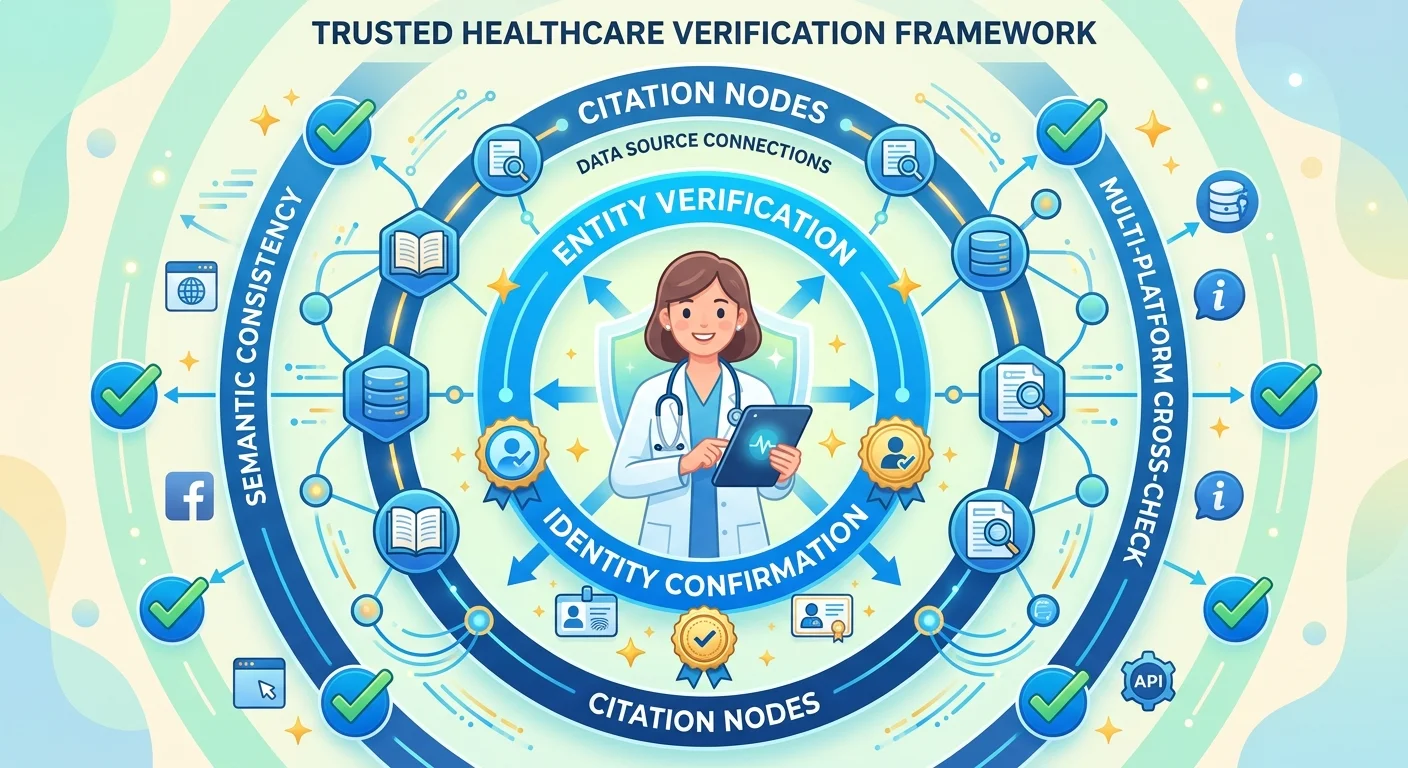
Here’s what separates the name AI says from the name it skips.
Patients aren’t trusting artificial intelligence as a concept. They’re trusting the single answer it gives them.
That answer gets cited because the AI scanned your digital infrastructure and scored three things-Entity Signals, Citation Density, and Semantic Consistency.
Not subjective. Measurable. And the only variables that determine whether you exist in the output or disappear entirely.
The AI doesn’t browse your site and decide if it likes you.
It ingests structured data. Scans schema markup. Traces citation networks. Weights semantic alignment across your content.
If those signals align, you’re trusted. If they don’t, you’re not even scored.
The verdict isn’t negotiable. You meet the threshold or you don’t exist in the answer.
Entity Signals
Entity Signals are machine-readable proof that you exist, that you’re who you claim to be, and that you’re categorized correctly in the knowledge graphs AI uses to make recommendations.
Schema markup tells the AI your business name, your specialty, your location, your credentials.
Without it, the AI can’t tell you apart from a blog post, a directory scrape, or a keyword-stuffed competitor.
The psychological factors influencing trust include performance expectancy, social influence, and facilitating conditions-and all three fire when the AI cites a name that feels verified and authoritative.
Entity signals make you real to the machine. If you’re not real to the machine, you’re not real to the patient.
Here’s where most practices fail: they think a Google Business Profile and a website check the box.
They don’t.
Entity trust builds when schema markup on your site matches your NAP data across directories, when your Knowledge Graph entry reflects your actual services, and when the AI can trace a clean line from your domain to your credentials without hitting conflicting data.
Every mismatch-outdated bio, inconsistent address, missing field-degrades entity trust.
And when entity trust drops below the threshold, the AI doesn’t rank you lower. It excludes you from consideration entirely.
That’s the line between being the answer and never being asked.
Citation Density
Citation Density measures how often authoritative external sources reference your content, your data, or your name when making claims in your field.
The AI doesn’t just read your site. It traces who else is citing you and whether those citations come from trusted institutional sources.
Deep learning algorithms have matched board-certified dermatologists at classifying skin cancers. That data gets cited because it’s quantifiable, verified, and anchored in peer-reviewed research.
The entities that produce or reference that kind of data inherit citational authority by association.
If no one outside your practice links to your content, you have zero citation density.
And zero citation density tells the AI your content isn’t trusted by anyone else-so why should it trust you?
Your content becomes citational when institutional sources, healthcare directories, and high-authority publishers link to it.
That’s not something you buy with backlinks from blog farms. That’s something you engineer by producing content that’s structured, sourced, and semantically aligned with what the AI already knows to be true.
And that’s building the authority infrastructure most competitors don’t even know they’re missing.
Semantic Consistency
Semantic Consistency is the AI’s measure of whether your content tells the same story across every page, every article, every schema field, and every external mention.
If your homepage says you’re a sports injury specialist and your blog covers general wellness tips with no connection to sports medicine, the AI reads that as semantic drift.
Semantic drift destroys trust.
The algorithm can’t confidently cite you because it doesn’t know what you actually do. You’re not a specialist. You’re noise.
Semantic consistency isn’t about repetition. It’s about coherence.
Every piece of content you publish should reinforce the same core positioning, use the same canonical terminology, and link back to the same authority pillars.
When the AI scans your site, it should see a unified narrative-not a content library that looks like five different agencies wrote it over ten years.
The practices that win the AI recommendation aren’t the ones with the most content. They’re the ones whose content consistently signals the same expertise, the same focus, and the same authority.
Consistency is what makes the AI confident enough to say your name. And confidence is what makes the patient trust the verdict.
| Trust Criterion | What AI Evaluates | What Breaks It |
|---|---|---|
| Entity Signals | Schema markup completeness, NAP consistency across directories, Knowledge Graph alignment, verifiable credentials tied to domain | Outdated bios, conflicting addresses, missing schema fields, inconsistent business names across platforms |
| Citation Density | External institutional references to your content, backlinks from high-authority healthcare directories, peer mentions in trusted sources | Zero external citations, blog-farm backlinks, no institutional recognition, content never referenced outside your own site |
| Semantic Consistency | Unified narrative across all pages, canonical terminology usage, coherent positioning from homepage to blog, clean internal linking structure | Semantic drift between pages, generic wellness content mixed with specialty claims, contradictory positioning, outdated content that conflicts with current focus |
The Risks When AI Trust Goes Unchecked
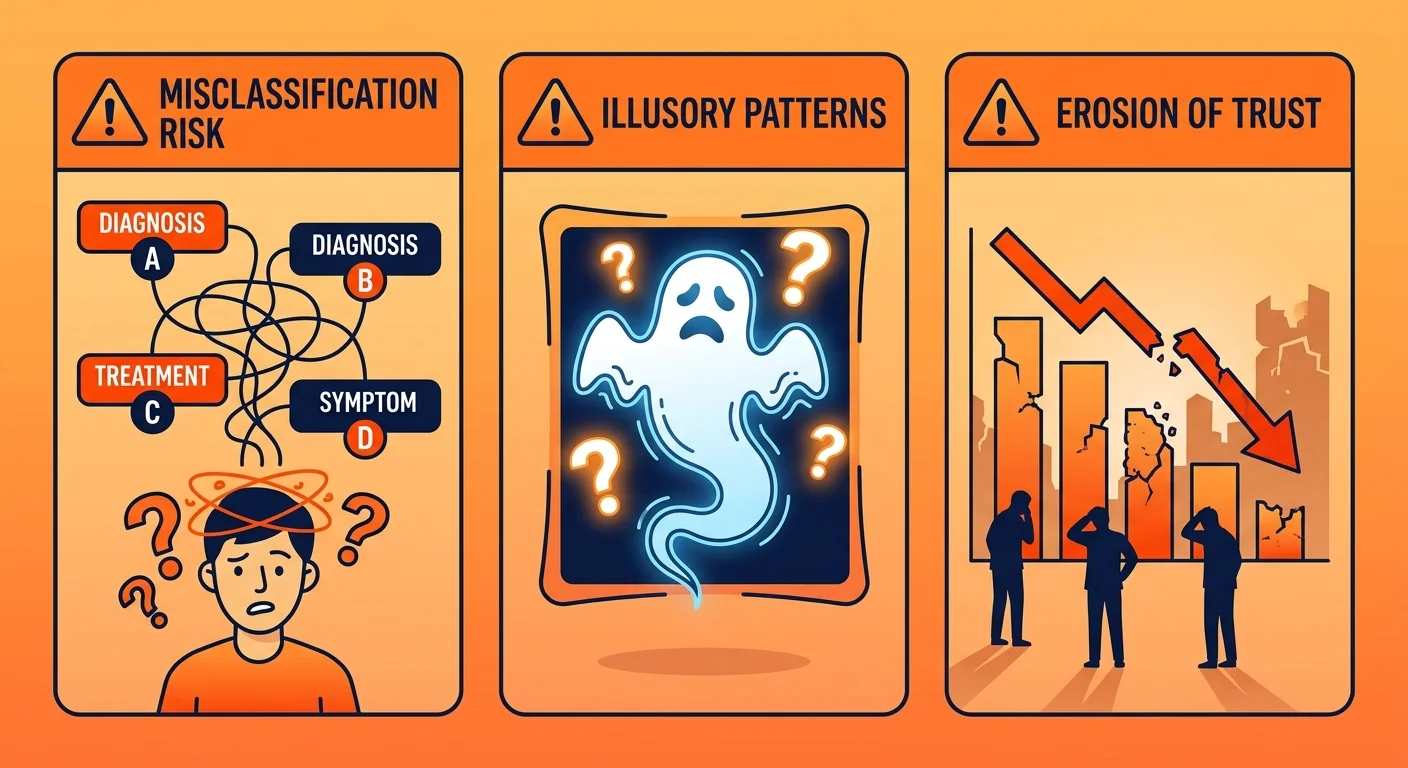
But here’s what nobody’s saying: displacement doesn’t guarantee accuracy.
It guarantees finality.
When a patient trusts the AI’s single recommendation, they’re not fact-checking it. They’re not calling three offices to compare. They’re booking the appointment. And if the AI named the wrong provider-if it misclassified your specialty, cited outdated information, or surfaced a competitor with better infrastructure but worse outcomes-the patient never knows.
They just trust the verdict.
That’s the edge-and the exposure.
The same psychological mechanism that makes patients trust AI recommendations also makes them vulnerable when those recommendations are wrong. And the practices that aren’t engineering their digital infrastructure to control what the AI says are gambling with something they can’t afford to lose: the patient who never even knew you existed.
Misclassification
Misclassification is the most immediate risk.
The AI doesn’t read your site the way a human would. It ingests schema markup, scans structured data, and classifies you based on the signals you’re broadcasting. If your schema says "general practitioner" but your content library focuses on sports medicine, the AI has to guess.
And when it guesses, it gets it wrong.
You’re either cited for the wrong specialty-confusing patients who aren’t a fit-or you’re excluded entirely because the algorithm couldn’t confidently categorize you.
Misclassification isn’t a ranking problem. It’s an identity problem.
The AI isn’t putting you lower on the list-it’s putting you in the wrong list. And once that happens, every patient who asks about your actual specialty gets a competitor’s name instead.
They trust that name. They book that appointment.
And you never get the chance to correct the record because you never entered the conversation.
The fix isn’t better marketing. It’s reclaiming the narrative when AI gets it wrong.
You have to rebuild the entity signals, correct the schema drift, and realign your semantic consistency so the AI reclassifies you correctly. That takes months. And every month you wait, a competitor is inheriting the patients who should’ve been yours.
Phantom Authority
Phantom Authority is what happens when a practice looks authoritative to the AI but isn’t actually trusted by patients who dig deeper.
The AI cited your name because your schema was clean and your citation density was high-but your reviews are thin, your content is generic, and your patient experience doesn’t match the authority the AI projected.
So the patient books the consultation, walks in, and realizes the verdict was overconfident.
They don’t blame themselves. They blame the system. And the next time they ask the AI, they add qualifiers: "Who’s the best provider with great reviews?" or "Who’s trusted by real patients?"
You’re still the top recommendation-but you’re no longer the one they trust.
Phantom authority is the outcome of infrastructure without substance.
You engineered the signals. You optimized the schema. You built citation density. But you didn’t build the patient experience that justifies the recommendation.
And once that gap becomes visible, the trust that displaced onto you evaporates.
The AI still says your name-but patients stop listening. That’s what happens when authority decays. And decay is permanent if you don’t fix the foundation.
Stagnation
Stagnation is the long-term risk no one sees coming.
You became the AI’s top recommendation. Patients are booking. Revenue is steady. So you stop publishing. You stop refining your content. You stop updating your schema.
And six months later, a competitor launches an authority engine of their own-and the AI starts citing them instead.
You didn’t lose the recommendation because you got worse. You lost it because you stopped compounding.
AI trust isn’t a static asset. It’s a decaying asset.
If you’re not reinforcing entity signals, expanding citation density, and publishing semantically consistent content every month, you’re falling behind competitors who are.
The practices that treat AI authority as a one-time project lose it within a year. The ones that treat it as a compounding system own the recommendation indefinitely.
And the gap between those two outcomes is the difference between a pipeline that fills itself and a pipeline that dries up the moment you stop feeding it.
| Risk Type | How It Manifests | Patient Impact | Provider Consequence |
|---|---|---|---|
| Misclassification | AI ingests conflicting schema, outdated content, or semantic drift-guesses your specialty wrong and cites you for services you don’t offer or excludes you from queries you should own | Patient books a consultation expecting sports medicine expertise, arrives to find a generalist with no relevant background-wastes time, loses trust in AI recommendations | You’re cited for the wrong specialty and flooded with unqualified leads, or excluded entirely from your actual specialty’s queries-revenue leaks to competitors while you handle patients who aren’t a fit |
| Phantom Authority | Clean schema and high citation density earn the top recommendation, but thin reviews, generic content, and weak patient experience don’t match the authority the AI projected | Patient books based on AI’s verdict, walks in expecting premium expertise, realizes the recommendation was overconfident-next time they add qualifiers the AI can’t guarantee you’ll satisfy | You’re still the top recommendation but patients stop converting-authority signal is intact but trust evaporates on contact, and you can’t recover credibility once the gap becomes visible |
| Stagnation | You became the AI’s answer, stopped publishing, stopped refining schema, stopped compounding authority-competitor launches their own engine and displaces you within months | Patient who would’ve found you last year now finds your competitor because the AI shifted its verdict-you never entered their consideration set and you’ll never know they existed | Pipeline that filled itself for months dries up the moment a competitor outpaces your decaying signals-revenue drops, you don’t know why, and by the time you diagnose it you’ve lost six months of compounding |
Frequently Asked Questions
Before we close, let’s hit the objections.
Because understanding displacement doesn’t mean ignoring the risks.
It means controlling them.
What is psychological displacement and how does it relate to AI recommendations?
Displacement is when trust anchored to one entity-your doctor, your therapist, your specialist-shifts to another.
In this case, the AI.
The AI doesn’t earn trust through experience or relationship. It fills the vacuum created when institutional trust erodes. Patients stop trusting the system. They stop trusting referral networks. They start trusting the single, confident answer the algorithm delivers.
The AI didn’t displace the doctor by being better.
It displaced the doctor by being final. One question. One answer. Zero ambiguity. And finality is what patients crave right now.
Is it really safer for patients to trust an AI recommendation over their doctor’s advice?
No. And that’s not the point.
Safety isn’t driving displacement-confidence is. The AI delivers a verdict with no hesitation, no caveats, no "it depends." The doctor qualifies every answer because that’s responsible medicine.
But the patient hears qualification as uncertainty.
And when they’re choosing between uncertainty from a human and confidence from an algorithm, they displace their trust onto the one that sounds sure. Even when they shouldn’t.
This isn’t rational. It’s psychological. And the practices that win aren’t the safest-they’re the ones the AI names with authority.
Why would a patient trust an impersonal algorithm more than a human expert with years of experience?
The algorithm doesn’t have a bad day. It doesn’t rush the appointment. It doesn’t forget details from the intake form.
Patients aren’t comparing expertise-they’re comparing consistency.
The human expert brings decades of training but also fatigue, bias, and the reality of working inside a broken system. The AI brings none of that. It’s consistent. It’s instant. And it sounds authoritative.
In a JAMA Internal Medicine study, licensed healthcare professionals preferred chatbot responses to physician answers in 78.6% of evaluations, rating them higher in both quality and empathy.
That doesn’t mean the AI is better.
It means the AI feels better. And when trust is psychological, feeling is everything.
What are the ethical risks if a healthcare practice tries to become the top AI recommendation?
The risk isn’t becoming the recommendation. The risk is becoming the recommendation without earning it.
If your infrastructure is optimized but your patient experience is terrible, displacement backfires. The AI cited you. The patient trusted the verdict. They booked the appointment-and then they walked into a practice that didn’t match the authority the algorithm projected.
That’s Phantom Authority.
And it doesn’t just lose the patient. It erodes trust in the entire mechanism.
The ethical obligation isn’t to avoid becoming the top answer. It’s to deserve being the top answer. That means building the authority infrastructure that justifies the patient experience, the clinical outcomes, and the operational integrity behind the recommendation.
If you can’t do that, you shouldn’t be engineering displacement. But if you can, you’re obligated to-because the alternative is letting a competitor with worse outcomes own the verdict instead.
How can providers use this AI trust phenomenon to improve patient outcomes, not just for marketing?
By treating displacement as a filtering mechanism, not a conversion tactic.
The AI doesn’t just recommend providers-it recommends providers whose infrastructure signals authority, consistency, and trust. That means practices with clean Entity Signals, deep Citation Density, and semantically consistent content get cited.
And those same signals correlate with better patient education, clearer clinical positioning, and more transparent care models.
So the providers who use displacement correctly aren’t gaming the system-they’re building the infrastructure that makes them worthy of the recommendation. And once they own that recommendation, they can publish content that educates patients before the appointment, reduces decision fatigue, and improves outcomes by setting clearer expectations.
The trust the AI displaced onto them becomes the foundation for better care.
That’s the outcome when authority infrastructure and clinical integrity align.
Doesn’t the lack of empathy in AI ultimately destroy patient trust in the long run?
Eventually, yes. But not before displacement reshapes the entire market.
Patients will figure out the AI’s empathy is simulated. They’ll realize the algorithm can’t adjust recommendations based on the nuance of their lived experience. And at some point, the pendulum swings back-trust re-anchors to human expertise, and the practices that relied purely on AI visibility without substance collapse.
But here’s the window: that correction is coming over years, not months.
And in the meantime, the practices that aren’t building AI authority lose the pipeline entirely. By the time empathy matters again, they’ll be so far behind in market share that catching up is impossible.
The answer isn’t to ignore displacement. It’s to use it now-while it works-and build the patient experience that survives the correction.
What happens to patient trust when an AI recommendation is proven to be wrong?
It fractures. Fast.
The patient doesn’t blame themselves for trusting the AI-they blame the AI. And once that trust breaks, they add qualifiers to every future query. "Who’s the best provider with verified reviews?" "Who’s trusted by real patients?"
The algorithm adapts. The recommendation changes. And the practice that was cited yesterday is invisible today.
That’s why Misclassification and Phantom Authority are existential risks. If the AI cited you incorrectly-or if you couldn’t deliver on the authority it projected-the trust that displaced onto you evaporates.
And once it’s gone, no amount of schema optimization brings it back.
You don’t just lose the patient. You lose the mechanism that was filling your pipeline. That’s why how iTech Valet engineers this outcome starts with infrastructure that earns the recommendation-not infrastructure that fakes it.
What This Means for Healthcare Practices Right Now
Displacement isn’t a future trend. It’s the mechanism governing patient decisions today.
The patient who opens ChatGPT and asks who the best chiropractor near them is doesn’t want options. They want a verdict. When the AI delivers that verdict with confidence, the patient trusts it-not because the AI earned that trust over years of care, but because the vacuum left by eroding institutional trust created the perfect conditions for displacement.
The human expert lost the psychological edge. The algorithm inherited it.
And the practice that becomes the answer the AI delivers doesn’t just win the booking-they inherit the trust that used to belong to the relationship itself.
Here’s what separates the practices that survive this shift from the ones that don’t: understanding that displacement is engineerable.
You can’t control whether patients trust AI more than humans-that ship sailed. What you can control is whether the AI says your name when the question gets asked.
Entity Signals, Citation Density, and Semantic Consistency aren’t marketing tactics. They’re the infrastructure that determines whose authority the AI recognizes. And the practices that aren’t building that infrastructure right now are betting that patients will somehow find them through the old channels-Google Maps, word of mouth, insurance directories.
They won’t.
Because the patient who displaces their trust onto the AI never makes it to those channels. They ask once, they get one answer, and they’re done.
If you’re not that answer, you don’t exist.
And this is the final step in becoming AI-ready.
You can fix Misclassification. You can build citation density from scratch. You can engineer semantic consistency across every page, every article, every schema field. But none of that matters if you don’t understand the psychological mechanism you’re optimizing for.
Patients aren’t comparing you to competitors anymore. They’re trusting the single verdict the AI delivered-and that verdict either has your name in it or it doesn’t.
The practices that grasp that finality-and build the authority infrastructure to control it-own the market. The ones that don’t are invisible. Not ranked lower. Not losing by a few spots. Invisible.
Once you’re invisible, no amount of marketing brings you back.
The vacuum doesn’t wait. It gets filled by whoever showed up first with the infrastructure the AI can trust. As patients displace their trust from human experts to the single, definitive verdict of an AI, the AI Authority System engineers the digital infrastructure required to become that trusted, singular answer-because AI gives one answer, and if you’re not it, you don’t exist.
You can’t stop patients from trusting AI over you. You can’t reverse the collapse of institutional authority. The vacuum exists.
But you can control whose name the algorithm says.
The practices that survive this aren’t hoping to be found. They’re building the authority infrastructure that makes them the answer. The first step is knowing where you stand right now.