
Why AI Can’t Trust Your Website Testimonials
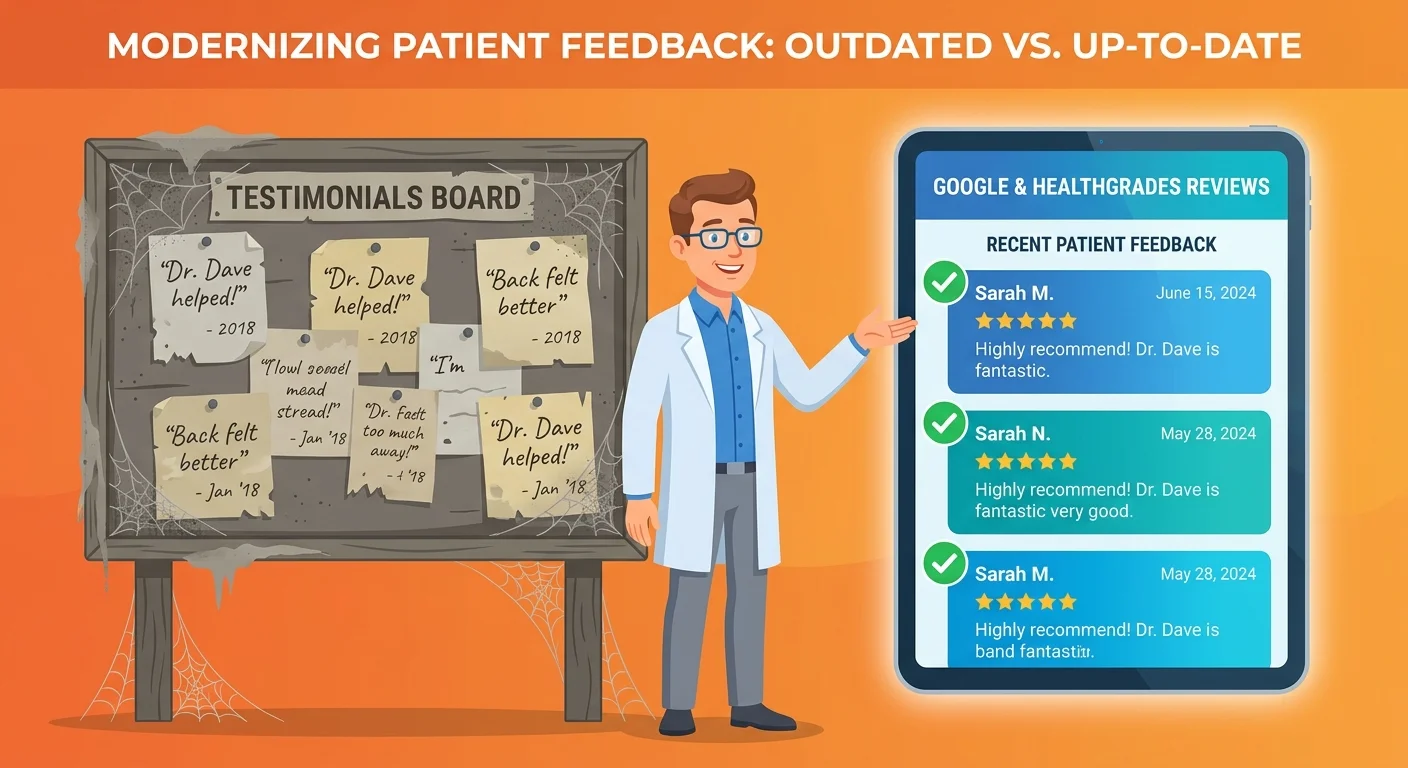
Your testimonials page looks great.
The quotes are real. The patients were happy. The results were legit.
AI doesn’t care.
Here’s what most chiropractors miss: AI doesn’t evaluate proof based on how heartfelt it sounds. It evaluates proof based on the trustworthiness of the data source.
And you control your own website.
That makes every testimonial on it a biased, unverifiable claim. Not because you’re lying – because the platform itself offers zero independent validation.
The Digital Brochure Fallacy
Most chiropractic websites treat testimonials like a digital brochure. Pretty design. Compelling copy. Zero structural authority.
AI sees: text you wrote, images you uploaded, layout you controlled.
You could’ve written every word yourself. AI has no mechanism to verify any of it came from real patients. So it doesn’t trust it.
This isn’t an accusation. It’s the default assumption AI engines make when they encounter self-published proof.
The Federal Trade Commission’s endorsement guidelines outline the legal standards for testimonials. AI applies an even stricter standard: it doesn’t count unverified endorsements at all.
Your testimonials page is commodity infrastructure. It’s the same thing every other practice has. Same format, same trust vacuum, same invisibility to AI.
What Makes Proof “AI-Readable”
AI-readable proof has three characteristics your website testimonials don’t:
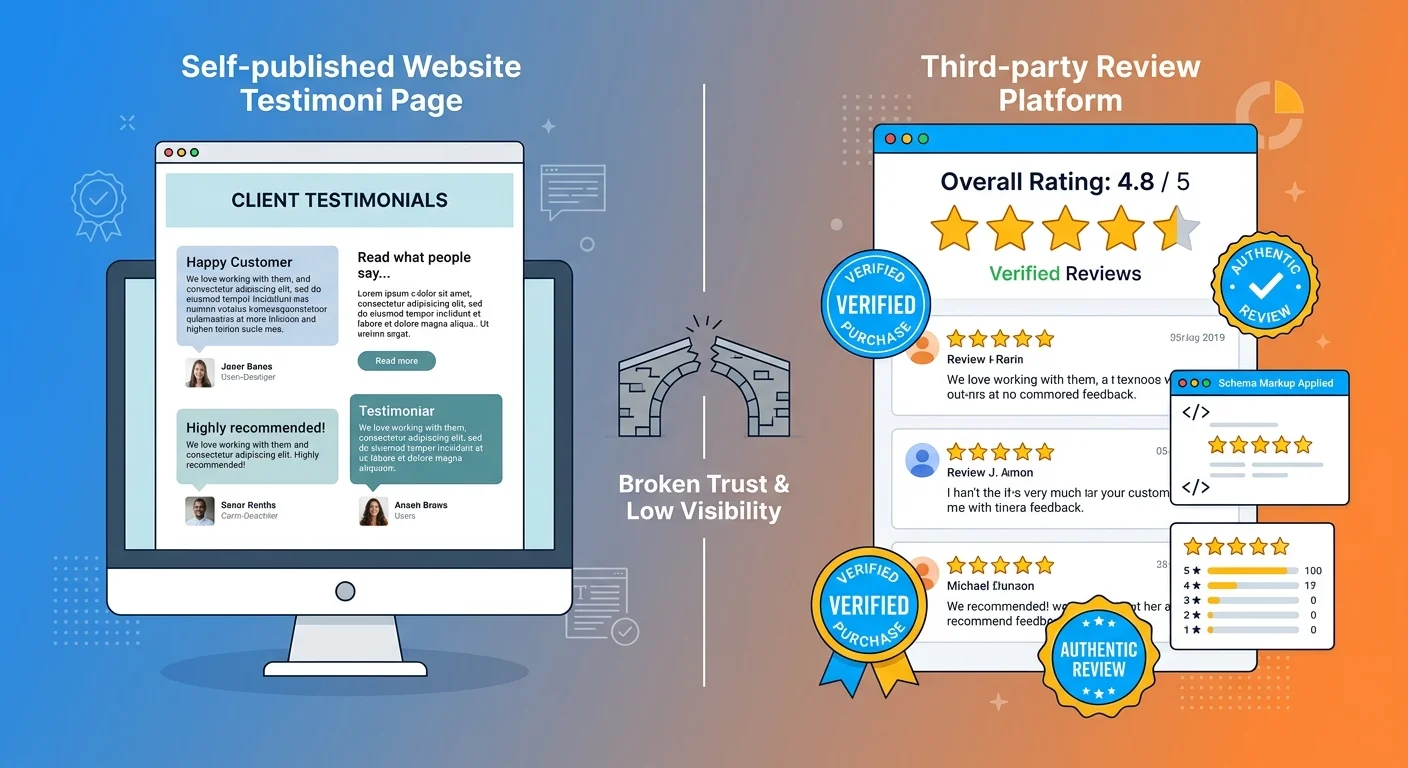
Third-party hosting. The review exists on a platform you don’t control – Google, Healthgrades, Clutch. That external hosting adds credibility because the platform validates the reviewer’s identity.
Structured data. Google Search Central’s documentation on review schema markup wraps the review in machine-readable metadata. AI can parse star ratings, dates, reviewer names automatically. Your static testimonials have none of that.
Recency signals. AI prioritizes reviews that demonstrate ongoing patient activity. A stream of reviews from the past six months signals a currently active practice. A wall of 2018 testimonials signals a practice that was once relevant.
If your proof doesn’t meet all three criteria, AI treats it as noise.
The Proof Decay Rule: Why Authority Has a Half-Life
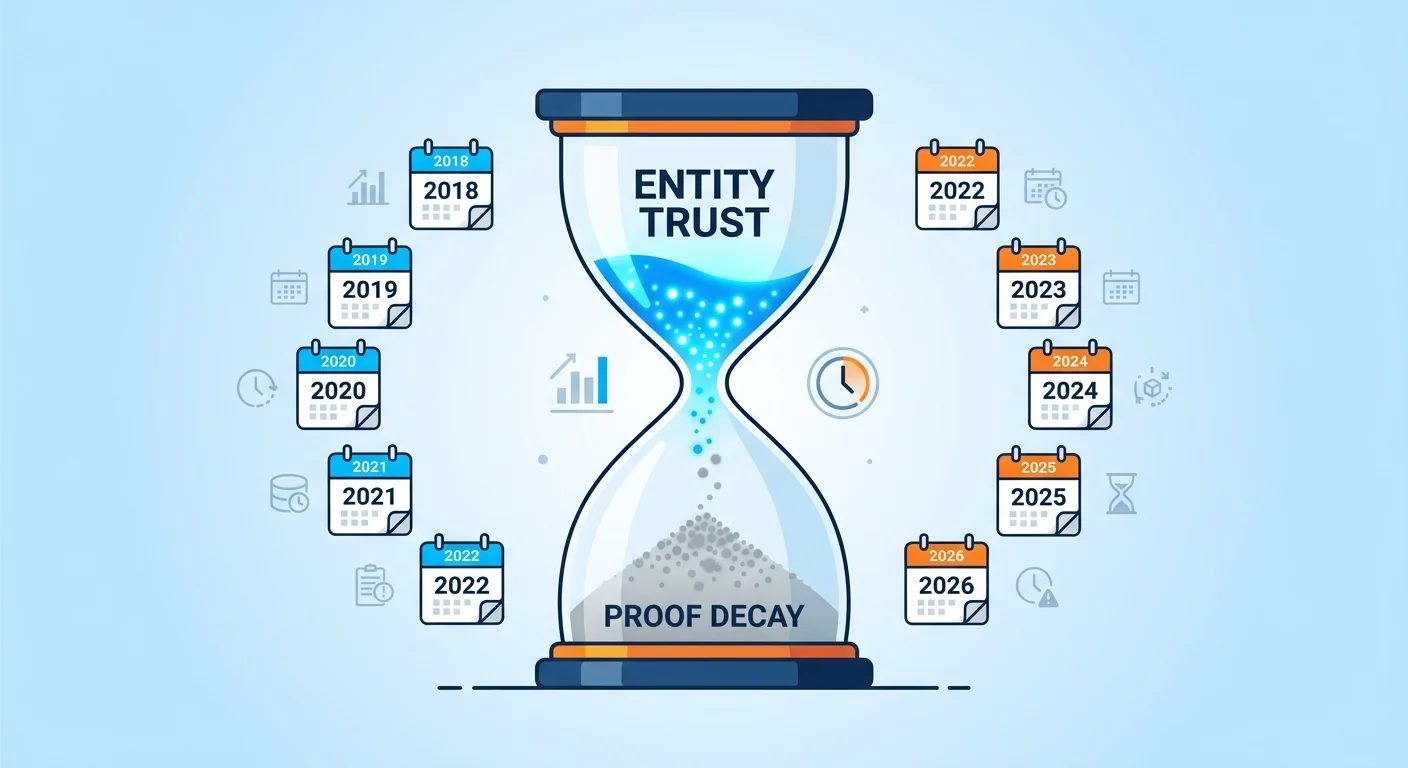
Authority isn’t a trophy.
It’s a furnace that requires constant fuel.
The Proof Decay Rule is simple: In the absence of new, verifiable signals, AI engines assume your entity trust is eroding.
They don’t care that you were the best chiropractor in your market in 2018. They care whether you’re the best answer right now.
And “right now” is measured by the recency and velocity of your third-party proof.
How AI Evaluates Citation Velocity
Citation velocity is the rate at which new, verifiable mentions of your practice appear across trusted platforms.
High citation velocity signals an actively growing business. Low citation velocity – or worse, zero citation velocity – signals stagnation.
Your 2018 testimonials contribute nothing to citation velocity. They’re frozen in time. AI sees them the same way a bank sees a 10-year-old credit report: outdated and irrelevant.
BrightLocal’s consumer review survey confirms what AI engines already know: 73% of consumers only pay attention to reviews written in the last month.
AI applies the same logic.
If your most recent verifiable review is from 2020, AI assumes your patient base dried up. That assumption – accurate or not – determines whether your name appears in the answer.
The Maintenance Problem
Most chiropractors treat proof like a marketing campaign. Build it once, move on.
That works when proof is static content on a website.
It fails catastrophically when proof is a dynamic system AI uses to rank entity trust.
Here’s the reality: authority decays without maintenance. Your 2018 testimonials were valuable in 2018. By 2020, they were aging. By 2024, they’re artifacts. In 2026, they’re invisible.
Not because the patients changed their minds. Because the platform – the mechanism AI uses to evaluate trustworthiness – moved on.
This is the problem we solve with the authority infrastructure iTech Valet builds. Not a one-time campaign. A system that consistently generates the verifiable signals AI engines require to maintain and compound entity trust over time.
| Signal Type | Website Testimonials | Third-Party Reviews | AI Trust Impact |
|---|---|---|---|
| Independent Verification | None – you control the platform | Platform validates reviewer identity and applies anti-fraud checks | Third-party reviews signal trustworthy entity; website testimonials signal biased self-promotion |
| Structured Data | Unstructured text blocks with no schema markup | Review schema with star ratings, dates, and reviewer metadata | AI can parse and weight structured reviews; unstructured testimonials are treated as generic text |
| Recency Signals | Static – frozen at publication date with no ongoing updates | Dynamic – new reviews demonstrate current patient activity | Fresh third-party reviews signal current relevance; old testimonials signal historical activity only |
| Citation Velocity | Zero – no ongoing accumulation of new proof | High velocity signals active growth and patient engagement | Velocity compounds entity trust; static testimonials contribute nothing to velocity calculations |
Why “Verifiable” Doesn’t Just Mean “Real”
Every chiropractor says the same thing: “But my testimonials are real. They’re from actual patients who got actual results. Why would AI ignore that?”
Because AI doesn’t evaluate authenticity based on sentiment.
It evaluates authenticity based on structure.
The Difference Between Truth and Trust
Your testimonials might be 100% truthful.
That doesn’t make them trustworthy in the eyes of AI.
Trust, in this context, is a technical determination – not a moral one.
AI engines apply something called E-A-T: Experience, Authoritativeness, and Trustworthiness. Search Engine Journal’s breakdown of E-A-T explains why third-party validation is the linchpin.
Without it, your claims – no matter how accurate – are just claims.
Here’s the mechanism:
Self-published testimonials: You wrote them, you formatted them, you published them on infrastructure you control. AI has no way to verify the patient exists, the result happened, or the quote is accurate. Trust score: near zero.
Third-party reviews: A neutral platform verified the reviewer’s identity, applied anti-fraud checks, and timestamped the review in a public, auditable record. Trust score: high.
Same patient. Same outcome. Completely different trust signal.
This is where verifiable trust becomes the deciding factor – not sentiment, not eloquence, but the structural mechanisms AI uses to determine whose claims can be validated.
Why “Real” Isn’t Enough
Let’s say you have 50 glowing testimonials on your site. All real. All from patients you treated between 2015 and 2020.
You spent time collecting them, formatting them, adding photos, building a beautiful testimonials page.
AI sees: a static content block with zero independent validation, no recency signals, no structured data, and no way to verify any of it actually happened.
Meanwhile, a competitor with 15 Google reviews from the past six months – even if those reviews are shorter, less detailed, less emotionally compelling – will outrank you in AI recommendations.
Every time.
Because AI doesn’t care about eloquence. It cares about verification.
This isn’t a flaw in AI. It’s a feature. The entire reason answer engines exist is to cut through the noise of self-promotion and surface the entities with the strongest independent validation.
Your testimonials page is self-promotion by definition.
| Proof Type | Independent Verification | Structured Data | Recency Signals |
|---|---|---|---|
| Website Testimonials | None – business owner controls the platform and content | No schema markup; AI processes as generic text blocks | Static publication date; no ongoing updates demonstrate current activity |
| Google Business Profile Reviews | Platform verifies reviewer identity and applies anti-fraud systems | Review schema includes star rating, date, reviewer name, and sentiment metadata | Timestamped reviews demonstrate when patients interacted with the practice; fresh reviews signal current relevance |
| Healthcare Directory Reviews (Healthgrades, Zocdoc, Vitals) | Industry-specific platforms verify provider credentials and reviewer authenticity | Structured review formats with ratings, dates, and verified patient status | Recent reviews on trusted healthcare platforms carry high trust value and demonstrate active patient relationships |
The False Security of the Testimonials Page
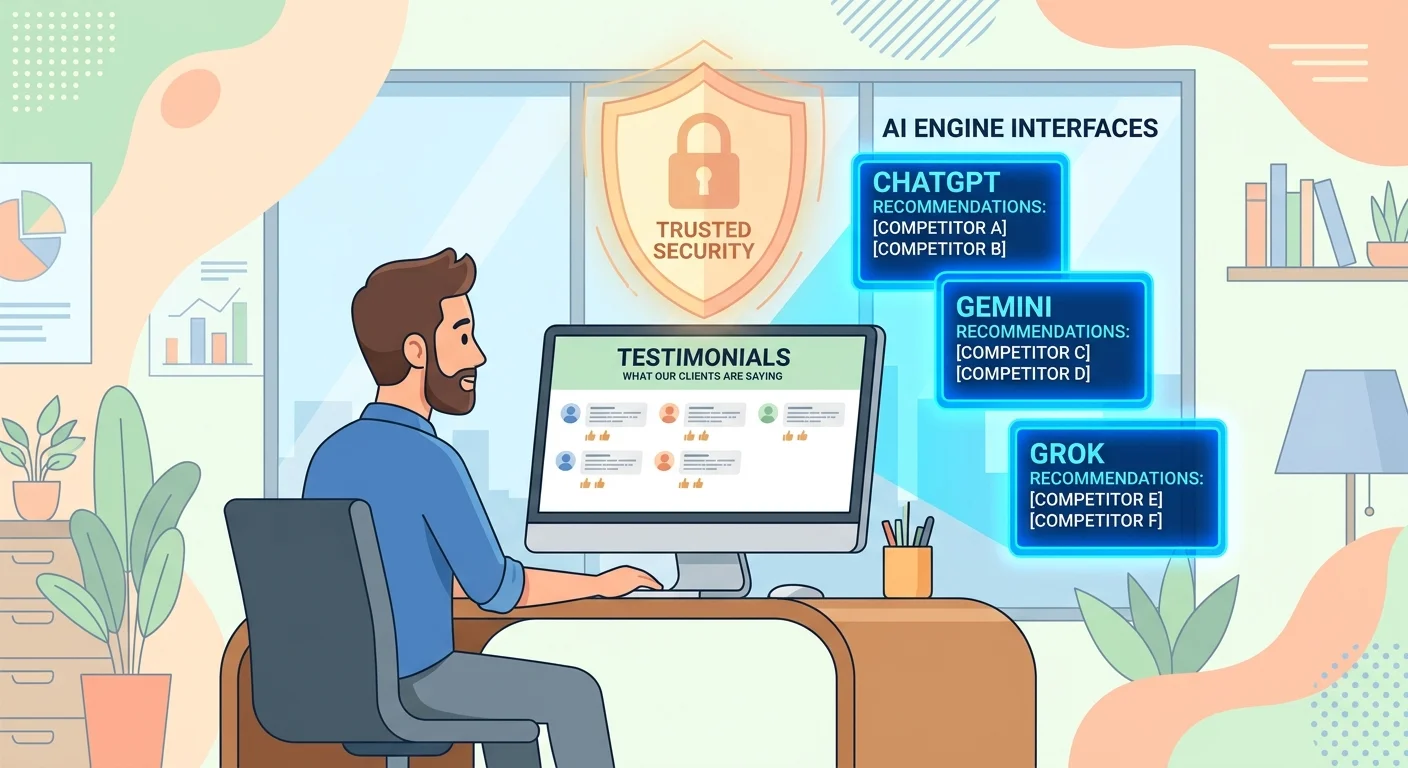
Most chiropractors look at their testimonials page and feel good.
It’s proof they’ve helped people. It’s validation of their skill.
And that emotional comfort creates a dangerous blind spot.
You think you have authority. AI thinks you’re invisible.
Here’s what’s really happening: your testimonials page is a vanity metric. It makes you feel like you’ve built proof. But it’s not connected to the systems AI uses to evaluate trust.
The “Set It and Forget It” Trap
The biggest mistake chiropractors make with proof is treating it like a project instead of a system.
You collected testimonials. You built the page. You launched it. Done.
Except authority doesn’t work that way. Not anymore.
In the age of AI recommendations, proof is a living asset that requires ongoing maintenance. Every month you go without adding new, verifiable signals, your authority decays a little more.
Your competitors who are actively building citation velocity – even if they’re objectively less skilled than you – are compounding trust while yours evaporates.
And you don’t even know it’s happening.
Because your testimonials page still looks the same. The quotes haven’t changed. The design is still clean.
But AI stopped counting any of it years ago.
Quick pause before we go further.
If you’re the kind of practice owner who wants to build authority once and never think about it again – this isn’t for you. No hard feelings.
But if that’s your expectation, you’re watching your market position erode in real time and calling it stability.
The practices that own AI recommendations six months from now are the ones treating proof as a system that compounds over time. Not a page that gets built and forgotten.
Why This Feels Unfair
I get it.
You did the work. You earned those testimonials. You built something you’re proud of.
And AI doesn’t care.
That’s not a moral judgment. It’s a structural reality. The platform changed. The mechanism for communicating value shifted. And the infrastructure you built for the old system doesn’t translate to the new one.
Your 2018 testimonials aren’t worthless because the patients lied. They’re worthless because the platform AI uses to evaluate trust didn’t exist in 2018 – or at least, it wasn’t the dominant mechanism it is now.
This is the same dynamic that happens in every industry when the rules change.
The factory that was state-of-the-art in 2000 is scrap metal in 2026 if it wasn’t maintained and upgraded. Your testimonials page is the same thing: an asset that depreciated because the market moved on.
The good news: you can rebuild.
But rebuilding requires understanding what AI actually counts as proof. Not what you wish it counted.
| Asset Type | Initial Value | Maintenance Required | Value After 5 Years Without Maintenance |
|---|---|---|---|
| Factory Machine (2000) | State-of-the-art production equipment | Regular upgrades, parts replacement, technology integration | Scrap metal – obsolete technology that cannot compete with modern systems |
| Website Testimonials (2018) | Proof of patient satisfaction and treatment success | Ongoing collection of fresh third-party reviews with structured data | Invisible to AI – static text with no verification, no recency signals, no citation velocity |
| Authority Infrastructure System | AI-readable proof across trusted platforms with schema markup | Consistent review generation producing 2-3 new verifiable signals per month | Compounding entity trust – each new signal builds on previous signals to strengthen AI recommendations |
What AI Counts as Proof (And What It Doesn’t)
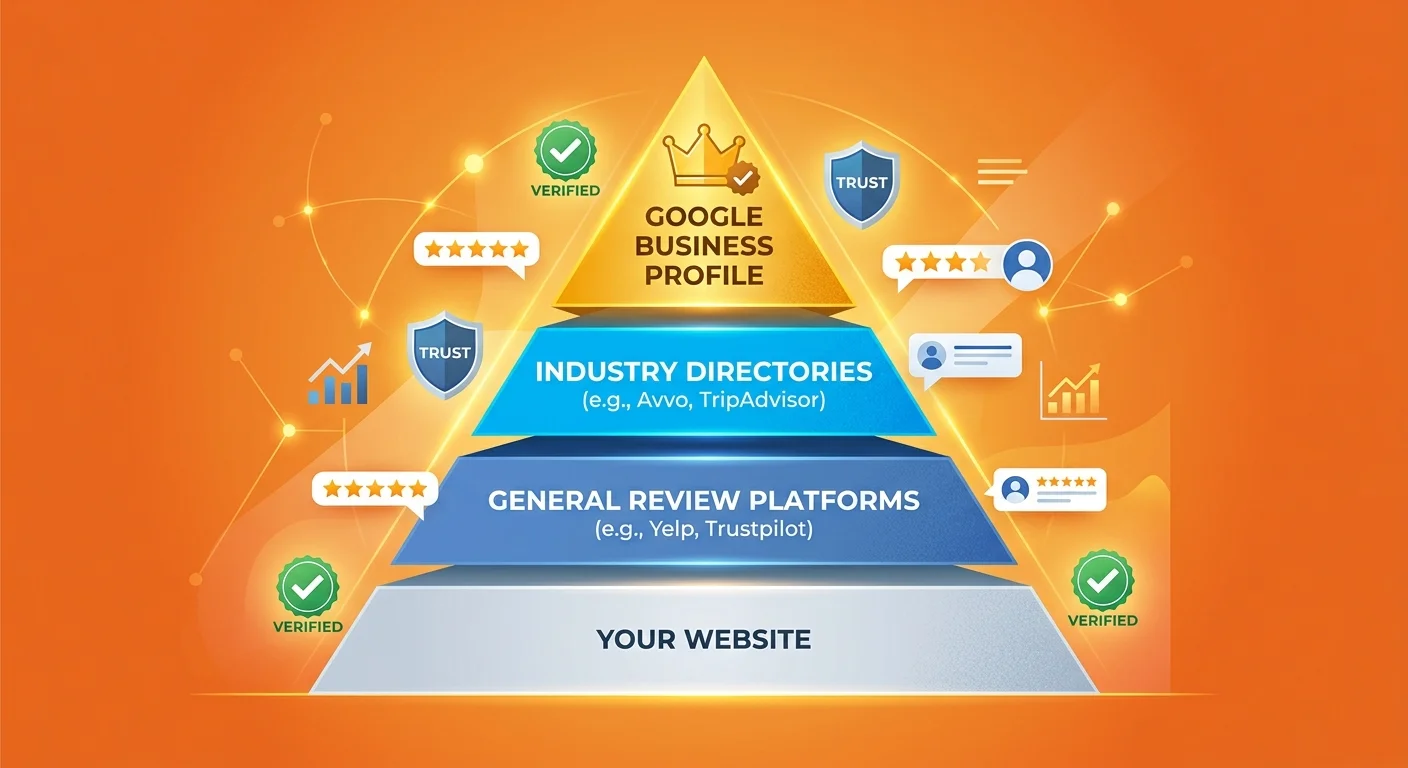
Let’s get concrete.
If your 2018 testimonials don’t count, what does?
AI evaluates proof based on three factors: platform trust, recency, and velocity. Every signal you want AI to count must meet all three.
Platform Trust Hierarchy
Not all review platforms are created equal in the eyes of AI.
Here’s the hierarchy:
Tier 1: Google Business Profile. The single most trusted source for local business proof. Google reviews are timestamped, verified, publicly auditable, and tied to real user accounts. If you’re going to focus your effort anywhere, it’s here.
Tier 2: Industry-Specific Directories. Healthgrades, Zocdoc, Vitals, RateMDs. These platforms verify healthcare providers, apply anti-fraud checks, and structure reviews in machine-readable formats. AI treats these as high-trust sources for chiropractic-specific proof.
Tier 3: General Review Platforms. Yelp, Facebook, Better Business Bureau. Still valuable, but lower trust than Tier 1 and 2 because they’re less tightly controlled.
Tier 4: Your Website. Static testimonials you publish yourself. Near-zero trust. AI can process the text, but it assigns almost no weight to it in entity trust calculations.
The further down the hierarchy you go, the less AI cares.
Recency Standards
How recent is “recent enough”?
There’s no magic cutoff, but here’s the practical standard:
Past 6 months: High-value signals. AI treats these as evidence of current relevance and active patient flow.
6-12 months: Moderate value. Still useful, but aging. Not as strong as fresh signals.
12-24 months: Low value. AI still counts them, but they’re starting to decay. They contribute to total volume but not to the recency signal AI prioritizes.
24+ months: Minimal value. These reviews demonstrate historical activity, not current authority. AI uses them as background context at best.
Your 2018 testimonials fall into the “24+ months” bucket.
That’s why they’re invisible.
Velocity Benchmarks
Citation velocity isn’t about hitting a specific number.
It’s about demonstrating consistent, ongoing activity.
A practice that gets 2-3 new Google reviews per month signals steady growth and active patient engagement.
A practice that got 50 reviews in 2019 and none since signals stagnation – or worse, decline.
AI doesn’t care if you used to be great. It cares if you’re currently relevant.
And “currently relevant” is measured by the rate of new proof accumulation, not the total volume of old proof.
Here’s the math: 10 reviews in the past six months beat 100 reviews from 2018. Every time.
Velocity compounds. Volume doesn’t.
How to Build a Proof System That Doesn’t Decay
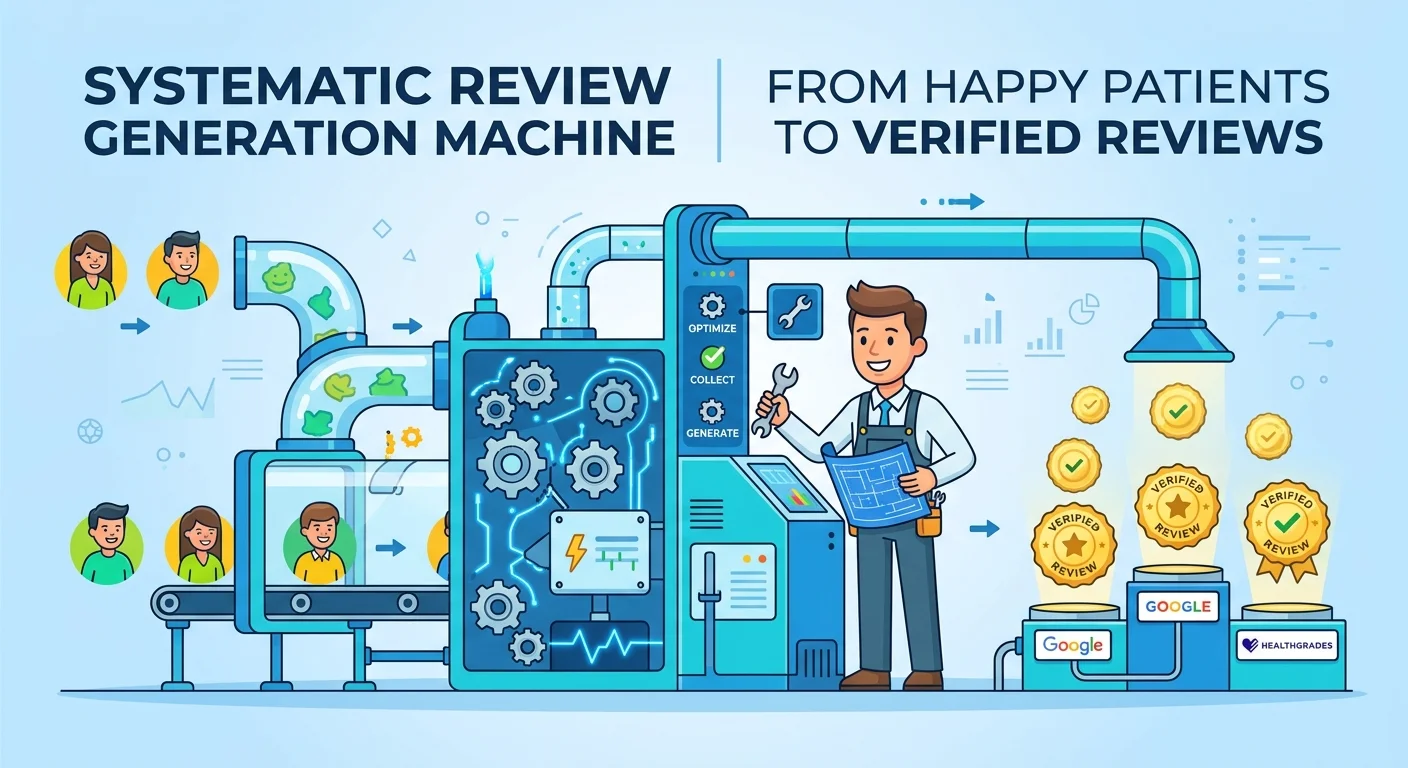
You can’t stop proof from decaying.
But you can build a system that generates new proof faster than the old proof loses value.
That’s the only sustainable model in the age of AI recommendations. Not a one-time testimonial collection campaign. A systemized, ongoing process that consistently produces the verifiable signals AI counts.
Step 1: Audit Your Current Proof Infrastructure
Before you build anything new, you need to know where you stand.
Run this diagnostic:
Google Business Profile: How many reviews do you have? What’s the average age of your most recent 10 reviews? Are any of them more than 12 months old?
Industry Directories: Are you listed on Healthgrades, Zocdoc, Vitals, and RateMDs? Do those listings have reviews? Are they accurate and up-to-date?
Website Testimonials: How old are they? Are they structured with schema markup? (Probably not.)
Citation Velocity: How many new reviews have you received in the past 6 months across all platforms?
If the answer is “zero” or “I don’t know,” you have a velocity problem.
Most chiropractors skip this step. They assume they know where they stand. Then they run the numbers and realize their proof infrastructure is 90% dead weight.
Step 2: Build a Review Generation System
You need a repeatable, low-friction process for turning happy patients into third-party reviews.
Not a favor you ask once in a while. A system that runs automatically.
Here’s what that system looks like:
Trigger Point: Identify the moment in the patient journey when they’re most satisfied. Usually right after a breakthrough result or at the end of a successful treatment plan.
Request Mechanism: Send a text or email with a direct link to your Google Business Profile review page. Make it one click. No friction. No multi-step process.
Platform Priority: Google first. Industry directories second. Your website testimonials last (if at all).
Consistency Over Volume: You don’t need 50 reviews this month. You need 2-3 reviews every month for the next 12 months. Velocity beats volume.
The practices that win AI recommendations aren’t the ones with the most total reviews. They’re the ones with the most recent reviews and the highest review velocity.
Step 3: Structure Your Existing Proof
If you already have testimonials on your website, don’t delete them.
Structure them.
Add review schema markup to each testimonial. This won’t make AI trust them as much as third-party reviews, but it’s better than unstructured text.
At minimum, schema tells AI: “This is a review. Here’s the reviewer name, the date, and the rating.”
Schema won’t save you if your proof is old. But it’s a baseline hygiene requirement.
If your testimonials don’t have schema, AI can’t even process them as reviews. They’re just generic text blocks.
Building Entity Trust requires this kind of infrastructure work. Not sexy. Not exciting. Absolutely critical.
Step 4: Monitor Your Decay Rate
Proof isn’t a set-it-and-forget-it asset.
It’s a system that requires ongoing monitoring.
Set a quarterly review cadence. Check:
Average age of recent reviews: Is it creeping up? That’s proof decay in action.
Review velocity: Are you maintaining a steady stream of new reviews, or did activity drop off?
Platform distribution: Are all your reviews on one platform, or are you building trust across multiple Tier 1 and Tier 2 sources?
If any of those metrics are moving in the wrong direction, your proof system is breaking down.
Fix it before it becomes invisible.
What Is Citation Velocity and Why Does It Matter for AI Authority? explains the math behind this in detail. If you’re not tracking velocity, you’re guessing.
Frequently Asked Questions
Does AI read the testimonials on my website at all?
AI can process the text on your website, but it assigns very low trust and authority value to self-published testimonials. They’re unstructured, unverified, and you control the platform.
That makes them biased sources in the eyes of AI.
AI doesn’t ignore your testimonials because they’re fake. It ignores them because it has no mechanism to verify they’re real.
No third-party validation means no trust signal. It’s that simple.
What’s the difference between a website testimonial and an AI-readable review?
A website testimonial is unstructured text you control.
You wrote it (or your patient did), you formatted it, you published it on infrastructure you own.
An AI-readable review exists on a trusted third-party platform – Google, Clutch, Healthgrades. It contains structured data (schema) that tells AI: “This is a review. Here’s the reviewer, the date, and the rating.”
And it contributes to a verifiable public record of your entity’s activity.
Same patient. Same outcome. Completely different trust signal.
The review is verifiable. The testimonial isn’t.
How often do I need new reviews for them to be considered “fresh”?
There’s no magic number, but AI prioritizes a steady, ongoing stream of reviews over a large batch from years ago.
Consistency matters more than a single burst of activity.
A practice that gets 2-3 new reviews per month signals steady growth and active patient engagement. A practice that got 50 reviews in 2019 and none since signals stagnation.
Citation Velocity compounds. Total volume doesn’t.
Two or three fresh reviews per month beats fifty old ones sitting idle. Every time.
But my old testimonials are from real, happy patients. Why would AI ignore them?
AI doesn’t evaluate the sentiment or authenticity of your self-published text.
It evaluates the trustworthiness of the data source.
Because you control your own website, AI considers it a biased source for proof compared to a neutral, third-party platform.
Your testimonials might be 100% truthful. That doesn’t make them trustworthy in the technical sense AI uses to determine entity trust.
Truth and trust are different things. AI cares about the second one.
Without independent verification, your claims are just claims. Doesn’t matter how real they are.
Is it better to have 10 new reviews on Google or 100 old testimonials on my website?
For AI visibility and building entity trust, the 10 new, verifiable reviews on Google are exponentially more valuable than the 100 old, unstructured testimonials on your site.
Recency and velocity beat volume. Every time.
AI doesn’t care that you used to be great. It cares if you’re currently relevant.
And “currently relevant” is measured by the rate of new proof accumulation across trusted platforms – not the total volume of old proof sitting on a page you control.
Ten fresh Google reviews this quarter say more about your practice than a hundred testimonials from 2018.
Can I just copy my old testimonials to Google and call it done?
No.
Google (and other third-party platforms) have anti-fraud systems that detect and remove fake or suspicious reviews.
If you copy testimonials from your website and post them as Google reviews, those reviews will get flagged and removed.
The whole point of third-party reviews is independent verification. If you’re the one posting them, they’re not independent.
The only sustainable way to build third-party proof is to ask your actual patients to leave reviews on the platforms AI trusts.
There’s no shortcut.
What happens if I just ignore this and keep my testimonials page as-is?
Your authority will continue to decay.
Every month you go without adding new, verifiable signals, your entity trust erodes a little more.
Your competitors who are actively building citation velocity – even if they’re less skilled than you – will compound trust while yours evaporates.
And you won’t know it’s happening until you realize AI is recommending them instead of you.
Your testimonials page will still look the same. The quotes won’t change. The design will stay clean.
But AI stopped counting any of it years ago.
The gap just keeps widening. And waiting doesn’t make it smaller.
How long does it take to rebuild authority after years of proof decay?
There’s no 90-day miracle here.
Authority compounds over time. The practices that moved early have a compounding advantage. The ones that start today have to close that gap.
But here’s the reality: starting today is better than starting six months from now.
Every month you wait, your competitors who are already building velocity pull further ahead.
I won’t promise you a timeline. What I will say: every month of consistent execution builds on the last.
The practices that stick with it compound. The ones that quit give that ground to whoever kept going.
Conclusion
Your 2018 testimonials aren’t worthless because the patients lied.
They’re worthless because the platform changed.
AI doesn’t evaluate proof the way humans do. It doesn’t care how heartfelt your testimonials sound or how many you collected.
It cares whether those testimonials exist on trusted platforms, carry structured data, and demonstrate current activity.
Your static testimonials page fails all three tests.
The Proof Decay Rule is simple: in the absence of new, verifiable signals, AI engines assume your entity trust is eroding.
Not because you stopped being good at your job. Because you stopped feeding the system AI uses to determine who to recommend.
This isn’t a temporary problem. It’s not a trend that will pass.
AI recommendations are the mechanism patients use to find chiropractors now. And that mechanism prioritizes recency, velocity, and third-party validation over everything else.
You can rebuild. But rebuilding requires understanding that authority is a system, not a project.
It’s a furnace that needs constant fuel.
The practices that treat it that way compound. The ones that don’t decay.
There’s no neutral landing here. Either your name is in the answer or a competitor’s is.
That gap widens every month it goes unaddressed.
Want to know if AI is recommending your practice – or your competitor’s?
Run the AI Visibility Check. It takes 15 minutes and shows you exactly what ChatGPT, Gemini, and Grok say when someone asks who to trust in your market.
If your proof infrastructure is decaying, you’ll see it. If your competitors have already built the systems you haven’t, you’ll see that too.
The check is free. The data is real. And it makes the next conversation a lot more concrete.