The Shift From Lists to Verdicts
Your #1 ranking isn’t broken. The system that made it matter is.
Patients don’t compare ten options anymore. They ask ChatGPT one question. They trust the one name it says. If that name isn’t yours, nothing else you optimized for means anything.
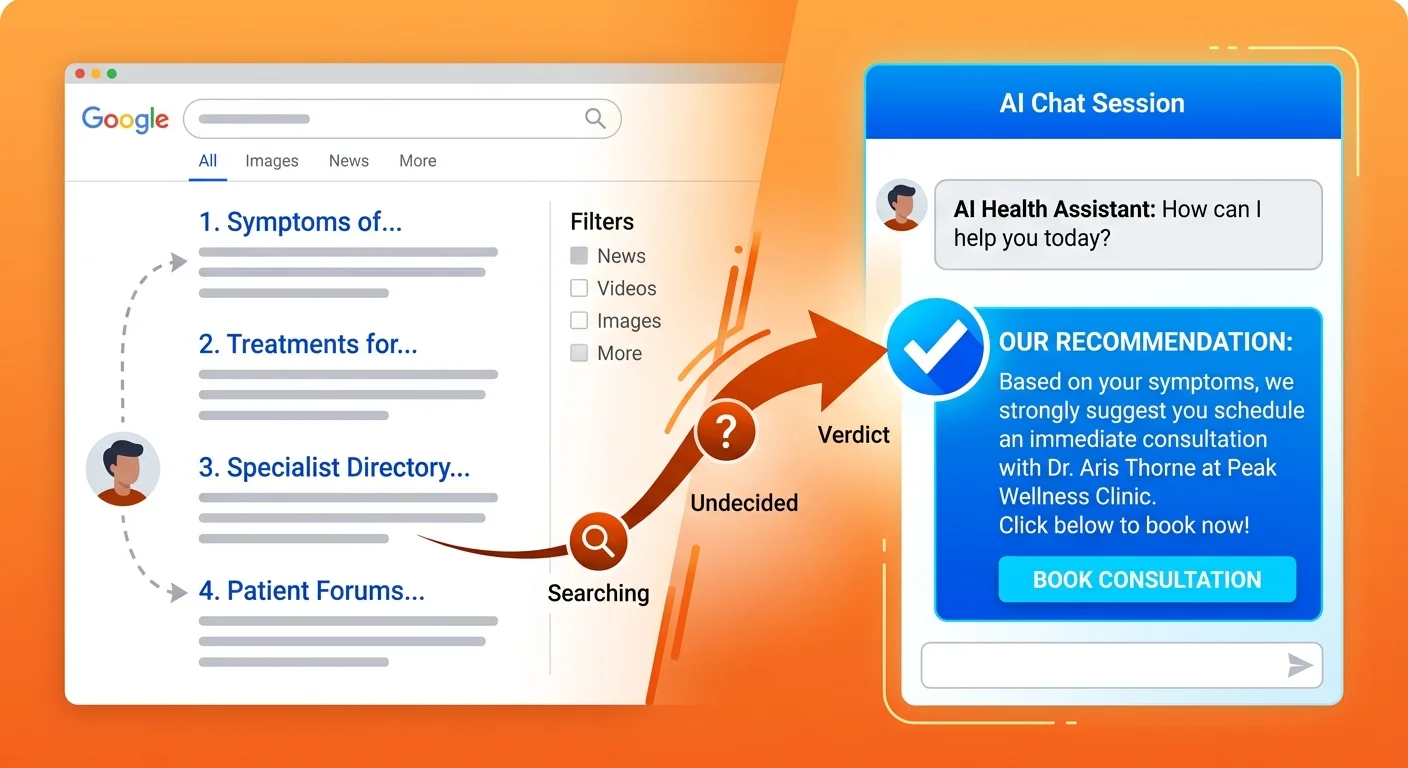
The entire foundation of SEO was built on behavior that just stopped. Google showed a list. Users clicked through. They evaluated multiple results. They compared. That’s over. AI doesn’t show options. It makes the call for them.
Search Engines Ranked – AI Engines Recommend
Google presented information. Ranked pages by relevance. Let users decide. The user clicked result one, scanned the site, backed out, tried result two. Evaluated. Compared. Eventually made a choice.
AI doesn’t work like that.
When someone asks “Who’s the best chiropractor near me?” ChatGPT doesn’t return ten links. It returns one name. That name becomes the recommendation. The patient doesn’t evaluate alternatives. They trust the verdict and move.
McKinsey research confirms generative AI is fundamentally restructuring search. The mechanism that drove discovery for twenty years got replaced in under two.
Here’s the kicker: what determines whose name AI says has nothing to do with what determined Google rankings.
Schema matters more than backlinks. Entity trust matters more than keyword density. Semantic depth matters more than domain authority. You can rank #1 on Google Maps and still be completely invisible to every AI engine making recommendations in your market.
The Zero-Click Future
Zero-click search: user asks the question, gets the answer, transaction ends. No website visit. No comparison. No secondary research.
This has been growing on traditional search for years through featured snippets and knowledge panels. AI accelerated it into the dominant model. SparkToro data (Similarweb) shows 68% of US Google searches now end without a click.
Patients get their recommendation. Act on it. Your website never enters the equation.
The traditional SEO model assumed traffic was the outcome. Get ranked. Capture clicks. Convert visitors. That chain just broke. If the patient never clicks because they already got the answer – and the answer wasn’t you – your ranking delivered zero value.
Zero-click doesn’t mean the patient took no action. It means they took action based on AI’s recommendation without needing to verify it elsewhere. AI became the trusted source. Your website became optional.
| Factor | Traditional Search | AI Search |
|---|---|---|
| User Behavior | Reviews list of ranked results, clicks multiple links, compares options before deciding | Asks conversational question, receives single recommendation, trusts AI verdict without comparison |
| Information Format | Ranked list of 10+ blue links with meta descriptions for user evaluation | Direct answer with cited source or single authoritative recommendation embedded in response |
| Decision Model | User is arbiter – evaluates multiple sources and decides independently | AI is arbiter – issues verdict based on entity trust and structured validation |
| Competitive Visibility | Top 3-5 results visible, lower positions still accessible via scroll | Only recommended entity visible – all others functionally invisible regardless of ranking |
Why Your #1 Ranking Doesn’t Mean What It Used To
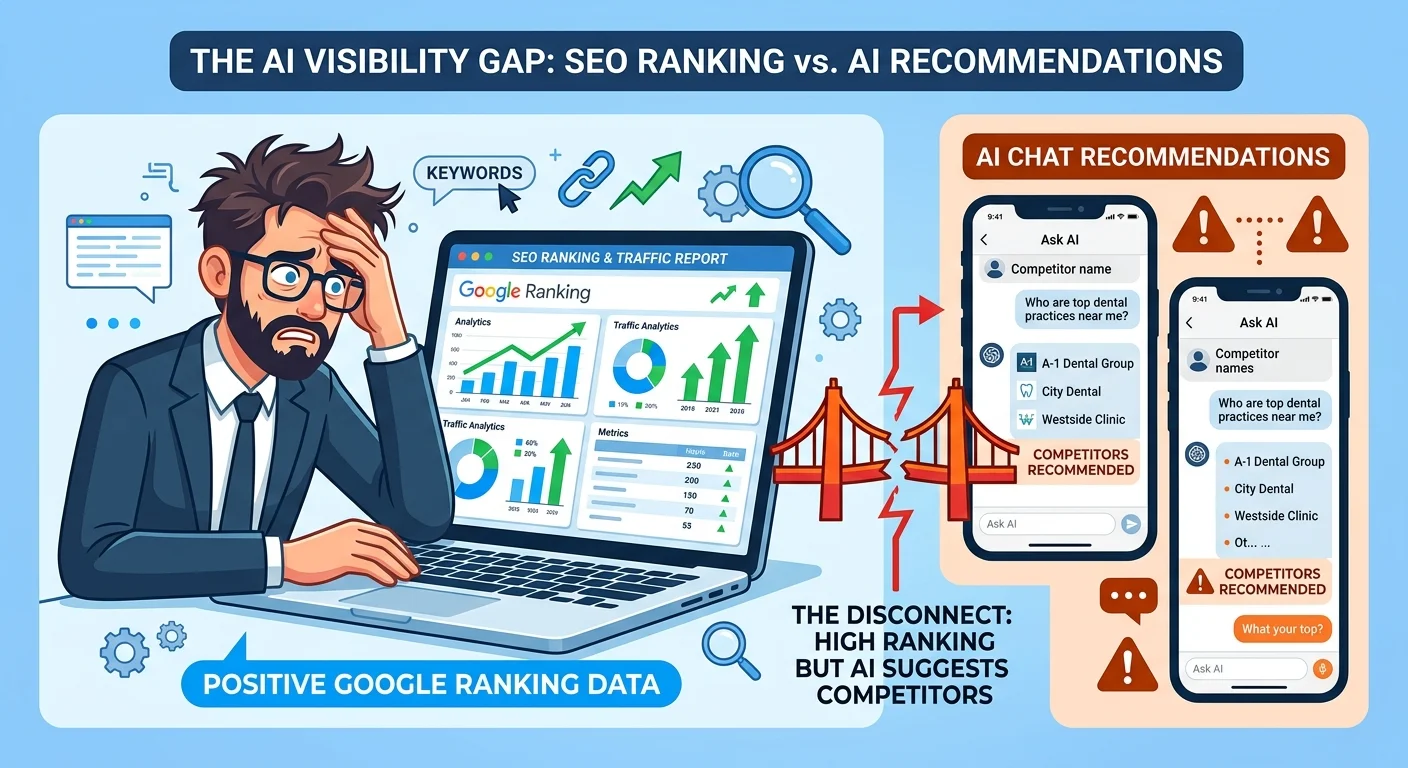
Your agency sends reports every month. Rankings up. Traffic steady. Everything looks fine.
Meanwhile ChatGPT’s recommending your competitor to every patient who asks.
You have no idea it’s happening. The reports your agency sends don’t measure it. They can’t. Because the infrastructure they built wasn’t designed for a world where AI makes the recommendation before the patient ever searches.
Rankings Measure the Old Game
Google rankings are backward-looking. They tell you how well you performed in a discovery model patients already abandoned.
High rankings meant visibility when patients reviewed lists. Now patients ask AI for a single answer. The list never loads. Your ranking never displays. The patient never sees it.
This is why agencies keep selling rankings. It’s all their infrastructure can measure. They built entire businesses around tracking keyword positions and generating traffic reports. Those metrics look impressive in a slideshow. They justify the retainer. But they measure performance in a paradigm that no longer determines patient behavior.
I’ve seen practices with perfect traditional SEO. #1 on Google Maps. Top three for every service keyword. Traffic reports showing thousands of monthly visitors.
And when we run the AI Visibility Check, ChatGPT recommends their competitor. Gemini recommends a different competitor. Grok doesn’t recommend anyone in their market at all.
The ranking you spent years building solved for the wrong outcome. You optimized for a list. Patients moved to verdicts. The gap between those two realities is where your growth disappeared.
The agencies selling you hopium aren’t lying about your rankings. The rankings are real. They’re just irrelevant. It’s like being the best typewriter salesman in 2010. Technically accurate. Strategically meaningless.
Authority Without Intent
Volume doesn’t equal value.
Your agency celebrates 10,000 monthly visitors. Sounds great. Until you realize those visitors came from broad, low-intent searches. They’re comparison shopping. Researching generically. Not ready to book.
The highest-intent patients – the ones who know they need a chiropractor and want a specific recommendation – never hit your website. They asked AI who to trust. AI gave them a name. They called that practice directly. You never entered the consideration set.
Traditional SEO chases volume because volume’s easy to report. More visitors looks like progress. But HubSpot research on changing search habits shows users are increasingly asking conversational, high-intent questions to AI engines. Those users convert at exponentially higher rates than users landing on your site from a generic keyword search.
Your visitor numbers go up while your actual patient capture rate goes down.
The math doesn’t work. Because the visibility you’re measuring is the wrong visibility. The patients you’re missing are the ones AI already sent elsewhere.
Volume without intent is a vanity metric. It justifies agency retainers. It doesn’t fill your schedule.
What AI Engines Actually Use to Decide
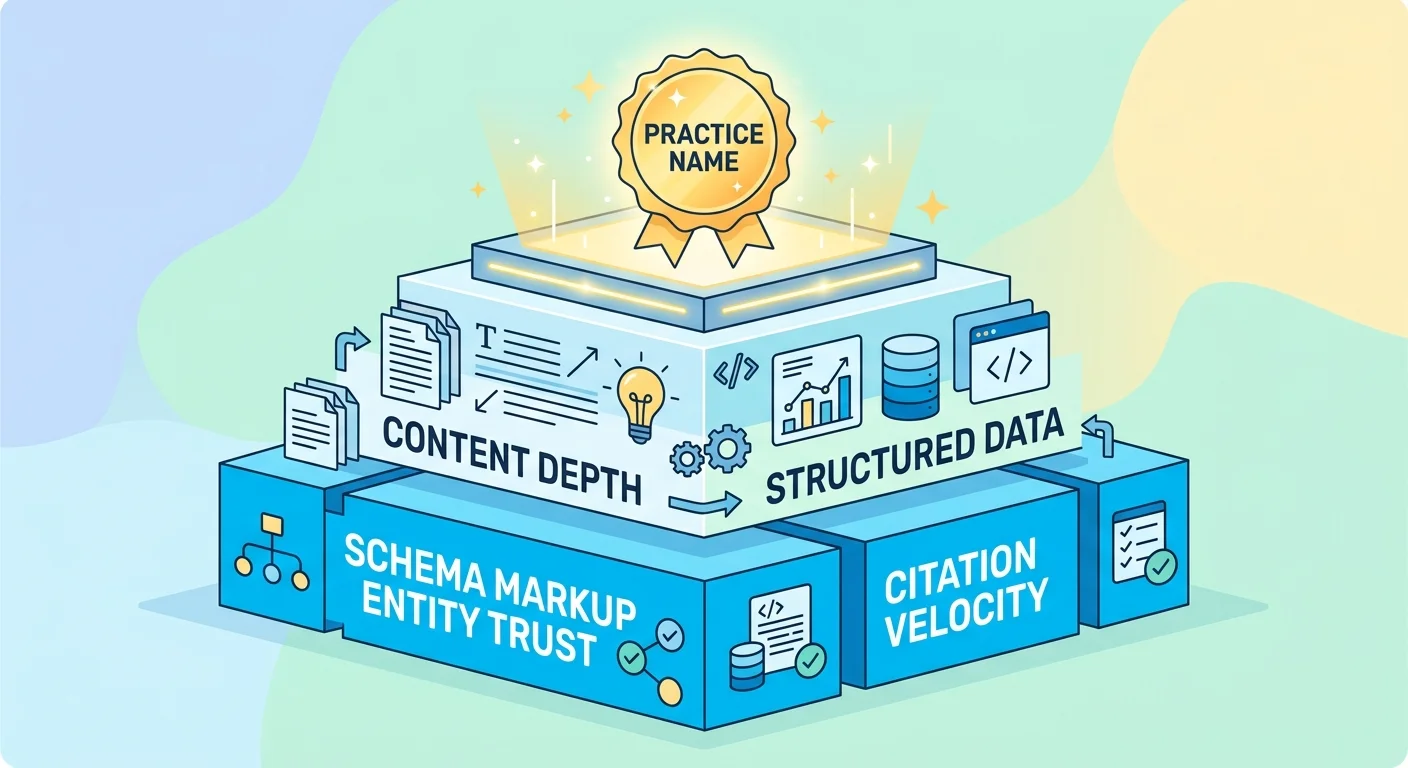
AI doesn’t rank. It validates.
Before an AI engine recommends your practice, it cross-references your identity, verifies your authority, confirms you’re a trustworthy entity. If any of those validation steps fail, you don’t get recommended. Period.
The signals AI uses to make that determination have almost nothing to do with the signals traditional SEO optimized for.
Entity Trust Over Keywords
Entity trust is how AI confirms you’re a real business with verifiable authority in your field. Not about keyword optimization. About whether AI can independently verify your identity across multiple sources.
Schema markup tells AI who you are, where you’re located, what services you provide, how to contact you. If your website doesn’t have structured data, AI can’t parse your identity reliably. You become noise. A generic result. Untrustworthy.
Directory consistency validates your entity. If your practice name, address, and phone number appear identically on Healthgrades, Zocdoc, Google Business Profile, and your website – AI sees consensus. Consensus builds trust.
If those sources conflict, AI sees uncertainty. Uncertainty disqualifies you.
Traditional SEO never prioritized entity validation. It optimized for ranking signals. Backlinks. Keyword density. Domain age. None of those signals help AI determine whether you’re the authoritative chiropractor in your market. They’re irrelevant to the decision AI makes.
Answer Engine Optimization is the discipline of building the infrastructure AI actually uses to issue recommendations. It starts with entity trust.
Structured Data as Verification
Machine-readable data is how AI understands your content.
Human-readable websites are designed for visual interpretation. AI doesn’t see design. It reads code. If your content isn’t structured with semantic markup, AI can’t extract meaning from it reliably.
This is why template websites fail in the AI era. They look fine to humans. But the code underneath is generic, unstructured, and semantically empty. AI scans it and finds nothing to validate.
The practice that built custom schema around their services, staff, conditions treated, and patient outcomes gives AI everything it needs to confirm authority.
Pretty websites optimized for humans don’t win in AI search. Structured websites optimized for machine interpretation do. Traditional web design never accounted for this. AEO does.
Citation Velocity and Third-Party Validation
AI doesn’t trust your claims about yourself. It cross-references third-party sources to confirm what you say is accurate.
If you claim you’re a chiropractor specializing in sports injuries, AI checks whether external directories, review platforms, and local citations support that claim.
Citation velocity is how frequently your practice is mentioned across authoritative third-party sources. Higher velocity signals higher relevance. If five directories mention you once and a competitor is mentioned across twenty platforms, AI interprets that as market consensus. The competitor gets recommended.
This isn’t link building. Links helped Google rank pages. Citations help AI validate entities. The mechanism is different. The outcome is binary. Either AI trusts you enough to recommend you, or it doesn’t. There’s no middle ground.
| Signal Type | Traditional SEO Value | AEO Value | Why It Matters |
|---|---|---|---|
| Keyword Density | High – determined relevance for specific search terms | Low – AI prioritizes semantic meaning over keyword repetition | AI understands context and synonyms; stuffing keywords signals low-quality content rather than authority |
| Backlink Volume | High – more links from other sites indicated authority and trust | Moderate – links help discovery but don’t validate entity identity | AI cross-references entity data from directories and structured sources rather than inferring trust from link graphs |
| Schema Markup | Low – optional enhancement for rich snippets in search results | Critical – required for AI to parse identity, services, and authority | Without structured data, AI cannot reliably extract or validate key entity information from unstructured web pages |
| Directory Consistency | Low – NAP consistency mattered for local pack but not organic rankings | Critical – validates entity across independent third-party sources | AI requires consensus signals to confirm a business is real, trustworthy, and authoritative before issuing a recommendation |
The Problem With Your Current Marketing Agency
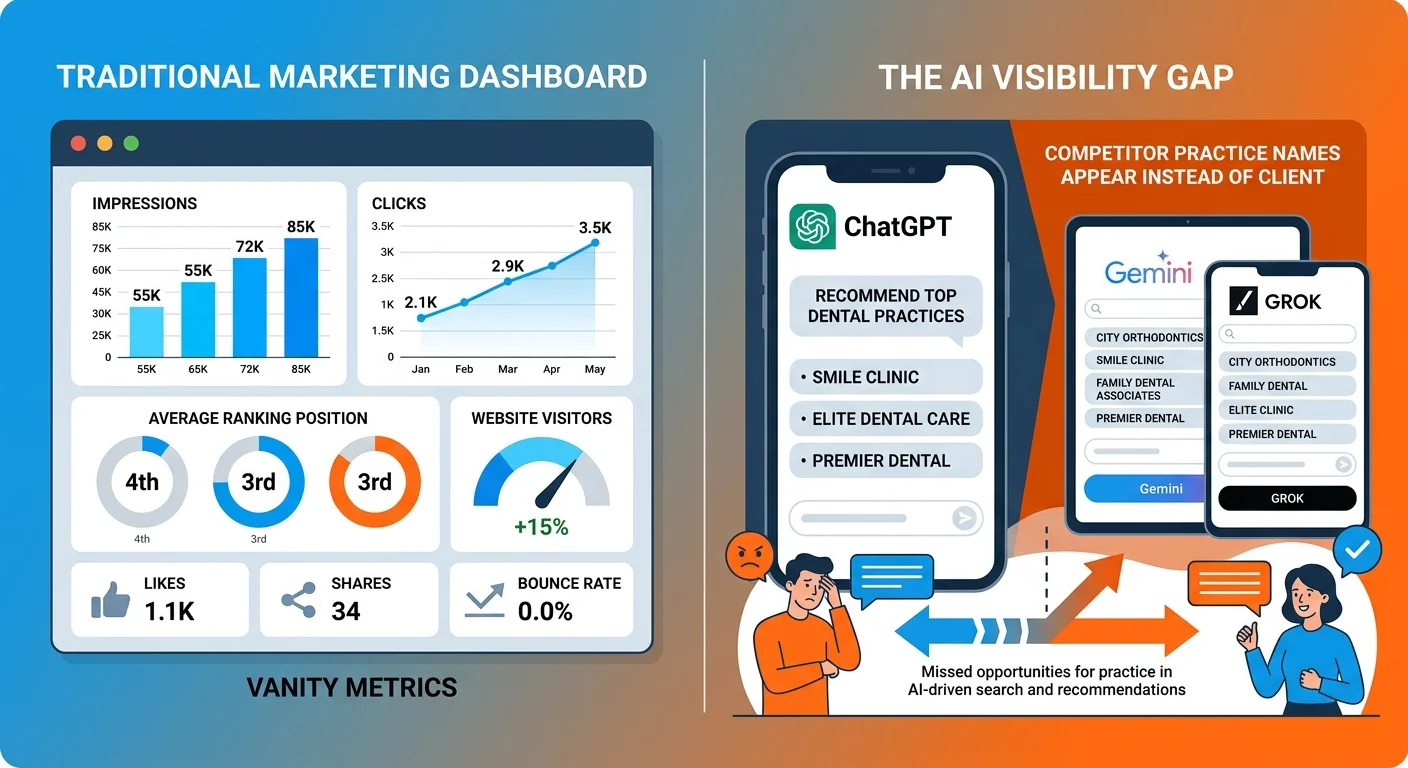
If you’re working with a traditional marketing agency right now, there’s a good chance they have no idea whether AI is recommending you or not.
Not because they’re incompetent. Because their entire infrastructure was built to measure a world that no longer exists.
And here’s the brutal part: they can’t tell you the truth even if they wanted to. Because admitting that rankings don’t matter anymore means admitting their entire service offering is obsolete. So they keep reporting what they can measure. And you keep paying for reports that don’t reflect reality.
Quick pause before we go further.
If you’re looking for a way to flood your schedule in the next 60 days, this isn’t it. Authority is built in layers. Foundation first, content compounding on top, AI visibility deepening every month. If that timeline doesn’t fit your decision framework – no hard feelings.
But if you’re tired of short-term tactics that disappear the moment you stop paying for them, you’re in the right place.
They Sell What They Can Measure
Marketing agencies built their businesses around tools that track rankings, impressions, and authority visibility. Those tools integrate with Google Analytics and Google Search Console. They generate reports automatically. The agency can show you graphs with upward-trending lines every month.
It looks like progress.
But none of those tools can tell you what ChatGPT said when a patient asked for a chiropractor recommendation in your city. They can’t tell you whether Gemini validated your entity or ignored you entirely. They can’t show you that Grok recommended your competitor instead of you.
So they don’t report it. They report what their dashboards show. Rankings. Authority visibility. Click-through rates. Metrics that made sense when patients evaluated lists. Metrics that are now completely disconnected from the mechanism determining who captures new patients.
iTech Valet doesn’t track rankings. We track what AI says. That’s the only metric that matters now.
But most agencies can’t make that pivot. Their entire infrastructure, pricing model, and operational workflow is built around managing traditional SEO campaigns. Rebuilding for AEO would require starting over. So they keep selling what they know how to deliver – even though it no longer drives the outcome you hired them to achieve.
The Reports Look Good While You Lose Ground
This is the part that makes the problem invisible.
Your agency isn’t lying. The numbers they report are accurate. You are ranked #1 for “chiropractor near me.” Your authority visibility did go up 15% this quarter. Your Google Business Profile views are higher than last year.
All true. And completely irrelevant if AI is recommending your competitor.
University of Pennsylvania research on post-ChatGPT SEO disruption confirms that large language models are fundamentally changing how search works – and traditional SEO metrics no longer correlate with user acquisition. The old signals measure the old game. The new game operates on entirely different infrastructure.
You’re paying for optimization that doesn’t influence the outcome that matters. Every month you stay with that agency, your competitor – the one AI is actually recommending – compounds their authority. The gap widens.
And your reports still look great.
The agencies that figured this out early pivoted to AEO. The ones that didn’t are still selling rankings. Guess which one most practices are still paying for?
The Verdict Economy
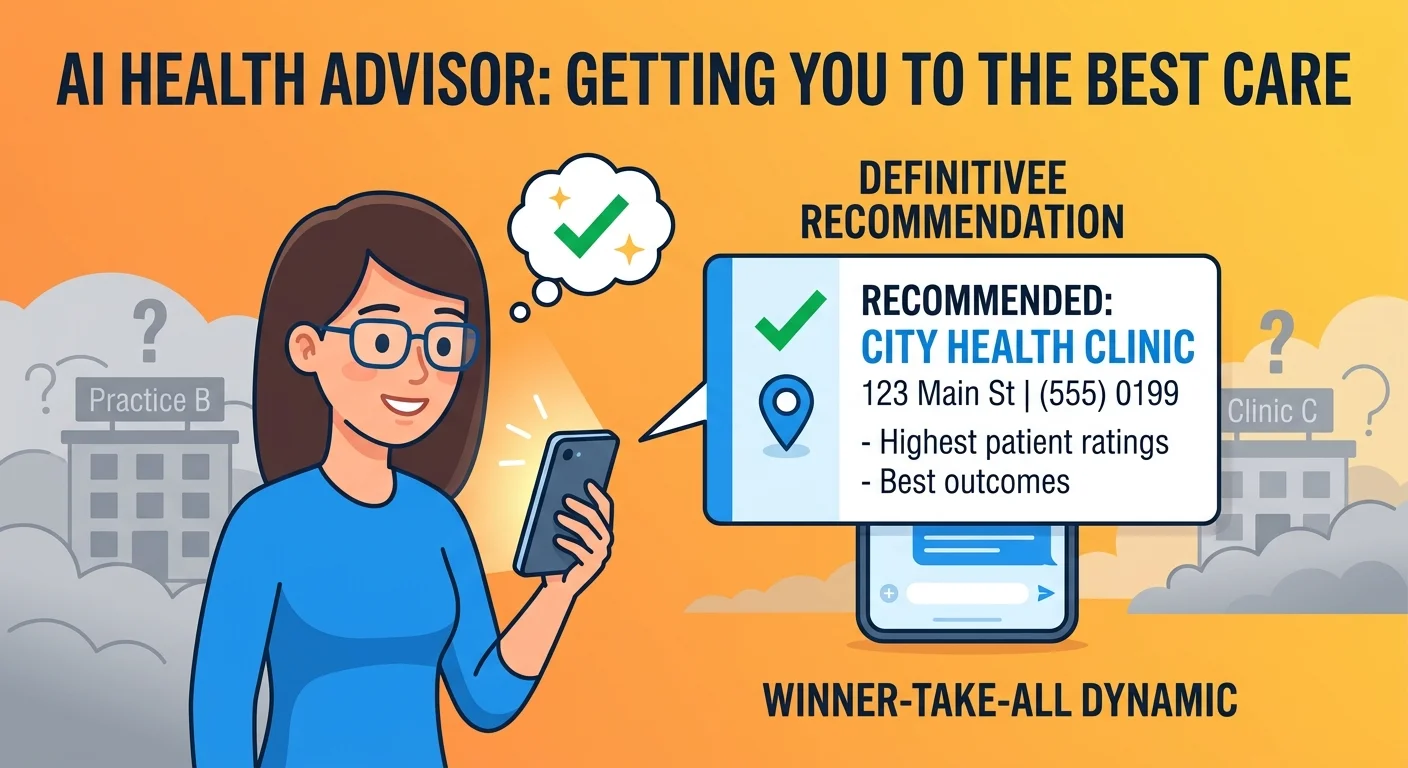
AI doesn’t present options. It picks winners.
One name per query. That’s the entire mechanism. And once a practice becomes the answer AI gives, every subsequent recommendation compounds their authority. The gap between first place and second place isn’t marginal. It’s infinite.
One Answer Takes Everything
Traditional search distributed visibility across multiple results. The top three spots captured most of the authority visibility, but positions four through ten still received clicks. There was a gradient. Visibility declined, but it didn’t disappear.
AI search is binary.
You’re either the recommendation or you’re not. There is no position two. If ChatGPT recommends your competitor, you captured zero visibility from that query. The patient never knew you existed. They didn’t scroll past you. They didn’t see your name and choose someone else. You were not in the conversation.
This is the zero-sum game of AI authority. One practice captures the patient. Everyone else gets nothing. The mechanism doesn’t distribute opportunity. It concentrates it.
Every patient who asks AI for a chiropractor recommendation and hears your competitor’s name strengthens that competitor’s position. The AI engines track which recommendations patients act on. If users consistently book with the practice AI recommended, that signals validation. The next time someone asks, AI is even more confident recommending that same practice.
Authority compounds. And market authority displacement happens fast. The practice that becomes the answer in January has exponentially more authority by June than the practice that waited to act.
The Compounding Gap
Let’s say two practices start the year with equivalent visibility.
Practice A invests in AEO. Practice B keeps paying for traditional SEO.
By month three, AI starts recommending Practice A. Not every time – but often enough that patients begin booking.
Month four: Practice A’s entity trust increases because AI engines see confirmation that users acted on the recommendation. Practice B still ranks #1 on Google. Still gets traffic. Still looks successful in their agency reports. But they’re not capturing the highest-intent patients. Those patients asked AI. AI said Practice A. They booked.
Month six: Practice A is now the dominant recommendation in that market. Their content library has grown. Their schema is validated across more platforms. Their citation velocity is higher. AI recommends them almost every time.
Practice B’s ranking hasn’t changed. Their authority visibility is stable. But their growth has flatlined because they’re not visible where decisions are actually being made.
By month twelve, the gap is insurmountable. Practice A owns the AI recommendations in that market. Practice B would need to rebuild their entire infrastructure from scratch to compete.
Most won’t. Because their agency is still telling them everything looks fine.
| Month | Recommended Practice Authority | Non-Recommended Practice Authority | Patient Capture Gap |
|---|---|---|---|
| Month 1 | Baseline entity trust established, initial schema deployed, early content execution | Baseline entity trust, no AEO infrastructure, traditional SEO only | Minimal – both practices capture similar patient volume through legacy discovery methods |
| Month 3 | AI begins issuing intermittent recommendations, citation velocity increasing, user validation signals emerging | Static authority, rankings maintained, traffic steady but intent declining | Moderate – recommended practice captures 20-30% more high-intent patients asking AI directly |
| Month 6 | Dominant AI recommendation in market, compounding content authority, consistent cross-platform entity validation | Authority unchanged, no AI visibility, growth plateaued despite stable rankings | Significant – recommended practice captures 60-70% of high-intent AI-driven patient queries |
| Month 12 | Market authority locked, insurmountable entity trust gap, owns AI recommendations across all major engines | Infrastructure rebuild required to compete, traditional metrics still positive but growth stagnant | Structural – recommended practice captures 85%+ of AI-sourced patients, gap now nearly impossible to close |
What Actually Drives AI Recommendations
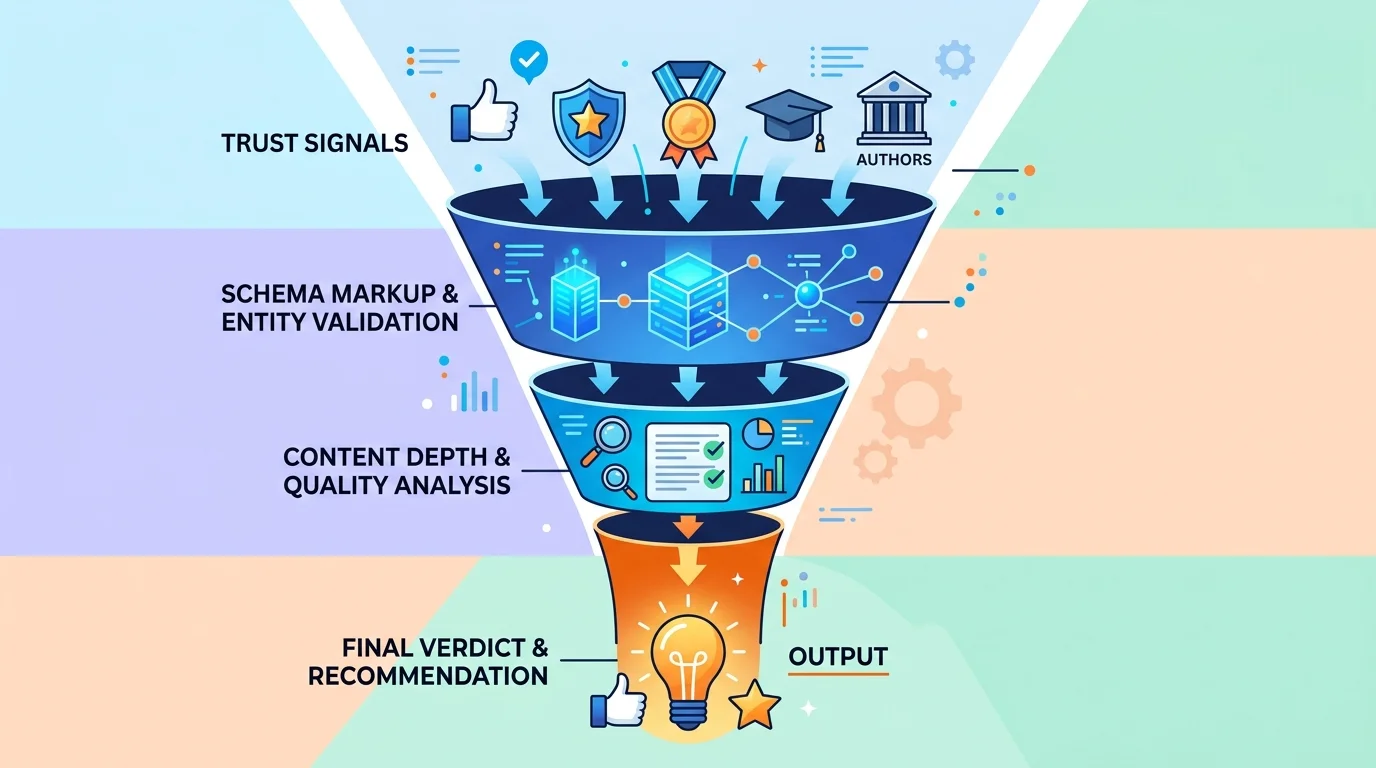
AI doesn’t make recommendations arbitrarily. It runs a validation process.
Your practice either passes that process or it doesn’t. The infrastructure that determines whether you pass has nothing to do with the infrastructure traditional SEO built.
Infrastructure That AI Can Read
A pretty website means nothing to AI if the underlying code is generic and unstructured.
Template websites are designed for human eyes. They look professional. They load fast. They have clean layouts. But when AI scans them, it finds nothing to validate.
Schema markup is how AI reads your website. It tells AI your business name, services, location, hours, staff credentials, and authority signals in a machine-readable format. Without it, AI has to guess. And when AI isn’t certain, it doesn’t recommend you.
Most websites don’t have schema at all. The ones that do often have incomplete or incorrectly implemented markup. LocalBusiness schema without the required properties. Service schema that doesn’t define what services you actually provide. Person schema with no credentials listed.
AI-readable infrastructure isn’t an SEO enhancement. It’s the foundation that determines whether AI can validate your entity at all. If your website fails that test, nothing else matters. You’re invisible by default.
Content That Proves Depth
AI validates authority through content depth.
A five-page website with generic service descriptions signals surface-level presence. A content library with dozens of condition-specific, treatment-specific, and question-specific articles signals expertise.
This isn’t blog content for the sake of publishing. It’s semantic proof. AI engines analyze whether your content demonstrates deep understanding of the topics patients ask about. If a patient asks “What causes sciatica?” and your website has a comprehensive, citation-backed article answering that question – and a competitor’s website has a single paragraph – AI sees a clear authority signal.
Content execution in AEO is about building a body of evidence that proves your expertise. Every article is another validation point. Another semantic anchor. Another reason for AI to trust that you’re the authoritative source in your market.
Generic content doesn’t count. AI can detect when content is thin, unsourced, or formulaic. The content that drives recommendations is specific, evidence-based, and demonstrates original thought. That’s the difference between content marketing as a commodity tactic and content as authority infrastructure.
Directory Consistency as Validation
AI doesn’t trust what you say about yourself on your own website. It cross-references third-party sources to confirm your claims are accurate.
If your practice name, address, and phone number appear identically on Healthgrades, Zocdoc, Google Business Profile, and Yelp – AI sees consensus. Consensus signals legitimacy.
If those sources conflict – your address is different on Healthgrades than it is on your website, your phone number has a typo on Zocdoc, your business name is inconsistent across platforms – AI sees uncertainty. Uncertainty disqualifies you.
Gartner survey data shows that the majority of consumers are now using generative AI tools regularly. Those users expect AI to provide vetted, trustworthy recommendations. AI won’t risk recommending a practice it can’t independently verify. The validation happens through directory consistency, citation velocity, and third-party authority signals.
This is why the AI Authority Engine starts with infrastructure. Entity validation first. Then content depth. Then citation building. In that order. Because if AI can’t validate your identity reliably, nothing else moves the needle.
Frequently Asked Questions
Is SEO dead because of AI?
SEO isn’t dead. Its purpose changed.
Traditional SEO optimized for rankings – getting your website to appear in a list of search results for specific keywords. That made sense when users evaluated multiple results and clicked through to compare options.
AI search doesn’t present lists. It provides answers. The discipline that optimizes for being the single, trusted answer an AI engine cites is called Answer Engine Optimization (AEO). It uses different signals, different infrastructure, and different validation mechanisms than traditional SEO.
If your SEO strategy is still chasing keyword rankings and backlink volume, you’re optimizing for a discovery model patients have already abandoned. If your strategy prioritizes entity trust, structured data, and semantic authority – you’re optimizing for the mechanism that actually determines who captures patients now.
SEO evolved. The agencies that didn’t evolve with it are still selling the old version.
If I rank #1 on Google Maps, will AI recommend me?
Not necessarily.
A strong Google Business Profile is one authority signal among many. It helps. But it’s not sufficient on its own.
AI engines like ChatGPT and Grok cross-reference multiple sources before issuing a recommendation. They check your website’s schema markup, your directory consistency, your content depth, and your third-party citations. If your Google Business Profile is strong but your website lacks machine-readable infrastructure – or your directory listings conflict – AI won’t trust the entity enough to recommend it.
I’ve seen practices ranked #1 on Google Maps who are completely invisible to AI. The local pack ranking measures performance in Google’s algorithm. AI recommendations measure entity trust across independent validation sources. Those aren’t the same thing.
Your Google Business Profile matters. It’s part of the validation process. But it’s not the whole process. If you’re relying on GBP alone to drive visibility, you’re missing the infrastructure that determines whether AI recommends you.
What is a “zero-click search”?
A zero-click search is when a user asks a question and gets the answer directly from the platform – without needing to click a link to a website.
They query the platform. The platform provides the answer. The transaction ends there.
This has existed on Google for years through featured snippets and knowledge panels. But AI has made it the dominant model. When someone asks ChatGPT “What causes lower back pain?” ChatGPT doesn’t return a list of articles to read. It provides a direct answer. The user never visits a website.
For practices, this changes everything. If a patient asks AI who the best chiropractor in their area is, AI provides a name. One name. If that name is yours, you captured the patient. If it’s not, the patient never knew you existed. Zero-click means zero visibility for everyone except the answer AI gave.
Your website traffic becomes irrelevant if patients are getting their recommendations from AI without ever clicking through to your site. The visibility you built through traditional SEO doesn’t matter if the discovery mechanism changed.
How can I find out what AI says about my practice?
You already know your rankings are strong. Your agency shows you reports every month. Traffic is steady. Everything looks fine.
Except new patient bookings aren’t keeping pace the way they used to. Something’s off. You just don’t know what.
Here’s what’s actually happening: patients stopped asking Google. They started asking AI. And when they ask ChatGPT or Gemini who to trust, your competitor’s name comes up. Not yours. You’re invisible in the exact channel where the highest-intent patients are making their decisions. And you had no idea because your agency can’t measure it.
The only way to find out what AI actually says is systematic discovery. You have to query multiple AI engines with the same patient questions your market asks – and see whose name appears.
That’s what the AI Visibility Check does. Fifteen minutes. We run your market through ChatGPT, Gemini, and Grok. You see exactly what patients see when they ask AI who to trust.
Most practices assume they’re visible. They’re ranked well. Their GBP is optimized. Their website looks professional. Then we run the check and show them that AI is recommending a competitor. Or worse – AI says it doesn’t have enough information to recommend anyone in that market. Which means the entire category is invisible.
You can’t fix a gap you don’t know exists. The check makes the problem self-evident. If AI is recommending you – we’ll show you that. If it’s recommending someone else – you’ll see exactly what patients are hearing instead of your name.
Why does Google visibility still matter then?
Google visibility still has value. If someone lands on your website and converts, that’s a win.
The issue isn’t that traditional search disappeared. It’s that the highest-intent patients already shifted.
Patients who ask AI for a recommendation are decision-ready. They want a trusted answer. They’re not comparison shopping. They’re not researching generically. When AI gives them a name, they call that practice. Those patients convert at exponentially higher rates than users who land on your website from a broad keyword search.
The visitors you’re still capturing from traditional search are lower-intent. They’re researching. They’re comparing. They might book eventually – but they’re not ready to act immediately. The patients you’re missing – the ones asking AI directly – are the ones who book fastest and show up most consistently.
Traditional search visibility is a lagging indicator. It measures performance in a discovery model that’s declining. The patients driving your future growth are already using AI. If you’re not visible there, you’re losing the exact audience that matters most. And your reports will never tell you that’s happening.
The Answer or Nothing
There’s no middle ground in AI search. You’re either the recommendation or you’re invisible.
That binary outcome is the entire game now. And the practices that recognize it early will own their markets. The ones that wait will spend the next two years watching their competitors compound authority while their traditional SEO metrics stay strong and their growth flatlines.
Rankings don’t matter if patients never see the list. Google visibility doesn’t matter if it’s the wrong visibility. Your agency’s reports don’t matter if they’re measuring the wrong outcome.
What matters is whether AI says your name when someone asks.
That’s it. That’s the entire mechanism determining who captures patients in your market going forward. The infrastructure that controls that outcome is AEO. Entity trust. Structured data. Semantic authority. Citation velocity. Content depth. Directory consistency. None of that overlaps with traditional SEO. None of it shows up in the reports your current agency sends.
The practices building that infrastructure now will be insurmountable by the time the rest of the market figures out what happened. Authority compounds. The gap widens every month. There is no version of this where sitting still is a safe play.
If your competitor is the answer AI gives six months from now, you lost market share you will never recover. Not because they outspent you. Because they moved when the mechanism changed and you didn’t.
Your rankings look great. Your Google visibility is steady. Your agency tells you everything is fine.
Meanwhile, every patient who asks ChatGPT for a recommendation is hearing a competitor’s name. Not yours. And you had no idea it was happening because your reports don’t measure what AI says.
The AI Visibility Check runs in fifteen minutes. We query ChatGPT, Gemini, and Grok with the exact questions patients ask in your market. You see what they see. If AI is recommending you – you’ll know it. If AI is recommending someone else – you’ll see exactly whose name patients are hearing instead of yours.
No guesswork. No assumptions. Just raw data showing whether you’re the answer or you’re invisible.
The practices that own AI authority six months from now are building it today. Waiting isn’t a neutral position. It’s a choice to let the gap widen while your competitor compounds.
See what AI says about your practice. Run My AI Visibility Check