Why AI Gets Your Business Wrong
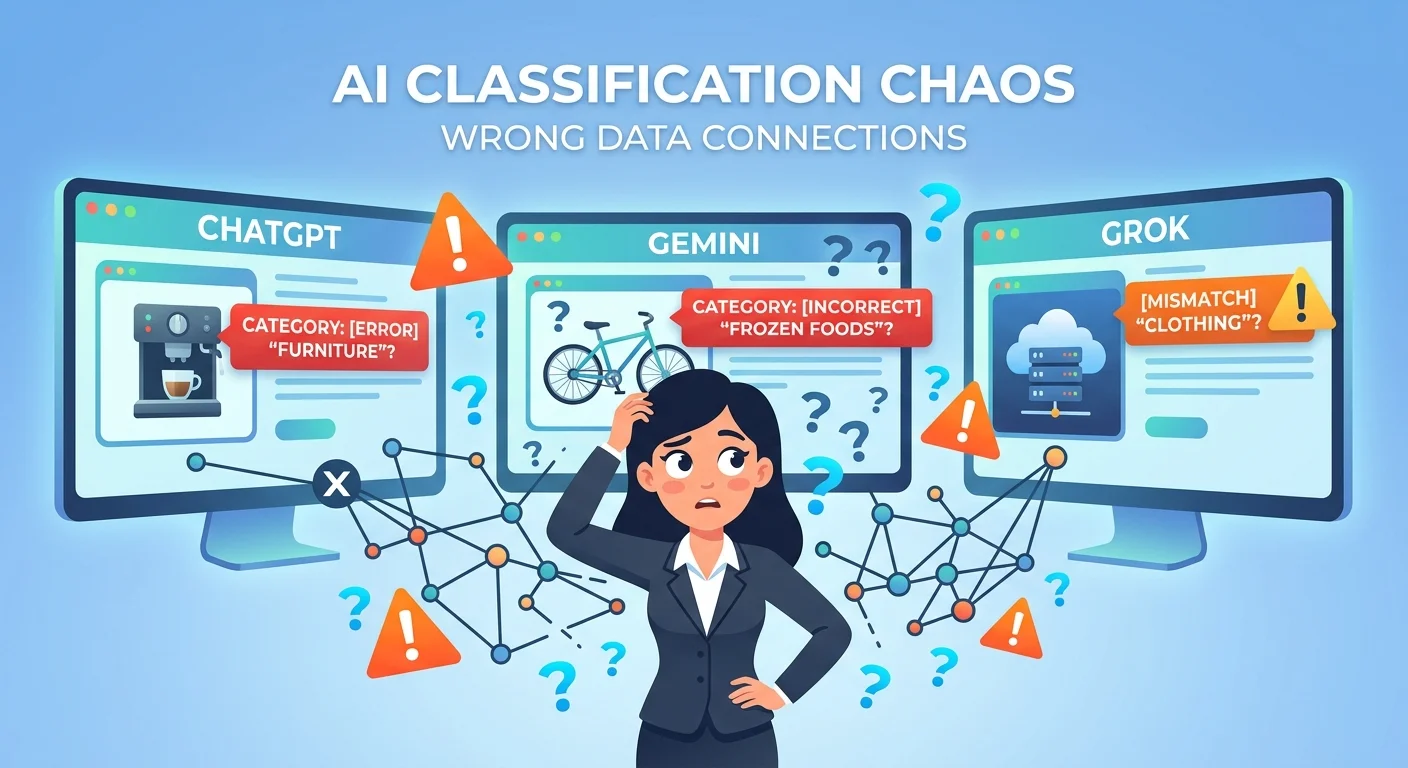
AI doesn’t classify your business based on what you tell it. It classifies you based on what it can verify across fragmented, contradictory sources scattered all over the internet.
AI models aren’t connected to a live database of truth. They’re trained on massive datasets scraped from the web – directories, reviews, blog posts, social profiles, news articles. They use statistical patterns to predict what answer sounds right. When your entity signals are weak, outdated, or inconsistent, the model fills the gaps with its propensity for AI models to ‘hallucinate’. It invents plausible-sounding facts. That’s not a bug. That’s what it’s designed to do.
The misclassification isn’t malicious. It’s structural. And you can’t fix it with a correction request. You fix it by addressing the root cause – the infrastructure AI engines use to decide whether your business is trustworthy enough to cite.
The Training Data Problem
AI models are trained on snapshots of the internet. Not real-time feeds. That training data is messy. Outdated directory listings. Competitor blog posts that misrepresent your services. Review sites with incomplete profiles. Social media pages you abandoned in 2019.
When the model encounters conflicting information – one source says you’re a general practitioner, another says you’re a wellness coach, a third lists services you stopped offering three years ago – it doesn’t flag the discrepancy. It picks the pattern that showed up most often in its training data. If your competitors have cleaner, more consistent entity signals, the model defaults to citing them. Not you.
You can’t fix training data retroactively. But you can flood future data collection cycles with such strong, consistent entity signals that the model has no choice but to classify you correctly.
The Entity Trust Gap
Search engines shifted from keyword-based ranking to entity-based authority. AI models inherited that framework. They don’t just look for mentions of your business name. They look for structured proof that your business exists, operates in a specific market, serves a defined audience, and has verifiable third-party validation.
- Schema markup is missing or broken
- NAP data is inconsistent across directories
- Content doesn’t reinforce entity relationships
- Internal linking structure is shallow
- AI engines interpret this as a trust gap – and when trust is weak, you don’t get cited
Building entity trust isn’t about perfecting a single page. It’s about constructing a machine-readable authority layer across every signal AI models use to validate businesses. How Google understands entities is the same framework these models rely on. When that layer is strong, misclassification becomes structurally impossible.
| AI Behavior | Root Cause | Why Corrections Don’t Stick |
|---|---|---|
| Names a competitor when asked for a local recommendation | Your entity signals are weaker or less consistent than theirs across the training data | Training data is already baked in – submitting a correction doesn’t rebuild your authority infrastructure |
| Describes your services inaccurately or lists outdated offerings | Fragmented NAP data, inconsistent directory profiles, and abandoned social pages create conflicting patterns | AI aggregates what it found most often during training – one updated profile doesn’t override dozens of stale signals |
| Classifies your business in the wrong category or industry | Missing or broken schema markup means the model has no structured entity data to reference | The model defaults to pattern-matching from unstructured text, which is inherently unreliable |
| Invents plausible-sounding facts about your practice that aren’t true | The model prioritizes textual coherence over factual accuracy – hallucinations fill gaps where verifiable signals are weak | Correcting one hallucinated output doesn’t address the trust gap that caused it |
| Cites outdated reviews, addresses, or team member names | AI training snapshots capture the web as it existed months or years ago | Real-time corrections don’t propagate backward into the static training set the model relies on |
| Recommends businesses with stronger online presence even when quality is comparable | AI engines interpret citation density, review volume, and content depth as proxy signals for trustworthiness | Surface-level fixes like monitoring mentions don’t build the citation-ready content architecture AI engines reward |
What Most Businesses Try (And Why It Fails)
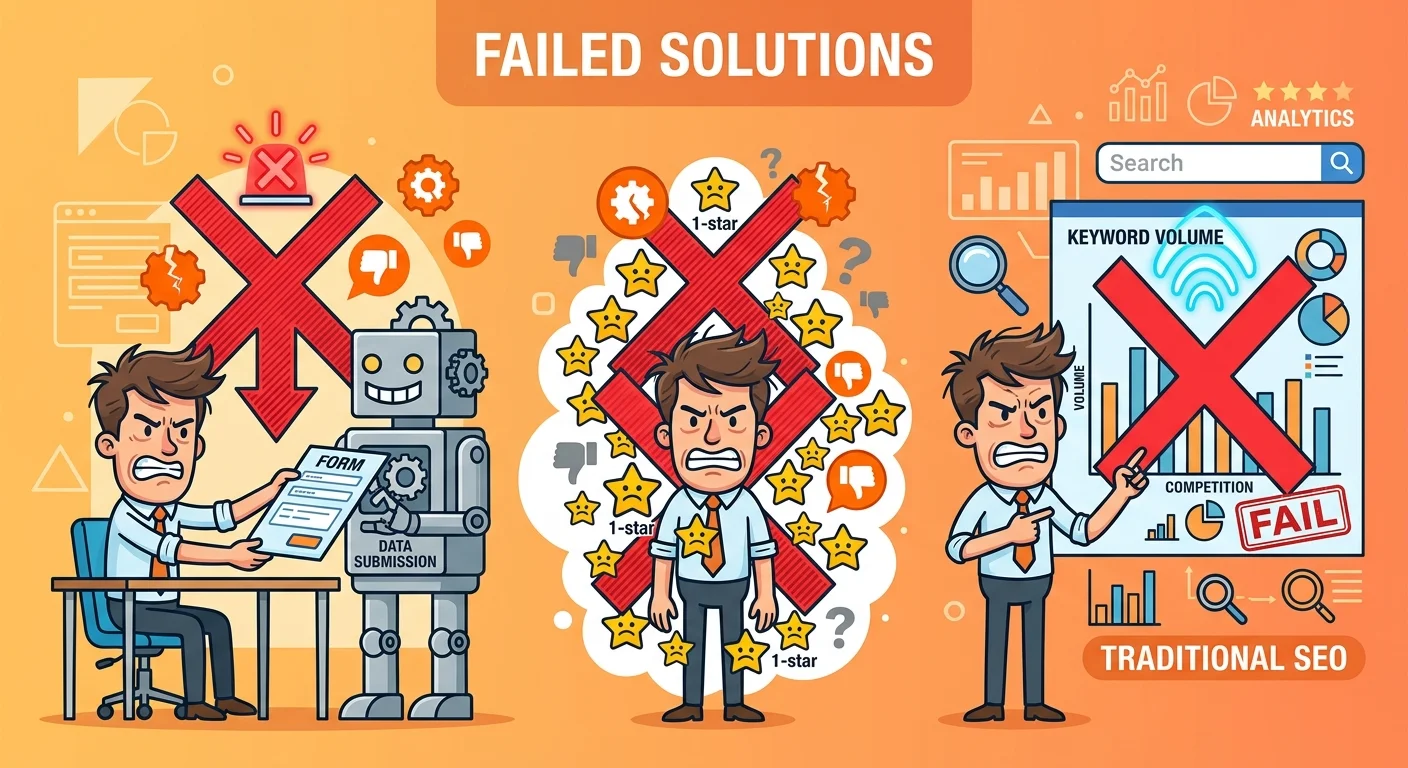
Most practices assume AI misclassification works like a typo you can fix with a quick email.
It doesn’t.
They discover ChatGPT named a competitor and reach for the same three moves. Submit a correction request to the platform. Hire a reputation management firm to monitor what AI says. Double down on traditional SEO and hope rankings fix it.
None of those work.
Not because the effort is wasted. Because they’re solving the wrong problem. AI misclassification isn’t a customer service issue you can ticket your way out of. It’s a structural authority gap. Structural problems don’t respond to surface-level fixes.
Submitting Correction Requests
The first move is predictable. Find the "report a problem" button. ChatGPT has a feedback form. Perplexity lets you flag bad answers. Google’s AI Overviews theoretically accept corrections. So you write a detailed explanation. You attach proof. You hit submit and wait.
Here’s the problem. Those forms don’t update the training data. They don’t rebuild your entity trust. They might adjust one output for a few weeks. But the next time the model generates an answer, it’s pulling from the same weak, fragmented signals that caused the misclassification in the first place.
You’re editing the symptom. The root cause compounds.
And even when corrections do get processed, they don’t propagate. ChatGPT doesn’t share fixes with Gemini. Perplexity doesn’t update Claude. You’re playing whack-a-mole across a dozen engines. Each has its own training snapshot. Each hallucinates differently.
That’s not strategy. That’s desperation with a dashboard.
Reputation Management Theater
The second tactic is hiring a reputation management firm to "monitor" AI outputs. They promise alerts when your business gets mentioned incorrectly. They offer dashboards. They deliver reports showing exactly what AI says about you across platforms.
But monitoring doesn’t fix anything. It tells you the building is on fire in real time. And when consumer trust in technology is declining by measurable points annually, you can’t afford to react after the damage is done.
Every incorrect recommendation that reaches a prospect is a conversion you’ll never get back. Monitoring gives you visibility. It doesn’t give you control.
Reputation management works when the issue is a bad review or a negative article. Those are discrete events you can address, respond to, or bury. AI misclassification isn’t discrete. It’s systemic. The model doesn’t "see" one bad review and change its mind. It synthesizes thousands of weak signals and outputs a classification based on pattern recognition.
You can’t reputation-manage your way out of weak entity infrastructure. That’s like painting over a cracked foundation.
The SEO Pivot That Misses the Point
So businesses pivot to what they know. SEO. They assume higher Google rankings mean more AI citations. They optimize title tags. They build backlinks. They chase keyword positions. They hope AI notices.
Here’s where that breaks. Traditional SEO optimizes for lists. Page one rankings. Click-through rates. AI search doesn’t produce lists. It produces verdicts.
When someone asks ChatGPT who the best chiropractor in Orange County is, the model doesn’t return ten options ranked by keywords. It names one. And the business it names isn’t the one with the most backlinks. It’s the one with the strongest entity trust.
Ranking on page one of Google and being cited by AI aren’t the same outcome. They’re not even adjacent outcomes. One is competing for attention in a list. The other is becoming the only verifiable answer the model can confidently cite.
SEO is still valuable. But treating it as a solution to AI misclassification is bringing a screwdriver to a foundation pour. Wrong tool. Wrong job.
| Common Fix Attempt | Why It Feels Logical | Why It Doesn’t Work |
|---|---|---|
| Submit a correction request to ChatGPT, Gemini, or Perplexity | AI platforms have feedback mechanisms, so it seems like a straightforward customer service issue | Corrections don’t update the underlying training data or rebuild entity trust – the next query pulls from the same weak signals that caused the original misclassification |
| Hire a reputation management firm to monitor AI outputs | If you can track what AI says about you in real time, you can respond quickly when something goes wrong | Monitoring gives you visibility into the damage after it happens – it doesn’t prevent the misclassification or rebuild the authority infrastructure AI engines use to form their verdicts |
| Double down on traditional SEO and chase Google rankings | Higher rankings on Google should translate to better visibility in AI search results | SEO optimizes for lists and click-through competition – AI search produces single-answer verdicts based on entity trust, not keyword rankings or backlink profiles |
| Update directory listings and social profiles manually | Consistent NAP data across directories should help AI engines verify your business accurately | Directory updates are necessary but insufficient – AI models need structured schema markup, citation-ready content architecture, and semantic density to build entity trust at scale |
| Wait for AI platforms to improve their accuracy over time | As AI models get better, they’ll naturally correct their mistakes and cite the right businesses | Passivity guarantees competitors with stronger authority infrastructure capture the citations you’re waiting for – AI engines reward businesses that actively build machine-readable trust signals, not those who hope for algorithmic charity |
The Authority Infrastructure Model
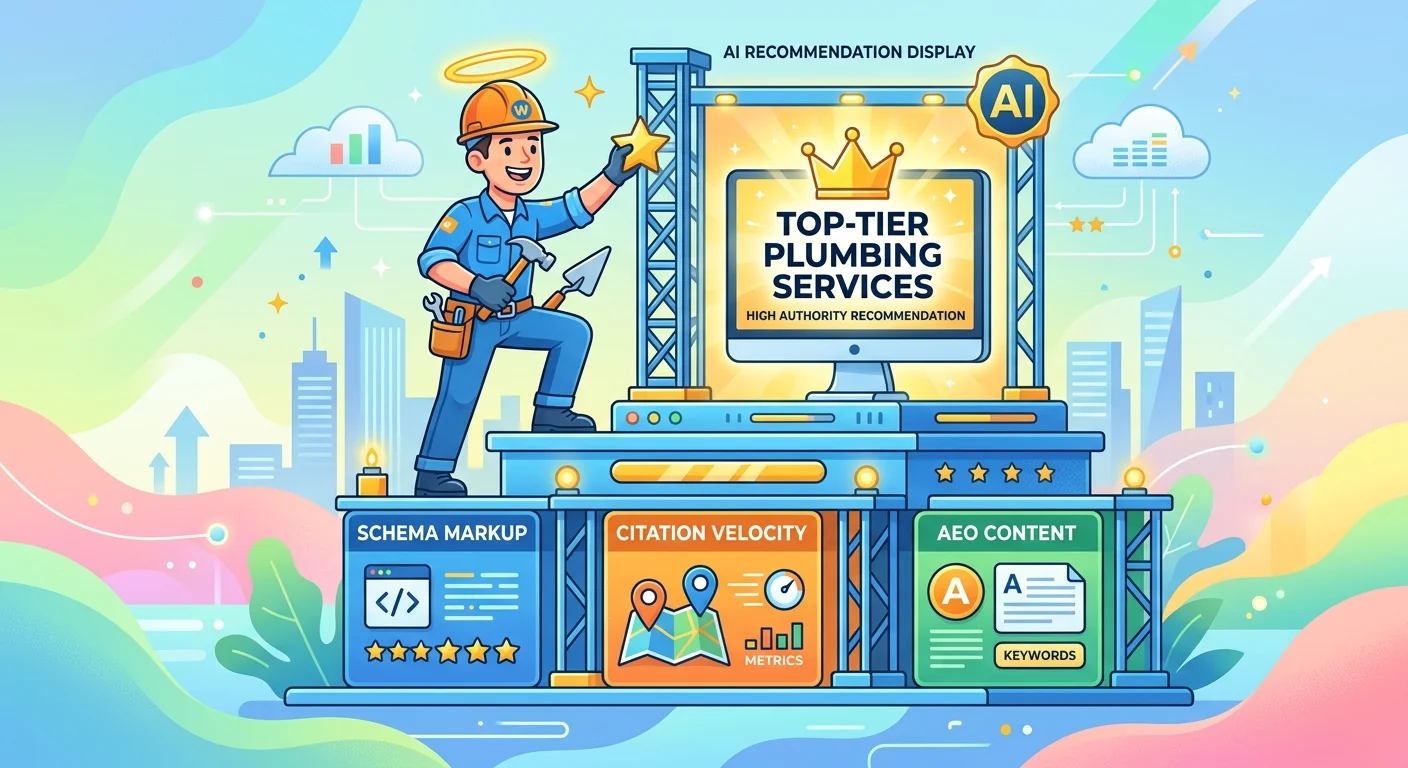
So here’s what actually works – not a patch, but a rebuild.
Authority Infrastructure is the permanent solution to AI misclassification because it addresses the root cause: weak, inconsistent entity signals that AI engines can’t verify. You’re not chasing outputs. You’re building the authority infrastructure that determines what outputs are structurally possible.
This isn’t a one-time fix. It’s a layered system that compounds over time.
Schema markup establishes your entity backbone. Citation-ready content creates verification loops AI engines can trace. Semantic density anchors your category positioning. Third-party validation signals prove you’re not self-promoting – you’re independently confirmed.
When those layers stack, AI doesn’t guess what you do. It knows.
And as Gartner’s prediction on GenAI adoption shows, over 80% of enterprises will have deployed generative AI applications by 2026.
That means the window to lock in correct classification is closing fast. The businesses that build this infrastructure now own the narrative. The ones that wait inherit whatever story their competitors write.
Schema as Your Entity Backbone
Schema markup is the structured data layer that tells AI engines exactly what your business is, where it operates, what services it offers, and how it relates to other entities in your market.
Most businesses either skip schema entirely or deploy it so poorly that it creates more confusion than clarity.
AI models don’t read your homepage copy and infer meaning. They parse machine-readable signals. Schema is the language they speak.
When your LocalBusiness schema declares your service area, your specialties, your NAP data, and your category relationships, the model doesn’t have to guess. It reads the declaration and moves on.
Schema isn’t something you drop on your homepage and forget. It’s a backbone that runs through every page.
Your service pages need Service schema tied to your Organization schema. Your team pages need Person schema with defined roles and credentials. Your blog posts need Article schema that reinforces authorship and topical authority. Your LocalBusiness schema connects it all – service area, specialties, NAP data, category relationships.
Every page feeds the entity graph AI engines use to validate your business.
When schema is clean and consistent, AI engines treat your site as a primary source. When it’s missing or broken, they default to third-party directories – which are often outdated, incomplete, or flat wrong.
You’re letting Yelp and Healthgrades define your entity instead of defining it yourself. That’s not a strategy. That’s negligence.
Citation Velocity and Verification Loops
AI engines don’t just look at what you say about yourself. They track how often other authoritative sources cite you, in what context, and whether those citations are consistent with your own entity signals.
This is citation velocity – the rate at which verifiable mentions of your business accumulate across the web.
The vast majority of consumers – 98% – used the internet to find information about local businesses in the last year. AI engines are trained on that exact behavioral data.
Reviews, directory listings, local news mentions, industry publications – every citation creates a verification loop the model can trace back to your entity. When those loops are strong, misclassification becomes structurally impossible.
But velocity without consistency is noise.
If your business name appears three different ways across ten directories, AI doesn’t see ten citations. It sees fragmentation. It can’t confidently verify that all ten mentions refer to the same entity. So it hedges. It downgrades your authority. It cites the competitor whose NAP data is clean across every platform.
This is where Gerek Allen’s approach to AI authority separates from traditional SEO thinking.
SEO chases backlinks for ranking juice. Authority Infrastructure chases citations for entity verification. One is about gaming an algorithm. The other is about becoming the answer that algorithm was designed to surface.
Content That Anchors Your Category
Search engines focus on understanding real-world entities and their relationships. That means your content can’t just rank for keywords.
It has to anchor your category positioning in a way AI engines can parse and cite.
Our AEO content writing services are built for this. Every article is structured to answer the exact questions your market asks AI engines. Every H2 and H3 is designed to be extractable as a standalone answer. Every internal link reinforces entity relationships the model needs to validate your authority.
This isn’t blog content. It’s citation-ready infrastructure.
The content compounds over time. The first article establishes topical relevance. The tenth article deepens semantic density. The fiftieth article makes your site the only authoritative source in your niche that AI can consistently cite.
And when the model has no better option – when your entity signals are the cleanest, the most consistent, the most verifiable – it stops classifying you alongside competitors. It classifies you as the category.
That’s the callback: reclaiming the narrative isn’t about editing someone else’s script. It’s about becoming the only source the script can be written from.
| Infrastructure Component | What It Does | How AI Uses It | Timeline to Impact |
|---|---|---|---|
| Schema Markup | Declares your entity identity in machine-readable structured data – business type, service area, specialties, NAP consistency, category relationships | AI engines parse schema as a primary source to verify what your business is, where it operates, and how it relates to other entities in your market | Immediate verification benefit once deployed site-wide; full entity trust builds as other signals align with schema declarations over subsequent months |
| Citation Velocity | Accumulates verifiable third-party mentions of your business across directories, reviews, local news, and industry publications with consistent NAP data | AI models trace citation loops to confirm your entity exists independently of your own claims; consistent citations eliminate classification ambiguity | Ongoing accumulation – impact compounds as citation density increases and AI engines re-train on updated datasets that include your verified mentions |
| AEO Content Execution | Publishes citation-ready articles structured to answer exact questions your market asks AI engines, with extractable H2/H3 answers and entity-reinforcing internal links | AI engines extract and cite content that directly answers conversational queries; semantic density across multiple articles positions your site as the authoritative source in your category | Compounding authority – first articles establish relevance, ongoing execution deepens topical density until your site becomes the only verifiable source AI can consistently cite |
| Third-Party Validation Signals | Secures authoritative backlinks, industry directory placements, professional credentials, and verifiable affiliations that confirm your claims independently | AI models look for corroborating signals from sources they already trust; validation signals prove you’re not self-promoting, you’re independently confirmed | Credibility layer builds as validation signals accumulate; full impact realized when multiple authoritative third parties consistently corroborate your entity positioning |
How to Audit What AI Actually Says About You
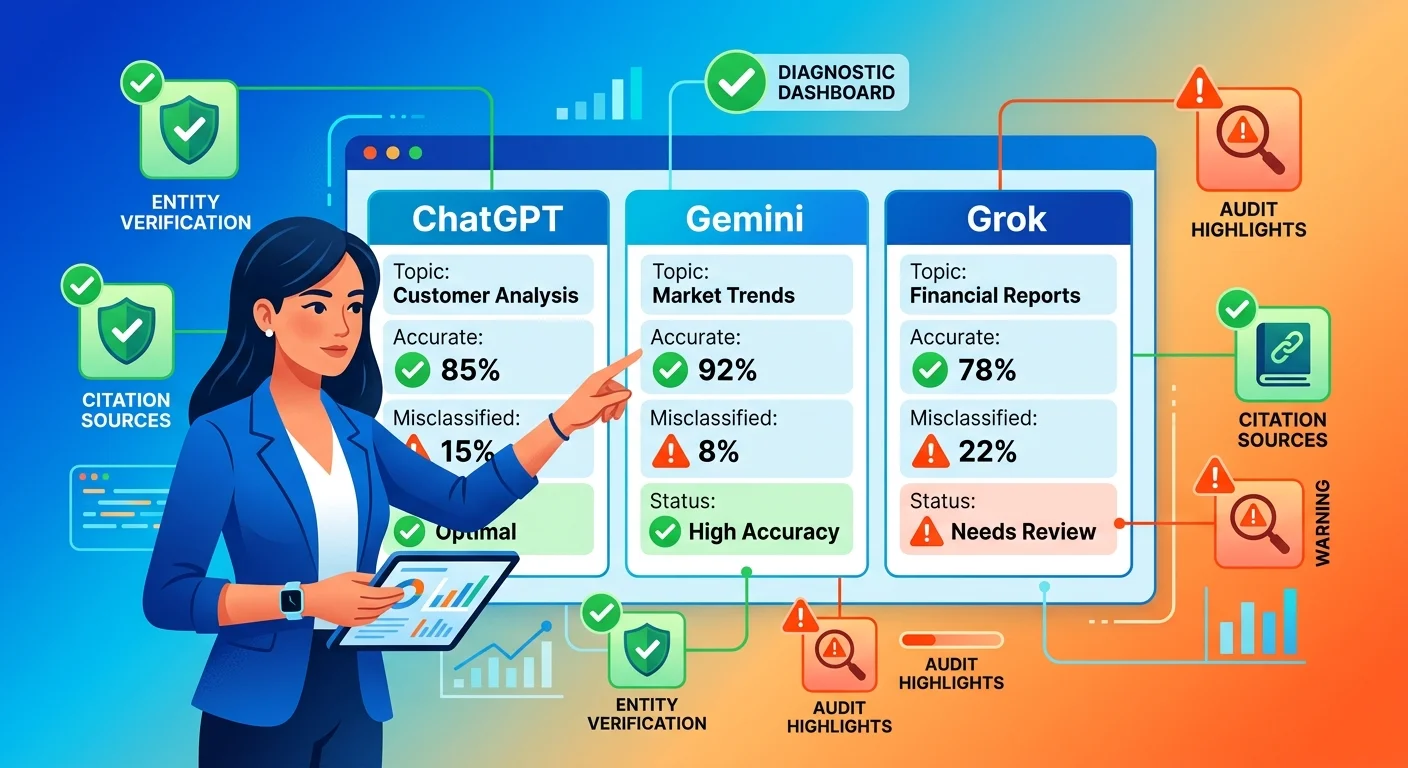
You can’t fix what you haven’t measured. And most businesses have never asked the question.
Here’s the diagnostic that changes everything. Ask ChatGPT, Gemini, and Perplexity who the best provider in your category is in your market. Don’t lead the witness. Don’t name yourself. Just ask the question your prospects are asking. Then read what comes back.
If your name isn’t in the answer – or worse, if the answer classifies you incorrectly – you’ve just discovered the gap between what you think your authority looks like and what AI engines actually see. That gap is costing you patients, clients, and revenue every single day. The audit isn’t theoretical. It’s a mirror.
Running the AI Visibility Check
The AI Visibility Check is the fifteen-minute diagnostic that shows you exactly where you stand. You query three engines with the same market-specific question. You document what each engine says. You compare the outputs. And you look for three specific failure modes: invisibility (you’re not mentioned at all), misclassification (you’re mentioned but categorized wrong), and displacement (a competitor is named instead of you).
This isn’t a vanity metric. It’s a snapshot of your entity trust at the exact moment the query runs. AI engines synthesize thousands of signals to produce that answer. If the answer is wrong, the signals are weak. If the answer names a competitor, their signals are stronger. The check doesn’t tell you how to fix it. But it tells you whether the problem exists and how severe it is.
Most practices are shocked by what they find. They’ve invested in SEO, paid for directories, maintained their reviews – and AI still names someone else. That’s the moment the infrastructure gap becomes undeniable.
What to Look For in the Results
So the engines returned results. Now what? You’re looking for consistency, specificity, and confidence. Does the engine name you without hedging? Does it cite verifiable sources? Does it describe your services accurately – or does it lump you into a generic category that doesn’t reflect what you actually do?
Consistency matters because AI engines cross-reference their outputs. If ChatGPT names you but Gemini names a competitor, that’s a signal that your entity trust is fragmented. The model isn’t confident. It’s guessing. And when engines guess, they default to the competitor with cleaner signals.
Specificity tells you whether the engine understands your category positioning. If it calls you a "local chiropractor" when you specialize in sports injury rehab, the entity signals feeding that answer are too broad. The model sees you. It just doesn’t see you clearly. That’s a semantic density problem, not an invisibility problem.
And confidence shows up in the language. Does the engine say "one of the top providers" or does it say "the best provider"? Hedging language means weak verification loops. The model can’t cite you with authority because the sources it’s pulling from are inconsistent, outdated, or contradictory. Given that 98% of consumers used the internet to research local businesses in the last year, those weak signals are costing you conversions at scale.
Benchmarking Against Competitors
Here’s where the audit gets strategic. Run the same query for your top three competitors. Document what the engines say about them. Compare their entity clarity to yours. Then audit a competitor’s AI citation profile to see which specific signals are giving them the edge.
This isn’t espionage. It’s competitive intelligence. If a competitor is consistently named across all three engines while you’re invisible, their authority infrastructure is stronger. If they’re described with more specificity, their semantic density is tighter. If the engines cite third-party sources when recommending them, their citation velocity is outpacing yours.
The benchmark tells you where the bar is. And once you know where the bar is, you know exactly what infrastructure you need to build to clear it. That’s when how patients trust AI recommendations becomes relevant. Because when you displace a competitor in the AI answer, you inherit their entire trust dividend.
| Audit Question | What It Reveals | Red Flag Indicators |
|---|---|---|
| Does the engine name you at all? | Your baseline visibility – whether AI engines see you as a viable answer in your market | No mention across multiple queries, or only generic category references with no business name |
| Does it describe your services accurately? | Entity clarity – how well the model understands what you actually do versus what category it assumes | Generic labels that don’t match your specialties, outdated service descriptions, or category misclassification |
| Does it cite specific sources when recommending you? | Citation velocity and verification loops – whether authoritative third parties validate your entity | Vague recommendations with no attribution, hedging language like ‘may be a good option,’ or competitor citations instead |
| Is the answer consistent across ChatGPT, Gemini, and Perplexity? | Signal fragmentation – whether your entity data is clean and verifiable across platforms or contradictory | Different business names, conflicting service lists, or one engine naming you while others name a competitor |
| Does it recommend a competitor instead of you? | Authority displacement – the competitor’s infrastructure is stronger and their entity trust is outpacing yours | Competitor named first or exclusively, detailed descriptions of their services while yours are absent or generic |
Frequently Asked Questions
Quick pause. Let’s hit the objections you’re already thinking.
These aren’t edge cases. They’re the exact questions I hear after someone runs the check and sees the gap.
How can I tell if my business is being misclassified by AI?
Run the check. Ask ChatGPT, Gemini, and Perplexity who the best provider in your category is. Don’t name yourself. Don’t steer it. Just ask what your prospects ask.
If your name doesn’t show up – or if it shows up with the wrong specialty, wrong services, wrong positioning – that’s misclassification. If a competitor gets named instead of you, that’s displacement.
Both mean the same thing. Your entity trust is weak. The signals feeding that answer aren’t strong enough to make AI confident in citing you.
Can’t I just submit a correction request to ChatGPT or Gemini to fix wrong information?
No. AI models don’t work that way.
These engines don’t have a backend database you can edit. They synthesize answers from patterns learned across billions of documents. A correction form might update one response temporarily. But the next time the model retrains or pulls from a different source cluster, the misclassification comes back.
You’re treating a symptom. The cause is weak entity signals. If the web’s authoritative sources don’t consistently verify who you are and what you do, the model has no stable foundation. Submitting a correction doesn’t fix that. Building the authority infrastructure does.
What’s the difference between fixing AI misclassification and traditional online reputation management?
Traditional reputation management is reactive. Someone leaves a bad review, you respond. A directory has the wrong phone number, you update it. You’re managing outputs.
Fixing AI misclassification is structural. You’re not managing what people say. You’re building the machine-readable signals that tell AI engines who you are, what category you own, and why you’re the verified authority. Schema markup. NAP consistency. Citation-ready content. Entity relationships across platforms.
Reputation management plays defense. Authority infrastructure plays offense. One is damage control. The other is category ownership.
How long does it take to correct how AI models see my business?
Depends on how fragmented your signals are and how strong your competitors’ infrastructure is. But here’s the honest answer: this isn’t a sprint.
Schema and NAP cleanup can happen in weeks. Content execution that builds semantic density takes months to compound. Citation velocity – the rate at which authoritative sources mention and link to you – builds over time as your infrastructure proves trustworthy.
Practices that expect results in 60 days are chasing shortcuts. Practices that commit to building authority as a long-term asset displace competitors permanently. And given that over 80% of enterprises will have deployed generative AI by 2026, the window to build that infrastructure before your market saturates is closing fast.
Is it worth fixing AI classification if most of my customers still come from Google search?
Yes. Google search is being displaced – not this year, maybe not next year, but the shift is already happening.
A 2023 Pew Research study found that 52% of Americans are more concerned than excited about AI’s increasing role. That skepticism is real. But it’s not slowing adoption. It’s accelerating the demand for verifiable, trustworthy answers. The businesses that demonstrate entity trust will win that demand. The ones that can’t will be filtered out.
And even if Google remains dominant in your market today, the authority infrastructure that fixes AI misclassification is the same infrastructure that strengthens your traditional search presence. Schema helps Google understand your entity. NAP consistency improves local rankings. Citation-ready content builds backlinks and topical authority. You’re not choosing between Google and AI. You’re building the foundation both systems reward.
Where This Leaves You
The narrative about your business is being written right now.
AI engines are answering questions about your category hundreds of times a day in your market. They’re naming providers. They’re explaining what makes someone trustworthy. They’re making recommendations your prospects act on.
If your entity signals are weak-if your infrastructure is invisible to the models doing that work-you’re not part of that conversation.
That’s not a technical problem. It’s an existential one.
Fixing AI misclassification isn’t about submitting a correction form or refreshing a directory listing. It’s about building the authority infrastructure that makes misclassification structurally impossible.
Schema that declares your entity. Citations that verify it across the web. Content that anchors your category positioning in language AI engines can parse and cite.
Every layer compounds. Every signal reinforces the last.
And when your infrastructure is complete, AI engines stop guessing. They stop hedging. They stop naming competitors. They name you-because you’ve become the only verifiable answer they can cite with confidence.
So here’s where this leaves you.
You can wait and hope the engines eventually figure it out. You can keep paying agencies to chase vanity metrics while your competitors lock in authority you’ll never displace.
Or you can run the AI Visibility Check-fifteen minutes that shows you exactly what AI says about your business right now-and decide whether that answer is one you’re willing to live with.
The businesses that move first don’t just fix misclassification. They own the narrative. And when you own the narrative, everyone else is fighting for scraps.
Here’s what’s happening right now: someone just asked an AI engine who to trust in your market. The answer it gave wasn’t you.
Maybe it named a competitor. Maybe it misclassified your entire business. Either way – you don’t own the narrative.
Fifteen minutes. That’s how long it takes to see what ChatGPT, Gemini, and Perplexity actually say when someone asks. Run the AI Visibility Check. Read the results. Then decide whether that’s the story you’re willing to let AI keep telling.