The Measurement Problem: Why You Can’t Track AI Citations Like Keywords
Any agency claiming they can track AI citations like keyword rankings is lying to you.
That data does not exist in a reliable, trackable format.
AI engines don’t publish logs showing who they recommended, when, or how often. There’s no citation dashboard. No API. No reporting tool that pulls “ChatGPT Recommendation Count” into a spreadsheet.
The agencies selling this metric are either fabricating it, running manual spot checks and presenting them as comprehensive data, or relying on third-party proxies so unreliable they might as well be guessing.
This isn’t a technical limitation that’ll get solved next quarter. It’s a fundamental design difference between how search engines and answer engines work.
Why Traditional Tracking Models Don’t Apply to AI Recommendations
Google Search gives you trackable data because Google wants you to have it.
They profit when you optimize for their platform. Analytics, Search Console, ranking trackers – all of it exists because the business model relies on advertisers and SEO professionals spending money to chase visibility.
AI answer engines have no equivalent incentive.
ChatGPT doesn’t sell ads. Gemini isn’t monetizing your practice’s ranking position. The platforms that produce recommendations have no reason to build tracking infrastructure for the entities being recommended.
And even if they did, the data would be nearly meaningless.
AI recommendations are contextual, not static. The same query asked twice by different users can produce different answers based on location, query phrasing, conversation history, and the platform’s real-time assessment of entity trust.
You can’t “rank #1 for chiropractor” in ChatGPT the way you could in Google. There is no #1. There’s only trusted or not trusted – and that status shifts based on the quality of the question being asked.
The Lie Agencies Are Selling
More agencies are jumping into the AEO space with promises of trackable AI citation metrics.
They’ll show you a report. They’ll claim your practice was recommended X times this month.
That report is performance theater.
What they’re actually doing is running manual queries – maybe a dozen, maybe fifty – across a few AI platforms, then extrapolating those spot checks into a number that sounds definitive.
It’s not data. It’s a snapshot presented as a dataset.
The model they’re using is borrowed from traditional SEO: rank tracking, position monitoring, competitive benchmarking. But AI doesn’t work that way. Applying the old measurement framework to a fundamentally different system doesn’t produce insight – it produces the illusion of control.
And illusions are expensive.
What You’re Actually Measuring: Authority as a Compounding Asset
The ROI of an AI recommendation isn’t a conversion you track.
It’s the increasing value of an asset you own.
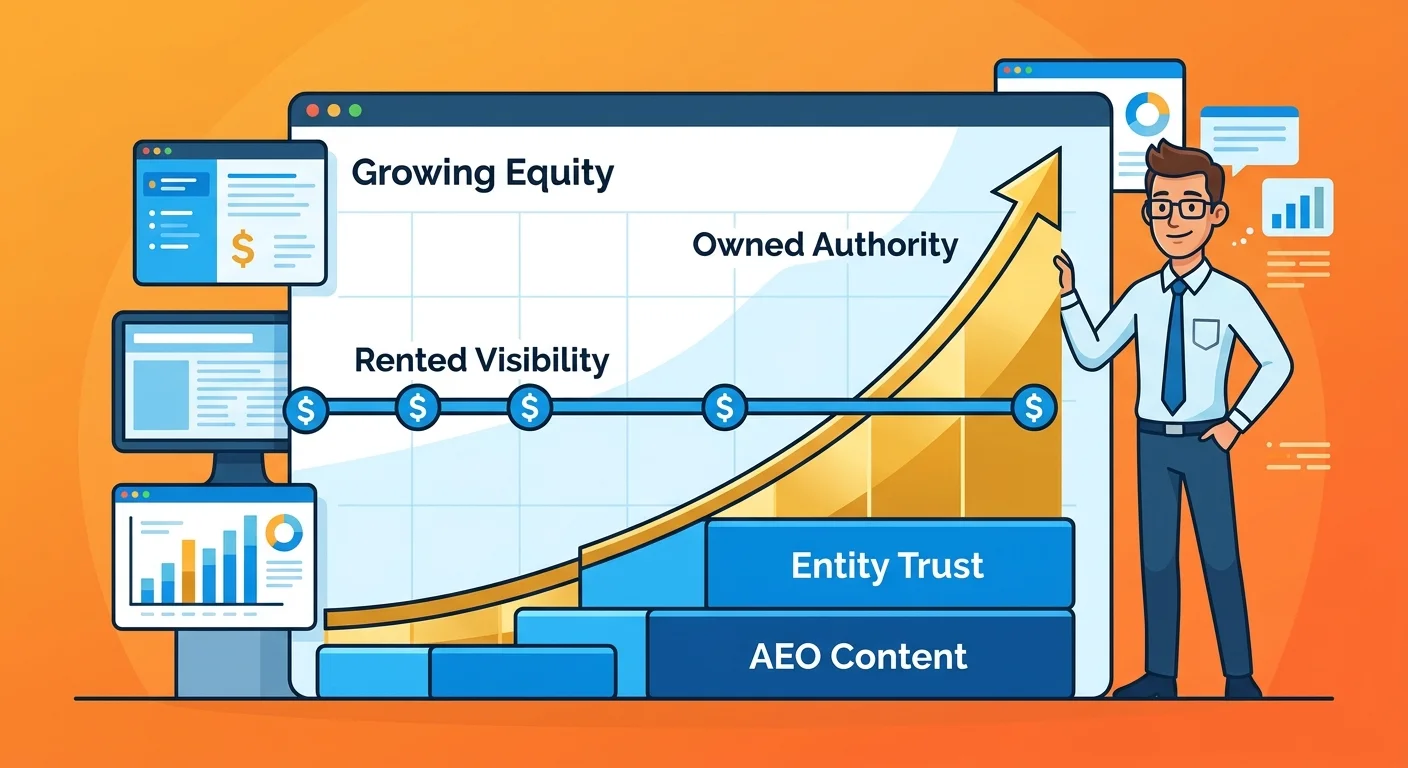
Think of it this way: every time you pay for Google Ads, you’re renting visibility. The moment you stop paying, the traffic stops. The value disappears. You own nothing.
When you build the authority that gets you recommended by AI engines, you’re building equity in your brand.
That authority doesn’t vanish when you pause a campaign. It compounds – every citation reinforces the next one, every trust signal makes the subsequent recommendation more likely.
The ROI isn’t linear. It’s exponential.
The Asset Valuation Model
Instead of asking “What’s one AI citation worth?” – ask this: What’s the lifetime value of owning the default trusted answer in my market?
Because that’s what you’re building toward.
Not occasional mentions. Not sporadic recommendations. Permanent, compounding authority that positions your practice as the answer AI engines trust when someone in your area asks who to see.
The value of that position doesn’t show up as a line item in a monthly report. It shows up in these places:
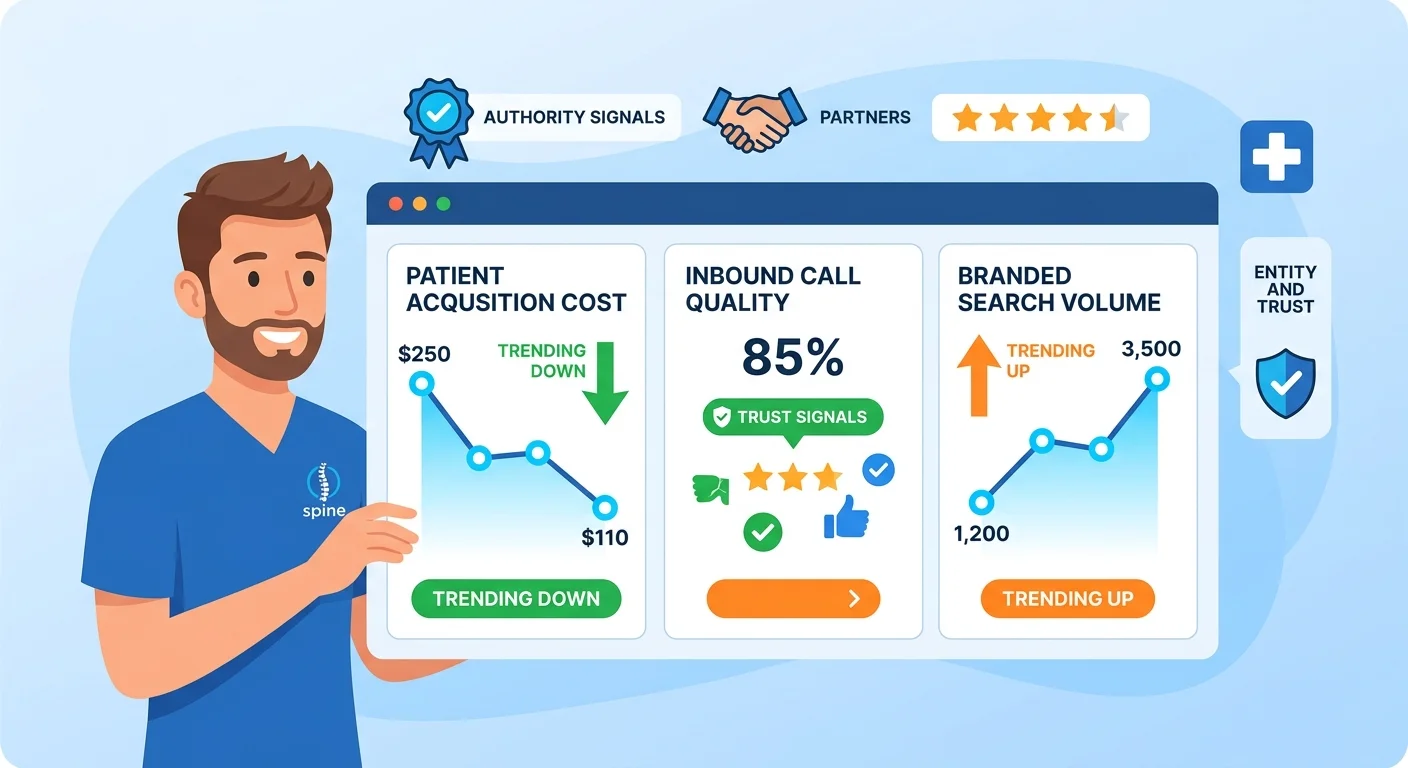
- Lower patient acquisition cost – fewer marketing dollars required to generate the same number of bookings
- Higher lead quality – patients contacting you have already been pre-sold by the most trusted source they know
- Increased direct traffic and branded search – brand awareness compounds as more people hear your name from AI
- Better conversion rates across all channels – authority makes every touchpoint more effective
You’re not measuring a single citation. You’re measuring the appreciation of a trust asset.
Why This Model Scares Traditional Agencies
Most marketing agencies sell monthly retainers based on activities: hours logged, content published, ads managed.
If they admitted that authority is an asset you own, not a service you rent, their entire pricing model breaks.
They need you to believe marketing is a recurring cost. A necessary evil. Something you pay for every month or the leads stop coming.
But authority doesn’t work that way.
Once you’ve built it, it keeps working. Authority decays without ongoing execution, but it doesn’t vanish. It doesn’t reset to zero the moment you pause.
That terrifies agencies whose revenue depends on you staying dependent.
The Proxy Metrics: How to Actually Measure AI Citation Value
You can’t track AI citations directly.
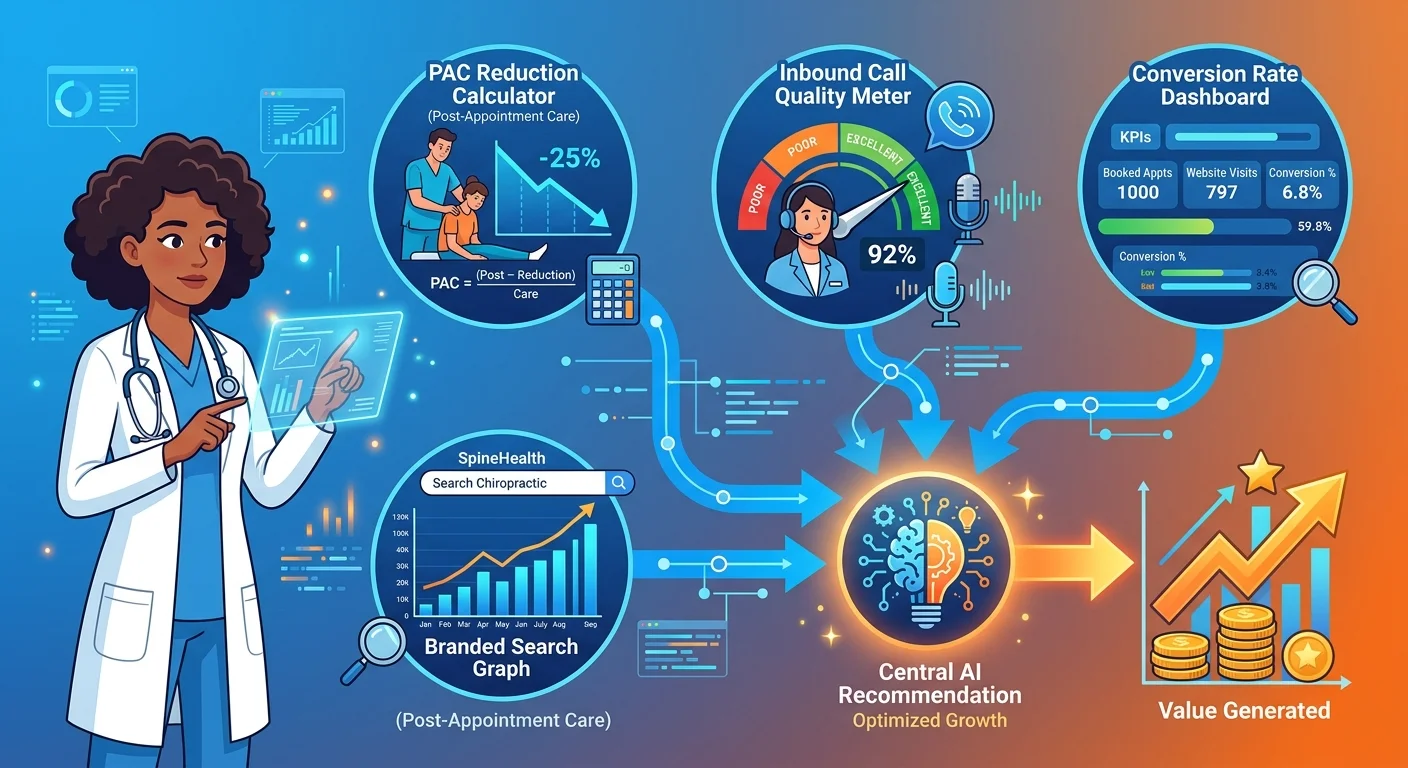
So you measure their impact through business-level proxies – metrics that reflect the downstream effects of being recommended by the platforms your patients trust.
Here’s the framework.
| Metric | What It Measures | Why It Matters |
|---|---|---|
| Patient Acquisition Cost (PAC) | Total marketing spend divided by number of new patients acquired | As AI authority increases, PAC should decrease because trust is pre-established before contact |
| Unprompted Inbound Call Quality | Percentage of inbound calls that are high-intent (already decided, asking about availability) vs. information-gathering | AI recommendations produce leads who’ve already received a trusted verdict – they call to book, not to shop |
| Direct Traffic Growth | Users typing your URL directly into their browser or clicking a saved bookmark | AI citations drive brand recall and awareness, resulting in patients remembering and returning to your site directly |
| Branded Search Volume | Number of searches for your practice name specifically | Being named by AI increases the likelihood patients will search for you by name to verify or learn more |
| Lead-to-Patient Conversion Rate | Percentage of inbound leads that convert to booked appointments | Authority-driven leads convert at higher rates because the trust barrier has already been cleared by the AI recommendation |
Patient Acquisition Cost (PAC)
This is the single most reliable proxy for AI citation value.
Patient acquisition cost is the total amount you spend on marketing divided by the number of new patients acquired.
As your AI authority increases, this number should decrease – because more patients are finding you through trusted recommendations instead of paid channels.
If you’re spending $3,000/month on marketing and acquiring 15 new patients, your PAC is $200.
If that drops to $150 over six months while your marketing spend stays constant, that $50 reduction per patient is a direct result of authority-driven leads entering your funnel.
Those leads didn’t come from an ad. They didn’t come from a keyword ranking. They came because AI said your name.
Multiply that $50 savings by the number of patients you acquire annually, and you’ve got a tangible ROI figure – one that compounds as authority deepens.
Unprompted Inbound Call Quality
Track the percentage of inbound calls where the caller says one of these phrases:
- “I was told you’re the best in the area.”
- “Someone recommended you.”
- “I heard your name.”
No mention of Google. No mention of your website. Just: they heard your name.
That’s an AI citation showing up in the real world.
The caller asked ChatGPT or Gemini who to see. Your name was the answer. They called.
These leads convert at a higher rate than any other source because they’ve already decided to trust you. The AI made the sale. Your job is just to not screw up the booking.
Direct Traffic and Branded Search Volume
As AI recommendations increase, more people hear your practice name without seeing your website first.
They search for your name directly – not “chiropractor near me,” but your actual practice name.
Brand awareness and recall are directly measurable in Google Analytics (direct traffic) and Google Search Console (branded search queries).
If those numbers are climbing while your ad spend stays flat, AI is doing the work.
This is also why the widening gap in AI visibility accelerates so quickly. The practice that gets recommended early starts showing up in branded searches. That drives more engagement signals. Which reinforces the recommendation. Which drives more searches.
It compounds.
Conversion Rate Across All Channels
Authority doesn’t just generate new leads – it makes every lead you already have more likely to convert.
When someone sees your Google Ad, visits your website, or reads your Google Business Profile after hearing your name from AI, they’re not evaluating you from scratch.
They’re confirming what they’ve already been told: you’re the trusted answer.
Track your website conversion rate, call booking rate, and form submission rate over time. As authority builds, these should trend upward – even if traffic stays flat or decreases.
Because you’re not optimizing for volume anymore. You’re optimizing for trust.
Why “Zero-Click” Recommendations Are More Valuable Than Traffic
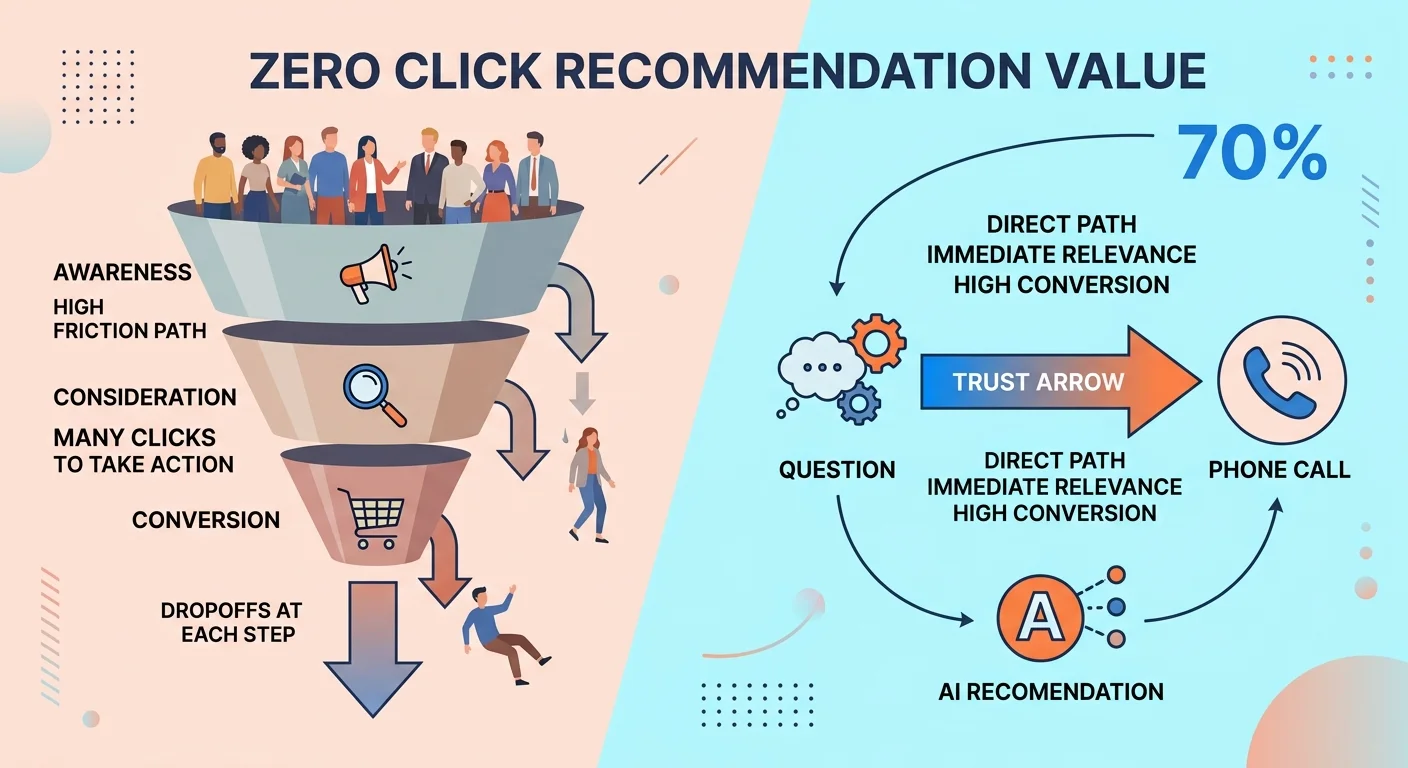
One of the hardest mental shifts for chiropractors coming from traditional SEO is this: traffic is no longer the goal.
In fact, in the AI-first world, less traffic can mean more value.
The Zero-Click Reality
Zero-click searches are now the majority of queries on Google – and they’re the default in AI answer engines.
The user asks a question. The AI provides the answer. The conversation ends.
No click. No visit. No traffic.
Traditional agencies would call that a failure. You paid for visibility, and the user never came to your site.
But if the AI’s answer was “Go see Dr. [Your Name] at [Your Practice]” – and the user picks up the phone and calls – that’s not a failure.
That’s the highest-value conversion possible.
You skipped the entire evaluation phase. You didn’t compete for attention on a results page. You didn’t hope they clicked through and read your About page.
The AI did all of that work for you.
The recommendation was the conversion.
Why Traffic Obsession Hides Real Value
Here’s what most chiropractors don’t realize: vanity metrics in SEO reports – clicks, impressions, “rankings” – exist to justify the agency’s retainer. Not to measure business impact.
If your agency admitted that traffic doesn’t matter as much as trust, they’d have nothing left to sell.
So they keep optimizing for the thing they can track, even as that thing becomes less relevant every month.
AI recommendations don’t show up in Google Analytics. They don’t generate page views. They don’t contribute to your “organic traffic” line chart.
But they generate phone calls from pre-sold patients.
And phone calls convert at 10-20x the rate of web form submissions.
That’s the ROI. Not the traffic. The trust.
The Attribution Problem: Why Old Models Break
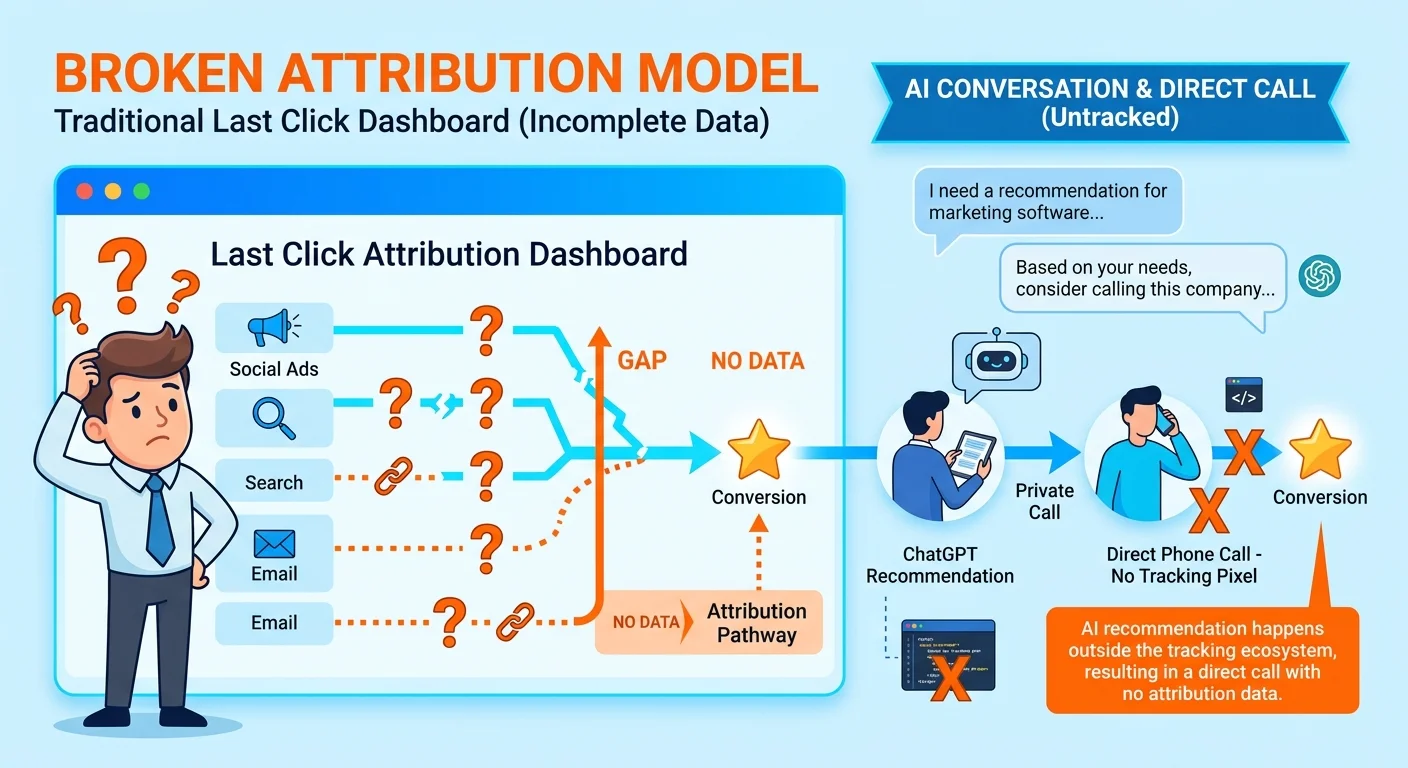
Traditional marketing attribution relies on last-click models.
The user clicked an ad, visited your site, booked an appointment – the ad gets credit.
AI breaks that model completely.
| Attribution Model | How It Works | What It Misses |
|---|---|---|
| Last-Click Attribution (Traditional) | Credits the final touchpoint before conversion – typically a Google Ad click or organic search result | Ignores all upstream trust-building that made the patient ready to convert; stops working the moment ad spend stops |
| Multi-Touch Attribution (Traditional) | Assigns fractional credit to multiple touchpoints across the patient journey | Still relies on trackable clicks and cookies; cannot measure trust built through AI recommendations or brand recall |
| Authority-Driven Attribution (AI-Era) | Measures indirect signals like reduced PAC, increased direct traffic, and higher conversion rates as proxies for trust and authority | Cannot provide a direct per-citation dollar value; requires patience and a longer measurement window to see compounding effects |
Multi-Touch Attribution Doesn’t Capture AI
Even sophisticated multi-touch attribution models – the ones that credit every touchpoint in the patient journey – can’t see AI recommendations.
Because the AI interaction happened outside your digital ecosystem.
No pixel fired. No cookie was set. No UTM parameter tracked the referral.
The patient asked ChatGPT. ChatGPT said your name. The patient called your office directly.
Your attribution model sees: Direct/None.
It looks like the patient magically appeared. But they didn’t. They were sold by the most trusted advisor they’ve ever consulted.
You just can’t see it in the dashboard.
The Compounding Effect Attribution Can’t Measure
Even if you could track every AI citation, attribution models are built for linear conversions.
User sees ad → user clicks → user converts.
But authority doesn’t work linearly. It compounds.
The first AI citation increases the likelihood of the second. The second makes the third more authoritative. By the tenth citation, your practice name is appearing in multiple contexts – different queries, different platforms, different user intents.
Attribution models assign credit to individual touchpoints. But when the entire brand becomes the answer, which touchpoint gets the credit?
All of them. None of them. The question stops making sense.
You’re not optimizing for conversions anymore. You’re optimizing for permanent trust.
What an AI Citation is Actually Worth: A Framework
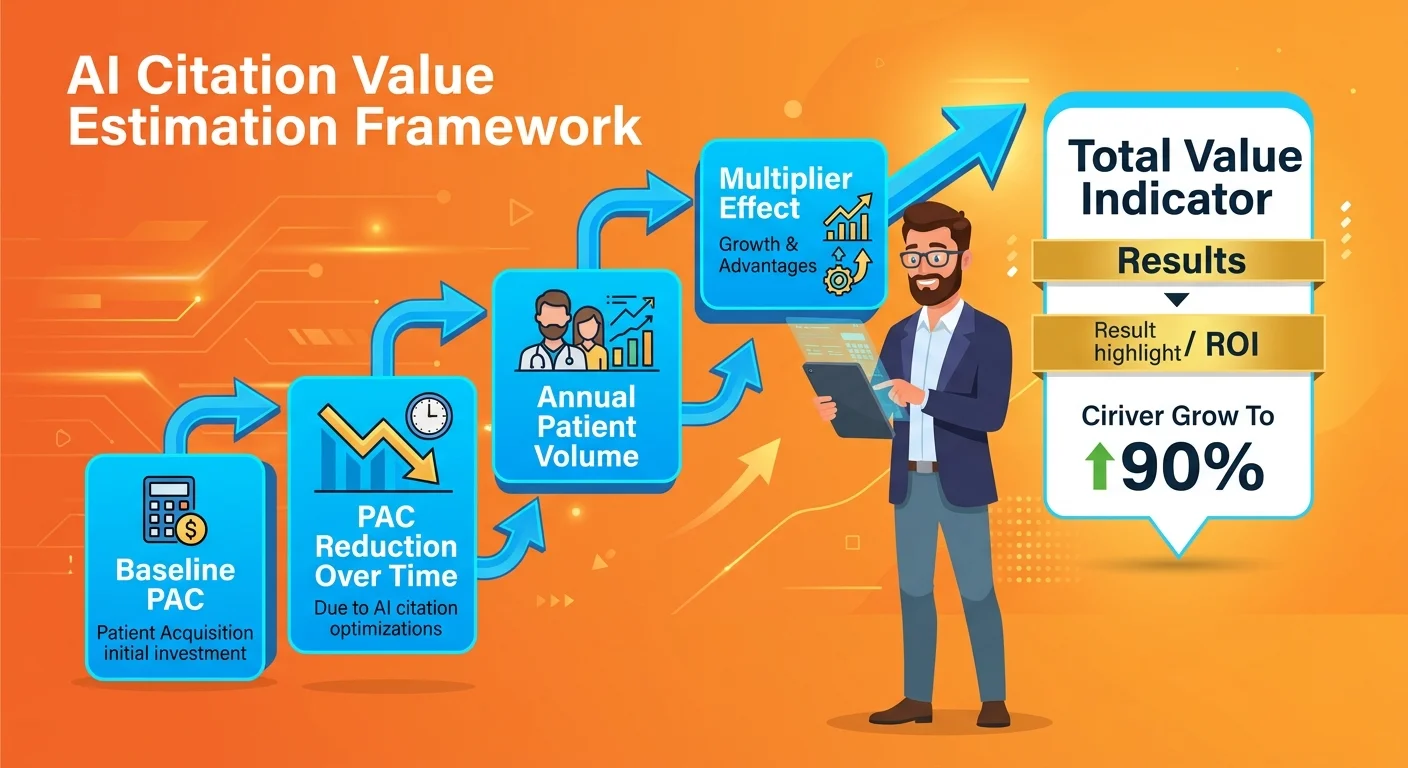
You can’t track it directly. Attribution models break.
So how do you calculate the value?
You build a directional estimate using the metrics you already have.
| Input Metric | How to Calculate It | Example Value |
|---|---|---|
| Average Patient Lifetime Value (LTV) | Total revenue from an average patient over their entire relationship with your practice | $3,500 per patient |
| Patient Acquisition Cost (PAC) Before Authority Build | Total marketing spend divided by new patients acquired during a baseline period (e.g., 6 months before AEO execution) | $450 per patient |
| Patient Acquisition Cost (PAC) After Authority Build | Same calculation after 6-12 months of AEO execution and authority compounding | $280 per patient |
| PAC Reduction per Patient | Subtract new PAC from old PAC | $170 saved per patient |
| Directional Citation Value Estimate | Multiply PAC reduction by number of new patients acquired in measurement period | $170 × 40 patients = $6,800 in realized value from reduced acquisition cost |
Step 1: Establish Your Baseline PAC
Pull your current patient acquisition cost from the last 6-12 months.
Total marketing spend divided by total new patients acquired.
If you spent $36,000 on marketing last year and acquired 180 new patients, your baseline PAC is $200.
Step 2: Track PAC Over Time
As you build AI authority – through Answer Engine Optimization (AEO), building entity trust, and consistent content execution – monitor how your PAC changes.
If it drops to $175 after six months, that $25 reduction per patient is your authority dividend.
You’re acquiring the same patients for less money because more of them are coming through trusted recommendations instead of paid channels.
Step 3: Calculate the Lifetime Value of the Reduction
Multiply that per-patient savings by your annual patient acquisition volume.
If you acquire 180 patients per year and save $25 per patient, that’s $4,500 in annual value – just from the reduction in acquisition cost.
But it compounds.
Next year, as authority deepens, PAC might drop to $150. Now you’re saving $50 per patient. That’s $9,000/year.
And you’re not spending more to get there. You’re just owning the asset.
Step 4: Add the Multiplier Effect
Now factor in the other proxy metrics: higher conversion rates, better lead quality, increased branded search, stronger performance from every other marketing channel.
Authority doesn’t just reduce PAC. It makes everything else work better.
Your Google Ads convert faster. Your website books more appointments. Your referral network expands because more people recognize your name.
Quantifying that multiplier is harder – but directionally, if authority increases your overall marketing efficiency by 20-30%, you’re looking at five-figure annual value from something traditional dashboards can’t even see.
The Anti-Persona Gate: This Isn’t for Everyone
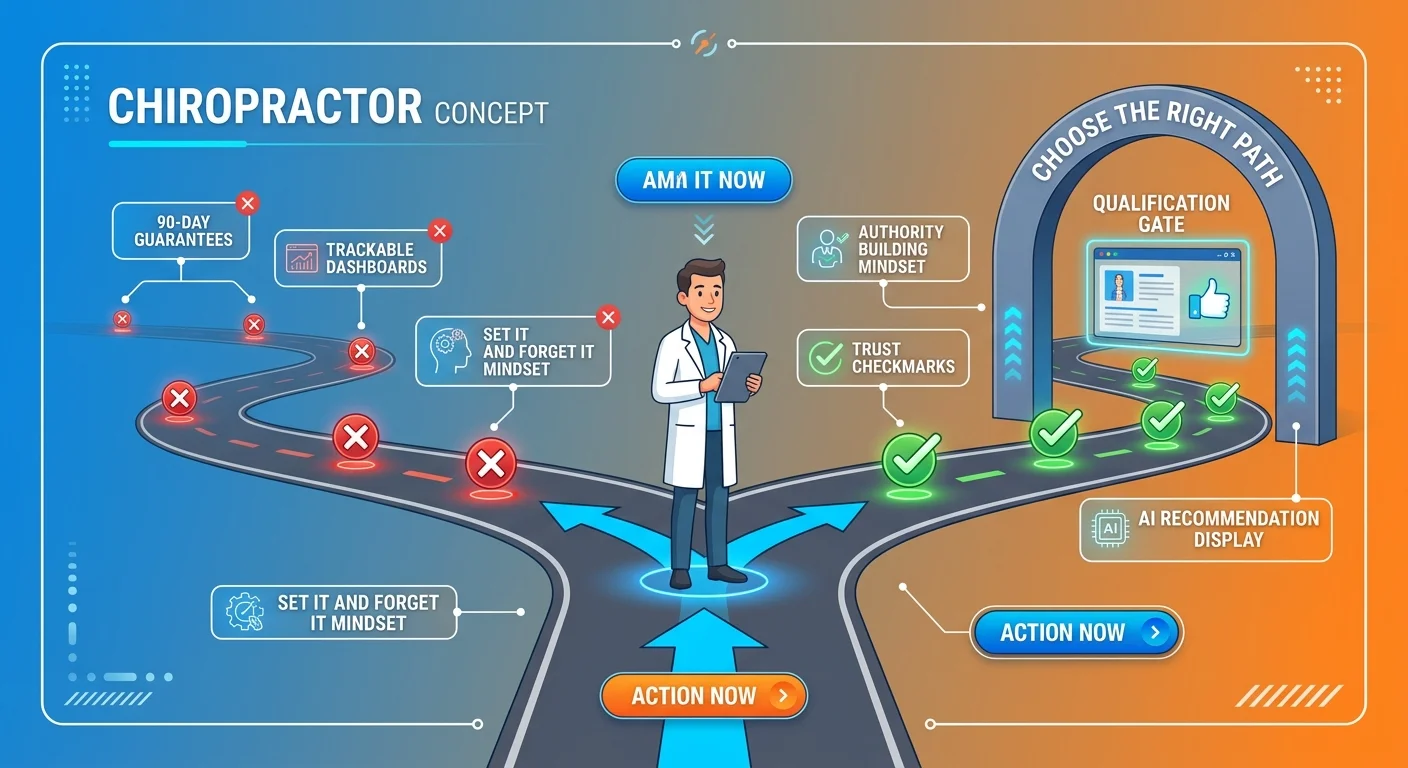
Quick pause before we go further.
If you’re looking for a dashboard that tracks AI citations like keyword rankings – this isn’t it. That product doesn’t exist, and anyone selling it is lying to you.
If you need a hard-dollar ROI guarantee within 90 days or you’re walking – this isn’t for you. Authority is built in layers. It compounds. The practices that see the biggest results are the ones that commit to the process and let it work.
If you want marketing to be a set-it-and-forget-it monthly retainer that delivers predictable traffic forever – you’re in the wrong place. Authority requires ongoing execution. The moment you stop maintaining it, competitors who didn’t stop will take the ground you gave up.
But if you’re tired of paying agencies to deliver vanity metrics that don’t translate to booked appointments – if you’re done chasing rankings that don’t matter and clicks that don’t convert – if you’re ready to own a trust asset that compounds instead of renting visibility that disappears the moment you stop paying – you’re exactly where you need to be.
Frequently Asked Questions
Is there a tool that can track how many times AI recommends my practice?
No. And any agency claiming to have this data is being dishonest.
The only way to measure AI visibility is through systematic, manual queries across multiple platforms. You ask the question. You see the answer. You document whether your practice was recommended.
That’s not scalable data. It’s a snapshot. It’s useful for directional validation – for proving the system works – but it’s not trackable the way keyword rankings are.
Anyone selling you a monthly report with “AI citation counts” is either fabricating the number, running a handful of spot checks and presenting them as comprehensive, or relying on proxies so unreliable they might as well be making it up.
How is the ROI from an AI recommendation different from Google Ads ROI?
Google Ads ROI is based on direct, last-click attribution and stops the moment you stop paying. You rent the visibility. You track the conversions. The data is clean.
AI recommendation ROI is a lagging indicator of a compounding authority asset you own. You can’t track individual citations. You can’t attribute specific conversions to specific recommendations. But the business-level impact – lower PAC, higher lead quality, better branded search – is measurable and permanent.
One is a transaction. The other is equity.
What’s a good proxy metric for AI citation value?
The best proxy is a blended metric: track your unprompted inbound lead quality and your overall patient acquisition cost.
As authority increases, lead quality should go up – more callers who say “I heard your name” or “I was told you’re the best” – and acquisition cost should go down, because fewer marketing dollars are required to generate the same number of bookings.
If both of those trends are moving in the right direction, AI citations are working – even if you can’t see them in a dashboard.
Can I calculate a hard-dollar value for an AI citation?
You can create a directional estimate by comparing your average patient lifetime value to the reduction in your patient acquisition cost over time.
But it’s a proxy, not a direct calculation. You’re estimating the downstream business impact of being the trusted answer, not counting individual citations like conversions.
That estimate is still more reliable than most of the metrics traditional agencies report – because it’s tied to actual revenue, not vanity numbers.
Does getting one AI recommendation guarantee a new patient?
No.
It gets you on the shortlist with an unparalleled level of trust – but your internal processes for answering the phone, qualifying the caller, and booking the appointment still need to convert that lead.
An AI recommendation is the strongest possible referral. But if your front desk doesn’t answer, or your scheduler is booked out three weeks, or your intake process is confusing – the lead still falls through.
AI can’t fix broken operations. It just makes the leads better.
What happens if I stop building authority after 12 months?
Authority decays without ongoing execution.
It doesn’t vanish overnight. The infrastructure stays. The entity trust you’ve built remains. But if you stop publishing, stop maintaining your schema, stop reinforcing the signals that AI engines use to validate recommendations – competitors who didn’t stop will start closing the gap.
Authority is a compounding asset. But compounding works both ways. The practices that maintain it pull ahead. The ones that pause fall behind.
How long does it take to see measurable ROI from AI authority?
Most practices start seeing proxy metric improvements – unprompted calls mentioning the practice name, increases in branded search, reductions in PAC – within 3-6 months.
But the compounding effect accelerates after 12 months. That’s when the gap between you and competitors who didn’t start becomes obvious. That’s when the proof is in the results.
If someone promises you measurable ROI in 60-90 days, they’re either overpromising or measuring the wrong things.
Can I track AI citations manually to validate the system is working?
Yes – and you should.
Run the same set of queries across ChatGPT, Gemini, and Perplexity once a month. Document the results. Track whether your practice is being recommended, how often, and in what context.
It won’t give you comprehensive data. But it’ll give you directional proof that the authority you’re building is translating into real recommendations.
Most practices that do this are shocked the first time they see their name come back as the answer.
Conclusion: The ROI is the Asset
The value of an AI recommendation isn’t a number you pull from a dashboard.
It’s the increasing value of owning the default trusted answer in your market.
You measure it through patient acquisition cost. Through unprompted inbound calls. Through branded search volume and conversion rates across every channel. Through the compounding effect of being the name AI says when someone asks who to trust.
Traditional agencies can’t sell that. Because they don’t know how to build it.
So they keep optimizing for traffic and rankings and clicks – metrics that matter less every month – and present those vanity numbers as proof of value.
But you know better now.
The practices winning in the AI-first world aren’t chasing rankings. They’re building authority. They’re not renting visibility. They’re owning trust.
And trust compounds.
Every month you wait, the gap widens. The competitors who started early are already being recommended. The patients in your market are already hearing their names. And every time that happens, the next recommendation becomes more likely.
You can’t track it like a keyword. But you can measure the business impact.
And once you see it – once your PAC drops, once the unprompted calls start coming in, once branded search starts climbing – you’ll realize the ROI isn’t the citations.
The ROI is the asset you built to earn them.
Want to see where you stand right now? Run the AI Visibility Check. It takes 15 minutes, and it’ll show you exactly what ChatGPT, Gemini, and Perplexity say when someone in your market asks who to trust. If AI isn’t recommending you – you’ll see the gap. If they are – you’ll see the proof. Either way, you’ll know exactly where to start.