
Why Most Scaling Strategies Fail Before They Start
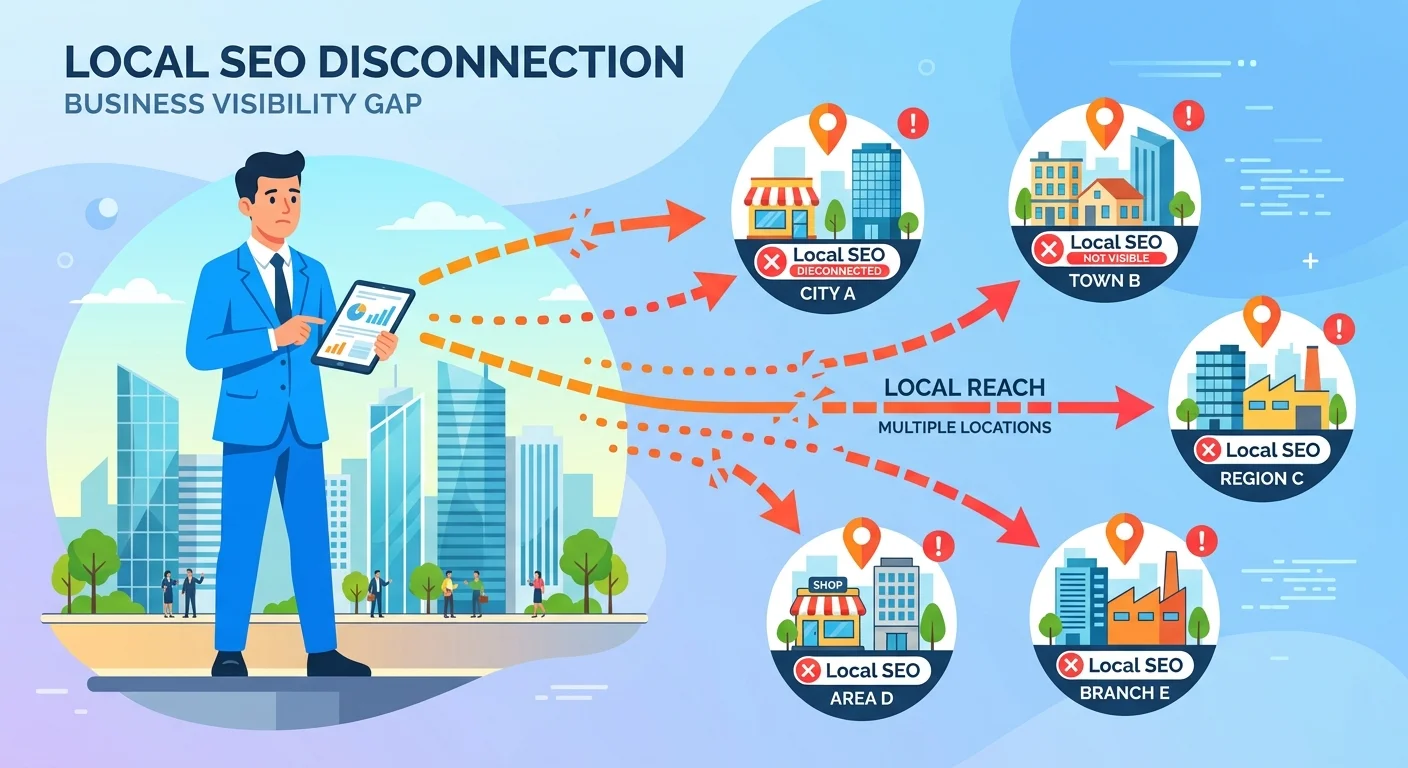
Before we talk about what works, let’s name why the default approach tanks.
Most agencies treat national scaling like a multiplication problem. They take the local playbook that worked in one city and copy it across fifty more. More GMB listings. More location pages. More city-specific keywords. The logic sounds right – if it worked once, it’ll work everywhere.
But AI doesn’t read your marketing the way people do. When ChatGPT or Gemini evaluates whether you’re the answer, it doesn’t count how many location pages you built. It looks for a single, coherent entity signal. If your brand’s digital identity fragments across hundreds of inconsistent citations and disconnected location pages, AI reads that as noise – not authority.
The Default Mistake
The default scaling mistake is assuming authority is additive. That if you dominated one city with foundational local SEO signals, you can dominate ten cities by running the same play ten times.
It’s not. Authority at national scale is architectural. AI engines don’t aggregate your local wins into a national verdict. They look at whether your entity is legible, consistent, and trustworthy across every signal they can access. When those signals conflict – different business names, mismatched addresses, disconnected content hierarchies – AI deprioritizes you entirely. The brand with clean, unified infrastructure wins the recommendation.
Why Multiplying Local Tactics Doesn’t Scale
Here’s the thing about multiplying local tactics: it compounds fragmentation faster than it builds trust.
In 2020, 64.82% of Google searches ended without a click. That number has only grown. Zero-click search isn’t a trend – it’s the infrastructure now. When someone asks an AI engine for the best provider in their industry, the answer isn’t a list. It’s a verdict. One name.
Traditional SEO optimized for being on page one of a list. National authority in the AI era requires being the single answer AI trusts enough to name. Multiplying local pages optimizes for the old game. It doesn’t solve the new one. Every inconsistent citation, every duplicate location page, every fragmented content silo tells AI your entity isn’t coherent enough to trust.
The Entity Trust Problem at National Scale
The entity trust problem gets worse as you scale – not better. When 80% of consumers lose trust due to inconsistent contact details, that trust erosion accelerates across a national footprint. One disconnected GMB listing in a single city is fixable. Fifty inconsistent listings across fifty cities is an entity crisis.
National authority requires treating your brand as a single, machine-readable entity. That means unified schema markup. Consistent NAP data across every directory. Content architecture that reinforces one coherent brand identity – not fifty location-specific microsites that AI can’t connect. The Cost of Inaction: How Authority Decay Erodes Your Market Share compounds faster when your infrastructure fragments at scale. Scaling authority isn’t about building more bridges to more cities. It’s about replacing the bridge, not building more of them.
What AI Needs to Recommend You Nationally
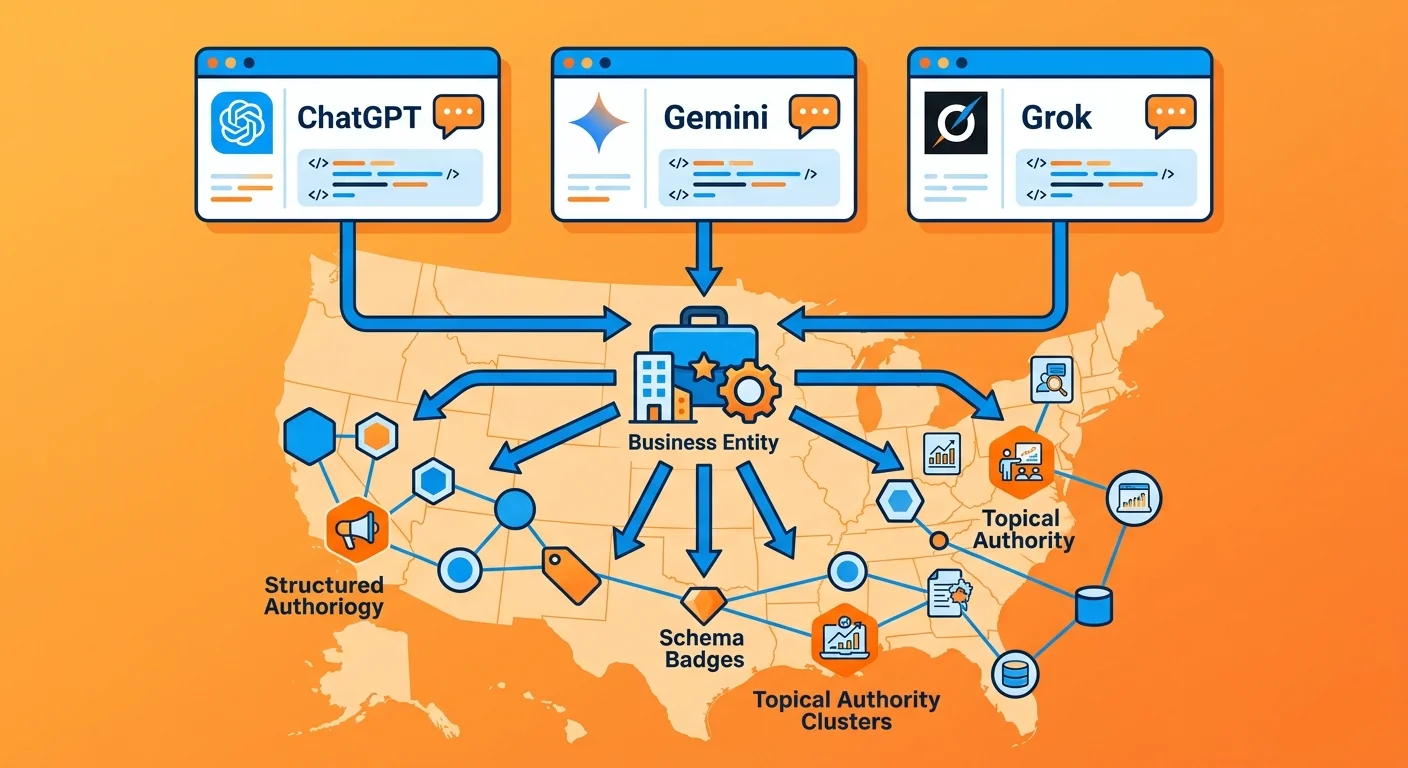
AI doesn’t care about your ranking in Denver and Dallas separately. It cares whether your entity holds together as one trustworthy thing. That distinction is what breaks most scaling attempts before they start.
National authority requires three non-negotiable infrastructure pieces. Coherent entity signals that verify you’re the same business everywhere. Topical authority that proves you know what you’re talking about independent of location. And national schema architecture that tells AI engines exactly what you are at scale. Miss any one of these and AI won’t recommend you – even if you dominate locally.
Coherent Entity Signals Across Geographies
Your business name, address, phone number, and brand signals must be identical across every platform AI checks. Not similar. Identical. 80% of consumers lose trust due to inconsistent contact details, and AI engines mirror that behavior. When your NAP data conflicts between your website, Google Business Profile, Yelp, industry directories, and social platforms, AI can’t verify you exist coherently. So it won’t cite you.
This isn’t about citation volume. It’s about building entity trust for AI recommendations through signal consistency. A business with 500 citations and 50 NAP variations signals chaos. Not authority. A business with 100 perfectly consistent citations signals coherence. AI picks the latter every time.
Most businesses assume their local citations are "good enough" and start scaling without auditing. Then they wonder why AI engines recommend competitors. The answer is simple: your entity fell apart the moment you added a second location without locking down every signal first. Maintaining brand signal consistency is the price of entry for national recommendations.
Topical Authority That Transcends Location
AI engines don’t rank single keyword targets anymore. They rank expertise. The average top-ranking page also ranks for about 1,000 other relevant keywords, which means AI sees topical depth – not isolated optimization – as the trust signal. If your content strategy is built around geo-targeted landing pages with shallow keyword targeting, you’re invisible nationally.
National authority means building content clusters that answer every angle of your core expertise. Not "chiropractor in Phoenix" repeated fifty times with city names swapped out. Deep, interconnected content that proves you understand the discipline itself – independent of where someone is standing when they ask. That’s what AI recommends.
This is the bridge metaphor again. Local SEO builds narrow bridges to specific neighborhoods. National authority requires infrastructure that spans the entire country without collapsing under its own weight. Shallow content doesn’t scale. Topical authority does.
National Schema Architecture
Local schema tells AI you’re a business at a specific address. National schema tells AI you’re an organization with reach, expertise, and trust that extends beyond geography. The markup is different. The signals are different. The way AI evaluates you is different. Most businesses never update their structured data for national organizations, so AI keeps treating them like a local shop – even when they’re trying to compete nationally.
National schema architecture includes Organization markup, sameAs properties linking every verified platform, aggregateRating at the brand level, and knowledge graph anchors that tell AI who you are independent of location. Without it, AI can’t distinguish between "a chiropractor with locations in ten cities" and "a national chiropractic authority." And if AI can’t tell the difference, it defaults to recommending whoever architected their entity correctly.
| Trust Signal | Local Scope | National Scope | AI Priority |
|---|---|---|---|
| NAP Consistency | Single verified address tied to one service area | Identical business name, address, phone across every platform AI checks-no variations | Critical – AI cannot verify entity without it |
| Schema Markup | LocalBusiness schema with geo-coordinates | Organization schema with sameAs links, brand-level ratings, knowledge graph anchors | Critical – tells AI you exist beyond a single location |
| Content Depth | City-specific landing pages targeting geo-keywords | Topical clusters demonstrating comprehensive expertise independent of geography | High – proves authority extends beyond proximity |
| Citation Strategy | Local directories and industry listings in one metro area | National databases, institutional sources, verified platforms with zero NAP drift | Critical – fragmented signals kill trust at scale |
| Brand Signal | Reviews and reputation tied to one location | Aggregated brand trust that travels with the entity regardless of user location | High – brand trust is prerequisite for purchase decisions |
| Keyword Strategy | Geo-modified keywords targeting one city or neighborhood | Semantic keyword clusters demonstrating expertise across the discipline itself | Moderate – AI ranks expertise, not isolated keyword targeting |
Re-Architecting Your Digital Presence for National Trust
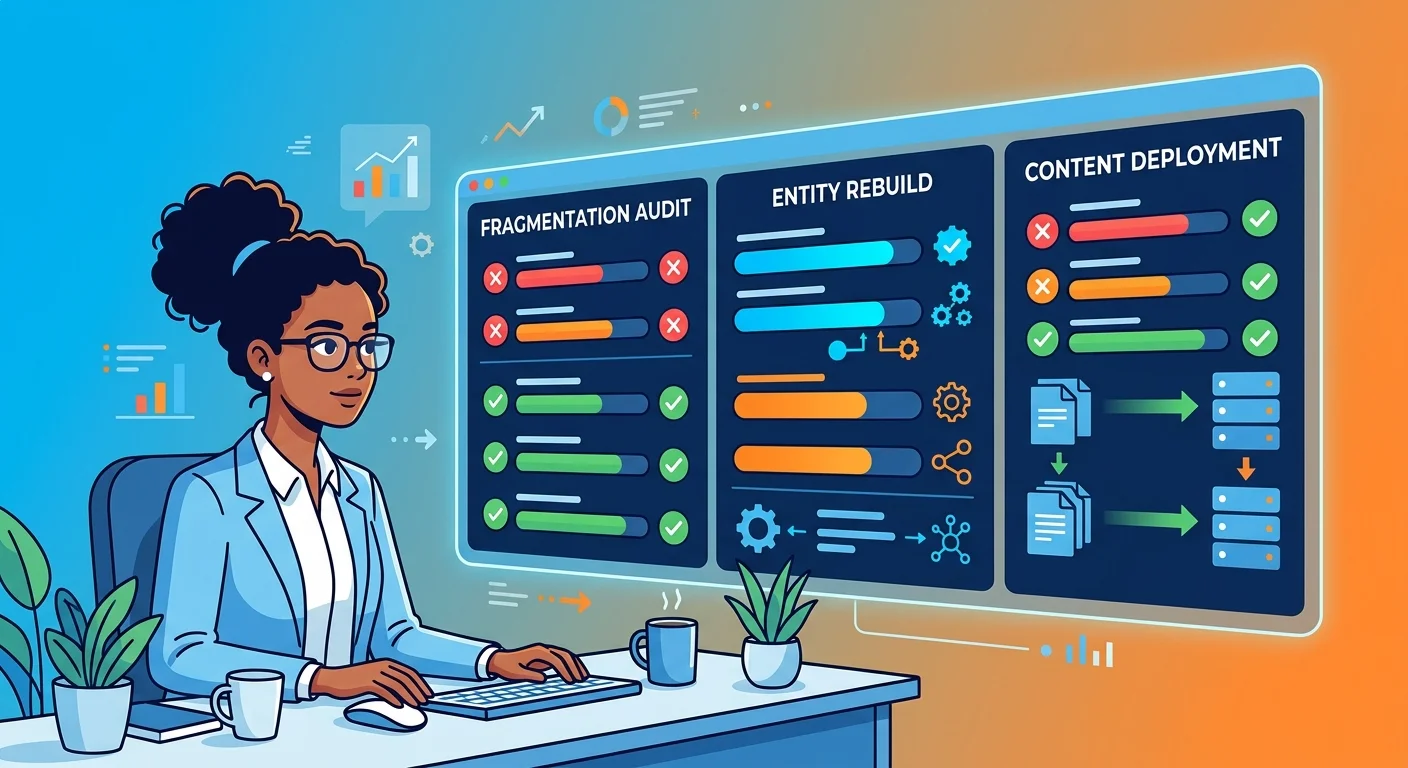
Now let’s talk about what the rebuild actually looks like.
Re-architecting for national trust isn’t a campaign. It’s an infrastructure project.
Three phases. Audit where your entity signals break. Consolidate everything into one canonical profile AI can verify. Deploy content execution that proves topical authority at scale.
Most businesses skip straight to content and wonder why nothing moves. You can’t build national authority on a fragmented foundation.
Audit Your Current Entity Fragmentation
Start by running an AI Visibility Check. Ask ChatGPT, Gemini, or Grok: "Who is the best [your discipline] in the United States?"
If they can’t answer with your name – or worse, if they name a competitor – you’ve confirmed it. Your entity isn’t legible at national scale yet.
Next, audit every platform where your business name, address, phone number, and brand signals appear. Google Business Profile. Yelp. Industry directories. Social platforms. Your website footer. Schema markup. Third-party listings. Document every variation.
If your phone number changes between platforms – if your business name says "LLC" in some places and not others – if your address abbreviates "Street" as "St." inconsistently – those are fractures. And 80% of consumers lose trust due to inconsistent contact details. AI mirrors that behavior when deciding who to cite.
The goal isn’t to find a few errors and call it done. The goal is to map every place your entity exists digitally and confirm whether AI can trace those signals back to one coherent thing.
If it can’t, you’re not ready to scale. Fix the fragmentation first – or every dollar you spend on national content will compound the confusion instead of the authority.
Build One Canonical National Entity Profile
Once you’ve mapped the fragmentation, consolidate. Pick one canonical version of every entity signal – business name, address, phone number, website URL, brand tagline, service descriptions – and make that version identical everywhere.
Not close. Identical.
AI engines don’t interpret variations as flexibility. They interpret them as uncertainty.
Now update your schema. Swap LocalBusiness markup for Organization markup. Add sameAs properties linking every verified platform where your brand exists – LinkedIn, industry associations, citation sources AI trusts. Include aggregateRating at the organization level if you have it.
The goal: tell AI engines exactly what you are, independent of geography. So they can verify your entity as one trustworthy thing across the entire country.
Most businesses never make this shift. They keep LocalBusiness schema on their homepage and wonder why AI treats them like a local shop when they’re trying to compete nationally.
The markup you use defines how AI categorizes you. Get it wrong and you’re invisible at scale.
Deploy National-Scope AEO Content Execution
With entity signals locked and schema updated, the final phase is content execution that demonstrates topical authority. The average top-ranking page also ranks for about 1,000 other relevant keywords. AI engines prioritize depth over breadth.
Shallow city-specific pages won’t get you there. Interconnected content clusters that answer every angle of your expertise will.
National AEO content execution means building interconnected articles that prove you understand the discipline itself – not just how to rank for geo-modified keywords. Why Consensus Trumps Traffic in the AI Recommendation Cycle matters here because AI doesn’t count page views.
It evaluates whether your content consistently answers the same questions better than anyone else. That’s the signal that moves you from "a business with content" to "the answer AI recommends."
Content marketing costs 62% less than traditional marketing and generates approximately 3 times as many leads – but only if the content compounds into authority instead of fragmenting into noise. That’s why AEO Content Writing Services exist. To build the interconnected, AI-legible content infrastructure that scales without breaking.
If your content strategy is still built around keyword targeting and city pages, you’re not architecting for national trust. You’re just making more noise.
| Audit Category | What to Check | Red Flag | Fix Priority |
|---|---|---|---|
| NAP Consistency | Business name, address, phone number across Google Business Profile, website, Yelp, industry directories, social platforms | Different phone formats, abbreviated vs. full street names, LLC included inconsistently, multiple address variations | Critical-fix before any national content execution |
| Schema Markup Type | Whether your site uses LocalBusiness or Organization schema, presence of sameAs properties, aggregateRating at brand level | LocalBusiness schema on homepage when competing nationally, missing sameAs links, no organization-level ratings | Critical-determines how AI categorizes your entity scope |
| Content Architecture | Topical depth vs. shallow city pages, internal linking structure, whether content clusters answer full discipline or just geo-modified keywords | Dozens of thin city landing pages, isolated keyword targeting, no interconnected content proving expertise | High-shallow content doesn’t scale to national authority |
| Brand Signal Alignment | Taglines, service descriptions, brand messaging consistency across platforms AI checks for verification | Different service descriptions on website vs. directories, tagline variations, conflicting expertise claims | High-inconsistent messaging fragments entity trust signals |
| Citation Platform Coverage | Presence on industry-specific directories AI trusts, verified profiles on LinkedIn and professional associations, institutional validation sources | Only present on consumer review sites, no industry directory coverage, missing professional association profiles | Medium-impacts citation velocity and institutional trust |
| Knowledge Graph Anchors | Wikipedia presence, Wikidata entity, mentions in institutional sources, third-party verification of expertise claims | No third-party verification, no knowledge graph presence, expertise claims exist only on owned properties | Medium-accelerates AI recognition but requires foundation first |
The Authority Engine: Local vs. National Configurations
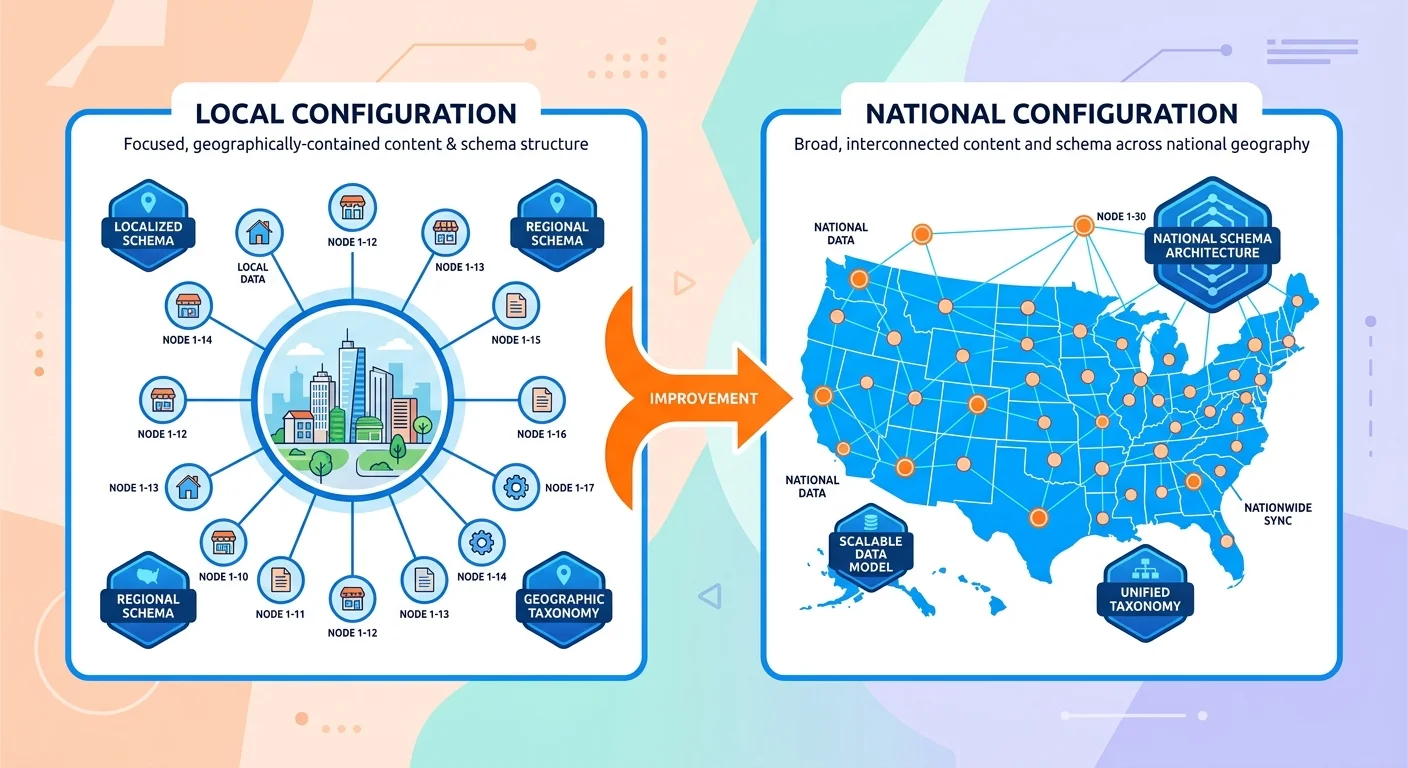
Infrastructure changes when the scope changes. A Local AI Authority Engine and a National AI Authority Engine aren’t the same service with different geographic tags. They’re different machines built to solve different problems at different scales.
Local authority optimizes for precision inside a city. National authority optimizes for consensus across a country. The signals AI engines evaluate change. The content depth changes. The entity architecture changes. The link ecosystem changes. You’re moving from "best in the city" to "best in the nation." Most businesses try to scale by repeating local tactics in more places. That’s not scaling authority. That’s fragmenting it.
Scope
Local authority targets a city or metro area. The question AI answers: "Who’s the best chiropractor near me?" National authority targets the entire country. The question becomes: "Who’s the leading chiropractor in the United States?" Those aren’t the same question with different ZIP codes. They require different entity signals, different content strategies, and different trust architectures.
Nearly one-third of all mobile searches are location-related, which means local intent still matters even at national scale. But national authority means AI can recommend you regardless of where someone is standing when they ask. Local SEO builds narrow bridges to specific neighborhoods. National authority requires infrastructure that spans the entire country without collapsing. You’re not abandoning local signals. You’re building a layer above them that works everywhere.
Content Volume and Semantic Density
Local authority can exist with modest content depth – a handful of well-optimized pages answering the core questions in your discipline. National authority cannot. The average top-ranking page also ranks for about 1,000 other relevant keywords, which means AI engines evaluate authority through semantic density. Shallow content doesn’t scale.
A local practice might need a dozen foundational pages and a steady stream of monthly content to maintain city dominance. A national brand needs significantly more – deep interconnected content that answers every angle of the discipline, proves expertise independent of geography, and demonstrates consensus across the industry. Not "chiropractor in Phoenix" repeated fifty times with city names swapped out. Authority as a compounding asset that covers mechanism, application, objection, cost, timeline, and integration for every major topic in your field.
Content marketing costs 62% less than traditional marketing and generates approximately 3 times as many leads, but only when the content builds authority instead of fragmenting into keyword-targeted noise. National authority means every article you publish reinforces the same entity signal: you are the answer, regardless of where the question is asked. That’s the semantic density AI engines reward.
Entity Signal Architecture
Local schema uses LocalBusiness markup and tells AI you’re a business at a specific address. National schema uses Organization markup and tells AI you’re an authority with reach, expertise, and trust that extends beyond geography. The structured data changes. The sameAs properties expand to include national-level platforms and industry associations. The aggregateRating shifts from location-specific reviews to brand-level consensus. Most businesses never make this transition, so AI keeps treating them like a local shop – even when they’re trying to compete nationally.
Without Organization-level schema, AI can’t distinguish between "a chiropractor with locations in ten cities" and "a national chiropractic authority." And if AI can’t tell the difference, it defaults to recommending whoever architected their entity correctly. This is where most businesses fail when they try to scale. They update their service pages and launch a national ad campaign, but they never rebuild the machine-readable entity signals that tell AI what they are at scale.
Link Ecosystem and Citation Velocity
Local link ecosystems prioritize city-specific directories, regional publications, and geo-tagged citations. National link ecosystems prioritize industry-wide publications, national directories, peer-reviewed sources, and institutional platforms AI engines trust as consensus validators. The volume increases. The velocity increases. The editorial standards AI applies to those links increase. A local practice can build authority with foundational citations and consistent NAP data. A national brand needs ongoing citation velocity from sources AI recognizes as authoritative nationwide.
This is one of the challenges of digital market expansion most businesses underestimate: the citation threshold that worked locally won’t carry you nationally. AI engines evaluate national authority by comparing your link ecosystem to every other business in your discipline across the entire country. If your link profile looks like a local shop’s, AI will treat you like one – even if you’re advertising nationally.
| Component | Local Configuration | National Configuration |
|---|---|---|
| Geographic Scope | City or metro area optimization | Entire country without location dependence |
| Content Depth Required | Modest foundational pages with steady monthly execution | Comprehensive interconnected clusters covering every angle of discipline |
| Content Marketing Efficiency | Costs 62% less than traditional marketing and generates approximately 3x as many leads when executed for topical authority | Same efficiency multiplier applies at scale when content compounds into consensus signals rather than fragmenting into keyword noise |
Frequently Asked Questions
Let’s hit the most common objections.
These surface when you realize the local playbook won’t carry you nationally – but you’re not yet sure what replacing it looks like. Every question below is real. Every answer is grounded in how AI engines evaluate authority at scale.
How do I transition from a local SEO strategy to a national one without losing my local rankings?
You don’t abandon local signals. You layer national infrastructure on top.
Your local schema, citations, and geo-specific content stay intact. They anchor your entity in the cities where you already have trust. What changes is the addition of Organization-level schema, national citation sources, and topical content clusters that prove expertise independent of geography. AI engines don’t see this as a conflict. They see a business with both local precision and national reach.
The risk isn’t losing your local rankings. The risk is fragmenting your entity by treating every city as a separate business. If your national expansion strategy is duplicating your local site ten times with different city names, AI will read that as ten disconnected entities – not one authoritative brand.
Maintain your local foundation. Build the national layer above it as a unified, machine-readable entity.
What are the biggest mistakes businesses make when trying to scale their digital authority nationally?
Can a business have national authority if it doesn’t have physical locations in every state?
Yes. National authority isn’t about geography – it’s about entity trust.
AI engines evaluate whether you’re a trusted source of expertise nationwide, not whether you have a storefront in every state. A business with a single location can have national authority if its content depth, citation ecosystem, and schema architecture signal topical expertise at scale.
The inverse is also true. A business with locations in twenty cities can still be invisible nationally if its entity is fragmented across disconnected local sites.
What matters is whether AI can trust you as the answer regardless of where the question is asked. That trust comes from semantic density, national-level citations, and Organization schema that tells AI you’re an authority – not a local shop with ambitions.
Physical presence helps. Entity coherence decides.
How does Answer Engine Optimization (AEO) change when scaling from a single city to the entire country?
AEO at local scale optimizes for being the answer to ‘Who’s the best near me?’ AEO at national scale optimizes for being the answer to ‘Who’s the leading authority?’
The content shifts from location-specific questions to discipline-wide topics. The schema shifts from LocalBusiness to Organization. The link ecosystem shifts from regional directories to national publications and industry validators. The citation strategy shifts from foundational NAP consistency to ongoing velocity from sources AI trusts as consensus signals.
In 2020, 64.82% of Google searches ended without a click. Being featured as the direct answer is more valuable than ranking on a list. At national scale, your content must prove you’re the authority AI should cite – not one of many options.
Local AEO can succeed with a dozen well-optimized pages. National AEO requires full topical coverage that answers every angle of your discipline. The depth, velocity, and editorial standards all increase when the scope changes.
What’s the first step to take after establishing city dominance to begin building national authority?
Run the AI Visibility Check at national scale.
Ask ChatGPT, Gemini, and Grok who the leading authority in your discipline is nationwide – not in your city. If they don’t name you, they’re naming someone else. That tells you exactly where you stand.
The first step after city dominance is auditing whether your current entity architecture can scale or whether it’s locked into local-only signals AI won’t recognize nationally.
Once you know where you stand, the next move is rebuilding schema from LocalBusiness to Organization, shifting your content strategy from geo-targeted pages to semantic clusters, and building citation velocity from national sources AI trusts. 81% of consumers need to trust a brand before they will buy, and AI engines evaluate that trust through entity coherence. If your digital presence reads as fragmented, trust collapses – and so does your ability to scale.
Fix the architecture first. Then feed it consistently.
The Choice You’re Actually Making
Here’s where this lands.
You’re not deciding whether to scale nationally. You’re deciding whether to abandon the infrastructure that made you invisible at scale and rebuild it correctly – or keep repeating local tactics in more places and hope AI figures it out.
It won’t.
AI engines don’t reward effort. They reward coherence. The businesses that architect their digital presence as a single machine-readable entity nationwide become the answer. The businesses that scale by duplicating city pages and geo-modified keywords stay on lists nobody clicks.
The bridge metaphor isn’t decoration. Scaling authority isn’t about building more bridges to more cities. It’s about replacing the entire bridge with infrastructure AI can see and trust from anywhere in the country.
That means Organization-level schema instead of LocalBusiness markup. Semantic content clusters instead of keyword-targeted city pages. National citation velocity instead of local directory listings. Entity signal consistency across every platform instead of variations AI interprets as uncertainty.
Most businesses never make this shift. They try to scale authority by doing more of what worked locally, and they fragment their entity in the process. AI doesn’t see a national brand with ten locations. It sees ten disconnected local businesses competing against each other for the same queries.
That’s the difference between scaling and breaking.
The AI Visibility Check shows you exactly where you stand right now. Ask ChatGPT, Gemini, and Grok who the leading authority in your discipline is nationwide. If they don’t name you, they’re naming someone else.
That gap widens every month you stay invisible at national scale.
You can keep optimizing for rankings that don’t matter. Or you can do what actually works: replacing the bridge, not building more of them. The Cost of Inaction: How Authority Decay Erodes Your Market Share isn’t a thought experiment. It’s what happens when you wait.
The businesses that moved early already own the consensus. The ones that hesitated are fighting for table scraps.
You already know whether AI names you or a competitor when someone asks who the leading authority is nationwide. The gap between city dominance and national trust isn’t a mystery – it’s an infrastructure problem you can map in fifteen minutes.
The AI Visibility Check shows you exactly where your entity breaks. Whether you’re building local bridges while someone else already owns the national highway. Whether your schema reads as fragmented noise or coherent authority.
If AI doesn’t name you, it’s naming someone else. That gap compounds every month you wait.