When a patient asks ChatGPT, “Who’s the best chiropractor for sciatica relief near me?” – the AI doesn’t scan for the phrase “best chiropractor for sciatica” fourteen times on your homepage. It analyzes the depth and clarity of the connection between your practice entity, the condition (sciatica), the treatment methods you use, the outcomes patients can expect, and the questions they’re actually asking. If those connections are weak, vague, or missing entirely – you’re not in the conversation. A competitor with stronger semantic anchors gets named instead.
This is why practices with beautiful websites and dozens of thin articles still don’t show up in AI recommendations. The content exists, but the connections don’t. AI can’t infer your expertise from a list of services or a photo gallery. It needs explicit, structured, verifiable proof that you are the authority on sciatica – not just a chiropractor who happens to mention it. Semantic anchoring is how you build that proof.
The shift from keyword optimization to semantic anchoring isn’t a trend. It’s the fundamental change in how visibility works now that patients have stopped Googling and started asking. And the practices that understand this early are the ones locking in authority while their competitors are still optimizing for an algorithm that’s being replaced.
Why Keyword Optimization No Longer Controls AI Recommendations
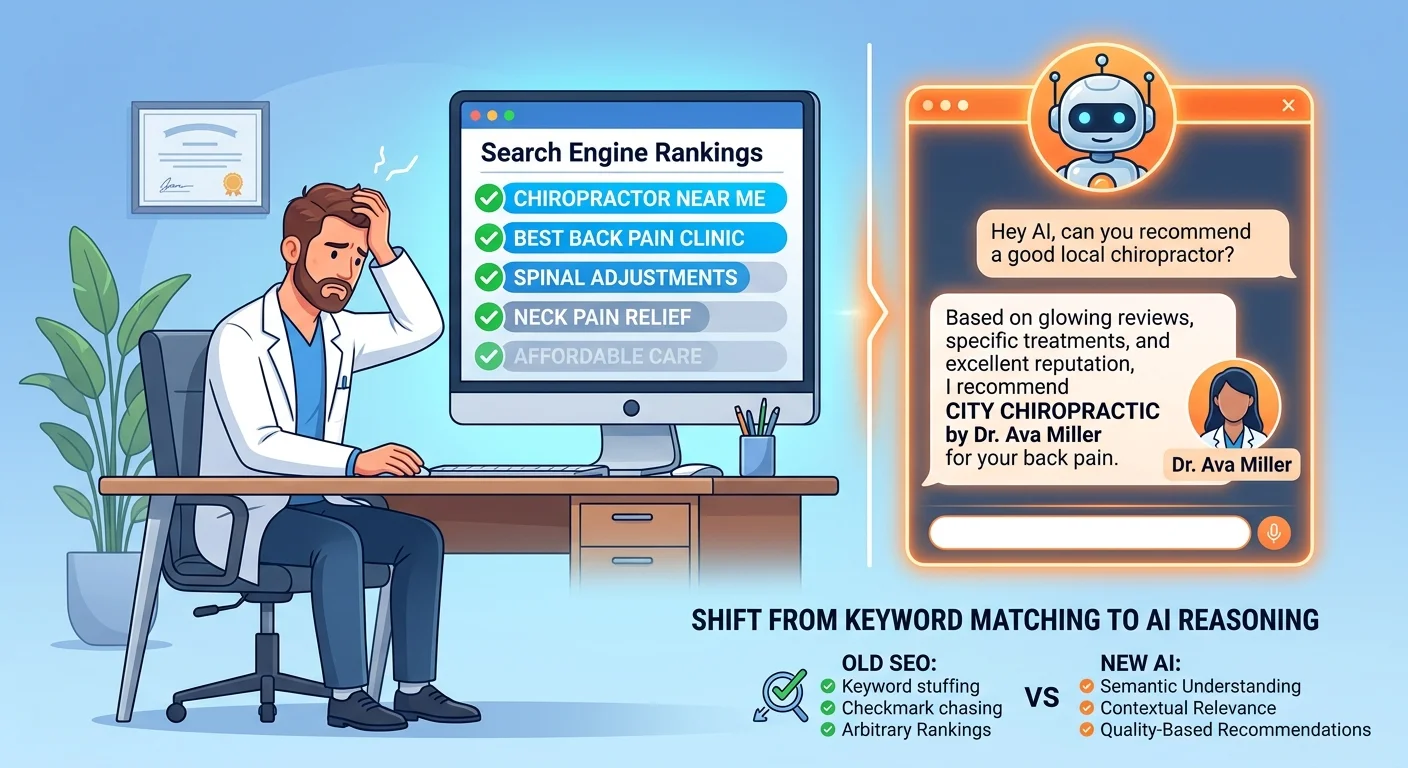
The way patients found you changed. Not gradually – all at once.
SEO got you on a list. Patients clicked through, compared options, made a decision. That system worked because patients did the work of evaluating and choosing.
Now they ask ChatGPT who to see. AI gives them a name. They book. The ranked list never appeared. Your keyword strategy never entered the equation.
The Patient Behavior Shift That Broke Keyword Optimization
Patients stopped browsing. They started trusting.
When someone asks, “Who should I see for sciatica relief near me?” and ChatGPT responds with a specific practice name, treatment approach, and reasoning – that’s the outcome. The patient doesn’t open five tabs. They don’t compare websites. The AI made the recommendation. The trust transferred. The booking happens.
Understanding searches better than ever before explains how Google’s AI systems moved beyond keyword matching to understanding the meaning and context behind queries. That shift didn’t just change how Google works – it changed how every AI answer engine evaluates content.
The question stopped being “which keyword should I rank for?” and became “which practice should I trust?” AI answers that question now. Not patients.
Why AI Ignores Keyword Density
Here’s the thing most practices don’t realize: AI doesn’t count how many times “sciatica” appears on your page.
It evaluates whether your content demonstrates actual expertise on sciatica as a condition.
The causes. The treatment protocols. The patient outcomes. The contraindications. The related conditions patients should know about.
Keyword density measures repetition. Semantic anchoring measures understanding. AI engines optimized for the latter years ago. Your competitors optimizing for the former are invisible – and they have no idea why.
The Rise of Semantic Search breaks down how conversational queries and contextual understanding replaced keyword strings as the primary mechanism search systems use to match content to intent.
Your 800-word article that says “sciatica” twelve times and “chiropractor near me” eight times isn’t authority content. It’s keyword spam wearing a business casual outfit. AI sees it for exactly what it is – and moves on to the practice with actual depth.
What Semantic Anchoring Actually Means for Chiropractors
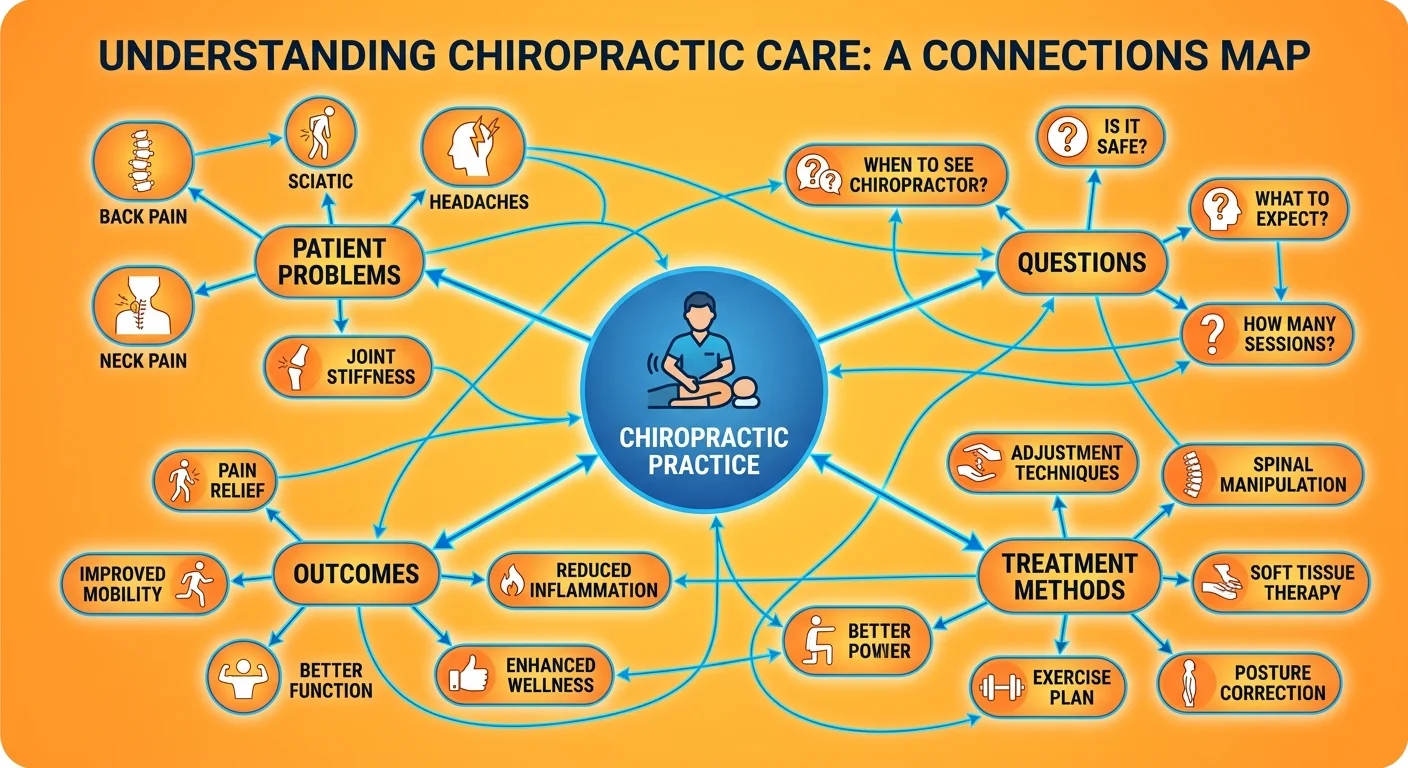
Semantic anchoring is how you build a map AI can read.
It’s the web of verified connections between your practice (the entity), the conditions you treat (the topics), the methods you use (the expertise), and the questions patients actually ask (the intent).
When those connections are clear, structured, and backed by factual depth – AI understands you’re the authority. When they’re missing or weak – you’re not in the conversation.
It’s not about mentioning more conditions. It’s about proving deeper expertise on fewer topics than any competitor in your market.
The Three Semantic Layers AI Reads
AI evaluates authority in layers. Miss one and the anchor breaks.
| Layer | What It Represents | Example |
|---|---|---|
| Entity Layer | Your practice as a verified business | Schema markup confirms you’re a real chiropractic clinic at a real address with real credentials |
| Topic Layer | The condition or service | Sciatica – not just mentioned but fully covered: causes, symptoms, treatments, related conditions, patient questions |
| Intent Layer | The patient’s actual question | “Will chiropractic help my sciatica?” “What causes sciatica?” “Is surgery better than chiropractic for sciatica?” |
AI connects those layers. Your practice → Sciatica → “Will chiropractic help my sciatica?”
If any layer is missing or weak, the anchor fails. Another practice with all three layers intact gets the recommendation instead.
That’s not a theory. That’s how the system works right now.
What “Machine-Readable” Actually Means
Machine-readable doesn’t mean robotic. It means structured enough that AI can extract, verify, and cross-reference your claims without human interpretation.
A paragraph that says “We treat back pain” is human-readable. A paragraph that says “We use the McKenzie Method for lumbar disc herniations causing sciatica, focusing on directional preference exercises to centralize pain and restore mobility” is machine-readable.
The second one gives AI specific entities to verify (McKenzie Method, lumbar disc herniation, sciatica, centralization), specific processes to understand (directional preference exercises), and specific outcomes to evaluate (pain centralization, mobility restoration).
What Is Semantic Search and Why Does It Matter for SEO explains how search engines analyze the structure and meaning of content – not just the keywords it contains.
AI cross-references that level of detail against institutional sources. If it matches – your authority signal strengthens. If it’s vague or generic – you’re unverifiable.
That’s why generic “we offer chiropractic care” websites are invisible. AI has no way to confirm expertise because there’s nothing specific enough to verify.
The AI Authority Engine rebuilds your infrastructure so every service, every condition, and every treatment method is machine-readable and semantically anchored to the questions patients ask. Not because it looks better. Because AI can’t ignore it.
The Five Components of a Strong Semantic Anchor
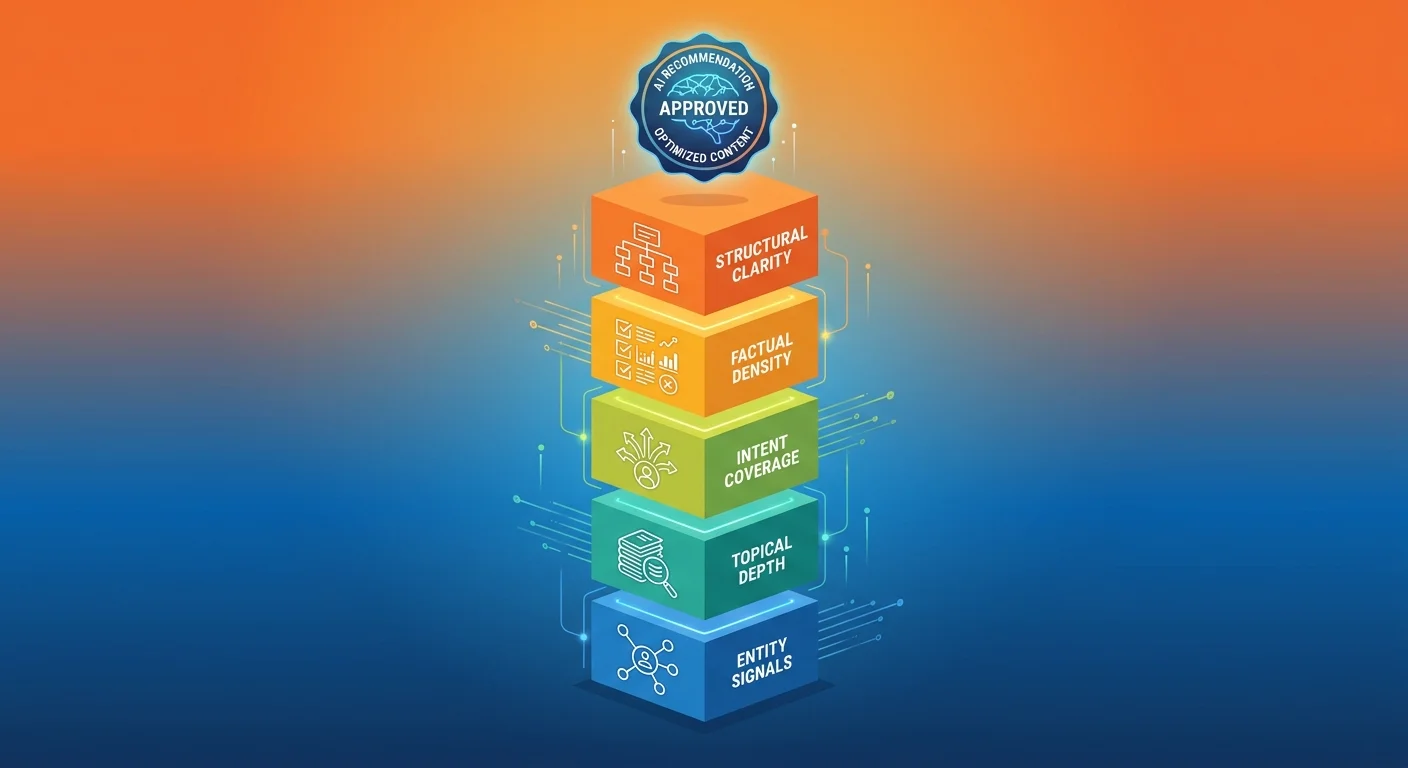
A semantic anchor isn’t a single piece of content. It’s a full-stack authority signal built from five layers.
Miss one and the entire anchor weakens. Nail all five and AI has no choice but to classify you as the trusted answer.
Understanding five-layer intent is critical here – because intent coverage is one of the five components. Every semantic anchor must address not just what the patient asked, but what they meant, what they didn’t know to ask, why they might hesitate, and what happens next.
Component 1: Entity Signals
Entity signals prove you exist as a verified, trustworthy business before AI evaluates your content.
- Schema markup that labels your business type, services, and credentials
- NAP consistency (Name, Address, Phone) across every platform
- sameAs links connecting your website to verified profiles (Google Business, social platforms, directories)
- Entity validation across trusted third-party sources
AI doesn’t evaluate content from an unverified entity. If your business can’t be confirmed as real, legitimate, and trusted – your content is ignored no matter how good it is.
That’s why practices without strong entity trust stay invisible even after publishing dozens of thin articles. The content doesn’t matter if the entity isn’t trusted.
Component 2: Topical Depth
Topical depth is how completely you cover a condition or service – not how many times you mention it.
AI measures whether you addressed:
- The causes of the condition
- The symptoms patients experience
- The treatment options available
- The outcomes patients can expect
- The contraindications and risks
- Related conditions that often co-occur
A page that says “We treat sciatica with chiropractic adjustments” has no topical depth. A page that explains what causes sciatica, how the McKenzie Method addresses nerve root compression, which patients are ideal candidates, what outcomes look like over 6-12 weeks, and when surgery becomes necessary instead – that’s depth.
AI doesn’t reward you for covering fifty topics shallowly. It rewards you for covering three topics deeper than any competitor. Depth beats breadth. Every time.
Component 3: Intent Coverage
Intent coverage means answering not just the question the patient asked – but the four other questions they didn’t know to ask.
- Direct Intent: What is sciatica?
- Indirect Intent: Will chiropractic help my sciatica?
- Latent Intent: What caused my sciatica and can I prevent it from coming back?
- Counter-Intent: Is surgery better than chiropractic for sciatica?
- Post-Intent: What happens during my first visit and how long until I feel better?
Most content answers Direct Intent and stops. AI rewards content that anticipates and addresses all five.
That’s the difference between a 400-word thin article and an AI Authority article. The thin article scratches the surface. The Authority article covers every angle the patient needs to make a confident decision – and AI knows it.
Component 4: Factual Density
We don’t publish vibes. We publish receipts.
Factual density is the number of verifiable, specific claims per paragraph. Thin content has low density – lots of words, few facts. Authority content has high density – every sentence advances understanding and can be cross-referenced.
Compare these two paragraphs:
Low Density: “Chiropractic care can help with many conditions. Our experienced doctors use proven techniques to provide relief and improve your quality of life.”
High Density: “The McKenzie Method uses directional preference exercises to centralize pain caused by lumbar disc herniations. The research is clear: when you nail the directional preference, 60-70% of patients feel their symptoms centralize in just the first few sessions. That’s not a vibe – it’s a verifiable outcome.”
The second paragraph gives AI specific entities to verify (McKenzie Method, lumbar disc herniation, directional preference), specific data points to cross-reference (60-70%, first few sessions), and specific mechanisms to understand (centralization).
Natural Language API is the underlying technology that allows AI to analyze text and extract entities, relationships, and sentiment. It’s not magic – it’s pattern recognition applied to structured content. And vague generalities don’t produce patterns AI can trust.
Vague language loses. Every time.
Component 5: Structural Clarity
Structural clarity is how easy it is for AI to extract and map your content’s meaning.
- H2/H3 hierarchies that organize content logically
- Schema markup that labels sections, lists, and data types
- Internal linking that shows how topics relate to each other
- Paragraph structure that delivers one clear idea per block
AI can’t infer structure from a wall of text. It needs explicit signals that say “this is the main topic, this is a subtopic, this is a supporting example, this is a related concept.”
A beautifully designed page with no structural clarity is invisible. A plain-looking page with strong semantic structure gets cited.
| Component | What AI Looks For | What Breaks It |
|---|---|---|
| Entity Signals | Verified schema, NAP consistency, sameAs links | Missing schema, inconsistent listings, unverified profiles |
| Topical Depth | Comprehensive coverage of causes, treatments, outcomes, risks | Shallow mentions, generic descriptions, missing context |
| Intent Coverage | All 5 intent layers addressed | Direct intent only, no objection handling, no post-action guidance |
| Factual Density | Specific claims, data points, verifiable protocols | Vague language, marketing fluff, unverifiable generalities |
| Structural Clarity | H2/H3 hierarchy, schema, internal links, logical flow | Wall of text, missing headings, no schema, broken navigation |
Why Most Chiropractic Content Lacks Semantic Structure
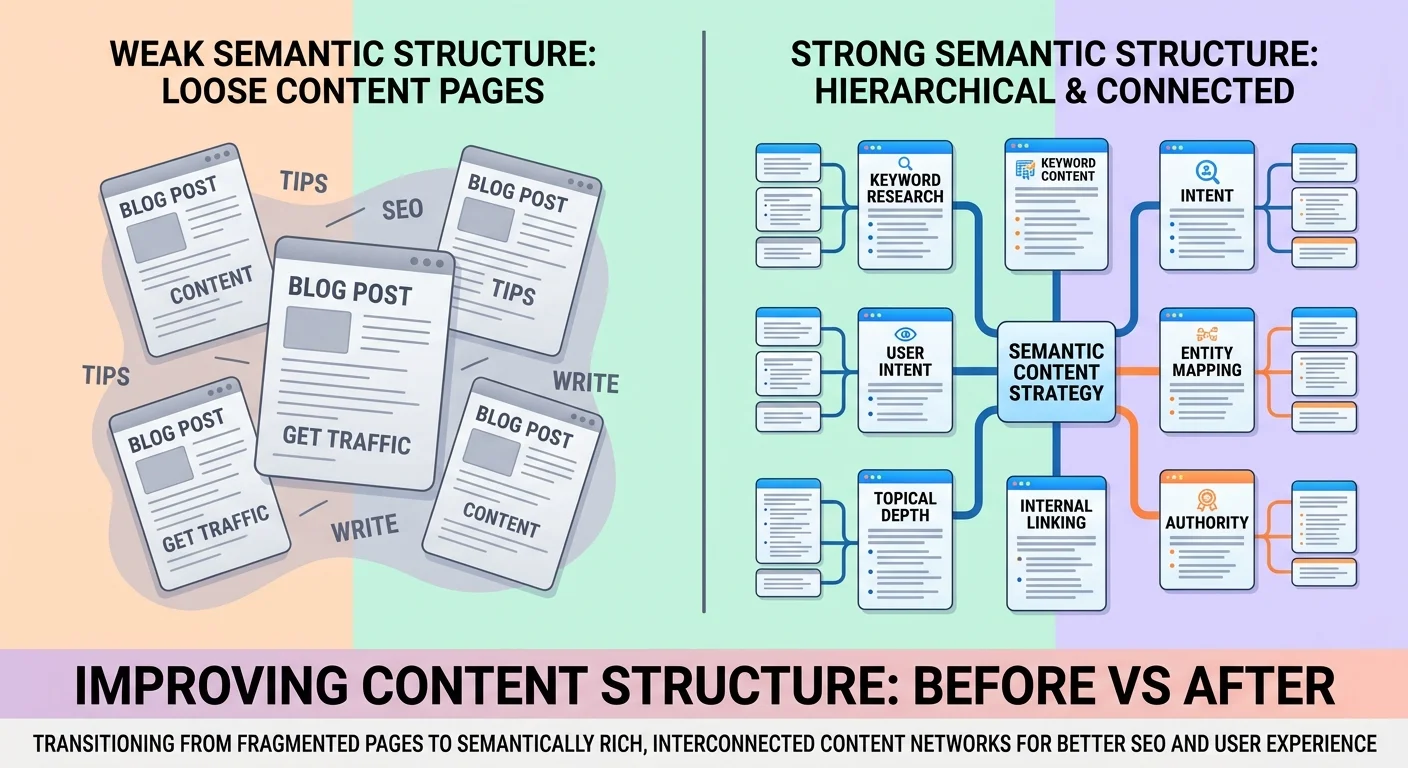
The content exists. That’s not the problem.
The problem is the content was built for the wrong system. It was optimized for Google’s old algorithm – keyword mentions, backlink volume, page rankings.
None of those signals matter to ChatGPT or Gemini when they’re deciding which chiropractor to recommend.
So practices end up with websites full of content AI can’t use. Beautiful. Well-written. Completely invisible.
The Template Website Problem
Template websites were built to look good – not to be machine-readable.
Services listed as bullet points with no context. Generic “About Us” pages with no schema. Homepage hero sections that say “Your Trusted Chiropractor” with nothing AI can verify. Photo galleries and testimonial sliders that do nothing for semantic anchoring.
AI can’t extract expertise from a pretty design. It needs structure. Labels. Depth. Verification.
That’s why AI-readable infrastructure is the foundation. Without it, every piece of content you publish sits on top of a structure AI can’t trust. And untrusted content doesn’t get cited.
The pretty website you paid for? It’s a digital brochure. AI scrolled past it.
The Freelance Writer Problem
Thin articles work when executed correctly. The problem is how most practices build them.
Most practices hire freelance writers who optimize for word count and keyword density. They’re not building semantic anchors because they don’t understand entity trust, schema architecture, or five-layer intent coverage.
They’re writing thin articles the way commodity content has always been written – which is exactly why they don’t work anymore.
The output looks like content. It reads fine. But it has no authority infrastructure underneath it. No schema. No internal linking strategy. No factual density. No intent coverage beyond “answer the question and hit 800 words.”
AI evaluates that content the same way it evaluates every other commodity article on the internet: low authority, low trust, not worth citing.
The cost of cheap content isn’t just wasted money. It’s wasted authority. Every thin, generic, keyword-stuffed article you publish actively dilutes your entity trust. AI learns you’re not a reliable source. And once that classification sticks, it’s harder to reverse than if you’d never published anything at all.
You can’t undo commodity classification with more commodity content.
Why “More Content” Doesn’t Fix Weak Anchors
Publishing more thin content doesn’t solve the problem. It makes it worse.
AI sees twenty shallow articles and classifies you as a low-authority site pumping out content for SEO. It sees three deep, factually dense, intent-covering topic clusters and classifies you as an expert.
Volume without depth is noise. Depth without volume is authority.
The practices invisible right now aren’t invisible because they don’t have enough content. They’re invisible because the content they have lacks semantic structure. And publishing more thin articles just reinforces the wrong signal.
| Content Approach | What Gets Published | What AI Sees |
|---|---|---|
| Keyword-Focused Publishing | 20+ generic 600-word articles, keyword-stuffed, minimal depth, no schema | High volume, low authority, commodity content, not worth citing |
| Semantic Anchoring | 8-12 deep topic clusters, 2000+ words each, full intent coverage, schema-marked, factually dense | High authority, verified expertise, trusted source, citation-worthy |
More isn’t better. Better is better.
How AI Evaluates Semantic Depth vs. Content Volume
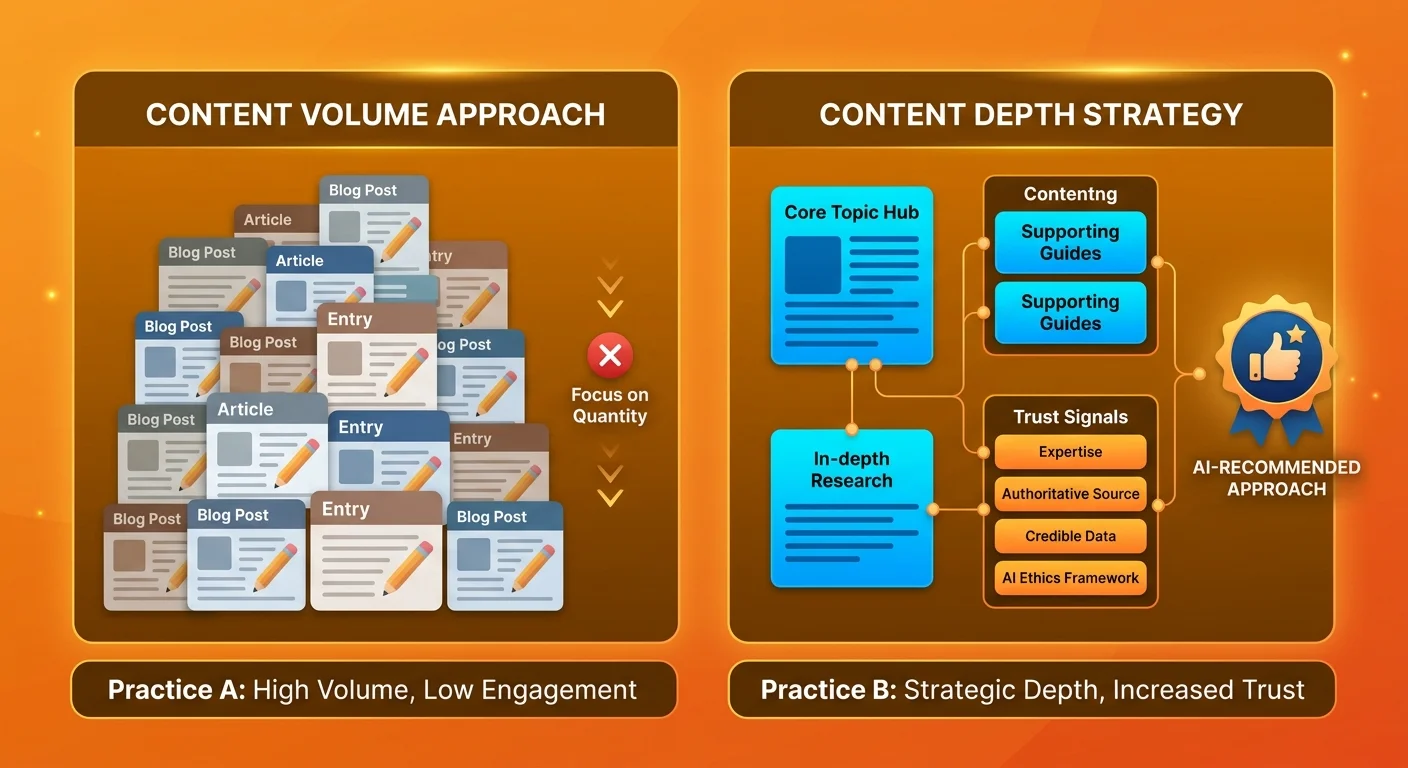
AI doesn’t count pages. It evaluates trust.
A practice with forty thin articles loses to a practice with twelve deep, semantically anchored topic clusters every single time. Because AI isn’t optimizing for content volume – it’s optimizing for citation reliability.
The question isn’t “how much content do I have?” The question is “how confident is AI that I’m the authority on this specific topic?”
Citation Velocity vs. Content Publishing Frequency
Publishing daily doesn’t build authority. Being cited consistently does.
Citation velocity is how often trusted sources reference you. Medical databases. Directories. Professional orgs. One deep article cited by three Tier 1 sources beats fifty thin articles no one mentions. One deep article that gets cited by three Tier 1 sources is worth more to AI than fifty thin articles no one references.
Entity-Based SEO explains how search engines moved from evaluating individual pages to evaluating entities as a whole. Your authority isn’t built one blog post at a time. It’s built by establishing your business as a trusted entity across multiple platforms and sources.
AI aggregates those signals. It doesn’t just read your website – it reads every platform that mentions you, every directory that lists you, every review site that validates you.
That’s entity trust. And entities with strong trust get cited more – which compounds their authority further. It’s a flywheel. And once it’s spinning against you, catching up isn’t just hard. It’s exponentially harder every month you wait.
The Semantic Density Metric
Semantic density measures how many verified, interconnected concepts are covered per piece of content.
Thin content has low density. Lots of words. Few claims. No verification. Generic advice anyone could have written.
Authority content has high density. Every paragraph advances understanding. Every claim can be cross-referenced. Every concept connects to related topics AI can map.
Compare these two thin article density examples:
Low Density (800 words, 3 verifiable claims): “Chiropractic care helps with back pain. Our doctors are experienced and use gentle techniques. We offer personalized treatment plans tailored to your needs.”
High Density (800 words, 15+ verifiable claims): “The McKenzie Method uses repeated end-range movements to identify directional preference in patients with lumbar disc herniations causing sciatica. Studies show 60-70% of patients with sciatica experience significant pain reduction within 6-8 weeks when directional preference is correctly identified and applied. And it has guardrails. This isn’t for cases with red flags like cauda equina syndrome or other serious neurological issues. That’s a different conversation.”
AI cross-references the second example against institutional sources. McKenzie Method – verified. Lumbar disc herniation – verified. Centralization – verified. 60-70% success rate – matches published studies. Contraindications – matches clinical guidelines.
The first example? Nothing to verify. Generic claims AI has seen on ten thousand other chiropractic websites. Not authority. Not citation-worthy.
Why Competitors With Fewer Pages Rank Higher
You have forty thin articles. A competitor has twelve AI Authority articles.
AI recommends them. Not you.
Why? Because their twelve pieces have stronger semantic anchors. Deeper topic coverage. Verified claims. Clear entity signals. Full intent layer coverage. Schema markup. Internal linking architecture.
Your forty articles were written by freelancers optimizing for keywords and word count. They hit “publish” and moved on. No schema. No structure. No depth. Just content.
AI evaluated both sites. Yours said “I publish a lot.” Theirs said “I’m the authority on these specific conditions.”
Authority won. Volume lost. Again.
The Cost of Weak Semantic Anchors
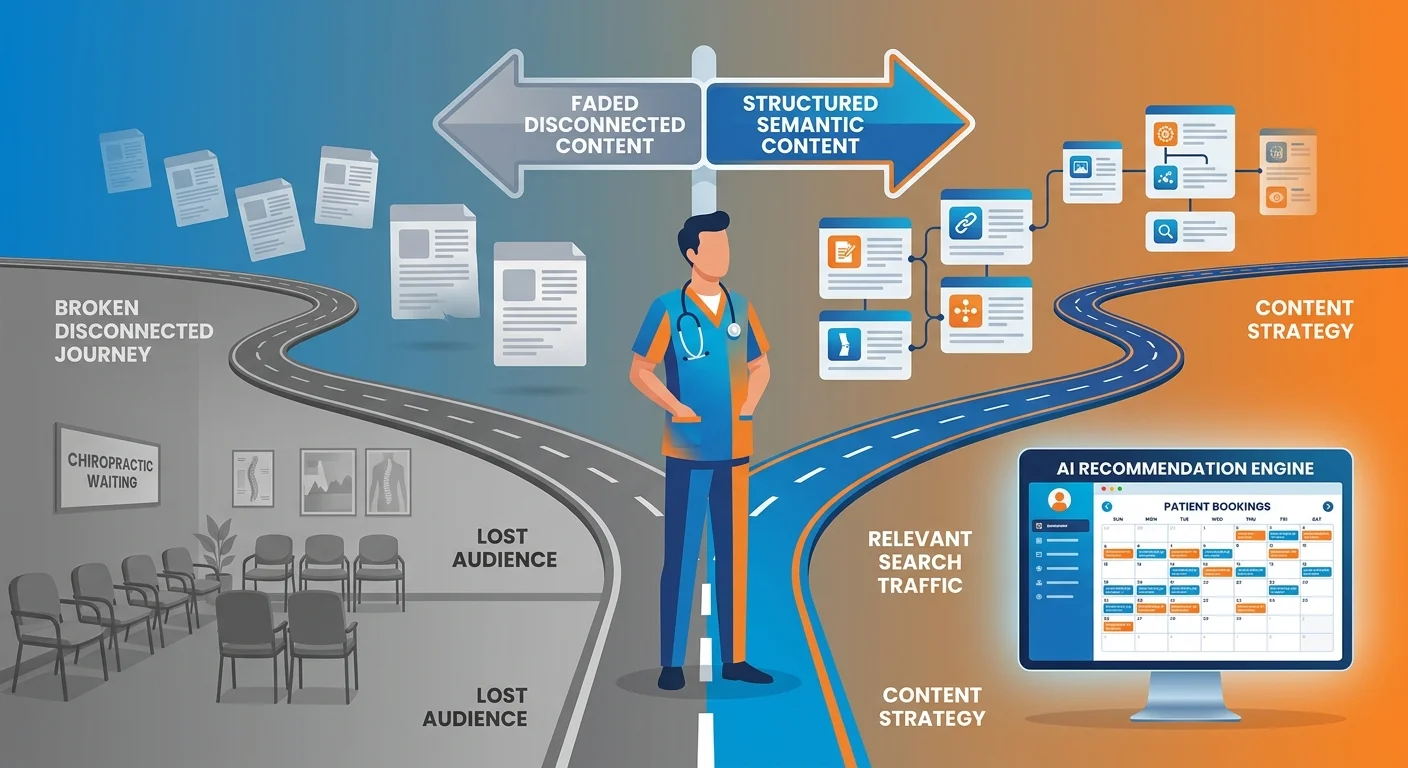
This isn’t a technical problem. It’s a business problem.
Every month you’re invisible to AI, a competitor with stronger semantic anchors is compounding their authority. Patients are asking questions. AI is giving answers. Your name isn’t in those answers. A competitor’s is.
That gap doesn’t stay static. It widens.
Invisibility as a Competitive Gap
AI learns over time. Every recommendation it makes strengthens that entity’s authority signal. Every citation builds on the last one.
Want to know where you stand right now? The AI Visibility Check shows you exactly what ChatGPT, Gemini, and Grok say when patients ask who to trust in your market. Fifteen minutes. Real data.
I’ve run this check with practices that were convinced they were in good shape. Most weren’t.
A practice AI recommends this month gets cited more next month. Those citations strengthen their entity trust. Stronger entity trust leads to more recommendations. More recommendations lead to more patient interactions. More patient interactions lead to more reviews, more backlinks, more directional searches.
The authority flywheel spins. And once it’s spinning for a competitor, catching up isn’t just hard – it’s exponentially harder every month you wait.
The practice that moves first doesn’t just win. They make it structurally difficult for anyone else to compete.
Wasted Marketing Spend
Running paid ads to a website with weak semantic anchors is like building a billboard for a business AI can’t verify exists.
Traffic shows up. Patients land on your site. They read your services page. Then they ask ChatGPT, “Is this chiropractor good for sciatica?” – and AI can’t confirm it because your semantic anchors are too weak to trust.
So the patient books with the competitor AI *did* recommend. Your ad spend drove traffic to a decision point where you lost.
That’s not a conversion rate problem. That’s an authority infrastructure problem.
| Scenario | Traffic Source | Semantic Anchor Strength | Outcome |
|---|---|---|---|
| Paid Ads to Strong Anchors | Google Ads | Deep topic coverage, schema-marked, entity verified | Patient asks AI → AI confirms authority → Patient books |
| Paid Ads to Weak Anchors | Google Ads | Thin content, no schema, unverified entity | Patient asks AI → AI can’t confirm → Patient books competitor |
| Organic Traffic to Strong Anchors | Google Search | Deep topic coverage, schema-marked, entity verified | Patient researches → Finds your content → AI confirms → Patient books |
| Organic Traffic to Weak Anchors | Google Search | Thin content, no schema, unverified entity | Patient researches → Finds your content → AI says competitor is better → Patient books competitor |
Every marketing tactic you’re running right now – ads, SEO, social media, referral programs – all of them route patients through an AI validation step at some point.
If your semantic anchors are weak, you lose at that step. Every time.
Semantic Anchoring vs. Schema Markup: What’s the Difference?
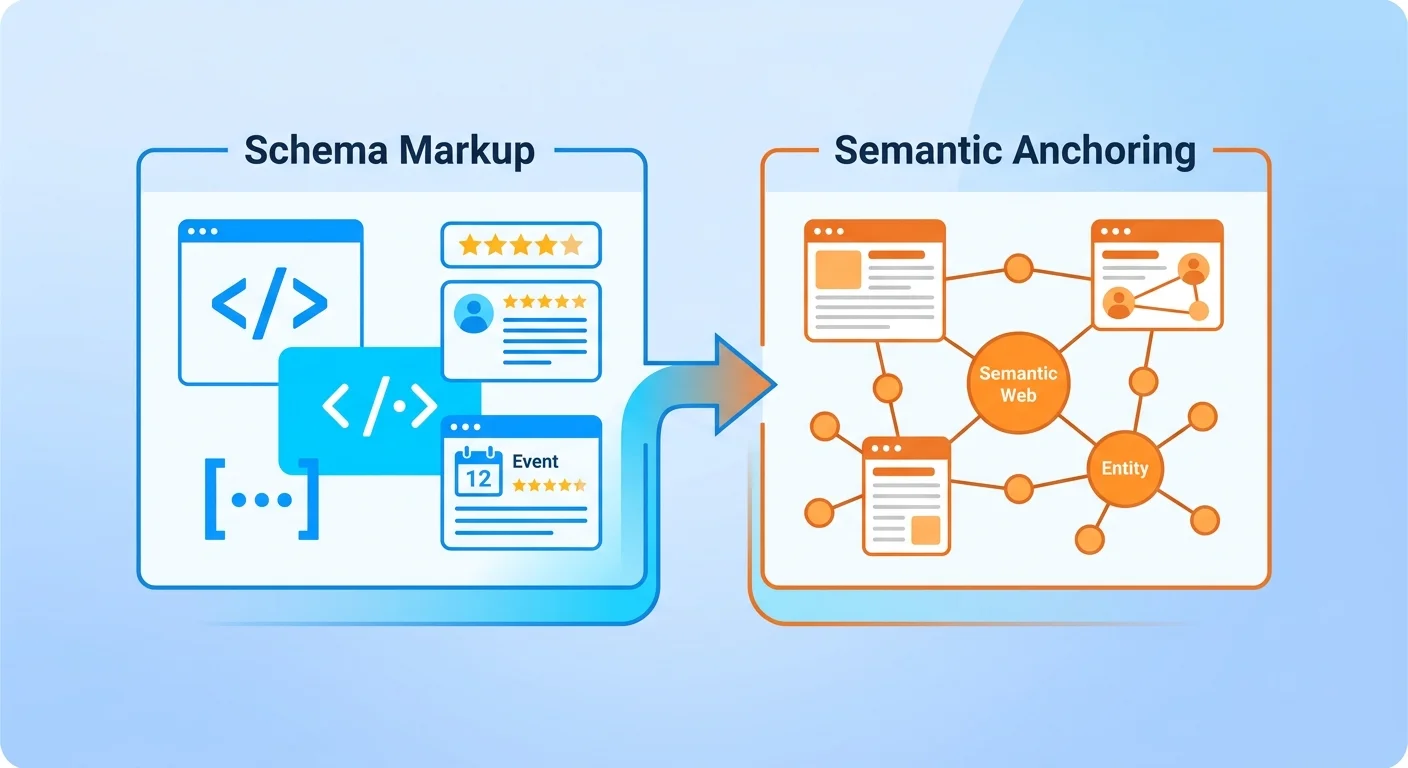
Schema markup and semantic anchoring aren’t the same thing. But you need both.
Schema is the tool. Semantic anchoring is the strategy.
What Schema Does
Schema is a markup language that labels your data so AI can read it.
It tells AI:
- “This is a business name.”
- “This is a service we offer.”
- “This is a review from a patient.”
- “This is the address where we’re located.”
Without schema, AI has to infer what everything means. With schema, you’re explicitly labeling it. That clarity matters – because AI prioritizes sources it can understand without ambiguity.
Schema is infrastructure. Critical infrastructure. But it’s not the whole picture.
What Schema Can’t Do
Schema can’t create expertise where none exists.
You can schema-mark a “Sciatica Treatment” page with 200 words of generic copy. AI will read the schema, understand it’s a service page, and then evaluate the content.
If the content is thin, vague, and has no factual density – the schema didn’t help. You labeled low-authority content. AI classified it as low-authority content with better labels.
Schema tells AI what to look at. It doesn’t tell AI you’re the authority. That comes from the content itself – the depth, the factual density, the intent coverage, the verifiable claims.
Why You Need Both
Schema provides the labels. Deep, factually dense, intent-covering content provides the substance.
Semantic anchoring is the strategy that ties them together into a coherent authority signal AI can trust.
- Schema without depth = well-labeled thin content
- Depth without schema = authority content AI struggles to extract
- Schema + depth = semantic anchor AI can verify and cite
That’s why AEO content writing isn’t just “better articles.” It’s a full-stack authority strategy that builds the infrastructure (schema, entity signals, internal linking) and the content (depth, density, intent coverage) simultaneously.
You can’t fix one without the other. Both have to be rebuilt together.
Frequently Asked Questions
What’s the biggest difference between semantic anchoring and traditional keyword optimization?
Keyword optimization focuses on matching specific words in a search query. You ranked for “chiropractor near me” by repeating that phrase and building backlinks.
Semantic anchoring focuses on building a deep contextual understanding of your expertise so AI can recommend you even when the exact keywords aren’t used.
When a patient asks, “I have shooting pain down my left leg – who should I see?” – AI doesn’t scan for the phrase “shooting pain down left leg.” It understands the patient is describing sciatica symptoms and recommends the practice with the strongest semantic anchor to sciatica treatment.
SEO gets you on a list. AEO gets you named as the answer. Those aren’t the same thing – and treating them like they are is why most practices are invisible right now.
Is Schema markup the same thing as semantic anchoring?
No. Schema markup is a specific type of code that helps label your data for AI. It’s one tool used in building semantic anchors – but semantic anchoring is the overall strategy of connecting all your content, services, and entity signals into a machine-readable web of authority.
Schema says “this is a service.” Semantic anchoring proves you’re the authority on that service by covering it deeper than any competitor, addressing every patient question, and building verifiable factual density AI can trust.
You need schema as part of the infrastructure. But schema alone doesn’t create authority.
Why would AI recommend my competitor if my website has more pages?
AI prioritizes the depth and clarity of trust signals over the volume of content.
A competitor with fewer pages but stronger semantic connections around a specific condition is seen as a more reliable answer than a practice with dozens of shallow pages covering everything generically.
AI doesn’t reward “more.” It rewards “deeper.” Fifty thin articles say “I publish a lot.” Twelve deep topic clusters say “I’m the definitive authority on these conditions.”
Authority wins. Every time.
Does this mean keywords don’t matter at all anymore?
Keywords still matter as indicators of patient problems – but they’re the starting point, not the goal.
If patients are searching “sciatica relief near me,” that tells you sciatica is a condition you should build a semantic anchor around. But the goal isn’t to rank for that keyword. The goal is to build such a deep, verifiable, intent-covering topic cluster around sciatica that AI has no choice but to classify you as the authority when anyone asks about it – regardless of the exact words they use.
Keywords tell you what to cover. Semantic anchoring is how you cover it in a way AI can trust.
Can I fix my site’s semantic authority with just thin articles?
No. Semantic authority depends on infrastructure and content working together.
AI Authority articles are critical – they provide the depth, intent coverage, and factual density AI needs to verify expertise. But if your site has no schema, inconsistent NAP data, weak entity signals, and broken internal linking – those articles sit on top of a structure AI can’t trust.
You need both. The AI Authority Engine rebuilds the foundation (schema, entity trust, site architecture) and the content layer (deep topic clusters, intent coverage, semantic anchors) simultaneously.
You can’t fix one without the other.
How long does it take to build strong semantic anchors?
Authority builds in layers. Foundation first, content compounding on top, AI visibility deepening every month.
I won’t promise you a timeline. Not because this doesn’t work – because authority doesn’t run on a microwave schedule. What I will say: every month of execution builds on the last. The practices that stick with it compound. The ones that quit give that ground to whoever kept going.
If you’re looking for a way to flood your schedule in the next 60 days, this isn’t it. But if you’re tired of short-term tactics that disappear the moment you stop paying for them – you’re in the right place.
Can I hire a freelance writer to build semantic anchors for me?
Freelance writers execute tasks. They don’t build authority infrastructure.
Semantic anchoring requires strategic depth, entity knowledge, schema expertise, and AEO methodology – not just “better articles.”
A freelance writer can produce 800 words on sciatica for $50. They’ll hit the keyword a few times, add some subheadings, keep it readable. It’ll look like content.
But it won’t have schema. It won’t cover all five intent layers. It won’t have the factual density AI cross-references. It won’t connect to your entity signals or internal linking architecture. It won’t be semantically anchored to anything.
So AI will evaluate it the same way it evaluates every other commodity article: not worth citing.
Building semantic anchors isn’t a writing task. It’s a full-stack authority strategy. And shortcuts don’t exist.
What happens if I don’t build semantic anchors and my competitors do?
The gap widens. Every month.
Competitor authority compounds. AI learns to trust them. Patients stop comparing options because the recommendation feels definitive. Your invisibility becomes structural – not temporary.
By the time you realize what happened, reversing it isn’t just hard. It’s exponentially harder than if you’d moved early.
The window to build these anchors before your market is locked isn’t infinite. And waiting isn’t a neutral position. It’s a choice to let someone else take the spot.
Conclusion
Semantic anchoring isn’t a feature. It’s the foundation.
Every month practices wait to address this, competitors with stronger anchors compound their authority. AI doesn’t forget. It learns who to trust and stops considering alternatives.
The practices invisible today will be structurally invisible tomorrow unless the infrastructure changes.
Keyword optimization was a tactic for a system where patients made the final decision. Semantic anchoring is the strategy for a system where AI makes the recommendation and patients trust it.
That’s not a future trend. That’s the current state.
And the window to build these anchors before your market is locked isn’t infinite. The practices that move now are the ones who’ll own AI recommendations six months from now. The ones who wait will be explaining to themselves why a competitor with fewer pages and a smaller ad budget is the only name patients hear when they ask.
There’s no version of this where doing nothing is a safe play.
Want to know if your practice has the semantic anchors AI needs to recommend you – or if competitors are filling that gap while you’re invisible? The AI Visibility Check takes 15 minutes and shows you exactly what ChatGPT, Gemini, and Grok say when patients ask who to trust in your market. No guesswork. Real data. If the results don’t make the problem self-evident – walk away. But if they do, you’ll know exactly what needs to be built.