What SEO Audits Were Built to Measure
Your SEO audit wasn’t built to lie to you.
It was built to measure something specific – your position on a list. A decade ago, that mattered. Someone searched “chiropractor near me,” Google returned ten results, the patient clicked one.
The higher you ranked, the more clicks you got.
SEO audits measured that. And they worked.
The Core Components of a Traditional SEO Audit
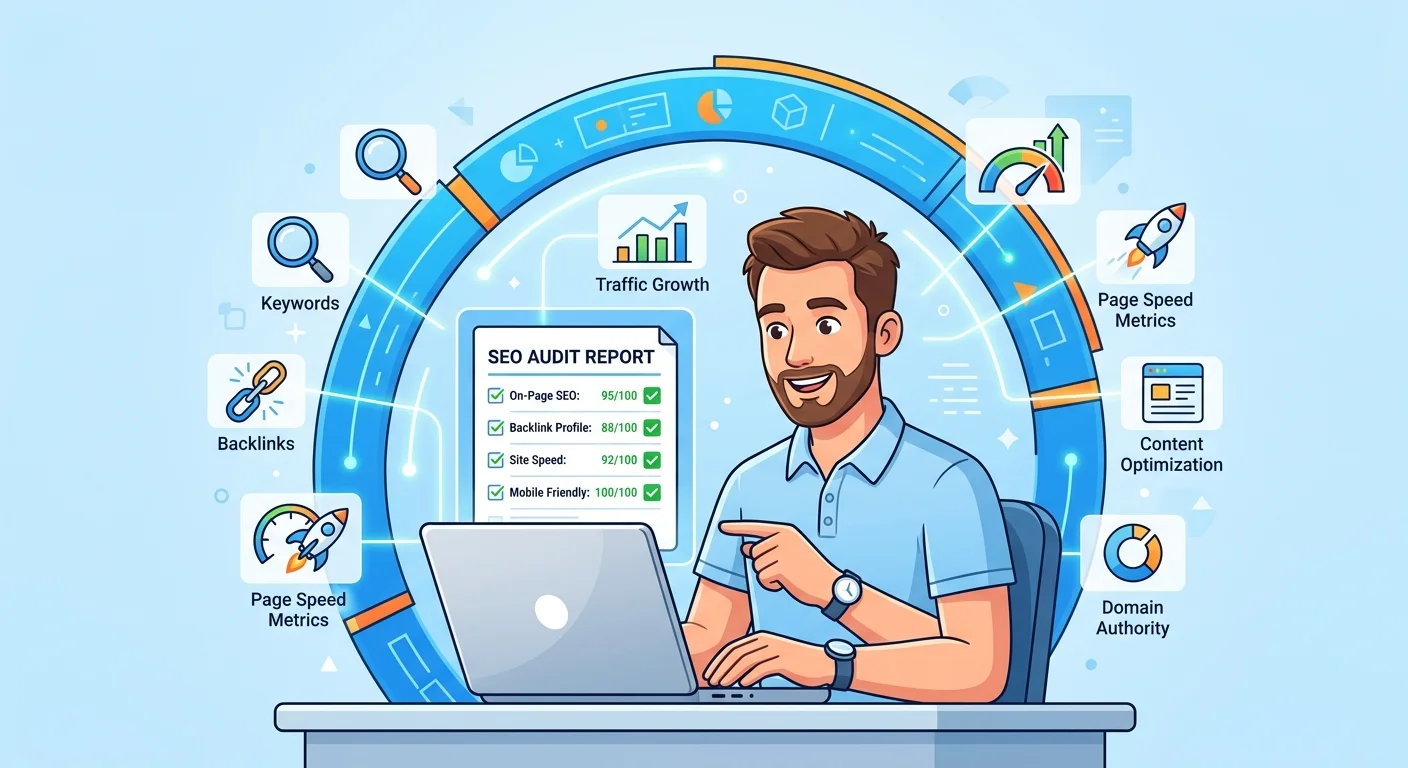
A standard SEO audit checks technical health. Keywords. Backlinks. Site speed. Mobile usability. Meta tags.
It asks: Can Google crawl your site? Are your keywords optimized? Do authoritative domains link to you? Is your page fast enough?
These checks made sense when ranking was the only mechanism that mattered. Keywords told Google what your page was about. Backlinks told Google other sites trusted you. Technical health meant Google could index you efficiently.
The audit produced a scorecard. Green meant good. Red meant fix it. Simple.
| Traditional SEO Audit Component | What It Measures | What AI Actually Needs |
|---|---|---|
| Keyword Density | How often target keywords appear on a page | Semantic depth-interconnected concepts that demonstrate mastery |
| Backlink Profile | How many external sites link to your domain | Citation velocity-how often your practice is named and validated across trusted platforms |
| Technical Health | Site speed, mobile responsiveness, crawlability | Entity schema-machine-readable structured data that builds knowledge graph presence |
Why Those Metrics Worked for Google’s Algorithm
Keywords helped Google understand relevance. Someone searched “chiropractor near me,” Google looked for those words in your titles, headers, body text.
Backlinks indicated authority. Ten reputable sites linked to your practice? Google inferred you were trustworthy.
Technical health ensured crawlability. If Google’s bot couldn’t access your pages, you didn’t get indexed.
This was functional. For ranked lists.
The problem? That’s not how patients find chiropractors anymore.
The shift to Answer Engine Optimization (AEO) changed what visibility means. AI doesn’t rank. It recommends. And the signals it uses? Fundamentally different from what SEO audits measure.
The Fundamental Problem: SEO Audits Measure List Position, Not AI Trust
Here’s the thing most practices don’t realize.
Your SEO audit is measuring a system that’s being replaced. Right now. In real time.
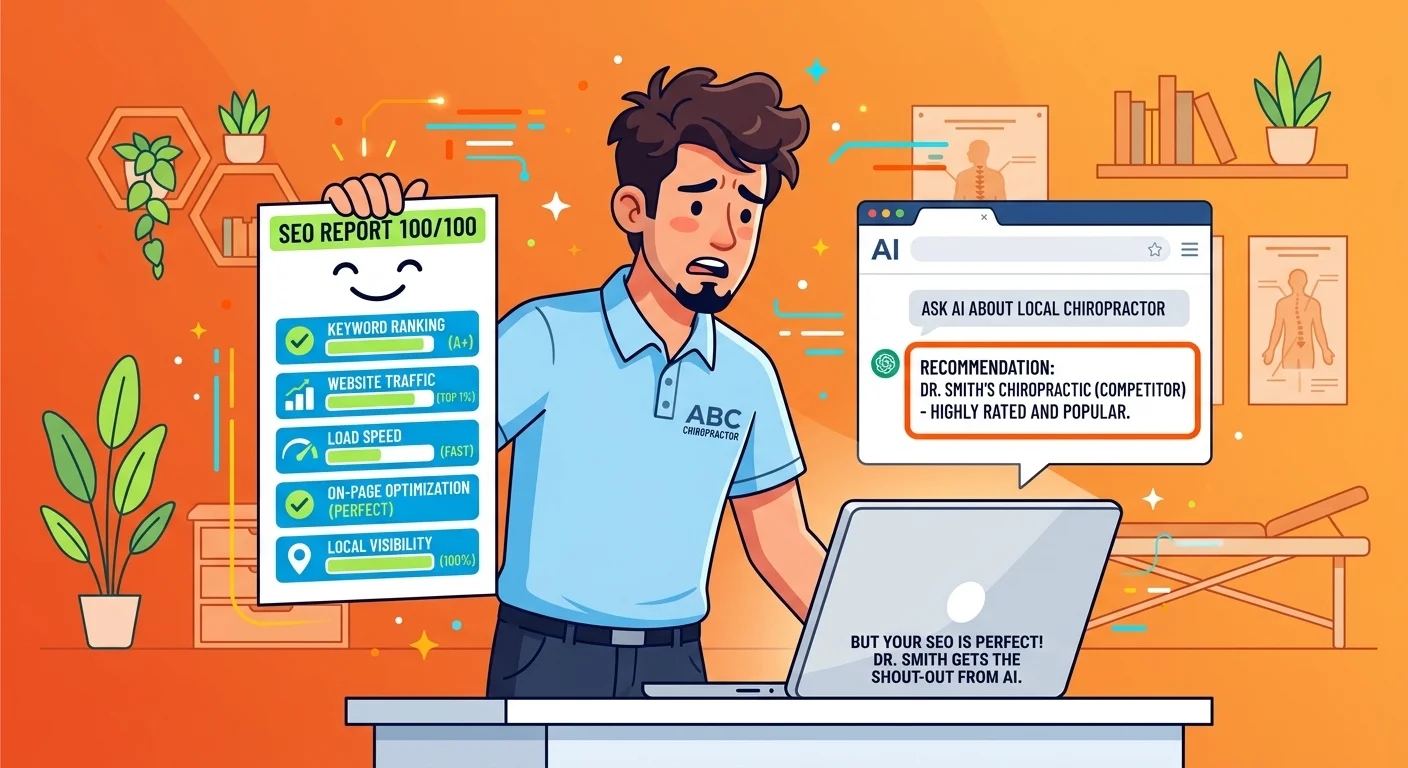
Traditional SEO agencies sell audits based on vanity metrics. Traffic. Impressions. Keyword rankings. These create a false sense of security. Your report shows green checkmarks. Traffic’s steady. Agency says you’re good.
ChatGPT’s recommending your competitor by name.
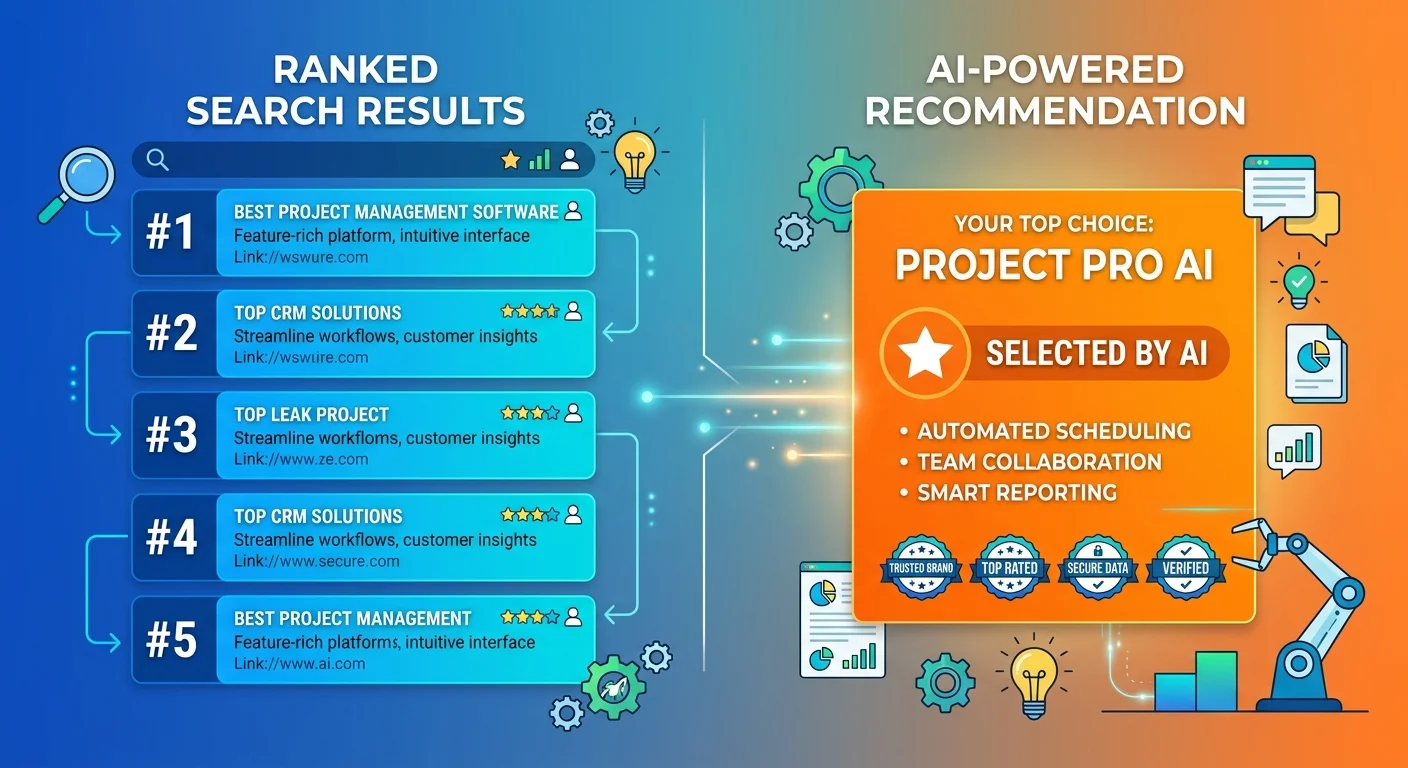
SEO audits aren’t wrong. They’re incomplete. They measure list position – how high you rank on a results page. AI doesn’t produce lists. It produces verdicts. One name. One recommendation.
And the signals AI uses to form that verdict? SEO audits don’t measure them.
SEO Audits Cannot See Entity Trust Signals
Entity trust is how AI decides whether your practice is legitimate enough to cite.
It’s built through structured schema markup – machine-readable data that tells AI who you are, what you do, where you’re located, how you’re connected to other entities. According to Google Research on Knowledge Graphs, AI and search engines build entity-based knowledge graphs that move far beyond keyword matching.
SEO audits check if schema exists. They don’t check if it builds machine-readable authority.
Most audits verify you have LocalBusiness schema. Done. Check the box.
They don’t verify that your schema includes consistent NAP data, disambiguates your entity from competitors, links to verified third-party platforms, or uses the specific schema types AI engines prioritize for trust.
The difference matters. Schema that passes an audit tells AI you exist. Schema that builds entity trust tells AI you’re the authority.
The Citation Velocity Problem
Citation velocity measures how often your practice is named and validated across trusted third-party platforms – Healthgrades, Zocdoc, Google Business Profile, industry directories.
SEO audits look at backlinks as a count metric. Ten backlinks. Fifty backlinks. More is better, right?
Wrong.
AI doesn’t count backlinks. It tracks citations. A backlink from a random blog doesn’t build trust. A citation from Healthgrades that confirms your name, specialty, location, credentials? That does.
BrightEdge’s 2024 Future of Search Report shows generative AI in search is fundamentally changing how users discover information and how businesses need to approach visibility strategy. Citation velocity is now a core trust signal.
And traditional SEO audits don’t measure it.
Semantic Density Is Invisible to Keyword Checkers
Semantic density measures the depth and interconnectedness of your content around a specific topic. It’s how AI assesses whether you genuinely understand a subject or whether you’re surface-level.
Keyword audits check if words appear. They don’t measure if the content demonstrates mastery.
A blog post titled “What Is Sciatica?” might include the keyword “sciatica” ten times. Passes a keyword check. But if the content doesn’t explain the mechanism, differentiate types, discuss conservative vs. surgical approaches, connect sciatica to related conditions like piriformis syndrome – AI sees it as shallow.
AI engines reward semantic depth. They prioritize content that shows interconnected understanding, not keyword repetition.
The gap between indexed vs. recommended is semantic density. Your page might be indexed in Google’s database. Doesn’t mean AI trusts it enough to recommend it.
Why “Good SEO” Produces Zero AI Recommendations
High Traffic Does Not Equal AI Authority
I’ve seen practices generate 5,000 monthly visitors from Google and still be completely invisible to ChatGPT.
The reason? Traffic measures click volume. AI authority measures trust signals. Those aren’t the same thing.
You can rank for “chiropractor + city name” and drive traffic. That traffic comes from people who type queries into Google, see your listing, click through. The ranking is based on keyword optimization, backlink profile, domain authority – exactly what SEO audits measure.
AI engines don’t care about your ranking. They care about your entity representation in their knowledge graph. If that representation is weak – incomplete schema, low citation velocity, shallow semantic density – you don’t get recommended.
No matter how much traffic Google sends you.
According to HubSpot’s State of SEO in 2024, traditional SEO practices are increasingly insufficient for visibility in an AI-driven discovery landscape. High traffic is a trailing indicator of past optimization. AI recommendations are a leading indicator of future patient acquisition.
Domain Authority Is Not Entity Authority
Domain authority is a proprietary metric created by Moz. It’s based on backlink quantity and quality. A score of 50 means you have a stronger backlink profile than a site with a score of 30.
Entity authority is AI’s understanding of your practice as a trusted source within a specific knowledge domain. It’s built from structured data, cross-platform validation, semantic content depth, citation velocity.
These are not the same thing.
You can have high domain authority and zero entity authority. Your backlink profile might be strong. Your schema might be incomplete. Your citations might be inconsistent. Your content might lack semantic depth.
SEO audits measure domain authority. AI engines use entity authority.
The scores don’t correlate.
The “Everything to Everyone” Problem
Here’s where the semantic depth issue becomes a filter.
A generalist chiropractic website – one that lists every service, every condition, every technique without specialization – might pass a basic keyword audit. It has pages for sciatica, headaches, sports injuries, prenatal care, pediatric adjustments, more.
The problem is depth. Each page covers the topic at a surface level. The content is thin. The semantic connections are weak. No demonstrated mastery.
AI engines prioritize specialization. Not because they’re biased against generalists, but because semantic density requires focus. You can’t build deep, interconnected authority on fifteen topics simultaneously.
If you’re marketing yourself as “everything to everyone,” you’re semantically shallow on everything. AI sees that.
It doesn’t recommend shallow authority.
| What SEO Audits Check | What This Actually Measures | What AI Needs Instead |
|---|---|---|
| Keyword Rankings | Your position in a ranked list of search results | Entity trust-whether your practice is represented in AI’s knowledge graph with sufficient authority markers |
| Backlink Count | How many external sites link to your domain | Citation velocity-how often your practice is named and validated across trusted third-party platforms with machine-readable data |
| Technical Health Scores | Whether Google’s crawler can access and index your pages | Schema completeness-whether your structured data builds entity authority that AI engines use to form recommendations |
How AI Answer Engines Build Recommendations (And Why SEO Audits Don’t Measure It)
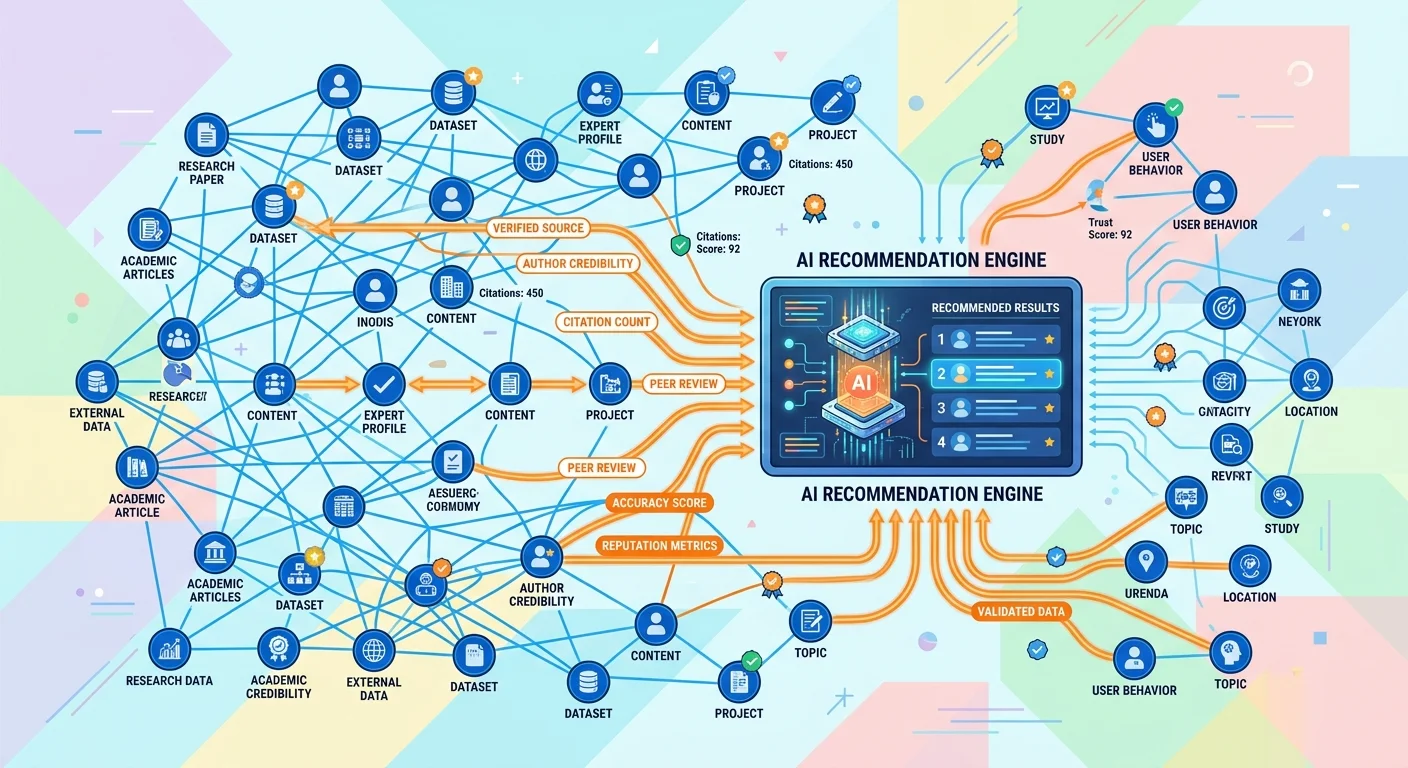
When someone asks ChatGPT for a chiropractor recommendation, the AI doesn’t run a keyword search.
It consults its knowledge graph – a machine-readable map of entities, relationships, trust signals.
That graph is built from structured data across the web. Schema markup from your website. Citations from Healthgrades and Zocdoc. Reviews on Google Business Profile. Cross-referenced data that confirms your entity is legitimate, trustworthy, relevant to the query.
If your entity representation in that graph is strong, AI names you. If it’s weak, AI names someone else.
If you’re not in the graph at all, you don’t exist.
This is what to expect during your AI Visibility Check – a diagnostic that measures your presence and authority in that knowledge graph across multiple AI engines.
Knowledge Graphs vs. Keyword Rankings
A knowledge graph is not a search index.
Google’s search index catalogs pages based on keywords. The knowledge graph catalogs entities based on relationships.
An entity is a distinct, identifiable thing – a person, place, organization, concept. Your chiropractic practice is an entity. So is your city. So is “sciatica.”
AI engines build recommendations by mapping relationships between entities. “Who is a trusted chiropractor entity in [city] entity who treats [condition] entity?”
According to Search Engine Land’s analysis, the shift from search engine optimization to answer engine optimization reflects this fundamental change – from optimizing for keyword-based rankings to building entity-based trust that AI engines can interpret.
Your keyword rankings measure list position. Your entity authority measures knowledge graph position.
SEO audits check the former. AI uses the latter.
Why Schema Markup Alone Isn’t Enough
Most SEO audits check if schema exists. They verify LocalBusiness markup is present. That’s it.
AI requires schema that builds entity trust. That means:
- Consistent NAP data (Name, Address, Phone) across all platforms
- Disambiguating properties that differentiate you from competitors with similar names
- Cross-references to verified third-party platforms (Google Business Profile, Healthgrades, licensing boards)
- Specific schema types that signal authority (Physician, MedicalBusiness, MedicalSpecialty)
Schema that passes an audit tells AI you exist. Schema that builds trust tells AI you’re the authority worth recommending.
The difference is execution depth. SEO audits check presence. AI visibility requires precision.
The Role of Third-Party Validation
AI engines don’t trust your website alone. They cross-reference.
If your website says you’re located at 123 Main Street, but your Google Business Profile says 456 Elm Street, AI sees inconsistency. Inconsistency erodes trust.
If your website lists your specialty as sports injury, but Healthgrades lists it as general chiropractic, AI sees conflicting data. Conflicting data reduces authority.
Third-party platforms function as trust validators. Healthgrades, Zocdoc, Google Business Profile aren’t just citation sources – they’re verification layers. AI uses them to confirm your entity data is accurate.
This is why your competitor is recommended by ChatGPT and you’re not.
Their entity data is validated. Yours isn’t.
The Real Audit You Need: What the AI Visibility Check Actually Measures
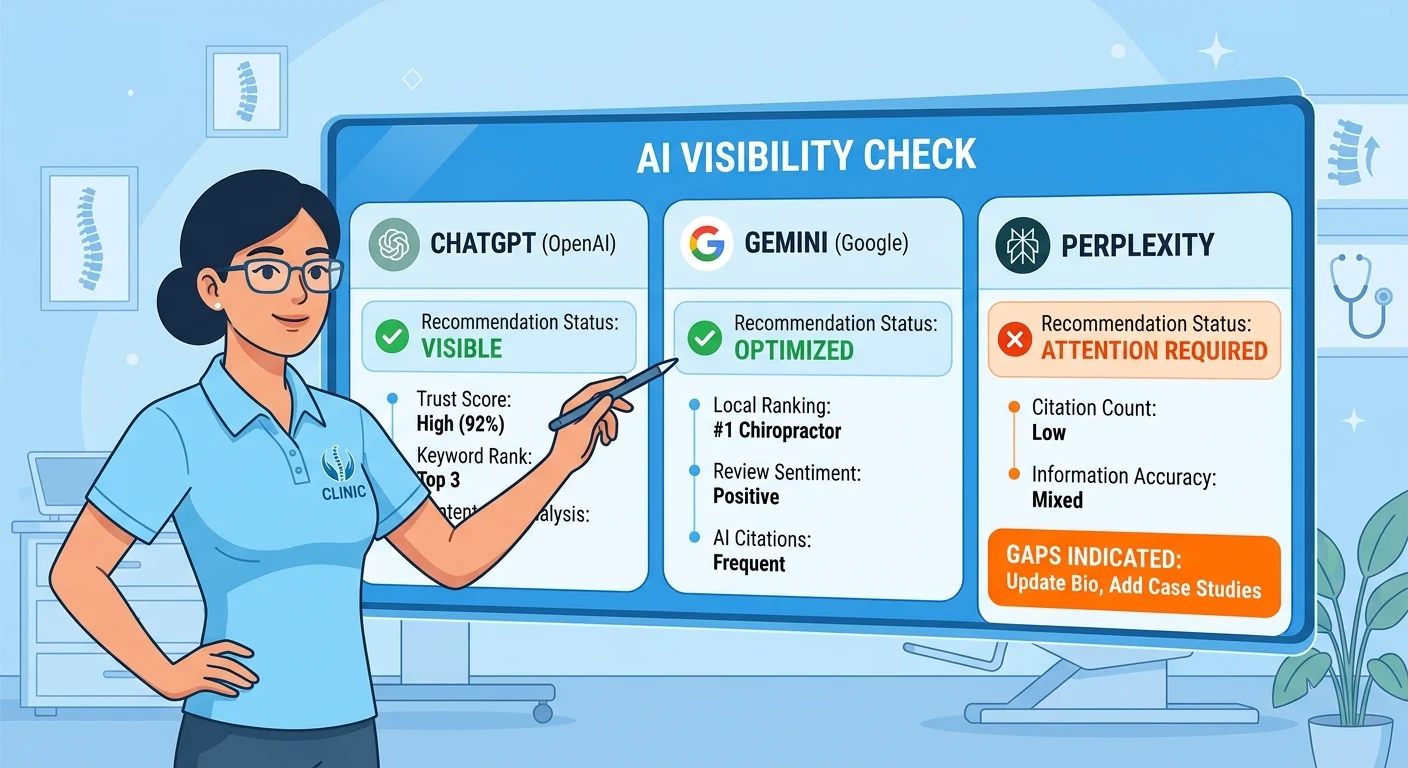
The AI Visibility Check is the diagnostic built specifically to measure what SEO audits miss.
It runs live queries across ChatGPT, Gemini, Perplexity. It asks each engine to recommend a chiropractor in your area. It records whether your practice is named, how you’re described, what trust signals the AI cites.
Then it audits the underlying infrastructure. Entity schema. Citation consistency. Semantic density. Cross-platform validation.
The output is a report that shows you exactly where you stand – and exactly what’s broken.
Entity Trust Audit
The entity trust audit checks schema completeness. Not just presence – completeness.
It verifies:
- LocalBusiness and MedicalBusiness schema are both present
- NAP data is consistent across your website, Google Business Profile, major directories
- Disambiguating properties differentiate you from competitors
- Cross-references to verified platforms are machine-readable
This is the foundation layer. If your entity representation is weak, everything else fails.
Semantic Density Analysis
The semantic density analysis evaluates your content depth. It measures:
- Topic interconnectedness – how well your content links related concepts
- Authority signals – citations, data, clinical reasoning that demonstrate expertise
- Coverage breadth – whether you address sub-topics, objections, related conditions
AI engines reward semantic depth. They prioritize content that shows mastery. If your content is thin, AI sees you as a surface-level source.
Surface-level sources don’t get recommended.
Citation Velocity Tracking
Citation velocity tracks how often your practice is named and validated across trusted platforms.
It measures:
- Frequency – how often your practice appears on Healthgrades, Zocdoc, directories
- Consistency – whether your NAP data matches across platforms
- Recency – how recently your citations were updated or validated
Low citation velocity signals dormancy. AI interprets dormancy as low trust.
High citation velocity signals active validation. AI interprets that as authority.
| AI Visibility Check Component | What It Measures | Why AI Needs It | SEO Audit Equivalent (if any) |
|---|---|---|---|
| Entity Trust Audit | Schema completeness, NAP consistency, disambiguating properties, cross-platform validation | To confirm your practice is a legitimate, trustworthy entity worth citing in recommendations | Schema presence check (incomplete) |
| Semantic Density Analysis | Topic interconnectedness, authority signals, coverage breadth, mastery demonstration | To assess whether your content shows genuine expertise or surface-level knowledge | Keyword density check (unrelated) |
| Citation Velocity Tracking | Frequency, consistency, and recency of citations across trusted third-party platforms | To validate your entity data through external sources and interpret active validation as authority | Backlink count (unrelated) |
| Cross-Engine Recommendation Test | Whether ChatGPT, Gemini, and Perplexity name your practice when asked for a recommendation | To see the actual outcome-whether you’re the answer or invisible | No equivalent |
Addressing the “But My SEO Still Works” Objection
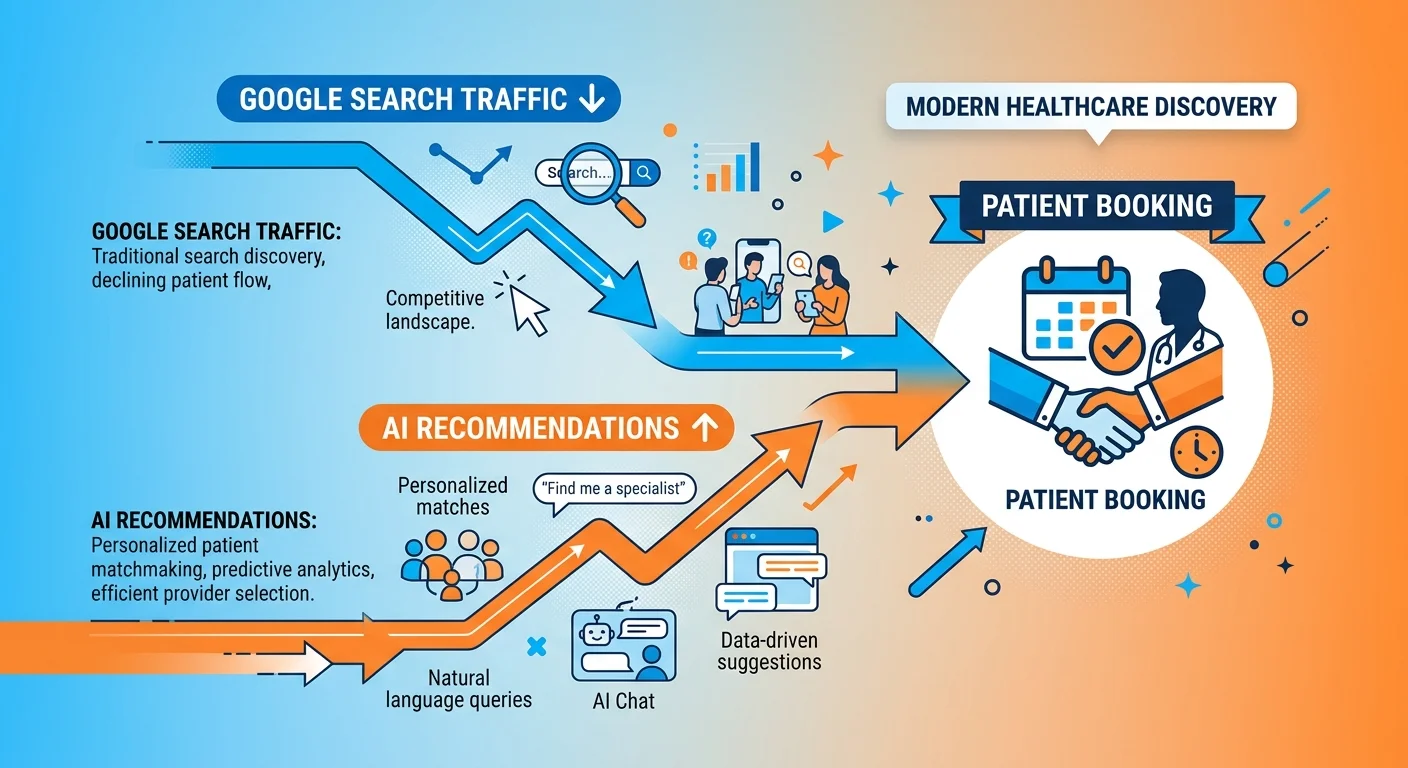
I get it. Your organic traffic is solid. Your SEO agency sends reports every month showing steady performance. You’re getting new patients from Google.
So why does AI visibility matter?
Because Google search traffic is a trailing indicator. It measures the effectiveness of a discovery mechanism that’s being replaced.
AI recommendations are a leading indicator. They measure your position in the mechanism that’s taking over.
Isn’t AEO Just Good SEO With a New Name?
No.
This is the most dangerous misconception in the industry right now – the belief that if you do SEO well enough, AI visibility will follow.
It doesn’t.
SEO optimizes for ranked lists. AEO builds entity trust for singular recommendations. Those aren’t variations of the same thing.
You can have perfect keyword optimization, a strong backlink profile, fast page speed, mobile responsiveness, clean meta tags – every green checkmark an SEO audit produces – and still be completely invisible to AI.
The signals are different. The infrastructure is different. The execution is different.
SEO and AEO aren’t variations of the same thing.
Semrush’s explanation of E-E-A-T (Experience, Expertise, Authoritativeness, Trustworthiness) provides some conceptual overlap with AEO’s focus on trust signals, but E-E-A-T is still fundamentally about ranking on Google’s search results page.
AEO is about being named as the answer by an AI engine that doesn’t produce a list at all.
The shift from “one of many results” to “the singular recommendation” changes everything.
If I’m Getting Traffic, Why Does AI Visibility Matter?
Because patients are shifting how they discover care.
Today, most of your traffic still comes from Google. Someone types “chiropractor near me,” sees your listing, clicks through. That mechanism still works.
But Zero-Click Search is growing. More queries are being answered directly by AI – no list, no click-through, no opportunity to compete. The AI gives one name.
If that name isn’t yours, you don’t exist in that conversation.
The timeline matters. Right now, you’re getting traffic from Google. Six months from now, the percentage of patients using AI for discovery will be higher. Twelve months from now, higher still.
Every month you’re invisible to AI, competitors compound their authority advantage. They build entity trust. They increase citation velocity. They deepen semantic density.
By the time the shift is obvious to everyone, they’ll have already locked in the AI recommendation spot.
Waiting isn’t neutral. It’s a choice to let someone else take the ground.
Can’t I Just Add This to My Existing SEO Plan?
No.
AEO isn’t an add-on. It’s infrastructure.
Traditional SEO optimizes an existing website for keyword rankings. AEO requires rebuilding the website’s structural foundation to make it machine-readable. That means:
- Schema architecture that builds entity trust
- Content strategy that prioritizes semantic depth over keyword density
- Citation management across third-party platforms
- Ongoing authority execution that compounds over time
You can’t layer this on top of a template website built for aesthetics. You can’t delegate it to a $500/month SEO retainer that checks keyword rankings and calls it done.
AEO is a different system. It requires different infrastructure. And it requires consistent, compounding execution – not a one-time fix.
Why Traditional SEO Agencies Keep Selling Audits That Miss the Problem
Here’s what I’ve watched happen over the last three years.
Traditional SEO agencies kept doing what they’ve always done. Monthly audits. Keyword tracking. Backlink reports. Green checkmarks. Everything looks good.
Their clients kept asking why new patient volume was declining.
The agencies blamed competition. Market saturation. Insurance changes. Anything but the real problem – their audits were measuring the wrong system.
The Tools They Use Weren’t Built for AI
Moz, Ahrefs, SEMrush – these are the standard tools SEO agencies use to generate audit reports. They’re excellent at what they were built to do: measure keyword rankings, backlink profiles, domain authority, technical health.
None of them measure entity trust. None of them track citation velocity. None of them assess semantic density. Because they were built before AI answer engines became the primary discovery mechanism.
The agencies kept using the tools they had. The tools kept producing reports that looked good. The reports kept missing the problem.
They’re Incentivized to Sell What They Know
Most SEO agencies built their service model around keyword optimization and link building. That’s what they know. That’s what they staff for. That’s what their contracts cover.
Admitting that the system they’ve optimized for a decade is no longer the primary discovery mechanism? That’s not an easy conversation.
So they don’t have it. They keep selling what they know. They frame AEO as “advanced SEO.” They add a few schema tags, call it entity optimization, and charge the same retainer.
It’s not malicious. It’s structural inertia. The business model is built around keyword audits. Changing that model requires rebuilding the entire service stack.
Most agencies aren’t doing that. They’re repackaging the same deliverables with different terminology and hoping the client doesn’t notice the gap.
The False Comfort of Green Checkmarks
SEO audits produce scorecards. Green means good. Red means fix it. Yellow means watch it.
That scorecard creates psychological comfort. It looks objective. It looks scientific. It looks like progress.
But if the scorecard is measuring the wrong system, the green checkmarks are meaningless. You’re getting a perfect score on a test that doesn’t determine the outcome anymore.
The real test is simple: Ask ChatGPT to recommend a chiropractor in your area. If your name doesn’t appear, the green checkmarks don’t matter.
Quick pause before we go further.
If you’re looking for a way to flood your schedule in the next 60 days, this isn’t it. Authority is built in layers. Foundation first, content compounding on top, AI visibility deepening every month.
If that timeline doesn’t fit your decision framework – no hard feelings.
But if you’re tired of short-term tactics that disappear the moment you stop paying for them, you’re in the right place.
Frequently Asked Questions
What’s the main difference between an SEO audit and an AI Visibility Check?
An SEO audit measures your position on a list of search results. It checks keyword rankings, backlink profiles, technical health, page speed – metrics designed to optimize your visibility on Google’s search results page.
An AI Visibility Check tests whether an AI engine will name your practice as the singular, trusted answer to a direct question. It measures entity trust, semantic density, citation velocity – the signals AI uses to form recommendations.
The core difference: SEO audits optimize for list position. AI Visibility Checks measure whether you’re the answer.
Can a chiropractic practice have perfect SEO scores but still be invisible to AI?
Yes. This is extremely common.
I’ve run the AI Visibility Check with practices that had domain authority scores above 40, strong keyword rankings, and 5,000+ monthly visitors from Google. When I asked ChatGPT to recommend a chiropractor in their area, their name didn’t appear.
The reason is structural. SEO metrics measure your performance in Google’s ranked list system. AI visibility measures your entity representation in AI’s knowledge graph. These are separate systems.
Performance in one does not guarantee visibility in the other.
You can have green checkmarks across every SEO audit category and still have weak schema, low citation velocity, shallow semantic density. Those gaps make you invisible to AI – even if your SEO looks perfect.
If my organic traffic from Google is high, should I still care about AI visibility?
Yes.
High traffic today doesn’t guarantee future patient flow as more people adopt AI for discovery. AI recommendations are a new, distinct patient acquisition channel. Ignoring it because Google still works is a short-term decision with long-term consequences.
The shift is happening now. Every month you’re invisible to AI, competitors who are building entity trust compound their advantage. By the time the shift is obvious to everyone, they’ll have already locked in the recommendation spot.
Traffic is a trailing indicator. AI visibility is a leading indicator.
Both matter – but one predicts where patient discovery is going.
What are the top 3 things a traditional SEO audit completely misses?
Entity trust schema. SEO audits check if schema exists. They don’t check if it builds machine-readable authority through consistent NAP data, disambiguating properties, cross-platform validation.
Semantic content density. SEO audits check keyword frequency. They don’t measure the depth and interconnectedness of your content – the signal AI uses to assess whether you demonstrate genuine expertise or surface-level knowledge.
Citation velocity across trusted platforms. SEO audits count backlinks. They don’t track how often your practice is named and validated on Healthgrades, Zocdoc, Google Business Profile – the third-party sources AI uses to confirm your entity data is accurate.
Are keywords and backlinks completely useless now?
No. But their role has changed.
Keywords and backlinks contribute to your overall digital footprint. They help Google understand what your pages are about and how other sites perceive your authority.
But they are no longer the primary signals that get you named as the answer by an AI engine. AI prioritizes entity trust, semantic depth, citation velocity. Keywords and backlinks support those signals – they don’t replace them.
Think of it this way: keywords and backlinks are still relevant for ranked search results. But if you’re optimizing only for ranked results, you’re optimizing for a shrinking mechanism.
AI recommendations are the growing mechanism. And the signals that drive recommendations are fundamentally different.
How long does it take to fix AI invisibility once it’s detected?
Months. Not weeks.
Building entity trust and semantic authority is a compounding process. Schema fixes can be implemented quickly. Citation consistency can be corrected in a few weeks. But semantic depth requires content execution over time.
Authority compounds. It doesn’t appear overnight.
The AI Visibility Check shows you where you stand. It identifies the gaps – weak schema, low citation velocity, shallow content. The Authority Engine builds what’s missing through infrastructure rebuild and ongoing content execution.
I won’t give you a 60-day promise. Authority doesn’t work that way. What I will say: schema fixes happen fast. Citation consistency gets corrected in weeks. Semantic depth? That’s months of compounding execution. The practices that stick with it own the recommendation spot. The ones looking for shortcuts stay invisible.
This is not a 90-day fix. It’s a strategic infrastructure investment.
Do I need to stop my current SEO efforts to focus on AEO?
No. But you need to understand that traditional SEO and AEO serve different purposes.
SEO maintains your existing visibility in Google’s ranked search results. If that traffic is still driving patient bookings, keep it. Don’t abandon what’s working.
AEO builds the infrastructure for AI recommendations. It’s a parallel system – not a replacement. The two can coexist. But they require different execution.
The mistake is assuming your existing SEO plan addresses AEO. It doesn’t. SEO audits check keyword rankings. AEO requires entity trust schema, semantic depth, citation velocity.
Those aren’t add-ons to a traditional SEO retainer. They’re distinct infrastructure layers that require dedicated execution.
Why don’t SEO agencies just pivot to AEO if it’s the future?
Because their entire service model is built around keyword optimization and link building. Pivoting to AEO requires rebuilding the service stack, retraining staff, and learning new tools.
Most agencies don’t want to admit their deliverables are becoming less effective. So they rebrand. They call AEO “advanced SEO.” They add a few schema tags and charge the same retainer.
The execution doesn’t change. The results don’t improve. The gap widens.
It’s not that they can’t pivot. It’s that pivoting threatens the business model they’ve built. So they don’t.
The Audit You’re Running Is Measuring the Wrong System
Your SEO audit shows green checkmarks. Your traffic is solid. Your agency sends reports that say everything looks good.
And ChatGPT is recommending your competitor.
This isn’t a failure of SEO. It’s a failure of measurement. The audit is checking the right things for the wrong system. It’s optimizing your position on a list that matters less every month while ignoring your position in the knowledge graph that matters more.
According to BrightEdge’s 2024 Future of Search Report, generative AI is fundamentally reshaping how users discover information and how businesses must approach visibility strategy.
The practices that move early – that build entity trust, semantic depth, citation velocity now – will own the AI recommendation spots six months from now.
The ones that wait will be explaining to themselves why their “perfect SEO scores” didn’t prevent them from becoming invisible.
The gap widens every month. AI authority compounds. And the diagnostic that measures it isn’t an SEO audit.
It’s the AI Visibility Check.
Your SEO audit might show green checkmarks across the board. That doesn’t mean AI knows you exist. The AI Visibility Check takes 15 minutes and shows you exactly what ChatGPT, Gemini, and Perplexity say when someone asks for a chiropractor in your area. If the results don’t make the problem self-evident – walk away. But if they do, you’ll know exactly what to do next.