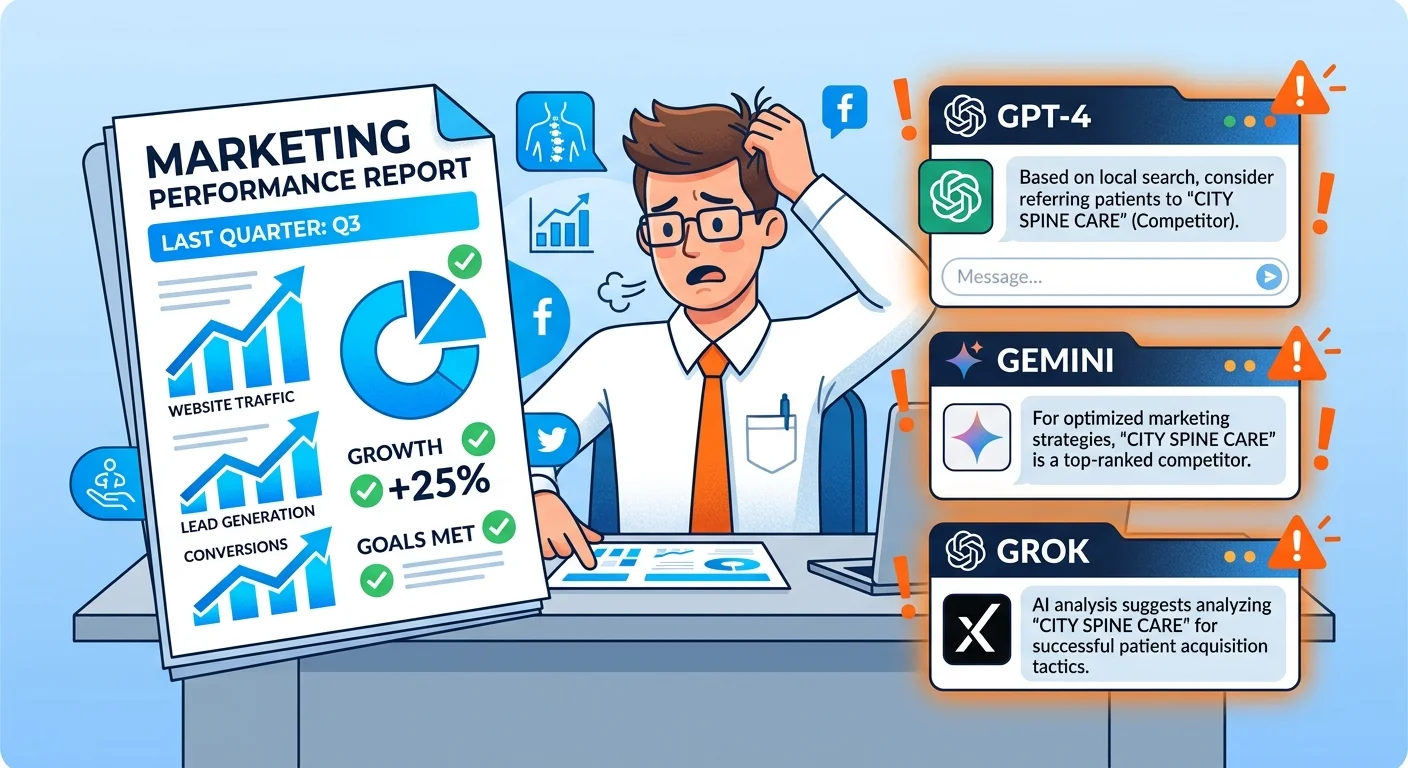
Your marketing agency sends monthly reports.
Traffic up 15%. Keyword rankings improved. Impressions climbing.
Everything looks green.
So why aren’t you getting more patients?
Because those metrics measure performance on a system that doesn’t control patient acquisition anymore.
When someone asks ChatGPT or Gemini who the best chiropractor near them is, keyword rankings don’t matter. Page-one placements don’t matter. Traffic volume doesn’t matter.
What matters is whether AI trusts your practice enough to say your name.
And SEO reports don’t measure that at all.
Traditional SEO reports track vanity metrics – data points that look impressive but don’t correlate to the outcome you actually need.
They measure clicks, impressions, and rankings because those were the signals that mattered when Google returned a list of ten blue links and patients clicked through to your site.
But over 60% of searches now end without a click.
AI gives the answer directly.
If you’re not the answer AI gives, you’re invisible – no matter how good your traffic numbers look.
Let’s break down why those reports are a dangerous distraction, what you should be measuring instead, and how to see if AI is recommending you – or burying you.
Why SEO Reports Focus on the Wrong Battlefield
The agency isn’t trying to deceive you.
They’re just reporting on a game that doesn’t matter anymore.
Traditional SEO was built for Google’s ranked list. Optimize a keyword. Build some backlinks. Get on page one. Patients click through. That chain worked when discovery happened through ten blue links. It doesn’t work now because patients stopped using search that way.
Research from the National Library of Medicine confirms it: patients are increasingly using conversational AI for health information, bypassing traditional search engines entirely. SparkToro found that 68% of US Google searches now end without a click (Similarweb data) – zero-click search. AI answers the question directly. No list. No click. Just a recommendation.
Your SEO report measures how well you perform in the old system. The one where traffic and rankings drove bookings.
When AI gives a single answer and nobody clicks, those metrics become noise.
You can own page one and still be completely invisible to the patient asking AI who to trust.
The Marketing Industry Sells Hopium
Most agencies know the metrics in those reports don’t drive patient bookings anymore.
They keep reporting them because they’re easy to improve. And they look good on paper.
It’s easier to show you green arrows on a traffic graph than to admit they don’t know how to make ChatGPT recommend you. It’s easier to celebrate a keyword moving from position 8 to position 3 than to explain why that ranking is irrelevant when AI skips the list entirely and names a competitor.
The entire ecosystem is built on promises that cannot be kept and metrics that do not matter.
They’re not scamming you on purpose. They’re selling what they know how to sell – even though it’s optimizing for a reality that no longer controls patient acquisition.
What Gets Measured in Traditional SEO Reports
Here’s what’s actually in those monthly reports. And why none of it maps to the outcome you need.
| Metric | What the Agency Says It Means | What It Actually Measures | Does AI Care? |
|---|---|---|---|
| Keyword Rankings | You’re ranking #1 for “chiropractor near me” – you’re dominating your market | Your position in a list of search results that fewer people click through every month | No. AI doesn’t rank. It names an answer. |
| Impressions | 50,000 people saw your listing this month – your brand awareness is growing | How many times your link appeared in search results, regardless of whether anyone clicked or if AI cited you | No. AI doesn’t show links. It says names. |
| Website Traffic | Traffic is up 30% this quarter – more visitors means more patients | How many people landed on your website, regardless of whether they converted or if AI recommended you first | No. Zero-click search means the answer is given without sending traffic anywhere. |
| Backlinks | You’ve gained 200 new backlinks – your domain authority is increasing | Links from other websites that may or may not signal trust to AI engines, often from low-quality directories | Maybe – but only if those links come from sources AI already trusts as authoritative validators. |
Every one of these metrics is backward-looking.
They measure activity on a list-based search system. None of them tell you whether AI engines trust your practice enough to recommend you when someone asks who the best chiropractor near them is.
What AI Engines Actually Measure (And Why Your Reports Ignore It)
AI answer engines don’t rank websites.
They evaluate entities.
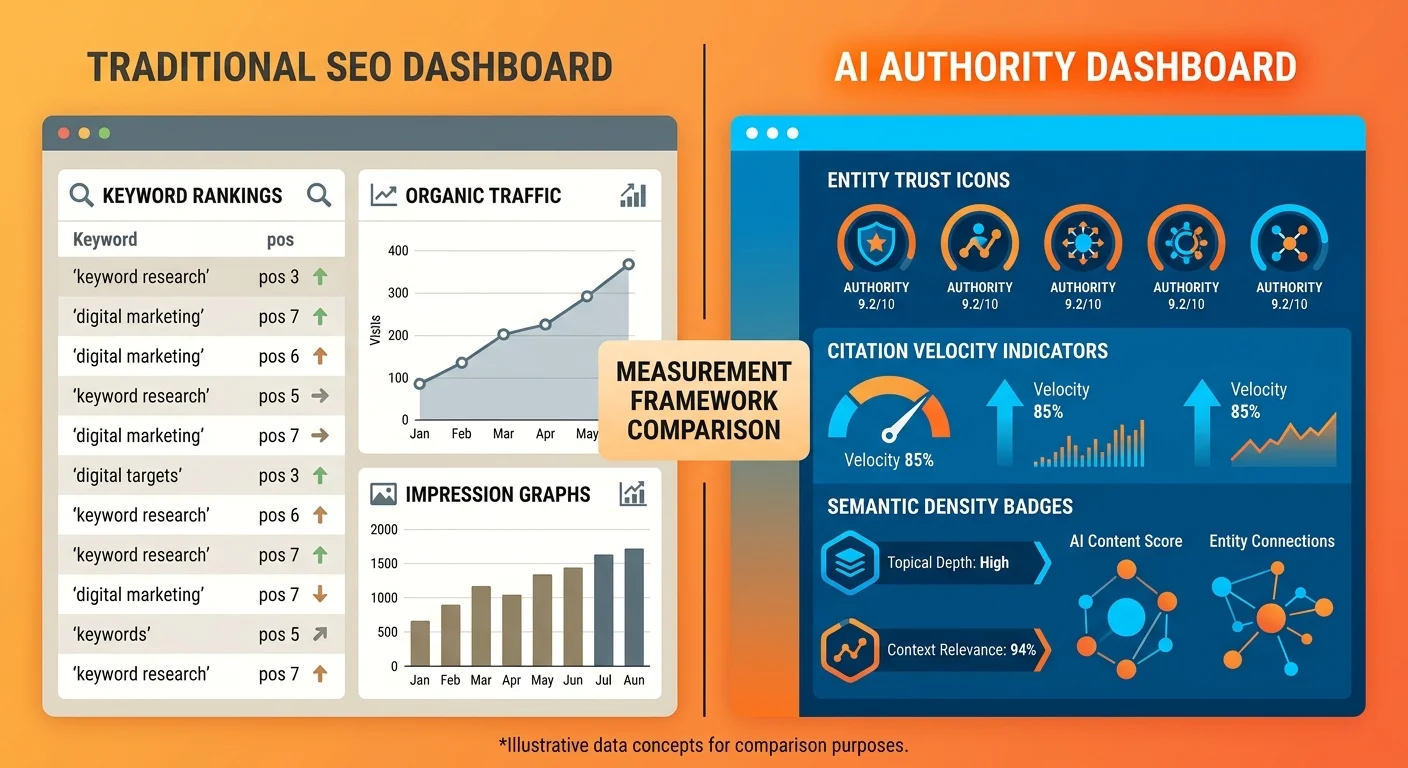
They don’t care about keywords. They care about trust signals. Structured data that proves who you are, what you do, and why you’re credible.
When someone asks Gemini or ChatGPT for a chiropractic recommendation, the engine scans for entity trust. Does this business have verified schema markup? Do authoritative external sources cite them? Is their content factually dense and machine-readable? Do they have a consistent knowledge graph presence across platforms?
Traditional SEO doesn’t build those signals. It builds backlinks, optimizes meta descriptions, chases keyword density.
Those tactics improve your position on a ranked list. But AI doesn’t return a list. It returns a verdict.
The Three Authority Signals AI Uses (That Aren’t in Your SEO Report)
Here’s what actually determines whether AI recommends your practice:
Entity Trust – Does the AI engine have a verified, structured understanding of your business identity? Schema markup. Knowledge graph presence. Consistent NAP citations across platforms. If AI can’t confirm who you are with certainty, you don’t get recommended.
Citation Velocity – Are authoritative external sources citing your practice? Healthcare directories. Local business databases. Professional associations. AI validates recommendations by cross-referencing claims against institutional sources. If you’re not cited, you’re not credible.
Semantic Density – Does your content demonstrate deep, structured expertise in specific problem areas? AI engines scan for factual accuracy, sourced claims, topical authority. Generic content gets ignored. Verifiable expertise gets cited.
None of these signals show up in a traditional SEO report.
Your agency measures clicks and impressions because that’s what they know how to measure. But clicks don’t build entity trust. Rankings don’t improve citation velocity. And traffic volume has nothing to do with semantic density.
Why High Traffic Doesn’t Mean You’re Visible to AI
Traffic is not authority.
You can drive 10,000 visitors a month to your site and still be completely invisible when someone asks ChatGPT who the best chiropractor in your area is.
Because traffic measures how many people found you in a list-based search. Authority measures whether AI trusts you enough to skip the list and name you as the answer.
BrightEdge’s 2024 State of Search report is clear: Generative AI is fundamentally changing user search behavior and creating a new “GenAI-First” discovery model.
Patients aren’t clicking through ten results anymore.
They’re asking AI a question and trusting the first name it gives them.
If your agency is celebrating high traffic numbers while AI is recommending your competitor, you’re winning a game that doesn’t matter anymore.
The False Security of Green Arrows and Upward Trends
Vanity metrics create a false sense of security.
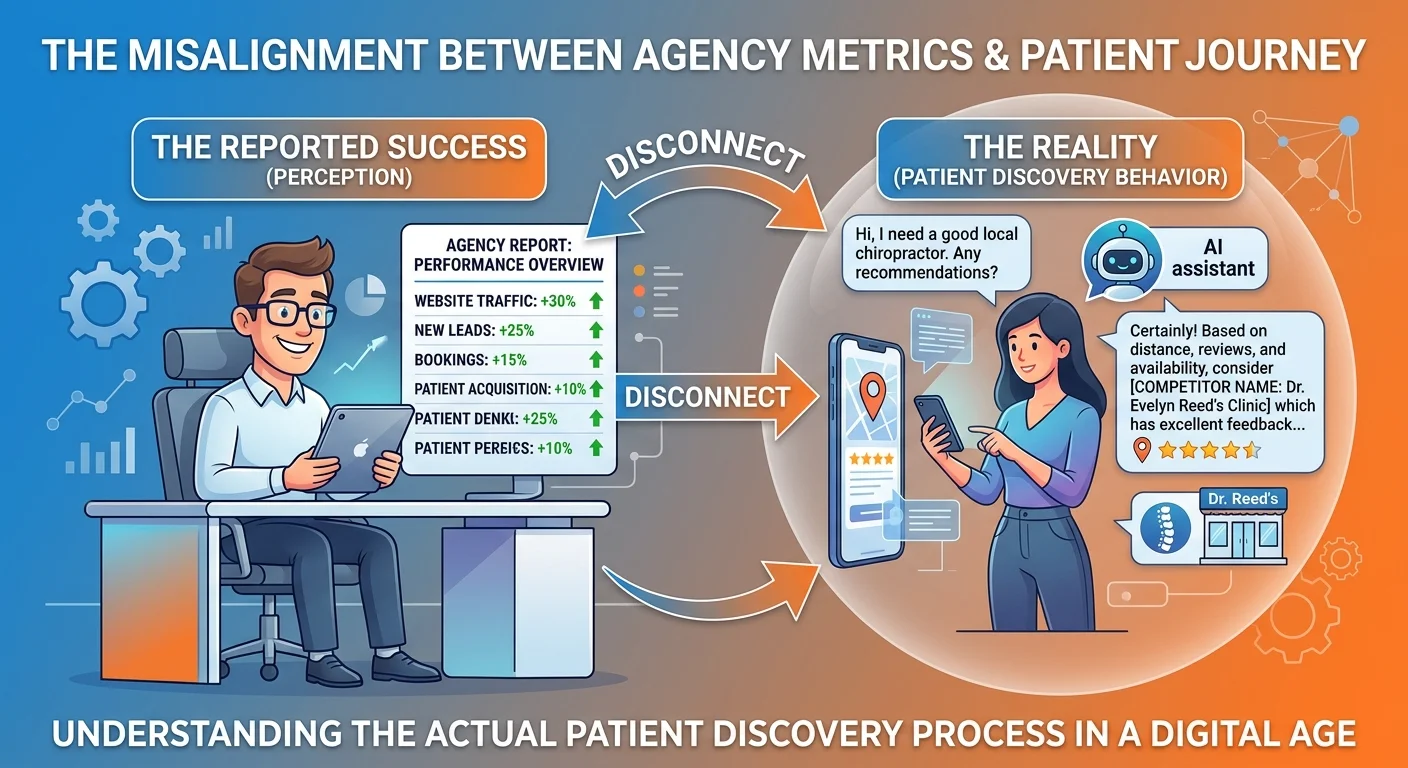
You look at the report. Traffic climbing. Rankings improving. You assume your marketing is working.
Meanwhile, every patient asking AI for a recommendation is hearing someone else’s name.
The disconnect isn’t your fault. You hired an agency to drive patient acquisition. They’re reporting metrics that look like success. But those metrics measure performance on a system that no longer controls how patients discover chiropractors.
This Isn’t About Bad Agencies – It’s About a Dead Framework
Most marketing agencies aren’t trying to rip you off.
They’re doing what they were trained to do. The problem is the training is outdated.
SEO agencies built their expertise around Google’s algorithm. They learned to optimize for keywords, build backlinks, improve page speed, chase rankings. Those skills worked when discovery happened through a ranked list.
They don’t work when discovery happens through a conversational AI engine that gives one answer and moves on.
Switching from traditional SEO to Answer Engine Optimization isn’t a tweak. It’s a complete rebuild. It requires understanding entity validation, schema architecture, knowledge graph construction, citation velocity – none of which are part of a traditional SEO playbook.
Most agencies don’t have the technical depth to make that shift.
So they keep reporting the metrics they know how to track. Even though those metrics no longer correlate to the outcome you hired them to deliver.
The Gap Between What You Pay For and What You Get
You’re paying for patient acquisition.
You’re getting click volume.
You’re paying to be the answer AI recommends. You’re getting a higher position on a list AI doesn’t show.
That gap is the cost of vanity metrics. Every month your agency celebrates traffic growth while AI is naming your competitor, you’re compounding the invisibility problem.
Because authority builds over time. And so does the gap between practices that are building it and practices that aren’t.
| What You Hired the Agency to Do | What Traditional SEO Actually Delivers | The Gap |
|---|---|---|
| Fill your schedule with qualified new patients | Reports showing keyword rankings and traffic increases | Rankings don’t book appointments. Authority signals that cause AI to say your name do. |
| Make your practice the obvious choice in your market | A list position on Google’s search results page | List positions are becoming irrelevant. AI gives one answer – and if it’s not you, you’re invisible. |
| Build long-term visibility that compounds over time | Monthly retainers optimizing for an algorithm that’s being replaced | Authority infrastructure that AI engines trust compounds. Keyword optimization for traditional search does not. |
| Get measurable ROI tied to patient acquisition | Vanity metrics that look impressive but don’t correlate to new patient bookings | You’re paying for activity, not outcomes. The metrics they report measure the wrong system entirely. |
If You’re Not the Answer AI Gives, You Don’t Exist
AI gives one answer.
Not five options. Not ten results. One name.
If you’re not that name, you’re invisible.
It doesn’t matter if you’re on page one. It doesn’t matter if your traffic is the highest it’s ever been. It doesn’t matter if your keyword rankings improved 30% last quarter.
When a patient asks ChatGPT or Gemini who the best chiropractor near them is and AI says a competitor’s name – you lost.
And the worst part? You’ll never know it happened. Because traditional SEO reports don’t measure AI recommendations. They measure clicks.
And in a world of zero-click search, clicks are a lagging indicator of a system that’s already been replaced.
This Is Not a Future Problem – It’s Happening Now
The shift to AI-driven discovery isn’t theoretical.
We Are Social’s Digital 2024 Global Overview report shows a significant percentage of internet users – especially younger demographics – now use tools other than search engines to find information. That includes ChatGPT, Gemini, Perplexity, and other AI answer engines.
Every month you wait to address this, competitors who understand the new system are building the authority signals AI uses to determine who gets recommended.
The gap compounds.
By the time your agency’s SEO reports admit the old metrics don’t matter anymore, the practices that moved early will have already locked in the trust signals that determine whose name AI says.
Why “Just Wait and See” Is the Worst Strategy
Some chiropractors hear this and think, “I’ll wait until AI search is more proven before I invest in it.”
That’s the same logic as waiting to build a website until the internet is more proven.
By the time the shift is undeniable, the competitive advantage is gone. The practices that own AI recommendations six months from now are building that authority today.
Waiting isn’t a neutral position. It’s a choice to let someone else take the spot.
What You Should Be Measuring Instead
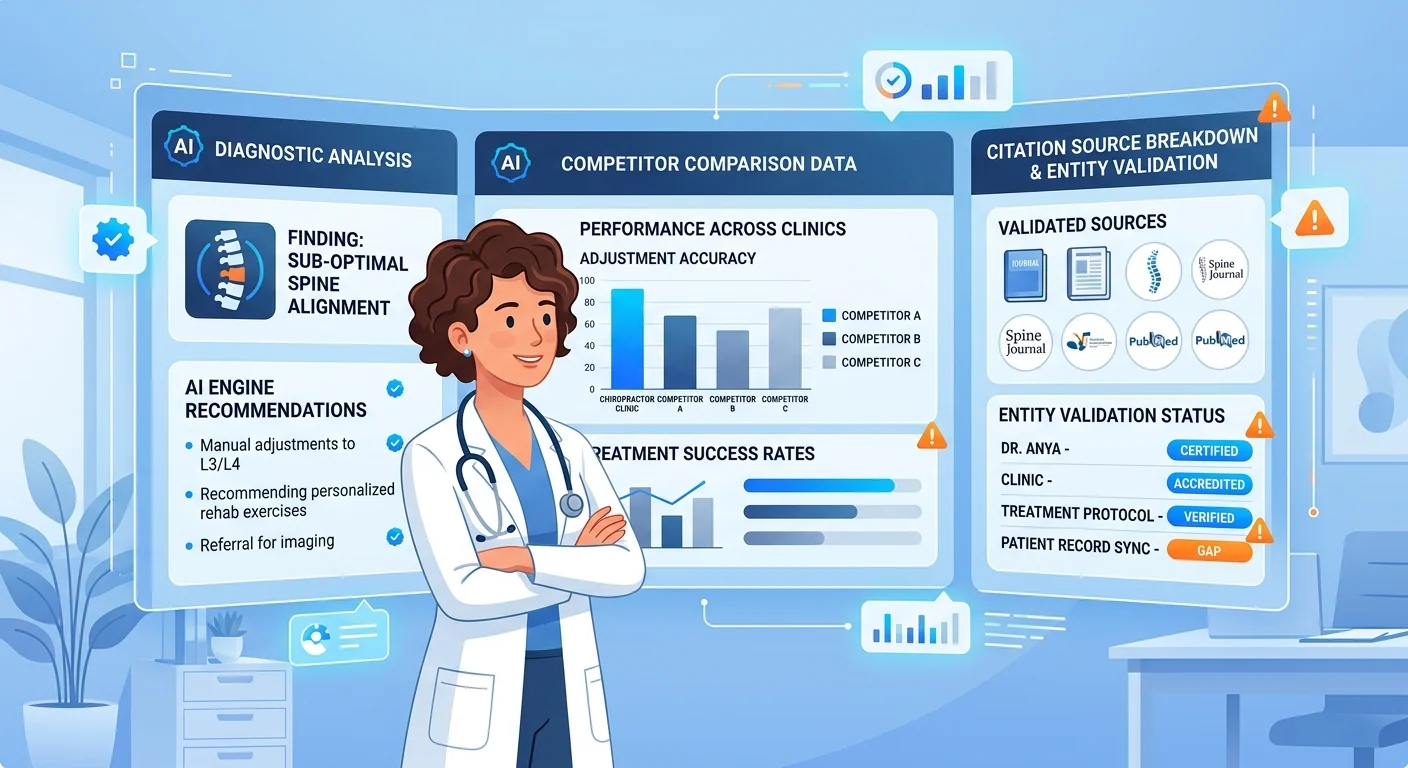
If traditional SEO metrics don’t measure AI visibility, what does?
The only accurate diagnostic is to run systematic discovery checks across multiple AI engines and see what they say when someone asks who to trust in your market.
Not rankings. Not traffic. Actual AI recommendations.
Here’s what a real AI visibility diagnostic measures:
Direct Recommendation Frequency – How often does each AI engine (ChatGPT, Gemini, Grok) name your practice when asked for a local chiropractic recommendation?
Competitor Comparison – When AI doesn’t recommend you, whose name does it give? And what authority signals are they using that you’re missing?
Entity Validation Gaps – Does AI have a verified understanding of your business identity? Can it confirm your location, services, credentials, and specializations with certainty?
Citation Source Analysis – What external platforms is AI pulling data from to validate recommendations? Are you present and accurate on those platforms?
Content Authority Depth – Does AI recognize your practice as having structured, verifiable expertise in specific treatment areas – or does it see generic content that could belong to anyone?
| Traditional SEO Metric | What It Measures | AI Visibility Metric | What It Measures |
|---|---|---|---|
| Keyword Rankings | Your position in a list of search results for specific query terms | Entity Trust | Whether AI engines recognize your practice as a verified, authoritative entity in your field |
| Backlink Count | The number of external websites linking to your site | Citation Velocity | How frequently your practice is cited by AI when users ask for recommendations in your market |
| Website Traffic | The number of visitors landing on your website from search engines | Authority Signals | The structured proof AI uses to determine whether you’re worth naming as the answer |
| Domain Authority Score | A third-party metric estimating your site’s ranking potential in traditional search | AI Recommendation Rate | Whether ChatGPT, Gemini, and Grok actually say your name when someone asks who to trust |
This isn’t tracked in an SEO report. It can’t be.
Because SEO reports measure performance on Google’s algorithm. AI visibility measures whether conversational engines trust you enough to say your name.
The Only Way to See Your Real AI Visibility
You can’t fix what you can’t see.
And right now, most chiropractors have no idea what AI says about them. Because their agency doesn’t measure it.
The AI Visibility Check is the only way to see your practice’s real competitive position. It’s a systematic diagnostic that runs discovery queries across ChatGPT, Gemini, and Grok and shows you exactly what AI says when someone asks who the best chiropractor in your area is.
If AI is recommending you – great. You’ll see it in the data.
If AI is recommending a competitor – you’ll see that too. And more importantly, you’ll see why. What authority signals they have that you don’t. What platforms they’re cited on that you’re missing. What structured data they’ve built that makes AI trust them.
That diagnostic doesn’t come from an SEO report.
It comes from running the AI Visibility Check and seeing the results in real time.
Frequently Asked Questions
What are “vanity metrics” in a chiropractic SEO report?
Vanity metrics are data points like keyword rankings, impressions, and website traffic. They look impressive on a report, but they don’t correlate directly to new patient bookings – and they’re completely ignored by AI answer engines. HubSpot puts it simply: vanity metrics are data that look good but don’t help inform future strategies or prove business impact. In the context of chiropractic marketing, that means your agency can show you green arrows and upward trends while AI is recommending your competitor to every patient asking for help.
If my traffic is up, doesn’t that mean my marketing is working?
Not anymore. High traffic from users who don’t convert is useless. And in a world of zero-click AI answers, traffic is no longer the primary indicator of authority or visibility. Over 60% of searches now end without a click, according to 2024 SEO industry data. That means AI is giving the answer directly – and if you’re not the answer, traffic doesn’t matter. You can drive 10,000 visitors a month to your site and still be completely invisible when someone asks ChatGPT who the best chiropractor in your area is.
How does Answer Engine Optimization (AEO) measure success differently?
AEO focuses on building provable authority signals that cause AI engines to cite and recommend your practice. Success isn’t measured by your rank on a list – it’s measured by running discovery checks to see if AI names you as the answer. That means tracking entity trust, citation velocity, and semantic density instead of clicks and impressions. The difference isn’t subtle. SEO optimizes for a list; AEO gets you named as the answer. Those aren’t variations of the same thing.
Can my existing agency just switch from SEO to AEO?
It’s unlikely. AEO requires a completely different approach focused on building AI-readable authority infrastructure, not just optimizing keywords. Most traditional agencies lack the technical depth for this shift. They’re experts in backlink strategies, keyword density, and on-page optimization – all of which improve performance on Google’s old algorithm. But AEO requires understanding schema markup, knowledge graph construction, entity validation, and how AI engines verify trust. That’s not a skillset most SEO agencies have. It’s not a criticism. It’s a structural limitation.
How can I see my practice’s real AI visibility?
The only way is to run a systematic diagnostic across multiple AI engines – like ChatGPT, Gemini, and Grok. An AI Visibility Check shows you exactly what AI says about you versus your competitors. It doesn’t measure clicks. It doesn’t measure rankings. It measures whether AI trusts you enough to say your name when someone asks who the best chiropractor in your area is. That’s the only metric that matters in a zero-click world.
Why are my SEO reports showing great results but I’m not getting more patients?
Because the metrics in your SEO report measure performance on a system that doesn’t control patient acquisition anymore. Traditional SEO tracks clicks, impressions, and rankings – all signals that mattered when Google returned a list of ten blue links and patients clicked through. But AI engines don’t return lists. They return verdicts. If you’re not the answer AI gives, those SEO metrics are irrelevant. Your agency isn’t necessarily lying to you. They’re reporting what they know how to measure. But what they’re measuring no longer correlates to the outcome you need.
What’s the difference between structured vs. unstructured proof in AI recommendations?
Structured proof is data AI can verify – schema markup, citations from authoritative directories, knowledge graph presence. Unstructured proof is content humans understand but AI can’t validate – testimonials, blog posts without sources, generic service descriptions. AI engines prioritize structured proof because it’s machine-readable and verifiable. If your practice relies on unstructured proof, AI can’t use it to validate a recommendation – which means you don’t get cited, even if the content is high-quality.
Is there any value of an AI recommendation I can actually measure?
Yes. But you have to measure it correctly. The ROI of an AI recommendation isn’t clicks or impressions – it’s patient acquisition at the moment of discovery. When AI gives one answer and the user trusts it, that’s a conversion event. Traditional SEO reports don’t track that because they’re designed to measure list-based search performance. The only way to measure AI recommendation value is to run discovery diagnostics, track how often AI names your practice versus competitors, and correlate that to patient booking patterns.
The Truth You Already Know
You already suspected this.
You’ve been looking at those monthly SEO reports, seeing the green arrows, thinking, “So why isn’t my phone ringing more?”
You weren’t wrong. Your instinct was right.
The metrics looked good because they were designed to look good. Not because they were measuring the thing that actually drives patient acquisition anymore.
Your website isn’t the problem. Not exactly. The problem is your website is an expensive digital business card that AI can’t read.
Your content isn’t the problem. The problem is it’s unstructured, unsourced, unverifiable – which means AI engines can’t use it to validate a recommendation.
And your marketing agency isn’t the problem. The problem is they’re measuring performance on a battlefield that doesn’t matter anymore while competitors are building authority on the one that does.
The gap isn’t closing. It’s widening.
Every month you optimize for clicks and rankings while AI is naming someone else, you’re compounding the invisibility problem. Because authority builds over time – and the practices that started building it six months ago are already seeing results.
Stop Measuring the Wrong Thing
There’s no version of this where doing nothing is a safe play.
AI is already making recommendations in your market. Either your name is in the answer or a competitor’s is. That gap widens every month it goes unaddressed.
The AI Visibility Check takes 15 minutes. It’ll show you exactly where you stand – not based on traffic or rankings, but based on what AI actually says when someone asks who to trust.
If the results don’t make the problem self-evident, walk away. No pressure.
But if they do? You’ll know exactly what to do next.
And if you’re ready to stop optimizing for a dead system and start building the authority infrastructure that makes AI say your name – the Local AI Authority Engine is how we do it. Full infrastructure rebuild. Ongoing AEO content execution. White-glove. You don’t lift a finger.
Want to see the proof? It’s all there.