
What Schema Markup Actually Does for Your Entity Identity
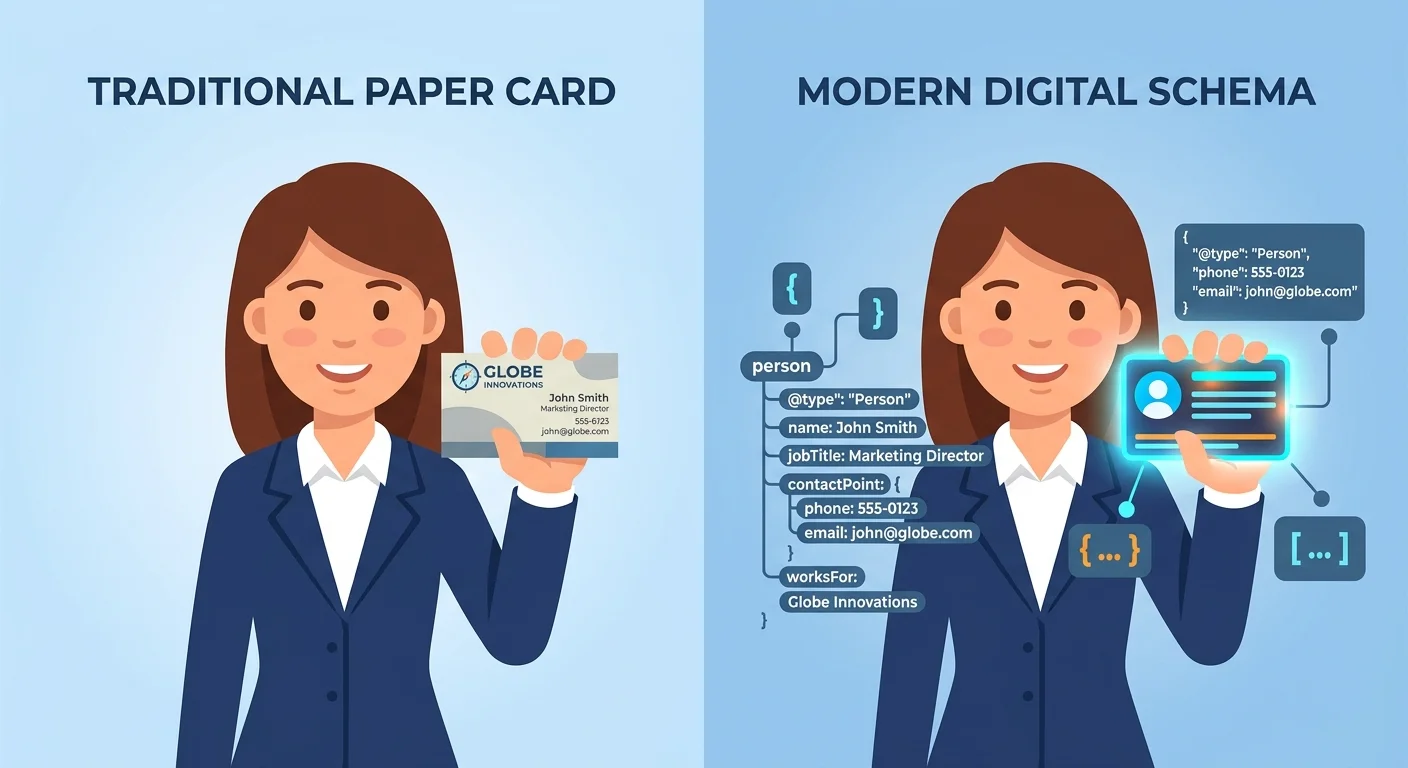
Schema markup doesn’t improve your website’s design. It doesn’t make your copy more persuasive. It doesn’t generate traffic in the traditional sense.
What it does is way more foundational. It transforms your website from a human-facing brochure into a machine-readable entity declaration. Your About page tells a story. Schema declares facts. AI engines don’t read stories – they parse structured data using the Schema.org vocabulary, cross-reference it against authoritative sources, and decide whether your entity is trustworthy enough to cite.
This is the AI Authority Engine at work. You’re not optimizing for clicks. You’re building Entity Trust – the machine-readable proof that your business exists, operates in a defined category, and connects to verified profiles across the web. Without schema, AI engines see your website the same way they see a PDF – words on a page with no formal structure. With schema, they see an entity.
Schema as the Machine-Readable Layer
Here’s the core mechanism. Schema sits in the background of your website as JSON-LD code that defines your entity’s attributes – business name, address, founder credentials, service offerings, links to authoritative external profiles. It’s invisible to human visitors. But to an AI engine parsing your site using the Schema.org vocabulary? It’s the only layer that matters.
Most businesses think their homepage copy is what AI reads. It’s not. AI engines prioritize structured data because it’s unambiguous, verifiable, and standardized across the web using the Schema.org vocabulary. Your narrative might say you’re the best in your market. Your schema says you’re an Organization of type LocalBusiness, operating at this address, founded by this Person with these credentials, verified on these platforms. One is a claim. The other is a machine-readable fact Google’s structured data guidelines can parse and validate.
Why AI Engines Require Structured Data
AI engines can’t make recommendations based on vibes. They need data structures they can parse at scale, cross-reference against known entities, and rank by trust signals.
Schema provides that. It’s the standardized format that lets an AI engine understand your business isn’t just a website – it’s a verified entity with attributes, relationships, and external validation. When ChatGPT or Gemini evaluates whether to recommend your business, they’re not reading your testimonials page. They’re checking whether your entity is formally declared, whether your schema matches your claimed identity, and whether your external profiles corroborate what your website says.
This is why schema isn’t optional anymore. It’s not a technical nicety. It’s the minimum dataset AI engines need to consider your business trustworthy enough to cite. If your entity identity isn’t formally structured, you don’t exist in the layer where AI makes decisions.
| Human-Readable Element | What AI Sees Without Schema | What AI Sees With Schema |
|---|---|---|
| Your homepage headline and tagline | Unstructured text with no formal entity declaration – AI parses words but can’t verify what type of business you are or whether you’re a legitimate entity | Organization schema with defined name, business type, and category – AI reads a formal entity declaration it can cross-reference and trust |
| Your About page founder bio | A narrative story with credentials mentioned in prose – AI can’t distinguish between a claim and a verified fact | Person schema linked to the Organization with structured credentials, alumni affiliations, and sameAs links to LinkedIn – AI sees a verifiable individual connected to a verified entity |
| Your NAP (Name, Address, Phone) in the footer | Text strings that might be scraped inconsistently – AI has no formal confirmation this is your official business location | LocalBusiness schema with structured address properties and geo-coordinates – AI reads an authoritative location declaration it can use for local recommendations |
| Your social media icons in the header | Image links with no semantic meaning – AI doesn’t know these profiles belong to your entity or whether they’re verified | sameAs properties linking to authoritative profiles on LinkedIn, Crunchbase, and industry directories – AI cross-verifies your entity across multiple trusted platforms |
| Your service descriptions and case studies | Marketing copy that AI reads as unstructured claims – no formal declaration of what services you offer or what expertise you hold | Service schema and knowsAbout properties defining your offerings in standardized vocabulary – AI understands your expertise in machine-readable terms it can match to user queries |
| Client testimonials and reviews | Unverified quotes that AI treats as promotional content – no way to confirm authenticity or aggregate sentiment | Review schema with structured ratings and reviewer attributes – AI can aggregate trust signals and compare your entity’s reputation to competitors |
Why Most Businesses Have Broken Entity Identity
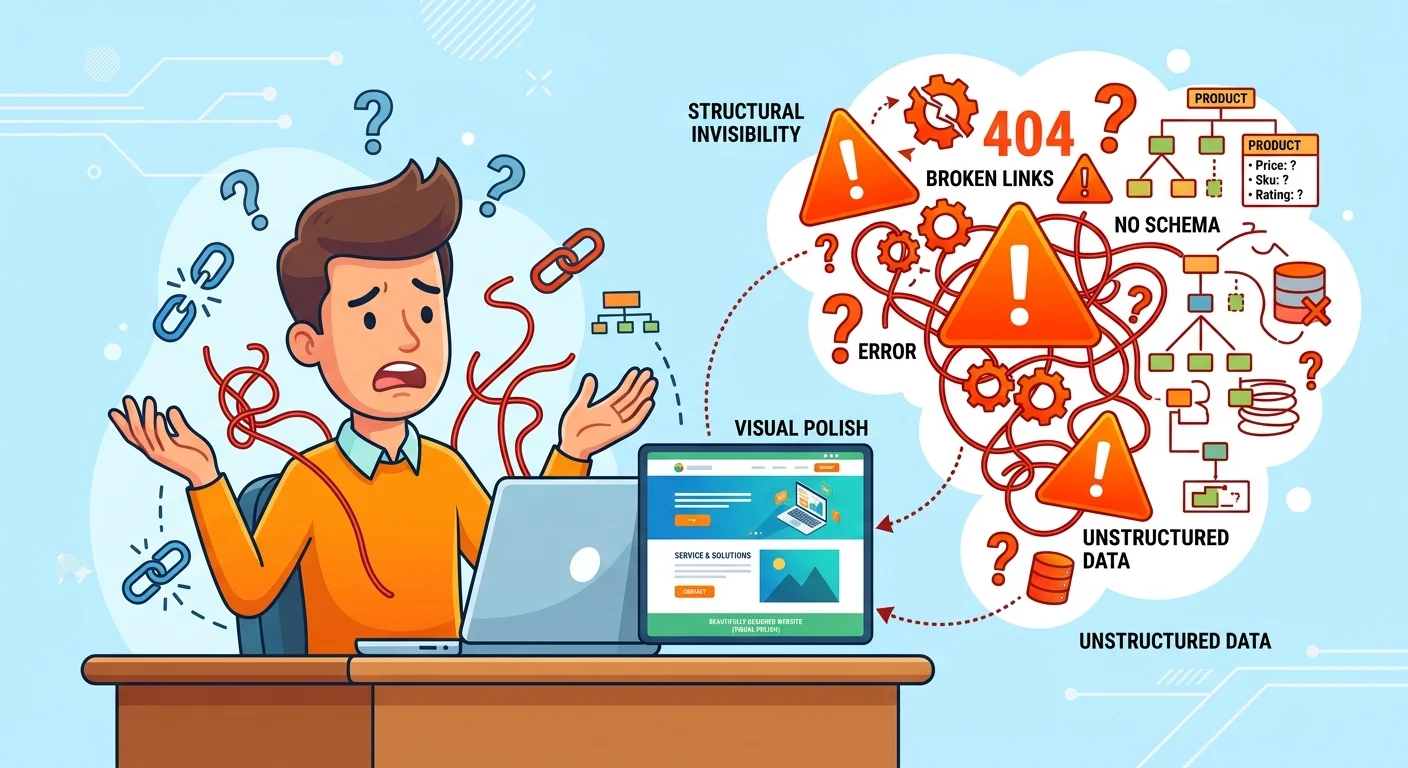
Here’s the friction: even businesses with well-designed websites are invisible to AI because they’re missing the one layer that matters.
The structured data that defines who they are.
Most business websites are built for human visitors. The homepage tells a story. The About page lists credentials. The Services page describes what you offer.
It’s all narrative. Persuasive, polished, professional.
They parse structured data, not marketing copy. If your entity identity isn’t formally declared in schema markup, you’re speaking a language AI doesn’t understand.
Here’s the kicker: 63.6% of Fortune 500 companies don’t use schema markup at all. Even the biggest, most established businesses in the world are structurally invisible to the AI engines replacing search.
The WordPress Plugin Myth
Here’s what most businesses do: they install a WordPress plugin, check a box, and assume their entity identity is now structured.
It’s not.
Most schema plugins generate incomplete markup. They’ll output your business name and address. They won’t define your founder’s credentials. They won’t link your entity to verified external profiles via sameAs properties. They won’t structure the relationships between your services and your organizational identity.
The plugin gives you a skeleton. It doesn’t build the machine-readable ID card.
And because the markup passes validation in the full Schema.org vocabulary, most businesses think they’re done.
Validation isn’t the same as completeness. You can have syntactically correct schema that tells AI engines almost nothing about who you are. The plugin checked the box. It didn’t build Entity Trust.
When Pretty Websites Are Structurally Invisible
Your website can be beautiful, fast, and conversion-optimized – and still be invisible to AI.
Because design and structure are different layers. A pretty website speaks to humans. A structured website speaks to machines. Most businesses invest in the first and ignore the second.
AI engines don’t care about your hero image or your testimonials carousel. They’re looking for Organization schema, Person schema for your founder, LocalBusiness schema if you serve a geographic area, and sameAs links that let them verify your entity against external platforms like LinkedIn and Crunchbase.
If those aren’t present – or if they’re incomplete – your website is a brochure, not an entity.
This Is Not for DIY Tinkerers
Quick pause before we go further.
If you’re looking for a way to bolt schema onto your existing site and walk away, this isn’t it. Building a machine-readable ID card isn’t a weekend project. It’s not a plugin you install once and forget.
Your entity identity evolves. New services, new credentials, new external profiles, new team members. If your schema doesn’t reflect those changes, it’s stale.
Stale data is worse than no data. It tells AI engines your entity isn’t actively maintained. If you want a set-it-and-forget-it solution, we’re not your fit.
The Core Schema Types That Define Your Business Entity
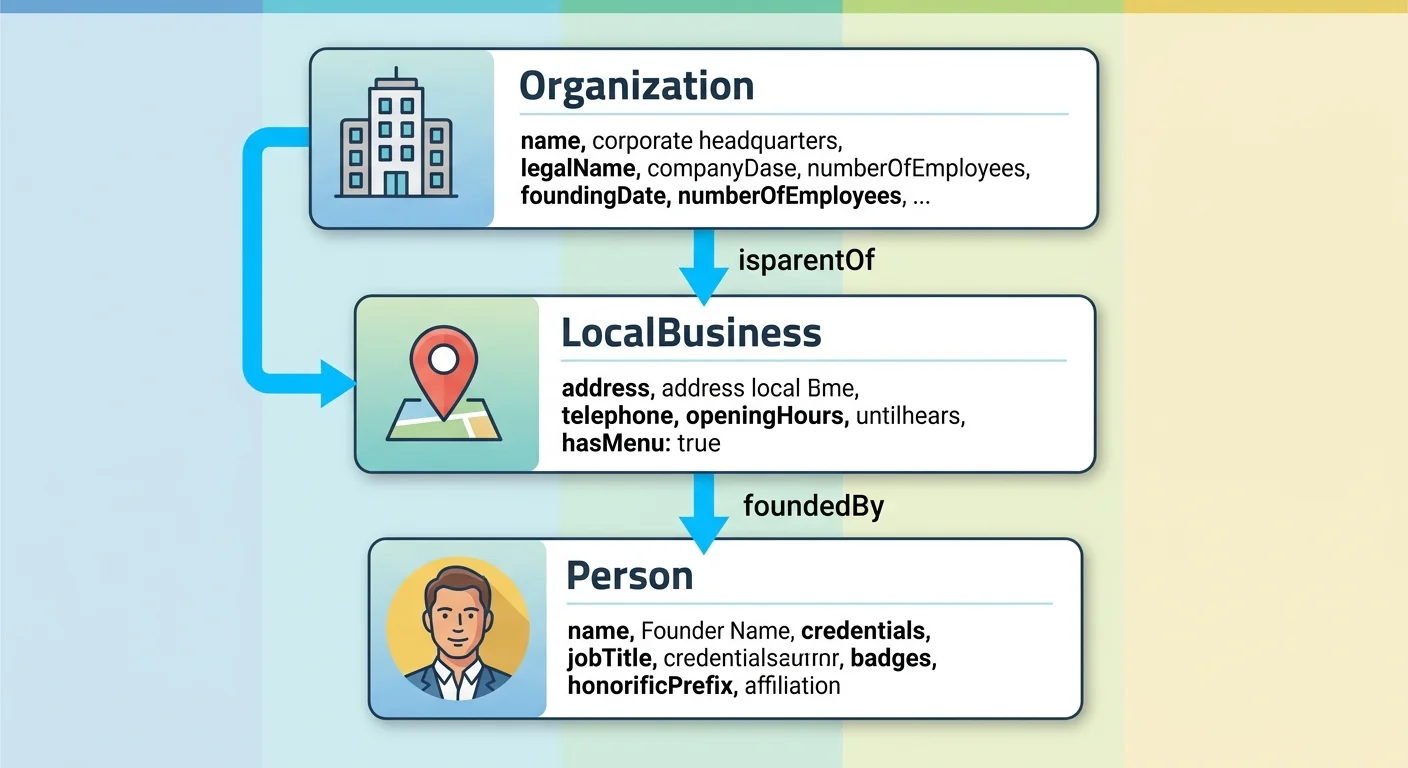
Three schema types form the foundation of your machine-readable ID card: Organization, LocalBusiness, and Person.
These aren’t suggestions. They’re the minimum dataset AI needs to classify your entity as trustworthy. Install Organization, LocalBusiness, and Person – or you’re invisible.
Most businesses stop at Organization schema. They declare their business name and call it done.
That’s not enough.
AI engines need to know whether you’re a national brand or a local service provider. They need to connect your business entity to the human authority figures who run it. Without LocalBusiness and Person schema, your ID card is incomplete.
Organization vs. LocalBusiness
Organization schema is the broadest type. It defines any structured entity – a corporation, a nonprofit, a school. You declare your business name, your logo, your verified external profiles via sameAs, and your contact info.
Most plugins stop here.
But if you serve a geographic area – if your customers are local, not national – you need LocalBusiness schema layered on top.
LocalBusiness schema is a subtype of Organization. It adds geographic specificity – your service area, your physical address if you have one, your hours of operation.
It tells AI you’re not Amazon.
You’re a chiropractor in Huntington Beach, a law firm in Austin, a dental practice in Phoenix. That specificity is what lets AI recommend you when someone asks for local help. If you’re operating locally and you’re only using Organization schema, you’re telling AI you’re national. And if you’re not actually national, you’re invisible in local queries.
Person Schema for Authority Figures
Person schema for founders connects your business entity to the human who leads it. It defines your founder’s name, credentials, LinkedIn profile, and their relationship to the Organization.
AI engines trust businesses more when they can verify the human authority behind the brand.
A founder with a declared alumni institution, a verified LinkedIn profile, and a formal connection to the business entity is a stronger trust signal than an anonymous Organization.
This is where the machine-readable ID card metaphor pays off. Your business exists as a formal entity. Your founder exists as a formal person. Schema links the two.
Without Person schema, AI sees your business as an abstract entity with no human validation.
With it, they see a business led by a real person with verifiable credentials. That’s the difference between a claim and a corroborated fact.
How These Types Interconnect
Here’s what most businesses miss: these schema types don’t sit in isolation. They reference each other.
Your Organization schema includes a ‘founder’ property that points to your Person schema. Your Person schema includes a ‘worksFor’ property that points back to your Organization. Your LocalBusiness schema inherits all the properties of Organization and adds geographic specificity on top.
AI engines parse these relationships. They’re not just reading your business name – they’re validating that your declared founder exists as a structured entity, that their LinkedIn profile matches the one you listed in sameAs, that their credentials are formally declared.
If the links break – if your Person schema doesn’t point back to your Organization, or if your founder’s external profiles don’t corroborate what your schema claims – AI flags it as low-quality data.
This interconnection is why you can’t outsource schema to a plugin. Plugins generate isolated blocks of markup. They don’t build the relationships between entities. They don’t link your founder to your business. They don’t cross-reference your Organization schema with your LocalBusiness schema.
They check syntax. They don’t build Entity Trust.
| Schema Type | Primary Use Case | Critical Properties | When to Use |
|---|---|---|---|
| Organization | Declare the core business entity and connect it to external validation platforms | name, legalName, logo, sameAs (LinkedIn, Crunchbase, etc.), contactPoint, foundingDate, founder | Every business – this is the baseline schema type that tells AI your business exists as a formal entity |
| LocalBusiness | Add geographic specificity for businesses serving a defined local area | address, geo (latitude/longitude), areaServed, openingHours, priceRange, aggregateRating | Service-area businesses where customers find you based on location – chiropractors, law firms, dental practices, local agencies |
| Person | Define the human authority behind the business and link them to the Organization | name, jobTitle, alumniOf, hasCredential, worksFor, sameAs (LinkedIn, personal site), knows | Founder-led businesses or practices where the individual’s credentials and reputation are trust signals for the entity |
| Service | Structure what your business offers so AI can map user needs to your capabilities | name, description, provider (links to Organization), areaServed, serviceType | When your offerings need to be explicitly declared – not implied from your business type – so AI can recommend you for specific service queries |
| FAQPage + Question + Answer | Make your FAQ content extractable as structured Q&A pairs for zero-click answers | mainEntity (array of Question objects), name (the question text), acceptedAnswer (Answer object with text) | Every article with an FAQ section – this is how you get your answers pulled into AI responses and Google’s People Also Ask boxes |
How to Structure Organization Schema
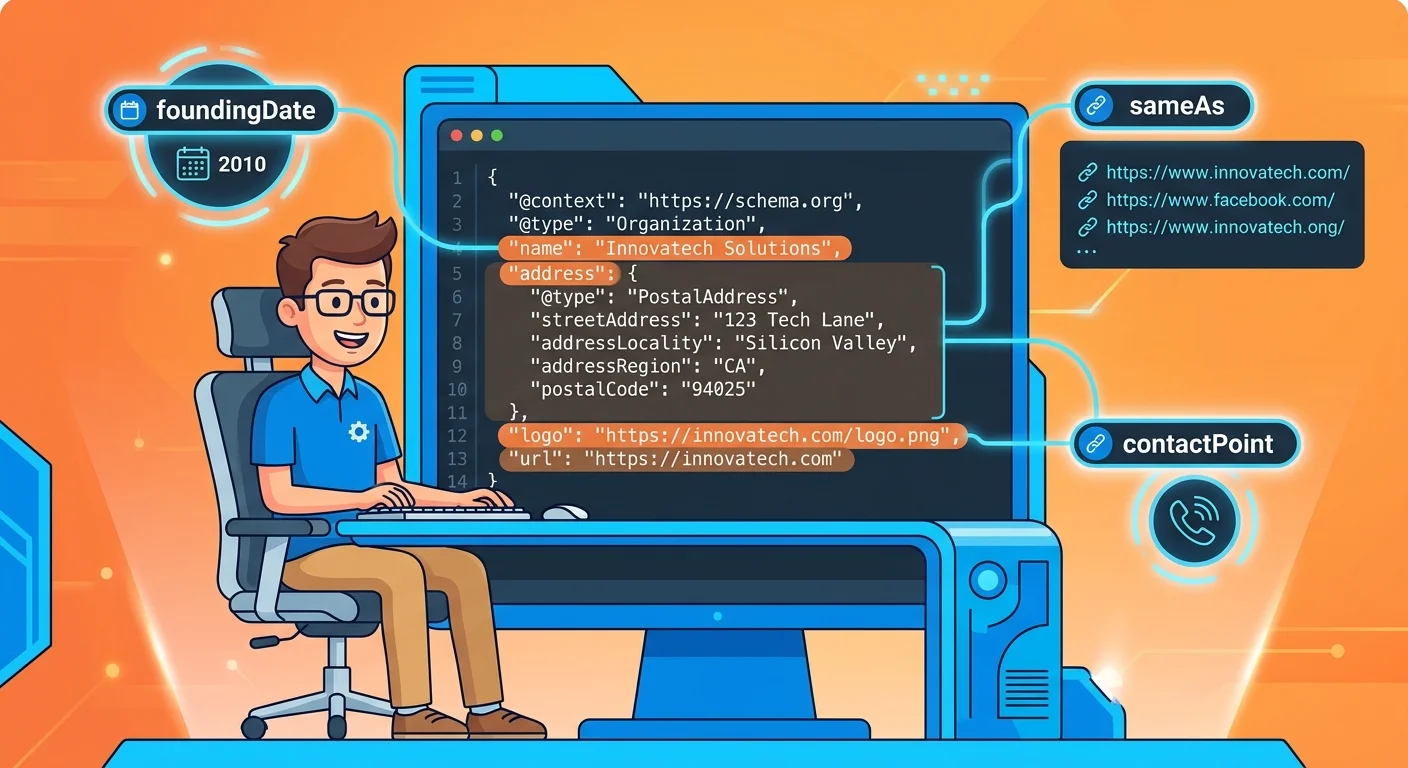
Organization schema is the anchor. It’s the primary declaration of your business entity – the machine-readable ID card that tells AI engines who you are, what you do, and where to verify your identity.
Everything else layers on top of it.
Most businesses get this wrong because they treat Organization schema like a plugin checklist. Install the tool, output your business name and address, call it done.
But Organization schema isn’t a checkbox. It’s a formal declaration.
If you don’t include the properties AI engines use to validate your entity, you’re handing them an incomplete ID card. Incomplete data doesn’t build Entity Trust. It signals that your entity isn’t fully defined – or maintained.
Required Properties
Start with the non-negotiables: name, url, logo, telephone, and address.
These are the minimum properties AI engines need to classify your business as a structured entity. Without them, your schema validates syntactically but tells AI engines almost nothing.
Your name property is your legal business name. Not your brand tagline. Not your DBA.
AI engines cross-reference this against external platforms. If your schema says one thing and your LinkedIn profile says another, that’s a trust signal failure.
Use the exact legal name consistently across every platform.
Your url property is your canonical homepage. Your logo property is a direct link to your logo image file. Your telephone and address properties are your verified contact information.
These aren’t decorative. They’re validation anchors.
AI engines check whether your declared contact information matches what’s listed on Google Business Profile, LinkedIn, and other authoritative directories. If it doesn’t match, your entity identity is ambiguous.
Recommended Properties That Build Trust
The required properties get you in the game. The recommended properties separate trustworthy entities from incomplete ones.
Description, founder, sameAs, and alumniOf for key people – these properties let AI engines verify your entity against external sources and confirm that a real human leads your business.
Your description property is a short, factual summary of what your business does. Not marketing copy. A declarative statement.
Your founder property links to your Person schema, connecting your business entity to the human authority behind it.
Your sameAs properties are URLs to your verified external profiles – LinkedIn, Crunchbase, Google Business Profile. These let AI engines corroborate your declared identity. If you claim to be a business but you have no external profiles AI can verify, you’re not corroborated. You’re just a claim on a website.
JSON-LD Implementation
Google’s recommended format for implementing structured data is JSON-LD. It’s a script block you drop into your website’s
or .It doesn’t require you to mark up every HTML element on your page. It’s a standalone declaration AI engines can parse independently of your site’s visual design.
Here’s why JSON-LD wins: it separates your machine-readable identity from your human-readable content.
Your About page can be as narrative and persuasive as you want. Your Organization schema sits in a script block and declares the structured facts AI engines need.
The two layers don’t interfere with each other.
Most plugins generate JSON-LD automatically. But they generate incomplete markup.
If you’re building authority infrastructure – not just checking an SEO box – you write the JSON-LD yourself or you work with someone who understands How We Execute AEO Content and treats schema as a permanent, evolving dataset.
Properly implemented schema can make your website eligible for rich results in Google Search. But the real payoff is Entity Trust. AI engines parse your JSON-LD, validate it against external sources, and decide whether your business is a trustworthy entity worth citing.
If your schema is incomplete, that decision is no.
| Property Name | Data Type | Example Value | Why It Matters for Entity Trust |
|---|---|---|---|
| name | Text | iTech Valet | Your legal business name, cross-referenced against external platforms to confirm entity consistency |
| url | URL | https://itechvalet.com | Canonical homepage address – the single source of truth for your entity’s web presence |
| logo | ImageObject URL | /logo.png | Direct link to your logo image, used by AI engines to visually identify your brand across platforms |
| telephone | Text | (714) 794-2139 | Verified contact method that AI engines cross-check against directory listings for authenticity |
| address | PostalAddress | 16835 Algonquin St #155, Huntington Beach, CA 92649 | Physical location anchor – validates you’re a real business with a verifiable geographic presence |
| description | Text | AI Authority Agency specializing in Answer Engine Optimization | A declarative statement of what you do, not marketing copy – tells AI engines your core function |
| founder | Person | Reference to Person schema for Gerek Allen | Connects your business entity to the human authority who leads it, adding human validation layer |
| sameAs | URL array | [LinkedIn, Crunchbase, Google Business Profile URLs] | External verification anchors – lets AI engines corroborate your declared identity across trusted platforms |
How to Structure Person Schema for Founders and Key Individuals
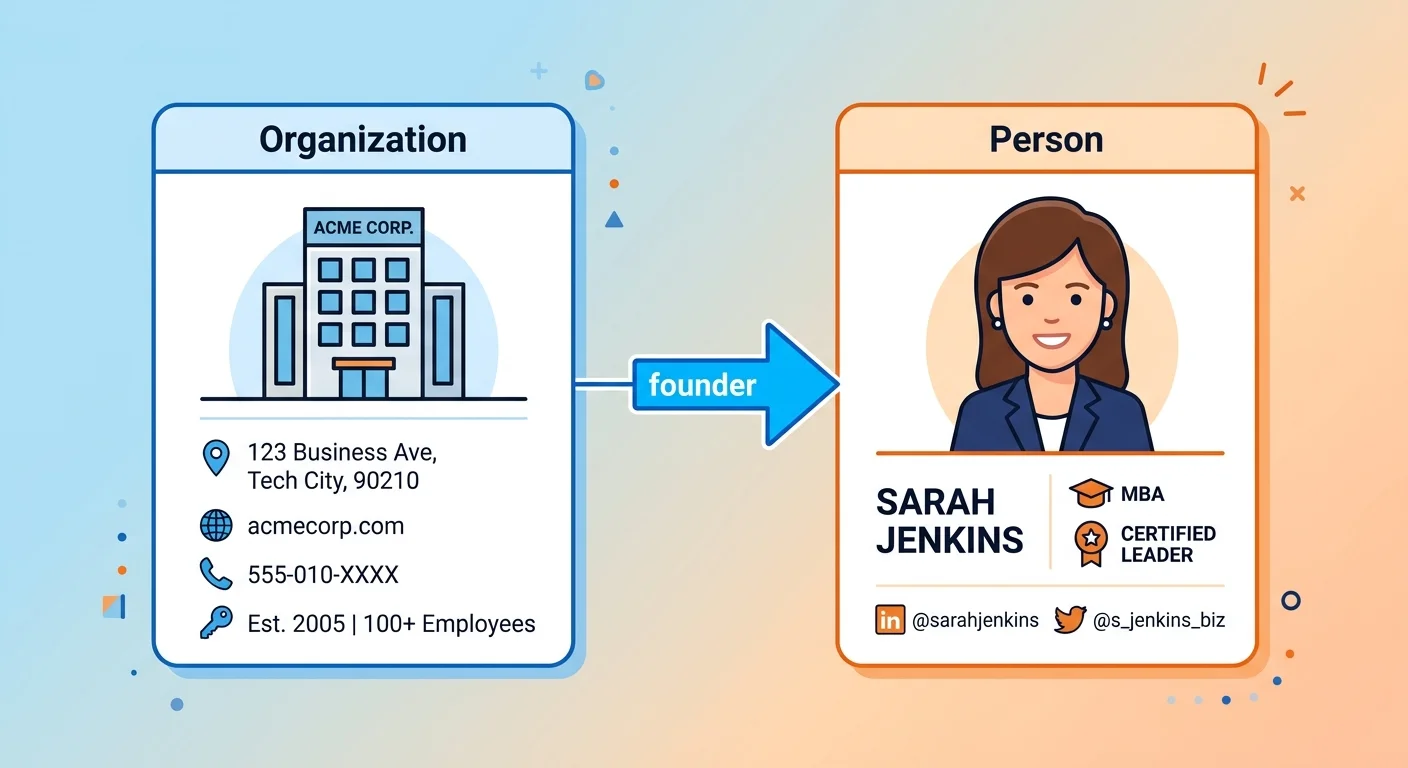
Your business entity is incomplete without the people behind it.
Person schema connects your founder or key individuals to the organization. AI engines don’t just evaluate businesses – they evaluate the humans who lead them. A business entity with a verified founder carries more Entity Trust than an anonymous organization.
Person schema is how you declare that connection.
Most businesses skip this entirely. They declare their Organization schema and call it done.
It’s not.
AI engines parse relationships. They want to know who founded the business, what credentials that person holds, and whether their external profiles back up the claims your schema makes. Without Person schema, your business is a claim with no human validation. With it, you’re an entity led by a real, verifiable authority.
Connecting Person to Organization
Person schema doesn’t sit in isolation – it references your Organization schema directly.
Your Organization schema includes a founder property that points to your Person schema. Your Person schema includes a worksFor property that points back to your Organization. These bidirectional links tell AI engines the relationship is declared, not inferred.
If the links break – if your founder’s Person schema doesn’t point back to your business – AI engines can’t validate the connection. You’ve built two isolated entities instead of one corroborated relationship.
This is where most plugins fail.
They generate Person schema as a standalone block with no relationship properties. They output your founder’s name and LinkedIn URL, but they don’t connect that person to your business entity. AI engines see two separate data points with no relationship.
That’s not Entity Trust. That’s ambiguity. The connection must be declared in both directions, or it doesn’t exist.
Credentials and Authority Signals
Credentials aren’t optional – they’re validation anchors.
Your Person schema should include alumniOf properties for educational institutions and hasCredential properties for certifications or licenses. These let AI engines verify that your founder’s claimed expertise is declared and corroborated by external institutions.
A founder who lists a degree in their bio but doesn’t declare it in their Person schema is making an unverifiable claim. AI engines don’t trust unverifiable claims.
The sameAs property is critical here too.
Your founder’s Person schema should link to their LinkedIn profile, any published author pages, and any other verified profiles where their identity is established. AI engines cross-reference these. If your schema says your founder graduated from Stanford and their LinkedIn profile says the same thing, that’s corroboration.
If the profiles don’t match, or if there are no external profiles to check, your Person schema is just a claim on your website. Claims don’t build Entity Trust.
Here’s the thing: credentials decay if they’re not maintained.
Your founder’s bio changes. They publish new articles. They earn new certifications. If your Person schema still points to a LinkedIn profile from three years ago, or if it lists credentials that are no longer current, AI engines flag it as stale data.
This is why authority infrastructure requires monthly maintenance and refreshes – your entity identity isn’t a one-time declaration. It’s a living dataset.
The Role of Author Markup in Articles
Every article your founder writes should include Author markup that connects the article to their Person schema.
This reinforces their authority signal every time they publish. AI engines parse the author property in your article schema and cross-reference it against your founder’s Person schema. If the two match, the article becomes a trust signal for both the business and the individual.
If they don’t match – if your articles don’t declare an author, or if the declared author has no Person schema – you’re publishing content with no attribution. That’s a missed opportunity to build Entity Trust.
This is the machine-readable ID card metaphor paying off again.
Your article isn’t just content – it’s a declaration that your founder is the author, that your founder is connected to your business entity, and that your business entity is the publisher. AI engines validate all three layers. If any layer is incomplete, the article’s authority signal weakens.
Author markup isn’t a nice-to-have. It’s the connective tissue between your content and your entity identity.
| Person Schema Property | What It Declares | Example for a Founder | Link to Organization |
|---|---|---|---|
| name | The person’s full legal name | Gerek Allen | Declared in Organization schema as ‘founder’ property |
| url | Canonical personal or professional bio page | /about/ | Provides context for the person’s role and connection to the business |
| jobTitle | Current position within the organization | Founder | Must match the role implied by the Organization schema’s ‘founder’ property |
| worksFor | Direct link back to the Organization schema | Points to iTech Valet Organization schema | Creates bidirectional relationship – person to business and business to person |
| alumniOf | Educational institution granting a degree | UC Riverside (BS, Business Administration) | Cross-references against LinkedIn education history for corroboration |
| hasCredential | Professional certifications or licenses | Not applicable if no formal certifications exist | Leave empty if no verifiable credentials – don’t invent them |
| sameAs | External verified profiles for cross-referencing identity | LinkedIn, Crunchbase, X, author pages | AI engines validate these against Organization sameAs properties to confirm the relationship |
| description | Short factual summary of expertise and role | Founder with 20+ years entrepreneurial experience in AI authority systems | Provides context for why this person is connected to the business entity |
The sameAs Property
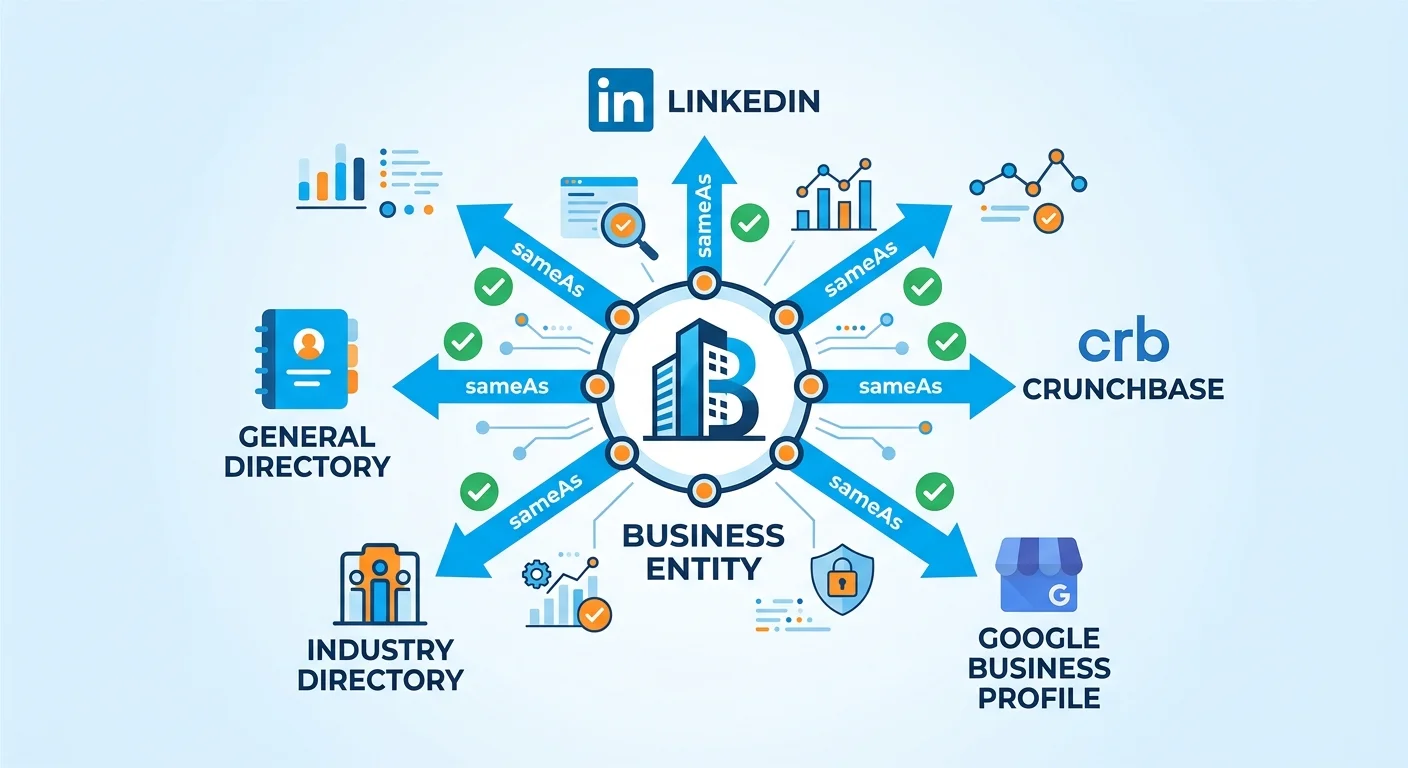
One of the most overlooked pieces of entity disambiguation is the sameAs property.
This is how you prove your entity exists beyond your own website.
The sameAs property links your entity to authoritative profiles on other platforms like LinkedIn or Crunchbase. It’s a direct declaration: This business entity here is the same entity as the one verified over there.
Without sameAs links, your entity identity is self-referential.
You’re asking AI engines to trust your claims based solely on what you’ve written on your own domain. That’s not corroboration. That’s assertion.
AI engines don’t trust assertions. They trust patterns of corroboration across multiple authoritative sources.
If your Organization schema declares your business name, address, and founding date – but there’s no external profile on LinkedIn, Google Business Profile, or Crunchbase that confirms those same details – AI engines flag your entity as unverified.
The sameAs property closes that gap.
It’s the formal bridge between your declared identity and the external platforms where that identity is independently confirmed. This isn’t about SEO. It’s about building Entity Trust by proving your business is a real, corroborated entity – not just a website making claims about itself.
Why Disambiguation Matters
Disambiguation is the process AI engines use to determine whether ‘Smith Consulting’ on your website is the same entity as ‘Smith Consulting’ on LinkedIn, or whether they’re two different businesses that happen to share a name.
Without sameAs links, AI engines can’t disambiguate.
They see two separate entities with similar names and no formal connection. That’s ambiguity. And ambiguity kills Entity Trust.
Here’s why this matters more now than it ever did.
AI engines are building knowledge graphs. They’re not just indexing web pages – they’re mapping relationships between entities. When someone asks ChatGPT or Gemini for a recommendation, the engine doesn’t search for keywords. It queries its knowledge graph and returns the entity it trusts most.
If your entity isn’t disambiguated – if there’s no formal link between your website and your external profiles – you’re not in that graph.
You’re invisible.
The sameAs property solves this.
You declare in your Organization schema that your business entity is identical to the entity on your LinkedIn company page, your Google Business Profile, your Crunchbase listing. AI engines parse those links, confirm that the core details match across platforms, and tag your entity as corroborated.
That corroboration is what separates trustworthy entities from unverified claims.
Without it, you’re asking AI engines to take your word for it. With it, you’re showing them the receipts.
Which Platforms to Include
Not every platform carries the same weight.
AI engines prioritize authoritative, verified platforms where entity data is curated and cross-checked. LinkedIn company pages, Google Business Profile, Crunchbase, and industry-specific directories are high-trust sources.
Your Facebook page, your Instagram profile, and your Twitter handle are not.
They’re social platforms. They don’t validate entity identity – they amplify brand presence. Those belong in your social media strategy, not in your sameAs array.
Start with LinkedIn – both your company page and your founder’s personal profile.
Add your Google Business Profile if you’re a local business. Include Crunchbase if you’re listed there. If you’re in a regulated industry, include any state licensing boards or professional directories where your business is registered.
These are institutional sources.
AI engines trust them because they require verification to get listed. A Crunchbase profile isn’t something you can spin up in ten minutes. It’s a curated dataset that external parties confirm. That’s why it carries weight.
Your Instagram account doesn’t.
Common sameAs Mistakes
The most common mistake is linking to a homepage instead of a specific entity profile.
If your sameAs property points to linkedin.com instead of linkedin.com/company/your-business-name, you’ve told AI engines nothing. The link must resolve to a page that represents your specific entity.
Homepages don’t disambiguate. Entity-specific URLs do.
The second mistake is including dead or outdated links.
If your sameAs array points to a Crunchbase profile that no longer exists, or a LinkedIn page that was merged into another company’s page, AI engines flag it as stale data. Stale data erodes Entity Trust.
This is why authority infrastructure isn’t a one-time build.
It’s a permanent dataset that needs ongoing validation. Your external profiles change. Your sameAs array must reflect those changes, or your entity identity drifts out of sync with reality.
Common Implementation Mistakes That Break Entity Trust
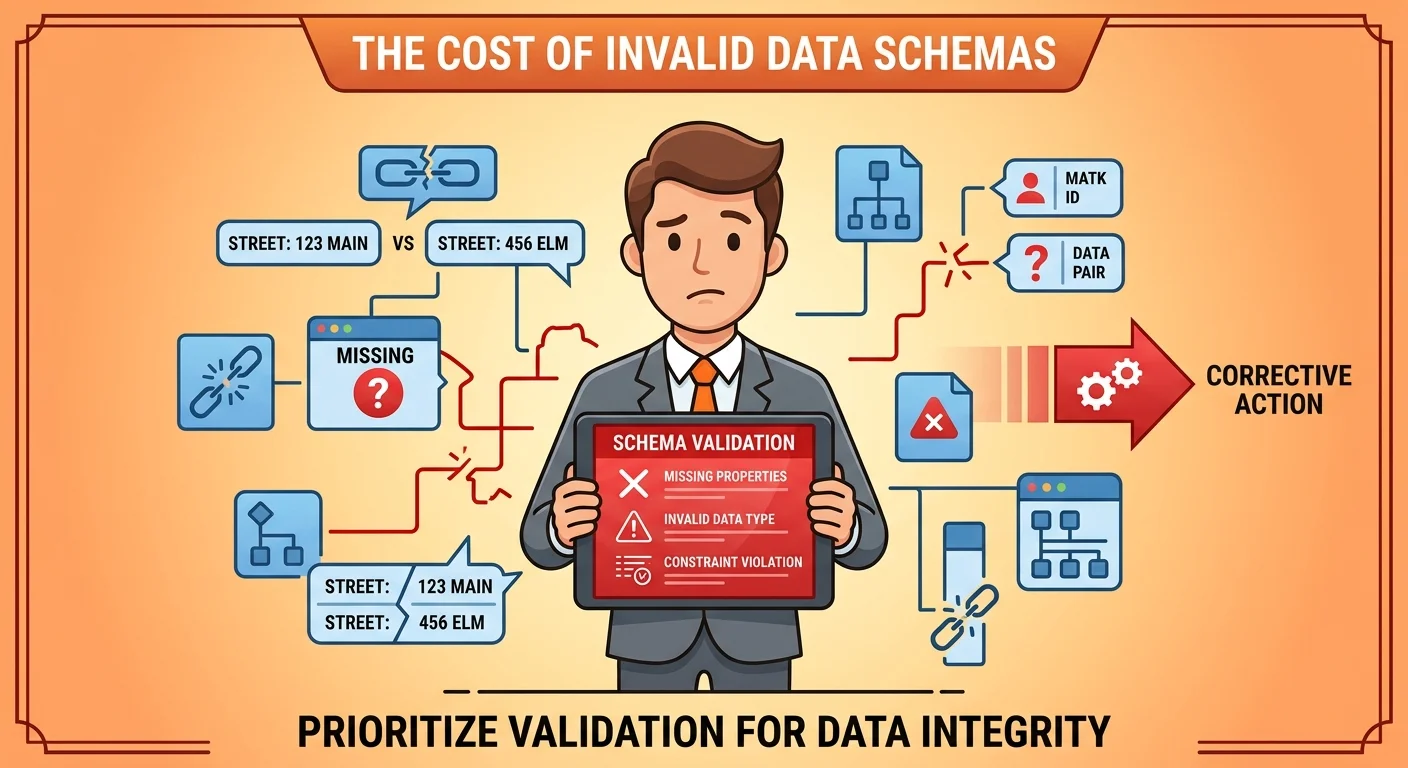
Even if you implement schema, these mistakes will make it worthless.
Worse – they’ll tell AI your entity data can’t be trusted.
Over 60% of Fortune 500 companies aren’t using schema markup at all.
The ones that do? They’re making mistakes that destroy Entity Trust.
Inconsistent NAP data. Wrong schema types. Unvalidated markup. These aren’t technical hiccups. They’re trust signals telling AI engines your entity identity can’t be verified. And when AI can’t verify, it doesn’t recommend.
Inconsistent NAP Data
NAP stands for Name, Address, Phone – the three data points that define a local business entity.
If your Organization schema says your business is at 123 Main Street but your Google Business Profile says 123 Main St., that’s inconsistency. AI engines don’t interpret abbreviations as equivalents. They see two different addresses.
Same with phone numbers. Your schema lists (555) 123-4567 but your LinkedIn profile shows 555-123-4567? Those read as two different contact points.
This isn’t AI being pedantic. It’s AI being precise. Inconsistent NAP data across platforms is the fastest way to tell AI your entity identity can’t be trusted.
The fix isn’t complicated. It’s disciplined.
Pick one canonical format for your business name, address, and phone number. Use that exact format everywhere. Your schema. Your Google Business Profile. Your LinkedIn page. Your Crunchbase listing. Your footer. Every citation, every directory, every external profile.
Character-for-character consistency.
If your legal business name is "Smith Consulting LLC" but your website says "Smith Consulting," you’ve introduced ambiguity. AI engines can’t tell if you’re one entity or two.
This is part of why authority infrastructure requires monthly maintenance and refreshes.
Your address changes. Your phone number changes. If your schema still declares the old data six months later, every external platform that updated correctly is now contradicting your declared identity.
You’re not just outdated. You’re flagged as inconsistent. And inconsistency kills trust.
Missing or Incorrect Schema Types
Using the wrong schema type is worse than using no schema at all.
If you’re a chiropractic practice and your markup declares you as a generic Organization instead of a MedicalBusiness or HealthAndBeautyBusiness, you’ve told AI engines nothing about what you do.
The schema type is how AI engines categorize your entity. It’s not decorative. It’s definitional. A law firm that uses LocalBusiness instead of LegalService or Attorney isn’t missing an opportunity – it’s declaring an identity that doesn’t match reality.
The temptation is to use the broadest, safest schema type because it feels like it covers more ground.
It doesn’t.
Broad types are low-signal. They tell AI engines you exist, but not what you are. Specific schema types carry semantic weight. They connect your entity to a category, and categories determine relevance.
When someone asks an AI engine for a recommendation, the engine queries entities by type. If your type is wrong, you’re not in the result set.
Failing to Validate Your Markup
You can write perfect schema and break it with a single syntax error.
A missing comma. An unclosed bracket. A misspelled property name. Any of these makes your entire schema block unreadable.
AI engines don’t guess what you meant. They parse what you wrote. If your JSON-LD is malformed, they skip it entirely. You’ve gone from declaring your entity identity to declaring nothing.
The fix is non-negotiable: validate your markup before you publish.
Google’s Rich Results Test and validating your markup will catch syntax errors, missing required properties, and type mismatches. These tools parse your schema exactly the way AI engines do.
If the validator flags an error, AI engines flag it too. Running validation isn’t optional.
Here’s what most businesses miss: validation isn’t a one-time step.
Every time you update your schema – and you will, because your entity identity evolves – you revalidate. A change to your founder’s credentials, a new service offering, an updated address. Any of these can introduce errors if you’re editing JSON-LD by hand.
Unvalidated changes are how clean schema turns into broken schema.
This is where the AI Authority articles we publish become critical – they reinforce your entity identity while keeping your schema layer synchronized with your actual authority infrastructure.
| Common Mistake | What It Signals to AI | How to Fix It |
|---|---|---|
| Inconsistent NAP data across platforms | Entity identity can’t be verified – your website declares one address while your Google Business Profile shows another, flagging your entity as unreliable | Pick one canonical format for business name, address, and phone number. Use that exact format everywhere – schema, Google Business Profile, LinkedIn, Crunchbase, footer, every directory. Character-for-character consistency. |
| Using generic schema types instead of specific ones | Your entity exists but has no category – a chiropractic practice marked as ‘Organization’ instead of ‘MedicalBusiness’ tells AI nothing about what you do, so you’re excluded from relevant queries | Use the most specific schema type that accurately describes your business. Law firms use LegalService or Attorney, not LocalBusiness. Specific types carry semantic weight and connect your entity to a category AI engines query. |
| Unvalidated or malformed JSON-LD markup | Your schema is unreadable – a missing comma or unclosed bracket means AI engines skip your markup entirely, rendering your entity invisible | Validate your markup before you publish using Google’s Rich Results Test and Schema.org’s validator. Revalidate every time you update your schema – unvalidated changes turn clean schema into broken schema. |
| sameAs links pointing to homepages instead of entity-specific URLs | No disambiguation – linking to linkedin.com instead of your specific company page tells AI engines nothing, leaving your entity ambiguous and unverifiable | Every sameAs link must resolve to a page representing your specific entity. Use linkedin.com/company/your-business-name, not the homepage. Entity-specific URLs disambiguate. Homepages don’t. |
| Dead or outdated links in sameAs array | Stale data – linking to a Crunchbase profile that no longer exists or a merged LinkedIn page flags your entity identity as outdated and erodes Entity Trust | Audit your sameAs array regularly. External profiles change. Your schema must reflect those changes, or your entity identity drifts out of sync with reality. Authority infrastructure requires ongoing validation. |
| Including low-trust social platforms in sameAs | You’re mixing brand amplification with entity verification – Facebook and Instagram profiles don’t validate identity; they amplify presence, which dilutes the trust signal of your sameAs array | Only include authoritative, verified platforms where entity data is curated and cross-checked – LinkedIn company pages, Google Business Profile, Crunchbase, state licensing boards. Social platforms belong in your social strategy, not your sameAs array. |
Frequently Asked Questions
These are the questions we hear most.
They’re not abstract debates. They’re the friction points where businesses stall – either because they don’t understand what schema actually does, or because they’re trusting shortcuts that can’t build real Entity Trust.
If you’re serious about making your business legible to AI, here’s what works and what doesn’t.
What is the difference between schema markup and my business’s entity identity?
Schema markup is the code. Your entity identity is what the code declares.
Your entity identity is who you are. Your business name. Location. Founder. Credentials. Services. Relationships to other entities. Schema markup is the structured data format that translates all of that into a machine-readable ID card AI engines can parse and verify.
Schema isn’t your identity. It’s the language.
You can have a strong identity and terrible schema. You can have perfect syntax and a weak identity. The goal is alignment – your real-world authority, structured correctly, validated across platforms, declared in a format AI engines trust.
Can I just use a WordPress plugin to handle all my entity schema?
No.
Most WordPress plugins generate generic schema that doesn’t disambiguate your entity. They’ll declare you as an Organization with a name and address, maybe a logo – but they won’t connect your founder’s credentials, link your sameAs profiles, specify your industry-relevant schema type, or structure the relationships between your services and your entity.
They automate the bare minimum. AI engines need specificity.
Plugins are a starting point, not a strategy. If you’re a local service business trying to become the answer AI recommends, you need custom schema that reflects your actual authority infrastructure – not a template that declares the same five properties every other business in your city is declaring.
And here’s the thing most businesses miss: Schema.org as a collaborative standard is designed for nuance. The vocabulary supports hundreds of entity types and relationship properties. Plugins use maybe ten of them.
How often should I update my Organization and Person schema?
Every time your entity identity changes.
Your founder earns a new credential? Update the Person schema. Your business moves or changes its phone number? Update the Organization schema. You launch a new service? Update the service declarations. Your LinkedIn profile URL changes? Update your sameAs array.
Schema isn’t static. It’s a living dataset that mirrors your real-world authority.
If your schema declares data that’s six months out of date, you’re not just outdated – you’re inconsistent. And inconsistency is a trust signal. AI engines prioritize entities whose declared identity matches external validation. If your schema says one thing and every external platform says another, you’ve introduced ambiguity.
Ambiguity kills Entity Trust.
Which schema types are absolutely essential for a local service business to be understood by AI?
Start with Organization or LocalBusiness, depending on whether you serve a specific geographic area.
Then layer in industry-specific types. If you’re a chiropractic practice, use MedicalBusiness or Physician. If you’re a law firm, use LegalService or Attorney. If you’re a financial advisor, use FinancialService. The more specific your schema type, the stronger the semantic signal you’re sending to AI engines about what category you belong to.
Then add Person schema for your founder or key authority figure. This connects a human identity to the business entity. Critical for trust.
AI engines don’t just verify that a business exists. They verify who runs it, what credentials they hold, and whether those credentials are disambiguated across platforms.
Skip any of these and you’re declaring an incomplete identity. AI engines can’t fill in the gaps. They can only work with what you declare.
Will adding schema markup guarantee that AI engines like ChatGPT will recommend my business?
No. And anyone who promises that is lying.
Schema is necessary infrastructure – but it’s not sufficient on its own. AI engines need schema to understand your entity identity, but they also need external validation, citation velocity, semantic density in your content, and proof that other authoritative sources recognize you as trustworthy.
Schema is the foundation. Authority is the compounding layer you build on top of it.
Without schema, you’re invisible. With schema alone, you’re declared but unproven. The businesses AI engines recommend are the ones that structured their entity identity correctly and then reinforced it with ongoing content execution, external citations, and platform consistency.
That’s why the AI Visibility Check exists – to show you where you actually stand, not where you hope to be.
How does schema for a founder or key person connect to the main business entity?
Person schema links to Organization schema through the ‘founder’ or ’employee’ property.
When you declare a Person entity for your founder, you’re not just listing a name and title. You’re connecting that person’s credentials, education, professional affiliations, and external profiles to the business entity. AI engines use this connection to verify that your business isn’t just a brand name – it’s run by a real, credentialed human whose authority is independently verifiable.
This is where Schema.org as a collaborative standard becomes critical. The vocabulary defines how entities relate to each other. A Person can be the founder of an Organization. An Organization can offer a Service. A Service can have a provider who is a Person.
These aren’t decorative relationships. They’re semantic links that tell AI engines how authority flows through your business.
If your founder has a strong LinkedIn presence, published work, or credentials from a recognized institution, Person schema is how you translate that human authority into machine-readable structure. Without it, AI engines see your business as an abstract entity with no verifiable leadership.
With it, you’ve anchored your business identity to a real person whose authority can be independently confirmed.
The Bottom Line
Here’s what it comes down to: you can have the best services, the most experience, and the cleanest website – but if AI can’t read your entity identity, none of it matters.
Schema markup isn’t about making your site prettier. It’s not about climbing a ranking ladder that’s already obsolete.
It’s about translating your real-world authority into a language AI engines actually understand.
Without that translation layer, you’re invisible. Not ranked lower. Not less competitive. Invisible.
This is the callback to the machine-readable ID card metaphor we opened with. Your website tells a story. Schema declares the facts. AI engines don’t parse narratives – they query data structures. If your entity identity isn’t structured, verified, and disambiguated across authoritative platforms, AI can’t confirm you exist. And what AI can’t confirm, it won’t recommend.
That gap – between what you know about your business and what AI can verify – is where authority gets lost.
Schema closes that gap. But only if it’s built right, validated consistently, and maintained as your identity evolves. This isn’t a tactic you deploy once and forget. It’s permanent infrastructure that compounds every time you publish new content, earn external citations, or build Entity Trust across platforms.
Structuring your entity identity with schema markup isn’t an SEO tactic. It’s the foundational layer of your AI Authority Engine that makes your business a legible, trustworthy answer for AI engines, transforming your website from a digital brochure into a canonical source of truth.
Most businesses will wait until the shift is undeniable.
By then, the practices that moved early will have already locked in the authority signals AI uses to determine who to trust.
If you’re ready to stop being invisible and start being the answer AI recommends, the first step is understanding where you stand. See what AI actually knows about your entity. Then decide whether you’re building authority infrastructure – or waiting for someone else to take the spot.
Schema isn’t optional anymore. It’s the machine-readable ID card that separates businesses AI can verify from businesses AI ignores. If you’re ready to stop hoping AI engines find you and start building the authority infrastructure that makes you the answer they cite, the first move is seeing where you actually stand. Run the check. Fifteen minutes. You’ll know exactly what ChatGPT, Gemini, and Grok say when someone asks who to trust in your market. If the results don’t make the problem self-evident, walk away. But if they do – you’ll know exactly what needs to be fixed.