
The Burned Chiropractor's Vetting Checklist: 7 Questions to Ask Before Signing
A vetting checklist for marketing agencies protects chiropractic practices from the contracts that cost them the most — not just in dollars, but in ownership, control, and digital infrastructure they may never recover.
There are 7 questions every chiropractor should ask before signing. They expose ownership structure, contract flexibility, performance accountability, and whether the agency is honest about who it cannot serve.
A contract is a mirror. It reflects exactly how much an agency trusts its own work. An agency confident in its results never needs 12 months of lock-in to keep a client.
The seven questions are: Who owns everything we build together? What happens to my assets if I cancel? Are you month-to-month or locked-in? What exactly are you guaranteeing? How do you measure success — and can I verify it independently? Who is not a good fit for you? And what does month 13 look like?
Each question targets a specific failure point. Ownership clauses determine whether the website, content, and data belong to the practice or revert to the agency on exit. Exit terms reveal whether cancellation is clean or whether digital assets — domain access, platform credentials — are held as a bargaining chip. Contract duration signals how confident an agency is in its own results. Performance guarantees, when present, often conflict with FTC advertising standards — they are a warning, not a selling point. Verification access separates transparent execution from vanity reporting. The fit question forces an agency to disclose who it cannot serve well. Month 13 reveals whether the agency is building permanent infrastructure or renting temporary traffic that disappears when payments stop.
Chiropractors allocate between 5% and 12% of gross practice revenue to marketing. That budget deserves a contract that protects every dollar spent and every asset built.
These 7 questions are the standard.
Last Updated: June 12, 2026
- • Why Chiropractors Keep Getting Burned
- • The 7-Question Vetting Checklist
- • The 7-Question Vetting Checklist (Continued)
- • What This Checklist Is Not For
-
• Frequently Asked Questions
- • Why do marketing agencies push 12-month contracts on chiropractors?
- • Can an agency legally keep my domain name or Google Business Profile when I cancel?
- • What legal language in a contract signals the agency owns my website data?
- • How does a month-to-month contract protect me from an underperforming agency?
- • What questions reveal whether an agency is building lasting assets or renting temporary traffic?
- • Stop Signing Contracts You Haven't Vetted
Why Chiropractors Keep Getting Burned
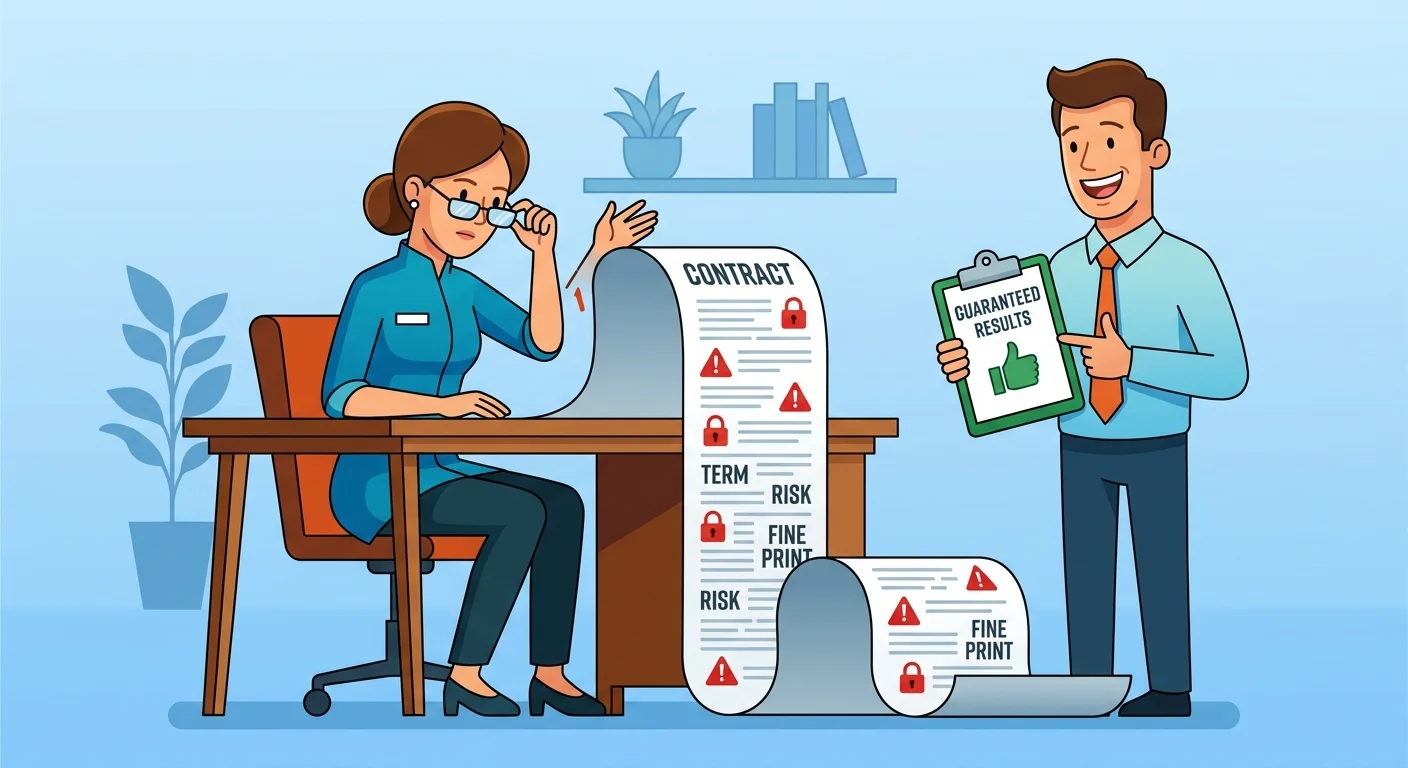
Chiropractors don't get burned because they're naive.
They get burned because burning them is profitable.
The average agency-client relationship lasts 2 to 3 years. That's not a coincidence. That's the natural lifespan of a model built on short-term optics and long-term lock-in.
By the time a chiropractor figures out the results don't match the pitch, they've burned 12 months of budget. And in most cases, they've handed over ownership of their own digital infrastructure — without ever knowing it was on the table.
The trap isn't buried in a clause you missed.
It's in the sales cycle that gets you to sign before you've looked.
The Hopium Sales Cycle
Here's what the hopium cycle looks like: a slick deck, a few borrowed case studies, a promise of Page 1 rankings, and a 12-month commitment that locks in the agency's revenue before they've proven a single result.
The sequence is deliberate. Lock in the contract first. Worry about performance second.
Guaranteeing search ranking positions isn't just a weak promise — it's a deceptive marketing practice that violates federal consumer protection guidelines. The FTC is explicit on this.
An agency that guarantees rankings is either lying to close the deal, or doesn't know enough to realize they're making an illegal claim. Neither version is someone you want building your practice's authority infrastructure.
The hopium sells because the buyer wants certainty. Any number — any benchmark, any guarantee — feels safer than the alternative, which is not knowing.
That's the mechanism. And once you see it, you can't unsee it. why most agencies fail chiropractors
Why the Standard Agency Contract Is Designed Against You
A contract is a mirror.
It shows you exactly how much an agency trusts its own work. The standard agency contract — 12-month minimum, auto-renewal clause, proprietary platform access, vague deliverables — reflects an agency that doesn't trust its work at all.
An agency confident in its results never needs 12 months of lock-in to keep you.
The lock-in exists for one reason: to keep revenue flowing long enough to survive the moment you figure out the results aren't coming. It's not a partnership structure. It's a hedge against their own underperformance.
The Local AI Authority Engine runs on the opposite premise: flat fee, client-owned infrastructure, no long-term contract required.
That's not a sales angle. That's what it looks like when an agency is willing to let the work speak for itself. The seven questions ahead hold every agency's contract up to the light — and show you, before you sign, exactly what kind of shop you're walking into.
| What the Agency Promises | What the Contract Actually Says | What the Chiropractor Loses |
|---|---|---|
| Page 1 rankings guaranteed | Performance benchmarks are undefined or measured by agency-controlled reporting only | Budget spent on unverifiable claims; no independent confirmation of results |
| Full-service digital presence built for your practice | Website, content, and tracking infrastructure remain agency property upon cancellation | Years of built assets revert to the agency the moment payments stop |
| Flexible partnership, cancel anytime | 12-month minimum commitment with auto-renewal clause and 30-to-60-day cancellation notice window | Locked into a contract long after it's clear the results aren't coming |
| Dedicated account manager and transparent reporting | Reporting delivered through proprietary dashboards the practice cannot access independently | No way to verify whether reported metrics reflect real patient-generating activity |
| Strategy tailored to your specific market and practice | Templated deliverables recycled across every client with surface-level customization | Generic content that builds no entity trust and signals nothing meaningful to AI engines |
| Everything you build with us belongs to you | Domain access, Google Business Profile credentials, and ad account ownership held by the agency | Held hostage at cancellation — clean exit requires negotiation or legal pressure |
The 7-Question Vetting Checklist
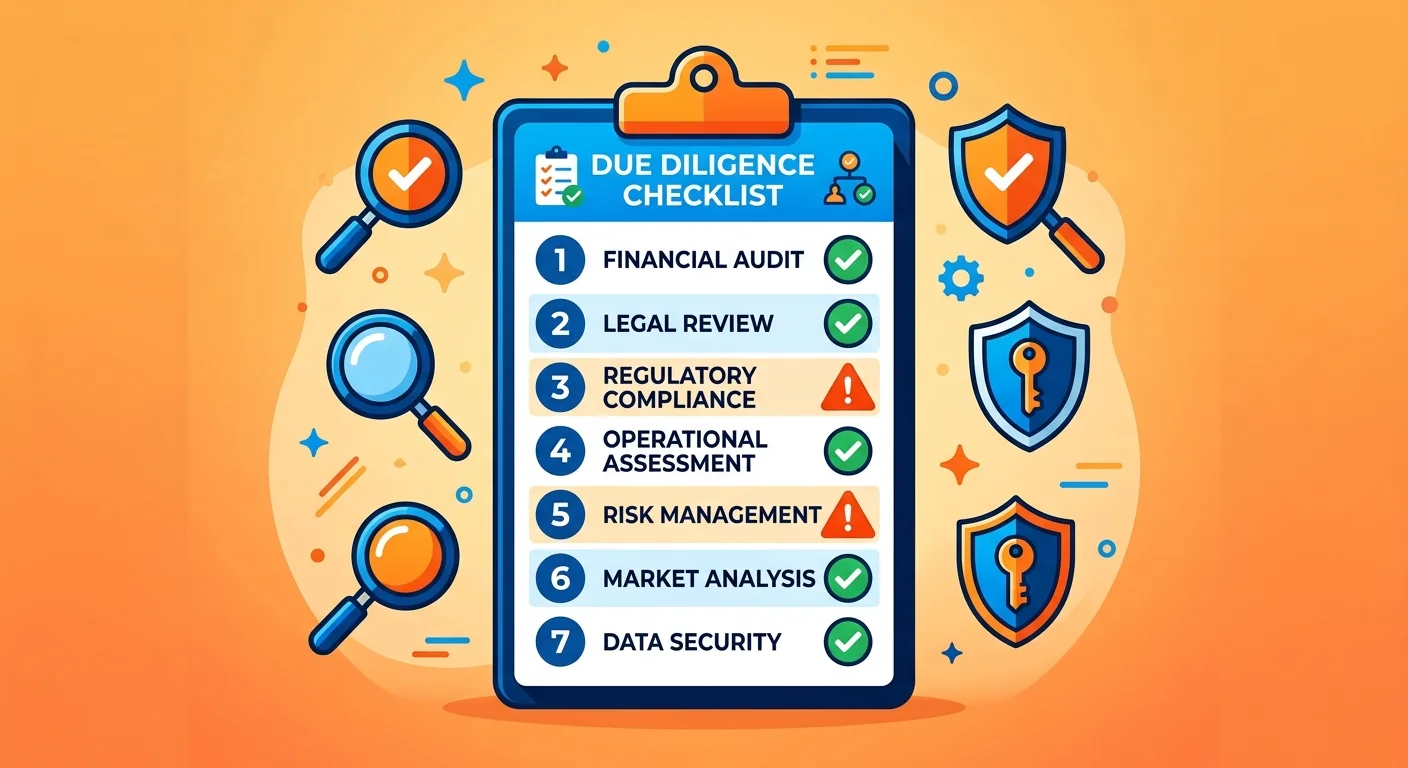
Most chiropractors walk into the agency meeting focused on the wrong things. The deck. The case studies. The retainer number. None of that matters if the contract underneath the pitch is designed to trap you.
These seven questions aren't a negotiating tactic. They're a diagnostic. Hold each one up to the agency's answer and you'll know exactly what kind of shop you're dealing with — before a single dollar changes hands.
Question 1: Who Owns Everything We Build Together?
This is the question most chiropractors never ask. They assume that because they're paying for it, they own it. That assumption is wrong.
Under default intellectual property law, ownership belongs to the creator — not the buyer. Without an explicit 'work for hire' clause or a written transfer of ownership, the agency that built your website, wrote your content, and configured your schema retains the intellectual property rights to all of it. You're licensing it. You don't own it. The intellectual property agreements framework is clear: the default is never in the buyer's favor.
The answer you want: everything we build — website, content, schema, credentials, data — is yours from day one, in writing. Anything short of that isn't a yellow flag. It's a red one.
Question 2: What Happens to My Assets If I Cancel?
This is Question 1's twin. And it's where the real trap usually lives. Owning something on paper means nothing if the agency controls access to it.
Here's what cancellation looks like at most legacy shops: credential transfers get stalled, access gets locked behind a proprietary platform you didn't know you were building on, and the agency goes quiet until the migration window closes. According to SBA contract management standards, vague termination clauses and missing deliverable definitions are the leading cause of SMB contract disputes. That ambiguity isn't an oversight. It's a design feature.
Ask it directly: if I cancel today, what do I walk away with, what gets transferred, and in what timeframe? A hesitant or vague answer is your answer. They're already designing your exit.
Question 3: Are You Month-to-Month or Lock-In?
Contract duration is the most honest signal an agency gives you. It tells you exactly how confident they are that their work will keep you around — voluntarily.
Month-to-month means the agency earns your renewal every single month. A 12-month lock-in means they've already built a financial cushion to survive the moment you figure out the results aren't coming. Those aren't equivalent risk profiles — they're opposite ones. That's why this structure matters.
An agency that won't operate month-to-month doesn't trust its own work. That's not a harsh read — it's the logical conclusion. If the results were going to speak for themselves, they wouldn't need 12 months of contract protection before showing you a single one.
Question 4: What Exactly Are You Guaranteeing?
This one breaks the pitch faster than anything else. Ask it flatly: what are you guaranteeing, exactly? Then wait.
If the answer includes a guaranteed ranking position — on any platform, for any keyword — walk away. Guaranteeing search rankings is a deceptive marketing practice that violates federal consumer protection guidelines. The FTC is explicit on this. An agency making that claim is either lying to close the deal, or doesn't understand the industry well enough to know the claim is illegal. Neither version is someone you want building your practice's authority infrastructure.
The right answer isn't a guarantee of outcomes. It's a guarantee of process. What you want to hear: we guarantee the quality and consistency of our execution. We don't promise rankings — because no one who understands how AI authority actually works would make that promise. That answer signals integrity. Not weakness.
| Vetting Question | Green Flag Answer | Red Flag Answer | What It Reveals |
|---|---|---|---|
| Question 1 — "Who Owns Everything We Build Together?" | Everything built during our engagement — website, content, schema, credentials, and data — is yours from day one, in writing, with no conditions. | Vague language about "licensed use," "platform access," or ownership that transfers only after contract completion. | Whether the agency is building an asset for your practice or a dependency for theirs. |
| Question 2 — "What Happens to My Assets If I Cancel?" | A clear, written process: all credentials transfer within a defined window, no proprietary platform lock, full access handed over immediately upon cancellation. | Hesitation, qualifications, or silence — or an exit process buried in vague termination language with no stated timeline. | Whether the agency's model depends on your inability to leave, or on your desire to stay. |
| Question 3 — "Are You Month-to-Month or Lock-In?" | Month-to-month. No auto-renewal. You earn continued business by delivering results every single month. | A 12-month minimum commitment, auto-renewal clauses, or a "discounted" rate contingent on a long-term contract. | How confident the agency actually is that their work will keep you — voluntarily. |
| Question 4 — "What Exactly Are You Guaranteeing?" | A guarantee of process quality and execution consistency — never a guarantee of ranking positions or specific outcome numbers. | Any promise of guaranteed Page 1 rankings, guaranteed traffic volumes, or guaranteed revenue results. | Whether the agency understands how AI authority works — or is closing deals with claims that don't hold up. |
| Question 5 — "How Do You Measure Success — and Can I Verify It?" | Clear, independently verifiable metrics — dashboards or reports the practice can access directly, not just screenshots delivered by the agency. | Proprietary reporting dashboards the client can't access independently, or metrics that can't be cross-referenced against a third-party source. | Whether the agency's reporting reflects real performance or is engineered to look like it. |
| Question 6 — "Who Is Not a Good Fit for You?" | A specific, confident answer — the agency names the type of client they actively turn away and why. | A deflection, a generic "we work with everyone," or a pivot back to the sales pitch. | Whether the methodology is built for a defined client type — or marketed indiscriminately to anyone who'll sign. |
| Question 7 — "What Does Month 13 Look Like?" | A clear description of compounding infrastructure — authority assets that belong to the practice and continue building value whether payments continue or not. | Vague talk of "ongoing strategy" with no description of what the practice actually owns or retains after the engagement ends. | Whether the agency is building a permanent AI Authority Engine for your practice — or renting you temporary visibility that evaporates when you stop paying. |
The 7-Question Vetting Checklist (Continued)
Questions 1 through 4 are about the contract. Ownership. Exit terms. Lock-in. Guarantees. Those four tell you whether you're walking into a trap.
Questions 5, 6, and 7 are about something harder to fake. They tell you whether the agency is honest — with you, and with itself.
Most agencies find a way to sidestep these three.
Not by accident. These are the questions that expose character — and character is exactly what a polished deck was designed to hide.
Question 5: How Do You Measure Success — and Can I Verify It?
Reporting is where agencies hide mediocre work in plain sight.
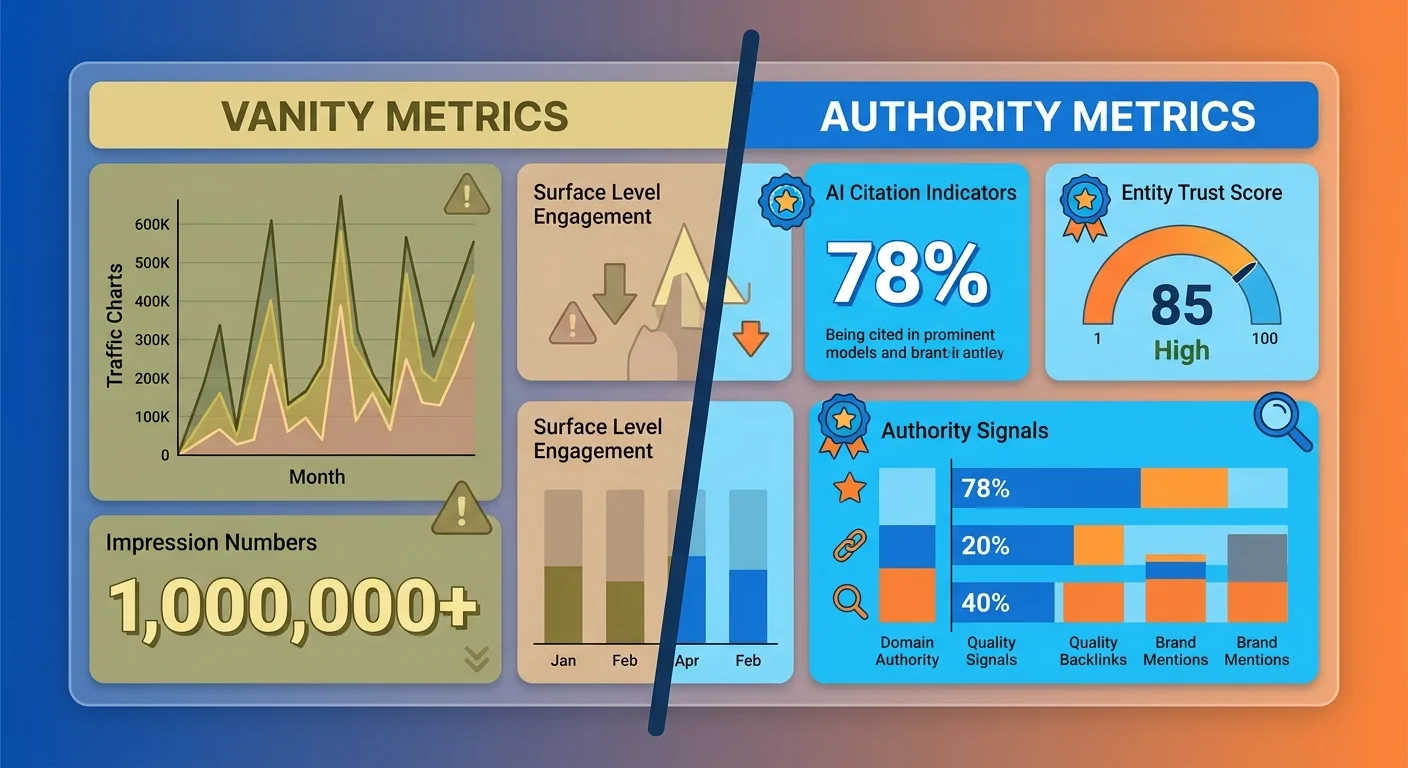
They hand you a dashboard packed with impressions, sessions, keyword movement — and none of it traces back to a single new patient booking. The question isn't what they're showing you. The question is whether you can verify any of it on your own.
Ask it directly: do I have login access to the underlying accounts — Google Analytics, Google Search Console, the actual platform — or do I only see what you choose to show me?
Verification access is the line between transparent execution and vanity reporting. If the answer is that you only see their branded dashboard, your performance data lives inside a system you don't control and can't audit. That's not a reporting structure. That's a filter.
The right answer is direct: your accounts are yours, you have login access, and we report against numbers you can pull yourself at any time.
Anything less than that isn't transparency. It's access control. And access control exists for one reason — to manage what you're allowed to see.
Question 6: Who Is Not a Good Fit for You?
This one's a gift — and most agencies hate it.
An agency that's built a real methodology knows exactly who it doesn't work for. An agency that markets to everyone hasn't built a methodology at all.
Listen for specificity. A sharp answer sounds like: we don't work with practices that need guaranteed results in 90 days, or with owners who can't stay involved in approvals. That's a methodology talking.
A vague answer — "we work with all kinds of practices" — tells you the agency is optimizing for the close, not the engagement. Practices that skip this question are the ones who end up blindsided by the data ownership trap.
60% of business owners are surprised by asset ownership clauses when they leave an agency.
The pattern never changes. The agency took the client without disclosing its limitations. Delivered mediocre results. Then held the digital infrastructure hostage on the way out.
Asking who they're not a good fit for is how you find that out before you sign — not after you're already that statistic.
Question 7: What Does Month 13 Look Like?
This is the most clarifying question on the entire list.
Month 13 is after the initial engagement window closes. After the honeymoon. After every "we're still building momentum" grace period the agency gave itself to defer accountability.
Ask it exactly this way: once our initial engagement ends, what does the ongoing relationship look like? What are you still building — and what stops?
That answer tells you everything. An agency building permanent AI Authority Engine infrastructure has a clear, specific answer for Month 13. An agency selling traffic has a renewal pitch.
By the time you've asked all seven, you're not reading a contract anymore.
You're reading the agency's character.
Every hesitation. Every vague answer. Every over-promise. All of it is information. A confident agency with a real methodology answers all seven cleanly, directly, and without flinching. The ones who can't answer them are telling you exactly why you shouldn't sign.
| Metric Type | Vanity Metric (Red Flag) | Authority Metric (Green Flag) | Why It Matters |
|---|---|---|---|
| Website Performance | Total sessions, pageviews, bounce rate | AI citation frequency, entity trust signals, structured data coverage | Sessions don't book patients — AI recommendations do |
| Search Visibility | Keyword rankings on Google Page 1 | Named as the answer in ChatGPT, Gemini, and Grok responses | Ranking on a list and being the answer are two different outcomes |
| Content Output | Number of blog posts published per month | Semantic density built per article, internal link authority compounding | Volume without structure doesn't signal expertise to AI engines |
| Reporting Access | Branded dashboard showing agency-curated metrics | Direct login access to Google Analytics, Search Console, and all underlying accounts | A filter exists to manage what you're allowed to see — not to inform you |
| Social & Paid Activity | Impressions, likes, ad spend, click-through rate | Owned authority assets that compound after campaigns stop | Rented visibility disappears the moment the budget does |
| Lead Generation | Form fills and phone calls attributed to agency campaigns | New patient bookings tied to verifiable AI-driven discovery | Attribution without verification is a story, not a result |
| Long-Term Value | Month-over-month traffic growth while under contract | Authority infrastructure that belongs to the practice and compounds independently | When the contract ends, rented visibility ends with it — owned authority doesn't |
What This Checklist Is Not For
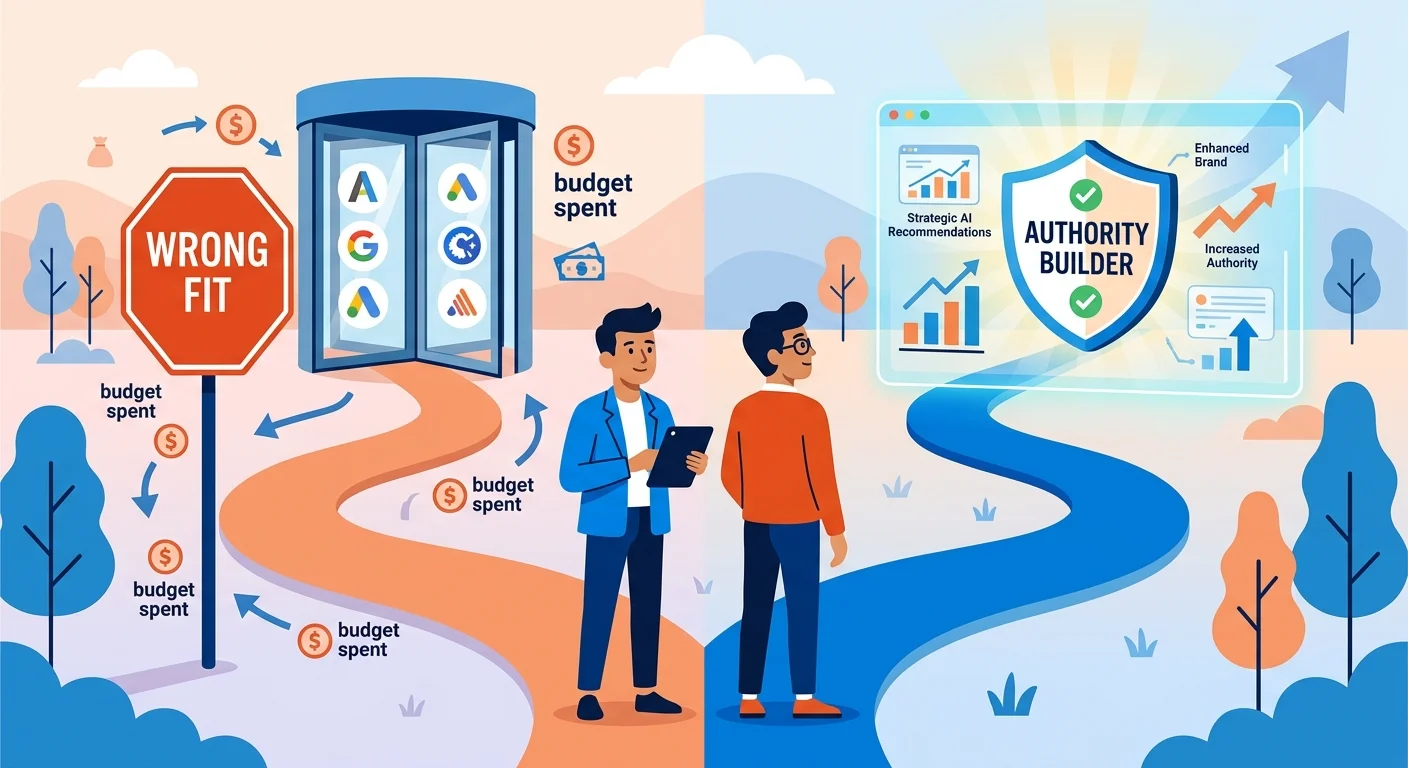
Here's the thing — this checklist is built for a specific kind of buyer.
Hand it to the wrong person and it'll feel like an obstacle course, not a filter.
Chiropractors who've been burned before will recognize every question on this list. They've lived the cost of skipping them.
But practices that haven't been burned yet — or buyers who think the lower monthly retainer is the smarter move — will read these questions as obstacles instead of filters.
That reaction is the tell.
This checklist assumes you're building something permanent. You want to own your infrastructure, verify your results, and operate without a 12-month financial leash.
If those priorities don't fit where you are right now — good to know now. Before you're in a room signing something.
The Buyers This Vetting Process Will Repel
The first buyer this process repels is the one who wants results in 90 days — promised in writing, on a slide deck.
That buyer doesn't want compounding AI Authority infrastructure. They want a number. Question 4 ends that conversation. It's supposed to.
It'll also repel the price-first buyer. Chiropractic practices allocate between 5% and 12% of gross revenue to marketing, according to Chiropractic Economics data. A buyer shopping purely on cost is already optimizing for the wrong variable.
The agency red flags that bite hardest aren't buried in the fine print. They're baked into any engagement where price beat process during the vetting stage.
By the time you notice the damage, you've already paid for it.
And it'll repel the set-it-and-forget-it buyer. The one who wants to hand off the problem and never think about it again.
Authority decays without ongoing execution. Client-agency lifecycle metrics put the average agency-client relationship at just 2 to 3 years. That means most practices eventually hit the separation moment this checklist is designed to protect against.
The buyers who skip the vetting process are the same ones blindsided when it arrives. If you haven't seen it yet, you're not immune — you're just early. what a broken authority model costs
How to Use the Checklist in a Real Sales Conversation
Don't wait for a contract before you ask these questions.
By then you're already inside a closing conversation. Closing conversations have social gravity — hard questions start to feel rude. Ask them on the discovery call, before any proposal lands.
Run them in order. Each question builds on the last — ownership before exit terms, contract structure before guarantees, reporting transparency before character.
By the time you've asked all seven, you're not reading a pitch anymore. You're reading the agency's character.
Chiropractic Economics data puts the stakes in plain numbers: practices allocating 5% to 12% of gross revenue to marketing deserve to know exactly who they're building with — and whether what gets built will still be theirs when the engagement ends.
| Buyer Type | Behavior Pattern | Why This Checklist Fails Them | What They Need Instead |
|---|---|---|---|
| The 90-Day Guarantee Seeker | Enters every agency conversation with a timeline demand — wants measurable ROI within a fixed window, usually 90 days or less | Every question on this checklist exposes why outcome guarantees don't hold. This buyer stops engaging at Question 4 and calls it a dealbreaker. | A short-term paid ads campaign with defined spend and a hard stop date — not a compounding authority infrastructure build |
| The Price-First Buyer | Evaluates agencies by monthly cost before anything else — compares retainer fees across providers as the primary filter | The checklist is built around process quality, ownership rights, and long-term asset control. None of those variables register when cost is the only lens. | A commodity content package or template-based SEO retainer where low price and low accountability are acceptable tradeoffs |
| The Set-It-and-Forget-It Buyer | Wants to hand off the marketing problem entirely and never revisit it — no check-ins, no approvals, no ongoing involvement | Questions 5 and 7 require a buyer who wants verification access and a clear picture of Month 13. A disengaged buyer reads those as burdens, not protections. | A fully managed hands-off service with no reporting requirements and no ownership expectations — where the agency controls everything by design |
| The First-Time Agency Shopper Without Prior Burns | Has never lived through a bad agency separation — no data ownership surprises, no locked-in contract lessons, no vanity metrics disappointment | Without prior context, the checklist questions feel overly cautious or adversarial rather than protective. The urgency behind each question doesn't land until it's too late. | A guided onboarding experience that builds awareness of what can go wrong before the first contract is signed — education before vetting |
| The 'Everything to Everyone' Practice Owner | Refuses to specialize their positioning or patient acquisition focus — wants to attract every demographic, every condition, every zip code | The checklist is designed for practices building targeted AI authority in a defined market. Without clear positioning, there's no compounding infrastructure to protect. | A broad-reach awareness campaign that prioritizes volume over authority — until the practice is ready to commit to a defined identity and market |
Frequently Asked Questions
These are the questions burned chiropractors wish they'd asked before they signed.
Every question below is about control. Who owns what. Who walks away clean. Who gets stuck holding an empty dashboard when the relationship ends.
Why do marketing agencies push 12-month contracts on chiropractors?
Because the structure protects the agency — not you.
A 12-month lock-in guarantees their revenue regardless of performance. It removes every incentive to deliver results fast. And it gives the agency time to build dependency into the relationship — proprietary dashboards, hosted platforms, tracking codes you can't export — so that leaving becomes painful even when the results are poor.
A confident agency doesn't need 12 months to keep you. Results keep you. The lock-in exists because the results aren't the retention plan.
Can an agency legally keep my domain name or Google Business Profile when I cancel?
That depends entirely on what your contract says. And most contracts are written so the agency wins.
Your domain is yours — if it's registered in your name. If the agency registered it through their account, they hold it. Same with your Google Business Profile. If they created it and hold admin access, they can restrict your access on the way out. It happens more than you'd think.
Read every account ownership clause before you sign. If the contract doesn't explicitly state that all accounts are yours and transferable on request, treat that silence as your answer.
What legal language in a contract signals the agency owns my website data?
Watch for these exact phrases: 'proprietary methodology,' 'agency-owned platform,' 'non-transferable license,' and 'work product remains the property of the agency.'
Under default intellectual property law, the creator owns the work unless a written agreement transfers ownership to you. That means any content, code, or infrastructure the agency built belongs to them — unless your contract includes explicit 'work for hire' language or a full assignment of rights.
If you don't see language that transfers ownership to you in writing, assume the agency owns what they built.
How does a month-to-month contract protect me from an underperforming agency?
It puts pressure back where it belongs — on the agency.
When you can leave without penalty next month, the agency has one option: perform. Month-to-month terms also kill the hostage dynamic. There's no financial cliff keeping you locked into a relationship that isn't working.
An agency that won't offer month-to-month terms is telling you their results aren't enough to keep you voluntarily. That's not a harsh read. It's the only logical conclusion.
What questions reveal whether an agency is building lasting assets or renting temporary traffic?
Ask what Month 13 looks like — and listen hard. An agency building real AI Authority infrastructure has a specific answer. Still executing. Still compounding content. Still deepening entity trust signals month over month.
An agency renting temporary traffic has a renewal pitch.
Also ask: what do you own if you cancel today? Vague answers mean the agency has been building on their infrastructure — not yours. 60% of business owners report being surprised by asset ownership clauses when they leave an agency. Don't be that statistic. The questions that expose lasting asset-building are always about ownership. The answers that expose rented traffic are always about what disappears when payments stop.
Stop Signing Contracts You Haven't Vetted
Seven questions. That's the whole test.
A confident agency answers every one cleanly, directly, without flinching. The agency that hedges, deflects, or pivots back to the pitch? It just told you everything you need to know.
Every hesitation on Question 1 is a data point. Every vague answer on Question 3 is a warning. Every over-promise on Question 4 is a reason to walk.
You don't need a lawyer to decode the fine print after that. The conversation before the contract is the contract. By question seven, you've already seen the answer.
Don't sign contracts you haven't vetted.
Ask these questions early — before any proposal lands, before the closing conversation has social gravity. Ask them in order. Listen for the hesitations as much as the words.
The practices that get burned aren't the ones who asked too many questions. They're the ones who didn't ask enough. A contract is a mirror. Hold it up before you sign — and it'll show you exactly who you're getting into business with.
You now know the questions. But knowing what to ask is only half of it. The other half is knowing what AI actually says about your practice right now — before you walk into any agency conversation. Run the AI Visibility Check first. See the gap. Then you'll know exactly what you're shopping for.
621 Enterprises, Inc. | Copyright 2026 | All rights reserved