What Your AI Visibility Check Is Actually Telling You
Most practitioners open their AI Visibility Check report and hunt for a score.
That’s the wrong instinct.
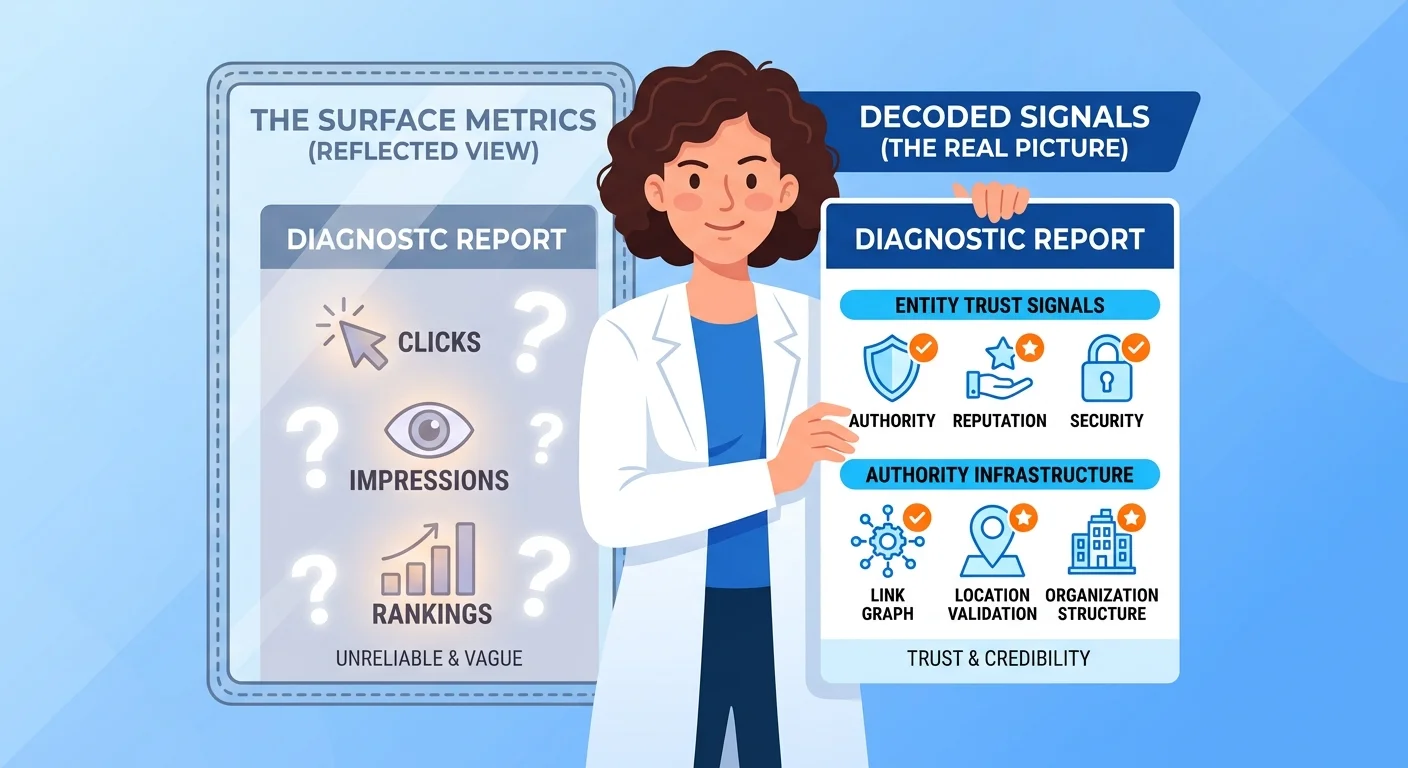
The report isn’t grading you. It’s showing you a structural reality – what AI engines can read, what they can’t, and which signals they’re using to decide whose name gets recommended when someone asks who to trust.
As this published analysis documents, generative search interfaces don’t serve a list of options anymore. They synthesize a single answer. That means the report isn’t comparing you to a ranking system. It’s showing you whether your entity is machine-readable enough to be named at all.
Here’s the thing: only 15% of Americans can correctly identify all six common applications of AI they encounter daily. That gap matters here.
Most practitioners read the diagnostic through the same lens they used for legacy search – traffic, rankings, visibility scores as the measure of success. AI engines don’t reward that frame. They reward structured authority signals.
The report is telling you something specific about your infrastructure. Not your content volume.
Why Most Practices Read the Report Wrong
So here’s what actually happens.
A practice gets the report, sees gaps in their listings or schema, and immediately reaches for the same tactics that failed them before – posting more content, adding keywords, refreshing old pages.
That’s not a decision. That’s a reflex.
And it’s exactly the kind of reactive move that burns budget without building anything that compounds. The difference between seeing the problem and deciding what to do about it – that’s where most practices lose months.
If you’re working through what comes next after the data lands, start with a structured decision framework for your AI Authority Snapshot before any execution begins. That’s the sequence that actually holds.
The report is the mirror. It can’t walk you anywhere.
The three decisions that follow it are what convert a diagnostic into infrastructure – and infrastructure is the only thing AI engines actually trust.
| What the Report Shows | What Most Practices Think It Means | What It Actually Means for AI Authority |
|---|---|---|
| Missing or incomplete schema markup | A technical fix to hand off to a developer | AI engines cannot confirm your entity exists – no schema means no structured signal for recommendations |
| Inconsistent business listings across platforms | A cleanup task that can wait | Conflicting entity signals create trust gaps – AI engines resolve ambiguity by naming someone else |
| Low citation frequency across AI engines | A content volume problem – publish more | A structural authority problem – content without entity trust doesn’t get cited regardless of volume |
| Weak presence on authoritative directories and platforms | A local SEO issue tied to link building | Missing authority signal nodes – AI engines use structured third-party validation to decide who to recommend |
| No named entity recognized by AI engines | A brand awareness problem solved by more content or social presence | Your entity is not machine-readable – AI cannot confirm who you are, what you do, or whether you’re trustworthy enough to name |
| Competitors named ahead of you in AI responses | A competitive ranking gap to close with more keywords | A compounding authority gap – competitors have built infrastructure AI trusts; the gap widens every month it goes unaddressed |
Decision 1 – Commit to Entity Trust Before Content
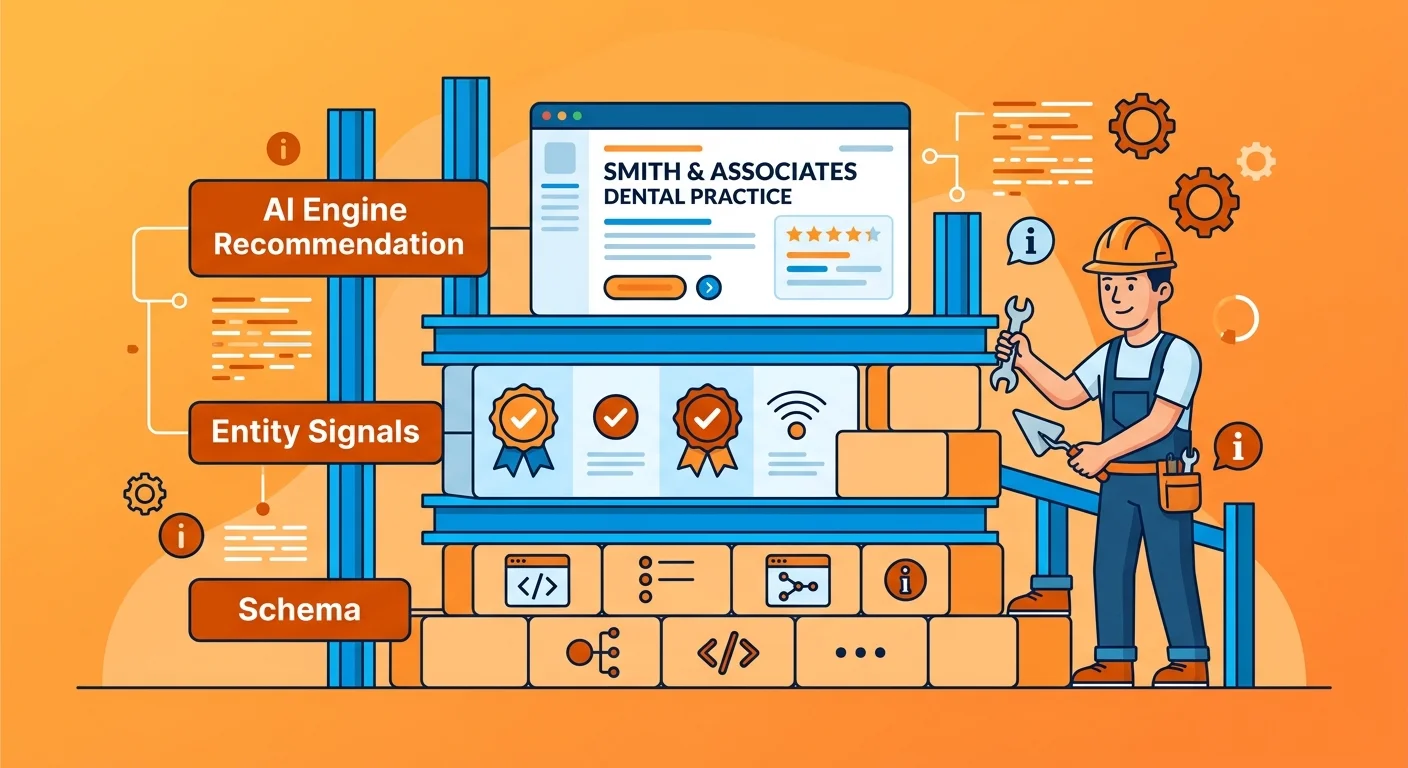
Entity trust isn’t a starting point. It’s the only point that matters before anything else gets built.
Here’s what those gaps in your schema and listings are actually saying: AI engines don’t know who you are.
Not really. They’ve seen your name. But they can’t verify your entity – your category, your location, your credentials, your authority signals. And when an engine can’t verify you with confidence, it won’t stake a recommendation on you. As recent industry analysis shows, organic discovery models are shifting away from index-style pathways because AI tools resolve user intent inside conversational panels. The engine names someone it trusts. If that’s not you, it’s whoever built their structural foundation first.
That’s why entity trust has to come before content. Every time.
Practitioners who skip this step and go straight to publishing are making one costly assumption: that the engine can already read what they’ve built. Most of the time, it can’t. If you’re trying to move from instinct to a structured prioritization system after seeing your diagnostic data, that instinct is right – but instinct without structure just accelerates in the wrong direction.
Why Content Without Structure Is Invisible
Generative search doesn’t serve a ranked list anymore. It synthesizes one answer – one name, one recommendation, one entity it’s determined is trustworthy enough to stake a response on.
That structural shift is what makes content volume a secondary variable. You can publish every week and still be invisible. If the foundation underneath the content can’t be read, the content doesn’t matter.
Content is how you demonstrate authority. Structure is how you prove identity.
AI engines verify identity before they’ll trust a demonstration. A practice with strong schema, consistent NAP data, and properly structured entity signals gives an engine exactly what it needs to say with confidence: this is who this business is, this is what they do, this is where they are. Without that foundation, excellent content sits in a structural void the engine can’t parse – and a void doesn’t get recommended.
Traditional search rewarded keyword-dense, link-rich content. That model trained an entire generation to treat content volume as the primary lever.
It isn’t. Not anymore. Gartner projects traditional search engine volume will drop 25% by 2026 as conversational AI agents absorb the discovery queries that used to flow through legacy platforms. The engine evaluating your entity doesn’t care how many pages you’ve published. It cares whether it can structurally verify you’re real, credible, and relevant.
The mirror showed you the gap. Now you’re standing at the actual fork.
Chase content volume – the reflex move – or build the structural layer that makes every piece of content you publish actually land. Entity trust comes first. Without it, you’re not building authority. You’re building a library no engine can find its way into. ITech Valet is built around this sequencing – infrastructure before content, structure before signal – because that’s the order AI engines actually use to decide whose name gets said.
| Infrastructure Layer | What It Signals to AI Engines | What Happens Without It |
|---|---|---|
| Schema Markup | Tells AI engines your business category, service type, location, and credentials in a structured, machine-readable format it can parse without guessing | AI engines encounter your name but can’t verify your entity – so they default to a competitor whose identity is structurally confirmed |
| NAP Consistency (Name, Address, Phone) | Creates a uniform identity signal across every platform AI engines crawl – confirming your business is a single, stable, trustworthy entity | Conflicting data across directories creates entity ambiguity – the engine can’t confidently stake a recommendation on a business it can’t verify |
| Structured Data (Entity Signals) | Enables AI engines to map your business to a specific knowledge graph node – connecting your name to your category, credentials, and authority footprint | Your content floats unattached – the engine sees words but no verified entity behind them, making citation impossible regardless of content quality |
| Directory & Citation Accuracy | Reinforces entity trust by confirming your business exists across multiple authoritative sources – building the cross-reference network AI engines use to validate recommendations | Sparse or inaccurate citations signal an unverified entity – AI engines won’t recommend a business they can’t independently corroborate |
| Authority Content (AEO Articles) | Demonstrates topical depth and subject-matter expertise once entity identity is already established – giving the engine something to cite that it can attribute to a verified source | Content without a verified entity foundation has no anchor – the engine can’t attribute expertise to an identity it hasn’t confirmed, so the content goes uncited |
| Internal Linking Architecture | Signals semantic relationships between your content and your core entity – helping AI engines understand what your business does, who it serves, and how deep its authority runs | Isolated content pages register as disconnected signals – the engine sees no cohesive authority structure and can’t build a trust picture around your entity |
Decision 2 – Choose Your Authority Signal Stack
Entity trust is locked. Now comes the second mistake.
The AI Visibility Check doesn’t hand you one problem. It hands you a long list of them. And when everything looks broken, the reflex is to attack all of it simultaneously – fix the schema, clean up the listings, launch content, rebuild the structure, shore up citations.
That reflex will exhaust your team and produce nothing that compounds.
Decision 2 – Choose Your Authority Signal Stack is the opposite move. It’s about identifying which signals actually move the needle for AI recommendations in your specific market – and committing to those with intensity instead of scattering effort thin across every platform at once.
Not every authority signal does the same job. Some verify your identity. Some demonstrate relevance. Some establish category authority.
Get the sequence wrong and you spend months pushing on the wrong layer. Get it right and every move compounds the one before it.
The Signals That Actually Move the Needle
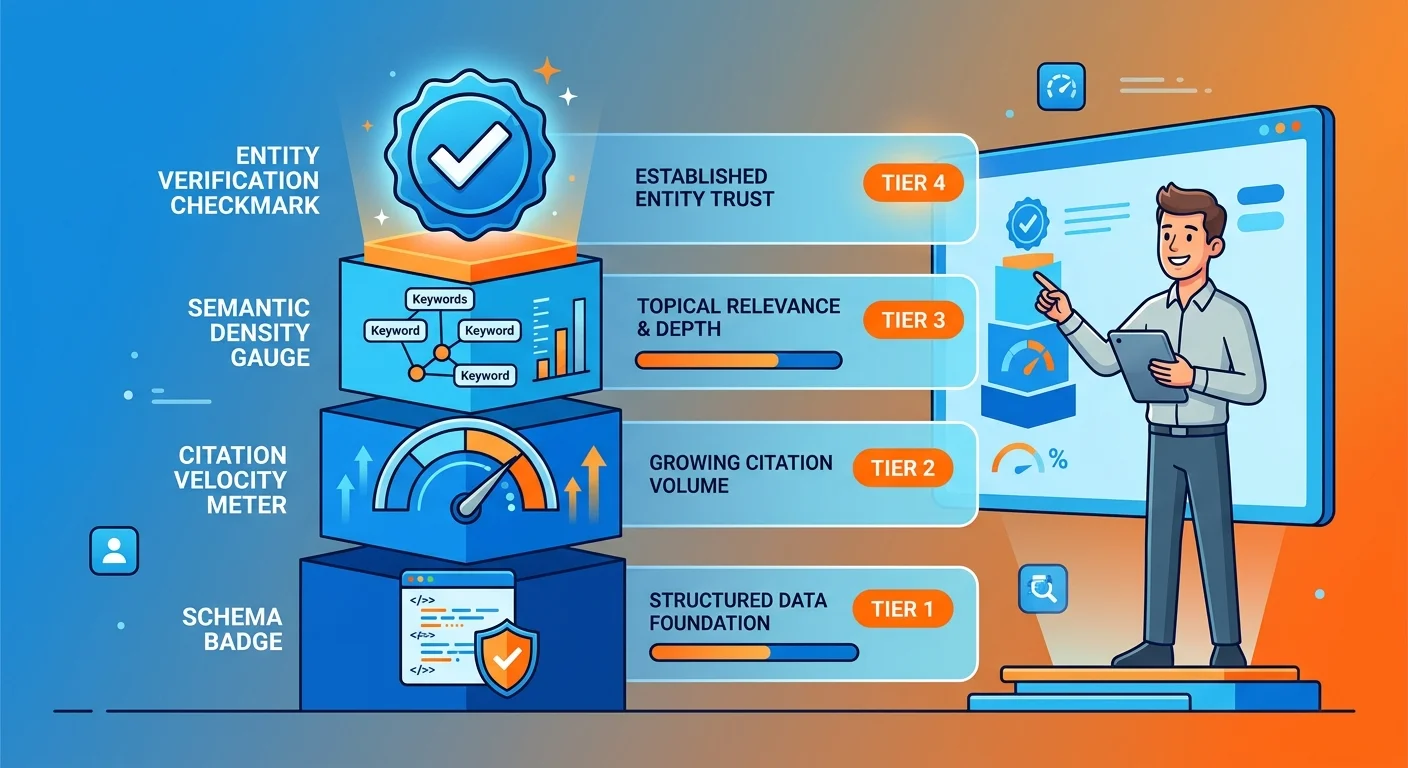
AI engines use three signal categories to build trust in an entity: structural signals, citation signals, and content signals.
Most practices sprint straight to content – more pages, more posts, more material – because that’s the lever they already know how to pull.
Here’s the problem with that. Content signals only amplify what’s already been structurally verified. If the structural and citation layers are weak, more content doesn’t solve anything. It just decorates a broken foundation.
Structural signals are the machine-readable layer – schema markup, NAP consistency, structured entity data, business category classifications. These are what let an AI engine say with confidence: this entity is real, located here, operating in this category.
Citation signals are the corroboration layer – third-party directories, reviews, mentions, and authoritative references that tell the engine your entity has been verified by sources it already trusts. The decision of where to invest first across reputation, content, and referrals matters at this stage – because the answer isn’t the same for every practice, and getting the sequence wrong means spending months building on nothing.
Content signals come last. Not because they matter least – but because they’re only readable to an engine that has already verified the layers beneath them.
FTC guidance on AI claims makes clear that commercial assertions about AI-driven recommendations must be substantiated and verifiable. That’s not just a regulatory standard – it’s how AI engines already operate. They don’t recommend entities they can’t verify.
Your signal stack has to give engines something to verify before it gives them something to amplify. That’s the entire point of Decision 2.
Gartner projects traditional search engine volume will drop 25% by 2026. The engines doing the recommending are conversational AI agents – not legacy search indexes. The signals those agents trust are structured, corroborated, and machine-readable. Build for that.
Who This Framework Is Not For
This framework isn’t for everyone. That’s not a disclaimer. It’s a filter.
If you want to fix AI visibility in 30 days without touching your infrastructure – this isn’t that. If you want a signal stack you can launch once and walk away from – this isn’t that either.
Authority compounds because it’s maintained. Not because it’s launched. McKinsey found that one-third of organizations globally already use generative AI in at least one business function, and 40% plan to increase their AI investments. That pressure isn’t slowing down.
The practices that will own AI recommendations in their markets are building and maintaining structured authority signals – consistently, month after month. Not running a one-time cleanup and calling it done.
If you want fast wins, low-commitment tactics, or a way around the structural work – this framework isn’t your fit. We’d rather say that upfront than waste your time.
But if you’re tired of watching a competitor get named while you can’t figure out why – and you’re ready to build the infrastructure that makes your entity the answer AI trusts – that’s exactly who this is for.
| Authority Signal | What It Does | Priority Tier | Time to Impact |
|---|---|---|---|
| Schema Markup | Gives AI engines a machine-readable identity layer – business category, location, services, and entity classification in structured code | Tier 1 – Foundation | Establishes baseline entity verification before any other signal can land |
| NAP Consistency | Ensures your business name, address, and phone number match exactly across every directory, citation, and platform AI engines cross-reference | Tier 1 – Foundation | Removes conflicting signals that prevent engine confidence in your entity |
| Third-Party Directory Listings | Creates corroborating citation signals on platforms AI engines treat as trusted validators – confirming your entity exists beyond your own infrastructure | Tier 2 – Corroboration | Accelerates once Tier 1 structural signals are clean and consistent |
| Review Signals | Builds social proof that AI engines read as community verification – reinforcing category authority and location relevance in conversational recommendations | Tier 2 – Corroboration | Compounds over time as volume and recency build together |
| AEO Content | Demonstrates topical authority and answers the specific questions AI engines surface in your category – only legible once structural and citation layers are verified | Tier 3 – Amplification | Builds compounding authority over months of consistent execution |
| Internal Linking Architecture | Signals content hierarchy and topical depth to AI engines – reinforcing which entity concepts are most authoritative within your practice’s domain | Tier 3 – Amplification | Strengthens over time as content volume and structural coherence grow together |
Decision 3 – Lock In an Execution Cadence That Compounds
Here’s where most practices quietly fall apart.
Entity trust is built. The signal stack is chosen. Then busy season hits, priorities shift, and execution stops. That’s not a setback. That’s where compounding dies.
Decision 3 – Lock In an Execution Cadence That Compounds isn’t about doing more. It’s about committing to a rhythm that builds on itself – month after month, without stopping.
And the window to lock in that advantage is closing faster than most practices realize.
Gartner projects traditional search engine volume will drop 25% by 2026 as conversational AI agents absorb the discovery queries that used to flow through standard indexes. That shift doesn’t wait for you to finish your busy season. A practice that executes consistently for twelve months builds a structural lead the competition can’t close with a one-time infrastructure audit.
Cadence is what separates authority that accumulates from authority that decays.
A single infrastructure rebuild without ongoing AEO content execution is a snapshot. Not a system.
Six months from now, when someone asks an AI engine who to trust in your market – cadence is what puts your name in the answer. Not the audit you ran once.
What Compounding Authority Actually Looks Like Over Time
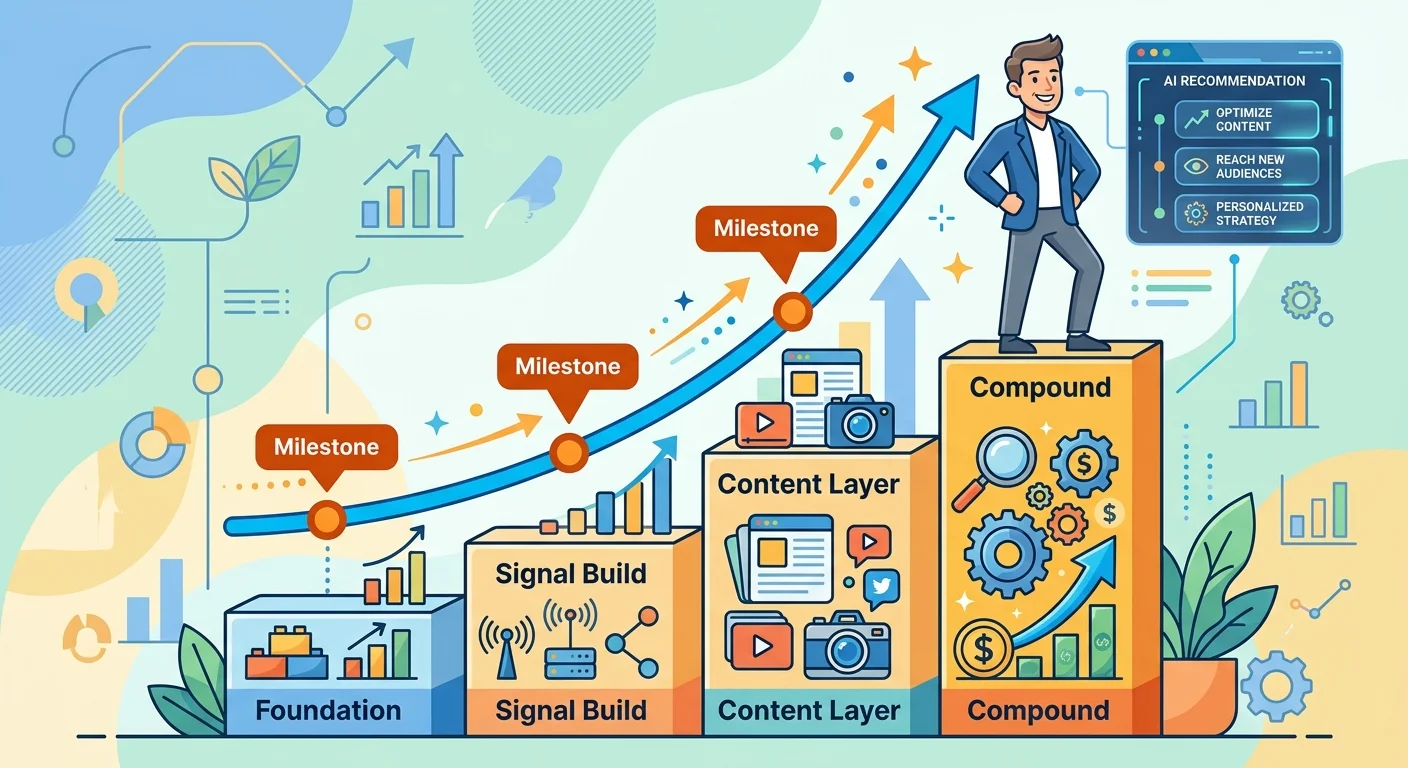
Compounding authority doesn’t look like a spike. It looks like a staircase.
The first months build structural verification – schema, entity signals, the machine-readable foundation AI engines need before they’ll trust anything. The middle months deepen that foundation with citation corroboration. The later months are when content execution starts landing on infrastructure the engine can actually parse. Practices that follow this sequence start showing up in AI recommendations that didn’t exist for them before.
The staircase is real. It just requires someone willing to climb it consistently.
McKinsey found that one-third of organizations globally already use generative AI in at least one business function. 40% plan to increase their overall AI investments.
That’s not a trend on the horizon. That’s the competitive environment your practice is operating inside right now.
Every month a competitor executes consistently, they’re deepening the entity trust signals AI engines use to decide whose name gets said. The practice that locks in a cadence now compounds. The one that waits hands that ground to whoever kept going – and it doesn’t come back.
Here’s where the through-line closes.
The diagnostic showed you the gap. But a mirror doesn’t execute for you. It just shows you what happens if you don’t act on what you saw.
Decision 3 – Lock In an Execution Cadence That Compounds is the commitment that turns the other two decisions into a real asset. Without it, entity trust drifts. Signal stacks erode. The authority you started building quietly reverts to the baseline you had before you ran the check.
Cadence isn’t the final step. It’s the mechanism that makes the first two steps matter at all.
| Execution Phase | Month Range | Primary Activity | Authority Milestone |
|---|---|---|---|
| Foundation Build | Months 1-2 | Schema markup, NAP consistency, entity data structuring, business category classification | AI engines can verify the entity as real, located, and categorized – structural trust established |
| Citation Corroboration | Months 3-4 | Third-party directory presence, review acquisition, authoritative reference building | Entity is corroborated by sources AI engines already trust – verification layer deepened |
| Content Signal Launch | Months 5-6 | AEO content execution begins – structured, machine-readable authority articles published on a consistent cadence | Content signals land on a verified structural and citation foundation – AI engines can parse and amplify |
| Authority Deepening | Months 7-9 | Ongoing AEO content execution, citation maintenance, signal stack auditing | Each month’s output makes the previous month’s layer more credible – staircase compounding begins |
| Competitive Separation | Months 10-12 | Cadence maintained without interruption – entity trust signals accumulate beyond what a one-time audit can replicate | Structural advantage closes – competitors cannot close this gap with a late-start cleanup |
| Ongoing Maintenance | Month 13+ | Signal stack reviewed, AEO content cadence sustained, entity data kept current | Authority remains active and compounding – does not decay back to pre-execution baseline |
Frequently Asked Questions
The three decisions are clear. But decisions on paper don’t answer the questions keeping you up at 11pm.
How does the check actually work? Why won’t SEO get you there? What does this look like in practice? Let’s go.
No hedge language. No ‘it depends.’ You get a straight answer or you don’t get one at all.
How does the AI Visibility Check determine if my practice is invisible?
The check queries ChatGPT, Gemini, and Grok directly. It asks each engine who the best provider is in your market and category. Then it records exactly what they say.
If your name isn’t in the answer, you’re invisible. That’s not an interpretation. It’s a documented output from the engines themselves.
The check also reviews your entity signals – schema presence, NAP consistency, directory corroboration, structured data. It shows you not just that you’re invisible, but why the engines can’t verify your entity. That gap is what the three decisions are built to close.
Why can’t I just use standard SEO instead of investing in AEO infrastructure?
Standard SEO optimizes for a ranked list. Generative AI engines don’t produce lists. They produce one answer.
Those aren’t variations of the same output. They’re structurally different problems requiring structurally different solutions.
Gartner projects traditional search engine volume will drop 25% by 2026 as conversational AI agents absorb the discovery queries that used to flow through legacy platforms. Optimizing harder for the index that’s losing volume doesn’t build authority on the engines gaining it.
AEO infrastructure builds entity trust AI engines can verify. Standard SEO wasn’t designed for that problem – and no amount of keyword density fixes a schema gap.
What are the first three decisions I must make after reviewing my diagnostic report?
Decision 1: Commit to Entity Trust Before Content. Fix schema, NAP consistency, directory signals, and structured entity data first. AI engines use these to verify your entity is real before they’ll recommend you. Nothing built on top of a broken foundation holds.
Decision 2: Choose Your Authority Signal Stack. The order is non-negotiable – structural signals first, citation signals second, content signals third. Invert it and you’re paying to amplify something the engines can’t yet verify.
Decision 3: Lock In an Execution Cadence That Compounds. Authority isn’t a one-time build. Engines reading your entity data need fresh corroboration every month. Cadence is what separates a compounding authority asset from a cleanup that decays the moment you stop.
How long does it take for AI engines to update their recommendations once we fix our schema?
There’s no fixed clock. AI engines re-evaluate entity data on their own schedule – not yours.
Schema corrections can register within days. Citation and directory signals take longer to propagate.
But here’s the thing: timing isn’t the variable that matters. Consistency is. A practice executing the right signals month over month builds a deeper corroboration trail every cycle. Engines notice that.
Stop asking when results show up. Ask whether you’re executing consistently. That’s the only variable you control.
Can my team execute these post-diagnostic changes themselves?
Some of it, yes. Content execution is accessible for most teams.
But most practices underestimate what AEO infrastructure actually involves. Schema markup, structured entity data, and citation architecture aren’t marketing tasks. They’re technical – and they have to be built in the right order.
The risk isn’t effort. It’s sequence. Get the order wrong and you spend real time on the wrong layer first.
That’s why done-for-you execution exists – not because your team can’t work hard, but because the framework has to be correct before content compounds on top of it. Build on the wrong structure and every month of execution deepens the problem.
The Diagnostic Was Just the Beginning
The diagnostic was never the destination.
It was the starting gun.
What you do next – Commit to Entity Trust Before Content, Choose Your Authority Signal Stack, Lock In an Execution Cadence That Compounds – is the only thing that decides whether the mirror stays decorative or becomes a blueprint for something that actually builds.
Here’s what most practices miss: seeing the gap and closing the gap are two completely different commitments.
The AI Visibility Check shows you exactly where you stand. It can’t walk the path for you.
The practices that turn a diagnostic into compounding authority make a structural decision first. They sequence their signals with intent. And they execute with enough consistency that AI engines have no choice but to trust the entity they’re reading. That’s not a philosophy. It’s a mechanism. And it works every time it’s actually executed.
A mirror shows you where you stand. These decisions determine where you go.
iTech Valet exists for the practice that’s done watching a competitor get named. The practice that’s ready to stop diagnosing and start building.
That move doesn’t start with a content sprint. It doesn’t start with a keyword audit. It starts with entity trust – and every month you execute from there, the engine reading your infrastructure gets one more reason to say your name instead of someone else’s.
The check shows you where you stand. These three decisions determine what you do about it. If you haven’t run it yet, that’s the only move that matters right now.