
In GetRankOnMap’s data, businesses showed up in 96.4% of searches made within 500 meters, about one in nine (11.1%) at one to two kilometers, fewer than one in a hundred (0.9%) at three to five kilometers, and none (0.0%) beyond five kilometers. That is zero times out of 3,258 chances. Local Falcon found that, unlike traditional local pack results, there was basically no link between how far away a business is and where it shows up within Google AI Overviews (a correlation of 0.001), when the business shows up at all. The writers at Search Engine Journal say they are seeing businesses rank well in the traditional local pack while being completely missing from AI answers for the very same searches.
How Tightly Distance Controls Google’s Map Results
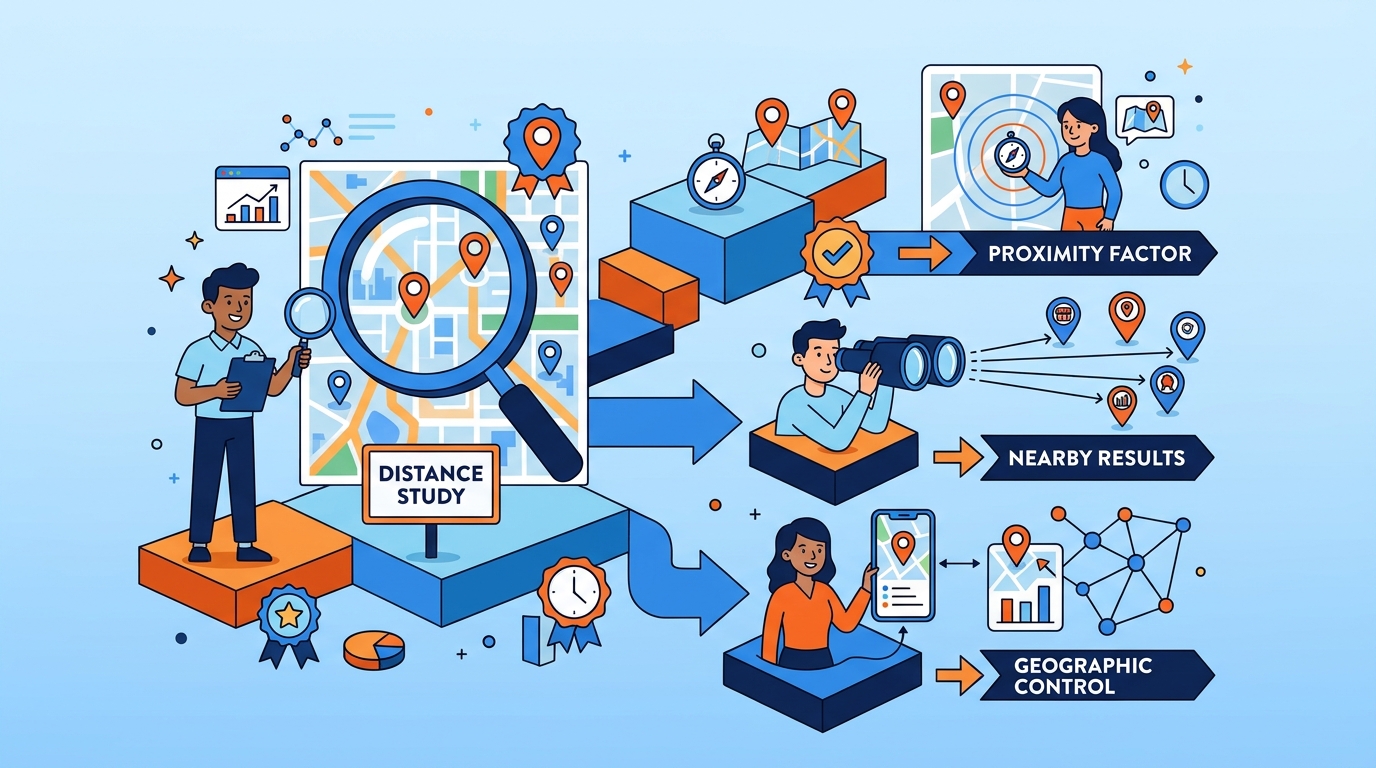
Here’s what the study covered.
The GetRankOnMap study (Distance decides whether you appear. Reviews decide the order.) looked at three cities. Bengaluru, Delhi, and Mumbai.
Four kinds of businesses. Cafés, dentists, gyms, and salons.
Local search in other places may work differently. And the study can’t tell you by how much.
Here’s what most people miss.
The paid rank-tracking tools often start out set to a more zoomed-out view.
So their heat maps are consistently flatter than the map really is.
I no longer use position-tracking to measure success.
AI tools now answer directly. They don’t hand back a list of links.
So I don’t read a rank-tracker heat map or a map-pack position as a sign a business gets found. However good it looks in a report.
Here’s how often a business showed up, by how far away the searcher was.
| Distance from searcher | Share of searches where the business appeared |
|---|---|
| Within 500 metres | 96.4% |
| 1 to 2 km | 11.1% |
| 3 to 5 km | 0.9% |
| Beyond 5 km | 0.0% |
Distance Decides Whether a Listing Appears
Within 500 meters, businesses showed up in 96.4% of searches. At one to two kilometers, they showed up 11.1% of the time, about one in nine. At three to five kilometers, it was 0.9%, fewer than one in a hundred. Beyond five kilometers, it was 0.0%. That is zero times out of 3,258 chances.
Distance decides whether a business shows up at all.
The study took distance out of its model. The model’s accuracy score (AUC) dropped from 0.9223 to 0.6259.
Then it took out every reputation feature. That cost only 0.006.
Review Count Shapes Order Among Nearby Listings
The study matched 10,890 pairs of businesses by distance.
The one with the higher star rating ranked above the other about half the time (52.7%). You can tell that apart from pure chance only because the sample is large.
The one with more reviews, measured the same way, won about two in three pairs (66.9%).
The raw correlation reads −0.095. That’s close to random noise.
Hold distance fixed, and it moves to −0.377.
Distance Barely Moves a Business’s Position Inside AI Overviews
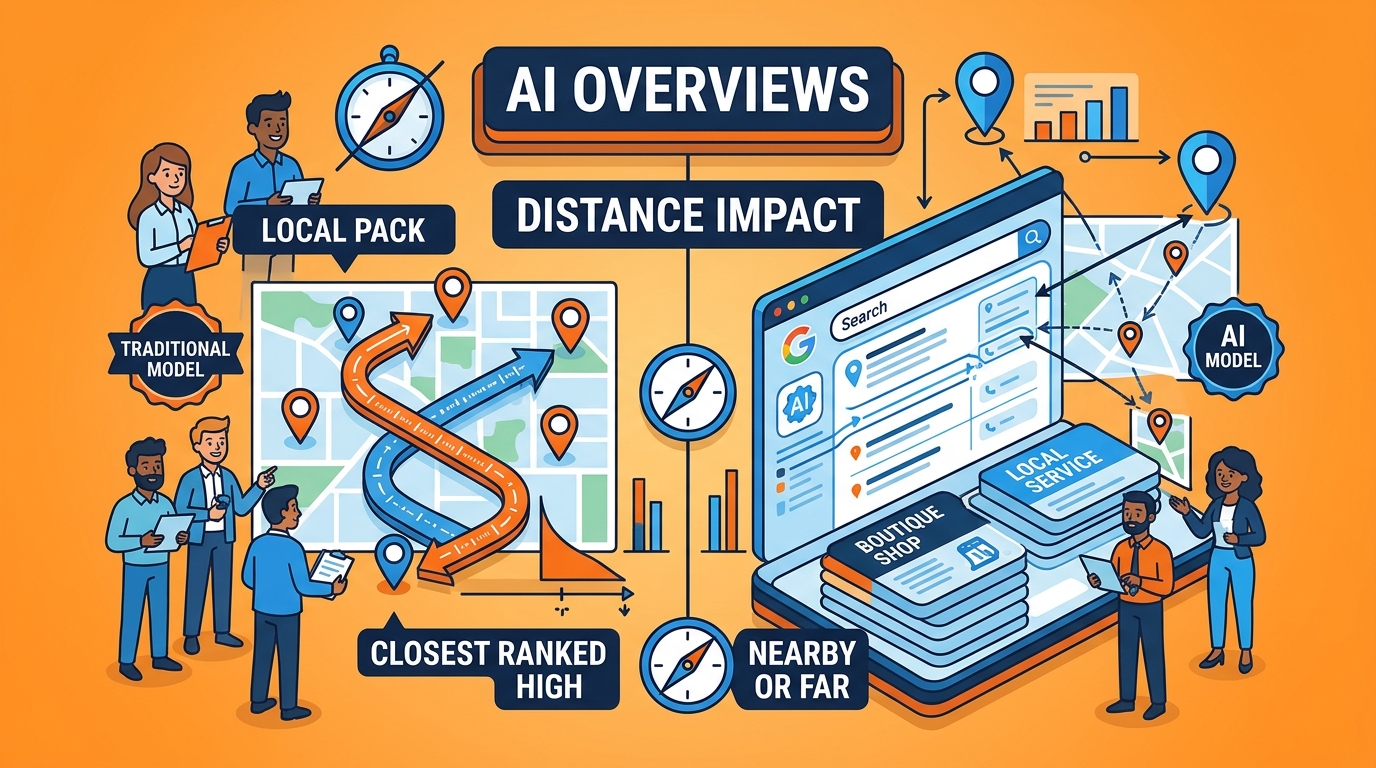
Local Falcon found that, unlike traditional local pack results, there was basically no link between how far away a business is and where it shows up within Google AI Overviews. The correlation was 0.001. That holds when the business shows up in the results at all.
The patient’s side of this is covered in How Far Will AI Tools Say a Patient Should Travel for Care?
How ChatGPT Learns Where the Patient Is
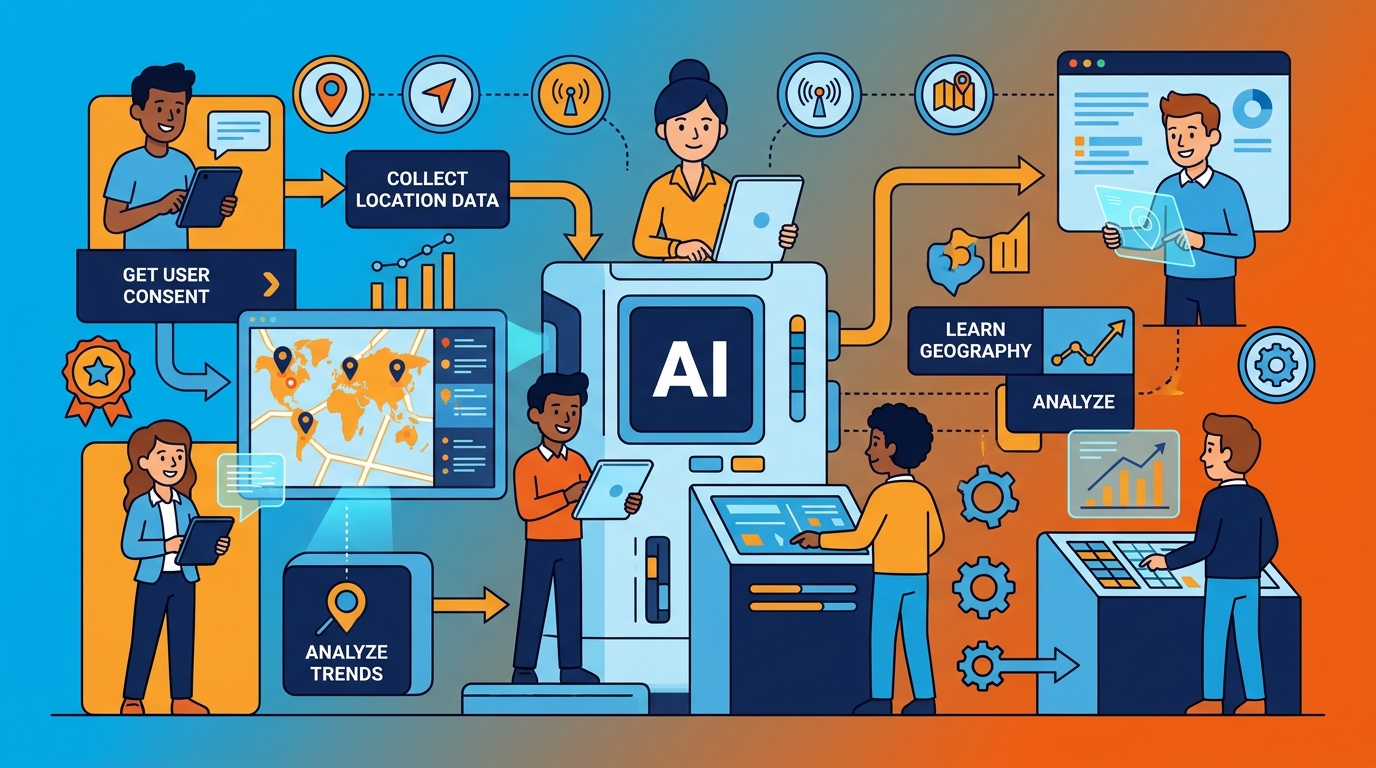
OpenAI launched location sharing for ChatGPT on March 26, 2026.
It lets people share their device’s GPS location. ChatGPT can then give them local suggestions, news, and weather.
PPC Land reported the launch in ChatGPT quietly rolled out location sharing.
Location sharing is a choice. A person has to turn it on.
It stays off unless they do.
On mobile, the two location settings can be split apart.
A person can keep sharing a rough location. And turn off the exact location setting on its own.
OpenAI says it deletes exact location data after using it to make an answer.
Local search has long been one of the weakest areas for ChatGPT.
How Often AI Overviews Show Up on Local Searches
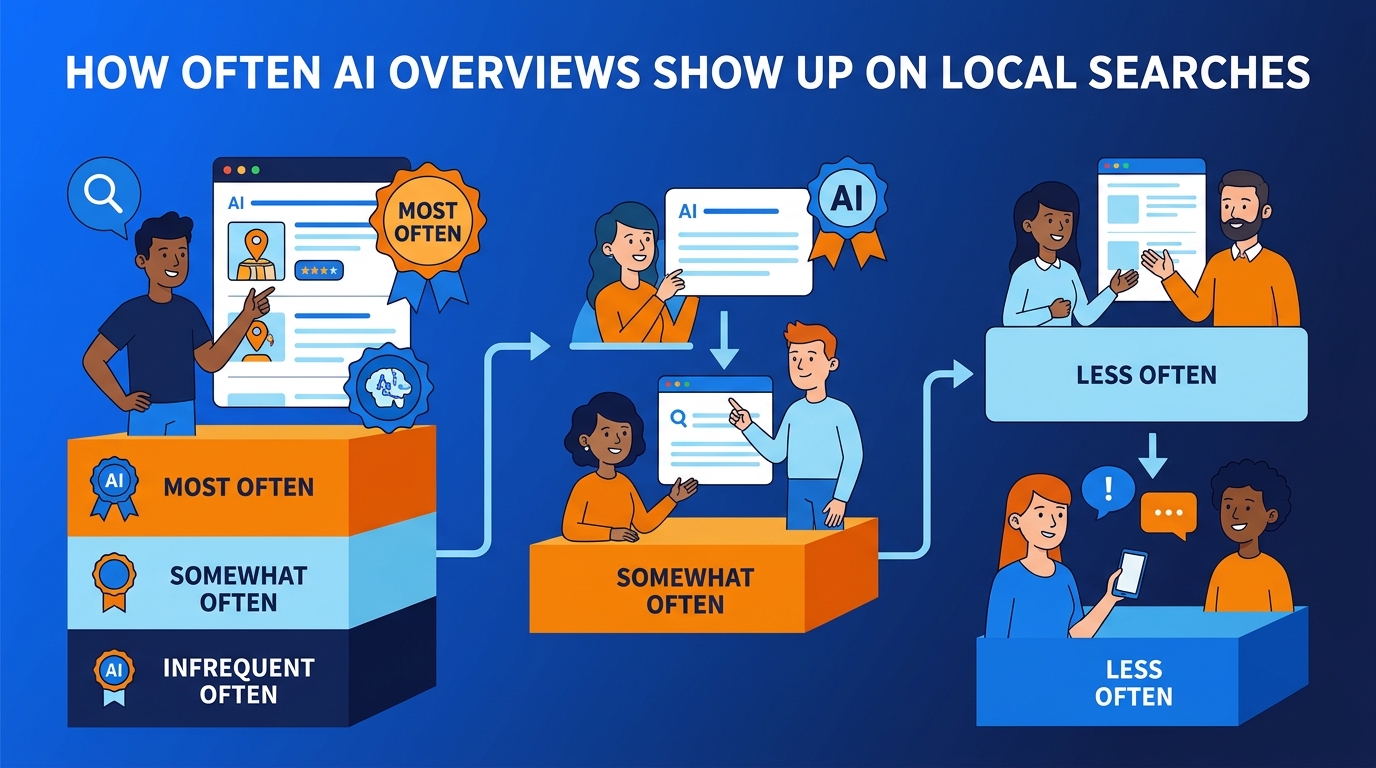
Here’s what’s happening.
A Whitespark study found that AI Overviews show up for about two in three local searches (68%). Local packs show up for only about two in five of those same searches (39%).
Search Engine Journal reported the numbers in AI Overviews Now Answer Most Local Searches.
Searches asking for information bring up AI Overviews 92% of the time. About nine times out of ten. Think “how long does an eye exam take near me.”
Whitespark found that too.
Mixed-purpose searches are even worse. “Average cost of dental implants in Phoenix” brings one up 97 times out of 100 (97%).
Now look at the money words.
“Price.” “Cost.” “Buy.” Searches with those words bring up AI Overviews more than four times out of five (over 80%).
And most local businesses won’t answer them.
Here’s how often each kind of local search brings up an AI Overview.
| Query type | AI Overview trigger rate |
|---|---|
| Local searches overall (local packs: 39%) | 68% |
| Informational local queries | 92% |
| Hybrid-intent local queries | 97% |
| Price, cost and buy queries | More than 80% |
Why Some Clinics Hold a Map-Pack Spot but Vanish From AI Answers
Here’s the part that stings.
The writers at Search Engine Journal say they are seeing businesses rank well in the traditional local pack. And be completely missing from AI answers for the very same searches.
Their article also reports these findings on AI citations:
- Owned vs. off-page sources. Omniscient Digital looked at more than 23,000 citations. For searches that use a brand’s name, the brand’s own content made up only about one in four (about 23%). The other three in four (77%) came from off-page sources.
- Where on the page citations come from. Kevin Indig looked at 1.2 million ChatGPT answers. A bit less than half of the citations (44.2%) came from the first 30% of a page’s content.
- Most-cited sources. Averi.ai found that Reddit is the source Google AI Overviews cite most. About one in five of all citations (21%). YouTube is close behind at almost one in five (18.8%).
- Freshness. Ahrefs looked at 17 million AI citations. On average, the content AI cited was about a quarter fresher (25.7%) than traditionally ranked content.
- Consistent business details. Your name, address, and phone number don’t match across directories? Your hours are out of date on Apple Maps? Your service categories on your Google Business Profile don’t match your website? AI trusts your business less.
Here’s where I stand.
I’d rather your clinic be the source an AI names and draws on than one more name in the map pack.
I value being relied on over simply being present.
Getting picked by AI answer tools is its own discipline. Not classic search work under a new name.
So I don’t chase keywords, inbound links, or ranking position.
Instead, I make it easy for these systems to work out who a practice is. And whether it’s credible.
The proof side is covered in What Proof Convinces AI to Recommend an Out-of-Town Clinic?
How Far Patients Already Travel for Hospital Care
Here’s where the numbers come from.
The Agency for Healthcare Research and Quality’s method is set out in Methods for Calculating Patient Travel Distance to Hospital in HCUP Data.
Overall, the median straight-line distance from patient to hospital was 6.6 miles. Three in four distances (75%) were under 15 miles, and nine in ten (90%) were under 30 miles. Driving distances ran about 30% longer on average than straight-line distances. That gap stayed about the same from place to place, changing only a little.
Patients will travel farther for a planned hospital stay than for an emergency hospital stay.
Other studies have found who travels farther.
Patients who are younger. Have more schooling. Are White. Come from higher-income areas. Live in rural areas. Are healthier. Or have private insurance.
Now look at it by area.
The longest distances were in the South region, the East South Central division, and rural areas.
The shortest were in the Northeast region, the New England division, and large central metro areas.
Frequently Asked Questions
How often does Google show an AI Overview at all?
Not on every search. Google says AI Overviews only show up when its systems decide they add something beyond classic Search. So they often don’t show up.
One arXiv paper puts overall activation at about 1 in 7 searches (13.7%). For searches asked as a question, it jumps to about 2 in 3 (64.7%). Politically touchy topics see much lower rates.
An arXiv study found about 1 in 5 Google searches in its sample (about 18%) produced an AI Overview.
And in a Pew Research survey, about six in ten people (58%) did at least one Google search in March 2025 that produced an AI-made summary.
What does a page need to be eligible as a link in Google’s AI Overviews?
It has to be indexed and eligible to show in Google Search with a snippet. It also has to meet Google Search’s technical requirements. That’s what gets you shown as a supporting link in AI Overviews or AI Mode.
Google says accuracy matters most in Search. So AI Overviews are built to show only information that top web results back up.
When it makes sense, AI answers can include product listings, product details, and information about local businesses.
What counts toward Google’s prominence factor for local listings?
Links and reviews count. Google says this factor is also based on things like how many websites link to your business and how many reviews you have.
How much of AI chatbot use does ChatGPT still hold?
ChatGPT’s share of site visits dropped from about 87% (86.6%) to about 65% (64.6%) during 2025. It fell below 65% for the first time since 2023, down from about 87% (86.6%) a year before, as Gemini jumped to 22%. OpenAI started testing ads on February 9, 2026, and ChatGPT now has 700 million people using it each week. Ahrefs found that ChatGPT sends websites 190 times fewer site visits than Google does, even though it handles about an eighth (12%) as many searches as Google.
Distance Caps the Map, Not the AI Answer
Distance sets the edge of the map pack. In GetRankOnMap’s data, businesses showed up in 96.4% of searches within 500 meters and in none beyond five kilometers, zero times out of 3,258 chances. Inside AI Overviews, Local Falcon found basically no link between distance and position: a correlation of 0.001. Search Engine Journal’s writers are seeing businesses rank well in the traditional local pack while being completely missing from AI answers for the same searches. The iTech Valet Service Plans & Pricing page explains how the work is done. To see where your practice stands in AI answers today, Run My AI Visibility Check.