
What Vanity Metrics Actually Are – And Why Agencies Love Them
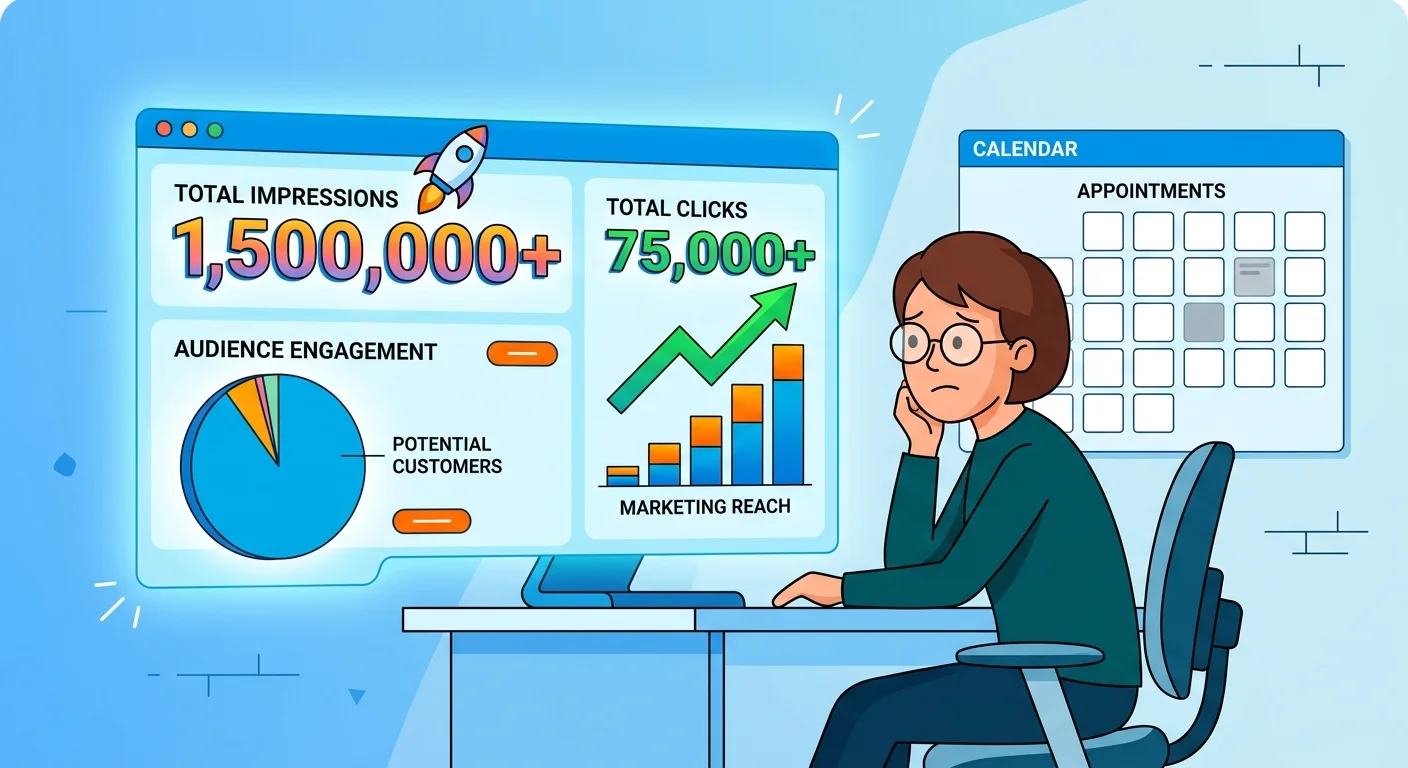
A vanity metric is any number that looks like momentum but doesn’t connect to a booking.
Impressions. Clicks. Page views. Session duration. They’re real numbers. They just don’t tell you whether a single patient walked through your door.
Agencies love these numbers because they’re easy to produce and impossible to dispute.
You can always get more impressions. You can always report more clicks. What you can’t fake – and what they don’t report – is an empty schedule.
Impressions don’t pay rent. Clicks don’t adjust spines. If you’ve ever stared at a green-arrow report while your schedule sat half-empty, you already know why this agency model keeps working.
The Metrics That Look Like Progress
Here’s the lineup: impressions, clicks, click-through rate, organic traffic, keyword rankings. These are the numbers agencies put in front of you every month. And not one of them requires a patient to choose you.
A thousand impressions means a thousand people scrolled past your name. That’s it. Keyword rankings tell you where you sit on a list fewer patients are using every year. Click-through rate measures who clicked – not whether that click turned into a booked appointment, a new patient, or a single dollar of revenue.
These numbers go up. That’s the trap. Going up feels like winning. It isn’t.
The green arrows in your monthly report are doing exactly one job: making the agency look useful long enough to collect next month’s retainer. What the report never shows is the gap between that upward trend line and a full schedule.
Marketing leaders are under sustained pressure to produce better business results with lower investment. The agencies serving chiropractors never adjusted. They kept selling the same smoke in a prettier report.
Why the Agency Business Model Depends on Your Confusion
Here’s the thing about the agency business model: it runs on your inability to connect their reports to your revenue.
That gap isn’t a bug. It’s the product.
When 71% of CMOs already believe they lack sufficient budget to execute their strategy, burning what’s left on top-of-funnel noise isn’t a miscommunication. It’s malpractice.
But that’s the model. The agency reports impressions. You measure appointments. Those two numbers don’t talk to each other – and agencies count on that. They hit their metrics. You miss yours. The contract renews because the report looked good.
The Chiropractor’s Hopium Cycle runs on this confusion. Agencies need you to believe that visibility is value – because if you connected visibility directly to patient acquisition, you’d fire them in month two.
The confusion is the product. Clarity is what they can’t afford to sell you.
| Metric | What Agencies Report It As | What It Actually Measures | Impact on Patient Bookings |
|---|---|---|---|
| Impressions | Proof of reach and brand awareness | How many times an ad or listing was displayed – regardless of intent | No direct connection – a patient who sees your name scroll past has not chosen you |
| Clicks | Evidence of audience engagement and traffic growth | How many people visited your site – not whether any of them booked or trusted you | Weak – clicks measure curiosity, not commitment; most visitors leave without contacting the practice |
| Click-Through Rate (CTR) | Indicator of compelling ad creative and relevance | The ratio of impressions to clicks – a math problem with no patient outcome attached | None – a high CTR on the wrong audience produces zero appointments |
| Keyword Rankings | Market dominance and competitive positioning | Where a page lands on a list – in a search environment where over half of searches end without a click | Minimal – ranking for a keyword no longer guarantees a patient ever reaches your site |
| Organic Traffic Volume | Proof the strategy is working and growing | The count of sessions on your site – not the quality, intent, or conversion of those sessions | Indirect at best – high traffic with weak authority signals and no AI trust infrastructure produces empty chairs |
| Monthly Report Score | Overall campaign health and agency accountability | A curated selection of metrics the agency chose to highlight – optimized to look good, not to reveal the gap | Zero – the report exists to protect the contract, not to build the practice |
Why Traditional SEO Packages Fail Chiropractic Practices
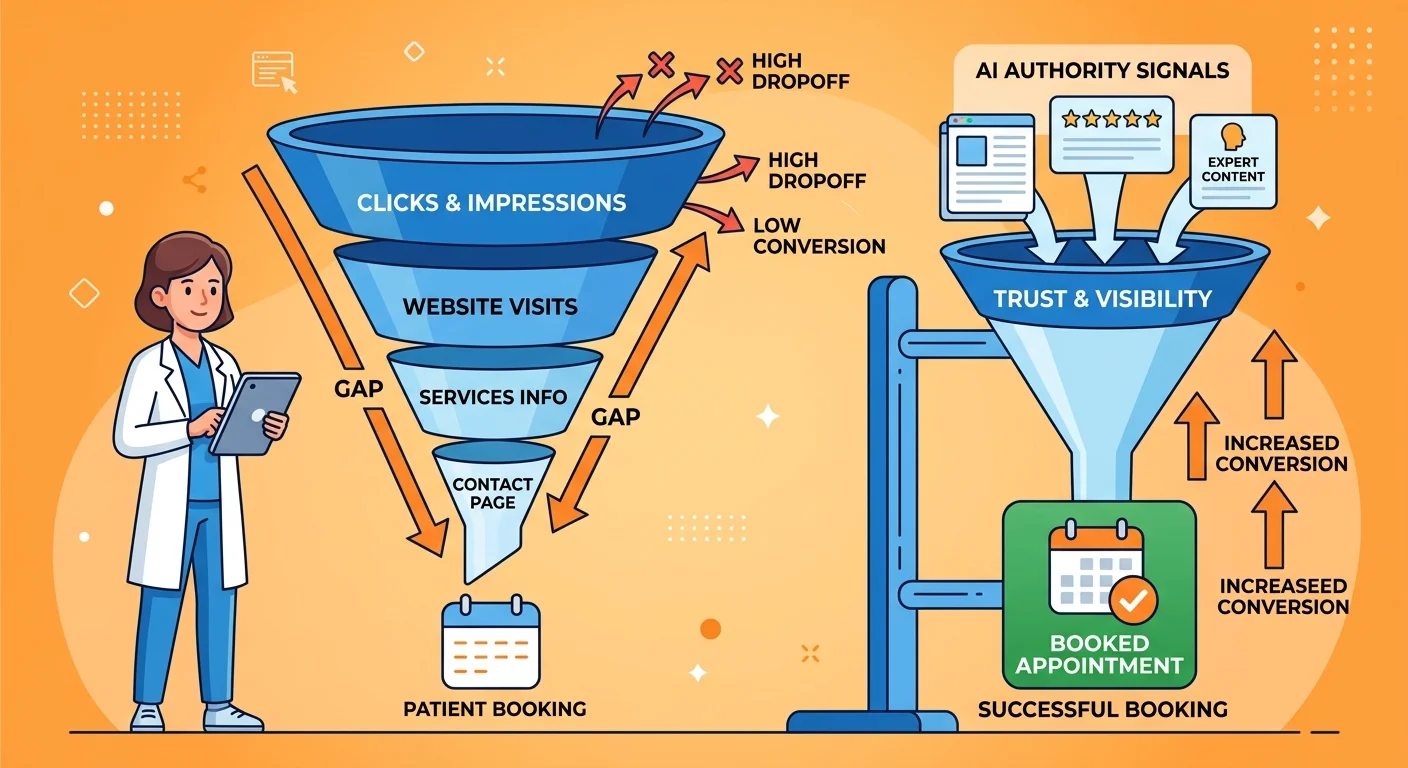
Traditional SEO was engineered for a list-based world. Get on page one. Get the click. Get the visit. That chain worked when patients typed a query and scrolled ten blue links. They don’t do that anymore.
The model broke quietly. No announcement. No industry reckoning. Agencies kept selling the same package while the search environment underneath them shifted toward AI-generated answers and direct recommendations. The keyword rankings still moved. The reports still had green arrows. And the schedule still wasn’t full.
Here’s the problem. Traditional SEO was designed to produce rankings, traffic, and impressions – because those are the outputs the model was built to generate. It was never designed to generate entity trust. And entity trust is the only signal that makes AI say your name.
The Click-Through Model Is Breaking Down
The click-through model assumes the patient searches, finds your site, visits it, and books. That assumption is now wrong for the majority of searches. Approximately 58.5% of mobile searches end without a single click to any website. Over 50% of desktop searches resolve the same way. The patient got an answer. They just never came to your site to find it.
That’s not a trend. That’s the current state of zero-click organic search statistics. Every traditional SEO package reporting traffic as its primary KPI is measuring a shrinking channel. The clicks that do happen are fewer. The ones that don’t are growing.
What replaced the click is the AI answer. The direct recommendation. Patients ask a conversational question and get a name back – not a list to scroll through. If that name isn’t yours, the click-through model has nothing left to optimize for.
Why Most Practices Optimizing for Traditional SEO Are Invisible to AI
Traditional SEO optimizes for keyword signals. AI engines run on entity signals – structured data, schema markup, citation consistency, semantic density across authoritative content. Those aren’t variations of the same requirement. They’re completely different infrastructure. A practice ranking on page one for ‘chiropractor near me’ can still be completely invisible to ChatGPT, Gemini, and Grok.
Chiropractic demand is already constrained – national utilization rates hover around 8.4% of the population. The practices capturing that demand aren’t winning on keywords. They’re winning on trust. According to chiropractic utilization and demographic research, trust in local provider entities drives more than 80% of patient retention behavior. AI engines are built to recognize exactly that kind of trust – and to reward the practices that have structured it into their digital infrastructure.
The agency that sold you a traditional SEO package wasn’t lying about rankings. They delivered what the package promised. The problem is what that model costs you in a zero-click, AI-first search environment – where rankings are irrelevant if AI doesn’t trust your entity enough to recommend you. The Local AI Authority Engine exists because rankings and authority are no longer the same thing. They never should have been treated as if they were.
| Search Behavior | Traditional SEO Outcome | AI-Driven Search Outcome | Practice Impact |
|---|---|---|---|
| Patient types a keyword query into Google | Practice ranks on page one for that keyword term | AI engine generates a direct answer naming a trusted local provider | Rankings become irrelevant if the practice lacks entity trust signals AI recognizes |
| Patient asks a conversational question to ChatGPT, Gemini, or Grok | No response – traditional SEO infrastructure is invisible to conversational AI | AI cites the practice with the strongest semantic density and structured authority signals | Practices optimized only for keyword lists are absent from the conversation entirely |
| Patient searches on mobile and receives an AI-generated summary | Click-through traffic reported as a KPI – but the patient never clicked | Patient gets a name and books directly without visiting any website | Traffic-based reporting masks the collapse of the click-through model in real time |
| Patient evaluates local provider trustworthiness before booking | Keyword rankings and page position are surfaced – not structured trust signals | AI surfaces the practice with consistent citations, schema markup, and review authority | Practices without machine-readable entity infrastructure lose the trust evaluation before it starts |
| Patient reads an AI recommendation and books without further research | Agency reports impressions and click-through rate – no booking data tracked | The named practice receives the appointment with zero additional patient effort | The gap between agency reporting and actual patient acquisition widens every month |
| Patient searches the same query repeatedly across different AI platforms | Rankings fluctuate with algorithm updates – no stable authority foundation | AI consistently returns the same trusted entity across platforms due to stable authority signals | Traditional SEO packages have no answer for cross-platform AI citation consistency |
The Metrics That Actually Predict Patient Bookings
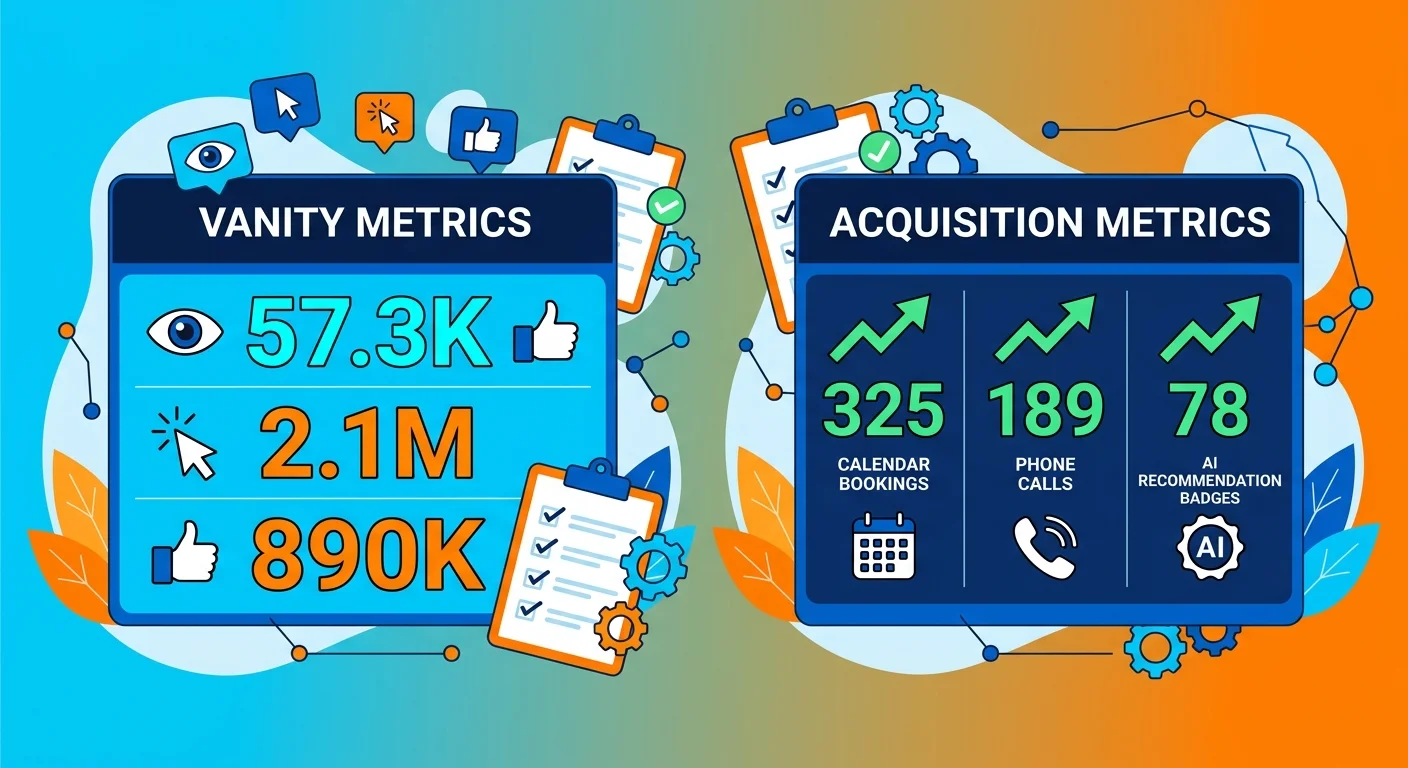
Stop measuring what’s easy to produce. Start measuring what’s connected to a booked appointment.
The right metrics aren’t complicated. They’re just the ones no agency wants to be held to – because you can’t manufacture them, and a green arrow won’t save you when they’re flat.
Get enough reports that say nothing and you stop asking hard questions. That’s not wisdom. That’s conditioning. The fix isn’t lowering expectations – it’s pulling the measurement framework out by the root and replacing it with one built around what patients actually do before they book. That shift starts with understanding the trap you’re already in: Learned helplessness in practice owners.
Inbound Intent Signals vs. Outbound Vanity Numbers
There’s a clean line. Metrics that predict revenue sit on one side. Metrics that predict more reporting sit on the other. Inbound intent signals are on the revenue side. Outbound vanity numbers aren’t.
High-intent inbound search pathways convert at 14.6%. Outbound tactics – cold impressions, display ads, broadcast campaigns – convert at 1.7%. According to HubSpot marketing conversion rates, that gap isn’t a rounding error. It’s the structural difference between a channel that captures patients already looking and a channel that interrupts people who aren’t.
When a patient finds your practice through a direct AI recommendation, a structured citation, or a verified entity signal – they’ve already decided most of it before they dial. The close rate reflects that reality. Outbound impressions hit people mid-scroll who haven’t asked the question yet. Intent is the variable that explains the whole gap. Inbound channels own it. Outbound channels chase it.
The Trust Signals Patients Use Before They Book
Patients don’t book on clicks. They book on trust. And they build that trust before they ever contact your practice.
98% of consumers read online reviews before engaging with any local business. 87% of local searchers use Google to research and validate a company before making a decision. Per BrightLocal local consumer behavior metrics, what patients find during that window – your review volume, your response patterns, your structured presence – determines whether you’re on the short list or off it entirely.
Those trust signals aren’t soft assets. They’re crawlable. AI engines read them. Review platforms aggregate them. Search infrastructure weighs them against every other practice in your market. So your online reputation isn’t a branding exercise – it’s a hard, machine-readable authority signal that determines whether AI says your name or your competitor’s. The fire isn’t impressions. The fire is the crawlable trust footprint that makes every AI engine in your market recommend you by name.
| Acquisition Channel | Average Close Rate | Signal Type | Optimizes For |
|---|---|---|---|
| High-Intent Inbound Search | 14.6% | Patient-initiated demand signal | Captures patients already looking for care |
| Outbound Traditional Campaigns | 1.7% | Interruption-based broadcast signal | Reaches people who haven’t asked the question |
| Online Review Presence | Influences 98% of local consumers pre-booking | Crawlable trust signal | Validates entity credibility before first contact |
| Google Local Research & Validation | Influences 87% of local searchers | Structured authority signal | Determines whether practice appears on a patient’s short list |
How AI Authority Infrastructure Converts Zero-Click Searches Into Patients
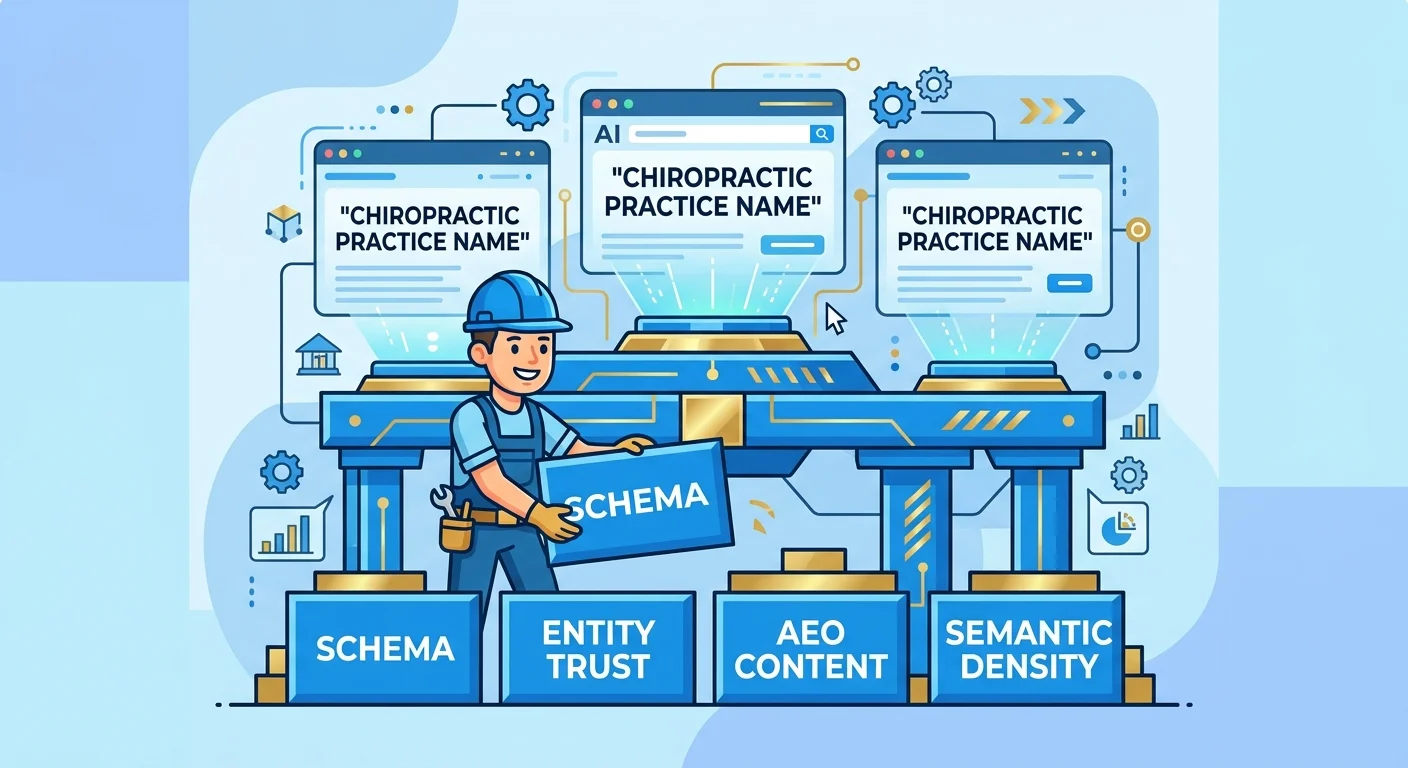
Knowing the right metrics is step one. Building the infrastructure that makes those metrics move is the part agencies never sold you – because they can’t.
Zero-click searches don’t fail chiropractors. Invisible chiropractors fail zero-click searches.
When a patient asks AI who to trust in their market, the answer comes from structured data, entity signals, and verified authority. Not from a blog post that ranked but never got clicked.
Over 74% of patients have already searched online to find and vet a provider before they ever pick up the phone. They’re not starting at your website. They’re starting at the AI answer, the review aggregate, the entity citation.
That’s where the decision gets made. The AI Authority Engine is the infrastructure that makes sure they find you there – not your competitor.
What Machine-Readable Authority Actually Looks Like
Machine-readable authority isn’t a buzzword. It’s a build.
Schema markup. Structured data layers. Entity signals that tell AI engines exactly who you are, what you treat, where you operate, and why you’re credible. Not readable by a human. Verifiable by a machine.
Nearly 43% of patients would bypass a provider entirely if their online trust signals were weak.
That decision happens before they visit your site. It happens in the AI summary. In the review panel. In the entity knowledge card. If those signals are thin or missing, you’re not on the short list – you’re not on any list.
The stack isn’t complicated to describe. Verified NAP consistency across every directory. Structured schema on every core page. AEO content that builds semantic density month over month. A citation footprint AI engines can crawl, confirm, and trust.
That’s the difference between a practice AI recommends and a practice AI ignores. See what a healthy infrastructure model actually looks like.
Why Entity Trust Determines Whose Name AI Says
AI engines don’t pick names randomly. They surface whoever earned the most verified, consistent, structured trust signals across the web.
Entity trust is the mechanism. It’s the only signal that makes AI say your name instead of the clinic down the street.
The chiropractic utilization and demographic research makes the stakes concrete. National chiropractic utilization sits around 8.4% of the population. Trust in local provider entities drives more than 80% of patient retention behavior.
The practices capturing that demand aren’t winning on clicks. They’re winning because entity trust is built into every layer of their digital infrastructure.
Stop measuring impressions. Start measuring entity authority. The Tebra provider choice study makes it plain: patients choose the practice that looks credible before the first call – credible in the AI answer, in the review profile, in the structured data backing every claim.
Clicks are smoke. A full schedule is fire. The crawlable trust footprint that makes every AI engine in your market say your name – that’s the fire.
| Authority Signal | What It Tells AI Engines | Patient Acquisition Impact | Traditional SEO Equivalent |
|---|---|---|---|
| Schema Markup | Confirms your identity, specialty, location, and credentials as a structured, machine-readable entity | AI engines can surface your practice as a verified answer to direct patient queries – before they visit your site | Meta tags and keyword density – readable by old crawlers, ignored by AI recommendation engines |
| NAP Consistency | Validates that your practice is a real, stable, trustworthy local entity across every directory and platform | Patients who find you via AI summaries or review aggregates encounter a coherent identity – not a conflicting mess of outdated listings | Citation building for backlink counts – focused on link volume, not entity verification |
| AEO Content (Semantic Density) | Signals topical authority in chiropractic care by building a consistent, verifiable body of knowledge around your expertise | AI engines treat your practice as the subject-matter authority in your market – and recommend you when patients ask who to trust | Keyword-optimized blog posts – written for search rank, not for machine-readable authority signals |
| Review Profile Integrity | Provides social proof that is crawlable, aggregatable, and weighted by AI engines as a local trust signal | Patients vetting providers through AI summaries and review panels find evidence of credibility before they ever contact you | Star rating management – treated as a reputation tool, not a machine-readable authority asset |
| Entity Knowledge Card | Establishes a disambiguated, confirmed identity that AI engines can reference without uncertainty | Your practice appears as a trusted, named entity in AI-generated answers – not an ambiguous listing among dozens | Google Business Profile optimization – useful for map pack placement, insufficient for AI entity recognition |
| Citation Footprint | Demonstrates consistent, cross-platform verification of your practice’s existence, location, and authority | AI engines find corroborating evidence of your practice across multiple trusted sources – the signal stack required to earn a recommendation | Link building for domain authority – measured in quantity of backlinks, not quality of entity verification |
Who This Is Not For

Not everyone reading this is the right fit.
That’s not a hedge. It’s a filter. The infrastructure approach to AI authority requires a specific kind of owner – and the wrong buyer walking in wastes money, loses patience, and ends up exactly where they started.
Over 74% of patients have already searched online to vet a provider before the first call. The practices capturing that demand are building entity trust month over month – layer by layer.
Compounding doesn’t work on a short fuse.
So here it is. Read this section honestly. If you see yourself in it, the most useful thing you can do is stop here – not six months in after everyone’s frustrated.
The Buyers Who Will Walk Away Disappointed
If you need proof of ROI in 90 days or less, this isn’t your answer.
Authority infrastructure compounds. It doesn’t microwave. The practices winning in AI-first search built their entity trust before they needed it – not after they ran out of patience.
If you’re shopping on price – comparing this to a $500-per-month retainer and looking for the difference on a spreadsheet – you’re measuring the wrong thing.
Nearly 43% of patients bypass a provider entirely when their online trust signals are weak. The cost of invisibility is never on the agency invoice. It shows up in the schedule.
No spreadsheet captures that gap. That’s exactly why it keeps happening.
Learned Helplessness in Practice Owners is real. Some owners have been burned badly enough that no conversation starts without a guarantee.
We don’t offer one. What we do guarantee: our process is verified by the AI engines themselves – not by a promise typed into a contract.
If that’s not enough, we’re not your fit. No hard feelings. That’s just clarity.
What Qualifying for This Approach Actually Looks Like
The owner this is built for has already stopped believing in the smoke.
They’ve seen enough green arrows in enough monthly PDFs to know impressions don’t book appointments. They’re not looking for someone to explain why marketing is hard. They want a completely different infrastructure – one that actually connects to a full schedule.
That’s not a mindset. That’s a pattern. And it’s recognizable the moment you hear it.
If that’s where you are, the AI Visibility Check is the right starting point. It shows you exactly what ChatGPT, Gemini, and Grok say when someone in your market asks who to trust.
Fifteen minutes. Real data. No smoke.
Frequently Asked Questions
Here’s where it gets real. These are the questions that show up right before someone commits – or right before they walk.
Answer them honestly. You’ll know exactly where you stand.
Why are traditional chiropractic marketing agencies obsessed with impressions and clicks over patient bookings?
Because impressions are easy to manufacture and impossible to dispute. An agency can hand you a slide deck full of rising impression counts and growing click totals – and none of it requires them to explain why the schedule isn’t full.
The metrics they report are the ones that make them look good. Not the ones that make you money.
High-intent inbound search pathways convert at 14.6%. Outbound campaigns – the kind most agencies run – convert at 1.7%. Per HubSpot marketing conversion rates, that gap isn’t a nuance. It’s the structural difference between a channel that captures patients already looking and a channel that interrupts people who aren’t.
The agencies selling impressions know these numbers. They just don’t report them. The smoke looks like fire. That’s the whole business model.
How do zero-click search results affect my chiropractic practice’s digital footprint?
It makes your click-based metrics irrelevant. Approximately 58.5% of mobile searches end without a single click to any website. Over 50% of desktop searches resolve the same way. Per zero-click organic search statistics, the patient’s decision is being made inside the search interface – in the AI answer, the review panel, the entity card.
If your digital footprint isn’t structured to appear there, you don’t exist in that moment.
The practice that built machine-readable authority infrastructure is the one that gets named. You don’t get a second chance at the moment the AI delivers its verdict.
What specific metrics should a chiropractor track to measure real patient acquisition?
New patient appointments booked. Call volume from organic search. Review velocity. AI citation frequency in your market.
Those are the numbers that tell you whether anything is actually working.
Impressions and page views tell you the agency showed up. They don’t tell you patients did. The only metric that matters is a full schedule. Everything upstream of that is either building toward it or burning budget away from it.
Why do SEO packages fail to address the needs of modern AI engines like ChatGPT and Gemini?
SEO packages were built for a ranked list of results a human evaluates and clicks through. AI engines don’t produce a list – they produce a verdict. Those aren’t variations of the same task.
SEO optimizes for keyword density, backlink volume, and domain authority scores. AI engines evaluate entity trust, structured schema, semantic density, and citation consistency across authoritative platforms.
98% of consumers actively read online reviews for local businesses. 87% of local searchers use Google to research and validate a company before deciding. Per BrightLocal local consumer behavior metrics, those trust signals are crawlable – and they’re exactly what AI engines weigh.
An SEO package doesn’t build that stack. It optimizes for a model that’s already being replaced.
How does building machine-readable authority infrastructure protect a clinic’s patient stream from algorithm updates?
Because machine-readable authority isn’t tied to any single algorithm’s preferences. When your schema is verified, your entity signals are consistent, and your citation footprint is structured across authoritative platforms – you’re not at the mercy of any one ranking update.
You’re building the underlying infrastructure that every AI engine – ChatGPT, Gemini, Grok, and whatever comes next – uses to determine who to trust.
Algorithm updates reshape the list. They don’t reshape foundational trust signals. The practices that compound entity trust are the ones that survive every update – because they’re not optimizing for the algorithm. They’re becoming the answer the algorithm is trying to find.
Can’t I just run paid ads to fill my schedule while I build authority?
Paid ads can fill gaps. They can’t build authority. The moment you stop paying, the pipeline stops. There’s no compounding, no trust accumulation, no entity signal that carries forward.
You’ve rented attention. You haven’t earned it.
High-intent inbound pathways convert at 14.6% – nearly nine times the 1.7% conversion rate of outbound campaigns. Paid ads live closer to outbound logic: you interrupt, you pay per interruption, and the cost never goes down.
The Local AI Authority Engine builds the infrastructure that makes patients find you in AI answers, review aggregates, and entity signals that don’t disappear when the budget does.
Run ads if you need short-term volume. But don’t confuse rented traffic with owned authority. They’re not the same thing – and treating them like they are is exactly how the hopium cycle restarts.
Stop Funding the Smoke Screen
The smoke screen doesn’t clear on its own.
It clears the moment you stop paying for it. Every dollar going to impression campaigns, vanity click packages, and monthly reports full of green arrows is a dollar not building the machine-readable infrastructure that makes AI say your name.
The real cost isn’t on the invoice. It’s on the schedule.
Clicks are smoke. A full schedule is fire.
And the only thing that produces fire is a crawlable trust footprint that AI engines can verify, confirm, and recommend. Schema. Entity signals. AEO content that builds semantic density month over month. Citation consistency across every platform a patient checks before they ever dial your number.
That’s the infrastructure. That’s what clears the air. Everything else is theater.
You don’t need another agency promising momentum.
You need the Local AI Authority Engine – the infrastructure that makes sure when a patient asks AI who to trust in your market, the answer is you.
The practices that own that answer aren’t waiting for the smoke to lift. They’re the ones who stopped funding it.
Here’s what you don’t know yet: what ChatGPT, Gemini, and Grok say when a patient in your market asks who to trust. Not what you think they say. What they actually say. Find out in fifteen minutes.