Why Most Agency Relationships Fail Before They Start

Most agency relationships don’t fail because the agency couldn’t do the work.
They fail because nobody ever agreed on what the work was supposed to build.
Average agency tenure has slipped to less than 3 years. That number is the outcome, not the cause.
The cause is what happens inside those 3 years. Year one disappears chasing impressions. The client exits before anything real exists. The agency rolls to the next retainer. Repeat.
And it’s not a skills problem. Communication failure is one of the main reasons agency relationships end.
Misaligned expectations. No defined deliverables. No shared answer to what "working" actually means.
That’s a structural failure – and it starts the moment a retainer invoice replaces a blueprint.
Why the ‘Keep the Retainer Running’ Model Is a Trap
The retainer model is built to keep billing. Not to build anything you own.
Here’s the problem: a traditional agency gets paid whether the work compounds or not.
Monthly fees hit your account. Monthly reports land in your inbox – impressions, clicks, keyword rankings that look like progress and connect to zero new revenue. The agency has no financial incentive to build something you own. They have every incentive to keep the meter running.
By the time you recognize the pattern, six months of budget are gone.
That’s the trap. Not the agency. Not the team. The model.
A retainer with no defined asset at the end is a subscription to hope. Hope is not a deliverable. And this failure pattern is consistent enough that you can see exactly how it plays out before you sign anything.
Shifting from agency retainers to an AI authority engine is not a positioning change.
It’s the difference between renting someone else’s vanity metrics forever and owning an authority asset that compounds every month you run it.
What a Healthy Relationship Signals in the First Week
A healthy agency relationship shows its hand in week one.
Not with a welcome deck. Not with a 30-slide capabilities presentation. With one clear answer: what are we building, and who owns it when we’re done?
A builder doesn’t show up on day one and start swinging a hammer. They show up with a plan.
Week one of a real engagement is infrastructure diagnosis. What does the entity trust signal look like right now? What is AI currently saying about your practice? What has to be fixed before a single piece of content gets written?
That’s Infrastructure Before Content – not a philosophy, a sequence. Anything less is a retainer in disguise.
| Relationship Signal | Healthy Agency Does This | Typical Retainer Agency Does This |
|---|---|---|
| Week One Activity | Runs an infrastructure diagnosis – audits entity trust signals, schema gaps, and what AI currently says about your practice | Sends a welcome deck and schedules a kickoff call to align on ‘brand voice’ |
| Deliverable Definition | Defines the finished asset upfront – what gets built, who owns it, and what the structure must withstand | Defines monthly deliverables by activity (posts, reports, hours) rather than by outcome or asset |
| Performance Measurement | Tracks AI recommendation signals, entity trust growth, and revenue-connected outcomes | Tracks impressions, clicks, keyword rankings, and other vanity metrics disconnected from new revenue |
| Incentive Structure | Builds toward an authority asset the client owns permanently – value compounds after engagement ends | Maintains a monthly retainer model where value disappears the moment payments stop |
| Communication Standard | Establishes a shared definition of ‘working’ before execution begins – both parties agree on what success looks like | Reports results without a pre-agreed baseline, leaving the client to interpret whether progress is real |
| Onboarding Structure | Follows a defined phase-by-phase blueprint with locked milestones for each 30-day window | Begins content execution immediately with no infrastructure foundation – skips the blueprint entirely |
Days 1-30: Infrastructure Before Content
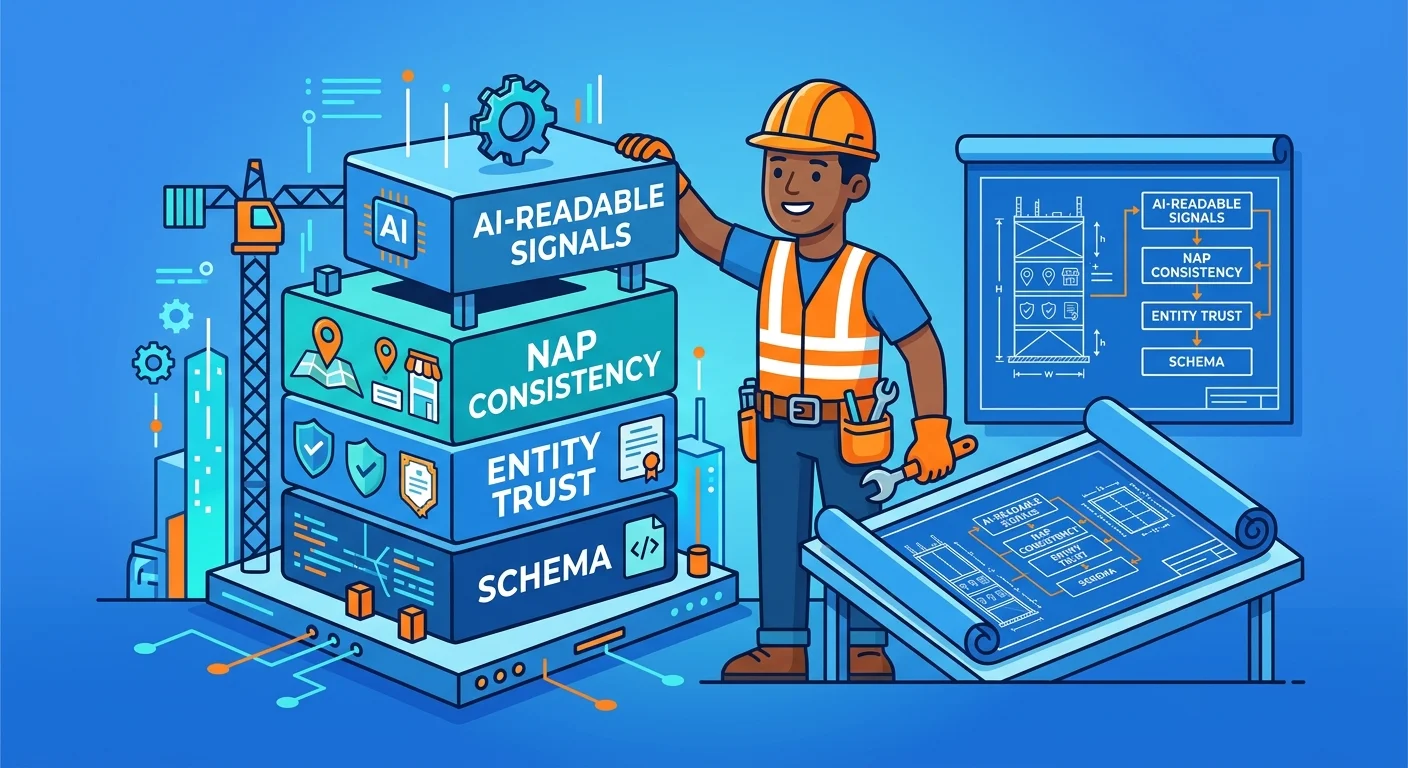
Day 1 is not a kickoff call.
It’s a foundation audit. And if your agency doesn’t know the difference – that’s your answer. Right there. Before a single invoice clears.
Structured onboarding protocols measurably improve how long agency relationships last.
That holds for one reason: structure kills the ambiguity that ends most engagements before Q1 is over.
When both parties know exactly what’s being built – and why – there’s a foundation. Without that, you’re billing against a feeling. And feelings don’t compound.
But structure alone doesn’t close the gap. 80% of marketing leaders say mutual trust outweighs technical capability in long-term satisfaction.
Here’s the thing – trust isn’t built with a welcome deck or a 30-slide capabilities presentation.
It’s built by showing up in week one with a diagnostic. A real accounting of where entity trust stands right now. What AI engines actually say about the practice. What has to be fixed before a single piece of content goes live.
The Entity Audit: Confirming AI Can Find and Trust You
The entity audit is the first deliverable of Infrastructure Before Content.
Not optional. Not preliminary. First.
Here’s what an entity audit actually looks like: run the practice name through ChatGPT, Gemini, and Grok and record exactly what each engine says.
Does AI name the practice when someone asks who to trust in that market? Does it cite the right address, the right specialty, the right credentials?
Or does it name a competitor? Or say nothing at all?
That gap – whatever it is – is what the first 30 days exist to close.
A retainer tracks clicks. An entity audit tracks AI trust signals – the inputs that determine whose name gets recommended when a patient asks an AI engine who to see.
Those aren’t the same measurement.
They never were. Treating them like they are is how six months of budget disappears with nothing to show for it.
Schema, NAP Consistency, and AI-Readable Signals
Schema is the language AI reads.
If your site doesn’t speak it, AI engines have no way to confirm who you are, what you treat, or whether your entity is worth recommending.
NAP consistency – Name, Address, Phone – is the foundation of entity trust.
Every directory listing, every citation, every structured data block on the site has to say the same thing. One discrepancy introduces ambiguity.
AI engines resolve ambiguity by not recommending you. The fix is methodical and unsexy. It’s also non-negotiable.
So ask your agency one direct question at the end of week two: what AI-readable signals are now live on the site, and what did the entity audit surface that’s being fixed?
Vague answer? You have a problem.
If the answer involves a keyword report, the blueprint was never drawn. The retainer just got a new name.
What Week-Four Deliverables Should Look Like
By the end of week four, a real engagement has three things documented and delivered.
The entity audit findings – specific gaps identified, not general observations. The schema implementation – live on the site and verified. The NAP consistency report – showing every corrected citation.
Those aren’t suggestions. They’re the structural deliverables that make everything after Day 30 actually compound.
A blueprint is drawn before construction begins. Week-four deliverables are proof the blueprint was followed.
Not proof the agency was busy. Not proof they care. Proof the foundation exists.
If your week-four report is full of impressions and rank movement instead of infrastructure documentation, you’re not in a 90-day authority build. You’re in a retainer with better branding.
| Days 1-30 Deliverable | What It Is | Why It Matters for AI Authority | Status Checkpoint |
|---|---|---|---|
| Entity Audit | A structured diagnostic that queries ChatGPT, Gemini, and Grok to record exactly what each engine says about the practice – name, specialty, location, and whether it recommends the practice at all. | AI engines can only recommend what they can verify. The audit exposes every gap between what the practice claims and what AI currently trusts. | Delivered by end of Week 1 – findings documented with specific gaps identified |
| Schema Implementation | Structured data markup added to the site that speaks the language AI engines read – telling them who the entity is, what it does, and why it is credible. | Without schema, AI has no machine-readable confirmation of the practice’s identity. Schema is the infrastructure that makes every piece of content that follows worth reading. | Live on site by end of Week 2 – verified and confirmed, not just submitted |
| NAP Consistency Audit | A full sweep of every directory listing, citation, and structured data block to confirm Name, Address, and Phone are identical across all platforms. | A single discrepancy introduces ambiguity. AI engines resolve ambiguity by not recommending the practice. Consistency is non-negotiable for entity trust. | Corrected citation report delivered by end of Week 3 – every discrepancy resolved |
| Site Architecture Review | An assessment of the site’s internal linking structure, page hierarchy, and content organization to confirm AI engines can crawl and contextualize the practice’s authority signals. | Authority content written on a structurally broken site does not compound. The architecture review ensures the foundation supports everything built on top of it. | Findings and fixes documented by end of Week 3 – structural gaps prioritized before content begins |
| AI Visibility Baseline Report | A formal record of what AI engines currently say about the practice before any infrastructure changes are made – the before snapshot the entire 90-day build is measured against. | Without a documented baseline, there is no way to prove the infrastructure work changed anything. The baseline is what makes the Day 90 measurement meaningful. | Completed at the start of Week 1 – locked as the benchmark before any work begins |
| Week 4 Infrastructure Sign-Off | A deliverable package confirming the entity audit findings, schema implementation, NAP consistency corrections, and site architecture fixes are complete and verified. | Days 31-60 content execution only compounds when it lands on a verified foundation. The sign-off is proof the blueprint was followed – not proof the agency was busy. | Delivered at end of Day 30 – all three structural deliverables documented before Content That Signals Authority to AI begins |
Days 31-60: Content That Signals Authority to AI

Infrastructure locked. Now the work shifts.
Days 31-60 are where raw entity signals turn into AEO content – structured, sourced, and built for AI engines to read, trust, and cite.
This phase is not about publishing more.
It’s about publishing right. Every article that goes live in this window has one job: give AI engines a documented reason to associate your name with authority in your market.
Here’s where most agency relationships quietly collapse.
42% of businesses report tracking vanity metrics rather than concrete outcomes during the first 90 days. That means the majority of clients inside a content phase are counting impressions and click-throughs while the asset that actually matters goes unbuilt.
That’s not a reporting problem. That’s a design flaw baked into the engagement from day one.
Why AEO Content Is Not the Same as a Blog Post
A blog post is written to rank. An AI Authority article is written to be cited.
Those are not variations of the same task.
Traditional blog content is optimized for a keyword, structured around a word count, and measured by organic traffic.
AI Authority content is built around a question AI engines are already answering – and written to give those engines a more complete, more entity-verified answer than what currently exists.
The goal isn’t a click. The goal is a citation. That distinction is everything – and it’s the core of how authority content deepens trust.
So if your agency is producing blog posts in Days 31-60 and calling them AEO content, ask one direct question.
Is this article structured to answer a specific question AI engines are already fielding? Does it cite verifiable institutional sources that reinforce entity trust?
If the answer is no – or if the answer is a shrug – you’re paying for content AI will ignore.
The Two-AI Validation System: Why It Matters
Here’s the thing about verification.
The agency that wrote the article can’t be the only entity validating it. That’s a conflict of interest baked directly into the delivery model.
iTech Valet runs every AI Authority article through a proprietary Two-AI Validation System.
Gemini researches. Claude writes. Gemini validates the output. Claude refines. Every claim is sourced. Every statistic is checked against an institutional reference before the article publishes.
Gerek Allen puts it plainly: we don’t publish vibes. We publish receipts.
74% of marketing executives are restructuring agency operational spend to drive tangible asset value.
They’re right to demand it. Content that can’t be verified is content AI engines can’t trust. And content AI engines don’t trust doesn’t get cited.
The Two-AI Validation System isn’t a differentiator. It’s the minimum standard for content that’s actually doing its job.
Measuring Content Progress in the Middle Phase
So what does progress look like in Days 31-60?
Not impressions. Not keyword movement.
The metrics that matter: AI citation frequency, entity mention accuracy across AI engines, and the depth of the answer AI produces when your practice name gets queried directly.
Look at what misaligned marketing vanity metrics cost practices in the first 90 days and the pattern is consistent.
The agency reports activity. The client measures activity. Neither party notices the authority asset was never being built.
By the end of Day 60, a real engagement has published AI Authority articles that are sourced, validated, and indexed. Run each article’s core question through ChatGPT, Gemini, and Grok. See whether the answer is shifting toward your entity.
That’s a measurable outcome. Impressions are not.
| Metric Type | What Agencies Typically Report | What Authority Progress Actually Looks Like |
|---|---|---|
| Content Volume | Number of posts published this month | Number of AI Authority articles verified, sourced, and indexed with institutional citations |
| Traffic Signals | Organic sessions, page views, impressions | AI citation frequency – how often your practice name appears in AI-generated answers to relevant queries |
| Keyword Performance | Keyword ranking movement in Google Search Console | Entity mention accuracy – whether AI engines are associating your name with the correct specialty, location, and credentials |
| Content Quality | Word count, readability score, engagement rate | Answer depth – whether the AI-generated response to your core questions is expanding toward your entity or staying generic |
| Audience Reach | Social shares, referral traffic, click-through rate | Structured source trust – whether AI engines are pulling your published content as a citation rather than ignoring it |
| Validation Standard | Internal agency review before publish | Two-AI Validation – independent research and verification pass before any article is considered ready for indexing |
Days 61-90: Compounding the Asset and Measuring What Matters
Day 61 is a different conversation.
The infrastructure is live. The first AI Authority articles are indexed. The blueprint was drawn and followed.
Now the only question that matters: is the asset compounding – or just sitting there? Most agency relationships never ask it. They keep reporting activity and call it progress.
Execution without measurement is just activity.
The final phase exists to prove the asset is compounding – not accumulating. That distinction matters more than any impressions report your agency has ever handed you.
Marketing executives are increasingly focused on restructuring agency operational spend to drive tangible asset value.
Not better traffic charts. Something they actually own.
Days 61-90 are where you find out whether your agency built you that – or just kept themselves busy billing.
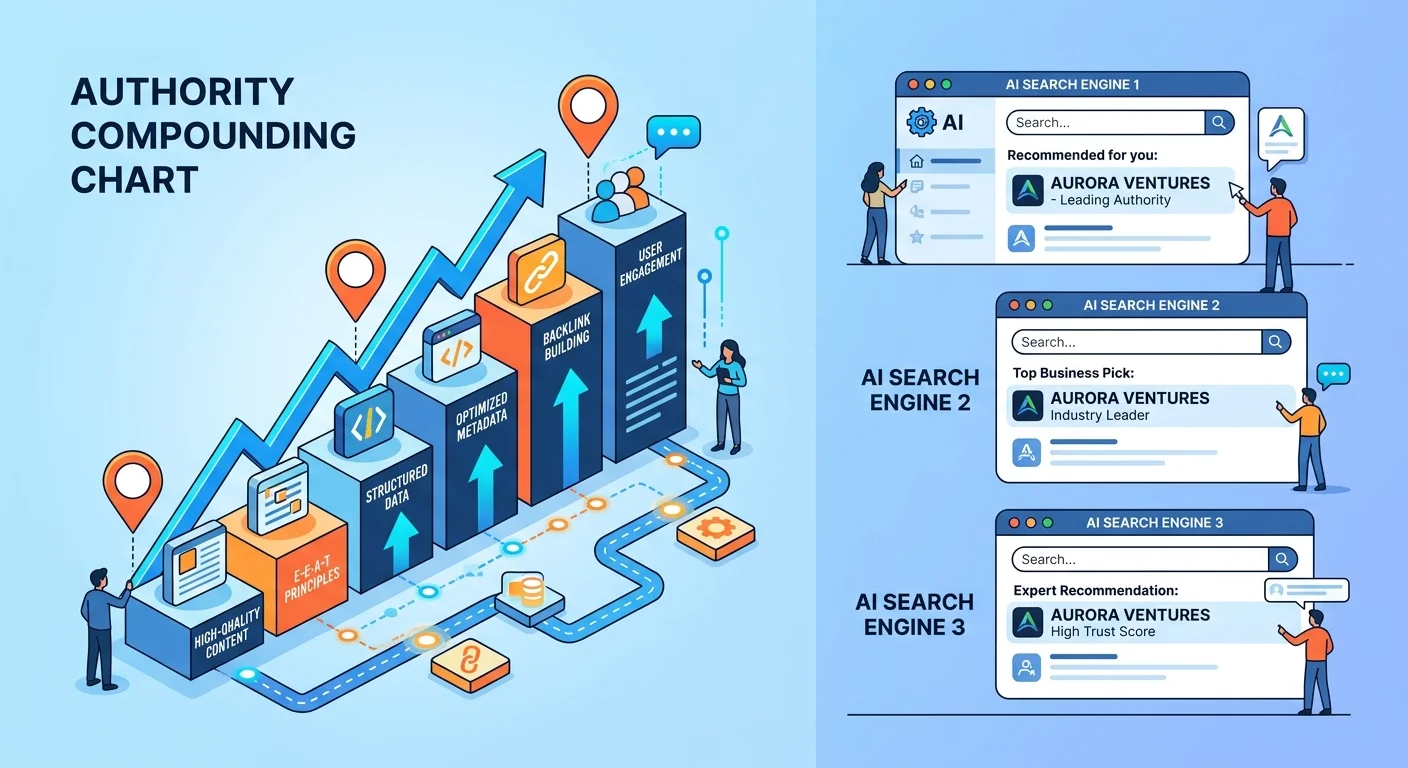
How Authority Compounds Month Over Month
Authority doesn’t switch on.
It layers. Each AI Authority article published in Days 31-60 becomes a citation anchor for the content that follows. Each new article deepens the semantic signal – telling AI engines that your entity is the most trustworthy answer in your market.
That’s not a metaphor. That’s how the infrastructure actually works.
By Day 90, you’re not starting over.
You’re building on a verified foundation – schema confirmed, NAP consistent, AI Authority content indexed and signaling.
The compounding effect is structural. It’s not luck. It’s what a blueprint produces when it gets followed.
But compounding requires continuity. And continuity requires commitment.
An agency that knows you can leave after 30 days has no incentive to build infrastructure that takes 90 days to prove itself. The math works against you before the engagement begins.
80% of marketing leaders agree that mutual trust outweighs technical capabilities in long-term satisfaction. Trust isn’t built in a single billing cycle. Agency-client relationship longevity research confirms it – commitment to the process is what separates the practices that own their authority from the ones that rented it month by month and ended up with nothing permanent.
That’s the real cost of month-to-month contracts. month-to-month contracts
The Metrics That Prove the Blueprint Is Working
The metrics that matter in Days 61-90 aren’t impressions.
Not keyword rankings. Not click-through rates.
They’re AI citation outcomes. And there are exactly three that tell you whether the blueprint worked.
First: run your practice name through ChatGPT, Gemini, and Grok directly.
Does AI name you when someone asks who to trust in your market? That answer at Day 90 should be meaningfully different from what it was at Day 1.
If it isn’t, the infrastructure was never built. A retainer got dressed up in better language – and you funded it for 90 days.
Second: query the core service questions your AI Authority articles were written to answer. Does your entity appear in the response? Is the answer more specific, more tied to your practice than it was 60 days ago?
Third: pull the AI Visibility Check results from Day 1 and compare them directly to what the engines say now.
That delta is your proof of work. That’s the receipt.
And that’s the difference between a blueprint that was drawn and followed – and no blueprint, just a retainer invoice and a hope.
| 90-Day Phase | Primary Deliverable | AI Authority Signal Built | How to Verify Progress |
|---|---|---|---|
| Infrastructure Before Content (Days 1-30) | Schema markup live, NAP consistency confirmed, AI-readable site architecture deployed, entity signals established across all citation sources | AI engines can identify, locate, and verify the entity – the foundational trust signal before any content is published | Run the AI Visibility Check at Day 1 and again at Day 30 – entity recognition accuracy should be measurably higher |
| Content That Signals Authority to AI (Days 31-60) | First wave of AI Authority articles published – each sourced, institutionally cited, and validated through a Two-AI system before indexing | Semantic density builds as AI engines begin associating the entity with specific questions in the market; citation anchors established | Query each article’s core question directly in ChatGPT, Gemini, and Grok – the entity should begin appearing in responses as a referenced answer |
| Compounding the Asset and Measuring What Matters (Days 61-90) | Continued AI Authority content publication building on indexed foundation; authority review session comparing Day 1 vs. Day 90 AI Visibility Check results | Each new article deepens the semantic signal – the authority asset compounds rather than accumulating in isolation; AI engine trust increases with each verified citation anchor | Compare AI Visibility Check results from Day 1 against Day 90 directly; query core service and clinical questions to confirm entity appears in AI responses with greater specificity and depth |
| Retainer Model (No Blueprint) | Monthly blog posts optimized for keyword rankings; activity reports tracking impressions, clicks, and rank movement | No entity trust signals built; AI engines have no structured reason to associate the entity with authority in the market | Impressions and click-through rates – neither of which confirms AI citation or entity recognition; no baseline AI Visibility Check exists to measure against |
| What a Real Day-90 Deliverable Looks Like | Documented proof: AI engines name the entity in response to direct market queries; AI Authority articles indexed and cited; authority infrastructure audit confirming schema integrity | A verified, compounding authority asset the business owns permanently – not a campaign that disappears when billing stops | Run three direct AI queries – practice name, core service question, and market trust question – and compare responses against Day 1 baseline to confirm measurable entity advancement |
Who This Blueprint Is Not For

Before you decide if this blueprint is for you – decide if you are for it.
Average agency tenure has slipped to less than 3 years. That’s not bad luck. It’s a pattern – and 42% of businesses enter those engagements tracking vanity metrics from Day 1, measuring the wrong things, and walking before the infrastructure ever proves itself.
The blueprint doesn’t fail those buyers. They fail the blueprint.
So here’s the call.
If any of the descriptions below match how you make decisions – this isn’t your program. Not an insult. A blueprint drawn for the wrong builder doesn’t get followed. It gets shelved.
The 90-Day Miracle Seeker
The 90-Day Miracle Seeker wants a reportable win before the foundation has had time to cure. Not citation velocity. Not compounding authority signals. A screenshot they can point to – in three months or less.
42% of businesses spend the first 90 days tracking vanity metrics instead of concrete outcomes. The Miracle Seeker isn’t in that group by accident – they built the engagement to measure the wrong thing from Day 1.
Authority infrastructure doesn’t produce a click report. It produces a citation signal that compounds over months. There’s no conversion spike to screenshot at the 90-day mark.
If your decision framework requires a win that fast, this blueprint will frustrate you. And you’ll exit before the asset becomes visible.
The Guarantee Demander and the Budget-First Buyer
The Guarantee Demander wants contractual assurance of rankings, traffic, or revenue before a single foundation block is poured. The Budget-First Buyer puts a full authority infrastructure build next to a $500-per-month retainer and decides on price alone.
Two different objections. Same door out.
Neither of those buyers is wrong for wanting certainty or value. But the Local AI Authority Engine isn’t a commodity retainer with a guaranteed deliverable list. It’s a 90-day build that constructs something your business owns permanently.
You can’t guarantee a specific AI citation outcome before the foundation is poured. What you can guarantee is that the blueprint gets followed, every claim gets verified, and the infrastructure meets the standard AI engines actually trust.
If that trade-off doesn’t sit right – this isn’t your fit.
What the Right Buyer Looks Like
The right buyer is established, done-for-you oriented, and already knows something in their digital visibility is broken. They haven’t yet identified AI answer engines as the mechanism causing it.
But they’re ready to find out.
That buyer doesn’t need to understand schema markup or how a Two-AI Validation System works. They need to trust that the blueprint exists, that it gets followed, and that when Day 90 arrives, the receipt is real – not a report full of impressions and hope.
That’s who this blueprint was built for.
And if that description fits, the next move is running an AI Visibility Check to see exactly where you stand before construction begins.
Frequently Asked Questions
Close-to-committing buyers don’t need a recap. They need straight answers to the questions most agencies dodge.
Here are the five that actually matter before you sign anything.
Why do most agency relationships break down within the first 90 days?
Communication failure is the mechanism. Over 50% of client-agency breakups trace back to misaligned expectations – not bad work.
The client expected revenue outcomes. The agency was tracking impressions. Nobody defined what success looked like before the invoice hit.
That is not bad luck. That is a missing blueprint.
When there is no shared definition of what gets built, the relationship runs on hope. And hope runs out – usually before anything permanent gets built.
What key deliverables should I expect in the first 30 days of agency onboarding?
Days 1-30 belong to infrastructure. Not content. Not campaigns. Not keyword reports.
Expect a full entity audit. Expect schema markup implemented and verified on the site. Expect NAP consistency confirmed across every directory AI engines actually read. If the foundation isn’t clean, nothing built on top of it holds.
Structured onboarding protocols improve relationship longevity by up to 35%. That number exists because structure kills the ambiguity that ends most engagements before the first quarter is over.
If your agency’s Day 30 deliverable is a traffic dashboard – the foundation was never the priority. The right Day 30 report is a verified technical foundation. Not a chart.
How does an AI Authority Engine differ from a traditional monthly SEO retainer?
A retainer optimizes for activity. An AI Authority Engine builds an asset you own.
That is not a semantic difference. It is a structural one.
Retainers produce reporting cycles – impressions, clicks, keyword movement. The AI Authority Engine produces schema-verified infrastructure, AI Authority content that compounds, and citation signals that keep working after the engagement ends.
74% of marketing executives are actively focused on restructuring agency operational spend to drive tangible asset value. The AI Authority Engine is what that shift looks like in practice.
Here’s the thing – when you stop paying a retainer, the rankings disappear. When the 90-day build is complete, the authority infrastructure your business owns does not.
Is a 90-day timeline realistic to see measurable results from authority content?
90 days builds the foundation and launches the compounding signal. It does not produce a fully saturated authority position in every AI engine by Day 90. That is not the goal.
What 90 days produces is verified infrastructure and an indexed body of AI Authority content actively deepening your entity trust.
The measurement at Day 90 is directional – not final. Run your practice name through ChatGPT, Gemini, and Grok at Day 1. Run it again at Day 90. The delta is your proof of work.
The authority keeps building after Day 90. What the blueprint prevents is the alternative – spending those same months on a retainer that produces no compounding asset at all. One path builds equity. The other rents visibility that disappears the moment you stop paying.
What are the red flags of an agency selling hopium instead of factual receipts?
The clearest red flag: vanity metrics dressed up as outcomes. 42% of businesses spend their first 90 days tracking performance indicators with no connection to revenue or authority.
If your agency leads with impressions, click volume, or keyword position reports – and cannot connect any of those numbers to AI citation outcomes – that is hopium.
The second red flag: no verifiable sourcing. At iTech Valet, the standard is simple. We don’t publish vibes. We publish receipts.
Every AI Authority article runs through the Two-AI Validation System – Gemini researches, Claude writes, Gemini validates, Claude refines. Every claim is sourced. Every statistic is verified before anything publishes.
Ask your agency what validates their content. If they can’t show you the receipts, the content isn’t built to be trusted by AI engines. And content AI engines don’t trust doesn’t get cited.
The Blueprint Is the Asset
Blueprints don’t become valuable when you file them away. They become valuable when construction follows them exactly – and when what gets built outlasts every contractor who touched it.
That is what this framework produces. Not a campaign. Not a retainer deliverable.
An authority infrastructure your business owns permanently. Built in three deliberate phases: Infrastructure Before Content, then Content That Signals Authority to AI, then Compounding the Asset and Measuring What Matters. Each phase builds on the last. None of it disappears when the invoice stops.
Most agency relationships never get there. They generate activity – reporting cycles, impressions dashboards, keyword movement charts – and when the relationship ends, the client walks away with nothing structural.
No schema. No entity signals. No AI Authority content compounding after the contract closes.
That is not a vendor failure. That is what happens when there is no blueprint. The work fills the retainer. The retainer fills the calendar. And the authority asset never gets built because no one drew the plans for it.
So here is the verdict.
The businesses that follow this blueprint are not buying better marketing. They are building something their competitors cannot buy back later. Every AI Authority article published, every schema signal confirmed, every citation anchored across ChatGPT, Gemini, and Grok – that is compounding equity. Our Case Studies show what that looks like when the blueprint is actually followed.
And the gap between the business that owns that infrastructure and the one that never drew the plans? It grows wider every month. The alternative is no blueprint, just a retainer invoice and a hope.
At iTech Valet, the blueprint is the work. The receipt is real. If you are ready to see exactly where you stand before construction begins – find out what AI says about your business right now.
You know what a healthy agency relationship looks like now. You know the red flags. You know the difference between receipts and hopium.
So here’s the only question left: what is AI actually saying about your business right now?
Run the AI Visibility Check. Fifteen minutes. Real data. No guesswork – just the truth about whether your name shows up when it matters.