


What Are E-E-A-T Signals and How Do Chiropractors Improve Them?
 by Gerek Allen ~ Last Updated: December 15, 2025 ~ 10 Min Read
by Gerek Allen
~ Last Updated: December 15, 2025 ~
~ 10 Min Read ~
E-E-A-T stands for Experience, Expertise, Authoritativeness, and Trustworthiness.
It's Google's way of figuring out if your content actually deserves to rank.
Here's the thing... as a chiropractor, you're already being judged harder than most businesses.
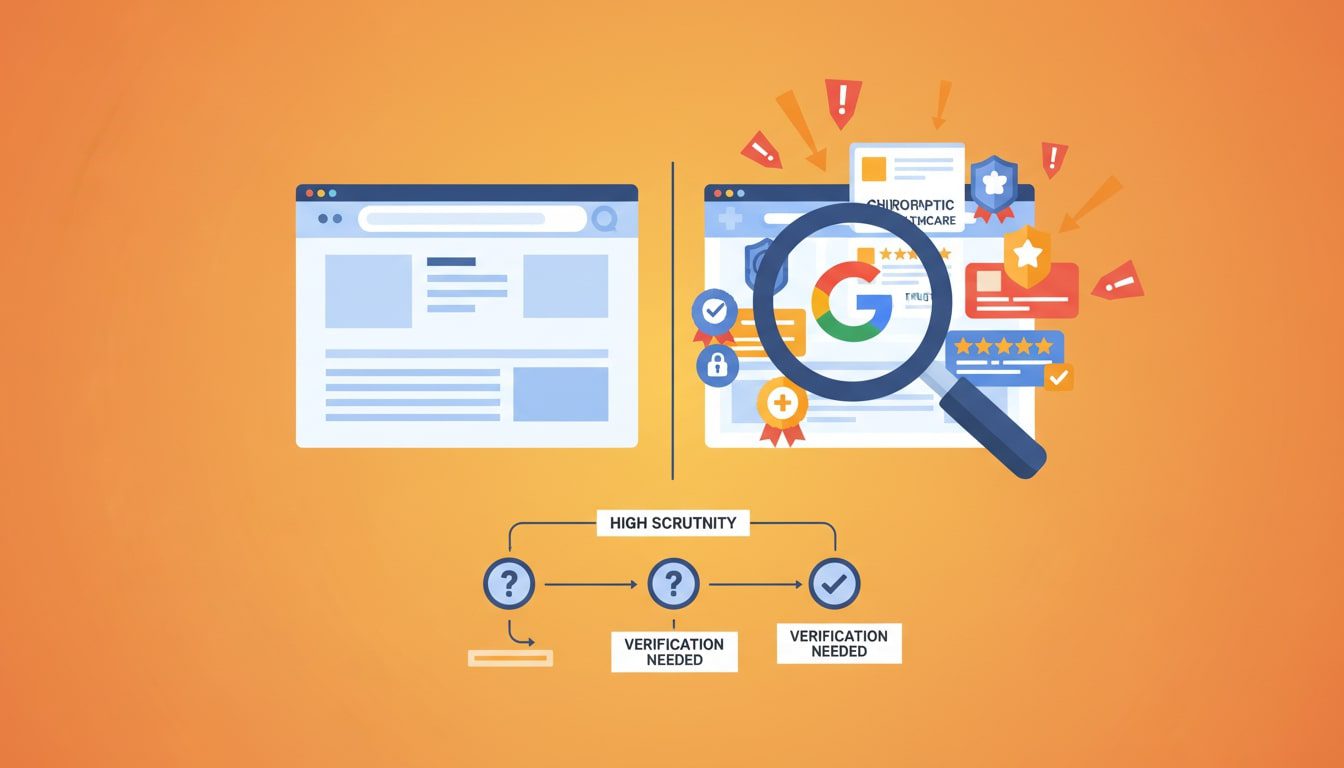
Google puts healthcare websites in a special category called YMYL (Your Money or Your Life). Basically, they're saying the info on your site could impact someone's health. And they don't mess around with that.
The Search Quality Rater Guidelines Google uses? They literally call out medical websites as needing the highest levels of E-E-A-T.
That's you.
Now... this part matters.
E-E-A-T isn't some checkbox you optimize like a meta description. It's a framework. Google uses it to evaluate your entire online presence.
Here's what kills me about most chiropractic websites...
You already have the credentials. The degree. The license. Years of patient care experience.
But your website? It's probably not telling Google any of that.
So let's fix it.
We're gonna break down what each E-E-A-T component means for your practice, why it matters way more for healthcare sites, and the exact steps to show Google you're the real deal.
Sound fair?
Breaking Down the E-E-A-T Framework for Healthcare Websites

Let's get clear on what each letter actually means.
Google added the extra "E" for Experience back in December 2022. Before that, it was just E-A-T.
That update was Google saying: "We wanna see content from people who've actually done the thing... not just researched it."
Experience: You've Actually Done the Work
This one's huge for chiropractors.
You've adjusted thousands of spines. You know what works for sciatica versus a herniated disc. You've seen the difference between textbook symptoms and how patients actually present.
That's experience.
Google's guidelines specifically mention content showing "actual use of a product, having actually visited a place, or communicating what a person experienced."
So what does experience look like on your website?
- Patient case studies (anonymized) - Real outcomes you've achieved with actual conditions, including timeline and approach
- Personal observations - "In my 15 years of practice, I've noticed that patients who..." That's gold right there
- Photos from your practice - Real images of your treatment rooms, your team, your equipment... not stock photos
- Treatment insights - Details that only someone who's done the work would know
Expertise: Your Credentials Are SEO Assets
Expertise evaluates whether you have the knowledge and skills for the topic.
Your DC degree, your certifications, your specialized training... these are SEO assets now.
Google's Search Quality Evaluator Guidelines literally say: "High E-E-A-T medical advice should be written or produced by people or organizations with appropriate medical expertise or accreditation."
That's describing you.
The problem?
Most chiropractic websites bury credentials in tiny footer text. Or skip them entirely.
Your expertise needs to be front and center:
- Display licenses and certifications prominently - Not just on your About page... on every piece of content
- Show continuing education - Specialized training in Gonstead, Activator, sports chiropractic... that's depth
- Academic affiliations - Where you studied, any teaching positions, research contributions
- Professional memberships - ACA, state associations, specialty councils... they all signal legitimacy
Authoritativeness: Others Agree You're the Expert
Here's where it gets tricky.
Authoritativeness is about external validation. It's not enough to say you're an expert.
Other people need to agree.
This is the hardest E-E-A-T signal to build because it depends on factors outside your control. But it's also one of the most powerful.
Authority signals for chiropractors:
- Quality backlinks - When reputable sites link to your content, Google notices
- Mentions and citations - Getting quoted in local news, health publications, or industry resources
- Professional directory listings - Active profiles in chiropractic directories and healthcare databases
- Community recognition - Awards, speaking engagements, local business features
Trustworthiness: The Foundation of Everything
According to Google, trustworthiness is "the most important member of the E-E-A-T family."
Think about it.
You can have decades of experience and impressive credentials. But if users don't trust your site, none of that matters.
Trust signals break into two categories...
Technical trust signals:
- SSL certificate (HTTPS) - Non-negotiable for healthcare sites
- Secure forms - HIPAA-compliant contact and intake forms
- Fast, mobile-friendly design - Poor user experience erodes trust instantly
Transparency trust signals:
- Clear contact information - Physical address, phone, email... prominently displayed
- About page with real people - Photos, bios, verifiable credentials
- Privacy policy and terms - Clear policies about how you handle patient data
- Patient reviews - Social proof from real patients who've experienced your care
Why E-E-A-T Matters More for Chiropractors Than Most Businesses
Let's keep it real...
Google treats your website differently than a restaurant or retail store.
Your site falls under YMYL classification. And that changes everything.
What YMYL Actually Means for Your Practice
YMYL stands for "Your Money or Your Life."
It's Google's term for content that could significantly impact someone's health, happiness, financial stability, or safety.
Healthcare websites are the textbook example.
When someone searches "is my back pain serious" or "should I see a chiropractor for sciatica"... they're making decisions that affect their physical wellbeing.
Google knows this. And they hold sites answering these questions to a much higher standard.
The January 2025 update to Google's Quality Rater Guidelines reinforced this emphasis. Even more instructions for raters evaluating health content now. Particular focus on catching AI-generated low-quality content pretending to be medical advice.
Remember the 2018 Medic Update?
In August 2018, Google released what the SEO community called the "Medic Update."
It devastated healthcare websites overnight.
Sites lacking clear author credentials, medical accuracy, and trust signals? Rankings plummeted. Some lost 50%+ of their organic traffic.
That update was Google saying: "We're done ranking health content from anonymous sources."
Since then, every major algorithm update keeps raising the bar on YMYL content.
What This Means for Your Content
If you're creating content for your chiropractic website, you can't treat it like a lifestyle blog.
Every piece needs:
- Clear attribution to a licensed chiropractor
- Medically accurate information that could withstand scrutiny
- Proper citations when referencing studies or statistics
- Transparent disclosure of any conflicts of interest
The days of ranking generic health content written by anonymous freelancers are over.
Google wants to know who wrote it, what qualifies them, and whether readers can trust it.

NEED MORE CLIENTS?
Free conversion-focused analysis uncovers the 3 biggest problems killing your bookings — we'll walk you through your results personally

The E-E-A-T Signals Table: What to Prioritize
Alright, quick reality check...
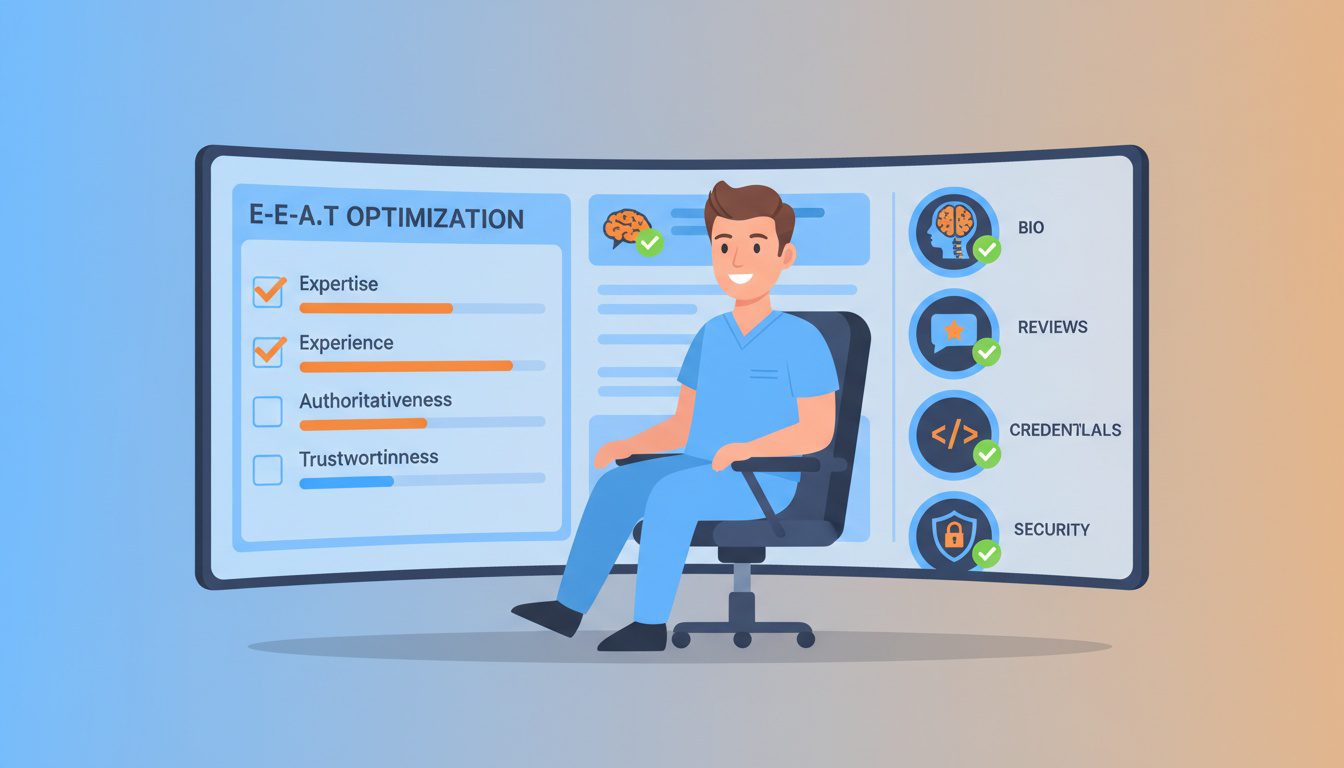
Not all E-E-A-T signals carry equal weight. Some deliver quick wins. Others take months of consistent effort.
This table breaks it down:
High-Converting Topic Categories
| Author bio pages with credentials | Expertise | High | Low | 1-2 weeks |
| Patient reviews on Google Business Profile | Trust | Very High | Medium | Ongoing |
| HTTPS/SSL certificate | Trust | High | Low | 1 day |
| Schema markup (Person, LocalBusiness) | All | Medium-High | Medium | 2-4 weeks |
| Professional directory listings | Authority | Medium | Low | 2-3 weeks |
| Case studies with outcomes | Experience | High | Medium | 1-2 months |
| Backlinks from health publications | Authority | Very High | High | 6+ months |
| Credentials displayed on content | Expertise | High | Low | 1 week |
| Transparent contact/location info | Trust | High | Low | 1 day |
| Privacy policy and terms | Trust | Medium | Low | 1 week |
| Real photos (not stock) | Experience | Medium | Low | 2-3 weeks |
| Response to reviews | Trust | High | Low | Ongoing |
Start with the low-difficulty, high-impact signals.
Get your author bios built out. Make sure HTTPS is active. Start systematically requesting patient reviews.
Then work your way up to earning quality backlinks and building media mentions.
Step-by-Step: Building E-E-A-T Signals for Your Chiropractic Website
Alright, let's get tactical.
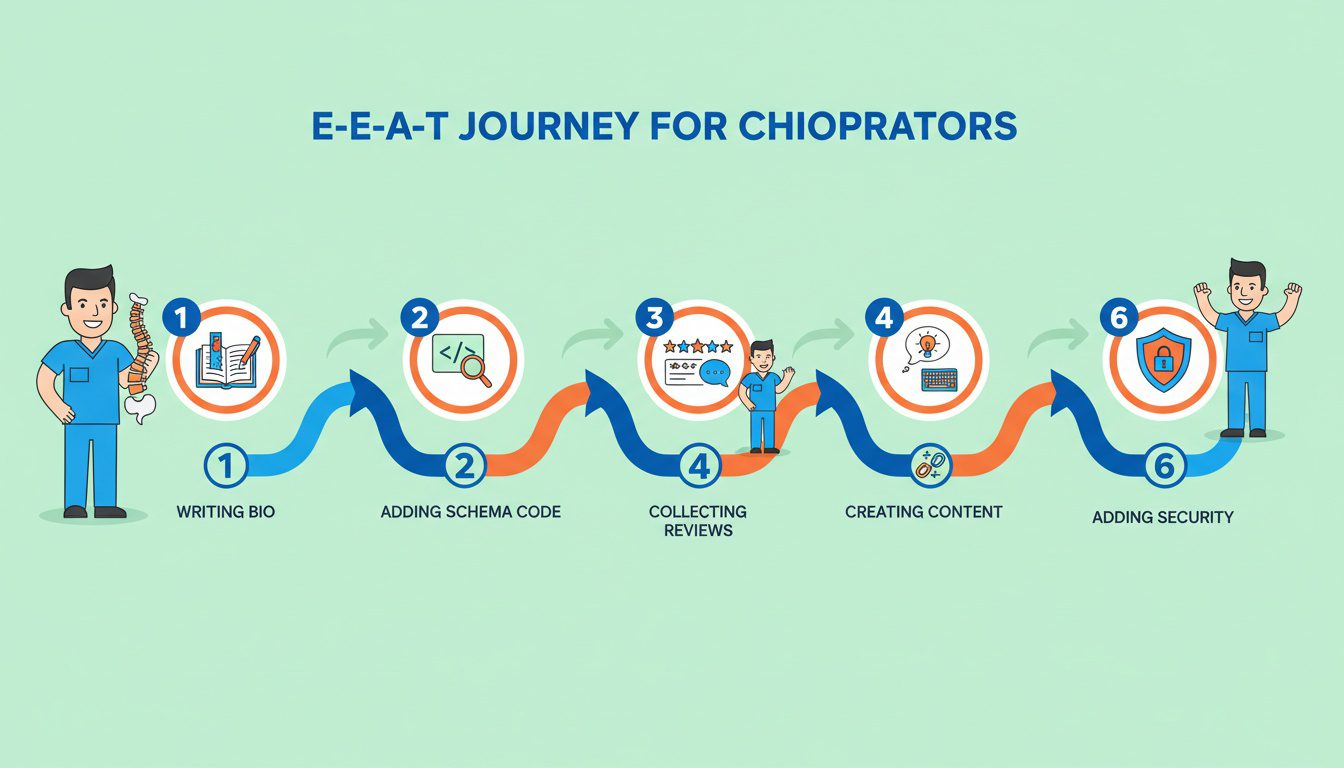
Here's exactly how to implement E-E-A-T improvements on your site. These are the same steps we use with clients.
Step 1: Create Killer Author Bio Pages
Your author bio is the single most important page most chiropractic websites are missing.
Every chiropractor creating content needs a dedicated bio page. Not a paragraph in the footer. A full page.
What to include:
- Full name with credentials (Dr. Jane Smith, DC, CCSP)
- Professional headshot (not stock photos... real you)
- Education and training history
- Years of experience and patient count
- Specialized certifications and techniques
- Professional memberships (ACA, state associations)
- Publications or speaking engagements
- Social media profiles and professional links
Now... this part matters.
Link to this bio page from every piece of content that chiropractor creates.
The byline should be clickable. It leads readers (and Google's crawlers) directly to the credentials backing up the content.
Step 2: Implement Schema Markup for Trust Signals
Schema markup is structured data that helps Google understand who you are and what you do.
For chiropractors, you need three types of schema markup:
- Person schema - For author bio pages, including credentials, education, social links
- LocalBusiness (or Physician) schema - For your practice... address, phone, hours, services
- FAQPage schema - For any FAQ content (can earn you rich snippets in search)
Here's what Person schema looks like:
{
"@context": "https://schema.org",
"@type": "Person",
"name": "Dr. Jane Smith",
"jobTitle": "Doctor of Chiropractic",
"description": "Board-certified chiropractor with 15 years experience...",
"image": "https://yoursite.com/dr-smith-photo.jpg",
"sameAs": [
"https://linkedin.com/in/drjanesmith",
"https://twitter.com/drjanesmith"
],
"worksFor": {
"@type": "MedicalBusiness",
"name": "Your Practice Name"
}
}
If that looks technical... don't worry.
WordPress plugins like Rank Math or Yoast can handle most of this automatically once you configure them.
Step 3: Build a Systematic Review Generation Process
Patient reviews are trust signals Google can verify independently.
You need a system. Not just hoping patients remember to leave one.
Tactics that actually work:
- Send follow-up emails 24-48 hours after appointments with direct link to your Google review page
- Train front desk staff to request reviews at checkout from satisfied patients
- Create a simple QR code linking directly to your review page
- Respond to every review (positive AND negative) professionally
The goal isn't manipulating reviews. It's making it easy for genuinely satisfied patients to share their experience.
Getting more patient reviews is one of the highest-impact activities for both E-E-A-T and local SEO.
Step 4: Create Experience-Based Content
Generic content won't cut it anymore.
Google wants to see that your content comes from actual experience.
Here's how to inject it:
- Start with personal observations - "In my practice, I see this pattern with sciatica patients..."
- Include specific details only practitioners would know - Treatment timelines, common patient questions, adjustment techniques
- Add real (anonymized) patient stories - "A patient came to me after three failed PT rounds..."
- Share your methodology - Why you approach certain conditions differently than textbook recommendations
Here's the test...
Ask yourself: "Could someone who's never practiced chiropractic have written this?"
If the answer is yes? Your content lacks experience signals.
Step 5: Establish External Authority Through Strategic Outreach
Building authority means getting your name and expertise in front of other trusted sources.
Tactics that actually work:
- Guest posts on health and wellness sites - Offer expert commentary on topics you know
- Local news interviews - Position yourself as the go-to source for chiropractic topics in your area
- Professional association involvement - Active membership and contributions
- Collaborative content - Partner with PTs, massage therapists, orthopedists on educational content
Here's the kicker...
Don't buy backlinks. Google is extremely good at detecting paid link schemes. The penalties can destroy your rankings.
Focus on creating content valuable enough that other sites want to reference it.
Step 6: Lock Down Technical Trust Signals
These are table stakes. Without them, nothing else matters.
Essential technical trust signals:
- SSL certificate - Your URL should show HTTPS, not HTTP. Period.
- Complete contact information - Physical address, phone, email on every page (typically in footer)
- Clear navigation - Users and crawlers should find important info easily
- Mobile-responsive design - Over 60% of health searches happen on mobile
- Privacy policy - Required by law most places, and a trust signal to Google
- Terms of service - Especially important if you collect any patient information online
If your website design is outdated, slow, or hard to navigate... fix that before worrying about advanced E-E-A-T tactics.
A poor user experience undermines every other trust signal you build.
Ready to See How We Fix Chiropractic Websites?
We've transformed 150+ service-based websites using our proven 4-step system. See exactly how we combine premium design with conversion science.
Basic vs. Advanced E-E-A-T Implementation
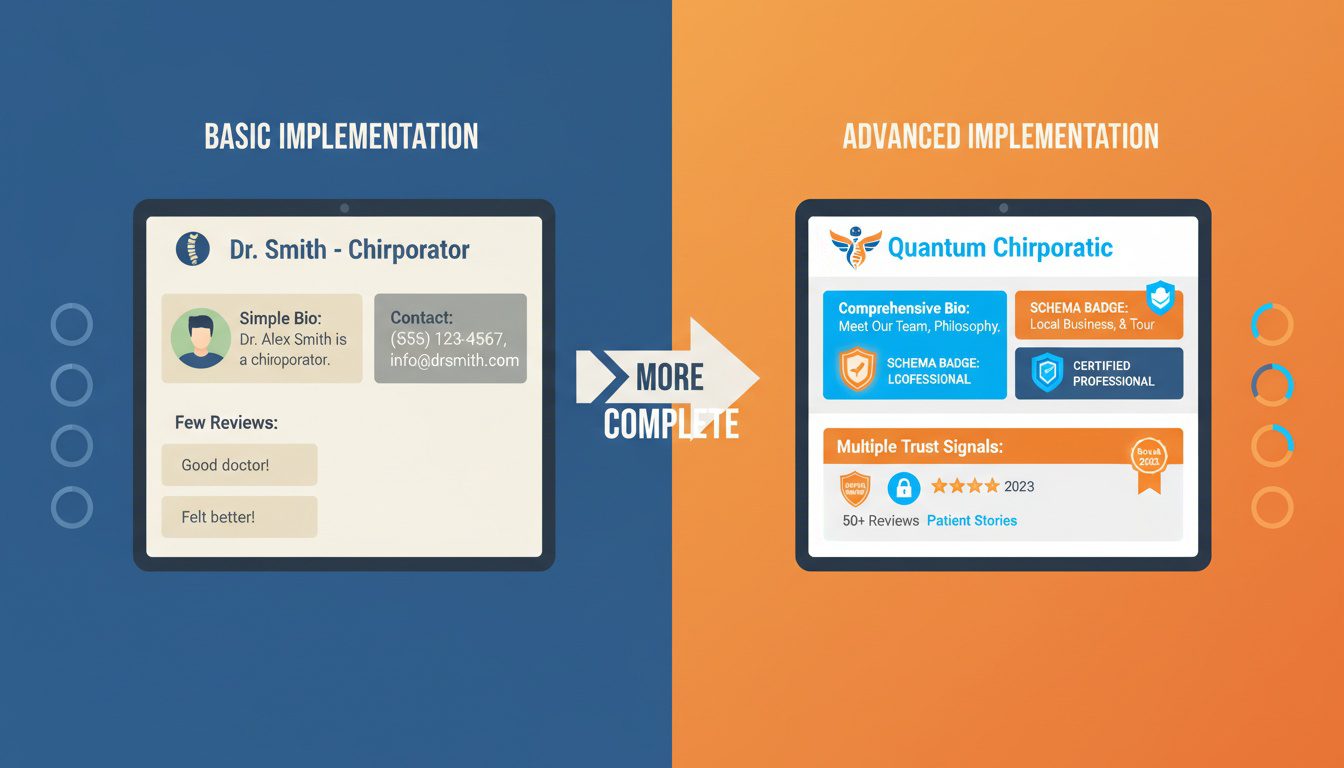
Not every practice needs to implement every E-E-A-T signal perfectly.
But understanding the difference helps you know where you stand.
| Author Bio | Name and credentials in byline | Dedicated bio page with schema, social links, publications |
| Reviews | Some Google reviews, occasional responses | 50+ reviews, systematic generation, responses to all |
| Content Attribution | Author name on posts | Author bio box, linked credentials, expert reviewer mentioned |
| Schema Markup | Basic LocalBusiness schema | Full Person, LocalBusiness, FAQPage, MedicalBusiness schema |
| Trust Signals | SSL certificate, contact page | SSL, trust badges, HIPAA compliance statement, memberships displayed |
| External Authority | Listed in basic directories | Backlinks from health publications, local media mentions, guest posts |
| Experience Signals | Generic health content | Case studies, personal observations, patient stories, original photos |
| Content Review | No formal review process | Licensed chiropractor reviews all content, "medically reviewed by" notation |
If you're at basic implementation right now? That's fine.
Start there and systematically work toward advanced.
Here's the thing...
Most chiropractors competing in local markets can see significant improvements just from reaching solid basic implementation. Because their competitors aren't doing even that.
Common E-E-A-T Mistakes Chiropractors Make

Let's talk about what NOT to do.
These mistakes can actively hurt your E-E-A-T signals.
Publishing Anonymous or Generic Content
If your blog posts say "Posted by Admin" or have no author attribution at all...
You're shooting yourself in the foot.
Google's guidelines explicitly look for clear authorship. Anonymous health content is a red flag for Quality Raters.
The fix: Every piece of content needs a named author with verifiable credentials. Using a content writer? Have a licensed chiropractor review and approve, then list them as author or medical reviewer.
Hiding Credentials Instead of Showcasing Them
You went to school for years. Passed boards. Maintain licenses and certifications.
Why is that buried in 10-point footer text?
Your credentials should be prominently displayed on every page where you're creating health-related content.
In the author bio box. In the header. In schema markup.
Everywhere Google might look.
Ignoring Negative Reviews
A one-star review feels terrible.
But ignoring it? That's worse.
How you respond to negative feedback is a trust signal.
A professional, empathetic response shows potential patients (and Google) that you care about patient experience and take feedback seriously.
Never argue with reviewers publicly. Acknowledge their concern, apologize for their experience, offer to discuss offline.
Using Stock Photos Exclusively
Stock photos of smiling people in lab coats don't demonstrate experience.
They demonstrate you have a Shutterstock subscription.
Real photos from your actual practice, with your real team, treating real patients (with permission) signal authenticity that Google's algorithms are increasingly capable of detecting.
You don't need professional photography. Decent smartphone photos of your treatment rooms, your team, your facility... infinitely better than generic stock images.
Creating Content Outside Your Actual Experience
If you've never treated pediatric patients, don't write a comprehensive guide to pediatric chiropractic care.
Google's Experience signal specifically looks for first-hand knowledge.
Writing authoritatively about topics outside your actual experience can backfire when Google's systems detect the disconnect.
Stick to what you actually know and do. That's where your E-E-A-T signals are strongest.
Measuring Your E-E-A-T Progress
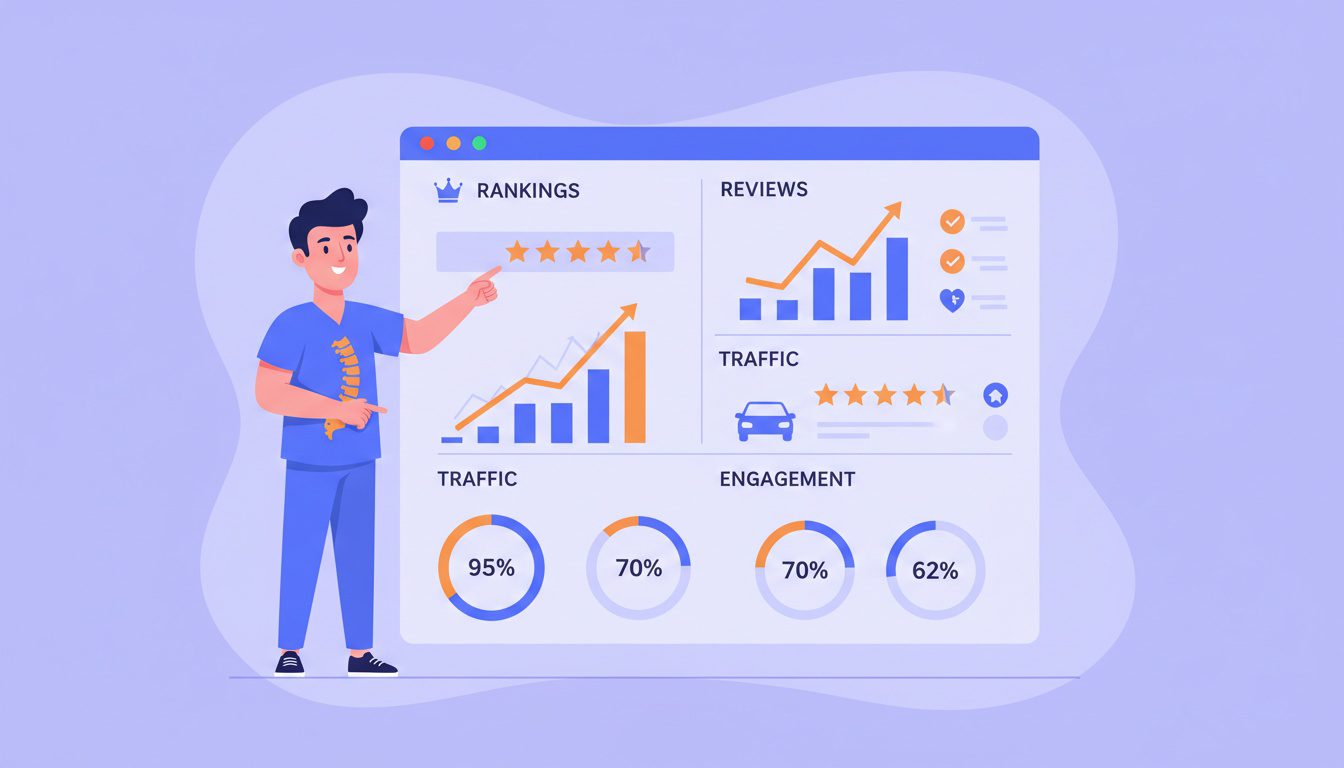
E-E-A-T isn't something you measure with a single tool.
But you can track proxy metrics that indicate whether your efforts are working.
Key metrics to monitor:
- Organic search rankings - Are you moving up for competitive healthcare terms?
- Organic traffic trends - Is Google sending you more visitors over time?
- Click-through rates - Higher CTR suggests users trust your listing
- Time on page - Longer engagement indicates content quality
- Review quantity and average rating - Direct trust signals
- Backlink growth - More quality links indicate growing authority
- Branded search volume - Are more people searching for your practice by name?
Use Google Search Console to track rankings and click-through rates.
Google Analytics shows you traffic patterns and engagement metrics.
For reviews? Track them monthly. Set a goal (maybe 5 new reviews per month) and measure against it.
For backlinks, tools like Ahrefs, Semrush, or even free alternatives like Ubersuggest can show who's linking to your site.
Now... here's the timeline reality.
E-E-A-T improvements typically take 3-6 months to show measurable ranking impact.
Don't expect overnight results from trust-building activities. This is a long game.
Is E-E-A-T a direct Google ranking factor?
Nope. E-E-A-T isn't a direct ranking factor like backlinks or page speed.
It's a framework Google uses to evaluate content quality through human Quality Raters.
But here's the thing... Google's algorithms are designed to reward content demonstrating strong E-E-A-T signals. So improving them indirectly impacts your rankings over time.
The Backlinko E-E-A-T research breaks this down in detail.
Why are chiropractors held to higher E-E-A-T standards?
Chiropractic websites fall under Google's YMYL (Your Money or Your Life) category.
You provide health-related information that can impact someone's wellbeing.
Google holds YMYL sites to stricter quality standards because inaccurate medical information could potentially harm users.
That means demonstrating expertise, credentials, and trustworthiness is even more critical for healthcare providers.
How long until I see results?
E-E-A-T improvements typically take 3-6 months to show measurable ranking improvements.
Google needs time to recrawl your site, evaluate changes, and adjust rankings.
Trust is built over time through consistent signals. Think of E-E-A-T as a long-term investment, not a quick fix.
Do I need to hire a medical writer?
Not necessarily.
The most effective approach? Have a chiropractor review and approve content, even if someone else writes the initial draft.
What matters is that content is medically accurate and attributed to a qualified professional.
You can use AI tools or content writers. But always have the licensed chiropractor add personal insights, verify accuracy, and be listed as author or reviewer.
What's the most important E-E-A-T signal?
Trustworthiness. It's the foundation everything else builds on.
For chiropractors specifically, this means:
- Verifiable credentials displayed prominently
- Genuine patient reviews
- Secure website (HTTPS)
- Accurate contact information
Without trust, experience and expertise signals carry less weight.
Can patient reviews really impact rankings?
Yes. Patient reviews are a powerful E-E-A-T signal.
Reviews demonstrate real-world experience with your practice and build social proof Google recognizes.
Both quantity and quality matter. Along with how you respond.
A practice with 50+ genuine reviews and thoughtful responses signals trustworthiness far more than one with zero reviews.
Managing your online reputation is one of the highest-impact E-E-A-T activities you can do.
Should I add schema markup myself or hire someone?
Basic schema markup (LocalBusiness, Person, FAQPage) can be implemented using free tools and WordPress plugins without coding knowledge.
For more complex implementations... or if you're not comfortable with technical tasks... hiring an SEO professional is worth it.
Incorrectly implemented schema can actually hurt your site. So accuracy matters.
How do I demonstrate 'Experience' as a chiropractor?
Share real patient stories (with permission). Include photos from your practice. Document your years of experience. Mention specific conditions you've treated.
Add personal insights to your content.
Instead of generic advice about back pain, share what you've observed in your 15 years of treating patients.
First-hand knowledge that only comes from doing the work... that's what Google looks for.
Wrapping This Up
E-E-A-T isn't going away.
If anything, Google's emphasis on experience, expertise, authoritativeness, and trustworthiness keeps increasing... especially for healthcare websites like yours.
The chiropractors who figure this out now? They'll dominate local search for years.
The ones who don't will keep wondering why competitors rank higher despite less experience.
Start with the fundamentals.
Build out your author bio pages. Implement basic schema markup. Create a system for generating patient reviews.
Then tackle the harder stuff. Earn backlinks from reputable sources. Get mentioned in local media. Create content demonstrating real experience... not regurgitated health info anyone could write.
You have the credentials. You have the experience.
You just need to communicate it in a way Google understands.
Look, I get it.
E-E-A-T optimization feels like one more thing on an already overwhelming list.
If you're thinking "this all makes sense, but I don't have time to do it right"... you're not alone. Most successful chiropractors we work with felt the same way before they realized their website was quietly costing them 15-20 qualified patient leads every single month.
That's why we created our Free Website Conversion Analysis. It's not a sales pitch—it's a genuine walkthrough of the 3 biggest problems killing your bookings, delivered personally via Loom video within 24 hours.
We'll show you exactly:
- Why visitors leave without booking
- What's broken on mobile devices (where most searches happen)
- Missing trust signals costing you patients
- Where you rank vs. local competitors
- Simple fixes that drive more calls this month
You'll also get an instant case study while you wait, showing real examples of how other chiropractors fixed these exact problems.
Get your free analysis here — no credit card, no obligation, just actionable insights you can use whether you work with us or not.
Because every day your website lacks proper E-E-A-T signals is another day Google is sending those patients to your competitors who've figured this out.

Gerek Allen
Co-Owner iTech Valet
Entrepreneur, patriot, CrossFit junkie, IPA enthusiast, loves to travel to tropical destinations, and knows way too many movie quotes.


About iTech Valet
iTech Valet specializes in web design and content marketing for online entrepreneurs who want to share their expertise.
Services Include:
- Web Design
- Graphic Design
- Sales Copy
- Funnel Building
- Authority Sites
- Membership Sites
- Course Creation
- Email Systems
- Content Marketing
- Competitive Analysis
- Tech Integrations
- Strategic Planning
NEED MORE CLIENTS?
Free conversion-focused analysis uncovers the 3 biggest problems killing your bookings — we'll walk you through your results personally

621 Enterprises, Inc. | Copyright 2022 | All rights reserved
Frequently Asked Questions About E-E-A-T for Chiropractors