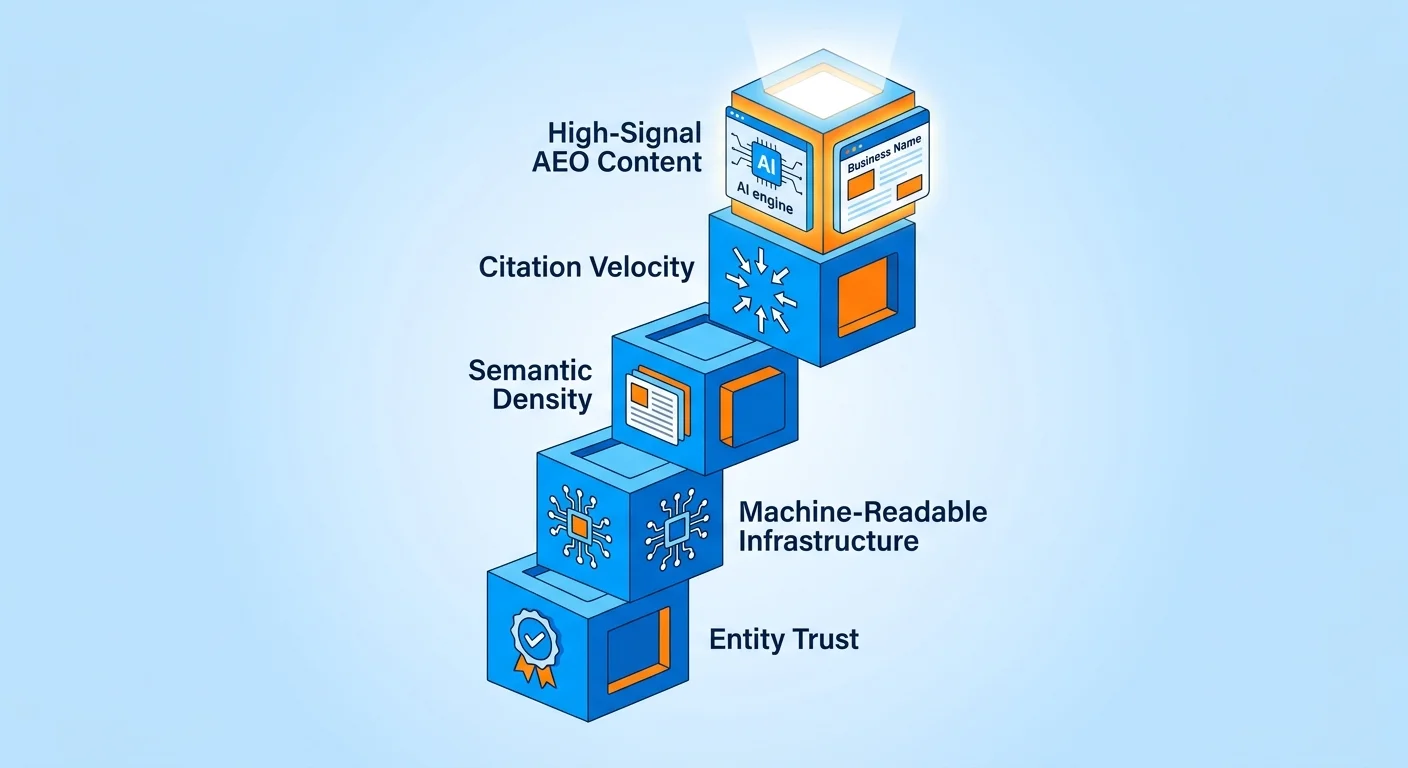
The Five Core Components of an AI Authority Engine
Most agencies still sell tactics for a world that no longer exists. They optimize for page one rankings when AI doesn’t show a page one. They chase traffic numbers when zero-click searches mean the answer never leaves the AI interface.
They’re playing a game that ended.
An AI Authority Engine isn’t a marketing tactic.
It’s the infrastructure that makes AI engines trust your business enough to say your name when it matters.
Five components build that trust. Each one compounds on the others. Miss one and the entire system weakens.
The five core components are Entity Trust, Machine-Readable Infrastructure, Semantic Density, Citation Velocity, and High-Signal AEO Content.
These aren’t SEO tricks rebranded for AI. They’re the actual signals AI engines use to decide whose name gets recommended.
| Component | What It Does | Why AI Needs It |
|---|---|---|
| Entity Trust | Establishes verifiable consistency across all platforms by confirming Name, Address, and Phone data match everywhere AI looks | AI engines validate businesses by cross-referencing multiple sources; inconsistent data signals unreliability and disqualifies recommendation |
| Machine-Readable Infrastructure | Uses structured data technologies like Schema.org to transform content into facts AI systems can extract and store in their Knowledge Graph | AI cannot read unstructured content; without machine-readable markup, your business is invisible regardless of content quality |
| Semantic Density | Demonstrates expertise through content clusters that cover a topic comprehensively across multiple related articles and pages | AI engines analyze topic depth to determine authority; single-keyword optimization signals shallow knowledge rather than genuine expertise |
| Citation Velocity | Measures how frequently and consistently AI systems reference your business as a trusted answer over time | AI engines prioritize entities with growing citation patterns; velocity signals increasing market authority and validates trustworthiness |
| High-Signal AEO Content | Addresses all five layers of user intent in every article, covering the literal question plus the real goal, objections, and next steps | AI engines extract answers that anticipate user needs; content answering only the surface question loses to comprehensive answers that satisfy complete intent |
Component 1 – Entity Trust
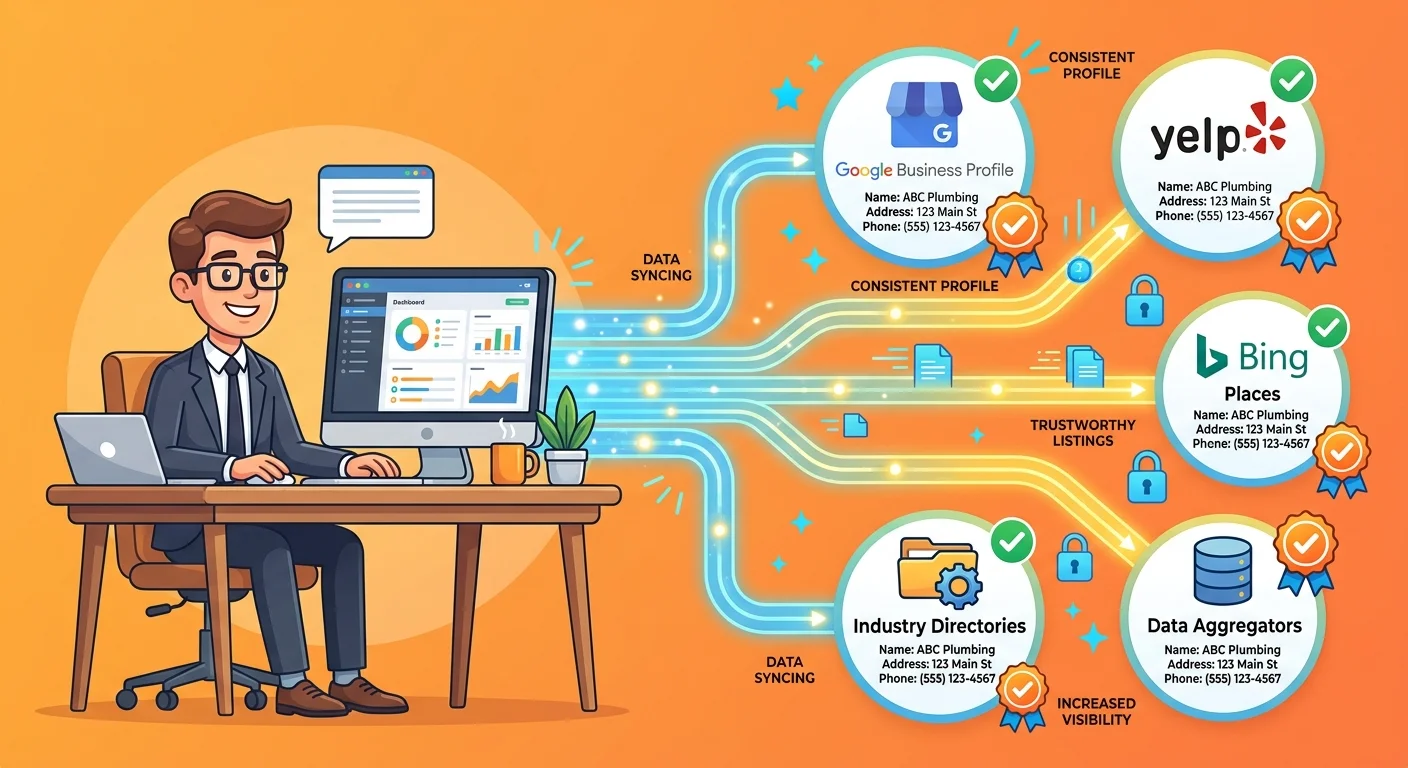
Entity Trust is the foundation. Before AI recommends you, it has to know who you are.
Entity Trust requires consistent and verifiable business information across the web. Your Name, Address, and Phone data match everywhere AI looks. Same spelling. Same phone format. Same address. AI engines cross-reference dozens of platforms to validate you’re real. One inconsistency weakens the trust signal.
Why Most Businesses Fail Entity Trust
Most businesses fail Entity Trust because they treat their digital presence like a patchwork quilt. Different names on different directories. Old addresses nobody updated. Phone numbers that changed three years ago but still live on 40 citations.
AI doesn’t guess which version is correct. It sees conflicting data and moves on to the next business.
The agencies selling you traffic and rankings never bothered to audit your entity consistency. They built pretty websites on top of broken foundations. When AI goes looking for verification signals, it finds chaos instead of clarity.
How AI Validates Entity Trust
AI cross-references your business information across platforms it already trusts. Google Business Profile. Major directories. Structured data on your website. Industry-specific databases.
Google’s understanding of entities starts with verifiable facts. AI builds a Knowledge Graph from consistent signals. The more platforms that confirm the same information about your business, the stronger your entity signal becomes.
Building entity trust isn’t about gaming the system. It’s about making sure every platform AI checks tells the same story. When AI validates your entity and finds consistency, you become a candidate for recommendation. When it finds inconsistency, you don’t.
| Entity Signal | Where AI Checks | Common Failure Point |
|---|---|---|
| Business Name Consistency | Google Business Profile, major directories, schema markup on website, social profiles | Abbreviations on some platforms, legal name on others, DBA inconsistencies across citations |
| Address Verification | NAP citations, Google Maps, industry directories, site footer, contact pages | Old address on legacy directories, suite number missing on some platforms, mailbox address treated as physical location |
| Phone Number Matching | Schema LocalBusiness markup, contact pages, directory listings, call tracking integrations | Call tracking numbers rotated across platforms, different numbers for different services, outdated listings with disconnected lines |
| Category and Service Consistency | Google Business Profile categories, schema Service markup, directory category selections | Generic categories chosen for broader reach, conflicting service descriptions, categories changed frequently to chase trends |
| Operating Hours Accuracy | Google Business Profile, schema OpeningHours, social profiles, website banners | Hours not updated after schedule changes, holiday hours left active year-round, emergency closures never reflected online |
Component 2 – Machine-Readable Infrastructure
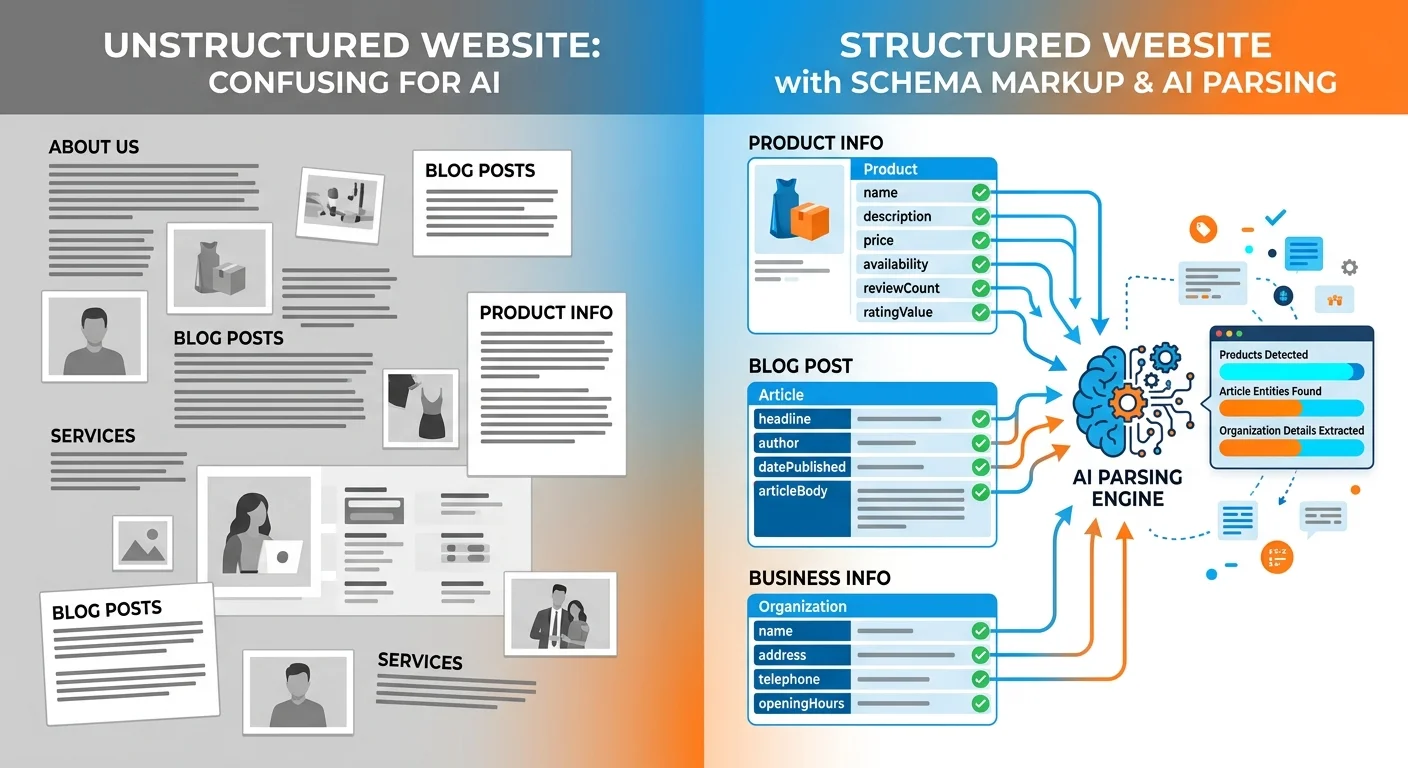
Entity Trust tells AI who you are. Machine-readable infrastructure tells AI what you know.
Without machine-readable infrastructure, AI can’t extract the facts it needs to build your Knowledge Graph entry. Your site becomes architecturally invisible. Doesn’t matter how good your content is if AI can’t parse it.
What Machine-Readable Actually Means
Machine-readable doesn’t mean human-readable. It means your website speaks the language AI uses to extract, validate, and catalog information.
Most websites get built for human visitors. Clean design. Clear copy. Pretty images. But AI doesn’t process visual design or marketing language the way it processes structured data and schema markup. AI needs explicit tags that label what each piece of content represents. Without that, you’re invisible.
Structured data helps Google and other AI systems understand page content and establish facts for their Knowledge Graph. It’s the difference between AI guessing what your business does and AI knowing with certainty.
The Schema Markup Layer
The Schema Markup Layer is where machine-readability gets real. Schema.org provides the vocabulary AI engines recognize.
Most agencies slap a basic LocalBusiness schema on your homepage and call it done. They miss the depth. Service schemas. FAQ schemas. Article schemas. Review schemas. Every content type needs its own structured data wrapper so AI knows exactly what it’s looking at.
When AI crawls a site with deep schema implementation, it doesn’t infer. It extracts. It catalogs. It adds your business to its index as a verified source.
Our AEO Content Writing Services build content with schema wrappers from day one. Every article. Every FAQ. Every service description. AI doesn’t guess what we’re saying because we’ve already told it in the language it understands.
Component 3 – Semantic Density
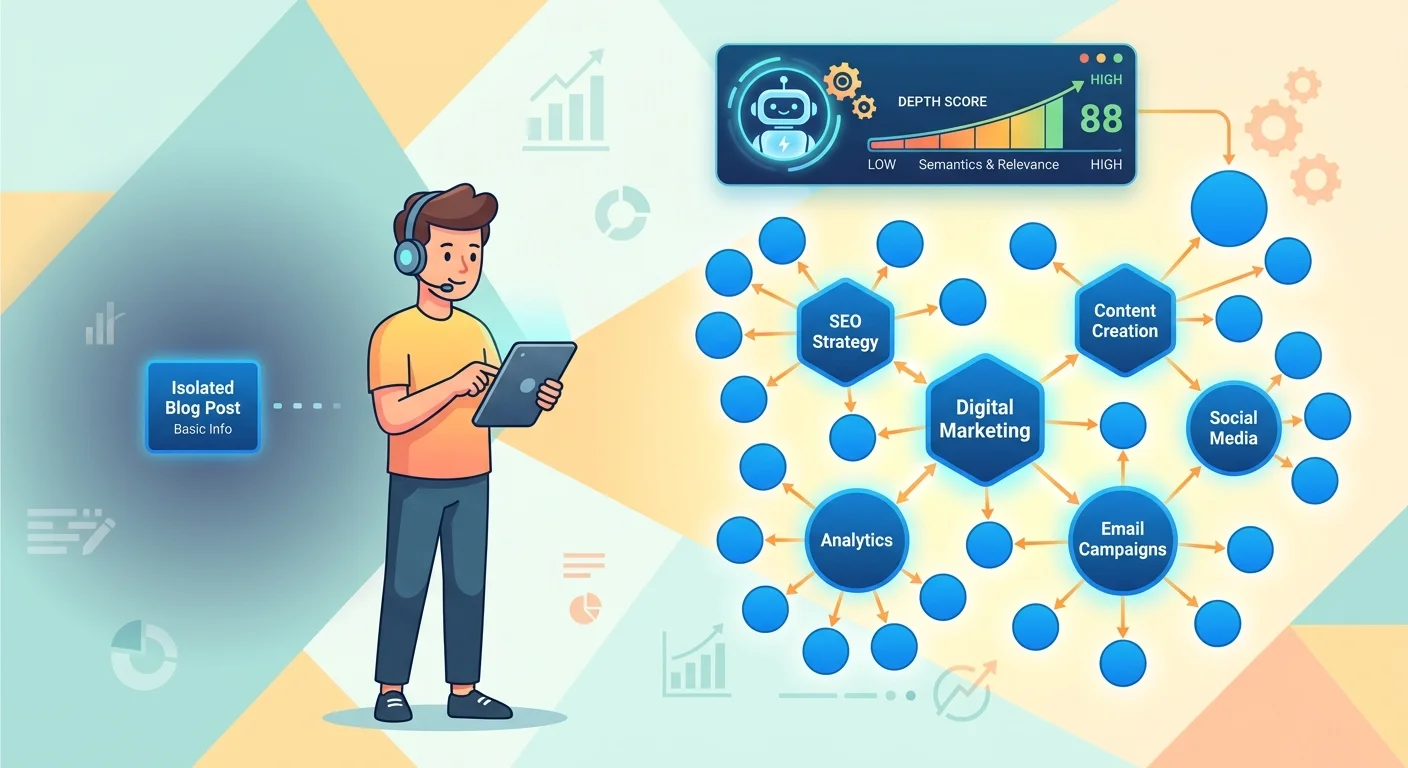
Infrastructure gets you readable. Semantic Density gets you credible.
Semantic Density is the depth and relevance of content on a specific topic. AI engines analyze content clusters to figure out how much you actually know – not how many times you mentioned a keyword. AI models moved beyond single keyword optimization years ago.
One article on a subject tells AI you mentioned it.
Ten interconnected articles on the same subject tell AI you own it.
Why One Article Doesn’t Cut It
Here’s what breaks it for most businesses. They publish one blog post on a topic and expect AI to treat them as an authority. It doesn’t work that way.
AI doesn’t evaluate individual articles in isolation. It maps your entire content footprint.
When someone asks an AI engine about a topic, it doesn’t pull the best single article. It looks for the business that’s demonstrated the deepest understanding across multiple pieces of interconnected content.
The agency that sold you monthly blog posts gave you isolated articles with no semantic relationship to each other. No clustering. No depth. Just disconnected content AI can’t use to build a credible expertise signal.
That’s why their traffic reports showed visits but zero AI citations.
How AI Measures Topical Depth
AI measures topical depth by analyzing how your content connects. Not just internal links – actual semantic search signals that prove you understand the relationships between concepts.
When AI crawls your site, it’s not counting keywords. It’s mapping the semantic network.
Does your content on Entity Trust connect to your content on Schema Markup? Does your explanation of Citation Velocity reference the mechanics of zero-click searches? Do your service pages tie back to the methodology you’ve documented in your content library?
Semantic Density compounds over time. Every article you publish that deepens the cluster strengthens the entire network. This is why building a semantic entity hub is the structural foundation of topical authority – not just publishing more content.
This is why The AI Authority System emphasizes monthly content execution as a non-negotiable. Authority isn’t built in a sprint. It’s built in layers.
| Content Depth Level | What AI Sees | Authority Signal Strength |
|---|---|---|
| Single isolated article | Mentioned the topic once | Weak – no credible expertise signal |
| Three to five related articles | Familiar with the topic | Moderate – basic topical coverage |
| Ten interconnected articles forming a content cluster | Demonstrates depth and understands relationships between concepts | Strong – credible expertise signal |
| Multiple clusters across core service areas with internal semantic linking | Subject matter authority with proven comprehensive knowledge | Very Strong – dominant authority signal |
| Ongoing monthly content execution building layered depth over time | Established trusted source with compounding semantic network | Maximum – AI cites you as the definitive answer |
Component 4 – Citation Velocity
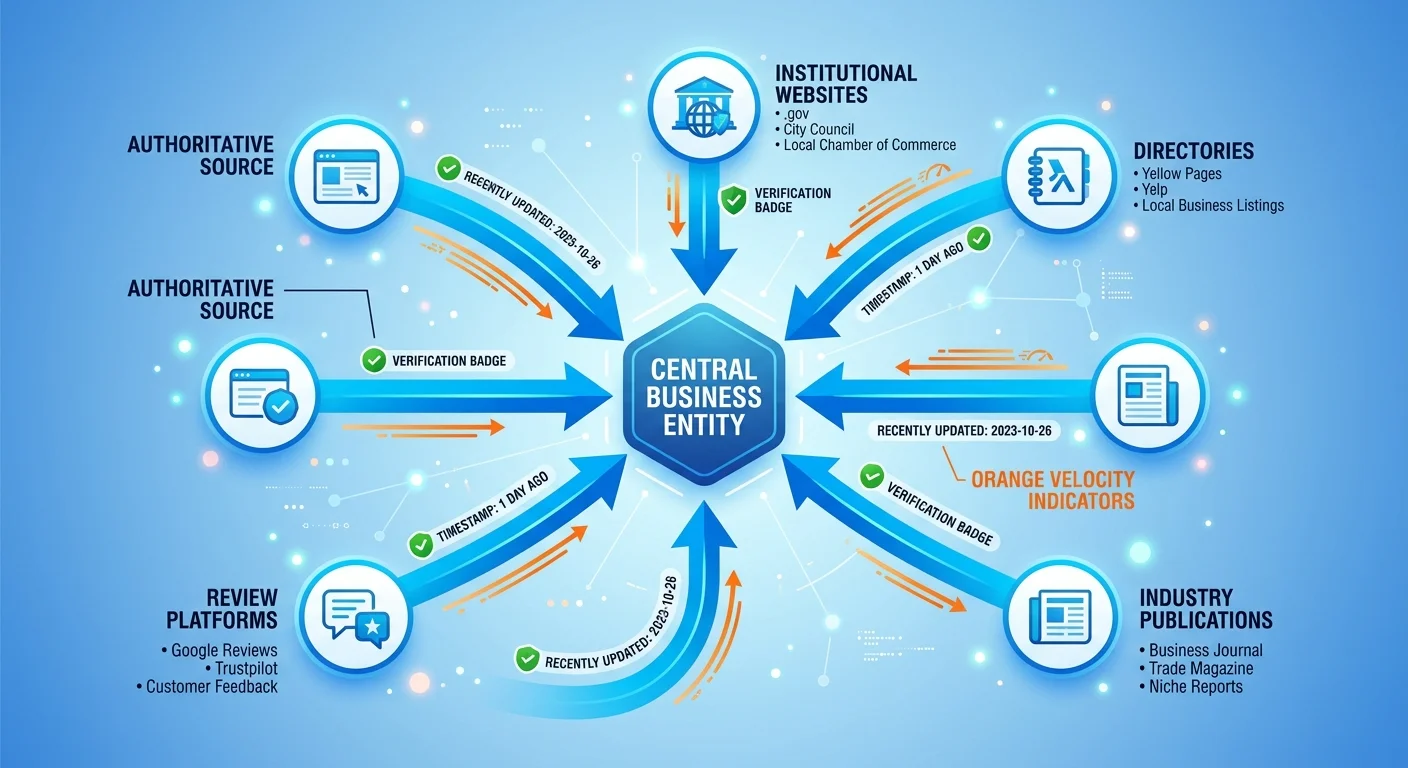
Semantic Density proves you know the topic. Citation Velocity proves others agree.
Citation Velocity measures how often AI engines say your name when someone asks a question in your domain.
Not how many backlinks you have. How often AI recommends you. When someone asks ChatGPT or Gemini who the best chiropractor in their area is – do they say your name?
The faster your citation rate grows, the stronger your authority signal becomes.
Why Citation Velocity Isn’t Link Building
Most agencies hear Citation Velocity and immediately start pitching link building packages. Guest posts. Directory submissions. Backlink outreach.
Wrong.
Link building was built for Google’s old algorithm. Citation Velocity is built for AI’s recommendation engine.
The mechanics aren’t even close. A backlink told Google another site pointed to you. A citation tells ChatGPT or Gemini you’re the trusted source worth naming in the answer.
AI doesn’t rank you. It names you. Or it doesn’t.
AI doesn’t care about your link profile the way Google did. It cares whether authoritative platforms already treat you as a credible answer.
When your business shows up as a recommended provider on healthcare directories, when your methodology gets cited in industry articles, when your content appears in AI training datasets as verified information – that’s Citation Velocity.
And it compounds.
Answer Engine Optimization builds Citation Velocity by making your business the answer AI engines extract and repeat.
Every time AI references your business in a response, your citation signal compounds. The businesses building Citation Velocity now are the ones AI will recommend six months from now.
The ones still buying backlinks are invisible.
Component 5 – High-Signal AEO Content
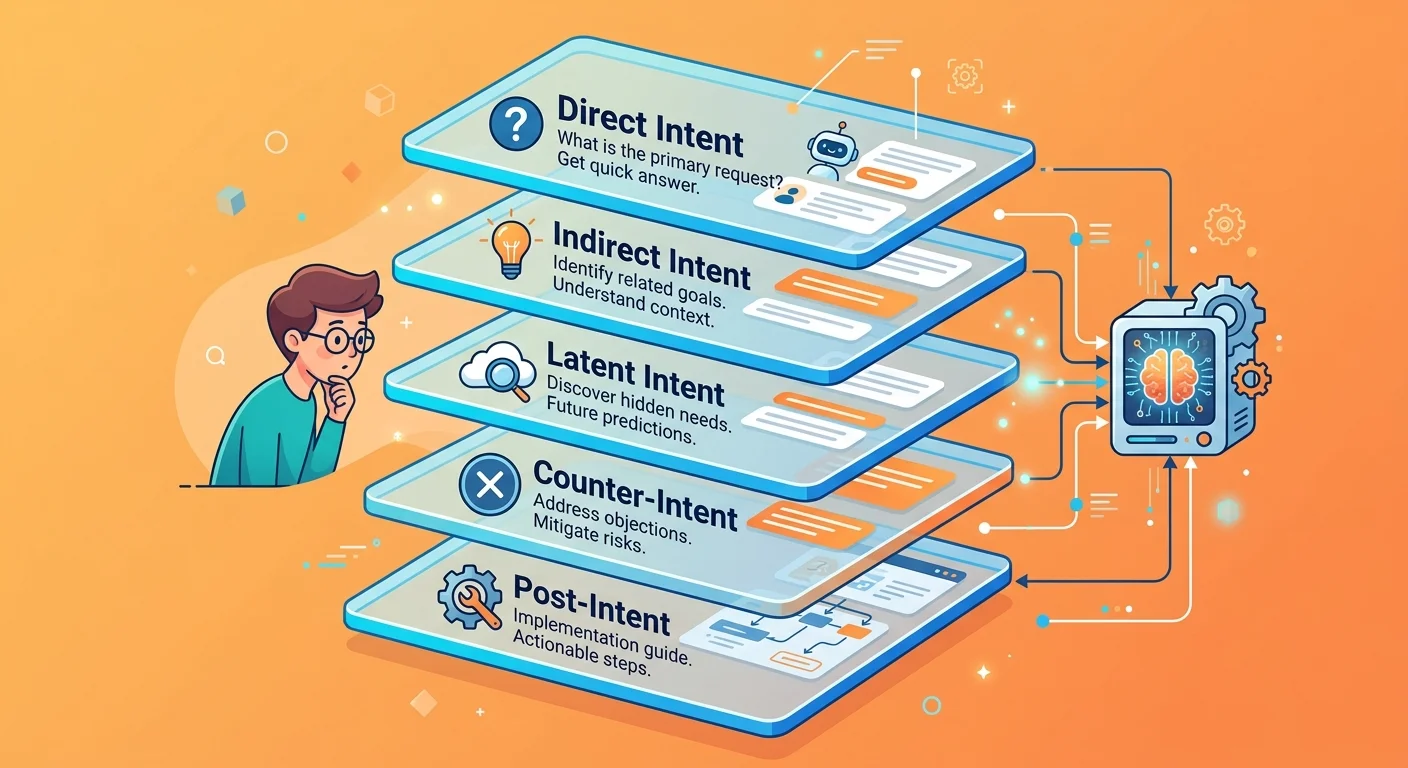
The first four components build the engine. High-Signal AEO Content is the fuel that makes it run.
Content that only answers the literal question loses to content that addresses the real goal, the objections, and what happens next. AI doesn’t reward shallow answers. It rewards depth. It rewards content that anticipates what the reader actually needs – not just what they typed.
The Five Intent Layers
High-Signal AEO Content addresses all five layers of user intent: Direct, Indirect, Latent, Counter, and Post-Intent. Each layer represents a different dimension of what someone’s actually asking when they type a question into ChatGPT or Gemini.
Direct Intent is the literal question. Indirect Intent is the real goal behind it. Latent Intent is what they don’t know they need yet. Counter-Intent addresses objections and hesitations. Post-Intent covers what happens after the answer – implementation, timelines, next moves.
Most content stops at Direct Intent. It answers the question and moves on. AI doesn’t pick the answer that technically satisfies the query. It picks the answer that delivers the most complete, most useful response. The business that built content addressing all five intent layers is the verdict AI delivers.
Why Most Blog Posts Fail AEO
Here’s why most blog posts fail AEO. They were written for Google’s old algorithm, not for AI extraction.
The agency that sold you content optimized for keywords and backlinks. They front-loaded your title with search terms. They stuffed your meta description. They built internal links to manipulate PageRank. None of that matters when AI is deciding whose name to recommend.
AI evaluates content on clarity, completeness, and structure. Can the content be extracted cleanly? Does it answer the question in the first paragraph? Does it provide verifiable facts AI can cite? Does it address objections and next steps? Traditional blog posts were never built to meet those standards.
Our proprietary Two-AI Validation System ensures every article we publish meets AI extraction standards before it goes live. Gemini researches. Claude writes. Gemini validates. Every claim sourced. Every statistic verified. We don’t publish vibes. We publish receipts.
How These Five Components Work Together
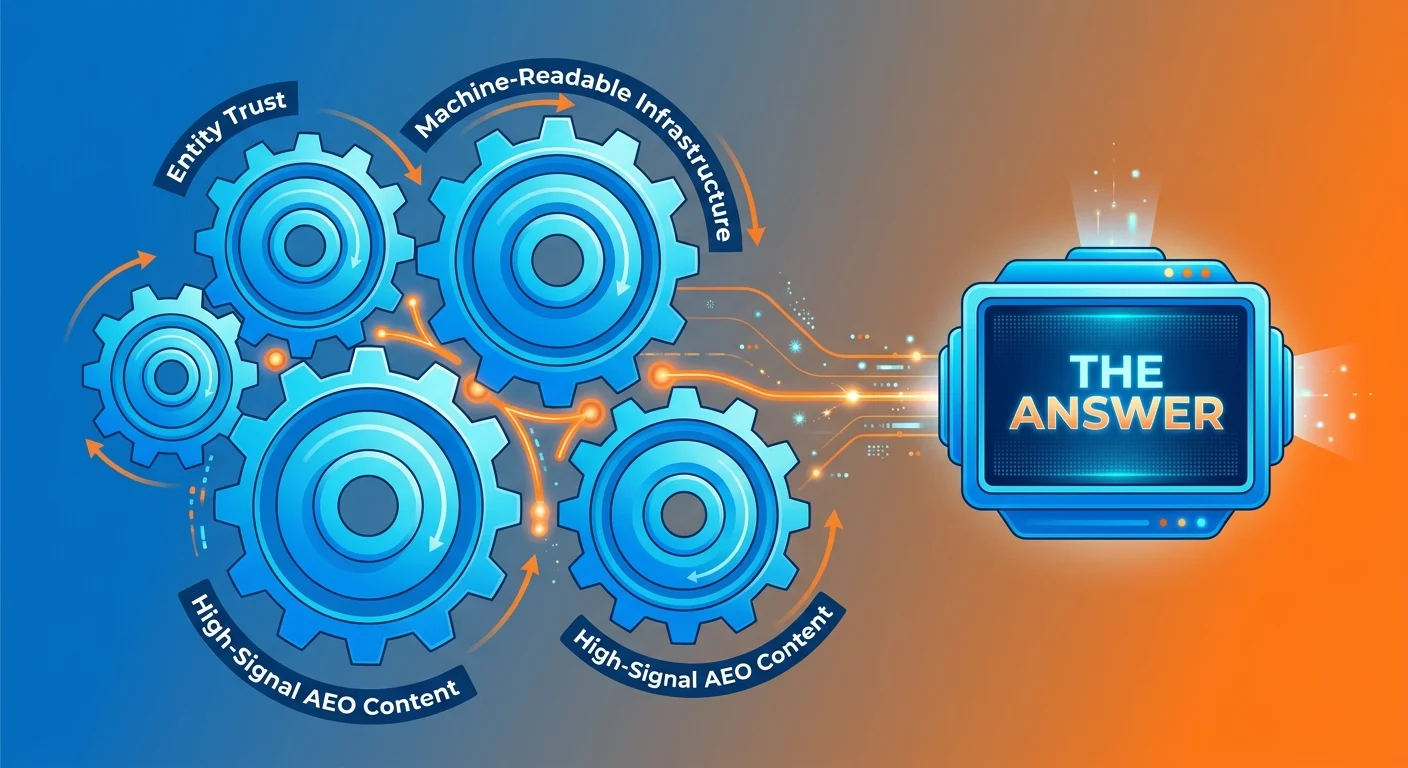
Each component matters. But it’s the integration that creates compounding authority.
- Entity Trust without Machine-Readable Infrastructure – AI knows who you are but can’t extract what you offer
- Machine-Readable Infrastructure without Semantic Density – clean data with zero depth to validate expertise
- Semantic Density without Citation Velocity – you can write but no one else agrees
- Citation Velocity without High-Signal AEO Content – your name gets mentioned but your answers don’t solve the problem
Here’s how it works when you build the whole thing. Entity Trust makes your business identifiable. Machine-Readable Infrastructure makes your content extractable. Semantic Density proves your expertise. Citation Velocity amplifies your reach. High-Signal AEO Content delivers the answer AI needs to recommend you. Together they don’t just get you visible. They make you the verdict.
The Compounding Effect
Authority doesn’t build linearly. It compounds.
The first article you publish with proper schema adds one signal. The tenth deepens the semantic cluster and strengthens every article before it. The twentieth creates enough topical density that AI starts treating your site as a primary source. By month six your Citation Velocity accelerates because AI engines now have enough verified content to recommend you confidently. That’s compounding.
This is why Gartner’s predictions on AI focus on the long game. The businesses building integrated authority infrastructure now are the ones AI will default to when the shift from ranked lists to single verdicts becomes the only search experience that matters. The ones waiting to see proof? Already six months behind.
What Happens When One Component Is Missing
Now here’s what breaks when you skip a component.
- Strong Entity Trust and deep Semantic Density but no Machine-Readable Infrastructure – credible to humans, invisible to AI
- Flawless schema and high Citation Velocity but shallow content – mentioned once, never again, because the answer didn’t solve anything
- Incredible AEO content but weak Entity Trust – your ideas get cited without your name because AI can’t verify who said it
The old game let you fake it with one strong tactic. Page one rankings covered weak content. Paid ads covered terrible websites. The new game doesn’t forgive gaps. AI doesn’t present options. It picks a winner. And it only picks businesses that built the entire engine.
| Missing Component | Immediate Impact | Long-Term Consequence |
|---|---|---|
| Entity Trust | AI knows the content exists but can’t verify who created it or whether the business is legitimate | Content gets extracted and cited without attribution – your ideas spread but your name stays invisible |
| Machine-Readable Infrastructure | AI sees unstructured content it can’t cleanly parse or extract for recommendations | You remain invisible in conversational AI responses even when you publish the best answer available |
| Semantic Density | AI treats you as a surface-level source rather than a trusted expert with proven depth | You get mentioned once and never again because AI finds competitors with demonstrated topical authority |
| Citation Velocity | AI has no external validation that your claims are credible or worth repeating | Your content lives in isolation with no amplification signal – competitors with growing citation rates eclipse you |
| High-Signal AEO Content | AI extracts shallow answers that fail to address objections or next steps | Users ask follow-up questions and AI recommends a competitor whose content delivered the complete answer |
Frequently Asked Questions
You’ve seen what the engine is made of. Now here’s what people get wrong.
These questions come up every time a business owner realizes the strategy they paid for was built for a world that doesn’t exist anymore. The answers matter. Every month you run on outdated assumptions is a month your competitors build the authority AI names instead of you.
How is an AI Authority Engine different from traditional SEO in 2026?
Traditional SEO optimized for ranked lists. AI Authority Engines optimize for single verdicts. SEO built backlinks to manipulate PageRank. AI Authority builds Entity Trust and Citation Velocity so AI engines verify your business exists and confidently recommend it. SEO chased keywords and traffic metrics. AI Authority focuses on becoming the answer AI extracts and cites. The goal shifted from page one to being the only name AI says.
What role does structured data like Schema.org play in an AI Authority Engine?
Structured data and schema markup is the foundation of Machine-Readable Infrastructure. Without it, your site is a PDF to an AI engine. AI can’t extract your services, credentials, location, or expertise cleanly. Schema.org markup is the translation layer. It turns human-readable content into machine-verifiable facts AI can add to its Knowledge Graph. No schema means AI can’t understand what you offer. And if AI can’t parse it, it won’t recommend you.
Is citation velocity just a new term for link building?
No. Link building optimized for Google’s old algorithm. Citation Velocity optimizes for AI recommendation engines. Link building bought backlinks to manipulate rankings. Citation Velocity earns citations by becoming the answer AI engines extract and repeat. A backlink tells Google another site pointed to you. A citation tells ChatGPT your business is the trusted source worth naming in the answer. The mechanics are different. The goal is different. The outcome is different.
How can I measure the ROI of an AI Authority Engine if not by traffic and rankings?
You measure it by running an AI Visibility Check every quarter. Ask ChatGPT and Gemini who they recommend in your market. Track whether your name appears in the answer. Track whether AI cites your content as a source. Track whether your business shows up when someone asks a question you should answer. Traffic and rankings measured visibility in a world of ranked lists. AI recommendation rate measures authority in a world of single verdicts.
What is the single most important component of an AI Authority Engine to start with?
Entity Trust. If AI can’t verify your business exists and matches what you claim to offer, nothing else matters. Start with consistent NAP data across every platform. Lock your Google Business Profile. Claim every directory listing in your industry. Make sure your legal name, address, and phone number match everywhere. Entity Trust is the foundation. Everything else builds on top.
Can a new business build AI authority, or is this only for established players?
Yes. But the window narrows every month. Established businesses have an Entity Trust advantage because AI already knows they exist. New businesses can build authority faster by publishing semantically dense content clusters from day one and deploying Machine-Readable Infrastructure immediately. The advantage established players have compounds over time. The longer you wait to start building, the wider that gap becomes. Start now or accept permanent invisibility in the only search experience that will matter.
The Cost of Building Later
The AI Authority Engine isn’t a project you check off. It’s infrastructure that either compounds or rots.
Every month you’re not publishing high-signal AEO content, your competitors are. Every quarter you run without Machine-Readable Infrastructure, AI engines learn to trust the businesses that have it.
The gap widens. Fast.
Here’s what happens when you wait.
The businesses building Entity Trust now become the names AI defaults to. The ones publishing semantically dense clusters become the sources AI cites. The ones with clean schema become the answers AI extracts.
The ones still running template websites and monthly blog posts? Invisible.
Not ranked lower. Gone.
AI doesn’t recommend them because it can’t verify them.
The shift from ranked lists to single verdicts isn’t coming. It’s here.
ChatGPT doesn’t present five chiropractors and let the user decide. It names one. Gemini doesn’t hedge with ‘it depends.’ It delivers a verdict.
AI doesn’t present options. It picks a winner.
The businesses that built the entire engine – Entity Trust, Machine-Readable Infrastructure, Semantic Density, Citation Velocity, High-Signal AEO Content – get their names said.
Everyone else gets skipped.
You can’t retrofit authority after the window closes.
See what AI says about your business right now. If the answer isn’t your name – someone else is building that authority while you’re sitting here.
The cost of waiting isn’t a delayed start. It’s permanent invisibility in the only search experience that matters.
Want to know if AI says your name when someone asks?
The AI Visibility Check takes fifteen minutes. You’ll see exactly what ChatGPT and Gemini recommend when someone asks who to trust in your market. If it’s not your name, you’re invisible. And every month you wait, the businesses building Entity Trust and Semantic Density pull further ahead.
AI doesn’t present options. It picks a winner.