What Most Agencies Do in Month One (And Why It Sets You Back)

Most agencies spend month one on documentation.
They run automated scans. They package the findings into a branded PDF. They schedule a call to walk you through what they "discovered."
That’s not execution. That’s a delay with a logo on it.
Here’s what it actually looks like. Around day ten, a strategy deck lands in your inbox. It outlines problems with your AI-readable infrastructure. It lists entity conflicts the audit uncovered. It describes what a content plan might look like.
It is thorough. It is well-formatted. And it touches nothing.
The contractor showed up, inspected the foundation, and handed you a report about how much work needs to be done. Without picking up a single tool.
Gartner defines SLAs as agreements that establish measurable baselines within the first 30 days of contract execution. An agency that burns that window on reports has already forfeited the only moment that sets the benchmark for everything that follows.
And once you understand what comes next after an initial diagnostic, the passive playbook is impossible to unsee. You stop reading the deck. You start asking why nothing has been built yet.
Why Passive Audits Don’t Move the AI Needle
Passive audits produce information.
AI engines don’t cite information. They cite entities they trust.
Those are not the same thing.
When a practice gets a report listing schema gaps, entity conflicts, and citation inconsistencies, none of it becomes legible to ChatGPT, Gemini, or Grok until someone actually fixes it.
A PDF describing the problem does not resolve the schema. A checklist of missing entity signals does not build entity trust.
The document is not the work. And in the AI visibility space, report-and-run Answer Engine Optimization is the industry’s most expensive stall tactic.
Every day a clinic’s entity signals remain unresolved, a competitor’s semantic density compounds.
The gap doesn’t pause while an agency prepares its presentation. Passive report collectors know this – which is exactly why they move fast on the proposal and slow on the execution.
Real AI visibility work is visible. It’s verifiable. And it starts in week one of the engagement. Not week four.
| Agency Action | What It Signals | Impact on AI Entity Trust | Legitimate Alternative |
|---|---|---|---|
| Branded audit PDF delivered in week one | The agency is documenting problems rather than solving them | Zero – schema gaps and entity conflicts remain unresolved; AI engines still cannot verify the clinic | Schema markup implemented and entity signals corrected before the end of Foundation Build |
| Automated scan results exported and formatted for a client presentation | The agency’s primary output is a report, not infrastructure | None – automated scans identify gaps but do not close them; AI engines reward resolved signals, not identified ones | Entity conflicts actively resolved across every platform an AI engine consults during Entity Verification |
| Strategy deck delivered mid-month outlining a future content plan | Execution is being deferred to a later phase the client cannot verify will arrive | Compounding loss – every day without AI Authority articles is a day a competitor’s citation velocity increases | First AI Authority articles drafted and structured during Content Infrastructure, not promised for a future quarter |
| Checklist of missing entity signals shared with the client | Accountability is being transferred to the client rather than owned by the agency | Negligible – a checklist does not build entity trust; only executed infrastructure does | Entity trust signals built and verified by the agency, with no action required from the clinic owner |
| Kick-off call to align on goals and review findings | Month one is being treated as a discovery period rather than an execution period | None – alignment conversations produce no machine-readable signals; AI engines cannot cite a strategy session | Baseline Lock closes month one with documented, measurable performance benchmarks – not open-ended alignment |
| Proposal for additional services presented before core deliverables are complete | The agency is upselling before demonstrating the value of what was originally purchased | Negative – attention and budget shift away from the foundational infrastructure that determines AI legibility | Scope stays fixed for the full first month; all resources directed toward the four locked phases before any expansion is discussed |
The Infrastructure Work That Actually Happens in Week One
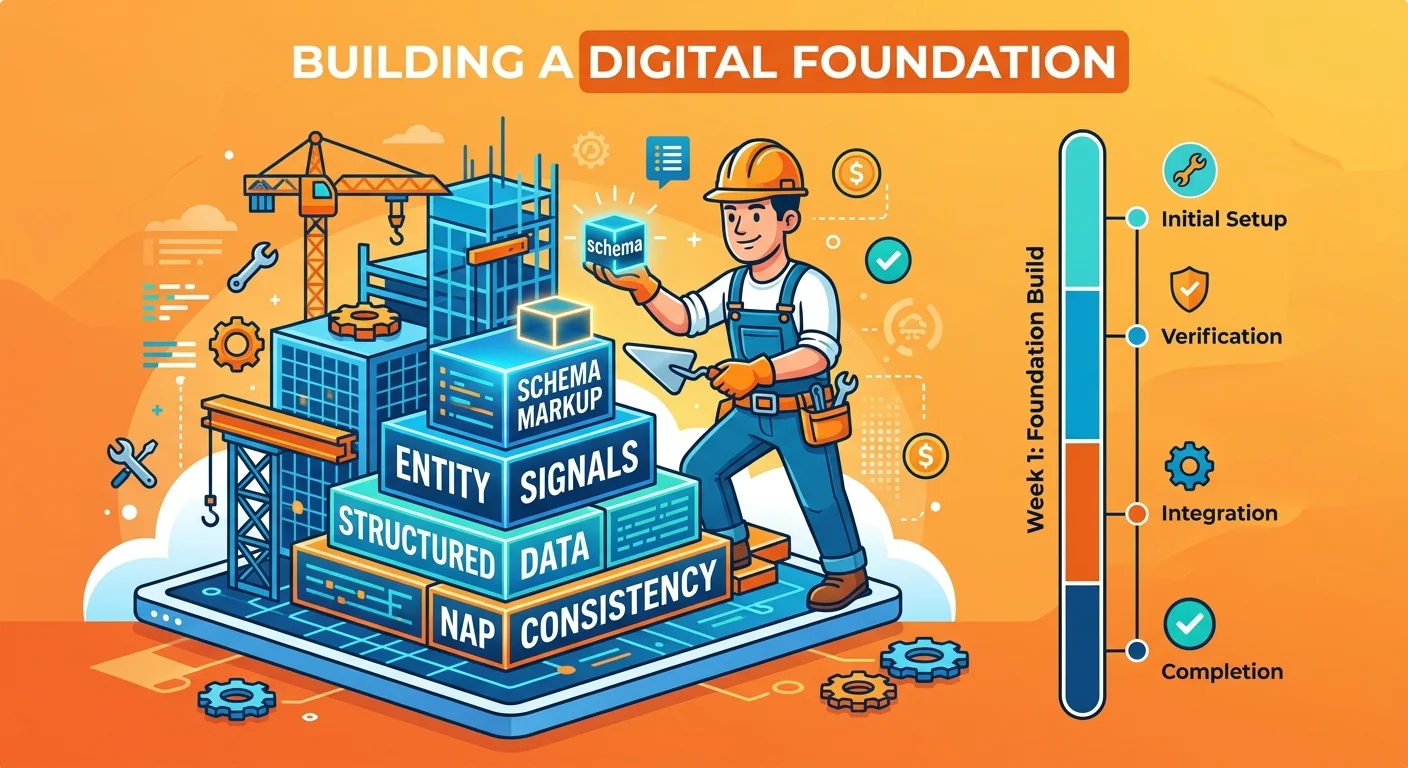
Week one is not a planning week.
It is a foundation pour.
The Foundation Build starts on day one. Not after the intake call. Not after the strategy alignment meeting gets scheduled and rescheduled. Day one.
The technical layer that makes a clinic legible to AI engines doesn’t live in a PDF. It lives in the actual markup – the entity signals and structured data that tell ChatGPT, Gemini, and Grok exactly who this practice is, what it treats, and where it operates.
That work begins immediately. At iTech Valet, there is no grace period for documentation. The crew is on-site from the first day of the engagement.
Clinics that have worked with passive report collectors bring a trained reflex into the first month: they expect a document.
That reflex is the problem.
A schema gap identified in a report is still a schema gap. An entity conflict described in a slide deck is still an entity conflict. Nothing becomes machine-readable until someone rewrites the code. Documentation is not a deliverable. It is a delay that looks like one.
Entity Signals, Schema, and the Machine-Readable Foundation
The Foundation Build runs three tracks at once: schema markup, entity signal consistency, and the structural corrections that close the gap between what AI engines see now and what they need to see to cite this clinic.
None of them wait for a strategy deck.
Schema markup is the machine-readable layer that tells AI engines exactly who a clinic is – its name, location, services, credentials, and relationships. Without it, the clinic simply doesn’t register as a citable entity in a conversational AI response. It doesn’t matter how good the practice is. If the markup isn’t there, the name doesn’t get said.
Entity signals extend that foundation outward. NAP consistency. Structured directory presence. Citation patterns that confirm this clinic is the same entity across every platform an AI engine checks.
The fragmentation problem isn’t abstract. According to NIH record-keeping standards, inconsistent records account for documentation failures in up to 35% of audits. The same fragmentation in a clinic’s AI-readable infrastructure produces the same outcome: an entity AI engines can’t confidently cite.
Standard service agreements establish measurable baselines within the first 30 days of contract execution. Every hour of week one spent on documentation instead of infrastructure is an hour that window narrows.
By the time week one closes, the structural backbone should already be in place. Schema deployed. Entity conflicts resolved. Machine-readable foundation poured.
Weeks two, three, and four build on what gets done here. If week one gets wasted on a report, there’s nothing to build on. That’s not a scheduling problem. That’s a structural failure.
| Infrastructure Component | What It Does | Why AI Engines Require It | Week 1 Status |
|---|---|---|---|
| Schema Markup Deployment | Encodes the clinic’s identity – name, location, services, and credentials – into machine-readable structured data that AI engines can parse and evaluate | Without schema, AI engines have no reliable signal to confirm who the clinic is or what it treats – making citation impossible regardless of content quality | Completed – deployed on day one of Foundation Build |
| Entity Signal Audit and Resolution | Identifies every instance where the clinic’s name, address, phone number, or service descriptions conflict across directories, citations, and digital profiles | AI engines cross-reference entity data across multiple platforms before issuing a recommendation – inconsistencies register as untrustworthiness, not minor errors | Completed – conflicts resolved within Foundation Build window |
| NAP Consistency Enforcement | Standardizes the clinic’s Name, Address, and Phone number to a single canonical format across every platform an AI engine is known to consult | Citation velocity – the rate at which AI engines confirm an entity across sources – depends entirely on a consistent, unambiguous NAP record | Completed – canonical format locked during Foundation Build |
| Structured Directory Presence | Establishes or corrects the clinic’s listings on authoritative directories that AI engines use as trust validators when generating recommendations | AI engines treat structured, authoritative directory presence as an independent confirmation of entity legitimacy – absence signals an unverifiable business | Completed – priority directories verified during Foundation Build |
| Technical Infrastructure Corrections | Addresses the underlying structural issues – missing markup, broken entity relationships, and misaligned content signals – that prevent AI engines from reading the clinic confidently | AI engines do not infer missing information – they skip entities that cannot be confirmed. Technical gaps translate directly to invisible practices. | Completed – structural corrections executed within Foundation Build |
| Baseline Performance Documentation | Records the starting state of the clinic’s AI-readable infrastructure after corrections are in place – establishing the measurable benchmark every subsequent month is evaluated against | Without a fixed post-build baseline, there is no standard against which progress can be measured or contract performance can be verified | Completed – baseline locked at close of Foundation Build, setting the standard for Entity Verification in week two |
How Baseline Measurements Are Established – and Why They Matter
Baselines aren’t a month-two conversation.
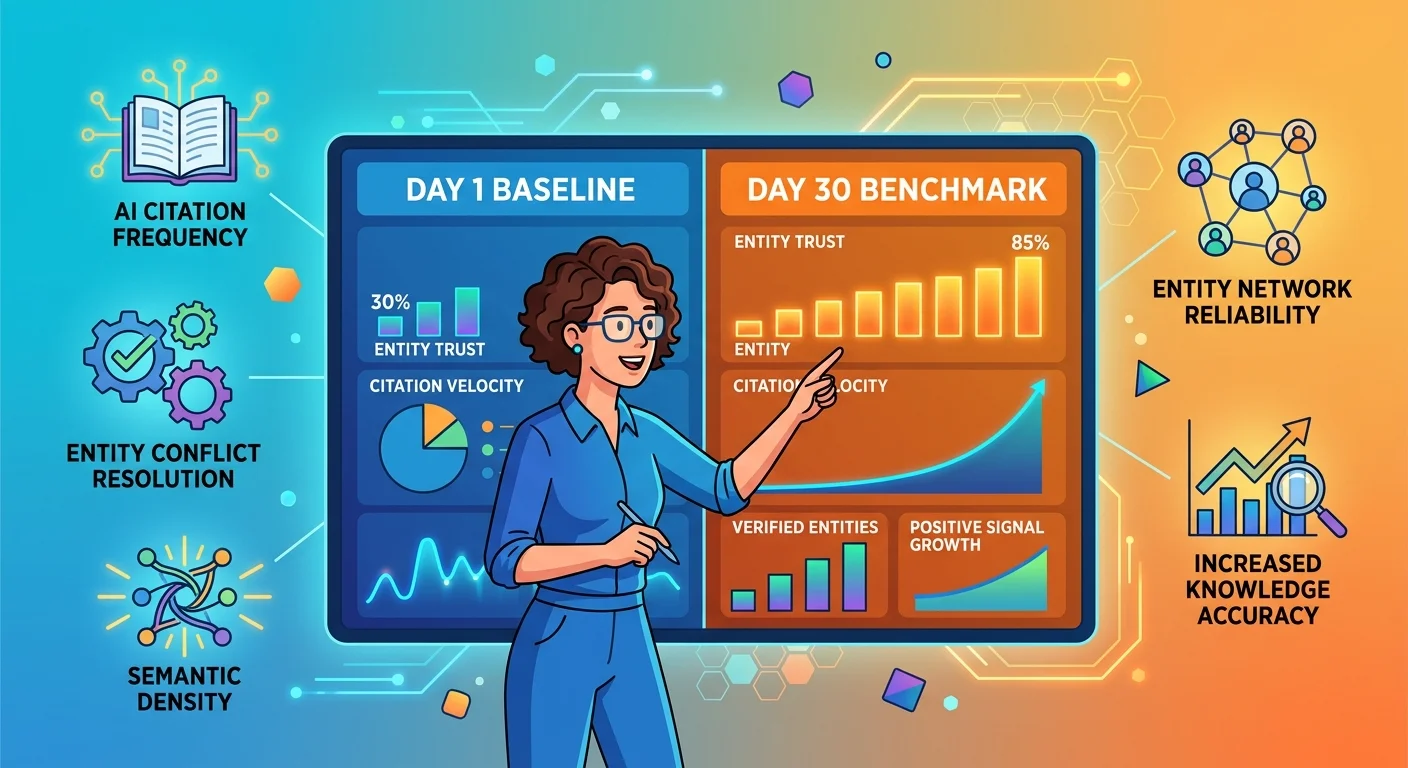
A legitimate engagement builds measurement infrastructure in parallel with the technical build. So when Baseline Lock closes week four, there’s a documented, verifiable starting point. Not a projection. A record.
Here’s where most agencies reveal themselves. If month one was spent on strategy decks, PDF reports, and audit summaries, there’s nothing concrete to measure against.
A baseline requires a before. And a before requires that someone actually changed something.
Published analysis on client onboarding confirms that proactive execution within the first 30 days is the determining factor in long-term service retention. Not the thoroughness of the intake report.
Think of it this way. A contractor who hands you a report about the foundation’s condition hasn’t poured concrete.
Same logic applies to AI-readable infrastructure. Until the schema is deployed, the entity signals are resolved, and the AI Authority articles are live – there is no baseline. There’s only a description of a gap that still exists.
Clinics that are still asking the question of more paperwork or more patients at the end of week four got a report when they needed a build.
What Gets Measured in the First 30 Days
Four categories define the Baseline Lock at the close of week four: entity recognition consistency, schema deployment coverage, citation velocity trajectory, and semantic density by topic cluster.
Each one reflects the structural work done during the first three weeks. Each one makes future progress verifiable – not theoretical.
If the work wasn’t done, the numbers don’t exist. That’s the point.
This published analysis on onboarding consistency shows that consistency across the full client journey improves long-term satisfaction metrics up to 20%.
In AI visibility work, consistency means one specific thing: the same clinic identity – same name, same address, same service taxonomy – appearing with the same structural accuracy across every platform an AI engine consults.
When that consistency breaks down, AI engines face competing signals. They default to the entity they trust most. That entity is almost never the one that skipped Entity Verification.
By the close of week four, the Baseline Lock should look nothing like a passive audit.
Not a list of problems. A record of what was built, what was resolved, and what the starting numbers are. Entity recognition rate. Schema coverage percentage. Number of AI Authority articles indexed. Citation velocity trend.
Those aren’t projections. They’re receipts.
And they’re only possible if weeks one through three were spent executing – not reporting.
| Measurement Signal | Baseline Established | Tracking Method | What Improvement Looks Like |
|---|---|---|---|
| Entity Recognition Consistency | Clinic name, address, and service taxonomy match across all platforms AI engines consult during Entity Verification | Cross-platform audit comparing NAP data, directory listings, and structured entity signals against a single source of truth | AI engines consistently surface the same clinic identity across ChatGPT, Gemini, and Grok responses – no competing or conflicting entity signals |
| Schema Deployment Coverage | Structured markup is live across all core clinic pages by close of Foundation Build | Technical review confirming schema types are correctly implemented, validated, and readable by AI engine crawlers | Every clinic page returns clean, parseable structured data – no missing fields, no invalid markup, no unresolved entity gaps |
| Citation Velocity Trajectory | First AI Authority articles are indexed and beginning to build topical authority by close of Content Infrastructure | Tracking how frequently the clinic is cited or referenced in AI-generated responses across target topic clusters | Citation frequency increases month over month as semantic density compounds – clinic moves from uncited entity to recommended answer |
| Semantic Density by Topic Cluster | Core treatment and service topics are mapped and covered by structured AI Authority articles during Content Infrastructure | Review of indexed content coverage against the clinic’s defined service taxonomy and competitive topic landscape | AI engines associate the clinic with a growing range of relevant topics – increasing the surface area of queries for which the clinic qualifies as a trusted answer |
| AI Authority Article Indexation | Published AI Authority articles are confirmed indexed by the close of Baseline Lock | Index status verification confirms each article is machine-readable and contributing to the clinic’s entity trust profile | Indexed article count grows each month – each addition expanding the clinic’s semantic footprint and citation eligibility |
What a Legitimate First-Month Deliverable Actually Looks Like
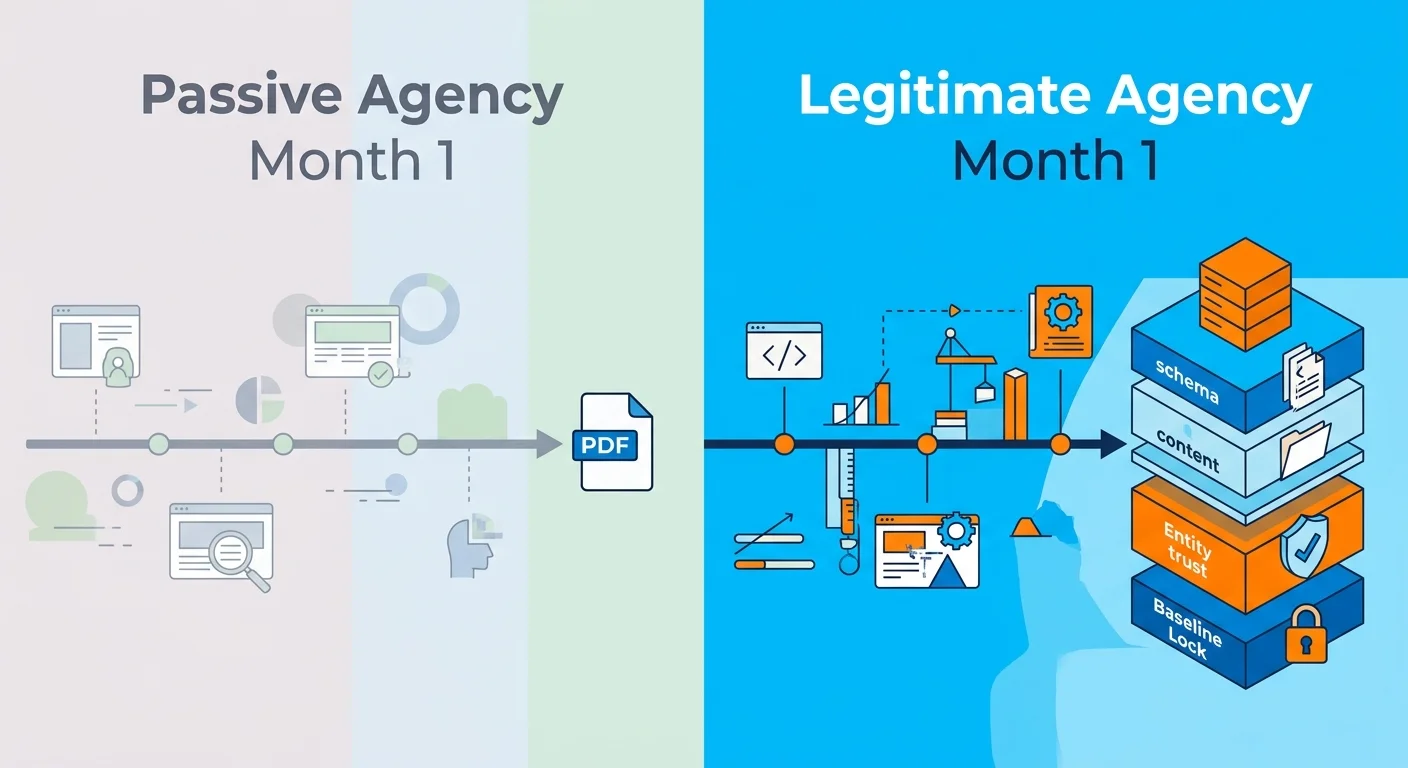
Here’s what a legitimate first-month deliverable is not: a PDF.
Not a strategy deck. Not an audit summary. Not a slide presentation explaining what should happen next.
A real deliverable is a record of what already happened. Schema deployed. Entity conflicts resolved. AI Authority articles live. If you can’t point to the work, the work wasn’t done.
Think about a contractor closing out week one. You walk the site. Concrete was poured. Framing went up. You can see it.
An AI visibility engagement works the same way – if the crew actually showed up. You should be able to point to the markup. You should be able to see what moved.
If you can’t, the crew didn’t show up.
Here’s the thing: once you know what real execution looks like week by week, a strategy deck at day 30 stops being ambiguous.
It’s immediately recognizable. A delay dressed up as a deliverable.
A clinic that can name the tactic can refuse it.
The 30-Day Deliverable Breakdown
The Local AI Authority Engine engagement produces four concrete, auditable outputs across the first 30 days – one per week, each building on the last.
Week one closes the Foundation Build. Schema is deployed. Entity signals are resolved. The machine-readable backbone is in place.
There is no ambiguity about what was done. It is verifiable in the markup. You can look at it.
Week two closes Entity Verification. Every platform an AI engine consults – directories, citations, structured data sources – reflects the same clinic identity with the same structural accuracy.
Week three closes Content Infrastructure. The first AI Authority articles are live, indexed, and building semantic density by topic cluster.
McKinsey’s research ties consistency across the full client journey to long-term measurable outcomes – improving results up to 20%. In AI visibility work, that consistency means one entity identity, one structural standard, zero conflicting signals. Not approximately. Exactly.
Week four closes Baseline Lock: a documented starting point capturing entity recognition rate, schema coverage, citation velocity trend, and semantic density – not as projections, but as receipts.
Clinics that structured their next steps without a baseline know what that absence costs. Month two begins with no benchmark. No before. No way to measure whether anything moved.
That is not a deliverable gap. That is a head start handed directly to a competitor.
| Deliverable | Passive Report Collector | Legitimate AI Authority Agency | Why It Matters |
|---|---|---|---|
| Schema Markup Deployment | Identifies schema gaps in a PDF audit; flags them for future action | Writes and deploys schema markup directly into the AI-readable infrastructure during Foundation Build | Schema gaps identified but not resolved remain schema gaps – AI engines cannot cite what they cannot read |
| Entity Signal Consistency | Documents NAP inconsistencies across directories; provides a list of corrections to pursue | Resolves entity conflicts across every platform an AI engine consults during Entity Verification | Competing signals cause AI engines to default to a more trusted, more consistent entity – typically a competitor |
| AI Authority Content | Outlines a content strategy; may produce a topic list or editorial calendar as the month-one deliverable | Publishes the first AI Authority articles during Content Infrastructure – live, indexed, and building semantic density | A content plan builds nothing; citation velocity and semantic density require actual published, machine-readable content |
| Baseline Measurement | Promises to establish a baseline after the strategy phase is complete – meaning month two or later | Locks a documented baseline at the close of Baseline Lock: entity recognition rate, schema coverage, citation velocity trend, semantic density | A baseline requires a before – and a before requires that structural work was already executed, not merely described |
| Month-One Deliverable Format | Strategy deck, audit summary, or PDF report describing what needs to happen | A verifiable record of what was built, resolved, and measured – receipts, not recommendations | Documentation of a gap is not a deliverable; proof of execution is |
| Client Workload | Requires the clinic to review reports, approve recommendations, and coordinate next steps – adding administrative overhead | White-glove execution: the clinic provides access, the agency executes – no learning curve, no platform management required | Practices that chose this agency model to reduce operational burden should not be spending month one managing a report review cycle |
Frequently Asked Questions About the First 30 Days of an AEO Agreement
Here are the questions chiropractors actually ask before they sign – and the answers that don’t hedge.
These aren’t questions from tire-kickers. They come from chiropractors who paid an agency, got a PDF, and never heard from them again. iTech Valet gets these calls often.
What structural updates happen in the first 30 days of an AEO agreement?
Four phases. Four weeks. All execution.
Week one closes the Foundation Build. Schema is deployed. Entity conflicts are resolved. The machine-readable backbone is in place.
Week two closes Entity Verification. Every directory, citation, and structured data source reflects one consistent clinic identity.
Week three closes Content Infrastructure. The first AI Authority articles are live and building semantic density by topic cluster.
Week four closes Baseline Lock. Entity recognition rate, schema coverage, citation velocity trend, and semantic density – documented as a verified starting point. Not a projection. A record.
Why do so many agencies deliver a PDF report in the first month and call it progress?
Because a PDF is easier to bill for than execution.
A report requires no infrastructure access. No schema deployment. No entity conflict resolution. It requires a template and a deadline.
This isn’t accidental. Agencies that rely on passive report delivery in month one are running a model designed to justify retention fees before any real work begins.
Standard SLAs require measurable baselines established within the first 30 days of contract execution. A PDF does not produce a baseline. It describes one that doesn’t exist yet.
How does a white-glove AEO agency prevent onboarding friction for a busy local chiropractor?
The clinic does nothing. That is the point.
White-glove execution means the agency handles every technical touchpoint – schema deployment, directory audits, entity conflict resolution, AI Authority article production – without asking the practitioner to learn a platform, attend a strategy session, or manage a deliverable.
The chiropractor’s job is to run the practice. The agency’s job is to make that practice legible to AI engines. Those two responsibilities do not overlap.
What baseline measurements are established during the initial 30-day window?
Four categories. All verified. None estimated.
First: entity recognition consistency – how reliably AI engines identify the clinic as a single, trustworthy entity across platforms. Second: schema deployment coverage – the percentage of structured data fields correctly implemented and indexed. Third: citation velocity trajectory – the rate at which authoritative sources are confirming the clinic’s entity signals. Fourth: semantic density by topic cluster – the depth of AI Authority content indexed around the clinic’s core service areas.
These aren’t projections. They’re receipts – verifiable in the markup, not described in a summary document.
When will my chiropractic practice start appearing as the recommended answer in ChatGPT and Gemini?
There is no contractual timeline for AI citation. Anyone who guarantees one is selling hopium.
Here’s what is true: authority compounds. Every week of execution builds on the last. The Foundation Build, Entity Verification, Content Infrastructure, and Baseline Lock create the structural conditions under which AI engines begin to trust and cite the clinic.
That process starts on day one. Every day a competitor executes while a practice waits is a day the gap widens.
The practices appearing as the recommended answer built their AI-readable infrastructure. They did not wait for a guarantee.
What is the difference between an AI Visibility Check and the first 30 days of a full engagement?
The AI Visibility Check is a diagnostic. It shows exactly what ChatGPT, Gemini, and Grok return when someone asks who to trust in a given market – and where the clinic’s entity signals are confirmed, fragmented, or absent.
That’s the before picture.
The first 30 days is the construction phase. The Foundation Build, Entity Verification, Content Infrastructure, and Baseline Lock turn that before picture into a machine-readable infrastructure AI engines can confidently cite.
The Check reveals the gap. The engagement closes it. The FTC’s Cooling-Off Rule gives consumers 3 days to cancel certain agreements – but when the diagnostic makes the problem self-evident, that window stops feeling necessary.
The First 30 Days Are the Foundation – Not the Preview
The first 30 days are not an orientation window.
They are the construction phase.
Every day spent on reports instead of execution is a day a competitor’s schema gets read, a competitor’s entity signals get confirmed, and a competitor’s name gets returned as the answer. Not eventually. Right now.
The Foundation Build, Entity Verification, Content Infrastructure, and Baseline Lock are not milestones on a roadmap.
They are the four walls. Either they go up in month one – or the whole engagement is sitting on dirt.
Passive report collectors will always find a reason to document before they execute. A legitimate engagement has no such delay. The work starts on day one, and the receipts are verifiable in the markup by the time week four closes.
Here’s the thing about the construction analogy – it was never decorative.
A contractor who shows up on day one and hands you a report about how your house needs work – but touches nothing – isn’t renovating. That’s a delay.
The clinic walks away from that engagement in the exact same condition it was in the day the agreement was signed. That is not a slow start. That is a compounding gap that widens every week a competitor keeps executing.
AI gives one answer. The practices that are that answer built their AI-readable infrastructure during the first 30 days. The ones that received a PDF did not. Your competitor is not waiting for a strategy deck – and neither should you.
Here’s the thing – you can’t fix what you haven’t measured. Run the AI Visibility Check now, before day one of the Foundation Build, and know exactly what the construction phase is up against.