
What Entity Data Actually Means to a Machine That Doesn't Know Your Clinic
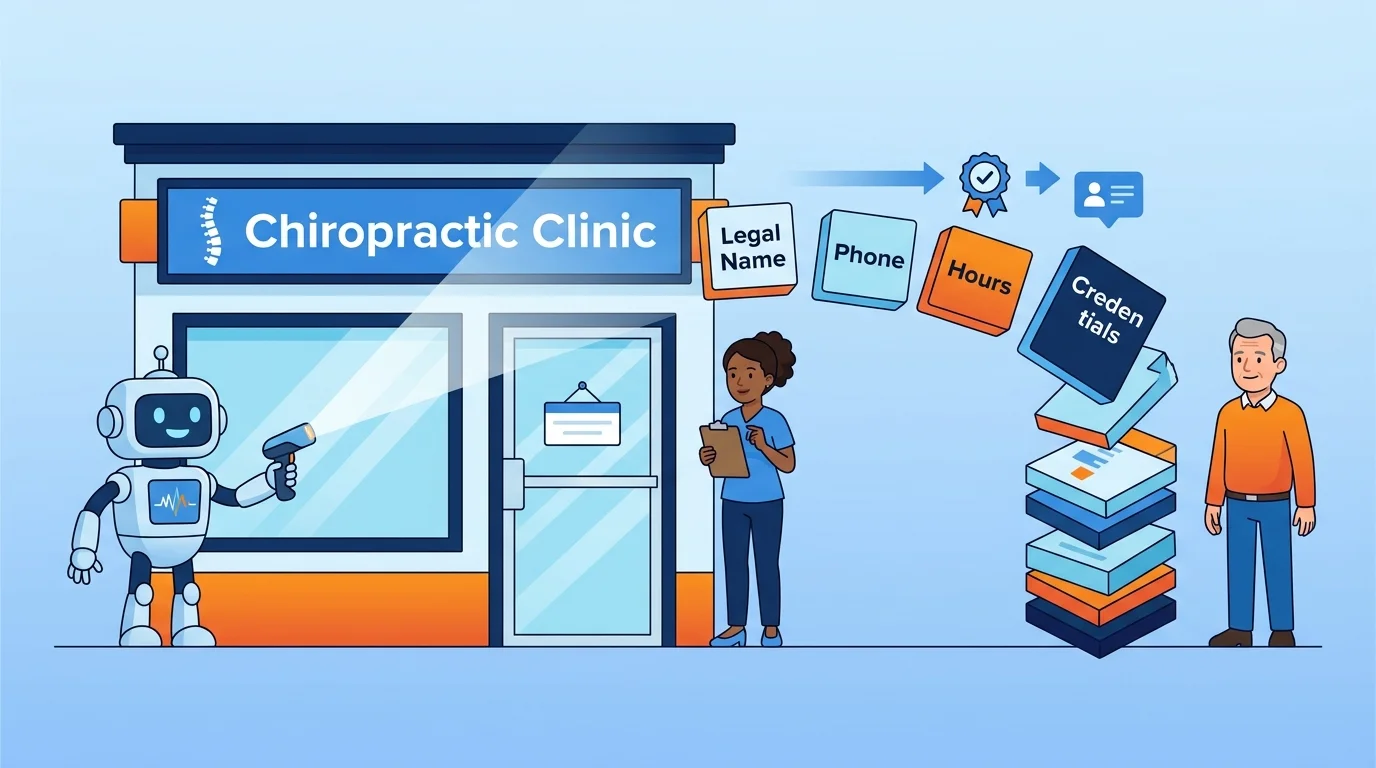
Here's the thing: entity data is the raw material a clinic hands an AI engine to work with. Legal name, address, phone number, hours, services offered, practitioner credentials — that's the whole case file.
Now… this part matters: the machine reading that file has never met the clinic, can't walk through the door, and can't pick up the phone to double-check a detail. So it works only from what's written, and every mismatch can become a reason to doubt everything else in the file. That's the real job behind deciding who should handle a clinic's AI visibility work — somebody has to own keeping that file consistent.
Why a Wrong Suite Number Does More Damage Than It Used To
A wrong suite number used to be a small annoyance. The patient called to confirm, or circled the block once and found the door anyway.
Now? That same slip may make a clinic invisible to the AI engine deciding who gets cited and who gets ignored.
The Address-Listing Mindset That No Longer Applies
Legacy search optimization treated address details like a listings chore. Push the name, address and phone number onto enough directories, and the ranking signal kinda took care of itself.
That habit assumed a human would sort out the little contradictions later. In AI visibility work, the reader is a machine that may treat every mismatch as evidence, not noise.
Why Small Mismatches Compound Instead of Canceling Out
Alright, quick reality check: one wrong suite number looks tiny on its own. But an AI engine may not look at it on its own.
It may stack that detail against every other source it checks. One mismatch can invite scrutiny of the rest, and errors may compound rather than average out, which is exactly the gap between agency processes and solo clinic identity that lets small inconsistencies slip through unmanaged.
Inside the Confidence Score: How AI Engines May Decide What to Trust
Here's the kicker: a confidence score doesn't come out of thin air. It may be built query by query, from sources that either back each other up or contradict each other.
| Ranking Framework | What It Evaluates | Why Entity Data Matters |
|---|---|---|
| E-E-A-T (Experience, Expertise, Authoritativeness, Trust) | Whether a source demonstrates real experience and credible authority, with trust weighted above the rest | In our view, consistent entity data is the evidence a clinic offers that it is who it claims to be, which is what trust is built on |
| Query Fan-Out Cross-Referencing | Multiple related searches across subtopics and data sources, checked against each other before an answer forms | Every mismatched detail may become a contradiction the fan-out surfaces, not a fact it confirms |
Query Fan-Out and the Cross-Checking Behavior Behind an AI Answer
A single question about a clinic rarely triggers one lookup. Google's AI features documentation says AI Overviews and AI Mode may use a "query fan-out" technique, issuing multiple related searches across subtopics and data sources to develop a response. One question can set off several checks across several sources at once.
Authority built this way may compound with every confirmed match. Rented attention expires the second a listing goes stale. That's why it pays to see what post-signing founder access looks like when you're figuring out who keeps that record owned instead of rented.
What Google Says Trust Is Actually Built On
Google's documentation says Google's ranking systems are designed to prioritize helpful, reliable information created to benefit people rather than content created to manipulate search rankings. Trust carries the most weight among the factors Google names.
How the Knowledge Graph Builds Its File on a Business
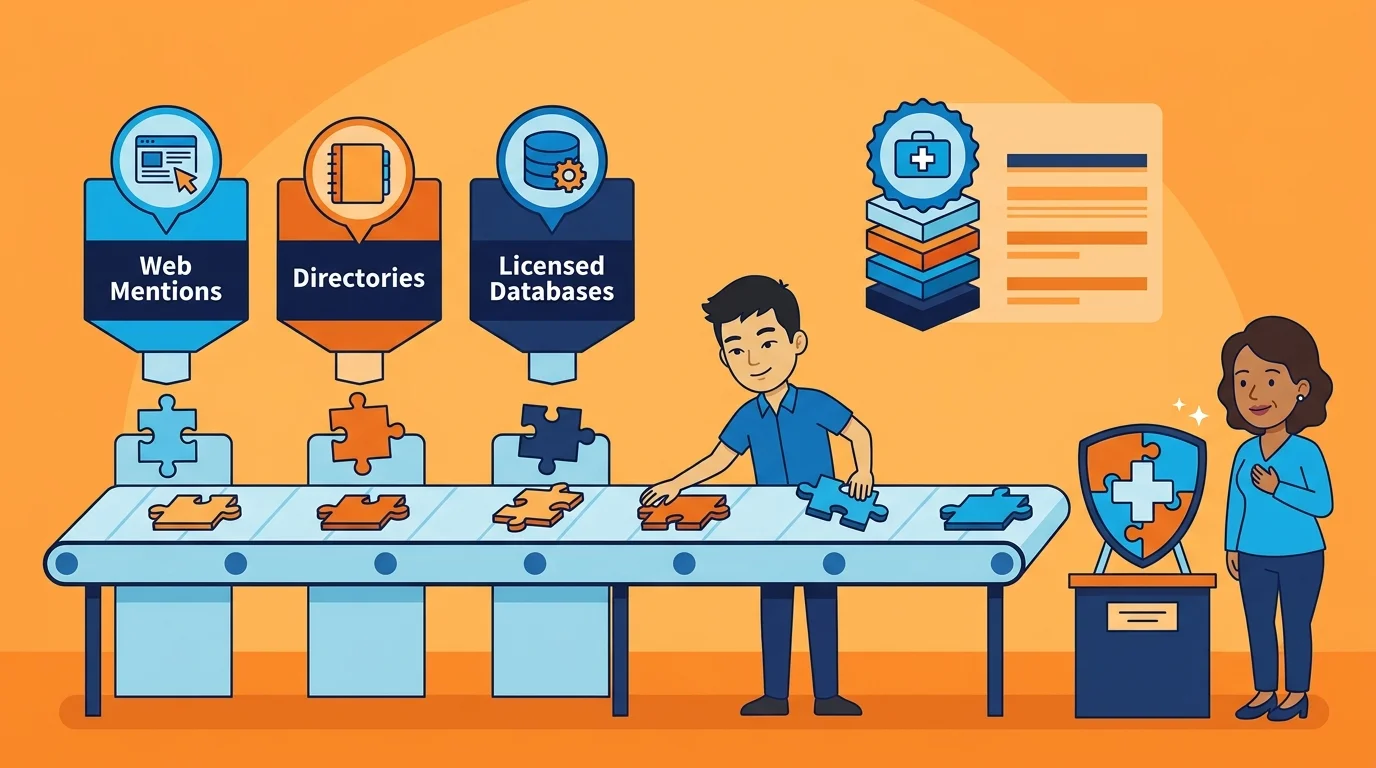
So where does a clinic's case file actually live? On the open web, it lives in Google's Knowledge Graph, which pulls facts from across the web plus open source and licensed databases and had amassed over 500 billion facts about five billion entities as of 2020. A clinic's record is one tiny slice of that giant structure.
| Data Source Type | Example | Role in the Entity File |
|---|---|---|
| Materials shared across the web | A clinic's own site, press mentions, professional directories | Supplies the baseline facts the Knowledge Graph first associates with a clinic's name |
| Open source databases | Publicly maintained records and reference datasets | Cross-checks a clinic's claimed details against independently maintained facts |
| Licensed databases | Commercial data providers Google contracts with directly | Adds a verified layer |
| Structured markup on a clinic's own site | Schema-style labeling of name, address, hours, and services | Gives the Knowledge Graph a direct, machine-readable statement instead of an inference |
Why Knowledge Graphs Can Absorb Mismatched Data Without Flagging It
That scale brings flexibility, and flexibility carries risk.
Hofer et al. (Leipzig University, 2023), a review of how knowledge graphs are built in general, note knowledge graphs may be schema-flexible and can accommodate heterogeneously structured entities more readily, though they are often built in a batch-like manner that can make incorporating new facts difficult.
Use AI Authority System services to catch that gap before the engine does.
What Happens When a New Fact Arrives Late
Correcting course later is not instant. Batch-built systems may let a new fact sit unrecognized until the next full re-computation.
Google's 2020 blog post (Danny Sullivan) said Google's Knowledge Graph may draw its information about entities from materials shared across the web as well as from open source and licensed databases, having amassed over 500 billion facts about five billion entities as of 2020.
A late correction may not slot in cleanly. It may wait for the next cycle that reconciles the whole structure, not just one clinic's file.
Where a Flawed Data Practice Breaks Down in the Wild
The Mechanism of Silent Exclusion
Rented attention describes a listing bought, boosted, or claimed once and then left alone. It behaves like a lease, not a record.
A clinic's entity file does not get evaluated once. It may get re-checked every time a query touches it, which means a record built to be owned can outperform one treated as paid-for and forgotten.
Fixing the Record: What Correction Actually Requires
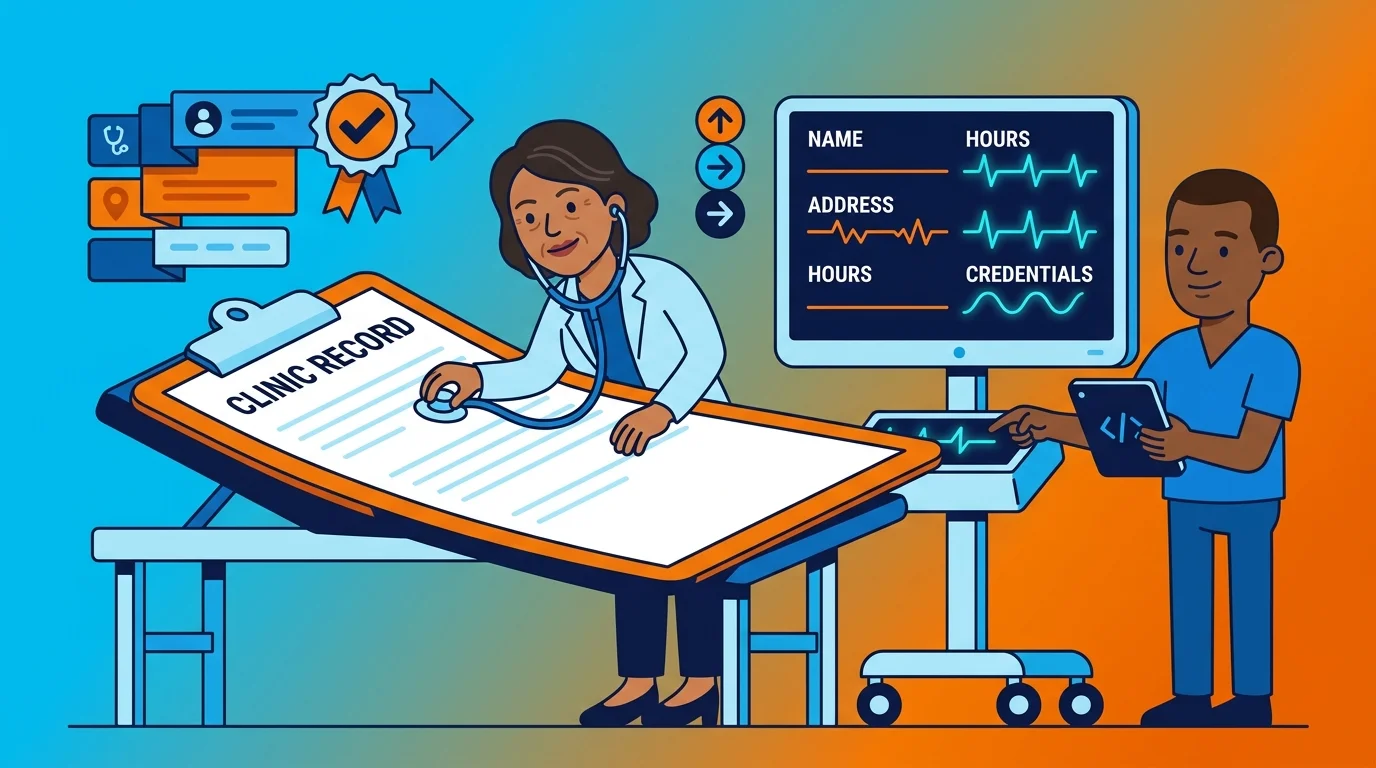
Correction is not a single edit. It is a sequence, starting with an audit of every source the engine checks.
| Correction Step | What It Involves |
|---|---|
| Audit Every Listed Source | Pull the clinic's name, address, phone number, hours, and credentials from the website, Google Business Profile, directories, and review platforms, laying every version side by side. |
| Reconcile Conflicting Versions | Correct every mismatched field across sources until one version of the clinic's facts exists everywhere the engine checks. |
Auditing the Sources That Feed the Graph
Pull the clinic's name, address, phone number and hours from its website, Google Business Profile, directories and review platforms, then lay every version side by side, because mismatches jump out fast once they're sitting next to each other. And no, piling on more published pages won't fix this (kidding… not kidding, people try it all the time). Stacking keyword-targeted articles on top of a wrong suite number adds volume, not accuracy, and an engine weighing contradictory evidence may not reward volume over consistency.
Frequently Asked Questions
Once a clinic sees its file the way an AI engine sees it, the same mechanical questions always pop up. Here are the ones docs ask most.
What specific pieces of clinic data are most critical for AI search engines?
Legal name, address, phone number, hours, services, and practitioner credentials carry the most weight. These are the core facts an engine cross-references across every source it checks.
How long does it take for incorrect business data to be corrected by search engines once I fix it?
There's no fixed timeline, and anyone promising one is guessing. Knowledge graphs are often built in batches. So a fix may sit unseen until the next full re-computation.
Can a single wrong detail, like an old suite number, really impact my clinic's visibility?
It can. One mismatched detail may invite scrutiny of every other source, and an engine weighing contradictory evidence may not average the error away.
If my website is correct, does it matter if old directory listings are wrong?
Yes, it still matters. An engine may check multiple sources per query, and a stale directory listing contradicts the correct website regardless of which one came first.
Besides my address and phone number, what other entity data can cause conflicts for AI search?
Practitioner credentials, listed services, and operating hours all create conflicts when a source goes stale. Any one of these can contradict the rest of the file.
How does having different information on my Facebook page versus my website affect AI's trust in my clinic's data?
Different details on each platform may read as contradictory evidence, not a small slip. Every mismatch an engine finds between them can chip away at trust.
The Bottom Line
Being correct was never the finish line. Being cited is.
Treat the AI engine as a detective building a case file on a clinic. Every mismatched fact is a piece of contradictory evidence.
A detective holding contradictory evidence does not guess. It may close the file on a different suspect, and the clinic with the clean file may be the one that gets named.
Here's what I know: owning your record beats renting a listing and hoping it holds, because confidence comes from evidence, not volume. Your clinic's own file is the evidence an engine checks first. If nobody's ever audited that file against what AI engines actually see, get an AI Visibility Check before the detective closes it on someone else.