
Why Most Medical Practice Websites Are Invisible to AI
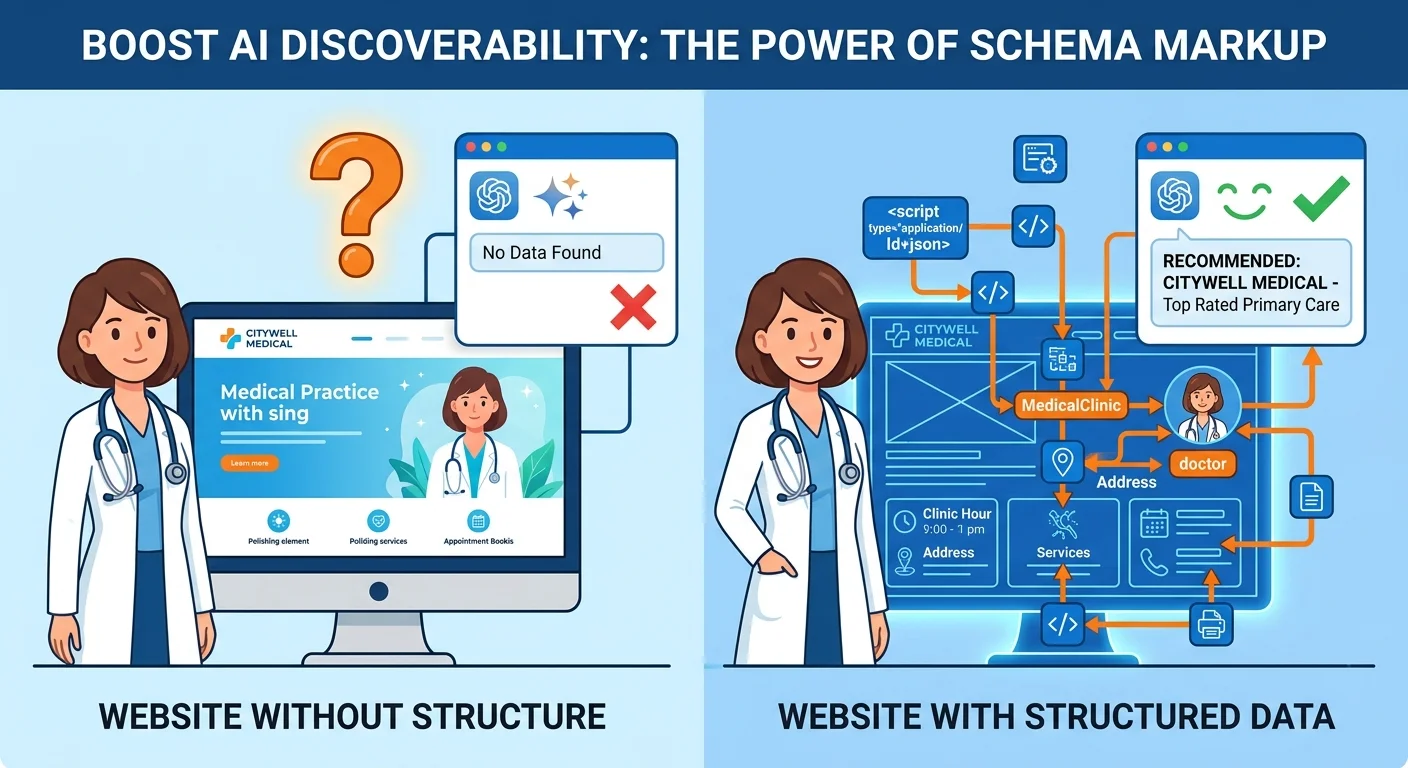
Your website looks great. The photos are professional. The contact form works. Patients who already know your name can book an appointment.
But when ChatGPT or Gemini needs to recommend a practice in your specialty, your site is invisible. Not because it’s poorly designed. Because it’s not built as an entity.
ChatGPT doesn’t read your homepage copy. Neither does Gemini. They read structured data-the machine-readable layer that defines who you are, what you treat, and how you connect to the broader medical knowledge graph. Most medical practice websites don’t have this layer. They’re why your CMS template is invisible to AI–digital brochures that don’t speak the language AI engines use to classify and cite authority. Schema.org is that language. Without it, you’re invisible.
Entity Definition
AI needs to know what your practice is before it can recommend you. Not your tagline. Not your mission statement. Your entity type.
A semantic entity hub defines your practice as a named entity-a MedicalBusiness, a Physician, a MedicalClinic. It uses Schema.org to tell AI engines exactly what category you belong to. Without that definition, you’re unstructured text. AI can’t classify you. It can’t cite you. It ignores you.
Most practice websites assume the patient will read and infer. AI doesn’t infer. It parses. If the entity definition isn’t explicitly declared in structured data, the practice doesn’t exist in the AI’s ontology.
Attribute Mapping
Defining the entity is step one. AI also needs to know the entity’s attributes-the characteristics that make your practice distinct and trustworthy.
Attributes are things like medical specialties, board certifications, years in practice, conditions treated, procedures offered, and insurance accepted. Google’s understanding of structured data relies on these attributes to classify content and determine relevance. A semantic entity hub maps every attribute in Schema.org markup. A traditional website mentions them in paragraphs. One is machine-readable. The other isn’t.
When AI evaluates two practices, it doesn’t compare prose quality. It compares entity completeness. The practice with more structured attributes wins.
Relationship Architecture
Entities don’t exist in isolation. They exist in a web of relationships-provider to practice, practice to condition, condition to treatment, treatment to outcome.
A semantic entity hub builds these relationships explicitly. It connects your providers to the medical conditions they treat using Schema.org types like MedicalCondition, MedicalProcedure, and MedicalTherapy. It links your practice to its geographic service area, its affiliated hospitals, its professional memberships. These relationships form the knowledge graph AI engines use to determine authority and relevance.
A traditional website lists services on separate pages with no semantic connections. AI sees isolated text. A semantic entity hub maps the entire network. AI sees a trusted, interconnected entity worth citing.
| Element | Traditional Medical Website | Semantic Entity Hub |
|---|---|---|
| Entity Definition | No machine-readable declaration of what the practice is – AI sees unstructured text and cannot classify the business type or specialty | Explicit Schema.org markup defining the practice as MedicalBusiness, Physician, or MedicalClinic – AI knows exactly what entity it’s evaluating |
| Structured Attributes | Specialties, certifications, and services mentioned in paragraphs – readable by patients, invisible to AI parsers | Every attribute mapped in structured data – board certifications, conditions treated, procedures offered, insurance accepted – all machine-readable |
| Entity Relationships | Services listed on isolated pages with no semantic connections – AI sees separate text blocks, not a knowledge graph | Providers linked to conditions, conditions linked to treatments, treatments linked to outcomes – a fully connected entity web AI can crawl and trust |
| Geographic Scope | City name in the footer and a contact page – AI cannot determine service area or map the practice to a location entity | GeoCoordinates, areaServed, and address markup that tells AI exactly where the practice operates and which communities it serves |
| Authority Signals | Provider bios mention credentials in prose – AI has no way to verify or weight professional authority | Alumni affiliations, board certifications, and professional memberships declared in Schema.org – AI can cross-reference and validate entity trust |
| Content Architecture | Blog posts and service pages treated as separate content silos – no topical clustering, no semantic hierarchy | Interconnected hub pages that comprehensively define the entity and its relationships – every page reinforces the central knowledge graph |
What a Semantic Entity Hub Actually Is
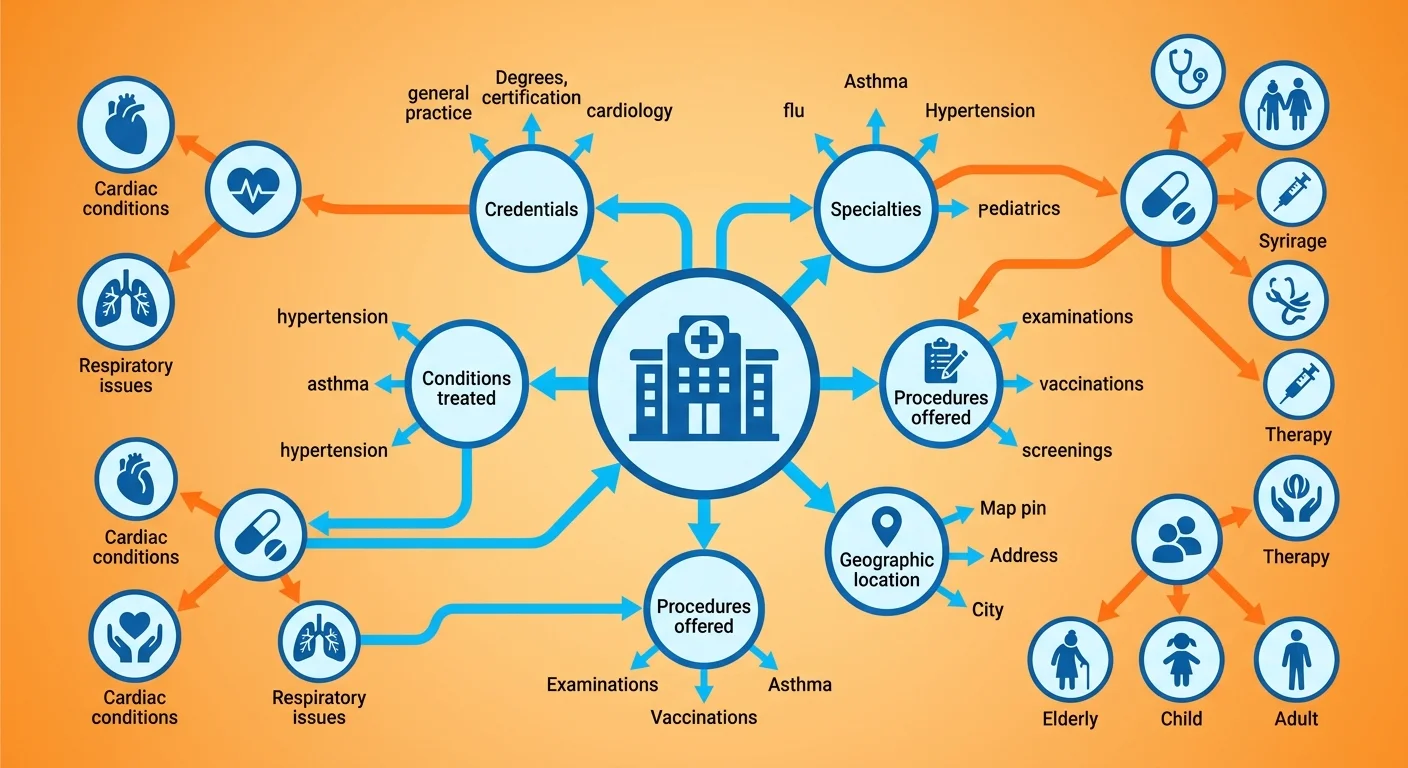
A semantic entity hub is a collection of interconnected pages that define your practice as a machine-readable entity. Your clinic is a MedicalBusiness. Your providers are Physicians. The conditions you treat are MedicalConditions. The procedures you perform are MedicalProcedures. All marked up using the vocabulary of Schema.org.
This isn’t content for patients.
It’s infrastructure for AI.
Your homepage declares your entity type-MedicalClinic-using Schema.org structured data. Your provider pages define each doctor as a Physician entity with attributes like medical specialty, board certifications, and affiliated organizations. Your service pages map the conditions you treat using specific medical schema like MedicalCondition, MedicalProcedure, and MedicalTherapy.
Each page connects to the others through semantic relationships. This provider treats this condition using this procedure at this location.
AI engines crawl those connections and build a knowledge graph of your practice.
The digital brochure model assumes patients will read your About page and infer your expertise.
The semantic entity hub model assumes AI will parse your structured data and cite your authority.
One is invisible to machines. The other is built for them.
Semantic search engines analyze contextual meaning and connect topics and concepts. If your practice isn’t built as a structured entity with explicit relationships, you’re not part of that analysis.
| Hub Component | What It Defines | Why AI Needs It |
|---|---|---|
| Entity Type Declaration | The practice’s core classification-MedicalBusiness, MedicalClinic, Physician, Hospital | Without an explicit entity type, AI cannot categorize your practice. It reads unstructured text with no ontological anchor. |
| Entity Attributes | Board certifications, medical specialties, years in practice, insurance networks, geographic service areas | Attributes differentiate your entity from competitors. AI compares structured attribute completeness, not prose quality. |
| Medical Condition Entities | Each condition treated defined as a MedicalCondition entity with symptoms, risk factors, and treatments mapped | AI builds knowledge graphs by connecting conditions to providers and procedures. Missing condition entities break the semantic chain. |
| Procedure and Treatment Entities | Each procedure mapped as MedicalProcedure or MedicalTherapy with indications, contraindications, and expected outcomes | AI needs to know what interventions your practice performs and which conditions they address to recommend you accurately. |
| Provider-to-Practice Relationships | Explicit Schema.org connections linking each physician to the parent organization and their subspecialties | AI evaluates entity trustworthiness by validating relationships. A provider with no semantic link to the practice is unverifiable. |
| Internal Semantic Links | Structured hyperlinks between related entities-provider pages to condition pages to procedure pages | AI crawls these connections to map your knowledge graph. Isolated pages with no semantic relationships don’t contribute to entity authority. |
How a Semantic Entity Hub Works Under the Hood
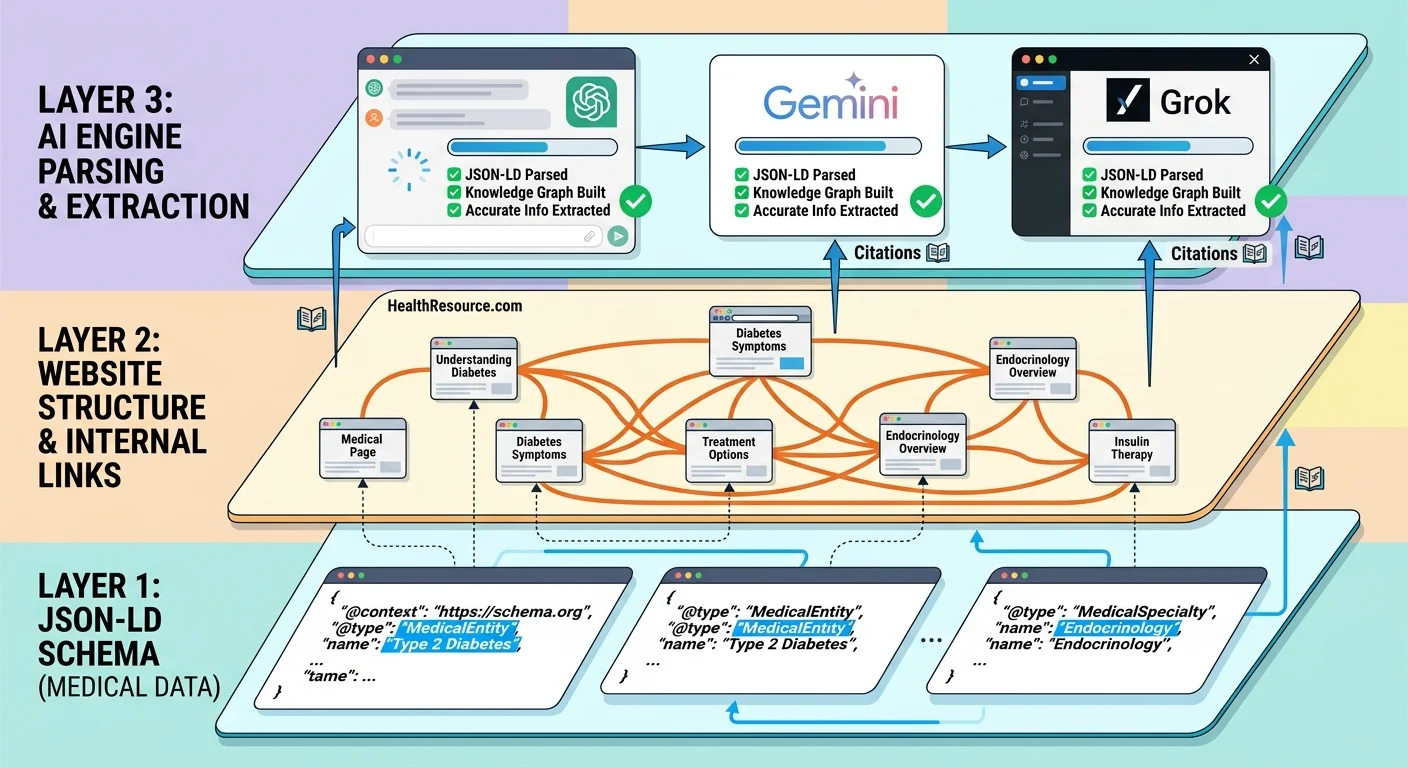
So how does it actually work?
A semantic entity hub runs on three layers: structured data markup, internal linking topology, and content depth signals. These aren’t bolt-on features. They’re architectural decisions that determine whether AI can read, classify, and cite your practice. Most medical practice websites are missing all three.
Structured Data Layer
Structured data is the language AI speaks. It’s machine-readable code-Schema.org markup-that defines what your page is. Not what it says. What it is. Google uses structured data to understand the content of a page, classify it, and display it in enhanced search result formats. Without structured data, AI reads your homepage as unstructured text. With it, AI reads your homepage as a MedicalClinic entity with defined attributes, relationships, and geographic scope. The code sits behind the scenes as JSON-LD markup. Patients never see it. AI engines use it to classify everything.
The structured data layer sits behind the scenes. Patients never see it. AI engines use it to classify every page in your hub-your provider pages as Physician entities, your service pages as MedicalCondition or MedicalProcedure entities, your location pages as Place entities. Each page carries JSON-LD markup that tells AI exactly what entity it’s looking at and how that entity connects to the others.
Most medical practice websites have zero structured data. Some have partial markup-auto-generated by a plugin and filled with placeholder values. Neither builds entity trust. AI engines ignore incomplete or generic structured data. They reward practices that define entities comprehensively and connect them semantically.
Internal Linking Topology
A semantic entity hub doesn’t just define entities. It connects them. Internal links are the mechanism. But not the way most websites use them. Traditional websites link for navigation-homepage to services, services to contact. A semantic entity hub links for semantic relationships. Provider to condition. Condition to treatment. Treatment to outcome. Each link reinforces the knowledge graph AI is building about your practice.
AI engines evaluate internal linking topology to understand how entities relate to one another. A provider page that links to the conditions that provider treats signals a semantic relationship. A condition page that links to the procedures used to treat that condition signals causality and expertise. Semantic search works by understanding the contextual meaning of queries and connecting topics and concepts. Your internal links are the map AI uses to read that context.
Most medical practice websites link randomly. The blog links to services. Services link back to the homepage. There’s no semantic logic. A semantic entity hub builds a deliberate linking topology that mirrors the knowledge graph you’re trying to create. Every link has a semantic purpose. Every connection reinforces entity trust. This is infrastructure work. It’s not something a web designer thinks about. It’s not something a patient notices. But it’s everything to an AI engine trying to determine which practice to recommend.
Content Depth Signals
AI engines don’t just read structured data and links. They evaluate content depth. Thin content signals low authority. Deep content signals expertise worth citing. If your content doesn’t cover the full scope of an entity-its definition, its causes, its treatments, its outcomes-AI assumes you’re not the authority.
A knowledge graph for healthcare can map relationships between diseases, symptoms, drugs, and treatments. A semantic entity hub does the same thing at the practice level. Each condition page defines the entity fully-symptoms, diagnostic criteria, treatment options, prognosis. Each procedure page explains the intervention in depth-indications, contraindications, outcomes, recovery timelines. This isn’t marketing copy. It’s entity definition. The more thoroughly you define each entity, the more trust AI engines assign to your practice.
Most medical practice websites skim the surface. A condition page has three paragraphs and a call to action. A procedure page lists benefits and a booking button. That’s digital brochure thinking. A semantic entity hub treats every page as an entity definition exercise. The goal isn’t to persuade a patient to book. The goal is to give AI engines enough structured, interconnected content-deep, specific, and semantically linked-that they classify your practice as the authority on that entity. One approach optimizes for conversion. The other optimizes for citation. Only one survives when AI gives a single answer.
What a Semantic Entity Hub Is Not
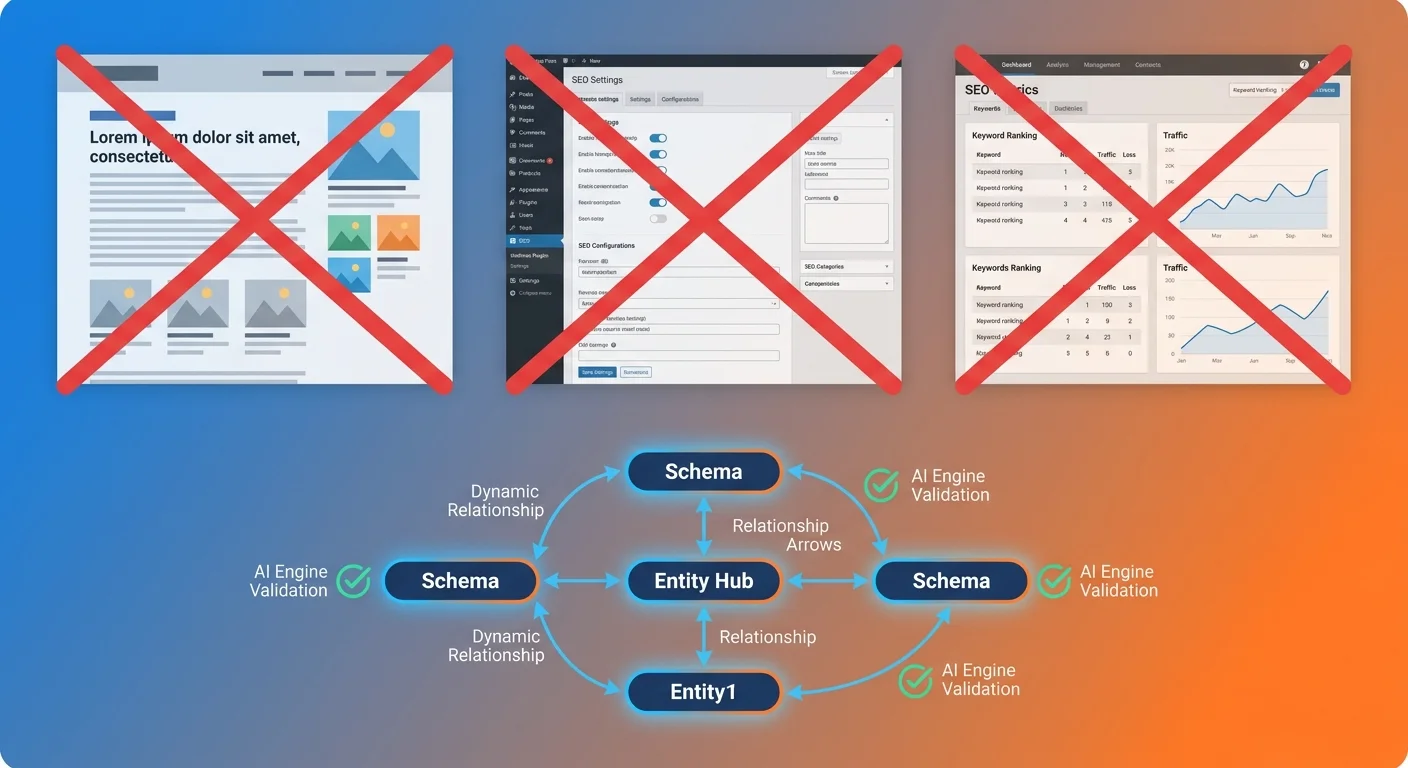
Before we go further, let’s clear out what most agencies get wrong.
A semantic entity hub isn’t a content tactic you layer on top of a website. It’s not a plugin. It’s not a service package promising to "optimize your entity." It’s foundational Authority Infrastructure-the structural layer that determines whether AI can read your practice as a trusted entity or dismiss it as unstructured text. Most agencies sell you the wrong thing because they don’t know the difference.
Not a Blog Strategy
Publishing blog posts about medical conditions isn’t building a semantic entity hub. It’s content marketing. The two aren’t the same. A blog post titled "5 Signs You Need to See an Endocrinologist" ranks for a keyword. It doesn’t define your practice as a MedicalBusiness entity. It doesn’t map semantic relationships between your providers, the conditions they treat, and the procedures they perform. It doesn’t build the structured data layer AI parses to determine authority.
Most medical practices blog for traffic. They write patient-facing articles optimized for keywords, hoping someone clicks through and books. That worked when Google returned ten blue links. It fails when AI gives a single answer. In 2020, nearly 65% of Google searches ended without a click-the query was answered on the results page itself. AI search pushes that number higher. If your content isn’t structured as entity definitions with semantic markup, AI reads it as generic advice and moves on.
A semantic entity hub uses content to define entities and connect them through structured relationships. Every page is a machine-readable entity declaration. Every link is a semantic assertion. The goal isn’t traffic. The goal is citation. Blogging for clicks and building a semantic entity hub aren’t variations of the same strategy. One optimizes for a ranked list that no longer exists. The other optimizes for the single answer AI will recommend.
Not a Schema Plugin
Installing a schema plugin doesn’t build a semantic entity hub. It adds markup to pages you already have. That’s not the same thing. Schema markup is the language, not the strategy. A plugin auto-generates Organization schema for your homepage and maybe Person schema for your team page. It fills in placeholder values. It doesn’t define your practice as a MedicalBusiness with complete attributes. It doesn’t map relationships between entities. It doesn’t build the internal linking topology AI needs to construct a knowledge graph.
Most schema plugins are designed for basic compliance, not entity authority. They give you enough structured data to pass a validator. They don’t give you the depth, accuracy, or interconnected architecture AI engines reward. Generic schema signals low effort. Interconnected schema signals expertise. AI ignores the former and cites the latter.
A semantic entity hub is a deliberate architectural build-structured data designed around your practice’s entities, internal links that map semantic relationships, and content that defines each entity in full. A plugin applies a template. A semantic entity hub is custom infrastructure. The difference is the difference between a form letter and a knowledge graph.
Not an SEO Campaign
An SEO campaign optimizes for rankings. A semantic entity hub builds entity trust. Those aren’t the same objective. Traditional SEO agencies target keywords, build backlinks, and track your position on page one. That work assumes patients will see a ranked list and click through. AI search doesn’t return a ranked list. It returns a verdict. Either your practice is the answer or it isn’t.
SEO campaigns focus on external signals-domain authority, backlink profiles, keyword difficulty. A semantic entity hub focuses on internal architecture-structured data depth, semantic linking topology, entity definition clarity, entity definition depth. External signals tell Google you exist. Internal architecture tells AI what you are. When AI decides which practice to recommend, it evaluates entity clarity, not backlink count. The practice with the clearest, most detailed entity structure wins.
Most SEO agencies sell ranking as the outcome. That metric no longer matters when the goal is to be the single recommended answer. A semantic entity hub isn’t an SEO campaign with better markup. It’s a different category of infrastructure-one that assumes AI engines parse entities, not keywords, and cite authority, not rankings. You can rank on page one and still be invisible to AI. You can have zero backlinks and be the only practice AI recommends. The variable is whether your practice is built as a machine-readable entity or as a digital brochure AI can’t parse.
What It Takes to Build a Semantic Entity Hub That Actually Works
Understanding the concept is one thing. Building it is another.
Most medical practices hear ‘semantic entity hub’ and assume it’s another website upgrade they can hand off to their web designer or SEO agency.
It’s not.
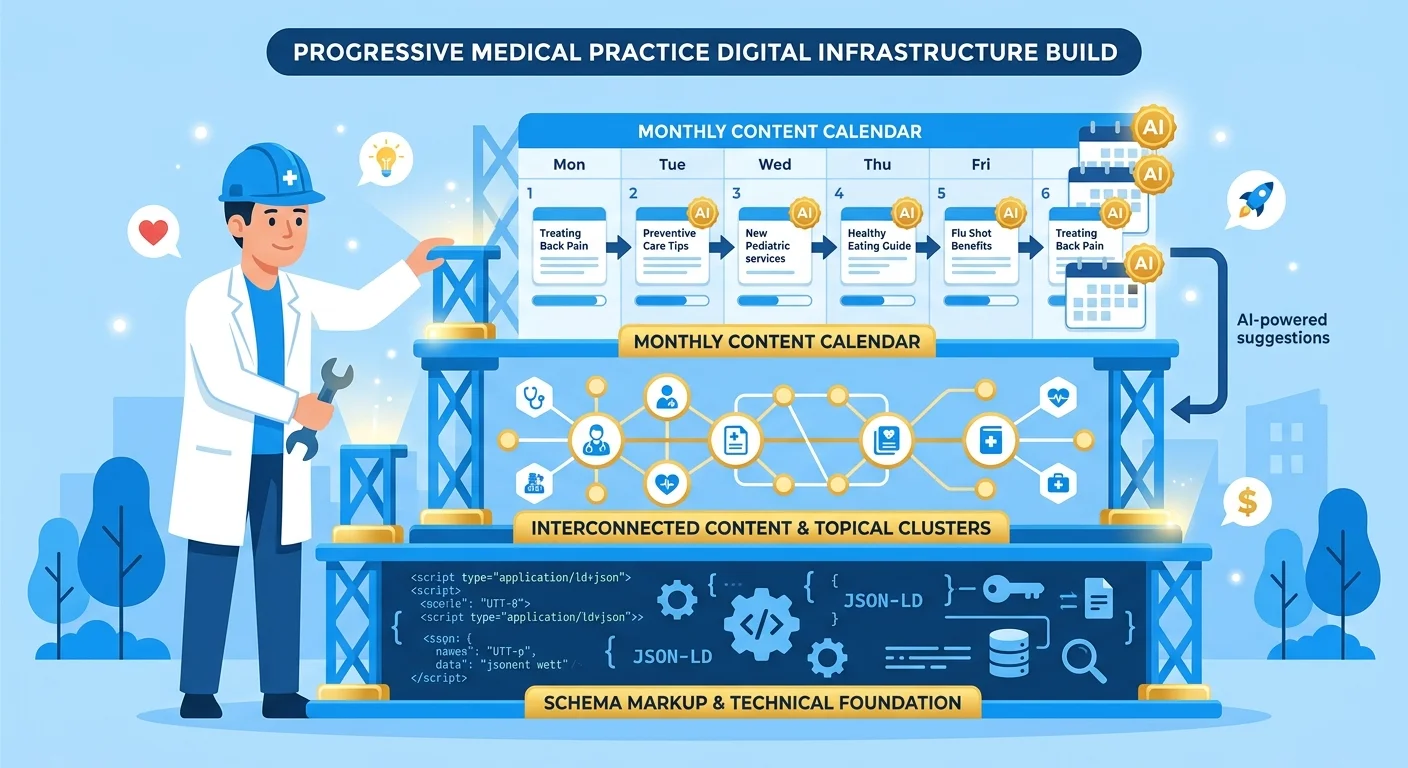
Building a semantic entity hub requires three architectural layers working together: entity-specific schema markup that defines your practice and its relationships in machine-readable format, a topical content architecture that treats every page as an entity definition exercise, and ongoing content execution that continuously expands the knowledge graph AI engines construct about your expertise.
Miss any one of these and you’re back to digital brochure territory-visible to patients, invisible to AI.
Entity-Specific Schema Markup
Generic schema markup doesn’t work here. The Schema.org vocabulary includes specific types for medical information like MedicalCondition, MedicalProcedure, and Drug. Most medical practice websites use Organization and LocalBusiness schema.
That tells AI engines you exist. It doesn’t tell them what you treat, who treats it, or how your expertise connects to specific medical entities.
A semantic entity hub uses MedicalBusiness schema at the practice level, then layers in MedicalCondition schema for every condition you treat, MedicalProcedure schema for every intervention you perform, and Person schema with medical credentials for every provider. Each schema type connects to the others through structured relationships-this provider treats this condition using this procedure.
That’s not something a plugin auto-generates. That’s deliberate infrastructure.
AI engines parse these relationships to build a knowledge graph. A knowledge graph for healthcare can map complex relationships between diseases, symptoms, drugs, and treatments, creating a powerful information resource. Your practice’s semantic entity hub does the same thing at the entity level-it maps your providers, conditions, treatments, and outcomes into a machine-readable structure AI engines can cite with confidence.
No entity-specific schema means no graph to parse. No graph means you’re not the answer.
Topical Content Architecture
Content architecture for a semantic entity hub is not ‘write more blog posts.’
It’s building a deliberate topical structure where every page defines a single entity and every internal link maps a semantic relationship. Each condition gets its own page. Each procedure gets its own page. Each provider gets their own page. Every page treats its entity as a structured knowledge resource-not as marketing copy.
Most medical practices organize content around patient navigation-about us, services, contact. A semantic entity hub organizes content around entities.
Diabetes isn’t buried under ‘Endocrinology Services.’ It’s a standalone entity page with structured definition, diagnostic criteria, treatment pathways, and outcome expectations. Every section on that page reinforces the knowledge graph AI is constructing. Every link from that page to a provider or procedure signals a semantic relationship AI can follow.
This requires a full Authority Infrastructure Audit to identify which entities your practice should own, which relationships matter most, and where the gaps are.
You can’t guess at this architecture and expect AI to parse it correctly. The topology has to be intentional.
Ongoing Content Execution
A semantic entity hub is not a one-time build. It’s ongoing execution.
AI engines evaluate content freshness, knowledge graph expansion, and citation velocity. A practice that publishes one condition page and stops signals limited authority. A practice that continuously expands its entity coverage signals deepening expertise.
This is where building entity trust becomes a compounding asset. Every new entity page adds to the knowledge graph. Every new semantic relationship reinforces the existing structure. AI engines track how thoroughly your practice covers its domain.
A knowledge graph for healthcare can map complex relationships between diseases, symptoms, drugs, and treatments-and the more thoroughly your practice builds that map, the more AI engines trust you as the definitive source.
Most medical practices publish sporadically-a blog post when the marketing director has time, a new service page when the doctor adds a procedure. A semantic entity hub requires disciplined, ongoing content execution tied to entity expansion strategy.
The goal isn’t volume. The goal is coverage. Every entity you define, every relationship you map, every schema type you deploy moves you closer to being the single answer AI recommends.
| Build Component | What It Requires | What Happens Without It |
|---|---|---|
| Entity-Specific Schema Markup | MedicalBusiness schema at practice level, MedicalCondition for every condition treated, MedicalProcedure for every intervention performed, Person schema with medical credentials for each provider-all connected through structured relationships | AI engines see a generic Organization entity with no medical authority signals-your practice exists but AI cannot map what you treat, who treats it, or how your expertise connects to patient queries |
| Topical Content Architecture | Every entity gets its own dedicated page-each condition, procedure, and provider treated as a comprehensive knowledge resource with structured definition, diagnostic criteria, treatment pathways, and semantic relationships mapped through internal links | Content remains buried under patient-facing navigation structures AI cannot parse-conditions live inside vague service category pages, expertise is scattered across marketing copy, and no machine-readable topology exists for AI to follow |
| Ongoing Content Execution | Disciplined entity expansion strategy that continuously adds new entity pages, deepens existing relationships, and expands knowledge graph coverage-every new entity published reinforces the entire structure and signals deepening domain authority | The knowledge graph stagnates-AI engines see limited authority scope, no signal of expanding expertise, and no reason to cite your practice over competitors who demonstrate continuous knowledge graph growth |
| Semantic Internal Linking Topology | Every internal link maps a deliberate semantic relationship-provider to condition, condition to procedure, procedure to outcome-creating the connective tissue AI engines follow to construct your practice’s knowledge graph | Pages exist in isolation with no machine-readable relationships-AI cannot determine which providers treat which conditions, how procedures connect to diagnoses, or what your practice’s actual domain coverage is |
| Authority Infrastructure Audit | Forensic analysis identifying which entities your practice should own, which relationships matter most for AI citation, where schema gaps exist, and how current content architecture maps to entity authority requirements | You build blind-guessing at which entities to define, how to structure relationships, and whether your schema implementation actually signals authority-resulting in wasted execution on infrastructure AI engines ignore |
Frequently Asked Questions
Let’s talk about the objections. Most practices assume they can hand this off to their web designer or install a plugin.
They can’t. Here’s why.
How is a semantic entity hub different from a standard medical practice website with a blog?
A standard medical practice website with a blog is built for human readers. A semantic entity hub is built for AI engines.
The standard site organizes content around patient navigation-about us, services, contact. The semantic hub organizes content around entities-conditions, procedures, providers-each defined with structured data that tells AI what the entity is, how it relates to other entities, and why your practice is the authority.
An entity hub is a collection of interconnected web pages that comprehensively explains a named entity, its attributes, and its relationships to other entities. Your blog posts are marketing content. Your entity pages are machine-readable knowledge resources.
AI reads one. Ignores the other.
What specific schema types are critical for a medical practice’s entity hub?
MedicalBusiness schema at the practice level. MedicalCondition schema for every condition you treat. MedicalProcedure schema for every intervention you perform. Person schema with medical credentials for every provider.
Each schema type connects to the others through structured relationships-this provider treats this condition using this procedure.
Google uses structured data to understand the content of a page, classify it, and display it in enhanced search result formats. Generic Organization or LocalBusiness schema tells AI you exist. Entity-specific medical schema tells AI what you treat, who treats it, and how your expertise connects to specific medical entities.
The specificity isn’t optional.
Can I build a semantic hub myself using a WordPress plugin?
No.
WordPress plugins auto-generate basic schema-Organization, LocalBusiness, maybe BreadcrumbList. They can’t map the semantic relationships between your providers, the conditions they treat, and the procedures they perform. They can’t build entity-specific content architecture where every page defines a single medical entity and every internal link signals a structured relationship. They can’t execute ongoing content expansion tied to entity coverage strategy.
A semantic entity hub requires deliberate Authority Infrastructure-entity-specific schema deployment, topical content architecture, and disciplined execution.
A plugin gives you markup. It doesn’t give you a knowledge graph.
How does a semantic entity hub help my practice get recommended by AI like ChatGPT or Gemini?
AI engines evaluate entity clarity when deciding which practice to recommend. When a patient asks ChatGPT or Gemini who to trust, the AI constructs a knowledge graph from available digital infrastructure.
A semantic entity hub builds that knowledge graph deliberately-structured data defines your practice as a named entity, entity pages cover conditions and procedures, semantic relationships map your expertise to specific medical entities. The more thoroughly your hub defines your practice and its domain, the more AI engines trust you as the definitive source.
In 2020, nearly 65% of Google searches were ‘zero-click,’ meaning the user’s query was answered on the search results page itself. AI search accelerates that trend.
The practice with the clearest entity structure wins the citation.
Will building an entity hub guarantee my practice shows up as the single recommended answer?
No.
Building an entity hub doesn’t guarantee your practice is the single recommended answer. It makes you eligible for consideration. AI engines evaluate multiple signals-entity clarity, content depth, citation velocity, domain authority, structured data completeness. A semantic entity hub controls the internal architecture signals-the ones that tell AI what you are and what you treat. It doesn’t control external signals or the competitive field.
What it does guarantee: without entity infrastructure, you’re invisible to AI regardless of your clinical outcomes or patient reviews.
With entity infrastructure, you’re in the conversation. The difference is between being evaluated and being ignored.
The Bottom Line
Your website looks great. Your reviews are five stars. Your clinical outcomes are stellar.
None of it matters if AI can’t read you as an entity.
When someone asks ChatGPT or Gemini who to trust, AI isn’t judging your design. It’s asking: can I build a knowledge graph from this practice’s data? If the answer is no, you don’t exist in that conversation. Not because you’re unqualified. Because you’re illegible.
A semantic entity hub isn’t an advanced tactic you bolt on later. It’s the foundation that decides whether you’re visible at all.
Every day you wait, competitors with entity infrastructure pull further ahead.
The gap accelerates. AI cited them last month, so AI cites them this month-because the graph got richer. You stayed invisible because the digital brochure is still unreadable.
This isn’t a fair fight. It’s a widening chasm.
You can keep optimizing for a ranked list that doesn’t drive patient decisions anymore. Or you can build the entity architecture AI actually reads.
Those are your options.
One assumes the old game still works if you just try harder. The other assumes the game changed and your infrastructure has to change with it.
Most practices are still playing the old game because they don’t know it ended.
If you’re ready to see where you stand-whether AI can parse your entity or whether you’re still an invisible digital brochure-start with visibility. Fifteen minutes. Real data. No guessing. You’ll see exactly what AI says when patients ask who to trust in your market. That’s what our AI Authority Engine is built to fix-transforming practices from illegible websites into machine-readable entities AI will cite.
You know what a semantic entity hub is. You know why it matters. Here’s what you don’t know: whether your current site actually functions as one. Most practices assume they’re fine. Professional design. A few keyword rankings. Then they run the check. AI has no idea what they treat. Fifteen minutes tells you where you stand. See what AI says about your practice right now.