
What is an AI Authority Engine for Chiropractors in 2026?
An AI Authority Engine is a proprietary digital infrastructure that shifts a chiropractic practice from traditional keyword-based SEO to Answer Engine Optimization (AEO) — making the practice visible, readable, and trustworthy to AI engines like Google Gemini, ChatGPT, and Perplexity. Not a website. Not an SEO campaign. The technical foundation that determines whether AI recommends your practice when a patient asks for a chiropractor in their area.
The core function is building machine trust. AI doesn't rank a list of websites by keyword relevance. It reads structured data, validates your entity across citation networks, evaluates your content depth against patient intent, and synthesizes all of it into one answer. That answer is a citation. A recommendation. Either your practice earns it — or you don't exist in that conversation.
That distinction matters more than most chiropractors realize. Traditional SEO gets you to Page 1. An AI Authority Engine gets you into the answer itself — the zero-click recommendation that appears before any search results load. Those are fundamentally different goals requiring fundamentally different systems.
The AI Authority Engine is built on five core layers: technical schema infrastructure, entity clarity across the web, AI Authority articles that answer the questions patients actually ask AI, citation authority from validated third-party sources, and a two-AI validation system that AI engines can trust. Each layer compounds on the others. Pull one out and the whole structure weakens.
This article covers what each layer does, why your current website probably can't replicate it, how machine trust actually gets built, and who this investment is the right fit for — and who it isn't.
Last Updated: April 10, 2026
Why Most Chiropractic Practices Are Already Invisible to AI
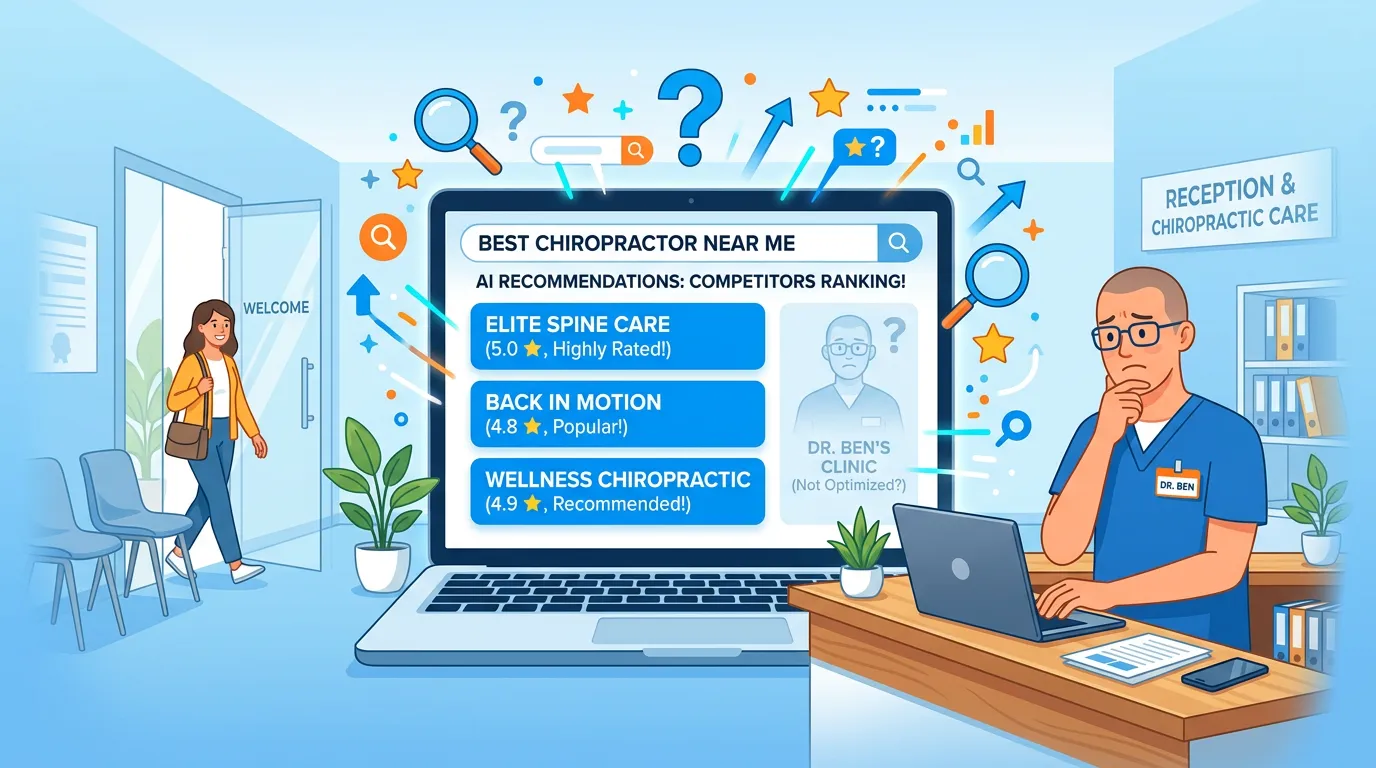
Traditional SEO is a treadmill.
Pay an agency, chase rankings, algorithm changes, start over. That's been the pitch for 20 years. And for a while it worked.
It doesn't work the same way anymore.
As the AI authority agency we built iTech Valet to be, we watch this play out constantly — practices paying for a channel their patients already moved off of, wondering why new patients aren't coming in like they used to. The treadmill is still running. It just stopped going anywhere useful.
Gartner projects traditional search volume drops 25% by 2026 as patients shift to AI chatbots. The Stanford HAI 2025 AI Index found 78% of organizations accelerated AI adoption in 2024. That's not something on the horizon. That's your patients, right now, asking AI instead of Google.
You could have 200 five-star reviews and a Map Pack position you've held for years. Doesn't matter. If AI can't verify your entity, you're not getting recommended. Full stop.
Why SEO Rankings No Longer Mean You Get Recommended
Here's what the SEO industry won't say out loud.
A patient opens ChatGPT. Types "best chiropractor for sciatica near me." ChatGPT doesn't crawl Google. Doesn't pull up the Map Pack. It looks at what it's already indexed — structured data, entity signals, citation authority — and produces one answer.
One answer. Not a list.
If your practice is keyword-optimized but entity-unclear, you don't get cited.
I've watched this wreck practices with genuinely great reputations. The reviews were there. The clinical outcomes were real. Their Google rankings were solid. But their digital footprint was a mess — inconsistent directory data, zero schema markup, surface-level content AI couldn't call authoritative. To the AI? That's an unverifiable entity. AI doesn't recommend unverifiable entities.
Chasing keywords was never the actual problem. The real question is whether AI can read your entity clearly enough to stake its own credibility on recommending you. Keyword rankings don't touch that. They're measuring something else entirely.
"Top 3 on Google" was the goal in 2020. Being the AI answer is the only goal that matters now. Those aren't two versions of the same thing. They require completely different architecture.
What AI Actually Looks For When It Makes Recommendations
Here's what AI is actually checking. Most practice websites give it almost none of it.
- Schema markup — Does AI know exactly who you are, what you treat, and where you're located without having to guess? Schema is the language AI reads natively. No schema means AI infers. AI doesn't love guessing.
- Entity consistency — Is your practice name, address, phone, and specialty identical everywhere AI checks? Google Business Profile, Healthgrades, Zocdoc, WebMD, Vitals — all of it. One mismatch introduces doubt.
- Content depth — Real answers to specific questions patients ask AI about chiropractic. Not generic service pages. Actual intent-matched content with verifiable claims behind it.
- Citation authority — Are authoritative third-party sources validating your entity from the outside in? Healthcare directories, professional associations, institutional sources. AI cross-references. It wants outside confirmation.
- Topical coverage — Does your content actually demonstrate expertise across conditions and patient concerns — or does it look like every other practice website that covers the same three topics at the same surface level?
The practices getting recommended aren't the best clinics in their market. They're just the ones AI can actually read. That's the only thing that produces a citation.
What an AI Authority Engine Actually Does
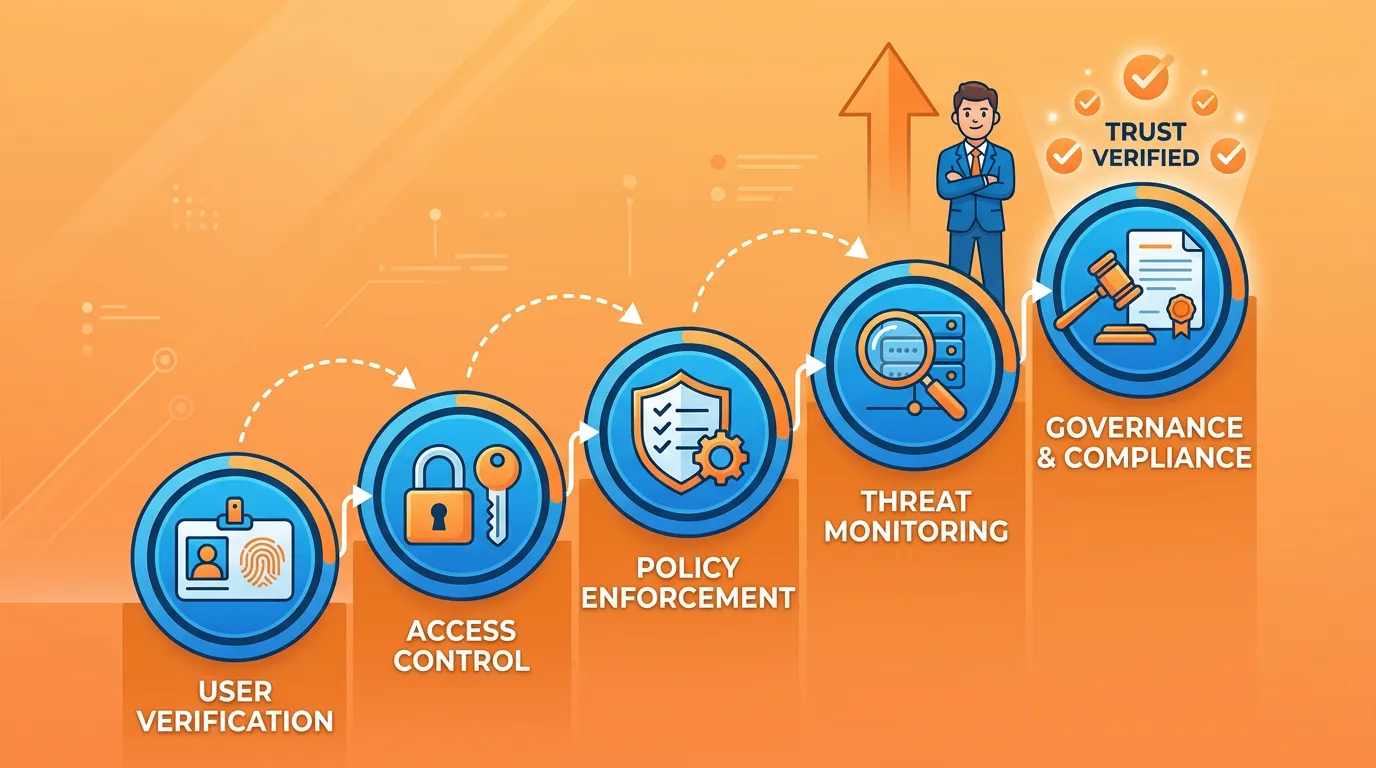
Five layers. Not a website refresh. Not a tactic. Infrastructure you own.
None of them are optional. Pull one and the whole thing weakens. I've seen practices try to DIY pieces of this — fix the schema but skip the content, or pump out articles with no citation network behind them. They get nothing. Partial authority infrastructure isn't authority. It's just noise AI partially sees and mostly ignores.
The Five Layers of Authority Infrastructure
| Layer | What It Is | What It Does for Machine Trust |
|---|---|---|
| Technical Schema Infrastructure | Machine-readable structured data embedded in your website | Defines your entity precisely: who you are, what you specialize in, where you're located, and why you're credible — in the language AI reads natively |
| Entity Clarity Network | NAP consistency + citation signals across authoritative directories | Cross-validates your practice identity across every source AI checks to confirm you're a real, trustworthy entity |
| AI Authority Content | AEO-optimized articles built around patient intent layers | Answers the specific questions patients ask AI — creating the content depth AI engines require to consider you a definitive authority |
| Citation Authority | Verified presence in Tier 1 and Tier 2 healthcare and professional sources | Third-party validation that AI uses as independent confirmation of your expertise and legitimacy |
| Two-AI Validation System | Gemini research + Claude execution + Gemini cross-validation | Ensures every piece of published content is accurate, internally consistent, and free of the hallucinations or unsupported claims that destroy AI credibility |
The Two-AI Validation System: Why It Actually Matters
Content AI trusts isn't the same as content people enjoy reading.
Perplexity and Gemini cross-reference everything. Unverifiable claim? Discounted. Contradicts itself across pages? Unreliable entity. Reads like generic AI output? No citation.
Most AI models are getting better at recognizing AI-generated fluff. And fluff doesn't get cited.
So here's how the validation works. Gemini builds the research brief. Claude writes against it. Gemini validates the output — every factual claim, every stat, every piece of intent coverage checked against the original research. Every claim traceable. Every stat sourced. We don't publish vibes. We publish receipts.
That's not a quality control step. That's the whole reason a competitor spinning up generic AI content isn't building the same thing.
Volume isn't authority. Verified depth is.
For a deeper look at how Authority Infrastructure actually differs from a conventional website build, that article covers it in full.
The Invisible Practice Problem: You Can Be Excellent and Still Get Ignored
This is the part that genuinely gets to me.
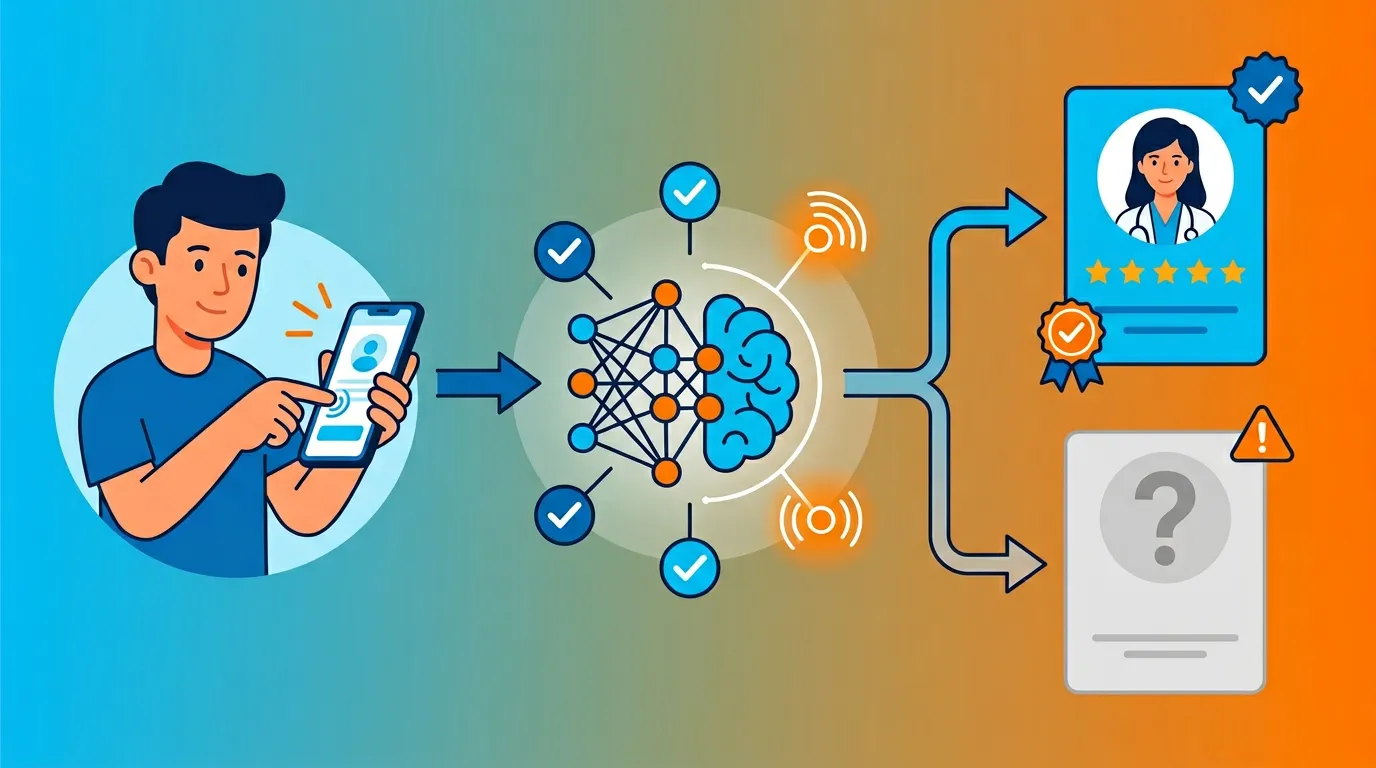
Somewhere in your zip code last week, a parent opened ChatGPT and typed "best chiropractor for sports injuries near [city]." They weren't scrolling Google. Weren't checking the Map Pack. They read one recommendation, clicked the link, and booked an appointment. The whole thing took four minutes.
You never had a chance. Not because you're not good enough. Because AI didn't know you existed with enough confidence to say your name.
There are good chiropractors out there. Skilled doctors. Real outcomes. Practices their communities actually love. And AI isn't recommending them. Not because they're not good enough. Because their digital infrastructure doesn't give AI enough to work with.
Your expertise and your machine trust are two completely different things.
AI doesn't care how good you are. It cares whether it can verify you. And the only thing that gets you recommended is being verifiable enough to cite.
A RepuGen study found 39.7% of patients now use AI directly to find healthcare providers — 14.7% use AI exclusively. Deloitte's 2026 US Health Care Executive Outlook found 80% of health executives expect agentic AI to drive significant patient engagement value this year. The patients are already there. Question is whether AI knows your practice exists when they ask.
How AI Evaluates Your Practice Right Now
Here's what AI actually checks when a patient asks for a chiropractor — and what most practice websites hand it to work with:
| AI Evaluation Signal | What AI Is Checking | What Most Practice Websites Currently Provide |
|---|---|---|
| Entity Verification | Consistent name, address, specialty, and credentials across all web sources | Inconsistent, outdated, or missing data across directories |
| Schema Markup | Structured machine-readable data defining the practice entity | None, minimal, or incorrectly implemented |
| Content Authority | Deep, intent-matched answers to the questions patients actually ask AI about chiropractic | Generic service descriptions and broad health claims |
| Citation Signals | Mentions in authoritative healthcare directories and third-party sources | Sporadic, low-authority, or inconsistent mentions |
| Topical Depth | Comprehensive coverage of conditions, patient concerns, and clinical questions | Surface-level pages covering only what the practice wants to highlight |
Why High Google Rankings Don't Guarantee AI Recommendations
Most docs don't know this gap exists until it's already a real problem.
Google ranks pages. AI recommends entities. Those aren't the same channel. Different criteria. Different signals. Different outputs.
You can rank for keywords and be completely invisible to AI at the same time. I've seen it.
Forbes Business Council confirms it — entity-based signals and relationship depth are now superseding traditional backlink metrics as the primary trust signals for AI engines. The targets moved. Most practices and most agencies are still aiming at the old ones.
I've run visibility checks on practices that were totally confident they were in good shape. Their SEO looked solid on the surface. But when you look at what AI actually sees? Fragmented entity data. No schema. Content with zero intent depth. Most weren't where they thought they were.
For a full breakdown of the 5 Intent Layers AI uses when deciding which chiropractor to recommend, that article gets into the specifics.
AI Authority Engine vs. Traditional SEO: Why the Comparison Misses the Point
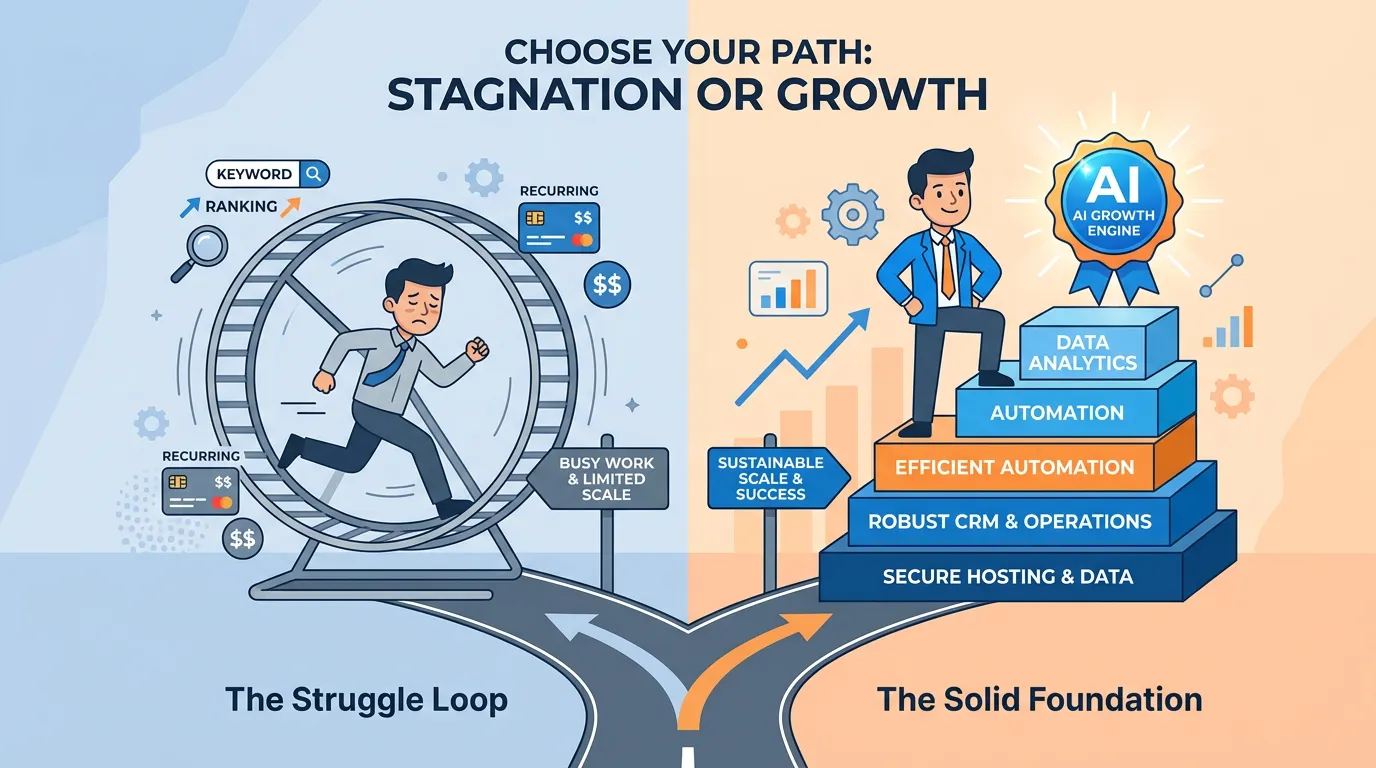
The most common thing I hear: "Isn't this just SEO with a new name?"
No. Traditional SEO optimizes for a list. AI search produces a verdict. Those aren't variations of the same thing.
Calling the AI Authority Engine "new SEO" is like calling a hospital an upgraded doctor's office. Similar building from the outside. Completely different function inside.
But here's the thing nobody in the SEO world wants to talk about. Ownership.
SEO is rented. Stop paying — it stops working. No residual. No compound. Just a recurring expense that only produces results while the check clears. I tell docs this and they look at me like I said something crazy. But it's just true. You don't own any of it.
The AI Authority Engine is infrastructure you own. Schema doesn't disappear when you cancel a retainer. Content authority compounds. Entity signals get stronger over time as more citation sources validate your practice. That's not a service. That's an asset.
The Core Difference: Authority That Compounds vs. Rankings That Expire
Simple math.
SEO retainer active → rankings up. SEO retainer cancelled → rankings decay. I've watched practices go through three, four agencies — starting over each time, each restart costing months of momentum and thousands of dollars. That's the hopium cycle. New tactic, partial results, lose faith, switch vendors, repeat.
The AI Authority Engine doesn't work that way.
Every AI Authority article published deepens topical authority. Every citation added strengthens entity verification. Every schema update makes the practice more readable. None of that goes away. It just keeps building.
For the full comparison, AI Authority vs SEO covers why the traditional approach is structurally broken for AI-first search. Not an opinion. A mechanics problem.
What Zero-Click Search Actually Means for Your Practice
"Zero-click" gets thrown around constantly. Let me just tell you what it actually means.
Patient asks Google about chiropractors. Google's AI Overview shows one recommended practice. Patient calls that number. Books that appointment. Never clicked a single blue link. Never saw your website. Never saw Page 1 at all.
The recommendation already won before anyone clicked anything.
Entity Authority — how clearly AI can read and verify your practice — is the only variable that decides whether that recommendation has your name on it. Not your load speed. Not your ad budget. Machine-readable clarity. That's it.
Who the AI Authority Engine Is For — and Who It Isn't

Not every practice is the right fit. I'd rather say that now.
There's a specific type of practice this is built for. And there's a type it'll frustrate — not because the system doesn't work, but because they want something this isn't.
The Practice Built for This Investment
The right fit is a chiropractor who thinks about patient acquisition in years, not months. They're not comparing this to a $500/month SEO retainer. They understand those aren't competing products any more than a building permit competes with a yard sign.
- Owners who think long-term. Authority compounds. The practices that commit fully — infrastructure, content, execution — are the ones AI recommends consistently. Staying power is the whole game.
- Docs ready to be the answer in their market. Not "one of a few options." The recommendation. That takes real infrastructure to earn.
- Practices done with the agency-hopping cycle. They've paid for SEO, social media, PPC, all of it — and have nothing durable to show. They're done renting and ready to build something that's actually theirs.
Doctors who want to treat patients, not manage marketing. We do everything. The client does nothing. No platform management, no content creation, no learning curve. Infrastructure gets built. They see patients.
If You're Comparing This to a $500/Month Agency, Stop Here
I'm serious. Not a dismissal — a favor.
If your first question is "Can I get a cheaper version of this?" — we're not the right fit. Not because we're gatekeeping. Because that mindset is the single biggest predictor of wasted investment in this space.
I've seen it. Practices shop on price, get a diluted version of the infrastructure — partial schema, thin content, inconsistent citation signals — and it produces nothing. They spend less. They get nothing. Then they blame the concept instead of the execution gap.
The math isn't complicated. What's the lifetime value of one new patient to your practice? What have you already spent on three years of $500/month retainers with nothing compounding behind it? That comparison usually settles the question.
If you want to invest in owned authority that builds over time, you're in the right conversation. If you want the cheapest version of something, this isn't it — and honestly, nothing that actually works is.
The AI Authority Engine Price article covers the full investment context, including why the cost reflects the category of asset being built.
Frequently Asked Questions About the AI Authority Engine
Is an AI Authority Engine just a new type of SEO?
No.
SEO gets you on a list. The AI Authority Engine makes you the answer. Those aren't the same thing.
Traditional SEO optimizes for a list. AI search produces a verdict. Those aren't variations of the same thing. The targets are different. The infrastructure is different. The thing you own at the end is different.
Rankings sometimes improve as a side effect of better entity trust. But that's not the point. The point is being the AI answer — the recommendation that shows up before any list loads.
Why can't my current web developer build this?
Your web developer builds for people. Beautiful pages, fast load times, clean design. Real skills.
But an AI Authority Engine isn't built for people. It's built for machines. Schema architecture. Entity verification across citation networks. Content depth that passes AI validation. A two-AI system that catches anything that would undermine credibility.
That's not a web design job. Your developer isn't who you call for this any more than you'd call your general contractor to rewire the building. Different problem. Different expertise.
How long does it take for AI to start recommending my practice?
We don't give timelines. Not because we're being evasive — because any agency promising AI citations within a specific number of months is selling something that doesn't exist as a guarantee.
Here's what's real. Once the infrastructure is live and content is indexed, AI can start validating your entity. Authority builds as more articles publish and more citation sources validate your practice.
The practices starting now are the ones getting cited six months from now. The ones waiting to "see how this plays out" are just giving that window to whoever isn't waiting.
Will an AI Authority Engine help me rank #1 on Google?
That's not the goal — though better organic rankings often follow anyway.
The actual target is Google's AI Overview. The synthesized answer that appears above all the traditional results. That's not Position 1 in the blue links. That's the answer before the links even load.
When AI Overview shows your practice name, your phone number, and a booking link before a single blue link appears — the patient is already deciding. The click race never started. You already won.
Can I use AI to write this content myself?
You can. It won't build machine trust.
Generic AI content doesn't earn citations. AI engines are getting better at recognizing it — and they don't recommend sources they can't verify as genuinely authoritative.
The two-AI process isn't just "AI writing content." Gemini builds the research brief with verified institutional sources. Claude writes against it. Gemini validates the output for factual accuracy and intent coverage. People are in the loop the whole time. Every claim traceable. Every stat sourced.
Anyone can generate AI content. Not everyone can generate content AI trusts enough to recommend.
What's the difference between entity trust and just having a Google Business Profile?
A Google Business Profile is one data point.
Entity trust is the full picture — consistent NAP data across every healthcare directory AI checks, schema markup on your own website, authoritative content that matches what patients ask AI, and third-party validation from sources AI actually weights as credible.
A Google Business Profile with nothing else behind it is a single data point AI can note but can't verify against anything. AI cross-references. If your GBP says one thing, your Healthgrades listing says something slightly different, and your website has no schema — that inconsistency is a flag. And AI doesn't recommend entities it can't fully verify.
What happens if I do nothing and wait?
The gap widens. Every month.
Machine trust compounds. The practices building now are piling up signals, content depth, and entity verification while you're watching from the sidelines. Waiting doesn't pause anything. It just hands the head start to whoever isn't waiting.
If AI recommends your competitors and not you, the gap gets bigger every month you do nothing. I've watched this math play out. It's not pretty when a practice finally realizes how far behind they've fallen — because the answer isn't "catch up faster." It's "start the compound process from behind while your competitor's already ahead."
The free AI Visibility Check shows you exactly where your practice stands right now — what AI can see, what it can't, and what the gap looks like in your market.
Authority Is Built. It's Never Claimed.
The chiropractors who own their local AI market two years from now won't have the best websites or the most Google reviews.
They'll be the ones who figured out the game changed — from ranking in a list to earning the citation — and built for it.
You don't claim authority. You build it. And it doesn't stop once it's built. Every article, every citation, every schema update stacks. Your competitor down the road who started six months ago is already six months ahead of where you are right now.
Here's what I keep coming back to every time I talk to a doc about this. The gap widens every month you do nothing. I've watched it play out. When a practice finally wakes up to how far behind it's fallen, the answer isn't "catch up faster." You're starting from behind while someone else's compound process is already running.
Start now and you're ahead. Wait and you're catching up.
You now know what an AI Authority Engine is. Here's the next question — does AI know your practice exists?
There are practices in your market already getting recommended. Not because they're better doctors. Because their infrastructure got there first. That gap compounds every month.
The AI Visibility Check shows you exactly what AI can see about your practice right now — where your entity signals are strong, where they're weak, and what the gap looks like between your current footprint and the practices getting cited in your zip code.
Not a sales pitch. A diagnostic. The check that shows you where you actually stand.
See what AI sees when it looks for your practice
Running it takes minutes. What it shows you is a different conversation entirely.
621 Enterprises, Inc. | Copyright 2026 | All rights reserved