
What Is an AI Authority Article? A Breakdown for Healthcare Experts
An AI Authority Article is a machine-readable evidence node — structured, sourced, and schema-marked to give AI systems like ChatGPT, Gemini, and Grok exactly what they need to cite a practice as a trusted answer. It is not content written for patient browsing. It is infrastructure built for machine trust.
Every AI engine functions as a judge. When a patient asks who the best chiropractor in their area is, that judge renders a verdict — one answer, not a list. An AI Authority Article is the evidence submitted to that court. Without properly structured evidence, the verdict does not go in the practice's favor.
Traditional content was built for keyword indexes. Conversational engines operate differently. They prioritize structured data and entity signals to construct a single, unified answer. A standard editorial article satisfies neither requirement.
The clinical stakes clarify the distinction. Public trust in AI-generated healthcare recommendations depends directly on source validation transparency. Pew Research found that 60% of US adults report discomfort with healthcare providers relying on AI for medical decisions. The burden on any AI-recommended practice follows directly: the content behind that recommendation must be verifiably accurate, peer-referenced where appropriate, and free of unsubstantiated claims. The FTC enforces exactly this standard — claims tied to AI-generated content must be scientifically verifiable.
An AI Authority Article meets that standard by design. It maps entity signals across digital reference channels. It aligns content structure to how knowledge graphs evaluate domain expertise. It embeds schema markup so AI engines can extract and verify credentials without ambiguity. Every clinical claim is anchored to sourced, structured data that builds machine trust and counters health misinformation.
This is not content marketing. It is evidence infrastructure.
Last Updated: July 10, 2026
- • Why AI Engines Ignore Most Healthcare Content
- • The Anatomy of a Machine-Readable Evidence Node
- • How AI Engines Evaluate Healthcare Entity Trust
- • Who This Is For — and Who It Is Not
-
• Frequently Asked Questions About AI Authority Articles
- • How does an AI Authority Article differ from a standard blog post?
- • Why do conversational search engines ignore traditional medical content optimization techniques?
- • How does structured schema markup help ChatGPT recommend a local clinic?
- • Will publishing AI-assisted content hurt my practice's credibility with patients?
- • How long does it take for a healthcare practice's AI authority assets to compound?
- • Does my practice need to be on every platform for AI engines to recommend me?
- • The Verdict: What AI Authority Articles Actually Do for Your Practice
Why AI Engines Ignore Most Healthcare Content

Most healthcare content isn't ignored because it's bad writing.
It's ignored because it was built for the wrong judge.
AI engines aren't grading your prose. They're auditing your infrastructure. And most practices never got that memo.
Conversational engines don't crawl pages hunting for phrases. They synthesize trust signals — structured data, entity relationships, verified source networks.
That's a different evaluation system entirely. And most practices built their content for the old one.
A well-crafted editorial article with zero schema markup doesn't register. It's the healthcare equivalent of testifying without a sworn statement on record.
This isn't a gradual shift. What publishing means for a clinical practice was restructured the moment AI engines became the answer layer.
Traditional indexed content was built for a system that ranks lists. AI engines don't produce lists. They produce a single verdict.
The infrastructure that earns that verdict looks nothing like what most practices are currently putting out.
Why Traditional Healthcare SEO Gets Ignored by AI Engines
Traditional healthcare content optimization was engineered for search indexes. Not for conversational synthesis.
Keywords, backlinks, meta descriptions — those were the levers. Pull them, get on page one, call it a win.
That model is gone.
Conversational systems bypass traditional index listings entirely. One answer. Not a ranked list.
They're looking for the entity with the most verifiable trust signals. Most clinics haven't built those signals at all.
The CDC's infodemic framework makes this structural requirement explicit. Digital health spaces demand authoritative, structured, clear data pipelines — not just accurate information, but information delivered in a machine-readable format that maps to trusted institutional bodies.
Most healthcare content doesn't come close. It's written for patients scrolling a page. Not for AI systems auditing an entity's credibility.
That's the gap the Local AI Authority Engine is built to close.
Without schema. Without entity signal alignment. Without sourced, verified content architecture — a practice's content isn't underperforming. It's absent from the verdict entirely.
The verdict is already out. Most practices never submitted their evidence.
| Content Type | What AI Engines Look For | What Traditional Content Delivers | Result |
|---|---|---|---|
| AI Authority Article | Structured schema markup, entity signals mapped to verified reference networks, sourced clinical claims, machine-readable data architecture | Schema-embedded evidence nodes with peer-referenced claims and entity-trust signals aligned to knowledge graph evaluation | AI engine identifies the practice as a credible, verifiable entity — recommendation rendered |
| Traditional Editorial Article | Structured data pipelines, entity relationship mapping, verifiable authority signals tied to institutional bodies | Keyword-dense prose written for human readers, no schema markup, no entity signal alignment | AI engine finds no machine-readable trust signals — content is structurally invisible, verdict never reached |
| Standard Informational Page | Clear data pipelines that suppress misinformation and map authority to trusted sources | General health information presented in readable prose, not anchored to verifiable institutional frameworks | AI engine cannot confirm source authority or entity credibility — content bypassed in favor of structured alternatives |
| Keyword-Optimized Content | Entity trust signals, verified source networks, unified synthesized answers — not ranked keyword lists | Optimized for index-based ranking systems using keyword density, meta descriptions, and backlink volume | Traditional index levers don't register in conversational synthesis — practice remains absent from the AI verdict |
| Unstructured Clinical Q&A | Machine-readable format with schema that allows AI systems to extract and verify credentials without ambiguity | Conversational answers written for patients browsing a page, no schema, no structured data delivery | AI engine cannot audit the practice's credibility — content fails the court's evidentiary standard entirely |
The Anatomy of a Machine-Readable Evidence Node
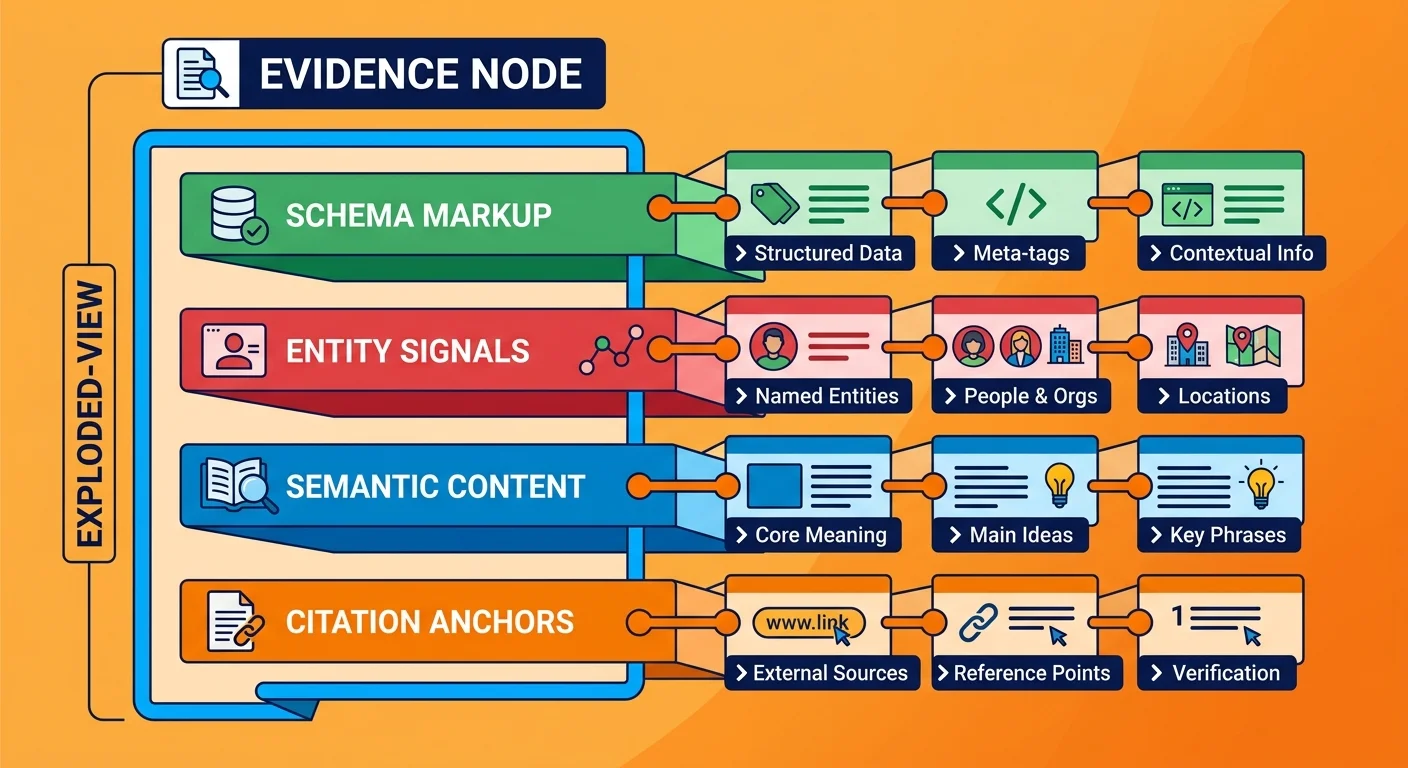
An AI Authority Article has a specific anatomy.
And it's not built from editorial instincts. It's engineered from components that AI engines can read, verify, and trust — in that exact order.
Every element of a properly built evidence node serves the same function: submitting verifiable proof to the judge.
Schema markup. Semantic density. Peer-referenced sourcing. Entity signal alignment.
Strip any one of those out and the submission is incomplete. And incomplete evidence doesn't win verdicts.
Why so many practices are publishing content that never earns a patient comes down to what's missing from the structure. Here's what that looks like, component by component.
Structured Schema: The Language AI Engines Actually Speak
Schema markup is the difference between content AI engines can read and content they have to guess at.
It's a standardized vocabulary — a formal language that tells AI systems exactly who the practice is, what it treats, where it operates, and what credentials back up those claims.
Conversational engines build answers from structured data — not keyword density. That means schema isn't a nice-to-have. It's the format the court requires. Without it, even accurate, well-written clinical content doesn't register as evidence.
The judge can't rule on what the court can't read.
That's not an opinion. NIH research confirms it: consumer interactions with medical AI responses depend deeply on systems citing primary academic literature.
The chain runs from your content to your schema markup to your sourced clinical references. That chain is what gives an AI engine the confidence to make the recommendation. Break it anywhere — at the schema layer, at the sourcing layer, anywhere — and the engine defaults to whoever didn't break it.
Semantic Density: Why Thin Content Gets Zero Citations
Thin content doesn't just underperform. It gets ignored entirely.
AI engines aren't skimming for relevance. They're auditing for depth, sourcing, and entity coherence. Those are two completely different standards.
Semantic density means every section of an AI Authority Article does real work.
Clinical claims tie back to verifiable sources. The practice's entity signals appear consistently across the content architecture. The subject matter connects — through structured data — to trusted institutional bodies that AI systems already recognize.
The CDC's infodemic framework makes this explicit: digital health spaces require authoritative, structured, clear data pipelines that map to trusted institutional bodies. That's the technical standard for being cited. Not an editorial preference. A requirement.
The AI Authority Article vs. Traditional Blog Post: A Side-by-Side Comparison makes this contrast impossible to ignore.
Thin content — however readable for a patient scrolling through — reads as noise to a conversational engine.
The judge doesn't rule on noise. The verdict goes to the practice that submitted something substantive.
| Structural Component | What It Does for AI Engines | What Happens Without It |
|---|---|---|
| Schema Markup | Tells AI engines exactly who the practice is, what it treats, where it operates, and what credentials back up those claims — in a standardized language machines can parse without guessing | AI engines can't verify the entity. The practice exists as unstructured noise. The court never receives the sworn statement. |
| Semantic Density | Every section performs real epistemic work — clinical claims tie to verifiable sources, entity signals appear consistently, and subject matter connects to trusted institutional bodies AI systems already recognize | Content reads as thin and unverifiable. The engine audits for depth and finds none. The submission is rejected before the verdict is rendered. |
| Peer-Referenced Sourcing | Anchors clinical claims to primary academic literature and institutional sources — creating the structured chain AI systems require to validate a recommendation before making it | The evidence chain breaks. AI engines default to an entity that did submit sourced, verifiable content. The practice loses the verdict to a competitor who did. |
| Entity Signal Alignment | Maps the practice's identity — name, specialty, location, credentials — consistently across all digital reference channels so knowledge graphs evaluate domain expertise without contradiction | Conflicting or absent signals create entity ambiguity. AI engines can't confidently cite an entity they can't verify across multiple reference points. |
| Structured Data Pipelines | Delivers information in a machine-readable format that connects the practice's content to trusted institutional bodies — the technical standard AI systems require to surface a recommendation | Even accurate, well-written content becomes invisible. The judge can't rule on information that wasn't properly submitted to the court. |
How AI Engines Evaluate Healthcare Entity Trust
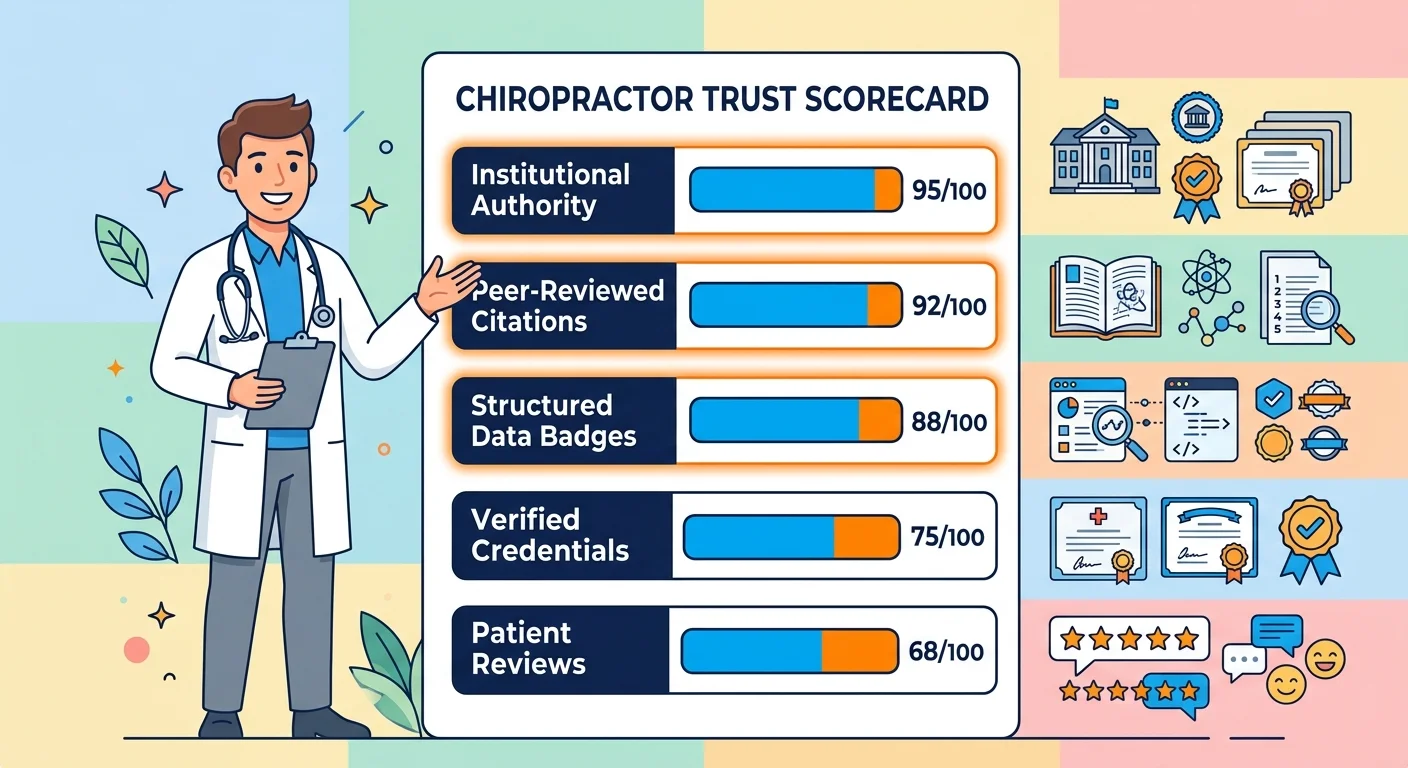
Here's where most practices miss it entirely.
They understand what an AI Authority Article looks like. They have no idea how AI engines actually judge it.
AI engines don't score content on a spectrum. They rule on it.
The criteria come down to entity trust. Can the engine verify who you are, what conditions you treat, and whether the sources behind your clinical claims are legitimate?
If the answer is no on any of those counts, it doesn't matter how well-written the content is. The verdict goes to someone else.
Publishing frequently doesn't build entity trust. Neither does writing clean, patient-friendly prose.
What builds it is structuring content so an AI system can audit it. Cross-referencing your signals against institutional data, peer-reviewed literature, verified source networks.
That's the submission standard. Most clinics aren't meeting it.
The Role of Source Validation in AI-Generated Health Recommendations
Source validation is how AI engines decide whether a healthcare recommendation is credible enough to say out loud.
Not editorial judgment. A structural audit.
NIH research confirms this directly: consumer trust in medical AI responses depends on the system citing primary academic literature. The chain from your content to its sourcing has to be intact, verifiable, and machine-readable. Break it anywhere and the engine moves on.
Pew Research Center data makes the stakes concrete: 60% of US adults are uncomfortable with healthcare providers relying on AI for medical decisions.
That discomfort doesn't go away. It gets managed — by sourcing transparency.
When an AI engine cites your practice, the sourcing architecture behind that citation is what patients are implicitly trusting. Whether they know it or not.
The gap between an AI Authority Article and a standard clinical article isn't cosmetic. It's structural.
One format is built to pass the audit. The other was never designed for that courtroom.
An AI Authority Article closes that gap. A conventional post doesn't come close.
What the FTC and CDC Frameworks Mean for Your Content Strategy
The FTC has been explicit: marketing claims about AI-generated content must be scientifically verifiable.
That's not a best-practice suggestion. It's an enforcement standard with real consequences.
Every clinical claim in an AI Authority Article has to be supportable, sourced, and clean of unsubstantiated assertions. The court doesn't accept evidence it can't verify — and the FTC doesn't either.
The CDC's infodemic framework hits the same requirement from a different direction.
Digital health spaces require authoritative, structured, and clear data pipelines to counter misinformation. Authority signals have to map to trusted institutional bodies.
For healthcare content, that's not optional infrastructure. It's the minimum standard for being recognized as a trustworthy entity by any AI engine operating in the health space.
So here's what that means in practice.
An AI Authority Article that doesn't align with the FTC's verifiability standard and the CDC's structured-data requirement isn't just incomplete. It's a liability.
In a regulated space like healthcare, the wrong format doesn't just lose the verdict. It gets remembered for the wrong reasons. One format is built for the judge. The other was never meant for that courtroom.
| Trust Signal | Why AI Engines Weight It | Healthcare-Specific Implication |
|---|---|---|
| Schema Markup | Converts raw content into a machine-readable submission format — AI engines can parse who the entity is, what it treats, and what credentials back the claims without guessing | A clinic without schema forces AI engines to infer its identity from unstructured text — that inference is unreliable, and unreliable entities don't earn citations in health queries |
| Peer-Referenced Sourcing | Provides the chain of institutional validation AI engines use to confirm a clinical claim is trustworthy enough to surface in a recommendation — editorial opinion alone doesn't clear that bar | Healthcare recommendations carry patient safety implications; AI engines apply a higher sourcing threshold to health content than to any other category |
| Entity Signal Consistency | AI engines cross-reference a practice's identity signals across multiple data points — name, specialty, location, credentials — and flag inconsistencies as trust deficits | A single mismatch between a practice's listed credentials and its content claims can suppress the entity from consideration entirely, regardless of content quality |
| Semantic Density | Thin content registers as noise — AI engines audit for depth, clinical specificity, and topical coherence before assigning any authority weight to a piece of content | A clinical article that covers a topic broadly without verifiable detail gives an AI engine nothing substantive to extract, validate, or cite in a patient-facing response |
| Structured Data Pipeline Alignment | Content must connect — through its architecture — to institutional bodies and source networks the AI engine already recognizes as authoritative in the health space | Practices whose content infrastructure maps to recognized health institutions are treated as extensions of that trust network; those whose content floats unanchored are not |
Who This Is For — and Who It Is Not

Not every practice is ready for this.
That's not an insult. It's a filter. AI Authority Articles are engineered infrastructure — they compound over time, they demand consistent execution, and they only work for practices willing to be verified, sourced, and committed to the long game.
Here's the thing: the practices that win AI recommendations aren't necessarily the best clinicians in the market.
They're the ones whose digital infrastructure can survive a judge's audit. Knowledge graphs evaluate authority across multiple digital reference channels — which means the court is already running checks your competitors don't know about.
So here's the split. The practices this is built for. And the ones it isn't.
The Practices That Compound Authority Over Time
The practices that benefit are the ones playing for permanence.
They're not chasing a spike in patient inquiries next month. They understand that authority is an asset — not an expense. Every properly structured evidence node they publish makes the next one more credible to the engines already evaluating their entity signals.
That's compounding. It doesn't work without the long-game commitment.
These are practices with defined specialties, consistent clinical positioning, and the patience to let structured content do its work.
The connection between how authority infrastructure actually drives appointment volume and what a practice publishes isn't instant. But for the practices that build it correctly, it becomes the most durable patient acquisition channel they've ever owned.
Nothing else compounds the same way.
And these practices understand the sourcing requirement isn't optional.
Pew Research found that 60% of US adults feel uncomfortable with healthcare providers relying on AI for clinical decisions. That number matters. The practices that compound authority are the ones whose content earns patient trust because it's verifiably sourced — transparent enough for the engine, credible enough for the patient.
Both bars have to clear. Most content doesn't clear either.
The Practices That Will Not Benefit From This Approach
Now for the other side.
Forcing this onto the wrong fit doesn't just produce poor results. It burns the most expensive asset a practice has: execution time.
So let's be direct about who won't benefit.
If you want measurable ROI in 90 days or less — this isn't it.
If you need a contractual guarantee of rankings, traffic, or bookings before you commit — this isn't it.
If you're looking to hand off a brief, get some content written, and check it off the list — this isn't it.
The court doesn't work on your timeline. The verdict never lands until the evidence is complete, verified, and consistent.
The blog index exists for practices still building context around what AI Authority content actually means. That's a valid starting point.
But practices that bolt AI Authority Articles onto a fragmented, unverified digital presence — without the structural commitment — don't compound. They publish into a vacuum.
The evidence never reaches the court.
| Practice Profile | Mindset | Fit for AI Authority Content | Reason |
|---|---|---|---|
| Established specialist clinic | Playing for permanence — authority is an asset, not a tactic | Strong fit | Defined specialty and consistent clinical positioning give AI engines a verifiable entity to trust and cite |
| Multi-location practice with unified brand | Willing to build structured infrastructure across all locations | Strong fit | Consistent entity signals across channels compound faster — knowledge graphs reward coherence at scale |
| Growth-stage practice with long-term focus | Understands compounding — not chasing a short-term inquiry spike | Good fit | Authority builds over time; practices that commit early accumulate a structural advantage competitors can't easily close |
| Practice seeking 90-day ROI guarantees | Needs measurable bookings before committing to execution | Poor fit | The court doesn't render a verdict on a timeline — evidence must be complete, verified, and consistent before a citation is earned |
| Generalist practice with no defined specialty | Wants to be everything to every patient | Poor fit | AI engines match entity signals to clearly defined clinical authority — broad, undifferentiated positioning produces no citable entity for the engine to trust |
| Practice with fragmented or unverified digital presence | Looking to bolt content onto an existing infrastructure without structural commitment | Poor fit | Evidence submitted to an unreliable courtroom never reaches the judge — content published into a broken entity framework publishes into a vacuum |
Frequently Asked Questions About AI Authority Articles
Here's where the objections show up.
Every question below is one a real healthcare professional asks before deciding whether to move — or keep doing what hasn't worked.
None of these are hypothetical. Each one determines whether a practice is building real evidence — or publishing into a void.
How does an AI Authority Article differ from a standard blog post?
A standard post is written for a reader. An AI Authority Article is structured for a judge.
One is editorial. The other is evidence.
A standard post optimizes for engagement and readability. An AI Authority Article optimizes for machine-readable trust signals — schema, entity verification, sourced clinical claims. The format, the sourcing architecture, and the structural intent are entirely different.
One was built for a scroll. The other was built for a verdict.
Why do conversational search engines ignore traditional medical content optimization techniques?
Conversational engines don't scan for keywords. They evaluate entity trust.
Credibility gets assessed across a practice's entire verified digital presence — directories, citations, structured data, content. Not just one piece of it.
Traditional content optimization was built for a ranked list. AI search returns a single verdict. Those aren't variations of the same problem — they demand completely different infrastructure.
How does structured schema markup help ChatGPT recommend a local clinic?
Schema markup is machine-readable labeling. It tells AI engines exactly what your practice is, who you treat, and where you're located — without ambiguity.
Without schema, a conversational engine has to guess. Guessing introduces uncertainty. Uncertainty means the engine recommends someone it can verify instead of you.
Schema closes that gap. It isn't a ranking tactic. It's a verification signal — the difference between submitting labeled evidence and handing the judge a pile of unmarked documents.
Will publishing AI-assisted content hurt my practice's credibility with patients?
That concern is legitimate. Don't dismiss it.
Pew Research found that 60% of US adults feel uncomfortable with healthcare providers relying on AI for medical decisions. But the credibility question cuts the other direction too.
Consumer trust in medical AI responses depends on whether the system cites primary academic literature. An AI Authority Article that's properly sourced — peer-reviewed references, verifiable clinical claims, transparent attribution — actually builds patient trust.
What damages credibility is unverified, loosely-sourced content. Structured evidence nodes do the opposite.
How long does it take for a healthcare practice's AI authority assets to compound?
There's no microwave timeline here.
Authority compounds. Each properly structured evidence node builds on the last. The engine tracks the accumulation.
What won't happen: a single article doesn't flip a verdict overnight. What does happen: consistent, structured execution deepens the entity signal the engine is already evaluating.
The practices that stick with it build something durable. The ones that quit after a few months give that compounding ground to whoever kept going.
Does my practice need to be on every platform for AI engines to recommend me?
No. But consistency across the platforms that matter isn't optional.
Knowledge graphs evaluate authority across multiple digital reference channels. The engine cross-checks your entity signals across directories, citations, and structured data — not just your content.
Being everywhere isn't the goal. Having accurate, consistent, verifiable entity signals on the right platforms is.
Gaps and contradictions in those signals introduce doubt. Doubt sends the verdict somewhere else.
The Verdict: What AI Authority Articles Actually Do for Your Practice
Here's the verdict.
An AI Authority Article isn't content. It's evidence. Structured, sourced, machine-readable evidence — submitted to a court that's already in session, already evaluating your entity, already deciding whether you're the answer or just noise.
Without it, the judge doesn't rule in your favor. The judge rules for whoever submitted something the court could actually evaluate.
That's what this whole article has been building toward.
Practices earning AI recommendations aren't winning on charisma or keyword density. They're winning because their digital infrastructure holds up under scrutiny. Every properly structured evidence node compounds the one before it. Every verifiable clinical claim strengthens the entity signal the engine is already tracking.
The courtroom is always in session. The only question is whether your practice has submitted anything the judge can actually use. Without that infrastructure, the verdict never goes in your favor.
If you don't know what AI engines are currently saying about your practice — that's where to start.
The AI Visibility Check takes fifteen minutes. It shows you exactly where your entity signals stand right now. iTech Valet built it for one reason: you can't fix what you can't see.
Run it. See what the judge already thinks. Then decide if the evidence you've submitted is enough to win — or if the court has already moved on without you.
AI is already naming someone in your market. Find out if it's you.

621 Enterprises, Inc. | Copyright 2026 | All rights reserved