What Makes an Authority Infrastructure Audit Different
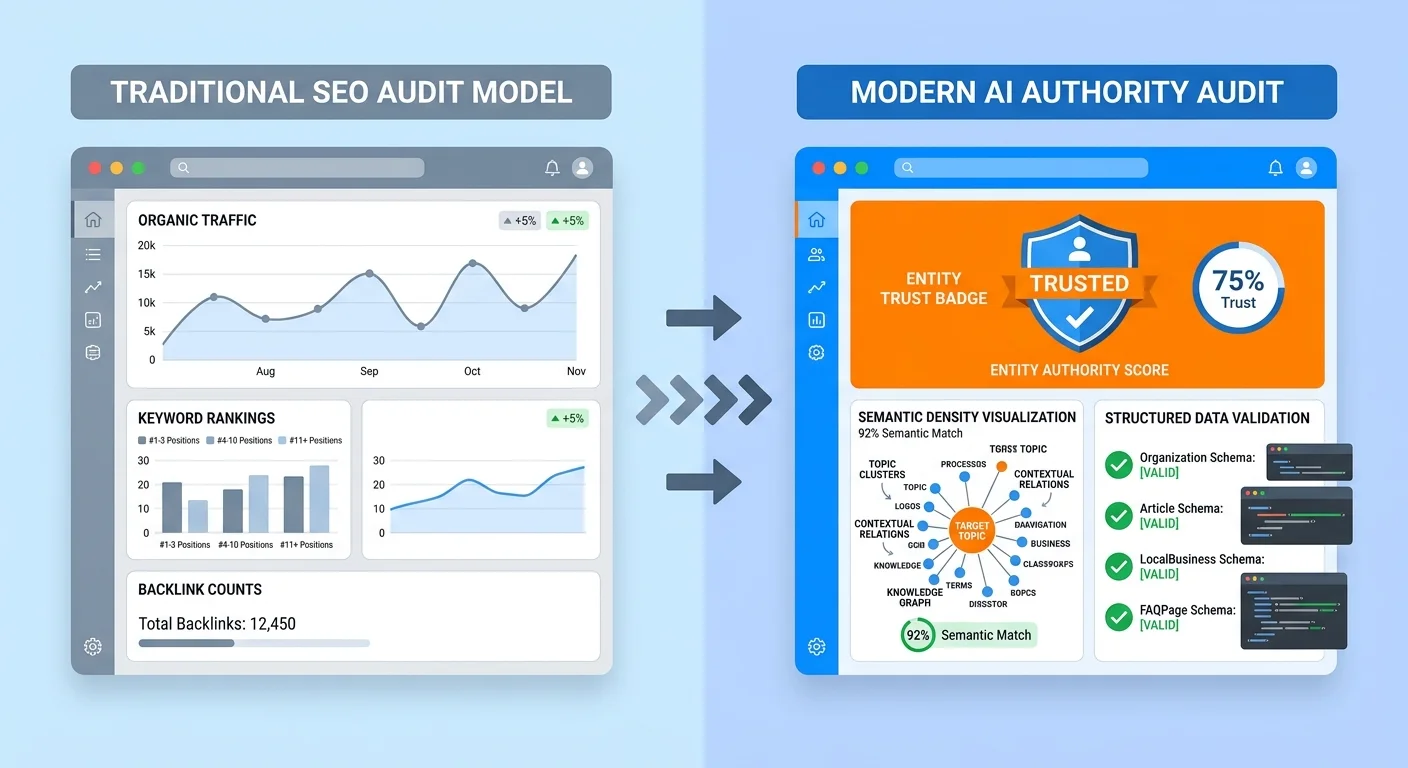
Here’s what most business owners miss: a traditional SEO audit and an Authority Infrastructure Audit aren’t variations of the same thing.
They measure different outcomes. They optimize for different engines. They solve different problems. One assumes the user will click through a list of options. The other assumes AI will name you as the only option worth considering.
That distinction isn’t cosmetic. It’s architectural. And it determines whether you’re building a website that looks good to humans or infrastructure that AI engines trust enough to cite.
Traditional SEO Audits Focus on Ranking in a List
Traditional SEO audits chase visibility in a ranked list. They count keyword rankings, backlink counts, mobile responsiveness, and on-page optimization. They track whether you’re in position seven or position three. The entire game is moving your link up the list.
That model worked when users clicked through ten blue links. Not anymore. With 25% of desktop searches ending without a click, users aren’t evaluating options. They’re reading the answer ChatGPT or Gemini serves them directly. The list doesn’t matter if no one’s clicking it.
A traditional audit measures performance in a game that’s being replaced. It tells you where you rank in a list of competitors. It doesn’t tell you whether AI can read your entity, trust your credentials, or name you as the answer.
Authority Infrastructure Audits Focus on Being the Answer
An Authority Infrastructure Audit measures whether AI engines can name you as the single authoritative answer. It evaluates Entity Trust Signals, Semantic Density and Topical Authority, and Machine-Readable Infrastructure. Those are the three layers AI requires to recommend a business.
Google designs its systems to reward content that demonstrates strong Experience, Expertise, Authoritativeness, and Trust. AI engines extend that model. They don’t just rank pages. They name entities. And if your digital presence doesn’t communicate entity trust through full structured data implementation and semantic depth, you don’t exist in that calculation.
This is why your standard website is invisible to AI. It wasn’t built to be read by machines. It was built to be scrolled by humans. The audit identifies every place your infrastructure fails the machine-readability test – and provides the roadmap to fix it.
| Audit Type | Primary Goal | Success Metric |
|---|---|---|
| Traditional SEO Audit | Rank higher in a list of search results | Keyword position, backlink count, traffic volume |
| Authority Infrastructure Audit | Be named as the single authoritative answer by AI | Entity trust, semantic density, machine-readable infrastructure |
| Traditional SEO Audit | Optimize for human users who click through ranked links | Click-through rate, time on page, bounce rate |
| Authority Infrastructure Audit | Optimize for AI engines that extract and cite authoritative answers | AI recommendation presence, zero-click visibility, citation velocity |
| Traditional SEO Audit | Improve technical performance and on-page optimization | Page speed score, mobile responsiveness, meta tag completeness |
| Authority Infrastructure Audit | Rebuild infrastructure AI engines require to trust and recommend you | Structured data completeness, entity disambiguation, topical authority depth |
The Three Diagnostic Layers of an Authority Infrastructure Audit
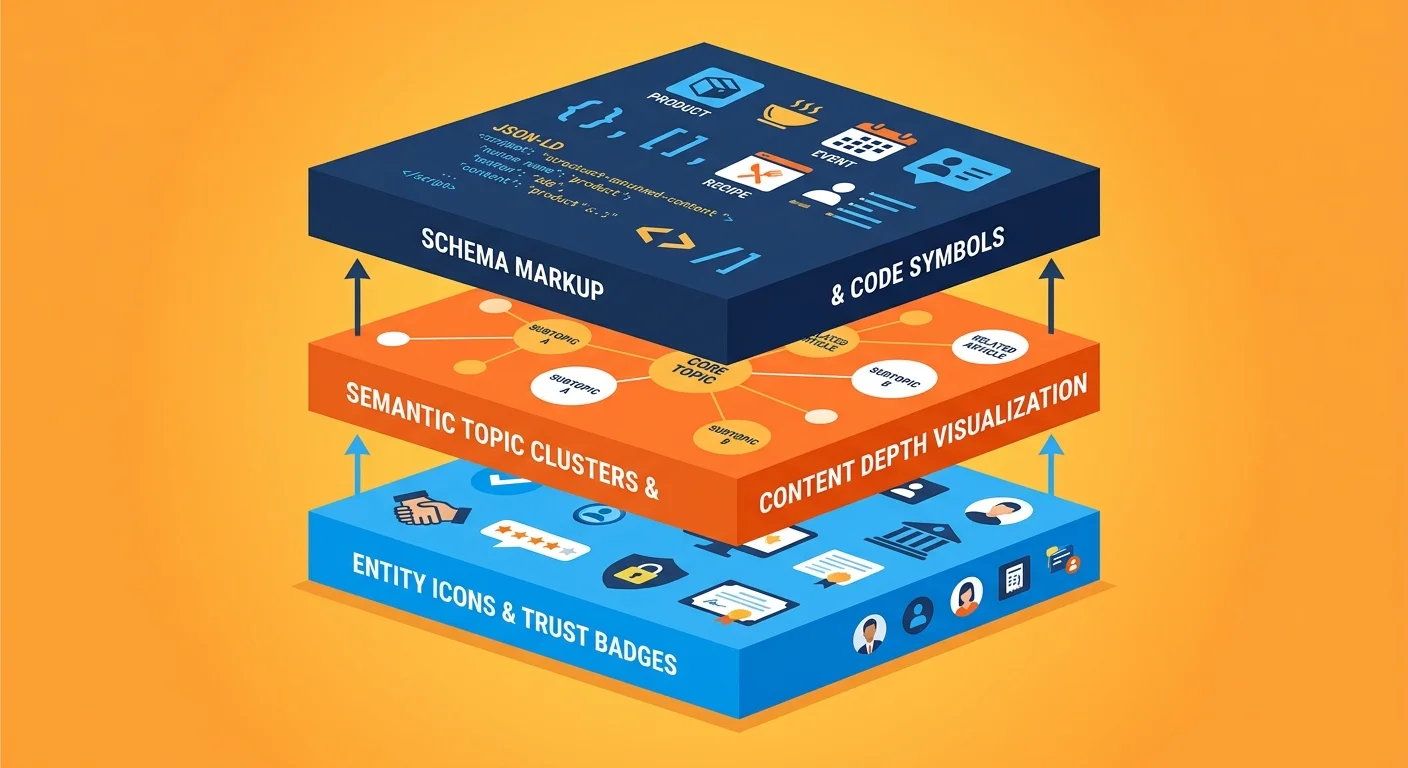
So what does the audit actually measure?
Three distinct layers. Each diagnoses a different failure mode. Each maps to a specific fix that makes your business visible to AI.
Layer 1: Entity Trust Signals
Entity Trust Signals verify your business exists as a recognized, credible entity across the web. AI engines don’t trust isolated claims. They triangulate. Your business name shows up consistently across Google Business Profile, industry directories, citation sources, and structured schema markup? You pass. If it doesn’t, you’re a ghost.
This layer measures NAP consistency (Name-Address-Phone), schema implementation, backlink profile quality, and third-party validation signals. Google explicitly designs its systems to reward content that demonstrates strong Experience, Expertise, Authoritativeness, and Trust (E-E-A-T). AI extends that standard. It won’t recommend an entity it can’t verify.
Most practices fail here not because they’re untrustworthy. They fail because their digital footprint is fragmented. The audit identifies every inconsistency – misspelled business names, outdated addresses, missing schema – and maps the fixes required to pass entity-based SEO verification.
Layer 2: Semantic Density and Topical Authority
Semantic Density and Topical Authority measure whether your content library establishes you as the definitive source on your topic. AI doesn’t recommend businesses with three blog posts. It recommends entities that have covered a subject from every angle.
This layer evaluates content depth, internal linking architecture, keyword clustering, and topic coverage completeness. The audit asks: if someone queries every variation of your core service, does your content answer all of them? Or do gaps exist where competitors own the semantic territory?
Most websites have coverage gaps they don’t realize exist. The audit surfaces those gaps and quantifies how much authority you’re leaving on the table by not creating a semantic entity hub that addresses every intent layer your buyer navigates.
Layer 3: Machine-Readable Infrastructure
Machine-Readable Infrastructure determines whether AI can parse, extract, and cite your content. This is where most websites fail before they ever reach the content evaluation stage. 99.99% of analyzed websites have at least one technical error impacting performance. Many of those errors make the site unreadable to AI.
Structured data provides AI engines with explicit clues about the meaning and context of a page. Without it, AI has to guess what your page is about. With it, you’re telling the engine exactly what entity you represent, what services you offer, and what questions your content answers.
This layer audits schema markup completeness, site speed, mobile usability, crawl errors, indexation health, and all the foundational machine-readable signals that determine whether your infrastructure is accessible. If AI can’t read you, it can’t recommend you. Period.
| Diagnostic Layer | What It Measures | Common Failure Point |
|---|---|---|
| Entity Trust Signals | Verifies that your business exists as a recognized, credible entity across the web through NAP consistency, schema implementation, backlink profile quality, and third-party validation signals. | Fragmented digital footprint – inconsistent business names, outdated addresses, missing structured data, or weak third-party citations that prevent AI from triangulating your identity. |
| Semantic Density and Topical Authority | Assesses whether your content library comprehensively covers your topic from every relevant angle, evaluating content depth, internal linking architecture, keyword clustering, and topic coverage completeness. | Coverage gaps – insufficient content volume, shallow topic exploration, or failure to address all intent layers, leaving semantic territory to competitors. |
| Machine-Readable Infrastructure | Determines whether AI can parse, extract, and cite your content by auditing schema markup completeness, site speed, mobile usability, crawl errors, indexation health, and technical accessibility. | Technical barriers – missing or incomplete structured data, performance errors, crawl issues, or infrastructure problems that make the site difficult or impossible for AI to parse. |
What the Audit Reveals That Traditional SEO Misses
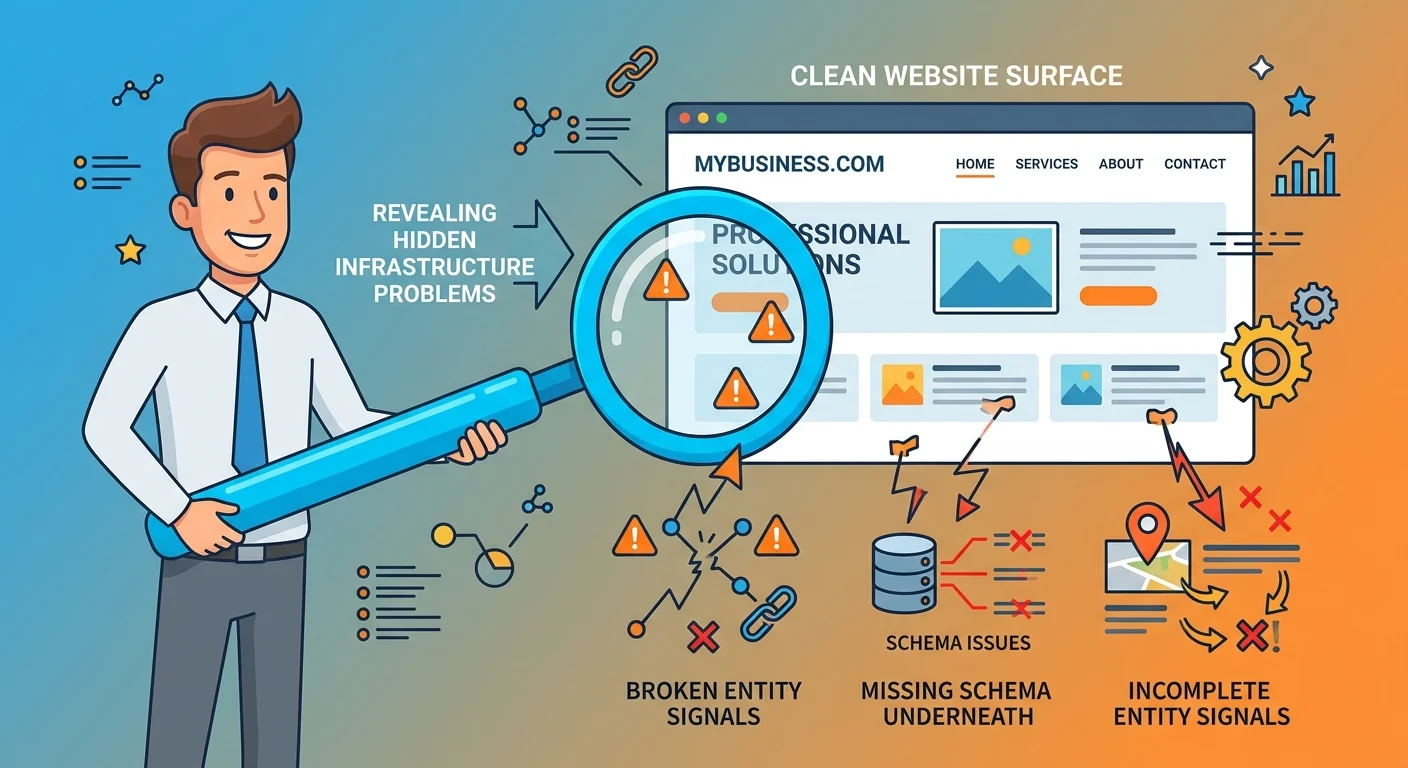
These three layers expose a set of failures that traditional SEO audits don’t even look for.
Most agencies check page speed, mobile responsiveness, broken links. They track keyword rankings. They count backlinks. They optimize meta descriptions.
All of that matters.
But none of it tells you whether AI can identify your business as a trustworthy entity. None of it verifies your credentials across the web. None of it measures whether AI can extract your content as the authoritative answer.
Traditional SEO assumes the user will click through a list of options. The audit reveals whether you’ve built the infrastructure required to be the only option AI names.
Invisible Entity Identity
66% of pages have zero backlinks. That means most businesses have no external validation signals AI can use to verify entity credibility.
The problem goes deeper than link count.
Many businesses have inconsistent NAP data across directories, missing or incomplete schema markup, and fragmented citations that make it impossible for AI to confirm the entity is real.
A traditional SEO audit flags duplicate meta descriptions. An Authority Infrastructure Audit flags the fact that your Google Business Profile lists a different phone number than your website schema, which lists a different address than your Yelp listing.
AI sees that inconsistency as a red flag.
If AI can’t triangulate your identity across multiple authoritative sources, it won’t recommend you.
It’ll recommend the competitor whose entity signals are clean.
The audit surfaces every point of entity drift and maps the corrections required to pass Google’s core E-E-A-T principles at the infrastructure level.
Thin or Inconsistent Topical Coverage
The average first-page result contains 1,447 words. Most businesses publish content well below that threshold. And worse, they publish sporadically across unrelated topics rather than building semantic coverage of their core service area.
Traditional audits measure whether you have blog posts.
Authority Infrastructure Audits measure whether your content library establishes you as the definitive source on your topic.
AI doesn’t cite businesses with three generic posts about wellness tips. It cites entities that have systematically covered every question, objection, symptom, and intent layer a buyer moves through before making a decision.
The audit identifies semantic gaps – topics your competitors own because you never published on them – and quantifies the topical authority you’re leaving on the table.
If your content doesn’t form a complete, interconnected web of answers, AI has no reason to trust you as the authority.
It’ll pull from the entity that does.
Broken Structured Data or Missing Schema
99.99% of websites have at least one error impacting performance. Many of those errors make the site unreadable to AI.
Structured data tells AI what your page is about, who your business is, what services you offer, and what questions your content answers.
Without it, AI has to guess.
And when it guesses, it guesses wrong – or it skips you and recommends the competitor whose schema explicitly declares their entity type, service area, and credentials.
Traditional audits check whether schema exists. Authority Infrastructure Audits check whether your schema is complete, accurate, and aligned with the entity signals you’re broadcasting everywhere else.
Broken or incomplete structured data is worse than no data at all. It signals to AI that your infrastructure is unreliable.
The audit runs a comprehensive technical SEO audit through the lens of machine readability, surfacing every technical barrier that prevents AI from trusting, parsing, or citing you.
How the Audit Is Performed
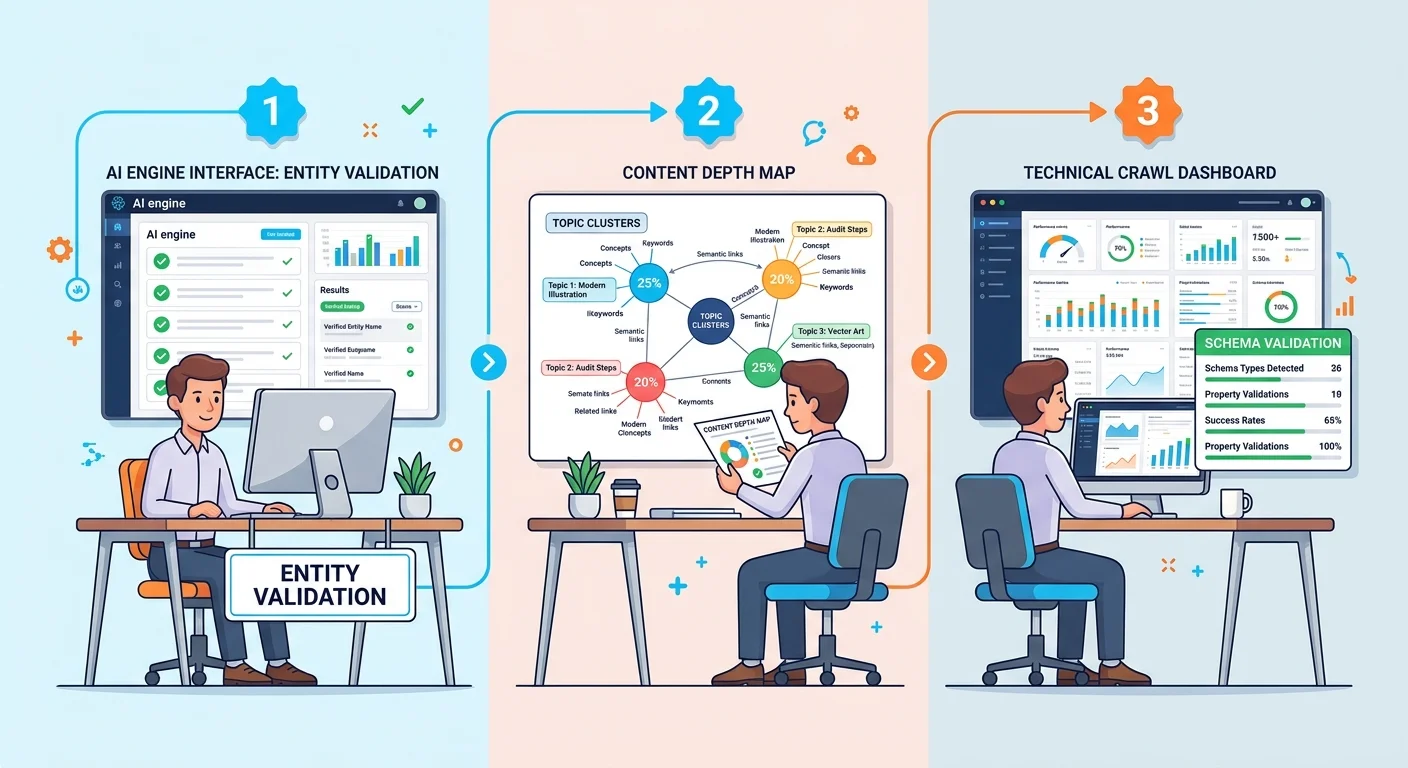
So how does someone actually run this audit?
It’s not one tool or one checklist.
It’s a systematic, multi-layer diagnostic that tears through your digital presence across the three infrastructure layers AI uses to decide who to recommend.
Part forensic analysis. Part entity validation. Part technical crawl.
Each step exposes a different failure mode keeping you invisible.
Step 1: Entity Recognition Validation
The first step confirms your business exists as a recognized, credible entity across the web.
AI doesn’t trust isolated claims. It triangulates.
It hunts for your business name, address, and phone number across Google Business Profile, industry directories, citation sources, and structured schema markup. Then it checks whether those signals align.
If your Google Business Profile lists one phone number, your website schema lists another, and your Yelp page has a third variation of your business name, AI sees fragmentation.
It doesn’t guess which one is correct.
It marks you as unverifiable and moves on to the competitor whose entity signals are clean.
This step audits NAP consistency across every directory, validates schema completeness, and maps your backlink profile to confirm third-party sources are citing your entity correctly.
Nearly all websites have at least one technical error tanking performance. And many of those errors start here – with entity drift that makes it impossible for AI to confirm you’re real.
Gerek Allen’s methodology treats entity recognition as the foundational layer. Without it, nothing else matters.
Step 2: Content and Semantic Depth Analysis
The second step checks whether your content library proves you’re the definitive source on your topic.
AI doesn’t recommend businesses with three blog posts. It recommends entities that have covered a subject from every angle.
Direct intent. Indirect intent. Latent concerns. Objections. Post-decision implementation.
This phase maps your existing content against the full semantic territory your competitors occupy.
It identifies coverage gaps – topics where you have zero content while competitors own the answer. It checks your internal linking architecture to confirm your content forms a cohesive web of authority rather than isolated posts.
And it benchmarks your topical depth against the length and comprehensiveness AI expects.
Most businesses find they’ve published sporadically across unrelated topics rather than building systematic coverage of their core service area.
The audit surfaces every gap and maps the content needed to own the semantic space.
If your content doesn’t answer every variation of the buyer’s journey, AI has no reason to name you as the authority.
Step 3: Technical Infrastructure Crawl
The final step checks whether AI can parse, extract, and cite your content.
This is where most websites fail before they ever reach the content evaluation stage.
Structured data gives AI explicit clues about the meaning and context of a page. Without it, AI has to guess what your page is about.
When it guesses, it guesses wrong.
Or it skips you entirely.
This step audits schema markup completeness, site speed, mobile usability, crawl errors, indexation health, and every technical signal that determines whether your infrastructure is accessible.
Broken or incomplete structured data is worse than no data at all. It actively tells AI your infrastructure is unreliable.
The AI Authority Engine rebuilds this layer from the ground up. Your website isn’t a brochure for humans – it’s a trust signal for machines.
| Audit Step | Primary Tool/Method | Key Output |
|---|---|---|
| Entity Trust Signals Verification | Cross-directory NAP consistency scan, schema validation crawl, backlink citation audit | Entity drift map showing every conflict across directories, schema gaps, and citation inconsistencies that prevent AI triangulation |
| Semantic Density and Topical Authority Mapping | Content inventory analysis, semantic gap identification, internal linking architecture audit, topical depth benchmarking | Coverage gap report identifying every topic competitors own that you’ve never published on, plus semantic density score comparing your content depth to AI’s expectations |
| Machine-Readable Infrastructure Diagnostic | Full structured data markup audit, technical crawl for speed/mobile/indexation, schema completeness validation | Technical barrier report flagging every schema error, crawl issue, and infrastructure failure that makes your site unreadable or unverifiable to AI engines |
Frequently Asked Questions
Let’s address the most common objections.
You’ve seen the gap. You know your infrastructure was built for a world where people clicked through ten blue links instead of asking ChatGPT who to trust.
Knowing the problem exists and understanding how to fix it are two different things.
These are the questions practices ask when they realize their digital presence isn’t infrastructure – it’s a liability.
What is the main difference between an Authority Infrastructure Audit and a standard SEO audit?
A standard SEO audit checks whether you rank in a list of options.
An Authority Infrastructure Audit checks whether AI can name you as the one answer.
Traditional audits measure traffic, keyword positions, and backlink counts. Vanity metrics tied to a browsing model that’s dying. Over 25% of desktop searches now end without a click. Being on page one of Google is worth less every quarter.
Authority Infrastructure Audits measure entity trust, semantic density, and machine readability. The signals AI uses to decide who gets recommended when someone asks a question.
If your audit isn’t diagnosing whether AI can parse, verify, and cite your entity, it’s optimizing for a world that no longer exists.
How can an Authority Infrastructure Audit directly lead to being recommended by AI like ChatGPT?
AI recommends entities it can verify across multiple authoritative sources.
The audit maps every signal AI triangulates to confirm you’re credible. Your NAP consistency across directories. Your schema markup completeness. Your backlink profile. Your content depth against the benchmark AI expects. Your technical infrastructure’s accessibility.
Google’s systems are designed to reward content demonstrating strong Experience, Expertise, Authoritativeness, and Trust. AI engines use those same signals to compile their recommendation lists.
When your infrastructure meets the standard across all three layers – Entity Trust Signals, Semantic Density and Topical Authority, and Machine-Readable Infrastructure – AI has the data it needs to name you.
When it doesn’t, AI names the competitor who fixed the gap first.
What technical skills are needed to fix the issues found in an Authority Infrastructure Audit?
None.
You don’t fix this yourself.
The audit identifies the failures. The execution requires developers, content strategists, and infrastructure architects who understand how AI parses entities. Most businesses lack the in-house expertise to rebuild schema, fill semantic gaps, and audit entity drift across directories.
That’s not a weakness. It’s why agencies exist.
But here’s the filter: if the agency you’re evaluating doesn’t talk about entity trust, semantic density, and machine-readable infrastructure as the core deliverables, they’re selling traditional SEO under a new label.
The AI Authority Engine rebuilds this infrastructure as a turnkey system because most practices don’t have time to learn how AI triangulates authority signals. They need the infrastructure built correctly once.
Is an Authority Infrastructure Audit necessary if my website already ranks on Google’s first page?
Yes.
Ranking on Google’s first page means you optimized for a list of options people used to click through and compare.
AI doesn’t show lists. It names one answer.
If your infrastructure isn’t built for AI to extract, verify, and cite you as that answer, your first-page ranking is borrowed time. The majority of web pages lack significant authority signals – over 66% of pages have no backlinks at all – and most of those pages are surviving on outdated SEO tactics that AI ignores entirely.
First-page rankings don’t immunize you from AI invisibility. They just mean you optimized for the last era before the shift happened.
What is the first step a business should take after receiving the results of their Authority Infrastructure Audit?
Prioritize the Entity Trust Signals layer.
If AI can’t verify your business exists as a credible entity, it won’t evaluate your content or technical infrastructure.
That means auditing NAP consistency across every directory, validating schema completeness, and fixing entity drift before you touch anything else. Most businesses discover fragmented data – different phone numbers across Google Business Profile and their website, incomplete schema markup, inconsistent business names across citation sources.
AI sees that fragmentation and marks you as unverifiable.
Fix the entity layer first. Everything else compounds on top of it.
The Bottom Line
Here’s where this leaves you.
Your website isn’t a brochure for humans – it’s a trust signal for machines.
An Authority Infrastructure Audit measures whether your digital presence meets that standard across all three layers: Entity Trust Signals, Semantic Density and Topical Authority, and Machine-Readable Infrastructure. Traditional SEO audits check whether you rank in a list of options. This audit checks whether AI can name you as the one answer.
That’s the distinction. And it’s the reason most businesses are invisible right now.
Most businesses are running on infrastructure built for humans browsing pages in 2015.
Schema is missing or incomplete. NAP data drifts across directories. Content covers random topics instead of owning a semantic territory. Technical errors pile up because nobody’s auditing for machine readability – just mobile responsiveness and page speed.
That worked when Google showed ten blue links and users clicked through to compare.
It doesn’t work now.
AI doesn’t browse. It extracts. And if your infrastructure can’t be extracted, you’re invisible.
The audit exposes what’s keeping you invisible when someone asks AI who to trust.
It maps the exact corrections required to build entity trust, establish topical authority, and make your infrastructure machine-readable at the level AI demands.
You can keep optimizing for a list of options that fewer people click through every year. Or you can run your AI Visibility Check and see where your infrastructure actually stands.
Either way, AI is already making recommendations in your market.
The only question is whether you’re the answer it gives.
Your website isn’t a brochure for humans – it’s a trust signal for machines.
Here’s where this lands.
You can keep guessing whether your infrastructure meets the standard AI demands. Or you can run your AI Visibility Check and see exactly where you stand right now.
Takes fifteen minutes. Shows you what ChatGPT, Gemini, and Perplexity say when someone in your market asks who to trust.
No sales pitch. No obligation.
Just the gap between where your infrastructure is and where it needs to be for AI to name you as the answer.
Your authority infrastructure isn’t a brochure for humans – it’s a trust signal for machines.