The Referral Model Worked – Until It Didn’t
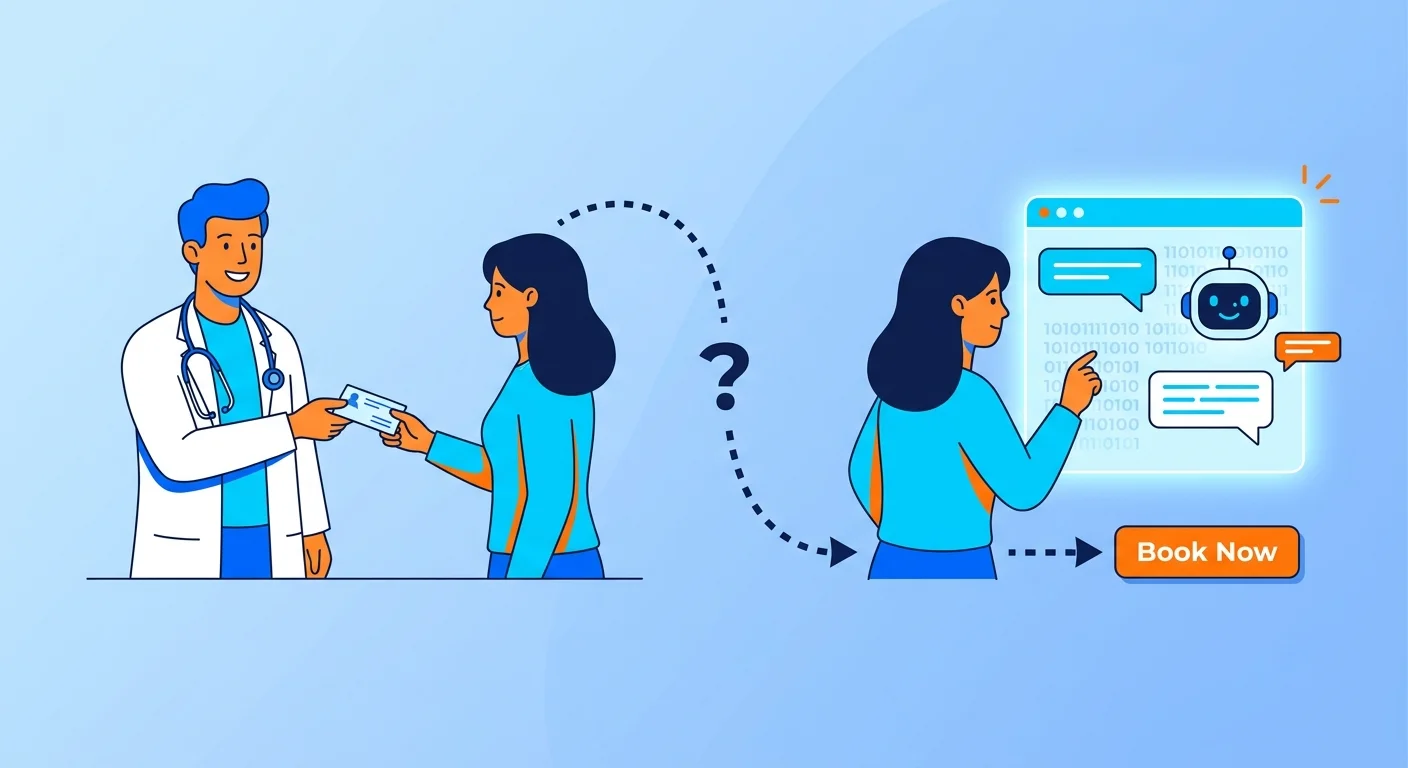
The referral flywheel built medicine. Patient gets great care. Tells a friend. Friend books. No algorithm. No ad spend. Just trust moving person to person – and for decades, that was the whole game.
It filled schedules without a single dollar of paid media. It created loyalty no campaign can manufacture. For most established chiropractors, it’s still the thing they’re most proud of – proof that the work speaks for itself.
But the flywheel picked up a new friction point.
And most practices don’t see it until the schedule starts thinning.
Why Word-of-Mouth Can No Longer Close Itself
Here’s the thing: the referral no longer closes itself. A trusted friend still says your name – that part works exactly the same as it always did. What’s different is what happens next. The patient goes home, opens ChatGPT or Gemini, and asks whether you’re actually worth booking.
That verification step is now standard consumer behavior. Research on how patients evaluate medical authority online confirms that a large majority of consumers cross-check personal recommendations against independent online platforms before booking their first appointment. The referral gets them interested. The AI closes – or kills – the deal.
So the question isn’t whether your patients trust you.
They do. The question is whether the machine they consult next trusts you enough to say so.
The Hidden Verification Gate Patients Added Without Telling You
Think of it as a gate your patients added without telling you. They’re not being disloyal. They’re doing what every consumer does now – they cross-check the recommendation against whatever the AI returns. If the AI says your name, you’re confirmed. If it returns silence or a competitor, the referral evaporates.
That gate is getting harder to pass by the month. Zero-click searches have risen to 68% of US Google searches – 68.01%, to be exact (Similarweb data) – meaning patients aren’t landing on your homepage to evaluate you. They’re reading the AI’s verdict directly on-platform. And that verdict depends entirely on structured data and entity signals the AI can actually find. Most practice websites provide none of it. why so many agencies miss this
The referral model didn’t break. It grew a second half – one that runs on machine-readable authority signals instead of human trust.
Until your practice speaks that language, the handshake never closes.
| Discovery Era | How Patients Found You | What Closed the Decision | Who Controlled the Outcome |
|---|---|---|---|
| Word-of-Mouth Era | A trusted friend or colleague gave a personal recommendation | The referring person’s credibility and relationship closed the decision | The patient and the referral source – two humans, zero machines |
| Early Digital Era | Google search and directory listings supplemented referrals | A website with good reviews and basic contact information confirmed legitimacy | The practice – through its own content and online presence |
| SEO Era | Keyword rankings and page-one placement drove organic discovery | Click-through to a well-designed website with service pages and testimonials | Search algorithm rankings – practices with the most optimized pages won |
| Conversational AI Era (Now) | A trusted friend still refers – but the patient then asks an AI to verify | The AI’s verdict: a single recommended answer based on structured entity data and citation signals | The AI engine – practices with machine-readable authority infrastructure get named; the rest don’t |
Why Traditional SEO Cannot Save a Referral-Dependent Practice
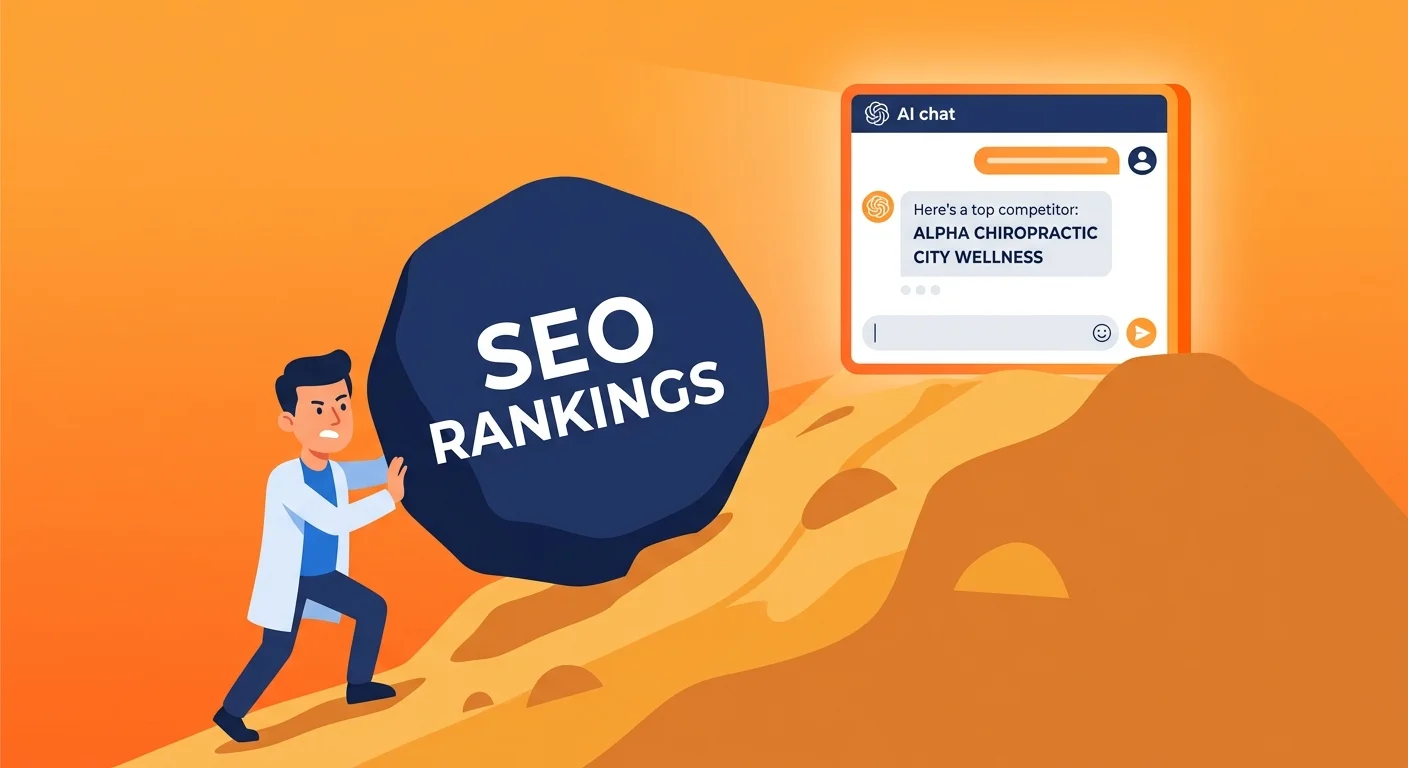
When referrals slow, every practice does the same thing. Call an agency. Start a blog. Optimize some keywords. It feels right – because it worked once, and because every agency in the room is still selling it like nothing changed.
But SEO is built for a world that’s already disappearing. Search engine volume will drop 25 percent by 2026 as conversational AI replaces the standard search box. And zero-click searches have increased to nearly 57 percent of all queries – meaning patients never reach your website even when they do search. You can rank on page one. You’re still invisible.
That’s the problem SEO can’t fix. It optimizes for a list. AI search produces a verdict. Those aren’t two versions of the same thing. Treating them like they are is exactly why referral-dependent practices keep losing ground while their SEO dashboard shows green.
Why Traditional SEO Fails Chiropractors Now
Traditional SEO was built for Google’s old algorithm. Pick a keyword. Build some backlinks. Climb a results page. Patients clicked, found you, booked. That chain worked – and then it stopped.
It doesn’t work anymore – because patients stopped Googling and started asking. When someone opens ChatGPT and asks who the best chiropractor near them is, keyword density doesn’t move the needle. Backlinks don’t move the needle. What matters is whether AI trusts your entity enough to say your name. Most practices running traditional SEO aren’t even in that conversation.
The agencies selling SEO to chiropractors right now are optimizing for an output – page rankings – that your patients never see. They’re measuring clicks to a website patients aren’t visiting. They’re publishing keyword-stuffed blog posts that AI engines can’t parse as authoritative entity signals. And they’re collecting monthly retainers while the verification gate your patients use every day returns nothing.
Before you sign another SEO contract, ask your agency one question: what does this do to make AI recommend me? If they don’t have a specific, structural answer, you’re paying for vanity metrics in a world that’s already moved on. Most agencies can’t answer that question. And the visibility gap they’re leaving is only part of the exposure – start with the HIPAA and compliance risks your agency creates
This Is Not for Every Practice
Here’s the thing. This isn’t for everyone. And that’s worth saying plainly.
If you need a packed schedule in 60 days, stop here. Authority infrastructure doesn’t work like a paid ad. It builds in layers. It compounds. If your decision framework runs on fast wins or guaranteed rankings, that’s a different kind of engagement – and honestly, a different kind of agency. We’re not it.
But if you’ve built real clinical credibility, earned genuine patient loyalty, and watched referrals slow down anyway – the problem isn’t your practice. It’s the gap between the authority you’ve actually earned and what AI can verify. That gap is structural. It’s specific. And right now, it’s the only gap that actually matters.
| What SEO Optimizes For | What AI Answer Engines Require | Why the Gap Is Structural |
|---|---|---|
| Keyword rankings on a search results page | Verified entity signals across structured databases | Rankings are a list position; AI produces a single named verdict – the two outputs are not interchangeable |
| Backlink volume and domain authority scores | Consistent Name, Address, and Phone records across authoritative directories | Backlinks signal relevance to a crawler; directory integrity signals trustworthiness to an AI recommendation engine |
| Click-through traffic to a practice website | Structured schema data that AI engines can parse without visiting a page | If patients never click through to your site – and most don’t – SEO traffic metrics measure an event that isn’t happening |
| Keyword-dense blog content published on a regular schedule | Citation velocity built from entity-linked, schema-rich authority content | Generic blog posts feed a crawl index; AI engines need machine-readable entity anchors that confirm who you are and what you do |
| Monthly vanity metrics: impressions, ranking position, page visits | AI recommendation frequency: how often your name appears as the answer to a patient’s direct query | The metric SEO tracks and the outcome a referral-dependent practice needs are measuring completely different things |
What AI Search Engines Actually Look For
So what does AI actually need before it trusts you?
Not a beautiful website. Not a keyword-optimized blog post. Not even a five-star review average – though that doesn’t hurt.
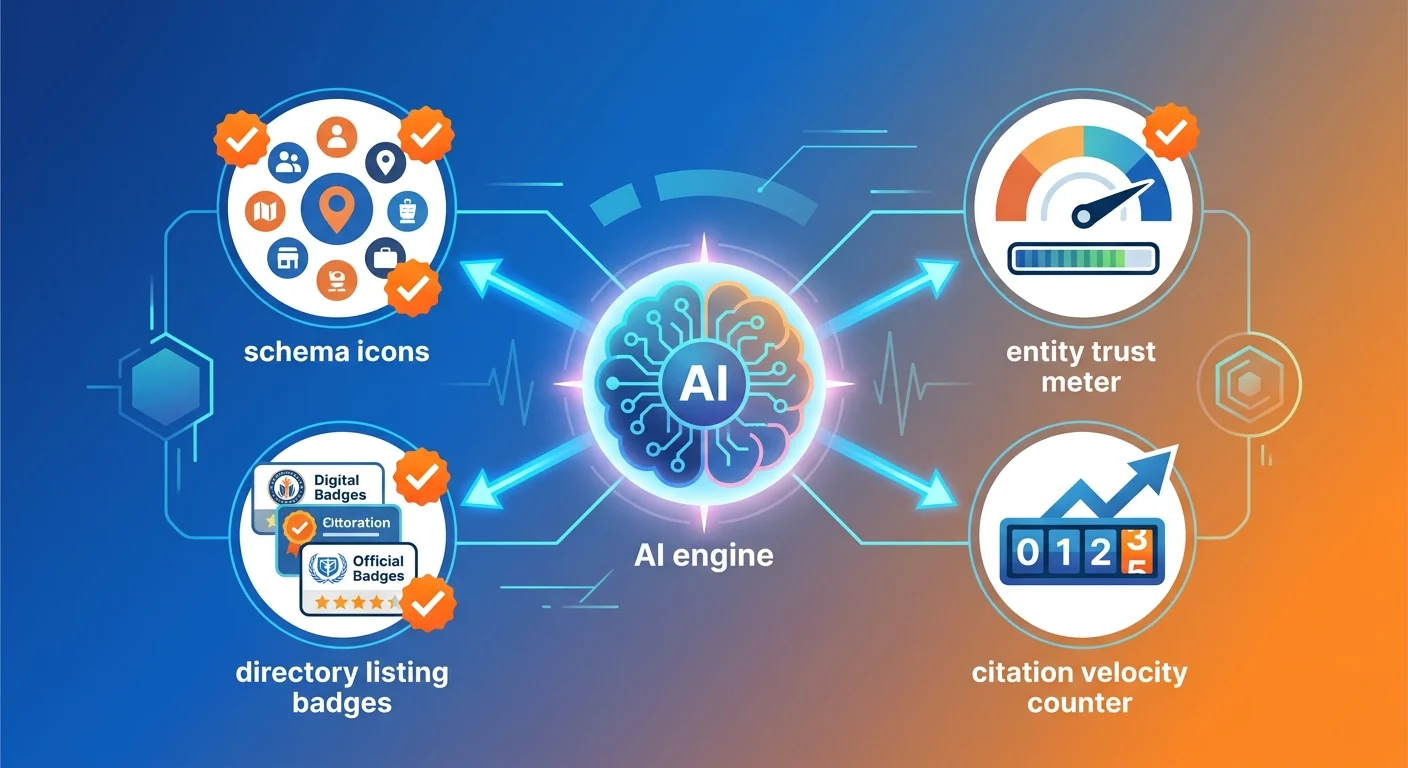
AI answer engines are entity resolution machines. They’re not reading your homepage and deciding if you sound credible. They’re cross-referencing structured schema nodes, directory records, and verified data signals to confirm whether you exist as a trusted, parseable entity. Signals present and consistent – you get cited. Signals missing or contradictory – you don’t.
Here’s the thing: the old authority model never had to think about any of this. Word-of-mouth didn’t require schema markup. A referral from a trusted colleague didn’t need NAP consistency across forty directories. But the second half of that referral handshake – the moment the patient turns to AI and asks – runs entirely on structured data. And most practices are handing that machine nothing.
Entity Trust: The Signal AI Uses Instead of Rankings
Rankings are a Google concept. AI engines don’t produce a ranked list. They produce a verdict. And that verdict is built on entity trust – the degree to which an AI system can confirm that you are who you say you are, operating where you say you operate, doing what you say you do.
Entity trust is built from structural web signals – not content volume. Generative AI tracker metrics show that AI systems cite localized entity data based on structural signals, not raw generic content files. Over 60% of citation footprints are pulled from structured reference databases with verified entity linkages – not unstructured web pages. Conversational engines reward infrastructure. They don’t reward publishing volume.
That’s a complete inversion of how traditional SEO works. More blog posts don’t build entity trust. More backlinks don’t build entity trust. What builds it is structured schema, verified directory presence, consistent NAP data, and citation velocity across authoritative sources. That’s exactly what most agency-built practice websites are missing – and exactly what those agencies never told you.
Why NAP Inconsistency Kills Your AI Visibility
Here’s the single most common reason practices fail the AI verification gate.
Their Name, Address, and Phone data is inconsistent across directories. It sounds mundane. It is catastrophic.
When NAP records conflict – a slightly different suite number here, an old phone number there – AI systems can’t resolve your entity with confidence. NAP discrepancies degrade entity trust metrics in central health indexing databases. You don’t slip slightly. You become structurally unresolvable – and AI recommends someone else.
This is exactly where the referral handshake dies. The patient gets your name from a trusted source. They ask the AI. The AI can’t confidently resolve your entity – because your directory data is a mess – so it names whoever it can verify. The referral evaporates. Not because your clinical reputation failed. Because a suite number was wrong in three directories. That’s the structural gap the AI Authority Engine is built to close.
| Authority Signal | What AI Engines Read | What Breaks It | Impact on Recommendation Probability |
|---|---|---|---|
| Structured Schema Markup | Machine-readable entity data embedded in site code – business type, service area, hours, credentials | Schema absent, incomplete, or contradicts directory records | AI cannot parse the entity as real; practice is skipped for any recommendation |
| NAP Consistency | Name, Address, and Phone data across all major directories and databases | Inconsistent suite numbers, old phone numbers, or name variations across listings | Entity becomes structurally unresolvable; AI recommends a competitor it can verify instead |
| Verified Directory Presence | Active, accurate listings on high-integrity platforms AI engines treat as trusted reference nodes | Missing listings, unclaimed profiles, or stale data on key directories | Citation footprint shrinks; AI has fewer verified signals to draw from when forming a recommendation |
| Citation Velocity | The rate at which authoritative sources reference and confirm the entity over time | Static presence with no ongoing content or signal accumulation | Authority decays relative to competitors actively building signals; AI confidence in the entity erodes |
| Entity Linkage | Cross-referenced connections between the practice’s web presence and verified external databases | Isolated website with no structured connections to authoritative external sources | AI treats the entity as unconfirmed; unlinked entities are deprioritized in favor of those with verified linkages |
| Semantic Content Density | AEO-structured content that answers specific clinical questions and reinforces the entity’s topical authority | Keyword-stuffed blog posts with no structured entity signals or verifiable claims | Content registers as generic noise; AI extracts no usable authority signal and excludes the practice from verdicts |
How to Rebuild Authority for the AI Era
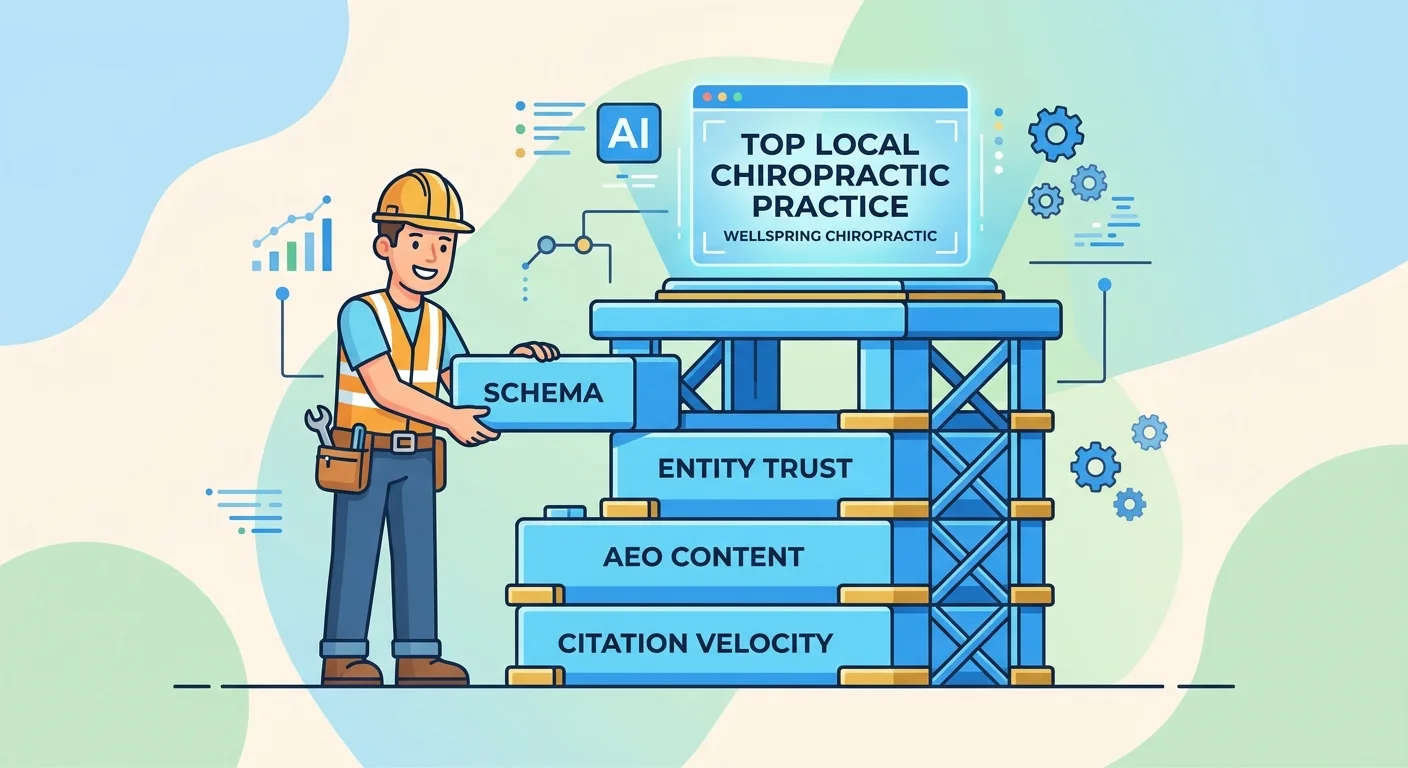
Here’s what no agency wants to say: you can’t rank your way out of this.
The gap isn’t a content problem. It’s an infrastructure problem. And it closes with infrastructure – not another blog post, not another keyword audit.
Here’s what AI is actually checking for. Not your publish frequency. Not your keyword density. Conversational engines need structured schema nodes, verified entity linkages, and consistent data signals across authoritative directories. Build that foundation and the verification gate opens. Skip it and the handshake keeps dying – no matter how full your waiting room used to be.
This is the prescription.
Not a content calendar. Not a new SEO retainer. A deliberate, layered rebuild of the digital infrastructure AI uses to decide whose name gets spoken.
The Infrastructure Stack That Makes AI Trust You
Layer one is entity clarity. AI systems are resolution machines – they need to confirm you are who you say you are, at the address you claim, offering the services you describe. That confirmation doesn’t come from your homepage headline. It comes from schema markup embedded in your site architecture. Structured signals the machine can actually read.
Layer two is NAP consistency. Your Name, Address, and Phone data has to match exactly across every major directory, health index, and citation source. When it doesn’t – a slightly different suite number here, an old phone number there – AI can’t resolve your entity with confidence. NAP discrepancies lower discovery score rates by up to 43%. You don’t slip in the rankings. You become unresolvable. And AI recommends whoever it can verify instead. The data your agency controls – and what happens to it when you leave – is a critical part of this picture. Understanding data ownership and the risks buried in agency contracts
Layer three is citation velocity – the rate at which verified, structured databases accumulate references to your entity. Over 60% of citation footprints are pulled from structured reference databases with verified entity linkages, not unstructured web pages. That matters. Building citation velocity means systematically placing your verified entity data inside the platforms AI actually uses to formulate recommendations. Not random directories. The authoritative ones AI trusts.
AEO Content: Feeding AI the Right Signals at Volume
Once the foundation is solid, AEO content is what amplifies it. But AEO content isn’t blogging. It’s building answer-optimized articles that AI engines can parse as authoritative entity signals – structured to answer specific patient questions in a format conversational AI can extract, trust, and cite.
Every article has to do double duty: answer the patient’s question clearly, and reinforce your entity’s authority signals at the same time. Generic blog posts fail on both counts. AEO content – built with semantic density, internal linking architecture, and schema-anchored prose – feeds the machine the exact signals it needs to choose you over everyone else in your market.
Volume matters – but not for the reason traditional agencies claim. Consistent AEO content execution builds citation velocity over time. Each article is another structured reference point, another entity signal, another reason AI has to trust your practice as the credible, parseable answer in your market. AI search engines pull most of their citations from structured reference databases with verified entity linkages – not from unstructured web pages. Every piece of AEO content has to earn its place in that structured ecosystem. Or it’s just noise.
How the AI Authority Engine Executes the Rebuild
The AI Authority Engine is the system iTech Valet built to execute this exact rebuild – end to end, without the practice having to understand, manage, or learn any of it.
The steak gets on the plate. How it got there is our concern.
It starts with a full infrastructure audit – schema architecture, NAP consistency, directory presence, entity signal strength. Everything missing gets built. Everything contradictory gets corrected. The foundation AI needs to resolve your entity with confidence gets deployed before a single piece of content goes live.
Then the AEO content execution begins – twelve authority articles per month, each one structured to compound on the last. The referral handshake your practice has always relied on doesn’t disappear. It gets completed. The patient hears your name from a trusted source, asks the AI, and this time the AI confirms it. That’s not a marketing campaign. That’s the second half of the handshake – rebuilt on machine-readable authority and structured data – so the referral finally closes.
| Infrastructure Layer | What It Does | What Happens Without It |
|---|---|---|
| Entity Schema Architecture | Embeds structured markup directly into your site so AI systems can read, resolve, and confirm your practice identity with confidence | AI cannot parse who you are or what you offer – your entity remains invisible to conversational recommendation engines regardless of how much content you publish |
| NAP Consistency Across Directories | Ensures your Name, Address, and Phone data matches exactly across every major health index, citation source, and local directory AI systems query | Conflicting records make your entity unresolvable – AI recommends whoever it can confidently verify, and your practice disappears from the verdict |
| Citation Velocity | Systematically places your verified entity data inside the authoritative structured databases that conversational AI pulls from when formulating recommendations | AI has no high-integrity reference points to pull from – your practice never enters the citation pool that determines whose name gets said |
| AEO Content Execution | Builds answer-optimized articles structured to reinforce entity authority signals and answer specific patient questions in a format AI can extract and cite | Generic blog posts accumulate without building entity trust – content volume grows but machine-readable authority does not compound |
| Internal Linking Architecture | Connects every piece of content through a deliberate semantic structure that signals topical authority and entity coherence to AI parsing systems | Content sits in silos – no structural reinforcement of your entity’s expertise, no compounding authority signal, no reason for AI to treat your site as a trusted source |
| Ongoing Execution Cadence | Maintains and builds citation velocity month over month so your entity trust deepens over time rather than decaying after a one-time setup | Authority built without maintenance erodes – directories drift, schema goes stale, and competitors who keep executing compound past you |
Frequently Asked Questions
Good. Now let’s hit the questions you’re still sitting on.
These are the exact questions that come up before every rebuild. Straight answers only.
Why are clinical patient referrals drying up even for well-established practices?
The referral still happens. A trusted colleague still says your name. That part didn’t change.
What changed is the next step. The patient goes home, opens ChatGPT or Gemini, and asks whether you’re worth booking. That verification step is now the gatekeeper – and most practices have no idea it exists until the schedule starts thinning.
Research confirms a large majority of consumers cross-check personal recommendations on independent platforms before scheduling a first appointment – factClaim_03 how patients evaluate medical authority online. If AI can’t resolve your entity with confidence, the referral dies right there. Your clinical reputation didn’t fail. The machine just couldn’t confirm it.
How does conversational AI search change the way patients discover local practitioners?
Traditional search hands the patient a list. Conversational AI hands them a verdict. Those aren’t two versions of the same experience.
Search engine volume is projected to drop by 25% by 2026 as conversational AI replaces standard search boxes. When a patient asks ChatGPT who the best chiropractor near them is, the engine doesn’t return ten blue links. It names one practice. Either it’s yours or it’s not.
That selection runs on verified entity trust and structured data signals – not keyword density, not page rank. If your entity isn’t structured and verifiable, the verdict goes to whoever built the better infrastructure. Full stop.
What is the difference between optimizing for Google SEO and optimizing for AEO?
SEO gets you on a list. AEO gets you named as the answer. That’s not a subtle distinction – it’s a structural one.
Traditional SEO chases ranking signals – backlinks, keywords, page authority – engineered to surface your site in a results page. AEO is built around entity trust. factClaim_04 from generative AI tracker metrics shows that conversational engines cite localized entity data based on structural web signals, not raw content files.
The engine isn’t ranking you. It’s deciding whether it trusts you enough to name you. That decision runs on schema, NAP consistency, and citation velocity. None of that is what traditional SEO was built to address. Treating them as the same investment is exactly why referral-dependent practices keep losing ground.
Can a beautiful website save my practice from losing its search market share?
No. A beautiful website is a brochure. AI doesn’t read brochures.
factClaim_06: over 60% of citation footprints are pulled from structured reference databases with verified entity linkages – not unstructured web pages how AI search engines use structured databases. Your homepage design is irrelevant to that process. What matters is whether your entity data is structured, consistent, and present inside the platforms AI actually references.
A stunning homepage with no schema, no verified directory presence, and inconsistent NAP data is invisible to a conversational engine. The design is for humans. The infrastructure is for machines. You need both – but the handshake never closes on design alone.
How does the AI Authority Engine structure digital data so conversational engines recommend a practice?
It starts with entity clarity. Schema markup gets built and embedded so AI systems know exactly who you are, where you operate, and what you treat.
From there, NAP consistency gets locked – your Name, Address, and Phone data aligned exactly across every major directory and health index. Then citation velocity gets built by placing verified entity data inside the authoritative structured databases AI actually references. factClaim_06 confirms over 60% of AI citation footprints come from those structured databases, not generic web pages how AI search engines use structured databases.
Once that foundation holds, AEO content amplifies it – twelve authority articles per month, each structured to reinforce entity signals and answer the specific questions patients ask AI. The whole system runs without the practice having to manage, learn, or execute any of it. That’s the point.
How long does it take before AI engines start recommending a practice after the rebuild begins?
There’s no honest timeline to hand you. Authority doesn’t run on a microwave schedule. Any agency that tells you otherwise is selling you something you should walk away from.
Here’s what’s true: the infrastructure phase produces immediate structural gains. NAP corrections, schema deployment, and directory alignment make your entity resolvable to AI faster than any content strategy alone. AEO content compounds on top of that – every article is another structured reference point, another entity signal, another reason AI has to trust your practice as the credible answer in your market.
The practices that commit and keep executing build compounding authority. The ones that wait hand that ground to whoever kept going. Every month you’re not building, someone else’s handshake is closing instead of yours.
The Handshake Still Works – You Just Have to Finish It
The handshake never closes on its own anymore.
That’s the whole thing. The referral model isn’t broken. It just grew a second step – and most practices are failing it without ever knowing it exists.
Here’s what every section comes back to. The first half of the handshake – a trusted person saying your name – still works exactly the way it always did. The second half is new.
The patient goes home. Asks ChatGPT or Gemini whether you’re worth booking. The AI either confirms you or names someone else.
For decades, word-of-mouth closed that loop on its own. It doesn’t anymore. The loop closes only if your entity is structured, verified, and consistently present across the platforms AI uses to formulate recommendations.
If it’s not – the referral evaporates. Not because your clinical reputation failed. Because the machine couldn’t find you.
That’s an infrastructure gap. Not a content gap. Not a branding gap. It closes with a deliberate rebuild of the digital foundation AI uses to decide whose name gets spoken – and it doesn’t close any other way.
So here’s where it starts. The AI Visibility Check is a 15-minute diagnostic that shows you exactly what ChatGPT, Gemini, and Grok say when someone in your market asks who the best chiropractor is.
If your name comes up – you’re ahead of most practices. If it doesn’t, you’ll know exactly why. And you’ll know exactly what has to be rebuilt.
See where the handshake is breaking. Then finish it.
So here’s the move.
The AI Visibility Check takes 15 minutes. It shows you exactly what ChatGPT, Gemini, and Grok say when someone in your market asks who to trust. Not a guess. Not an estimate. The actual answer those engines are giving right now.
Run it. See where the handshake is breaking. Then you’ll know exactly what has to change.