The Shift from Search Results to AI Verdicts
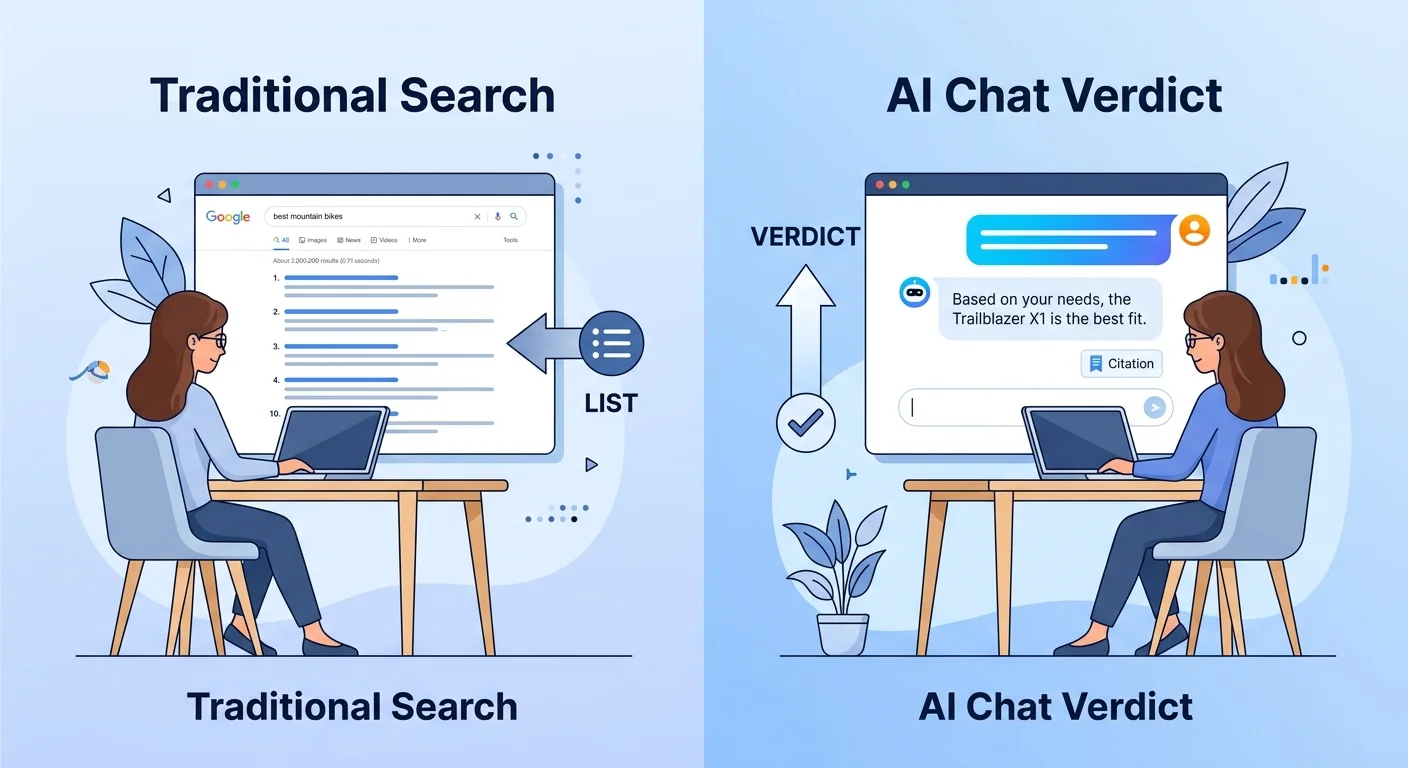
SEO was built for a world where Google handed you ten results. You clicked through. You compared. You decided.
That world’s gone.
The zero-click search killed it. 64.82% of all Google searches on desktop and mobile ended without a click to any web property in 2020. Users got the answer in the results. No click. No comparison. The search engine delivered the verdict.
Then Google’s Search Generative Experience (SGE) made it worse. Clicks from SGE snapshot links represent just 4.3% of the clicks a number one organic ranking would typically receive. The gap between being on page one and being the AI-selected answer isn’t incremental. It’s existential.
AI doesn’t curate ten options. It makes a call. It names one entity. Everyone else is invisible.
Here’s what that means for your business: every dollar spent optimizing for a ranked list is wasted. Every tactic designed to be one of ten options is solving for a system that no longer controls visibility.
AI search runs on entity trust, not keyword relevance. It picks the single most authoritative answer based on machine-readable infrastructure – structured data, schema markup, semantic density, verified entity profiles. Not backlinks. Not keyword frequency.
SEO was built for humans evaluating a list. AEO is built for AI engines making a recommendation. Those aren’t the same thing.
| Search Behavior | Traditional Google (2019) | AI Search (2024) | Implication for Visibility |
|---|---|---|---|
| User clicks through to website | Majority of searches resulted in clicks to websites | 64.82% of searches end without a click | Businesses optimized for clicks lose visibility when AI provides answers directly |
| Top organic ranking value | Number one ranking drove significant traffic and conversions | SGE snapshot links receive just 4.3% of traditional #1 ranking clicks | Traditional SEO metrics no longer predict traffic or authority in AI search |
| Voice assistant usage | Limited adoption, niche technology | Projected 8.4 billion units by 2024-exceeding global population | Voice search is now the dominant interface for AI-generated answers |
Why Traditional SEO Was Built for a World That No Longer Exists

Traditional SEO was built for a system that ranked web pages in descending order of relevance. The goal? Simple. Appear as high on the list as possible. Preferably position one.
That goal made sense when users clicked through options. When they compared ten possibilities. When visibility meant being one of several choices.
That’s not what happens anymore.
But AI search doesn’t present a list. It delivers a verdict. The business that gets named as the answer wins everything. Everyone else gets nothing.
The shift from "one of ten" to "the one" isn’t a tweak to the old model. It’s the extinction of it.
The Ranking Treadmill
Traditional SEO was an incremental grind. Move from position seven to position five. Position five to position three. Eventually-with enough time, enough budget-hit number one.
That’s how the game worked.
The entire industry was built around this treadmill. Agencies sold monthly retainers to nudge clients up the rankings. Tools tracked keyword positions. Success was measured in movement up the list.
And it worked. Until it didn’t.
Here’s the problem: AI doesn’t care where you rank on a list it doesn’t show. When ChatGPT recommends a chiropractor, it doesn’t present ten options ranked by relevance. It names one.
The ranking treadmill optimizes for an output format that no longer exists.
The Backlink Economy
Backlinks were the currency of traditional SEO authority. More links from more domains signaled to Google that a page was worth ranking. The entire SEO ecosystem revolved around link acquisition: guest posts, directory submissions, reciprocal exchanges.
That logic made sense when Google’s PageRank algorithm determined visibility.
But AI engines don’t count backlinks to determine which entity to recommend.
They evaluate entity trust through structured data, verified profiles, and citation consistency across authoritative platforms.
A business with ten thousand backlinks and no schema markup is invisible to AI. A business with Entity Trust, Semantic Density, and Citation Velocity-even with fewer backlinks-is the answer.
The backlink economy optimized for an algorithm that’s been replaced.
Keyword Density Over Semantic Meaning
Traditional SEO practitioners stuffed keywords into page copy. "Best chiropractor in Orange County" repeated seven times in five hundred words.
The density percentage mattered more than whether the content answered the question.
Google’s algorithm rewarded keyword matching. If a user searched for "chiropractor Orange County," the pages with the highest keyword density for that exact phrase ranked highest.
Content quality was secondary to keyword presence.
AI engines operate on semantic search. They understand meaning, intent, and context-not keyword frequency. They parse entities, relationships, and structured answers.
A page optimized for keyword density without semantic clarity is gibberish to an AI engine. Traditional SEO optimized for string matching. AEO optimizes for machine comprehension.
| Traditional SEO Tactic | What It Optimized For | Why AI Ignores It | What AI Looks For Instead |
|---|---|---|---|
| Keyword Density Optimization | Ranking for exact-match search phrases by repeating target keywords throughout page copy | AI engines parse semantic meaning and entity relationships, not keyword frequency. Repetition without context is noise. | Semantic Density – structured answers that define entities, explain relationships, and map to user intent |
| Backlink Acquisition | Building domain authority by accumulating links from other websites to signal relevance to Google’s PageRank algorithm | AI evaluates entity trust through verified profiles and citation consistency across authoritative platforms, not inbound link counts | Entity Trust – schema markup, verified business profiles, and machine-readable identity signals that establish legitimacy |
| Meta Tag Optimization | Writing meta titles and descriptions to improve click-through rate from a ranked list of search results | AI doesn’t present a list for users to click through. It delivers the answer directly inside the conversational response. | Citation Velocity – the frequency and recency with which an entity is referenced as authoritative across AI-indexed content |
| Ranking Position Improvement | Moving incrementally up a ranked list – from position seven to five to three to one – through ongoing optimization | There is no ranked list in AI search. The engine names one entity as the answer. Second place is invisibility. | Structured Content Architecture – machine-readable formats that AI engines can extract, parse, and cite as authoritative answers |
| On-Page Content Length Targets | Writing longer articles to outrank competitors, based on the assumption that word count correlates with comprehensiveness | AI prioritizes extractable answers and structured data over raw word count. A long article with no schema is invisible. | Schema Markup – Layer 1 of the AI Authority Infrastructure that tells AI engines what a business is, what it does, and where it operates |
What Answer Engine Optimization Actually Is
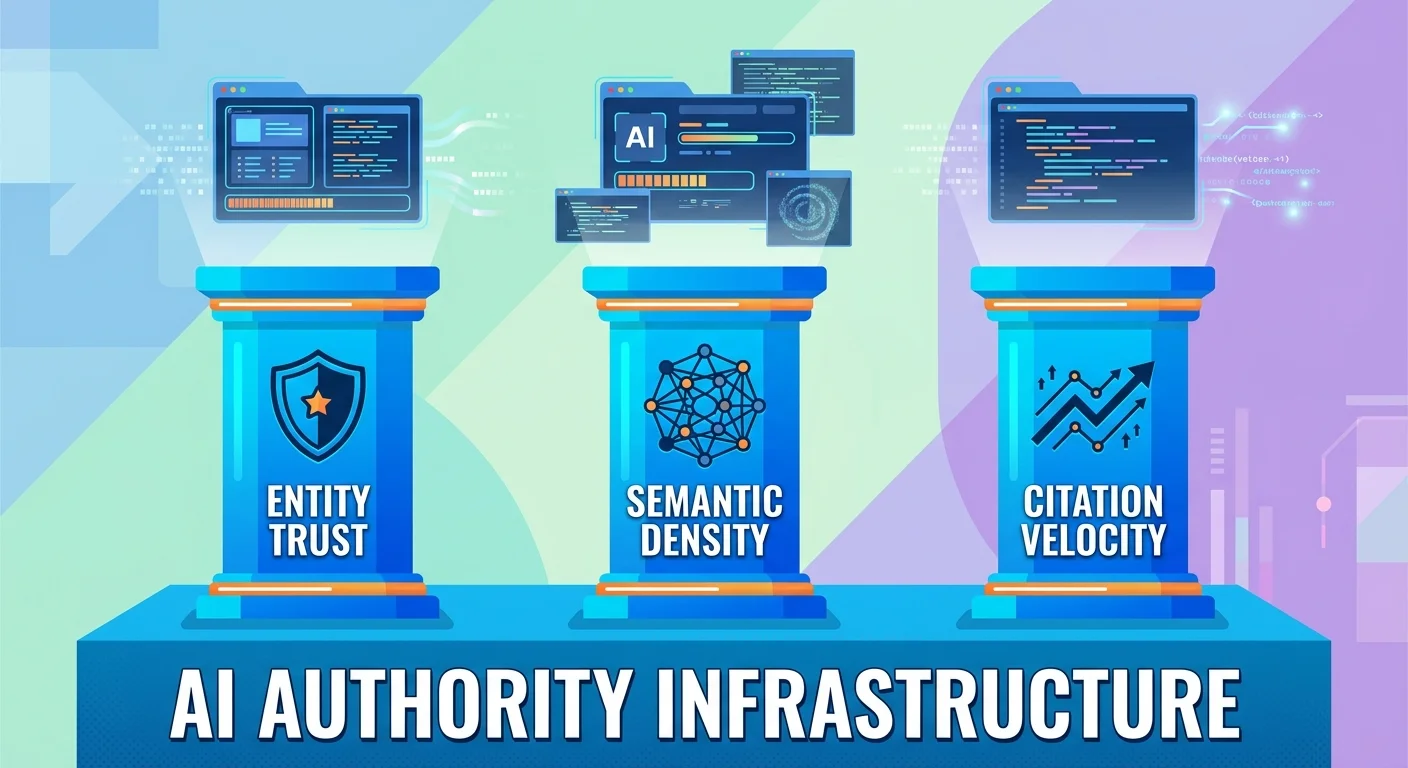
So if traditional SEO optimizes for a list that no longer appears, what does AEO optimize for?
Three signals. Entity Trust, Semantic Density, and Citation Velocity. These are the structural foundations AI engines evaluate when deciding which business to recommend. Not keyword density. Not backlink volume. Not domain age or page authority or any other metric from the ranked-list era.
Answer Engine Optimization is the practice of building an AI Authority Engine-a machine-readable infrastructure that establishes these three signals across every layer of a business’s digital presence. It is not a set of tactics applied to an existing website. It is a reconstruction of how a business exists online so that AI engines can verify identity, extract answers, and trust the entity enough to stake their credibility on recommending it.
The infrastructure has three layers: Schema Markup, Structured Content Architecture, and Verified Entity Profiles. Every layer reinforces one or more of the three signals. The result is a business that AI can read, verify, and cite-not a business that ranks on page one of a list no one sees.
Entity Trust
Entity Trust is the AI engine’s confidence that a business is legitimate, stable, and authoritative in its domain. Traditional SEO measured authority through backlinks-how many other sites pointed to yours. AI engines measure authority through entity trust-how consistently and accurately a business is represented across verified platforms.
Google’s ranking systems reward content that demonstrates Experience, Expertise, Authoritativeness, and Trustworthiness. These are not qualitative impressions. They are machine-verifiable signals. Schema Markup tells AI what the entity is. Verified Entity Profiles confirm the entity exists where it claims to exist. Structured Content Architecture demonstrates the entity knows what it’s talking about. Together, these layers build E-E-A-T signals that AI engines parse as trust.
A business without Entity Trust is a ghost. It has no machine-readable identity. AI engines cannot verify it, so they cannot recommend it. Every competitor with verifiable entity signals wins by default.
Semantic Density
Semantic Density is the depth and specificity of answers a business provides on its own digital properties. AI engines don’t scrape keywords. They extract meaning. They parse entities, relationships, and structured answers. A page that answers "What is chiropractic adjustment?" in three hundred words of generic fluff has low semantic density. A page that defines the entity, explains the mechanism, addresses contraindications, cites outcomes, and structures the answer in extractable format has high semantic density.
Structured Content Architecture is how semantic density gets built. Articles formatted for AI extraction. FAQ sections with questions as H3 headings and answers in clean prose. Tables that compare options. Lists that enumerate steps. All of it wrapped in structured data that tells the AI engine what each piece of content is and how it relates to the entity.
Websites using schema markup rank up to four positions higher in search results. But the real value is not the ranking-it’s the extraction. AI engines pull answers from content they can parse. If the structure is missing, the content is invisible regardless of how well-written it is. Semantic Density without machine-readable architecture is authority no AI can access.
Citation Velocity
Citation Velocity is the rate at which new, structured, authoritative content about the entity gets published and indexed. Traditional SEO treated content as a one-time build. Write the service page. Publish it. Maybe update it once a year. Done.
AI engines treat authority as a living signal. The business that published ten authority articles six months ago and nothing since is stale. The business that publishes two authority articles every week-each one answering a specific question, structured for extraction, reinforcing entity trust-is current. AI engines prioritize current authority because their users expect current answers.
Citation Velocity is why AEO is not a one-time project. It is an ongoing execution. The business that stops publishing stops compounding. The competitor that keeps publishing takes the recommendation.
| AEO Signal | What AI Evaluates | Traditional SEO Equivalent | Why the Old Metric Fails |
|---|---|---|---|
| Entity Trust | Whether the business is legitimate, verifiable, and authoritative across structured platforms-Google Business Profile, verified directories, consistent schema markup | Domain Authority / Backlink Count | Backlinks measured popularity among webmasters, not verifiability to AI. A business can have thousands of backlinks and zero machine-readable identity signals. AI cannot recommend an entity it cannot verify. |
| Semantic Density | Depth and extractability of answers-how thoroughly a piece of content defines entities, explains relationships, and structures information for machine parsing | Keyword Density / On-Page SEO | Keywords measured string matching, not comprehension. A page optimized for keyword frequency can still be semantically empty. AI engines parse meaning, not word repetition. |
| Citation Velocity | Rate and recency of new, structured, authoritative content being published and indexed under the entity’s domain | Content Freshness / Publish Date | Traditional freshness focused on update timestamps, not ongoing authority. A static website updated once a year signals stagnation. AI prioritizes entities that demonstrate current, compounding expertise. |
The AI Authority Infrastructure That Makes AEO Possible
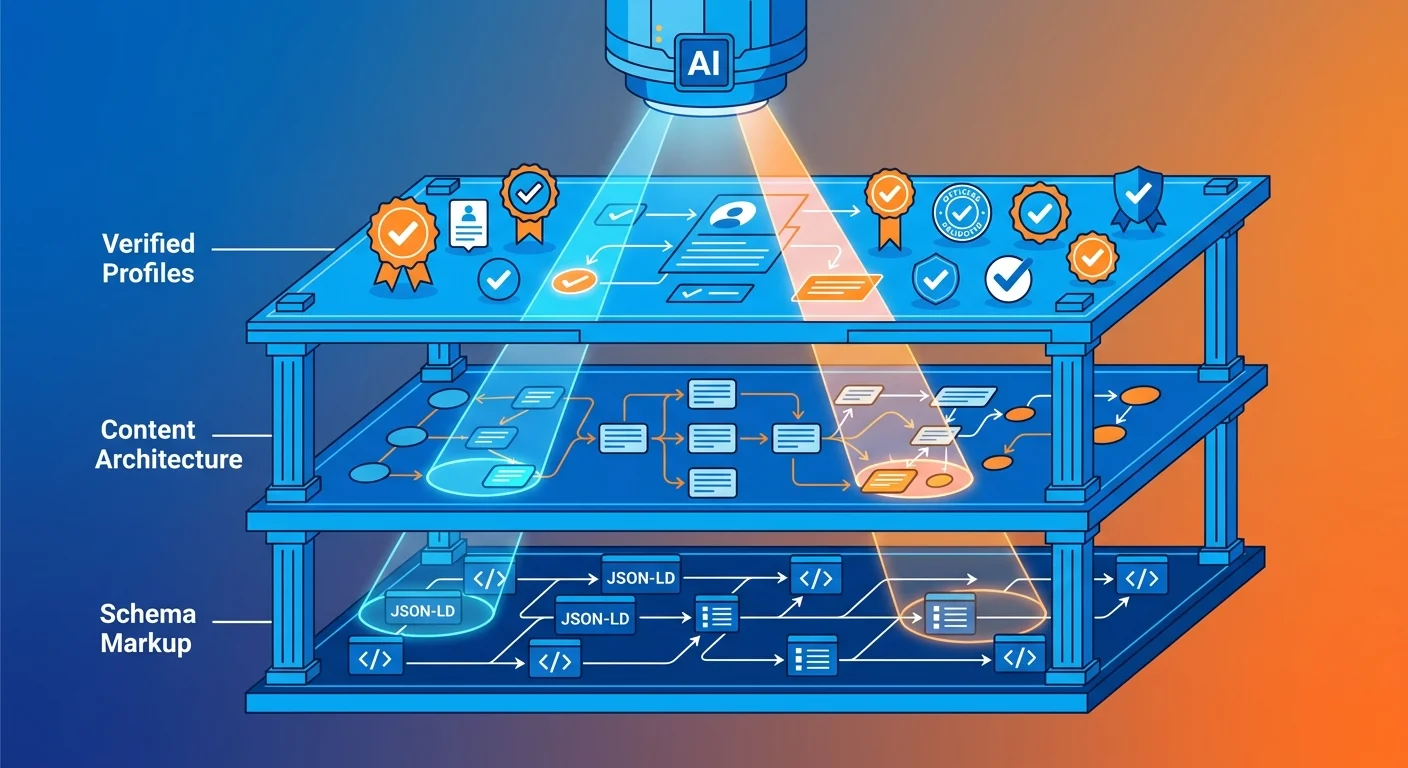
These three signals-Entity Trust, Semantic Density, and Citation Velocity-don’t emerge from blog posts.
They emerge from infrastructure.
The machine-readable foundation AI engines actually parse.
Traditional SEO treated websites as page collections optimized for human readers. Add some schema here. Tweak a meta tag there. Write a blog post, hit publish, hope Google picks it up.
Infrastructure was an afterthought. A checklist item, not the foundation.
AEO inverts that model. The AI Authority Infrastructure is the product.
Every layer-Schema Markup, Structured Content Architecture, Verified Entity Profiles-exists to answer one question: Can an AI engine verify this entity, extract its answers, and trust it enough to recommend it?
If the answer is no, the website is invisible. Regardless of how beautiful it looks or how much traffic it used to get.
Schema Markup
Schema Markup is the language AI engines use to understand what a business is, what it does, and how it relates to the world around it.
It’s structured data embedded in the website’s code. Invisible to human visitors. Essential for machine comprehension.
Without schema, your homepage is a wall of text.
AI engines see words. But they don’t see structure. They can’t tell the difference between your business name and a heading. Between a service description and a testimonial. Between an address and a paragraph about company history.
Websites using schema markup rank up to four positions higher in search results. But the ranking boost is secondary.
The real value is extraction. AI engines pull answers from content they can parse.
If schema is missing, the content doesn’t exist in the AI’s understanding. No matter how authoritative it is.
Schema Markup tells the AI engine what the entity is (LocalBusiness, ProfessionalService, Organization), where it operates (address, coordinates, service area), what credentials it holds (licenses, certifications, affiliations), and how users interact with it (phone, booking URL, hours).
It’s the identity layer. Everything else builds on it.
Structured Content Architecture
Structured Content Architecture is how a business organizes answers so AI engines can extract them.
Not blog posts written for humans to skim. Content formatted for machines to parse, verify, and cite.
That means FAQ sections with questions as H3 headings and answers in clean prose blocks. Tables that compare methodologies. Lists that enumerate steps.
All of it wrapped in schema that declares what type of content it is. FAQPage schema for questions. HowTo schema for processes. Table schema for comparisons.
Structure is the signal. Without it, AI engines skip the content entirely.
Here’s the kicker: 96% of marketers use AI. But most are using it to generate content faster-not to structure content for AI extraction.
They’re producing more unstructured fluff.
AEO builds the opposite: fewer pieces of content, structured correctly, designed for how the white-glove process works to deliver machine-readable authority.
Verified Entity Profiles
Verified Entity Profiles are the third layer.
These are the external platforms where the business’s identity is confirmed. Google Business Profile. LinkedIn. Industry directories. Better Business Bureau. Licensing boards.
AI engines cross-reference these profiles to verify the entity exists where it claims to exist.
A business with schema on its website but no verified profiles is an unconfirmed claim. AI engines can read the schema. But they can’t verify it.
Your business name, address, and phone number must match across every platform. Exact spelling. Exact formatting. No discrepancies.
One mismatch and the entity trust signal collapses.
And here’s what most businesses miss: the profiles themselves must be complete.
Not claimed and abandoned. Not half-filled with placeholder text. Fully populated with services, credentials, photos, reviews, structured data, and links back to the website.
Every incomplete profile is a trust gap AI engines flag as unverifiable.
| Infrastructure Layer | What It Does for AI | Implementation Complexity | Impact on Citation |
|---|---|---|---|
| Schema Markup | Tells AI engines what the entity is, where it operates, what credentials it holds, and how users interact with it – the identity layer that makes everything else parseable. | Technical – requires structured data implementation across website code, often invisible to human visitors but essential for machine comprehension. | Foundational – without schema, AI engines cannot extract or verify content regardless of how authoritative it is. Enables all downstream citation. |
| Structured Content Architecture | Organizes answers in machine-readable formats – FAQ sections with H3 questions, tables for comparisons, lists for steps, all wrapped in schema declarations. | Strategic – requires content redesign from human-skimmable blog posts to AI-extractable structured answers with semantic density. | Direct – AI engines pull answers only from content they can parse. Unstructured content is invisible to extraction regardless of depth or quality. |
| Verified Entity Profiles | Confirms the entity exists where it claims across external platforms – Google Business Profile, LinkedIn, industry directories, licensing boards – with exact NAP consistency. | Operational – requires profile completion, cross-platform verification, and ongoing maintenance to prevent discrepancies that collapse entity trust signals. | Compounding – every verified profile reinforces Entity Trust, allowing AI engines to cross-reference and stake credibility on the recommendation. Incomplete profiles create trust gaps. |
Why Most Practices Stay Invisible to AI Search
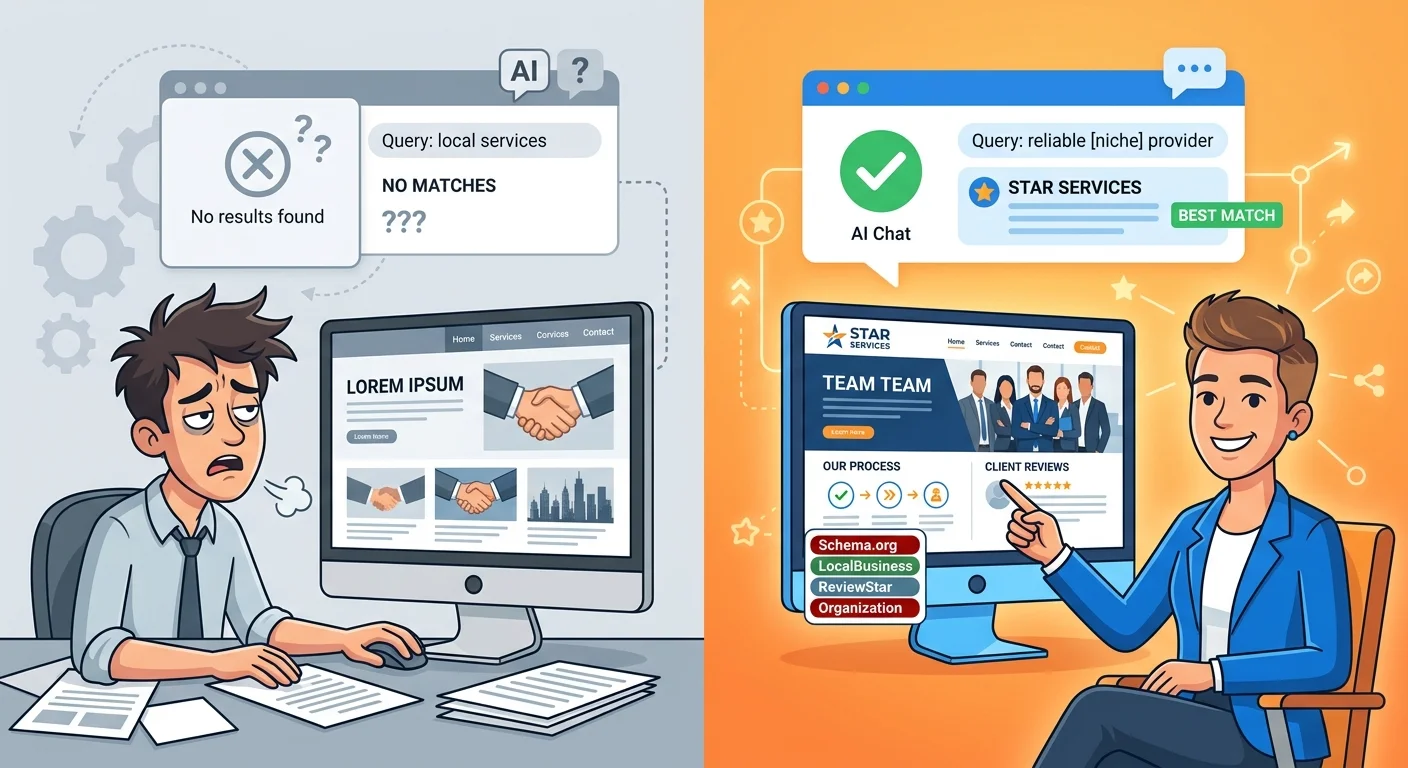
Let me show you what this actually looks like.
And why your name doesn’t come up when AI makes a recommendation.
You’ve invested in digital marketing. You pay for a website. SEO services. Content creation. Monthly retainers. You have a presence online.
But when someone asks ChatGPT or Gemini who the best chiropractor in their area is, your name doesn’t come up.
Not once.
Not because you’re bad at what you do.
Because your digital infrastructure is invisible to AI.
Three failures account for most of it: template websites, content without context, and entity drift.
Each one breaks a different signal. Together, they guarantee invisibility.
The Template Website Problem
Most practice websites are built from templates. WordPress themes. Wix. Squarespace.
They look professional. They’ve got all the right pages – About, Services, Contact. Fast load times. Mobile-responsive.
And they’re structurally invisible to AI.
The schema is either missing or auto-generated wrong by the theme. The content is generic placeholder text with your name swapped in. The architecture is built for human navigation – not machine extraction.
AI engines see a wall of text with no entity signals. No verification anchors. No extractable answers.
You exist. But the AI can’t confirm it.
So it recommends the competitor whose infrastructure is machine-readable instead.
The Content Without Context Trap
The second failure is content without structure.
You publish blog posts. Service pages. FAQs. You write about your methods. You answer common questions. The content is accurate and well-intentioned.
But it’s formatted for humans to read – not for AI to extract.
Paragraphs of narrative prose. No H3-tagged questions. No tables. No schema declaring what type of content it is. The answers are buried in unstructured text AI can’t parse.
So the AI skips it.
It pulls answers from competitors whose content is structured right – even if those answers are weaker. Structure beats depth when AI is deciding what to cite.
That’s why AEO Content Writing Services focus on machine-readable formatting from the start.
The Entity Drift Issue
The third failure is entity drift.
Your name, address, and phone number are listed differently across platforms. Your Google Business Profile says one thing. Your website says another. The directory listings use an old address. The schema has a typo in your business name.
AI engines cross-reference everything.
When the data doesn’t match, the trust signal collapses. The AI can’t confirm which version is correct, so it flags you as unverifiable.
And here’s the brutal part: most practices don’t even know this is happening.
They see traffic dropping. They see competitors getting recommended. But they don’t realize the root cause is entity drift – a fixable infrastructure issue, not a content quality problem.
Frequently Asked Questions
Let’s hit the questions we hear most.
These aren’t academic. They’re the friction points where traditional thinking crashes into the new reality. The questions that separate businesses building AI Authority Infrastructure from those still hoping the old playbook hangs together a little longer.
What is the core difference between SEO for a list of results and AEO for a single AI answer?
SEO got you on a list. AEO gets you named as the answer. Those aren’t the same thing.
Traditional SEO assumed the user would see your link, read your meta description, click through, and compare you against nine other options. Visibility meant being on the list.
AEO assumes the AI already made the call. The user never sees a list. They see one name. The entity the AI trusts enough to cite as the answer.
That changes the math. SEO optimized for relevance signals – keywords, backlinks, on-page factors. AEO optimizes for trust signals – Entity Trust, Semantic Density, and Citation Velocity. The AI doesn’t care if you rank fourth. It cares if you’re verifiable, structured, and authoritative enough to be the single answer it delivers.
How does Google’s SGE make traditional SEO tactics less effective?
SGE delivers the answer inside the search results. The user never leaves Google. 64.82% of searches already end without a click. SGE accelerates that.
Traditional SEO tactics – meta descriptions, title tags, backlink velocity – got built to win the click. But if the user gets the answer directly from the AI-generated snapshot, the click never happens. Your ranking position becomes irrelevant if the AI didn’t trust your entity enough to extract and cite your content in the first place.
Here’s the kicker: SGE doesn’t pull from the highest-ranked page. It pulls from the most structured, verifiable, and machine-readable content. A competitor with worse traditional SEO rankings can own SGE results if their infrastructure is built correctly. Schema Markup, verified profiles, and extractable content architecture matter more than keyword density ever did.
If AI provides the answer directly, why is having a website still important for AEO?
Because the website is the anchor. The source. The entity’s home base that every verification signal points back to.
AI engines don’t trust answers floating in the void. They trust answers they can trace to a verified entity. The website is where Schema Markup lives. Where the structured content architecture is built. Where the entity declares what it is, where it operates, and what credentials it holds.
Without the website, there’s no schema to parse. No structured answers to extract. No verified URL to cite. AI engines cross-reference the website against external profiles – Google Business Profile, LinkedIn, industry directories. If those profiles link back to a website with no machine-readable infrastructure, the trust signal collapses. The website doesn’t need to generate traffic. It needs to generate trust.
What are the first three signals an AI engine looks for to trust a business entity?
Entity Trust. Semantic Density. Citation Velocity. In that order.
Entity Trust confirms the business exists where it claims to exist. AI engines check Schema Markup on the website, then cross-reference Verified Entity Profiles across platforms. If the name, address, and credentials match exactly, the entity is verifiable. If they don’t, the AI flags it as unconfirmed and moves to the next option.
Semantic Density measures how completely the entity answers the question. Not keyword stuffing. Depth. Structure. Extractable answers formatted as FAQs, tables, and schema-wrapped content that AI engines can parse without guessing.
Citation Velocity tracks how often the entity is referenced across authoritative external sources – industry directories, licensing boards, verified review platforms. The more verified citations, the stronger the trust signal. One unverified website claiming authority loses to a competitor with twenty verified external profiles confirming it.
Is AEO a one-time project or an ongoing process?
Ongoing. Always.
Authority decays. Competitors publish. AI engines update their training data. Entity Trust strengthens with every new verified profile, every structured article, every schema layer completed. Stop publishing, and Citation Velocity flatlines. Competitors compound while your entity stagnates.
The businesses that treat AEO as a one-time project are the same ones staring at collapsed visibility six months later. This isn’t a website redesign. It’s infrastructure that demands monthly content execution, profile maintenance, and schema updates as AI engines evolve.
The good news: every month of execution compounds. The bad news: every month you pause, competitors gain ground you can’t recover without starting from behind.
The Widening Gap
Here’s what timing does to you.
Every month you wait, someone else compounds. The practices building AI Authority Infrastructure right now are stacking Entity Trust, Semantic Density, and Citation Velocity. They’re not waiting for proof. They’re not hoping the old playbook stretches another year.
They’re building the foundation AI trusts today. And that foundation gets stronger with every article published. Every schema layer completed. Every verified profile aligned.
The practices waiting? They’re not standing still. They’re falling behind.
Not gradually. Exponentially.
Traditional SEO was built for a world where being one of ten options mattered. Where ranking on page one meant something. Where users clicked through, compared, and chose.
That world ended.
AI search delivers a verdict, not a list. One answer. One recommendation.
The entity AI trusts becomes the answer. Everyone else is invisible.
There’s no page two. No ‘also consider.’ AI made its call. The user moves forward with that single recommendation.
If your name isn’t in that answer, you don’t exist in that buyer’s head.
This isn’t a trend. This is the infrastructure layer of digital authority.
The businesses that treat AEO as optional will watch their visibility collapse while competitors who built AI Authority Infrastructure own the recommendations.
The choice is binary. Build the infrastructure AI engines trust, or watch someone else become the answer.
You can see what AI says about your business right now. Fifteen minutes. Real data. No guessing.
If the results don’t make the problem obvious, walk away. But if they do – you’ll know exactly what to do next.
You don’t have to guess where you stand. The AI Visibility Check shows you exactly what ChatGPT, Gemini, and Perplexity say when someone asks who to trust in your market. Fifteen minutes. Real data. A verdict, not a list-and you’ll see whose name is in it.