
What AI Engines Actually Use to Decide Who to Recommend
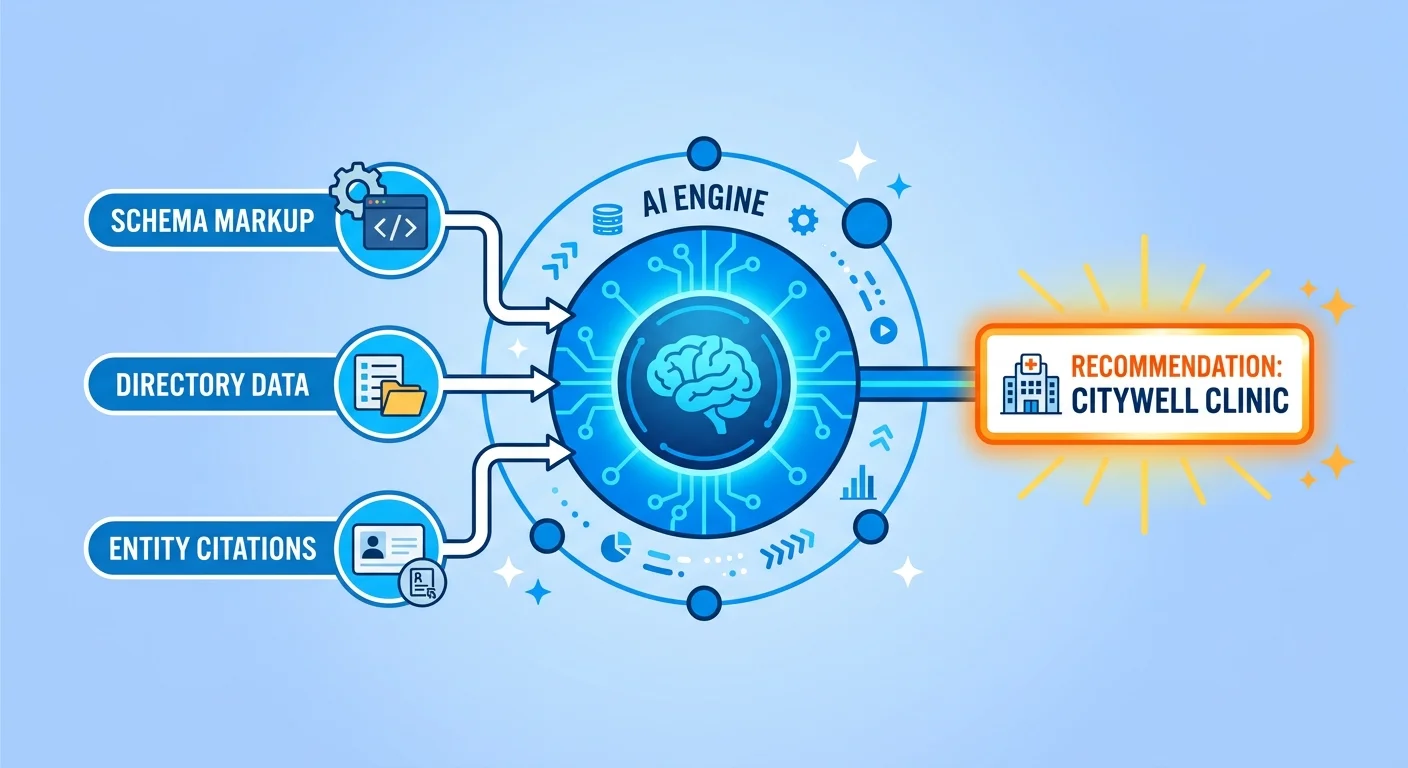
AI doesn’t evaluate your clinic the way a patient does.
No bedside manner assessment. No testimonial reading. No credit for your fifteen years in practice. The engine runs a checklist – and every item on that checklist is structured, machine-readable data.
Here’s the thing – you can’t close a gap you can’t see.
Most clinic owners have never been shown what the engine is actually reading. They assume good outcomes speak for themselves. That assumption is costing them recommendations every single day.
Your clinical excellence is real. AI can’t see it.
The engine doesn’t go looking for proof of your skill. It checks whether your entity is labeled correctly, registered in the right directories, and cross-referenced against networks it already trusts. If those signals aren’t there, you don’t exist – no matter how good you actually are.
The Verdict Model: One Answer, Not a List
Generative AI changed how patients start their healthcare search.
The old model gave them a list. Ten results. A map. The patient decided. The new model gives them a verdict. One answer. One recommendation. And that recommendation isn’t negotiable.
That changes the stakes completely.
In a list, fourth place still gets clicked. In a verdict, second place doesn’t exist. The practices winning AI recommendations aren’t necessarily the best clinicians. They’re the clinicians with the most verifiable, structured, machine-readable digital footprint. the economics of that footprint
AI engines default to public registry data and structured citation networks. Not because they favor big brands. Because they’re calibrated to avoid recommending anyone they can’t independently verify.
The structured digital data LLMs prioritize over offline outcomes includes schema markup, authoritative directory listings, and semantic entity signals. These are the exact components most clinics have never been told they need. The Local AI Authority Engine is built specifically to construct that infrastructure.
Why Patient Reviews Don’t Register as Authority Signals
Here’s where most clinic owners hit a wall.
Years of five-star reviews. Hundreds of them. And the assumption that social proof translates directly into AI authority.
It doesn’t.
Reviews are qualitative. AI engines are quantitative.
The engine isn’t reading sentiment. It’s scanning for structured entity signals that confirm you are who you say you are. Research on AI use in healthcare consistently shows that outcomes diverge based on the quality and structure of underlying data – not on the volume of praise. A hundred five-star reviews gives the engine nothing it can confirm. Unstructured praise doesn’t move the needle.
LLMs in medical environments require machine-readable digital evidence to cross-verify any clinical claim.
A glowing Google review tells the engine nothing it can confirm. A correctly structured schema entry that matches your directory listings, confirms your specialty, and aligns with your citation network – that’s data the engine can actually use. Your reviews are real. Your results are real. But to AI, only structured evidence counts.
| Signal Type | What It Is | Does AI Read It? | Why It Matters |
|---|---|---|---|
| Schema Markup | Structured code embedded in your website that tells AI engines exactly who you are, what you do, where you practice, and what conditions you treat – in machine-readable format | Yes – highest priority | Without it, AI can’t confirm your specialty, location, or identity. The cabinet has no label. |
| Directory Alignment | Consistent NAP (name, address, phone) data across authoritative public registries – Google Business Profile, Healthgrades, Zocdoc, state licensing boards, and similar platforms | Yes – cross-referenced constantly | AI engines default to public registry data to verify entity claims. Mismatched or missing listings signal an unverifiable entity. |
| Entity Citation Network | The web of structured references from authoritative third-party sources that confirm your practice exists, is licensed, and is recognized by trusted institutions | Yes – used to calibrate recommendations | AI won’t recommend an entity it can’t independently verify through its trusted citation network. No citations, no trust. |
| AEO Content Structure | AI Authority articles built around specific patient questions, formatted so AI engines can extract clear, single-source answers and attribute them to your practice entity | Yes – directly feeds answer verdicts | This is how your expertise becomes machine-readable. Unstructured content doesn’t get cited. Structured, entity-linked content does. |
| Patient Reviews (Google, Healthgrades) | Qualitative testimonials and star ratings submitted by patients across review platforms | Partially – volume and recency only | AI reads review signals as secondary data points, not primary authority signals. Sentiment and narrative content are ignored. Structured entity signals outrank review volume every time. |
| Clinical Outcomes | Real-world treatment results, patient recovery rates, technique proficiency, and in-office patient experience | No – not machine-readable | This is the gold inside the locked cabinet. AI has no mechanism to read it. Without structured digital infrastructure translating those outcomes into verifiable signals, they don’t exist in AI’s world. |
| Social Media Activity | Posts, follower counts, engagement metrics, and content published across Instagram, Facebook, TikTok, and similar platforms | No – unstructured and unverified | Social platforms don’t feed structured entity data into AI recommendation engines. Activity there builds audience awareness, not AI authority visibility. |
Why Traditional SEO and Five-Star Reviews Won’t Save You
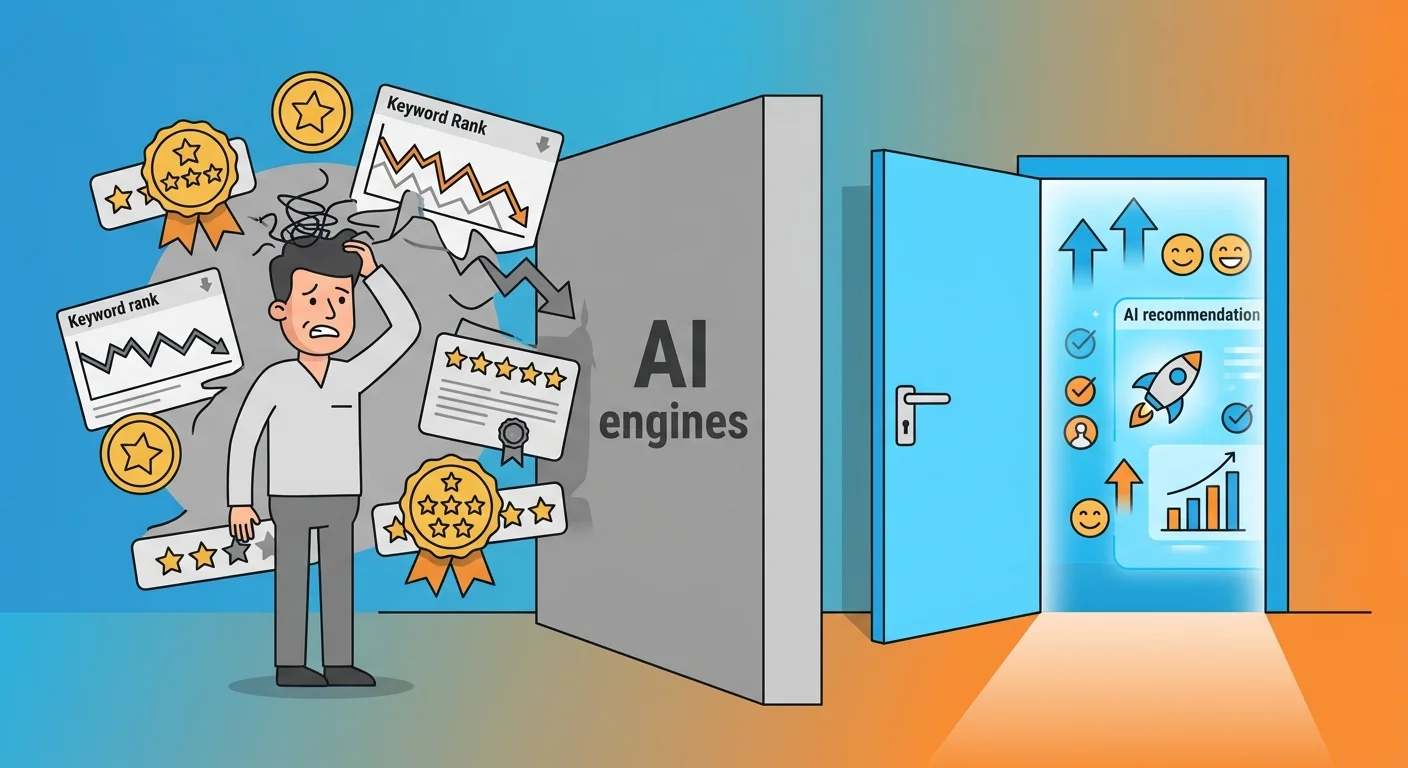
Here’s the question every clinic owner asks at this point: doesn’t my existing marketing already cover this?
It doesn’t. Not even close.
Traditional SEO was built for a list. Ten blue links. A map pack. Paid ads at the top. The patient scrolled, compared, and clicked.
Generative AI killed that model. There’s no list anymore. The engine gives one answer – and that answer is a verdict, not a suggestion.
And five-star reviews? They’re word-of-mouth with a digital timestamp. Powerful with humans. Invisible to machines.
Reviews rent you a moment of social proof. They don’t build the structured infrastructure AI uses to verify your existence. One disappears when patients stop writing. The other compounds.
That’s the difference between renting attention
Why Traditional SEO Fails Chiropractors Now
Traditional SEO’s core mechanics – keyword density, backlink counts, page-speed scores – were built to satisfy a ranking algorithm.
Not an answer engine. Those are two completely different machines.
A ranking algorithm asks: which page is most relevant to this keyword?
An answer engine asks: which entity can I verify and trust enough to recommend by name?
Not variations of the same question. Two completely different machines. Optimizing for relevance doesn’t build verifiability. Stuffing your homepage with keywords doesn’t tell AI who you are, what specialty you hold, or whether your entity signals match what the directories say.
The FTC requires strict scientific substantiation for healthcare marketing claims. AI engines run those same verification checks before recommending a practice – except they do it automatically, at scale, before any human ever sees your name.
The engine isn’t hunting for a keyword match. It’s hunting for a verified entity whose digital signals line up across authoritative sources.
Traditional SEO was never built to do that. It was built to chase an algorithm that’s already being replaced.
Here’s the kicker: a clinic that spent years on traditional SEO isn’t starting from zero.
It’s starting with the wrong infrastructure. The cabinet is built. But it’s labeled wrong, filed in the wrong registry, and cross-referenced against networks AI doesn’t trust.
The work was real. The foundation is just useless for the machine that’s making recommendations now.
The Review Platform Trap
Let’s talk about reviews. Because this is where the frustration runs deepest.
A clinic with 400 five-star reviews built something real. Built it for human trust. Not machine trust. Those are different currencies – and AI only accepts one of them.
AI engines don’t read sentiment. They don’t parse the story about how you fixed the shoulder issue three other chiropractors missed.
What they scan for: schema markup that confirms your specialty, directory listings that align with your primary citation sources, semantic data that tells the engine your practice is exactly what it claims to be.
Reviews contain none of that.
That’s the review platform trap: the more you invest in reputation tools built for human persuasion, the further you drift from the machine-readable infrastructure AI uses to make recommendations.
Your reviews prove you’re a great clinician. They don’t prove you’re a verifiable entity.
And in AI’s world, unverified doesn’t get named.
| Marketing Approach | What It Optimizes For | Does AI Reference It? | Net Result for AI Visibility |
|---|---|---|---|
| Traditional SEO | Keyword rankings and page-one placement in list-based search results | No – ranking algorithms and answer engines are two different machines with different requirements | Builds relevance signals for a model AI is actively replacing; zero entity verification value |
| Five-Star Reviews | Human trust, social proof, and reputation among prospective patients | No – unstructured qualitative sentiment cannot be cross-referenced by AI verification systems | Proves clinical quality to humans; invisible to the structured entity checks AI runs before recommending |
| Reputation Management Platforms | Aggregating and amplifying patient testimonials across review sites | No – review aggregation produces no schema signals, directory alignment, or machine-readable entity data | Deepens the gap between human-facing credibility and machine-readable authority |
| Paid Advertising | Immediate attention and short-term traffic from patients actively browsing | No – paid placement is rented visibility; it builds no entity infrastructure that persists after the spend stops | Zero compounding authority; disappears the moment the budget does |
| Schema Markup + Directory Alignment | Structured, machine-readable entity signals AI engines use for verification | Yes – directly satisfies the cross-referencing checks AI runs against authoritative registries and citation networks | Builds verifiable Entity Trust that compounds over time and positions a practice for AI recommendations |
| AEO Content (AI Authority Articles) | Semantic density, entity reinforcement, and topical authority signals for answer engines | Yes – structured content designed specifically for AI extraction and citation, not keyword ranking | Continuously deepens the entity footprint AI uses to identify and trust a practice as the recommended answer |
The Entity Trust Framework: What Machines Actually Read
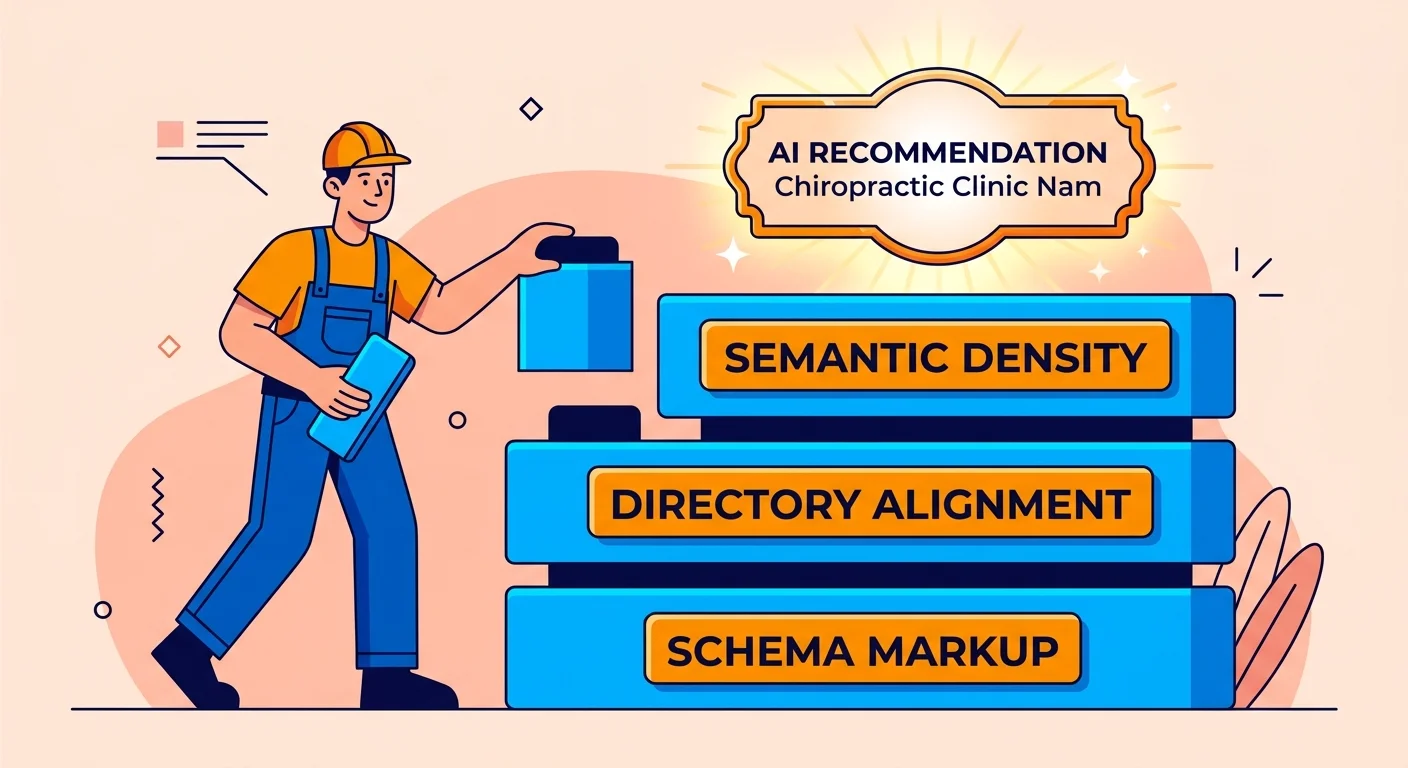
Entity Trust isn’t a single tactic. It’s a structured architecture of machine-readable signals – the specific data layer AI engines use to confirm your practice exists, operates where it claims, and specializes in what it says.
Think of it as the cabinet lock. No signals, no access.
AI engines don’t guess when they make a healthcare recommendation. They default to public registry data and structured citation networks because they’re calibrated to avoid recommending anyone they can’t independently verify.
AI cross-referencing of medical directories isn’t optional infrastructure – it’s the engine’s primary trust mechanism.
If your entity signals don’t show up in those networks, the engine doesn’t give you the benefit of the doubt. It moves on.
Here’s the framework in one sentence: Entity Trust is the structured, machine-readable proof that lets an AI engine open your cabinet.
Without it, the gold stays locked. And up to $350 billion in annual healthcare value is already flowing toward the practices that built this infrastructure first.
The Three Pillars of Machine-Readable Authority
Entity Trust runs on three pillars. Schema markup is the first.
It’s the structured code layer that tells AI engines exactly who you are – your specialty, location, hours, credentials – in a language machines can parse without interpretation.
LLMs in medical environments require highly structured, machine-readable digital evidence to cross-verify any clinical claim. Schema is how you give them that evidence. Nothing else substitutes for it.
Directory alignment is the second pillar. AI engines cross-reference your entity data against authoritative public registries – medical directories, licensing boards, local citation sources.
Every inconsistency is a trust signal failure.
If your name appears three different ways across five directories, the engine can’t confirm you’re a single coherent entity. Inconsistency reads as unreliability. The engine moves on – and doesn’t come back.
Semantic density is the third pillar. It’s the body of AI Authority articles, topical content, and structured internal links that build a documented record of your expertise over time.
This isn’t about publishing volume. It’s about building a verifiable, machine-readable record of what your practice knows, treats, and serves.
Three pillars. All three required. None optional. And the compliance piece matters here too – how to build authority compliantly covers the guardrails in full.
This Is Not for Every Practice
Now let’s draw the line.
This framework isn’t for every practice. It’s not designed to be.
If you want a 90-day guarantee, a quick-win tactic, or a vendor who’ll promise rankings for a monthly fee – this isn’t your model. Full stop.
Entity Trust is built in layers. Schema first. Then directory alignment. Then semantic density compounding over time.
The practices that benefit most have already built something worth recommending. They just need AI to be able to verify it. If that’s you, this is the infrastructure that makes it visible.
The Set-It-and-Forget-It buyer won’t find what they’re looking for here either.
Entity Trust isn’t a one-time build. It’s a compounding asset. The cabinet doesn’t stay open on its own – it requires ongoing execution to maintain the structured signals AI engines use to keep verifying your entity.
Stop maintaining the infrastructure and the engine’s trust decays. The gold goes back behind the locked door.
| Entity Trust Component | What It Signals to AI | Common Gap in Most Practices | Priority Level |
|---|---|---|---|
| Schema Markup | Confirms your specialty, location, credentials, and hours in machine-parseable code – giving AI engines the structured identity data they need to verify you without interpretation | Missing entirely, partially implemented, or never updated after a website rebuild – leaving AI with no structured identity layer to read | Critical – build first |
| Directory Alignment | Signals that your entity data is consistent across authoritative public registries, medical directories, and local citation sources – proving you are a single, coherent, verifiable practice | Name, address, phone, and specialty listed inconsistently across directories – every mismatch is a trust failure the engine registers | Critical – build alongside schema |
| Citation Network Presence | Demonstrates that authoritative third-party sources – medical boards, licensing registries, and structured directories – independently confirm your entity claims | Practice exists only on its own website and social profiles – no authoritative third-party citations that AI can cross-reference | High – required for verification depth |
| Semantic Density | Builds a documented, machine-readable record of what your practice knows, treats, and serves – through AI Authority articles and structured internal linking over time | No structured content strategy; generic homepage copy that names a specialty but provides no topical depth for AI to verify expertise | High – compounds over time |
| Entity Consistency | Confirms that your practice name, specialty designation, and contact data match across every touchpoint AI checks – from your website to every external registry | Rebrands, address changes, and staff updates that were never pushed through citation networks – creating conflicting entity signals | High – maintained continuously |
| Structured Internal Linking | Maps your content architecture for AI crawlers – signaling topical authority hierarchies and confirming the relationship between your core service claims and supporting content | Flat site structure with no logical content hierarchy – AI sees isolated pages rather than a connected, authoritative entity | Standard – built during content execution |
How to Audit Your Practice’s Current AI Visibility
Knowing the framework is step one. Knowing where your practice actually lands inside it – that’s the move that changes things.
Most clinic owners assume they’re fine. Then they run the check. Then they see what AI says about them in real time, with no filters, no context, no benefit of the doubt.
The audit isn’t complicated. It is honest.
You ask ChatGPT, Gemini, and Grok who the best chiropractor in your market is. You watch what comes back. Most of the time, your name isn’t in it.
That’s not a ranking problem. It’s an entity trust problem. And those two problems don’t share a solution.
Here’s what most clinic owners miss: the gap between showing up and not showing up has nothing to do with content volume.
It’s about structured signals. The practices getting named have cabinets AI can open. The ones getting ignored have gold locked behind doors AI can’t read.
The diagnostic tells you which one you are. authority decay
What the AI Visibility Check Actually Reveals
The AI Visibility Check isn’t a website audit. It’s not a keyword report.
It’s a live diagnostic. It tests what AI engines actually say about your practice when someone asks who to trust in your market – right now, no filters.
What it surfaces goes well beyond whether your name appears.
It shows whether your schema is structured correctly. Whether your directory listings are consistent across the citation networks AI cross-references. Whether your semantic record is substantial enough for an engine to confidently verify your specialty.
Generative AI engines default to public registry data and structured citation networks. The check shows you exactly how your practice measures up against that standard. That context matters more than most owners realize: patient trust in AI recommendations is already fragile – 60% of U.S. adults are uncomfortable with their provider relying on AI for their care. The practices that still get recommended despite that skepticism are the ones whose entity signals are airtight.
The check also shows you the competitive picture.
Which practices in your market are getting named. What their infrastructure looks like compared to yours. That’s not a discouraging result – it’s a map.
AI trust in clinical settings depends on transparency and consistent structured signals. The audit shows you exactly where yours break down – and where the gap is still closeable.
The Five Gaps That Keep Practices Off the AI Recommendation List
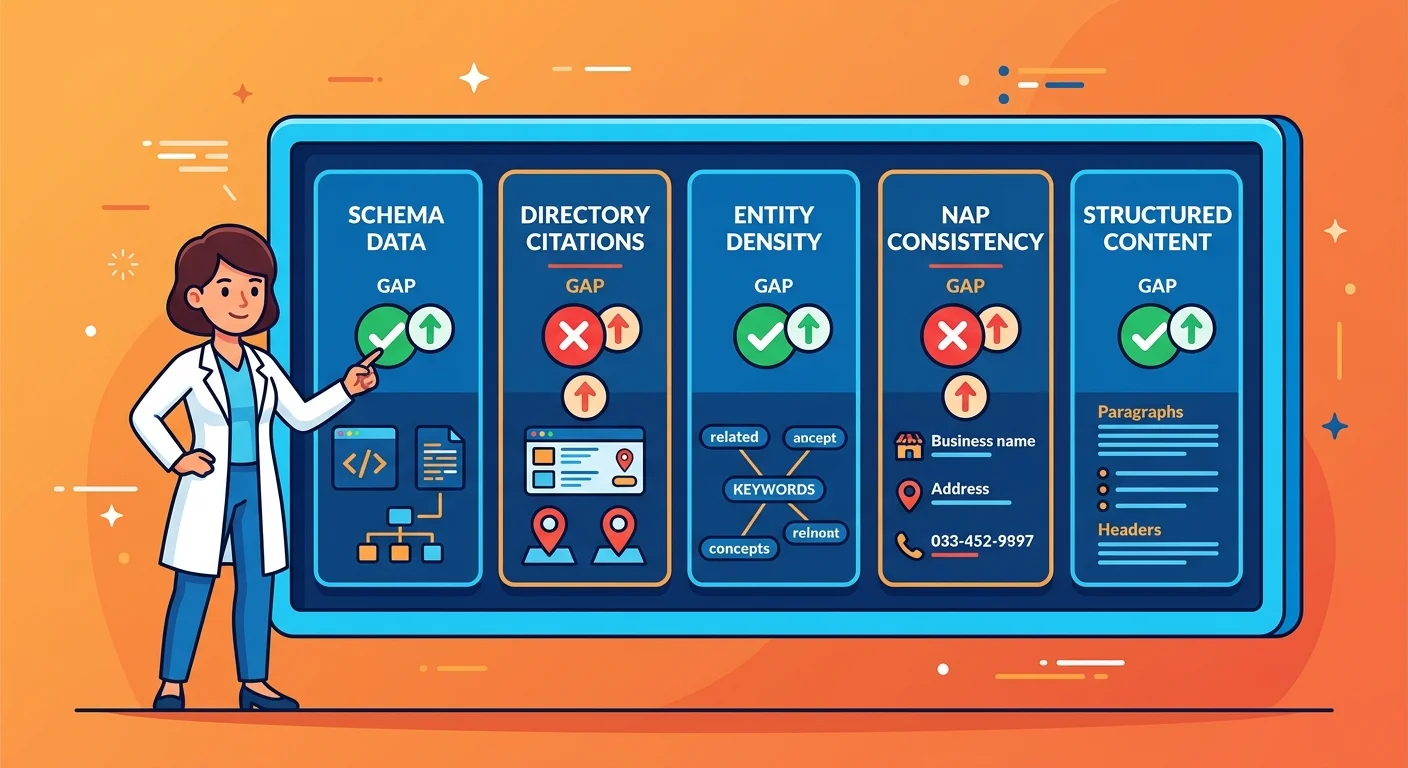
So what does the audit actually find? The same five gaps, practice after practice.
The first is missing or broken schema markup. No structured code layer means the engine can’t parse your specialty, your location, or your credentials.
An engine that can’t verify you won’t recommend you. That’s not a preference – it’s how the system works.
The second gap is directory inconsistency. Your name, address, and phone listed differently across authoritative registries tells the engine it can’t confirm you as a single coherent source.
The third is thin semantic density – a sparse content record that leaves AI with no documented evidence of what your practice actually knows and treats.
The fourth is weak citation network presence. If the authoritative medical directories AI cross-references don’t list you, the engine defaults to whoever they do list. It’s not personal. It’s infrastructure.
The fifth gap is the one that surprises most clinic owners: no entity claim at all.
Some practices have never formally established a machine-readable digital identity. The gold is real. The results are real. But the cabinet was never built – and AI has no record the practice exists.
That’s not a marketing problem. That’s an infrastructure problem. And it’s exactly what the Local AI Authority Engine is built to solve.
| Visibility Gap | What’s Missing | AI Engine Consequence | Fix Priority |
|---|---|---|---|
| Missing or broken schema markup | No structured code layer declaring specialty, location, credentials, or hours in machine-readable format | Engine cannot parse who you are or what you treat – unverifiable entities don’t get named | Immediate |
| Directory inconsistency | Name, address, and phone number listed differently across authoritative public registries and medical directories | Engine detects conflicting entity signals and cannot confirm a single coherent source – trust fails | Immediate |
| Thin semantic density | Sparse or absent AI Authority content record documenting your specialty, conditions treated, and clinical expertise | Engine has no documented evidence of what your practice knows – confidence in your entity stays too low to recommend | High |
| Weak citation network presence | Practice is absent from the authoritative medical directories and structured registries AI engines cross-reference by default | Engine defaults to listed competitors – your absence from the network is functionally the same as not existing | High |
| No entity claim established | Practice has never built a machine-readable digital identity – no schema, no structured NAP, no verified entity signals anywhere in the AI-readable web | AI has no record the practice exists regardless of real-world clinical results – the cabinet was never built | Critical – start here |
| Stale or decayed infrastructure | Entity signals were built at some point but have not been maintained – directory data has drifted, schema is outdated, semantic record has gone dormant | Authority decay sets in – engine trust erodes over time and competitors with active infrastructure fill the gap | Ongoing maintenance |
Frequently Asked Questions
Here’s what clinic owners ask once the framework clicks.
These aren’t theoretical. They’re what comes up the moment a clinic owner runs an AI Visibility Check and sees the gap between their clinical reputation and their actual AI authority. Direct questions. Direct answers.
Why does ChatGPT ignore my outstanding clinical patient reviews?
According to this source, because AI engines don’t read reviews. Full stop.
Patient reviews live on platforms built for humans – and humans love them. But ChatGPT isn’t pulling up your Google page and weighing your five-star average. It’s cross-referencing structured registry data, schema markup, and citation networks to verify whether your entity is real and trustworthy.
Reviews are qualitative. Entity signals are machine-readable. AI operates on the second category only.
Your outstanding clinical results are real. They just live behind a cabinet AI doesn’t have the key to open.
What metrics do AI search engines use to evaluate clinical authority?
Three metrics. All structural. None of them have anything to do with patient sentiment.
First: schema markup accuracy. Does your structured data correctly identify your specialty, credentials, location, and hours in a language machines can parse – or is it missing entirely?
Second: directory consistency. Does your entity data match across the authoritative registries AI cross-references? Or does it show up three different ways across five platforms?
Third: semantic density. Does your published content record actually verify your clinical expertise in a format the engine can confirm?
Generative AI engines default to public registry data and structured citation networks to reduce the risk of recommending unverified sources. If any of those three signals are weak, missing, or contradictory – the engine defaults to the practice whose signals aren’t.
Can traditional SEO help my clinic rank on conversational AI engines?
No. And treating them as interchangeable is one of the most expensive mistakes a clinic can make.
Traditional SEO optimizes for a ranked list – ten blue links on a search results page. Conversational AI produces a single verdict. Those aren’t variations of the same outcome. They’re structurally different systems with structurally different inputs.
Keyword density doesn’t signal entity trust to an AI engine. Backlinks don’t confirm your credentials to ChatGPT.
What got you found on Google won’t get you named by AI. The infrastructure is different. Schema, entity signals, machine-readable content – that’s what AI parses and verifies. Optimizing keywords while ignoring those signals is like polishing the waiting room while the front door is locked.
How does missing schema data make my practice invisible to AI crawler bots?
Schema markup is the structured code layer that tells AI engines who you are – in a language they can parse without guessing.
Without it, AI has no machine-readable confirmation of your specialty, location, credentials, or hours. LLMs in medical environments require highly structured digital evidence to cross-verify offline clinical claims. Schema is the primary mechanism for delivering that evidence.
When it’s missing or broken, the engine can’t verify the entity.
And an engine that can’t verify you won’t recommend you. That’s not a visibility preference. It’s a verification failure – and it doesn’t matter how good your outcomes are if that failure is sitting at the front of the line.
How long does it take to establish verified Entity Trust for a local clinic?
Entity Trust is built in layers. The timeline reflects that.
Schema can be implemented and indexed fast. Directory alignment takes longer – you’re correcting inconsistencies across multiple authoritative registries, and each one runs on its own update cycle. Semantic density compounds over time as your AI Authority articles build a verifiable record of your expertise.
There’s no microwave schedule. Any vendor who promises one is selling hopium.
Here’s what’s true: every layer compounds on the one before it. The practices that start now are compounding toward AI visibility. The ones still waiting are compounding toward irrelevance. The cabinet doesn’t build itself – but once it’s built, it keeps working.
Is AI-driven patient discovery replacing Google search entirely?
Not entirely – and that distinction matters.
Generative AI is redirecting the patient journey away from list-based search engines toward single-source, intent-driven answers. That shift is real and it’s accelerating. But the more important question isn’t whether Google disappears. It’s whether your entity signals are strong enough to get named when patients ask AI engines directly.
That behavior is already happening.
60% of U.S. adults are uncomfortable with their provider relying on AI for their own care – and yet they’re still using AI to find providers. The practices that earn the recommendation despite that skepticism are the ones whose authority infrastructure is airtight.
Build for where the behavior already is. Not for where you wish it would slow down.
The Gold Is Locked in the Cabinet
Here’s the verdict.
Generative AI doesn’t browse a shortlist of qualified chiropractors and pick the most popular one. It delivers a single answer – one name, one practice, one recommendation.
The clinics that get named aren’t necessarily the best in their market. They’re the ones whose cabinets AI can open.
Your results are real. Your outcomes are real. The gold is there.
But broken schema, inconsistent directories, and a thin semantic record mean AI can’t confirm any of it.
And an engine that can’t verify you doesn’t recommend you. It recommends whoever built the infrastructure instead. That’s not a quality judgment. That’s a structural fact.
The cabinet is buildable. The infrastructure exists. iTech Valet builds it.
Your gold is locked inside a cabinet AI doesn’t have the key to open – until you build the structure that changes that.
The only question is whether you build it first – or keep handing the recommendation to whoever did.
Here’s the thing – you don’t know what AI sees when someone asks who to trust in your market. That’s not a guess. That’s the problem. The AI Visibility Check shows you exactly where you stand. Fifteen minutes. Real data. No guesswork.