Why Traditional Traffic Metrics Don’t Show This Problem
The entire marketing industry built its business model on a metric that stopped mattering.
Traffic. Clicks. Impressions. Page views.
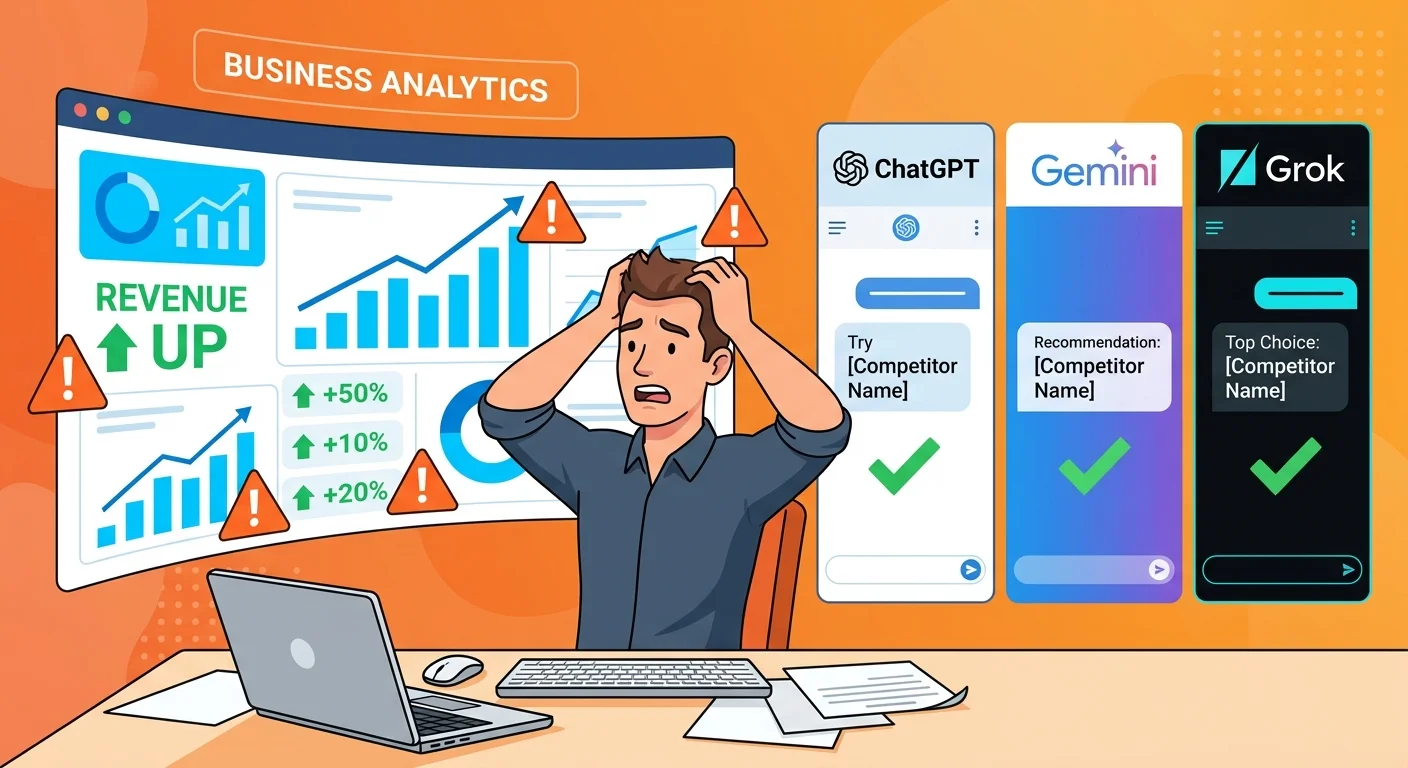
Those numbers look good in a monthly report. They make it seem like something’s working. But here’s what they don’t show: whether ChatGPT named you when a patient asked who to trust. Whether Gemini recommended your practice or the clinic three blocks over. Whether Grok cited your authority or ignored you completely.
You can have 500 visitors a month and zero AI citations.
Which means you’re visible to Google’s algorithm but invisible to the patients actually making decisions.
The Vanity Metrics Problem
Most chiropractors get monthly reports from their agencies showing keyword rankings, organic traffic, and click-through rates.
All of it carefully formatted to look like progress.
None of it measures the one thing that matters: whether AI engines recommend your practice when someone asks for help.
Those reports are vanity metrics from previous agencies – data that creates the illusion of visibility while the fundamental problem goes completely unmeasured. A practice can rank on page one for “chiropractor near me” and still be invisible in every AI recommendation.
The disconnect happens because traditional analytics track what happens on the web. Zero-click search happens outside the web.
The patient asks ChatGPT a question. Gets a recommendation. Books an appointment. Never clicks a single link.
Your analytics show nothing. The competitor who got recommended? Their analytics show nothing either.
The only difference: they got the patient.
Why Traffic Reports Miss Zero-Click Behavior
According to SparkToro’s research, nearly two-thirds of Google searches now end without a click.
That was 2020.
Before ChatGPT launched. Before conversational AI became the default way patients look for care.
The percentage is higher now. Significantly higher.
But here’s the kicker: traditional analytics can’t track zero-click behavior at all. Google Analytics doesn’t know when Gemini recommended a competitor instead of you. Your SEO tool doesn’t measure citation velocity in AI engines. Your agency’s dashboard doesn’t show whether you’re the answer or invisible.
So the reports keep showing traffic. And you keep paying for optimization. And the high-intent patients keep asking AI for recommendations.
And AI keeps naming someone else.
The gap widens every month. Invisibly.
The Question Your Agency Can’t Answer
If your last report showed 500 new visitors but zero new patients from organic search, your agency will blame conversion rate optimization.
Or your intake process.
Or “low-intent traffic.”
They won’t tell you the real problem.
Those 500 visitors weren’t high-intent patients. The high-intent patients never visited your website. They asked ChatGPT who to trust. Got an answer. Booked with whoever AI named.
Which wasn’t you.
Your agency can’t answer this question: “When a patient in my area asks AI who the best chiropractor is, does my practice get named?”
Not because they’re hiding the answer. Because they don’t have the tools to find it.
Their entire methodology is built for a world where visibility meant showing up on a list. That world doesn’t exist anymore.
The Shift from Search Lists to AI Verdicts
Patients stopped asking Google for options.
They started asking AI for answers.
That’s not a preference shift. That’s a behavior replacement.
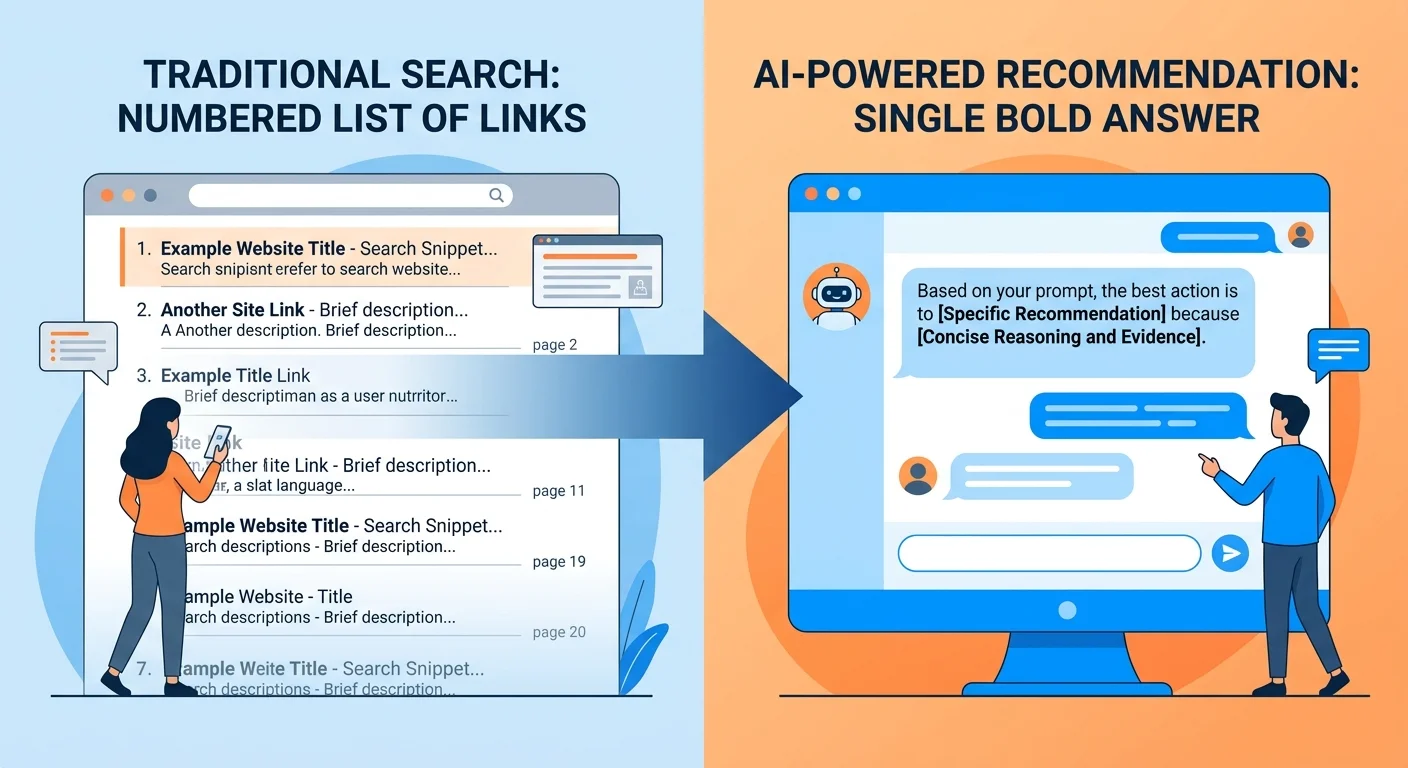
When someone types “chiropractor near me” into Google, they get ten blue links. They click through. Compare websites. Read reviews. Spend 15 minutes trying to figure out who’s credible.
When someone asks ChatGPT the same question, they get a name. One name. With reasoning.
“Based on patient reviews, specialization in sports injuries, and verified credentials, here’s who you should see.”
No comparison. No list. No second option.
The patient books. Done.
What Changed in Patient Search Behavior
McKinsey’s research on conversational search shows that users increasingly prefer natural language queries over keyword-based searches.
They’re not typing “best chiropractor Orange County.”
They’re asking full questions: “Who should I see for lower back pain that’s worse in the morning?”
That’s a conversation. Not a search.
And the output isn’t a list. It’s a verdict.
- Traditional search behavior: Patient inputs keyword → sees 10 options → clicks 3-4 websites → compares → makes decision
- AI-powered search behavior: Patient asks question → AI provides single recommendation with reasoning → patient books immediately
- Critical difference: The comparison phase disappeared. The patient never sees competitors. Never visits multiple websites. Never evaluates options.
AI engines eliminated the consideration set entirely.
Why AI Engines Don’t Provide Lists
Google’s job was to organize the internet and rank results by relevance.
Ten blue links. Pick the best one yourself.
AI engines don’t organize. They recommend.
Research from Cornell on conversational AI demonstrates that users interacting with conversational agents expect a single, synthesized answer – not a list of sources to evaluate. The design philosophy is fundamentally different: the AI is trusted to vet the options and provide the best one.
That’s why ChatGPT doesn’t say “Here are ten chiropractors in your area.”
It says “I recommend Dr. [Name] because…”
One answer. One practice. Your name or someone else’s.
The Binary Outcome
Here’s where chiropractors push back: “But Google still sends traffic. My analytics show it. So this can’t be that urgent, right?”
Wrong.
Every time AI recommends a competitor instead of you, that’s a high-intent patient you’ll never see in your schedule. Not next month. Not ever. They’re not coming back to compare. They already got their answer.
And that gap compounds.
The practices getting named build citation velocity. More recommendations lead to more patient reviews. More reviews strengthen entity trust. Stronger entity trust leads to more recommendations.
It’s a compounding loop.
And you’re either in it or you’re not.
The practices moving early aren’t just getting a head start. They’re locking in the authority signals that determine which names AI says for the next decade.
By the time the “wait and see” practices realize the problem, the gap won’t be closeable.
What Zero-Click Actually Means for Patient Discovery
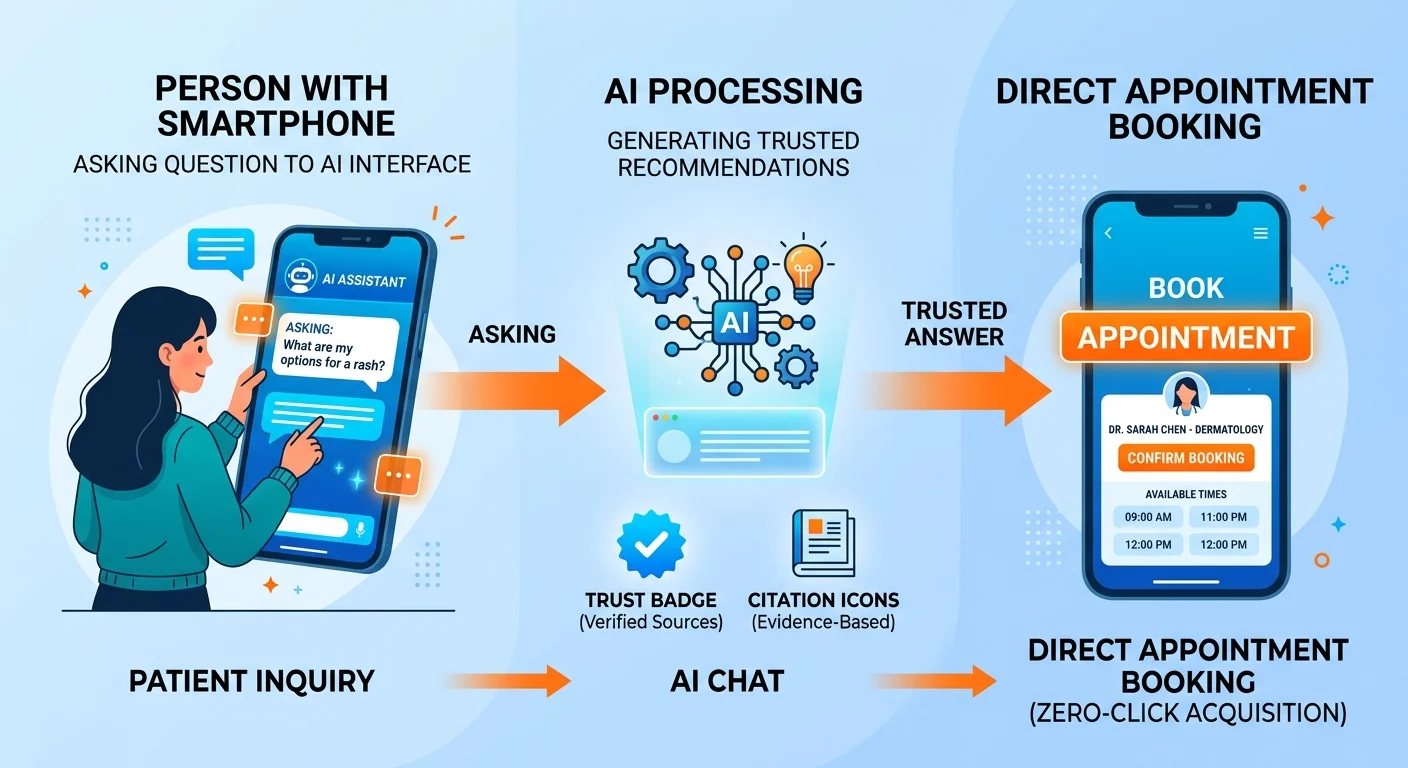
Zero-click patient acquisition is exactly what it sounds like.
The patient never clicks a link. They ask AI a question. Get a recommendation. Book an appointment. Your website never loads.
If you’re not the answer AI provides, you don’t exist in that transaction at all.
| Stage | Traditional Search | Zero-Click AI Search | Impact on Practice |
|---|---|---|---|
| Discovery | Patient searches keyword, sees list of practices | Patient asks natural language question | Practice must be in AI’s trusted source pool, not just indexed |
| Evaluation | Patient visits 3-4 websites, compares services and reviews | AI synthesizes data and provides single recommendation with reasoning | Practice must have verifiable entity signals AI can cite |
| Decision | Patient chooses based on website quality, reviews, convenience | Patient accepts AI’s recommendation without visiting competing sites | Being the answer AI provides eliminates all competition |
| Action | Patient clicks “book now” on chosen website | Patient books directly based on AI citation | Practice gets high-intent patient or doesn’t exist in the transaction |
The entire patient journey collapsed from a multi-step comparison process into a single AI verdict.
Featured Snippets vs AI Recommendations
When chiropractors first hear “zero-click search,” they think of Google’s featured snippets.
That’s not the same thing.
A featured snippet is a direct quote from your website displayed at the top of Google’s results. It’s still a list-based environment. The user sees your snippet, nine other organic results, three local pack results, and two ads.
They might click your snippet. They might click a competitor. They’re still comparing.
AI recommendations are categorically different.
Search Engine Journal’s breakdown of zero-click searches shows that traditional zero-click results on Google still exist within a competitive context. The user can scroll down and find alternatives.
When ChatGPT or Gemini provides a recommendation, there’s no scroll. No alternatives. No second option unless the user explicitly asks for one.
And most don’t.
The user gets one name. Yours or someone else’s.
Why Patients Trust AI Verdicts More Than Search Results
AI engines frame their recommendations as researched conclusions.
Not as “here are some options.” As “here is the best option and here’s why.”
That framing creates perceived authority.
When Google shows ten results, patients assume the list is algorithm-generated and possibly manipulated by SEO. Which it is. So they apply skepticism. They compare. They click multiple sites.
When ChatGPT names a practice and explains the reasoning – “This practice has strong patient reviews, specializes in the condition you described, and has verified credentials” – patients perceive it as a vetted recommendation.
They trust it.
That trust perception is irreversible. Patients aren’t going back to manually comparing ten websites after experiencing an AI-curated answer.
The Citation Economy
In the zero-click world, being cited is the only form of visibility that matters.
Traffic becomes a lagging indicator. You might get traffic from patients who already know your name. You might get traffic from unrelated blog searches.
But high-intent new patient acquisition happens through AI citations now.
Authority is the leading indicator. The practices with strong entity signals, verified credentials, semantic depth, and consistent patient validation are the ones AI cites.
The practices without those signals are invisible – even if their traffic looks fine.
This is why traditional SEO fails. Answer Engine Optimization focuses on becoming citable. SEO focuses on getting clicks.
Those aren’t variations of the same strategy. They’re fundamentally incompatible goals.
| Metric | Traditional SEO Focus | Zero-Click Reality | Why the Gap Matters |
|---|---|---|---|
| Traffic | Primary success indicator | Lagging indicator of brand awareness, not new patient acquisition | Practice optimizes for the wrong outcome |
| Rankings | “Page 1 for target keyword” | Irrelevant if AI doesn’t cite the practice | Rankings don’t translate to AI recommendations |
| Backlinks | Quantity and domain authority | Only matters if links strengthen entity trust | Most backlinks don’t affect AI citation logic |
| Citations | Not measured by traditional tools | Primary success indicator | Practice has no visibility into the metric that determines patient flow |
You can rank #1 on Google for every keyword in your niche and still be invisible to every AI engine.
That’s not an edge case. That’s the default state for most practices right now.
Why Most Practices Are Invisible Without Knowing It
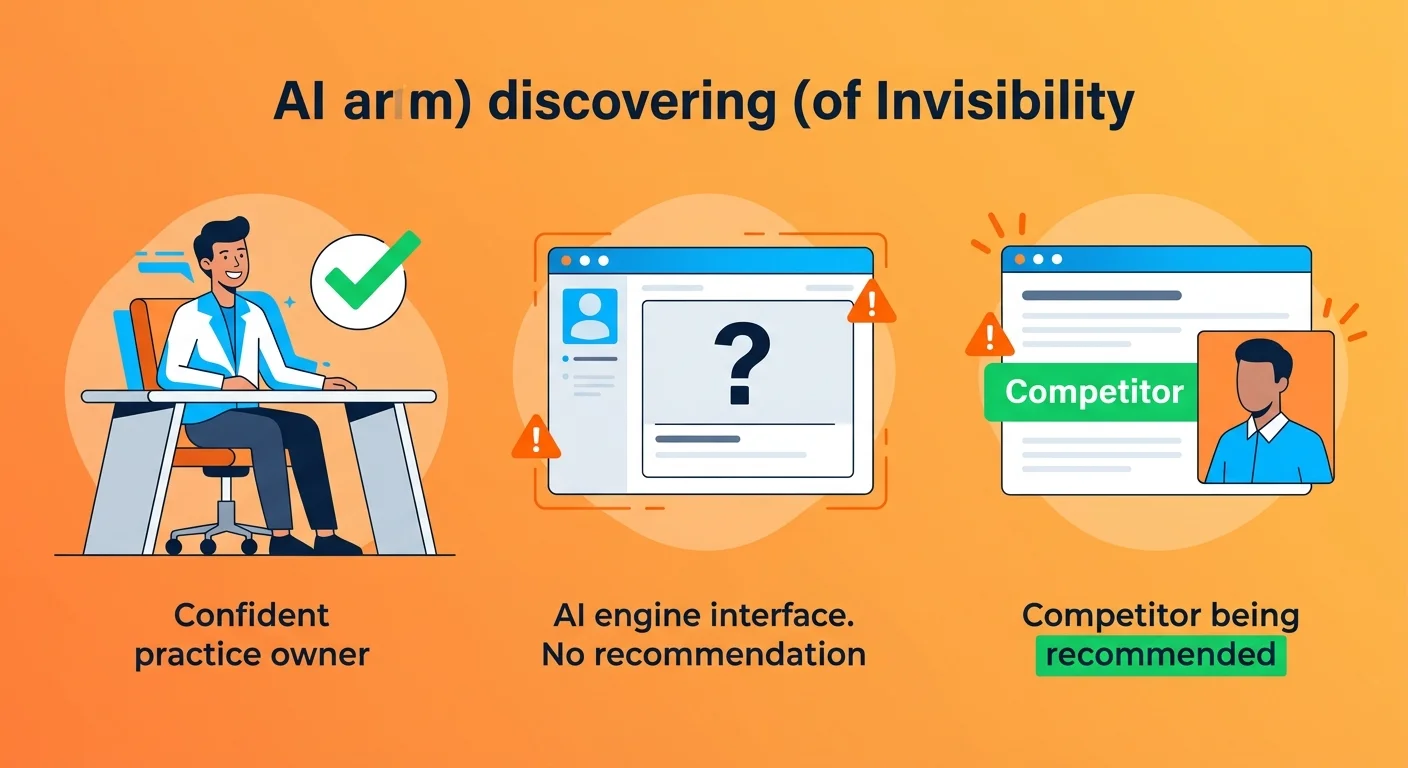
The scariest part about AI invisibility?
You don’t know you’re invisible until you test it.
Your website looks fine. Your traffic is steady. Your agency says everything’s optimized.
And then you ask ChatGPT who the best chiropractor in your area is – and it names three competitors. Not you.
That’s the moment most practice owners realize the problem. After months or years of being invisible while paying for “optimization.”
The Entire Marketing Industry Optimized for the Wrong Outcome
Here’s the friction most agencies won’t admit: their entire business model depends on metrics that stopped mattering.
- If traffic doesn’t convert to patients: Blame the website’s conversion rate
- If rankings don’t produce bookings: Blame “low-intent keywords”
- If ads don’t generate ROI: Blame the landing page or the offer
Never: “We optimized you for a world that doesn’t exist anymore.”
Because if they admitted traffic volume is the wrong goal, they’d have nothing left to sell.
The tools they use measure rankings and clicks. Not authority. Not entity trust. Not whether AI engines cite you as a trusted source.
So they keep selling what they can measure. And practices keep optimizing for invisibility.
Why SEO Agencies Can’t See This Problem
SEMrush doesn’t have a “ChatGPT citation tracking” feature.
Ahrefs can’t tell you whether Gemini recommends your practice.
Moz has no AI visibility score.
The tools don’t exist in the traditional SEO stack.
So agencies report on what they can measure: keyword rankings, backlinks, domain authority, click-through rates. All of it accurate. None of it relevant.
When you ask your agency “Does ChatGPT recommend my practice?” – they can’t answer.
Not because they’re avoiding the question. Because they don’t have the methodology to find out.
That’s not incompetence. That’s a structural limitation of an industry built for a search model that’s being replaced in real time.
The Template Website Trap
Most chiropractic websites look professional.
Clean design. Mobile-friendly. Fast load times. All the surface-level stuff done right.
And completely invisible to AI.
Why? Because they’re built like digital brochures, not authority infrastructure. No schema markup. No entity verification. No semantic clustering. No verifiable credentials structured in a way AI can parse and trust.
The website looks fine to a human.
To an AI engine trying to determine whether this practice is a citable authority? It’s blank. Generic. Unverifiable.
Template websites are optimized for aesthetics and conversions – on the assumption that traffic will come. But if AI never sends the traffic because it can’t verify your authority, the conversion rate is irrelevant.
What Happens When AI Can’t Verify Your Claims
When an AI engine encounters a website without clear entity signals, structured data, or verifiable credentials, it has two options:
- Skip the practice entirely
- Fill in missing data with fabricated information
Neither builds trust.
AI invents facts when it can’t verify them. I’ve watched AI engines attribute the wrong founder to a business. List credentials that don’t exist. Cite awards that were never given.
Not because the AI is malicious. Because the website didn’t provide machine-readable verification – so the AI improvised.
If your practice’s website doesn’t explicitly structure your credentials, specializations, and entity identity in a way AI can parse, you’re either invisible or misrepresented.
Both outcomes lose patients.
The Authority Infrastructure Zero-Click Requires
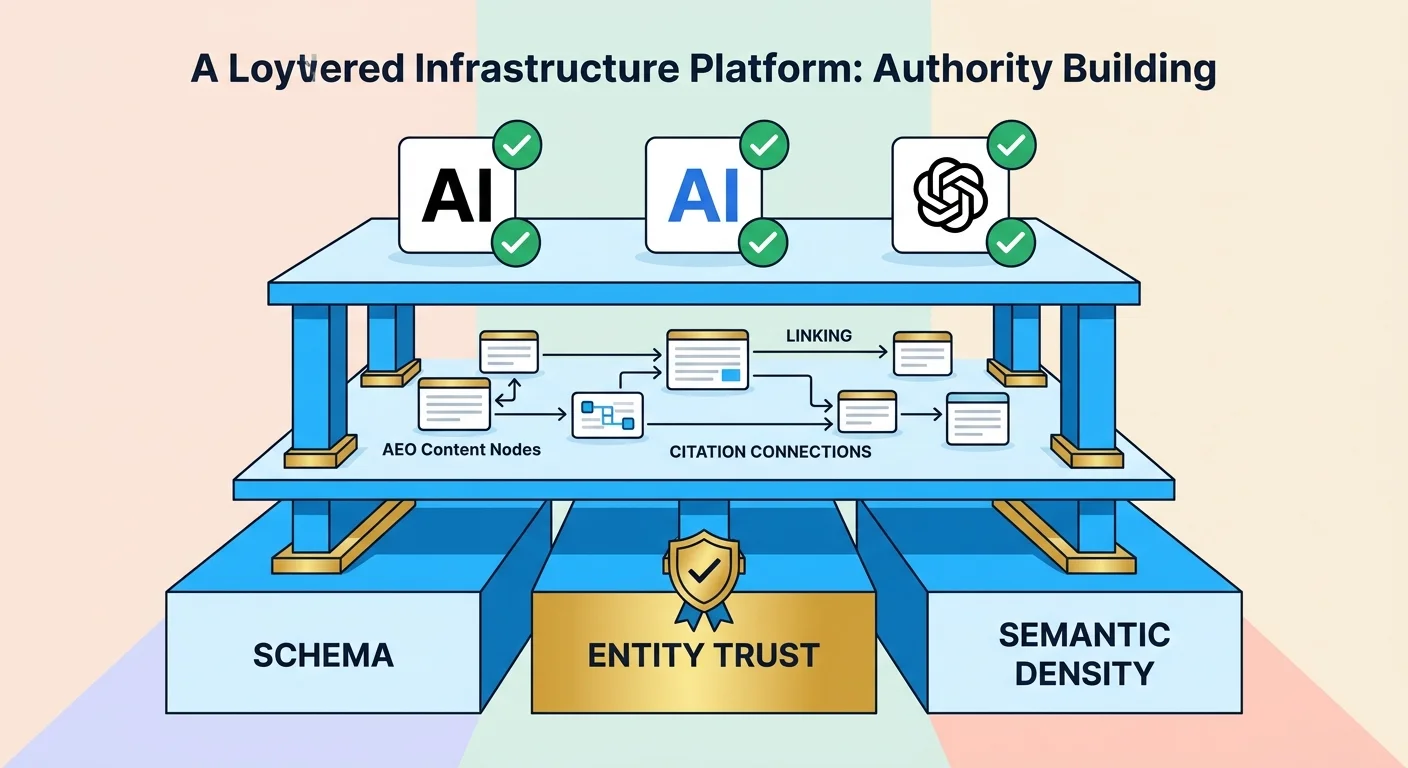
Zero-click visibility isn’t something you optimize for.
It’s something you build.
Schema. Entity verification. Semantic depth. Citation velocity. All of it structured in a way that AI engines can parse, verify, and trust enough to cite.
Most practices don’t have this. Not because they chose not to. Because no one told them it was the requirement.
| Component | Purpose | What It Does | Why AI Engines Require It |
|---|---|---|---|
| Schema Markup | Structured data that tells AI who you are | Explicitly defines practice name, credentials, specializations, location, contact info in machine-readable format | AI can’t cite what it can’t verify – schema provides verification |
| Entity Trust | Verified presence across authoritative directories and platforms | Links Google Business Profile, Healthgrades, Zocdoc, and other trusted platforms to confirm practice legitimacy | AI cross-references multiple sources – if data conflicts or is absent, practice is skipped |
| Semantic Density | Depth of content on specific topics | Demonstrates expertise through interconnected, evidence-backed content clusters | AI cites practices that show topical authority – one blog post isn’t enough |
| Citation Velocity | Frequency and consistency of new authoritative content | Ongoing publication of AEO-optimized articles that AI can use as source material | Stale or thin content signals low relevance – AI prioritizes actively maintained authority |
This isn’t website design. This is infrastructure.
Schema Markup and Entity Verification
AI engines don’t read websites the way humans do.
They parse structured data.
If your practice’s name, credentials, and specializations aren’t explicitly defined in schema markup, AI can’t verify them. It sees unstructured text. It moves on to a competitor whose data is structured.
Schema isn’t optional anymore. It’s the baseline requirement for being discoverable by AI.
- What schema does: Tells AI your practice name, the doctors’ names and credentials, what conditions you treat, where you’re located, and how to contact you
- What happens without it: AI can’t confirm your legitimacy – so it either skips you or fabricates missing data
- Why most practices don’t have it: Template website builders don’t include comprehensive schema by default – it has to be custom-built
Entity verification goes one step further.
It’s not enough for your website to say you’re a chiropractor. AI needs to see that claim validated across Google Business Profile, healthcare directories, and professional listings.
If the data matches, AI trusts you. If it conflicts or is absent, AI flags you as unverifiable.
Semantic Density and Topical Authority
AI engines cite practices that demonstrate depth.
One blog post on sciatica doesn’t establish authority. A cluster of interlinked, evidence-backed articles covering sciatica causes, treatment protocols, patient outcomes, and related conditions – that establishes authority.
This is semantic density. The depth and interconnection of content on a specific topic.
When ChatGPT needs to recommend a chiropractor for sciatica, it doesn’t just look at your homepage. It looks at whether your content library demonstrates expertise on that condition. Whether your articles cite verifiable sources. Whether your information is current and evidence-based.
- Thin content: Single 800-word blog post with generic advice
- Semantic density: Six interconnected articles covering mechanisms, differential diagnosis, treatment approaches, case outcomes, prevention strategies, and when to refer
AI cites the second practice. Not the first.
The Two-AI Validation System
This is where our methodology diverges from the commodity content mill.
Every piece of content we produce goes through a two-AI validation loop:
- Gemini research: Sources, evidence, institutional links, claim verification
- Claude writing: AEO-structured content in the client’s voice
- Gemini validation: Re-checks every claim, every source, every statistic for accuracy
- Claude refinement: Corrects flagged errors before publication
We don’t publish content that hasn’t been verified by the AI engines themselves.
Because if Gemini flags a claim as unverifiable during validation, ChatGPT won’t cite it as authoritative when a patient asks a question. The validation step eliminates the hallucination risk before the content goes live.
Most agencies publish first and hope AI engines trust it.
We verify trust before publishing.
That’s the difference between content that looks authoritative and content that AI engines actually cite.
What to Do About Zero-Click Invisibility
If you’re reading this and thinking “I need to know if my practice is invisible” – you’re in the right place.
But let’s be clear about what this is not.
This is not for practices looking for a 90-day miracle. Authority doesn’t build in a quarter.
This is not for practices that want guarantees. No one can guarantee AI will recommend you – but we can guarantee the infrastructure we build passes AI’s verification standards.
This is not for practices that want to “set it and forget it.” Authority decays without ongoing execution.
If those disqualifiers don’t fit – keep reading.
Run the AI Visibility Check
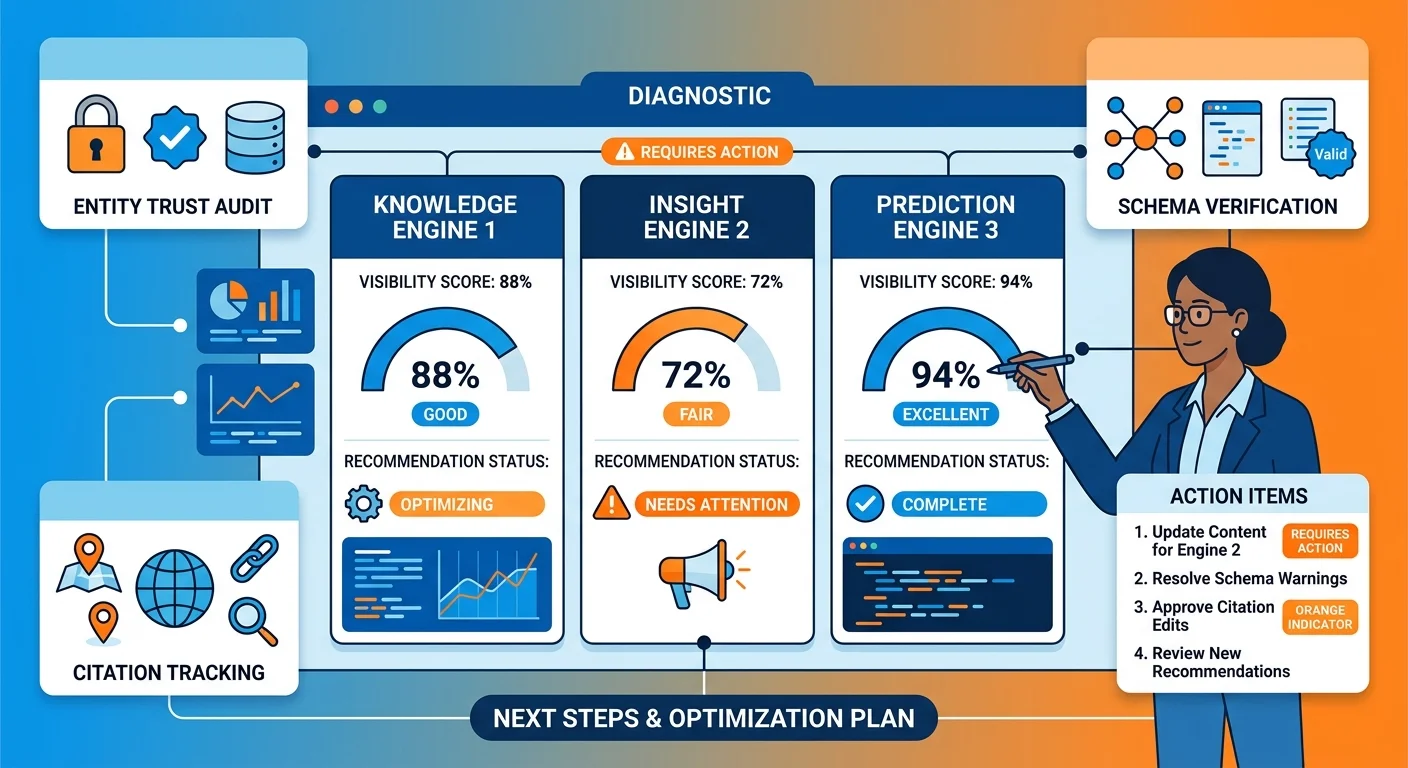
The only way to know if your practice is invisible is to systematically test what ChatGPT, Gemini, and Grok say when asked for recommendations in your market.
Not once. Multiple times. Across multiple engines. With variations of the questions patients actually ask.
That’s what the AI Visibility Check does. It takes 15 minutes. You’ll see exactly what AI engines say when someone asks who to trust in your area.
- What you’ll find out: Whether your practice is named, ignored, or misrepresented
- What you won’t find out: Why traditional metrics looked fine while you were invisible
- What happens next: If the results show invisibility, you’ll know exactly what infrastructure is missing
This isn’t a sales pitch. It’s a diagnostic.
If the results don’t make the problem self-evident, walk away. No pressure. But if they do – you’ll know what to do next.
Stop Optimizing for Clicks
If you’re still running paid ads focused on traffic volume, stop.
If your agency’s strategy centers on “driving more visitors,” fire them.
If your monthly reports emphasize clicks and impressions, those reports are measuring the wrong thing.
The goal is not more website visitors. The goal is being the answer AI provides when patients ask for help.
Every dollar spent optimizing for clicks is a dollar not spent building the authority infrastructure that determines whether AI cites you.
Redirect those resources.
- What to stop funding: Paid search campaigns focused on traffic volume, traditional SEO retainers optimizing for keyword rankings, agencies that can’t answer “Does ChatGPT recommend my practice?”
- What to start funding: Schema implementation, entity verification, semantic content clusters, ongoing AEO content execution
This isn’t about abandoning traffic entirely. It’s about recognizing that traffic is now a lagging indicator of authority, not a leading indicator of patient acquisition.
Build Authority Infrastructure That Compounds
Zero-click visibility is not a campaign. It’s not a tactic. It’s not something you launch and then stop.
It’s an infrastructure investment that compounds monthly.
Authority as an asset means every piece of content you publish strengthens entity trust. Every schema update improves AI verification. Every citation increases the likelihood of future citations.
The practices that start now will own the recommendations in their markets for years.
The practices that wait will spend the next decade trying to close a gap that became insurmountable while they optimized for traffic.
| Priority | Action | What It Solves | Timeline |
|---|---|---|---|
| 1 – Diagnostic | Run AI Visibility Check across ChatGPT, Gemini, Grok | Confirms whether practice is cited, ignored, or misrepresented | 15 minutes |
| 2 – Foundation | Implement comprehensive schema markup and entity verification | Makes practice machine-readable and verifiable to AI engines | 2-4 weeks |
| 3 – Content Execution | Launch ongoing AEO content clusters (minimum 12 articles/month) | Builds semantic density and topical authority AI requires to cite practice | 6-12 months to initial citation velocity |
| 4 – Maintenance | Continuous monitoring and content updates | Prevents authority decay – stale content loses citations over time | Ongoing monthly execution |
There’s no shortcut here. No “hack.”
Authority is built in layers. Foundation first. Content compounding on top. Citations deepening every month.
The practices that commit to this process will be the ones AI names for the next decade. Everyone else will be invisible.
FAQ
What’s the difference between getting a featured snippet on Google and getting an AI recommendation?
A featured snippet is a direct quote from your website displayed at the top of Google’s search results. It’s still part of a list-based environment – users see your snippet, nine organic results, local pack results, and ads. They can still click a competitor.
An AI recommendation is a synthesized answer where the AI names your practice as the best option with reasoning. There’s no list. No alternatives. The patient gets one name – yours or a competitor’s – and books immediately.
The comparison phase disappeared entirely.
Featured snippets improve visibility within a competitive context. AI recommendations eliminate competition by providing a singular verdict.
If zero-click searches don’t send traffic, why are they important for my practice?
Because they represent high-intent patients getting a definitive recommendation without ever visiting your website.
Traffic is a metric. Patient acquisition is the outcome.
When AI names your practice as the answer, patients book directly based on that recommendation – even if your analytics show zero referral traffic from the AI engine.
You’re not optimizing for clicks. You’re optimizing for being the answer AI provides when patients ask who to trust.
That’s the new measure of visibility.
Does my website’s design affect my visibility in zero-click search?
Not aesthetically. AI doesn’t care if your website looks modern or outdated.
It cares about structure. Schema markup. Entity verification. Semantic density. Whether your credentials are machine-readable. Whether your content demonstrates depth on the topics you claim to be an authority on.
A beautiful website with no schema is invisible to AI.
A basic website with comprehensive structured data and verified entity signals is citable.
Infrastructure beats aesthetics in the zero-click world.
Can traditional SEO help with zero-click visibility?
No.
Traditional SEO and Answer Engine Optimization are fundamentally incompatible strategies.
SEO optimizes for ranking in a list of links. AEO optimizes for being the single answer AI cites. SEO focuses on clicks. AEO focuses on authority. SEO measures traffic. AEO measures entity trust.
Practices trying to do both end up doing neither well.
You can’t optimize for page-one rankings and AI citations with the same methodology. The infrastructure requirements conflict.
This is why most SEO agencies can’t deliver zero-click visibility – their tools and processes are built for a model that’s being replaced.
How can I see if my practice is showing up in AI-powered zero-click answers?
The only reliable method is systematic discovery using multiple AI engines.
Ask ChatGPT, Gemini, and Grok variations of the questions a potential patient would ask: “Who’s the best chiropractor near me for sciatica?” “What practice should I trust for sports injuries?” “Who has the best patient reviews for spinal adjustments?”
Then analyze the recommendations. Are you named? Ignored? Misrepresented?
Most practices are invisible to ChatGPT and Gemini without realizing it.
Running the check yourself takes 15 minutes and provides immediate clarity on whether you have a visibility problem.
Why would a patient trust an AI recommendation over a Google search?
Because AI frames its recommendations as researched conclusions, not algorithm-generated lists.
When Google shows ten results, patients assume the list is influenced by SEO and possibly manipulated. So they apply skepticism. They compare. They click multiple sites.
When ChatGPT says “I recommend Dr. [Name] because they specialize in your condition, have strong patient reviews, and verified credentials” – patients perceive it as a vetted recommendation from a trusted source.
They book immediately.
That trust perception is irreversible. Patients aren’t going back to manually comparing ten websites after experiencing an AI-curated answer.
Can I fix zero-click invisibility without rebuilding my entire website?
Depends on what “rebuild” means.
If your site has comprehensive schema markup, verified entity signals, and semantic content depth – you might only need optimization and ongoing AEO content execution.
If your site is a template with no schema, no structured data, and generic blog posts – you need infrastructure. Not a redesign. Infrastructure.
The difference: A redesign focuses on aesthetics and user experience. An infrastructure rebuild focuses on making your practice machine-readable, verifiable, and citable to AI engines.
Most practices need infrastructure. Few agencies know how to build it.
How long does it take to become visible in AI recommendations?
There’s no timeline.
Not because this doesn’t work – because authority doesn’t run on a microwave schedule.
What I can tell you: every month of execution builds on the last. Schema implementation takes weeks. Semantic content clusters take months. Citation velocity takes 6-12 months of consistent execution.
The practices that start now compound. The practices that wait give that ground to competitors who kept going.
Authority isn’t a campaign you launch and finish. It’s infrastructure you build and maintain.
The practices treating it that way will own AI recommendations in their markets for the next decade.
Conclusion
There’s no neutral position here.
Every month your practice is invisible to AI engines, a competitor is being recommended instead.
That gap doesn’t stay static. It widens.
Authority compounds. The practices getting cited build entity trust. Stronger entity trust leads to more citations. More citations attract more patient reviews. More reviews strengthen authority.
The loop accelerates.
The practices that start building infrastructure now will own the zero-click recommendations in their markets for the next decade. The practices that wait will spend years trying to catch up to a gap that became insurmountable while they optimized for traffic metrics that stopped mattering.
This isn’t a scare tactic. It’s math.
AI gives one answer. If you’re not it, you don’t exist in that transaction. And every day you’re not the answer, someone else is locking in the authority signals that determine whose name AI says when the next patient asks for help.
You can’t fix what you can’t see.
Want to know if AI is recommending your practice – or your competitor’s? Run My AI Visibility Check. It takes 15 minutes and shows you exactly what ChatGPT, Gemini, and Grok say when someone asks who to trust in your market.
No guesswork. No assumptions. Just real data on whether you’re the answer or invisible.