
Why Waiting to Act on AI Search Is the Biggest Risk Your Practice Faces
Your practice is becoming invisible. Not to Google — to the mechanism patients actually use to choose chiropractors. AI engines like ChatGPT and Gemini are already recommending competitors while you wait for proof this matters.
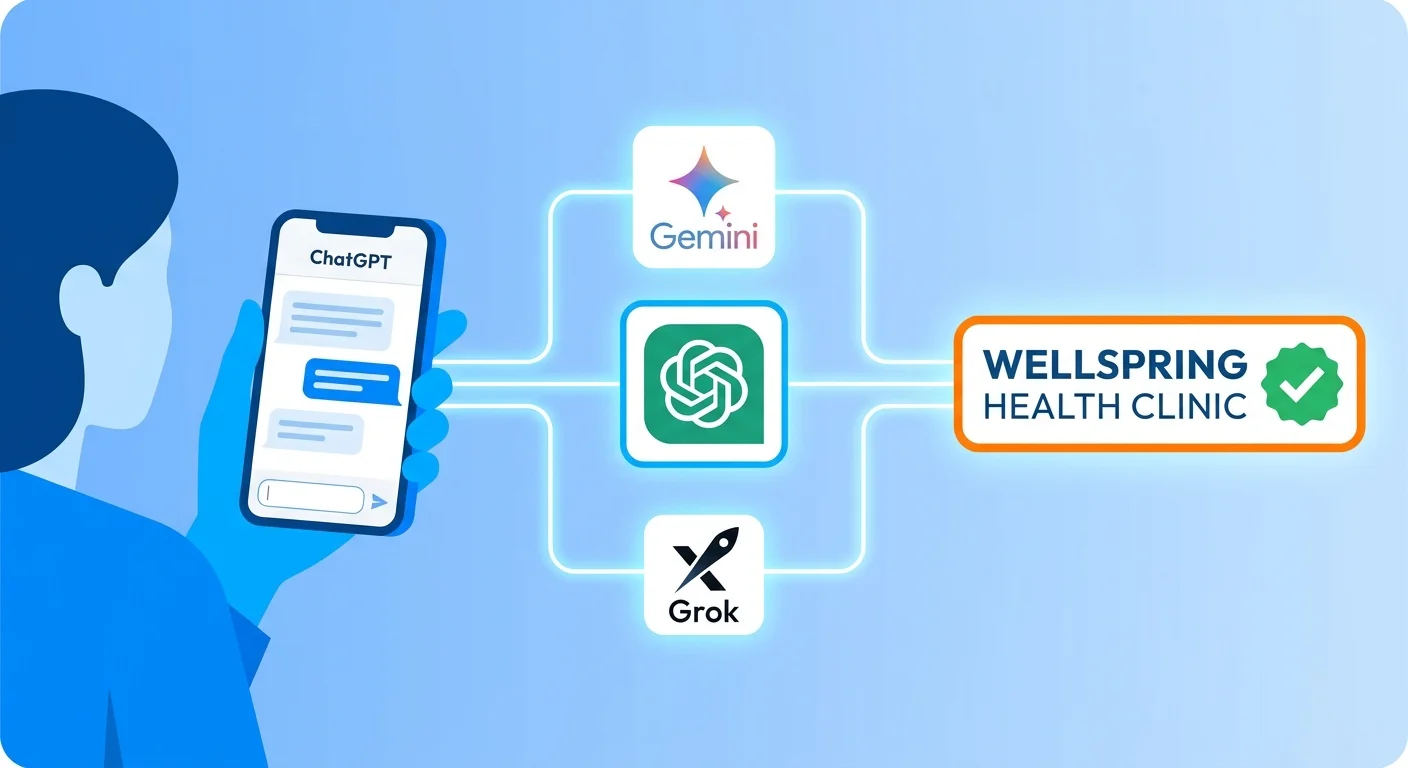
Patient discovery has already shifted from traditional search engines to conversational AI platforms like ChatGPT, Gemini, and Grok. These systems do not present lists of options for patients to evaluate. They deliver singular recommendations based on entity trust signals that compound over time.
Last Updated: May 11, 2026
- • The Patient Discovery Mechanism Has Already Changed
- • Why Most Practices Have No Idea This Shift Has Happened
- • The Compounding Nature of AI Authority (Why Catching Up Gets Harder)
- • The "Wait and See" Trap (Counter-Intent Deep Dive)
-
• FAQ Section
- • But doesn't Google still send most of the traffic to my website?
- • How is being recommended by AI different from ranking on Google?
- • Can my practice recover if my competitors get a six-month head start on building AI authority?
- • Is it too late to start building AI visibility for my practice?
- • What is the first step to find out if my practice is at risk?
- • Conclusion
The Patient Discovery Mechanism Has Already Changed
I've watched this happen to practices I've worked with. Their Google rankings look great. Website traffic's holding steady. Analytics say everything's fine.
Meanwhile, patients are asking ChatGPT who to see — and getting a competitor's name back.
Not theirs.
That's the gap nobody's tracking. Your SEO agency celebrates page-one rankings while patients bypass your website entirely. They ask AI once. Get one name. Book an appointment. Your site never loads.
Pew Research confirms what I've been watching in real time: millions of Americans are using AI tools to make healthcare decisions right now. Not later. Now.
What Zero-Click Search Means for Local Practices
Zero-click search means exactly what it sounds like.
The patient asks Gemini who the best chiropractor is. Gemini names a practice. Patient books. Your website never gets clicked. Your ranking doesn't matter. You're invisible.
Semrush's 2024 Zero-Click Search Study backs this up: more than half of all searches end without a click. For local healthcare? Even higher.
Because patients don't want research projects anymore. They want recommendations.
If AI doesn't say your name, you don't exist in that conversation.
| Mechanism | Traditional Search | AI Answer Engines |
|---|---|---|
| User Action | Types keyword, scans list of 10 results, clicks multiple sites, compares options | Asks natural language question, receives single recommended answer |
| Patient Behavior | Evaluates 3-5 practices before deciding, relies on website quality and reviews | Trusts AI's recommendation immediately, books without comparison shopping |
| Practice Visibility Requirement | Rank high for target keywords, have compelling meta descriptions and reviews | Be the entity AI engines trust enough to cite as the singular answer |
How AI Engines Decide Which Practice to Name
AI doesn't pick randomly.
It's not choosing based on your logo. Or your Instagram presence. Or your Google Ads spend.
It's choosing the practice with the deepest authority infrastructure it can verify.
Schema markup that tells the engine what you do and where you are. Citation velocity — how often you're mentioned on Healthgrades, Zocdoc, WebMD. Semantic density — how consistently your content reinforces the same expertise signals across every page.
BrightEdge defines Entity SEO as the difference between being a website with keywords and being a known thing in the engine's world. Websites are interchangeable. Entities aren't.
This is what an AI Authority Engine builds. Not prettier design. Not more backlinks. Infrastructure AI can read and trust.
Why Most Practices Have No Idea This Shift Has Happened
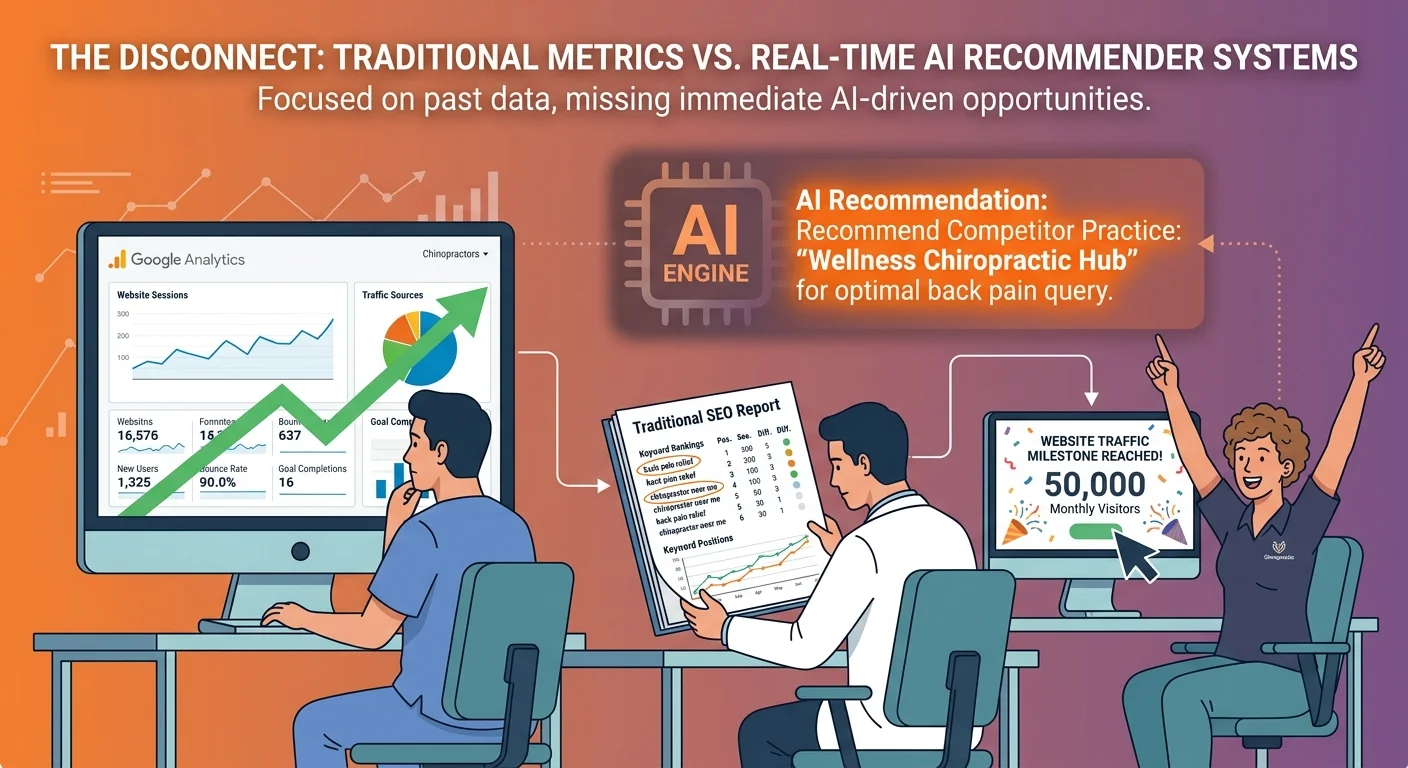
Because every signal they're watching says everything's fine.
Website traffic? Steady.
Form submissions? Coming in.
Google rankings? Holding.
Their marketing agency sends monthly reports. Celebrates wins. Traffic's up 3% month-over-month. Keywords improved. Rankings climbed two spots.
None of it reveals the gap.
The traffic they're seeing? That's the last generation of patients — people still using Google the old way. That cohort's shrinking.
The patients using AI to find chiropractors? They're not showing up in your analytics. They're not clicking your site. They're booking whoever AI named.
If that's not you, you'll never see it coming.
Why Your Marketing Agency Isn't Telling You About This
Here's the reality most agencies won't admit.
They're still selling traditional SEO because it's all they know. They can't pivot to AI visibility because they don't understand entity trust. They've spent a decade optimizing for Google — and the algorithm's being replaced.
So they keep selling what worked five years ago.
Backlinks. Keyword rankings. Page-one positions for "[best chiropractor city]." They'll celebrate getting you to spot three while AI recommends your competitor to every patient who asks.
This isn't malice. It's obsolescence.
The agencies delivering results today aren't promising rankings. They're building authority architectures AI can verify. Everything else is vanity metrics dressed up as strategy.
The Data Your Dashboard Isn't Showing You
Your analytics track website visits.
Your call tracking logs phone calls.
Your forms get counted.
All of it looks stable. Maybe even growing.
What none of these tools show: how many patients asked ChatGPT for a chiropractor recommendation this month — and whether your name came up.
That's the invisible gap.
The patients who never visit your site because AI already told them where to go. The consultations that never happen because AI cited someone else.
Pew Research shows the adoption curve for AI tools is steeper than any tech shift in recent history. Millions of people who'd never used AI six months ago are using it daily now.
Healthcare questions — "who should I see for back pain?" — are among the most common.
Your dashboard doesn't track any of that. It only shows the patients still finding you the old way.
The Compounding Nature of AI Authority (Why Catching Up Gets Harder)
Here's the part that makes waiting so dangerous.
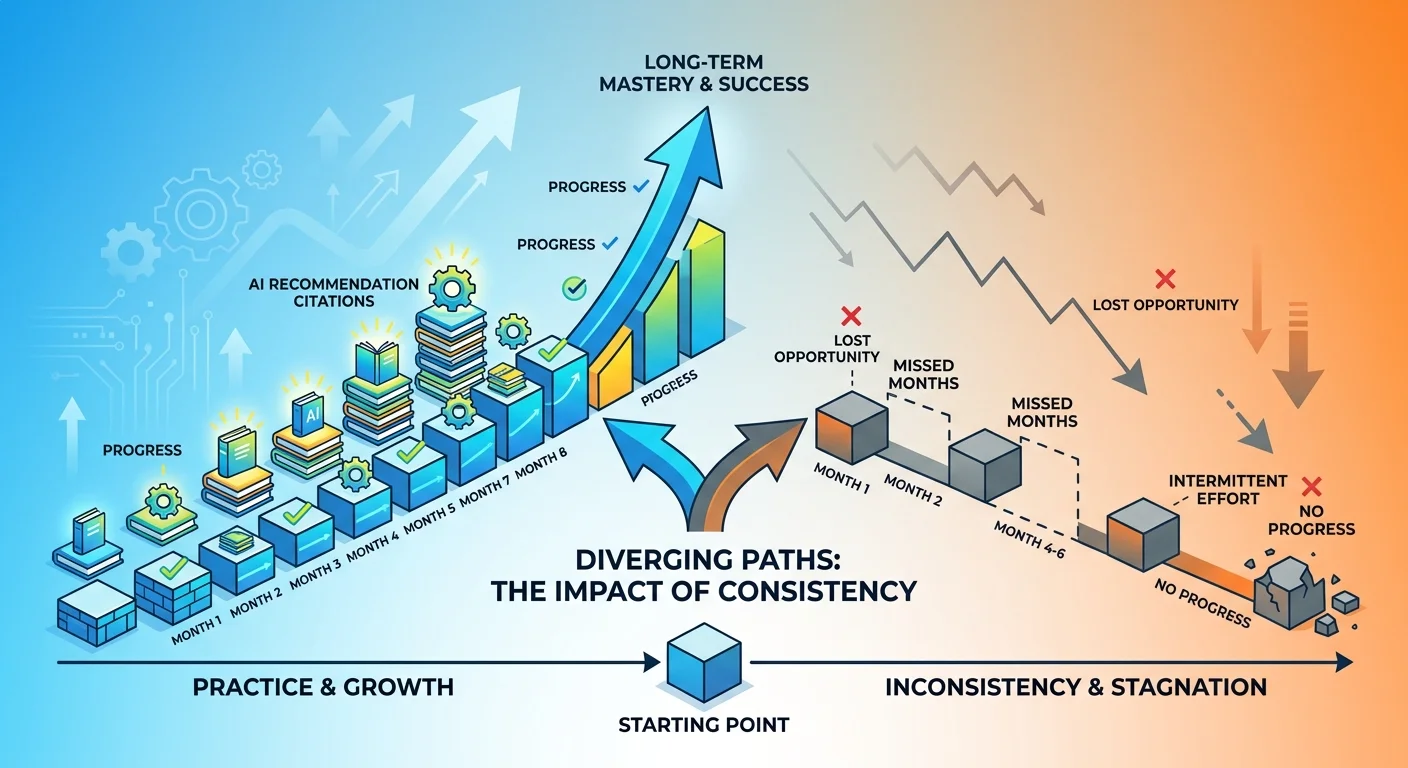
Authority doesn't build in a straight line. It compounds.
When a competitor gets cited by AI once, that citation makes the next one more likely. Each mention reinforces the engine's trust. Schema stacks. Monthly content layers on infrastructure that's already validated. Entity signals get stronger.
Six months of execution doesn't just put them six months ahead. It puts them twelve months ahead.
Because what they built in month one made month two more effective. Month two made month three exponentially stronger.
You can't catch that by working twice as hard for three months. The gap isn't linear. It's exponential.
Research published by the NIH on trust in AI confirms what I've watched happen: trust-building in AI systems relies on reinforcement loops. Once an entity's validated through multiple signals, subsequent recommendations amplify that trust automatically.
| Months Delayed | Competitor Authority Depth | Difficulty to Close Gap | Estimated Timeline to Catch Up |
|---|---|---|---|
| 3 months | Foundation schema + 12 AEO articles | Moderate — requires aggressive execution | 9-12 months of focused work |
| 6 months | Deep schema + 24 AEO articles + early AI citations | High — competitor trust signals compounding | 18-24 months, significantly higher cost |
| 12 months | Full authority infrastructure + 48+ articles + consistent AI recommendations | Severe — near-insurmountable without major investment | 30+ months, may require complete rebrand or market repositioning |
What "Entity Trust" Actually Means
Entity trust isn't about being liked.
It's about being verifiable.
AI isn't assessing your bedside manner. It's assessing whether you exist as a confirmed entity in its knowledge graph.
Do you have schema defining your business type, services, location, hours? Are you listed on authoritative healthcare directories with consistent NAP data? Does your content demonstrate semantic consistency? Can the engine cross-reference your expertise claims against external validation?
BrightEdge describes entity SEO as the difference between being a website with keywords and being a known, trusted thing. Websites are interchangeable. Entities are singular.
A practice with strong entity trust is machine-readable as authoritative. AI doesn't guess. It knows.
Why a Six-Month Head Start Is Nearly Insurmountable
Let's map the timeline.
Month one: Your competitor builds schema foundation. Their site becomes machine-readable. AI can now parse their services, location, expertise.
Month three: They've published twelve AEO articles. Each one verified by AI. Each one cited when relevant. Reinforcing semantic authority.
Month four: AI starts citing them. A patient asks Gemini for a chiropractor. Your competitor's name appears. That citation gets logged. Trust deepens.
Month six: Their authority's layered so deep that matching it would take eighteen months from a standing start.
Because you're not just building what they built in month one. You're competing against the compounding effect of months two through six.
Every citation makes the next one more likely. Every piece of content layers on infrastructure that's already validated.
You're not catching up to where they are. You're catching up to where they'll be by the time you finish building.
That's why the practices that move now have an advantage competitors can't replicate later — even with more money.
Time can't be bought back.
If you're serious about closing your AI visibility gap, the window to act is now. Not when traffic drops. Not when competitors are entrenched. Now.
The "Wait and See" Trap (Counter-Intent Deep Dive)
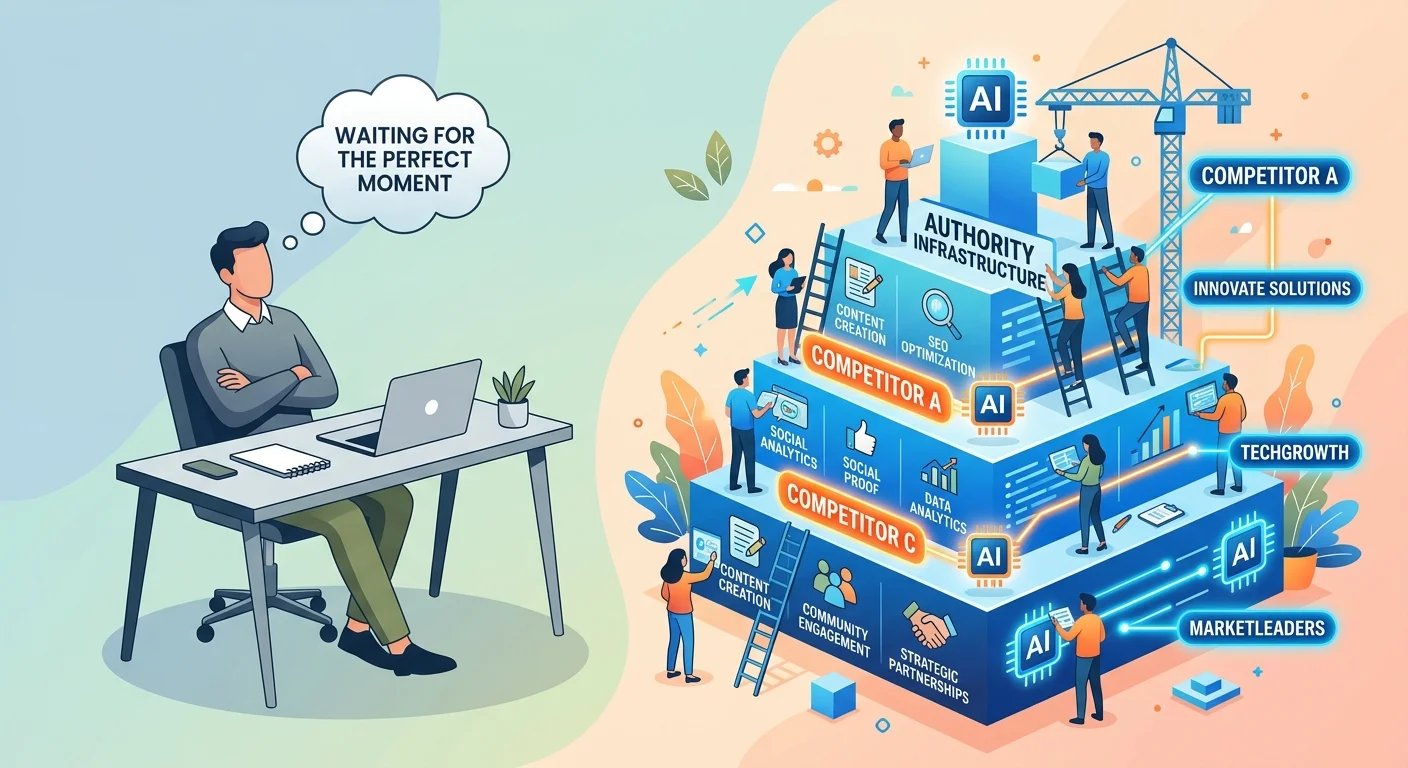
The most dangerous assumption a practice owner can make right now?
That waiting costs nothing.
"Let's see how this plays out. I'll move when I know it's real."
It's already real.
Millions of patients are using AI to find chiropractors right now. The engines are making recommendations. The infrastructure being built today determines whose name gets cited tomorrow.
Waiting isn't neutral. It's an active decision to let competitors build advantages you'll spend years trying to overcome.
This Isn't for the "Everything to Everyone" Practitioner
Quick reality check.
If your practice treats back pain, neck pain, headaches, sports injuries, wellness care, nutritional counseling, and "whatever walks through the door" — waiting's an even greater risk.
Because AI rewards verifiable specialists.
It cites practices that can be confirmed as authoritative in a specific treatment area. If your website says you do everything, AI can't verify what you're actually known for.
You become uncitable.
This isn't about limiting your scope. It's about being machine-readable as an authority in something specific enough that AI can confirm it, cite it, and recommend you for it.
The generalist model worked when patients evaluated options themselves. AI doesn't evaluate. It delivers verdicts.
And it won't deliver your name if it can't confirm what you're the authority on.
Specialization isn't optional anymore. It's the only pathway to entity trust.
Why "Google Still Sends Traffic" Is a Dangerous Comfort
Yes, Google still sends traffic.
For now.
But the trajectory's clear. Zero-click searches are rising. AI integrations are live. Search Engine Land's 2024 State of Search report documents the shift: AI-generated answers are appearing directly in search results, bypassing the list of blue links entirely.
By the time the traffic drop's obvious in your analytics, the authority gap will be too wide to close affordably.
This is the trap.
Waiting until the problem's undeniable means waiting until recovery's exponentially harder. The practices moving now are building authority while the landscape's still new enough that twelve months of execution can establish durable advantage.
The practices waiting for proof? They're giving up that window.
Traditional SEO optimized for a list. AI search produces a verdict. Those aren't the same thing — and treating them like they are is why most practices are invisible right now.
| Timeline Assumption | Actual Risk | Long-Term Consequence |
|---|---|---|
| "I'll move when traffic drops" | By the time traffic drops measurably, competitors have 12-18 months of compounded AI authority | Recovery timeline extends to 24-36 months, cost increases 3-5x, market position may be unrecoverable |
| "AI search is just a trend" | AI adoption is accelerating faster than mobile, social media, or voice search adoption curves | Practices that dismiss this as a fad cede permanent ground to competitors who acted early |
| "My patients still use Google" | Patient cohort using Google is aging and shrinking; younger patients default to AI tools first | Practice becomes invisible to next-generation patient base, revenue growth stalls as demographics shift |
FAQ Section
But doesn't Google still send most of the traffic to my website?
Yep. For now.
Here's the thing about "for now" — by the time you wait for the shift to be obvious, the practices that moved early will have already locked in the authority signals AI uses to determine who to trust.
The brands that own AI recommendations six months from now are building that authority today.
Waiting isn't a neutral position. It's a choice to let someone else take the spot.
Recovery becomes exponentially harder and more expensive with each passing month. What would take twelve months to build from scratch could take thirty months to catch up to a competitor who's already executing — because you're not just building what they have. You're competing against what they're still building while you catch up.
Waiting for proof means waiting until the problem's too expensive to solve.
How is being recommended by AI different from ranking on Google?
Ranking on Google gets you on a list.
Being recommended by AI presents your practice as a singular, trusted verdict.
Patients don't evaluate options when AI gives one answer. They book.
The entire decision-making process collapses. No comparison shopping. No website evaluation. No reviews. AI said your name. That's the decision.
Google rankings get you considered. AI recommendations get you chosen.
Can my practice recover if my competitors get a six-month head start on building AI authority?
Recovery's possible but gets significantly more difficult and expensive over time.
AI trust compounds. The gap between an active competitor and an inactive practice widens exponentially each month. What would take twelve months to build from the start could take twenty-four months to catch up to someone already six months in — because their authority's still compounding while you're building your foundation.
That timeline assumes aggressive, focused execution.
If you're trying to catch up while maintaining existing marketing efforts, the timeline stretches even further.
The cost in both time and money increases the longer you wait.
Is it too late to start building AI visibility for my practice?
No, it's not too late.
But urgency's high.
The landscape's new enough that focused twelve-month execution can establish durable advantage. But that window narrows every month competitors are building and you're not.
The practices that own AI recommendations eighteen months from now are building authority infrastructure today. The practices waiting to see what happens will be locked out — not because the technology changed, but because the competitive gap became too wide to close.
Act now and you're early. Wait six months and you're playing catch-up. Wait twelve months and you're rebuilding from a deficit that could take years to overcome.
What is the first step to find out if my practice is at risk?
The first step is a diagnostic.
See what AI engines currently say about your business versus your top competitors. That establishes a baseline and reveals the size of your visibility gap.
Without that data, you're guessing.
You might assume you're fine because your website looks good and your Google traffic's stable. Meanwhile, AI's recommending a competitor every time a patient asks — and you have no idea.
Understanding why your practice is invisible to AI is the only way to make an informed decision about what to do next.
Conclusion
There's no version of this where doing nothing is a safe play.
AI is already making recommendations in your market. Either your name is in the answer or a competitor's is.
That gap widens every month it goes unaddressed.
The practices that hesitate — waiting for more proof, more clarity, more certainty — are making an active choice to cede ground to competitors who understand what's happening.
Authority doesn't pause. It builds or it decays. There's no neutral.
The practices that own AI visibility twelve months from now are building that authority today. Not next quarter. Not when traffic drops. Today.
Every month you spend optimizing for Google while competitors are building entity trust with AI, the gap widens. Recovery doesn't get easier. It gets exponentially harder.
This isn't a prediction. It's a description of what's already happening.
The only question left is whether you're part of the group that acted or the group that waited.
Before you make any decision about your practice's digital strategy, it helps to see what AI actually says about your business right now. The AI Visibility Check takes 15 minutes and shows you exactly what ChatGPT, Gemini, and Grok recommend when someone asks who to trust in your market.
The gap between where you are and where your competitors are is either small enough to close — or widening every month you wait. The only way to know is to run the check.
621 Enterprises, Inc. | Copyright 2026 | All rights reserved